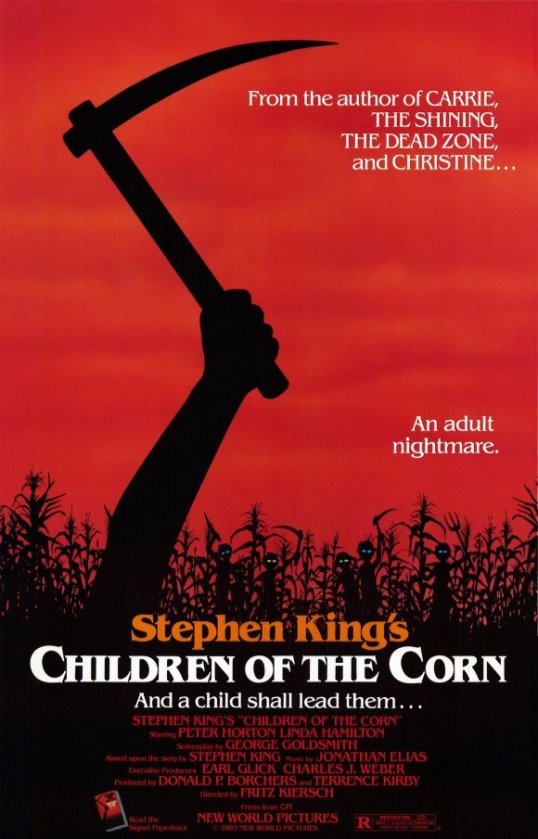
And I will admit — the kids are creepy. Especially that little Isaac guy with the shrill voice. Whenever Isaac starts screaming, “MALACHI!!!!,” — well, it’s like nails on a chalkboard, to be honest.
Anyway, in case you’d forgotten, this is the movie where all the little kids hang out in a cornfield and kill adults. It attempts to say something about religion but I’m not sure what it’s trying to say. It’s all kind of silly but, as I said, some people seem to like it.
(Personally, I prefer that old episode of South Park where they keep declaring shenanigans on the carnival, all the cows jump off a cliff, and the visiting yankee tourists end up getting devoured by rats in jail.)
In order to help you decide for yourself whether or not this is a decent film, here is Stephen King’s Children of the Corn! Enjoy it while you can because you just know that YouTube is going to eventually yank it down for copyright reasons.
I don’t know much about The Autopsy of Jane Doe but there are a few people, with whom I casually interact on twitter, who saw this film at TIFF two weeks ago and they swear it’s the scariest thing that they’ve ever seen.
Take that for what you will. I’ve lost track of how many horror films have been described as being “the scariest thing that has ever been seen.” Go read a few of Stephen King’s reviews and you’ll notice that he apparently thinks everything that has ever been written and/or filmed is “the scariest thing that he’s ever seen.”
Beware of hyperbole, I’m saying!
That said, here’s the trailer and it looks like the movie might be pretty scary…
So, as you may know, there’s a new version Stephen King’s It coming out. It’s scheduled to be released next year and it’ll star Bill Skarsgard as everyone’s favorite killer clown, Pennywise!
A new image of Pennywise’s costume appeared earlier today in Entertainment Weekly and here it is:
I have to admit that I’m not a huge fan of this look. According to the EW article, the film’s costume designer decided to incorporate ideas from all eras of clowning, in order to show that Pennywise has been around for centuries.
But, to me, that kind of misses the point. In the book, It appeared in many different forms, depending on who it was dealing with and it’s goal was at the time. It used the form of Pennywise the Clown to both get the attention of and to scare the Hell out of children. In the book, Pennywise kills Georgie Denbrough in 1957. In the upcoming film, the timeline has been updated so that Georgie dies in 1989. But, in both cases, why would Pennywise use the form of a Victorian-era clown to attack children in the 20th Century? Wouldn’t Pennywise appear as a contemporary clown?
I may be overthinking this but, honestly, it’s difficult for me to look at this Pennywise without thinking about the time that Bobby Hill performed as Tartuffe the Spry Wonder Dog on King of the Hill.
Am I right? Am I wrong? What do you think of this new Pennywise?
Hi there! Well, as of my birthday yesterday, I am now officially an adult. What does that mean for this site? Well, for the most part, it means that I’m going to be even more aggressive about giving my opinion. After all, I’m an adult now. Whatever I say matters, no matter how weird or random it may be! In fact, I’m such an adult that I’m not even going to worry about proofreading these posts anymore. Adults don’t have to worry abut makin typos.
So, what is Lisa’s editorial corner? Well, it’s a new weekly feature where I talk about whatever caught my eye during the previous week. Basically, it’s a way for me to embrace my inner know-it-all. Fear not, I’m going to keep it entertainment-related. You don’t have to worry about me using this feature to try to convince you to vote for Gary Johnson in 2016. (At least not yet…)
For instance, I might use this feature to talk about Gunnar Hansen…
On Gunnar Hansen and Andrew Bryniarski
On November 7th, Gunnar Hansen passed away from pancreatic cancer. He was 68 years old. When I first heard the news, I was out with my friends in the SBS (and I’ll explain what that stands for at a more appropriate time) and we were celebrating my upcoming birthday. I spent the day after that with my family and then it was Monday and it actually was my birthday and … well, long story short: I’ve only now gotten a chance to write about his passing on this site. And I feel really guilty about that because Gunnar Hansen was an iconic figure in film history.
Who was Gunnar Hansen? Well, you probably already know. He was Leatherface in the original Texas Chainsaw Massacre. Beyond that, he was also a teacher, a writer, an acclaimed poet, and reportedly one of the nicest guys that you could ever hope to meet. I never met Gunnar but every story that I’ve ever heard about him — whether it was from someone who met him at a convention or someone who knew him outside of the world of horror fandom — has been a positive one. As well, I’ve read many interviews with Hansen about the making of Texas Chainsaw and he always came across as being a very intelligent and well-spoken individual.
And it’s often overlooked just how good a performance that Hansen gives in Texas Chainsaw Massacre. Hansen may have been cast because of his large frame and he may have had to perform underneath a mask but he still turned Leatherface into a genuine character. It’s often overlooked that, out of the entire cannibal family, Leatherface is the only one who has any real responsibilities. He’s just trying to prepare everyone’s dinner and he keeps getting interrupted! No wonder he eventually ends up sitting down and slumping in frustration.
Now, upon until a few hours ago, I had absolutely no idea who Andrew Bryniarski was. Do you know who he is? Here’s a picture of him, with Gunnar Hansen:
Gunnar is on the right.
Why are Andrew and Gunnar posing together? Because Andrew played Leatherface in 2003 remake of Texas Chainsaw and in 2006’s Texas Chainsaw Massacre: The Beginning.
And here is what Andrew said on Facebook after several people tagged him in posts about Gunnar’s death:
Seriously, Mr. Bryniarski? Now, before you think that he “misspoke” or any of that, he went on to double down on his comments. When someone pointed out that, if not for Gunnar, Bryniarski would have never played Leatherface, Bryniarski wrote back, “I played the role twice without him.” Bryniraski then told another FB user to “suck Gunnar’s dead nutz.”
Seriously — what the Hell!?
For what it’s worth, Bryniarski has an official response to everyone who is upset with him. You can check it out here. As far as I can tell, it appears that he feels that, while promoting Texas Chainsaw 3D, Gunnar criticized the way that he played Leatherface.
There’s probably more to it than that but … well, it really doesn’t matter. If you’re going to speak ill of the dead, you better have a hell of a better reason that professional jealousy. End of story. Bryniarski’s comments and the outrage that greeted them only serve to remind us that Gunnar Hansen was a class act.
Gunnar Hansen, R.I.P.
On Jack The Ripper
Over 4 years ago, when I reviewed Murder By Decree, I wrote about my fascination with the unsolved case of Jack the Ripper. Well, after all this time, I’m still fascinated. So, needless to say, when I read that an Australian professor named Richard Patterson was convinced that he had figured out the identity of Jack the Ripper, I was intrigued.
Then I found out that Patterson thought that poet Francis Thompson was the murderer and I promptly yawned.
Poor Francis Thompson.
Seriously, most evidence (as opposed to the speculation of people who have seen From Hell) indicates that Saucy Jack was probably some psycho who lived on the margins of society. He got away with his murders because he committed them in 1888, a time when just taking fingerprints was considered to be advanced forensic science. He was never caught, he died in obscurity, and no one knows his name.
However, that’s no fun! Why spend so much time researching Jack the Ripper if the final solution is just going to be some creep that nobody’s ever heard of!? That’s why it seems the almost every Victorian of any sort of renown has, at some point, been accused of being the Ripper. Oscar Wilde, Lewis Carroll, Francis Thompson, and the painter Walter Sickert — all of them have been accused and, amazingly, all of them have had their creative work cited as evidence of their guilt.
You have to wonder if, 100 years from now, amateur criminologists will insist that Stephen King was responsible for every unsolved murder in New England…
Speaking of Walter Sickert…
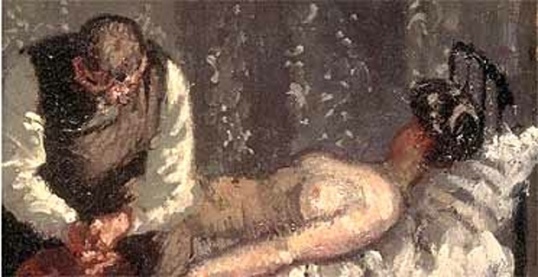
Here’s one of the infamous painting that’s always cited by people who are convinced that he was Jack The Ripper:
Why not listen to a little music before you leave?
Hey — did you know that I have a daily music blog? Check it out: Lisa Marie’s Song of the Day! This is the song that I shared on my birthday because a lot of people have told me that it might as well be about me:
You know what you should do now?
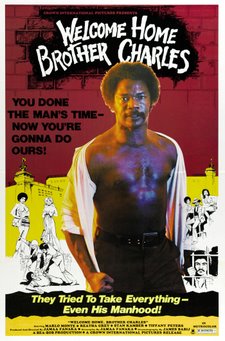
Since it’s the day after my birthday and all, why not go read the first review that I ever wrote for this site? Check out my thoughts on a strange little film called Welcome Home, Brother Charles.
This particular scene was my third favorite from Tobe Hooper’s Salem’s Lot.
There’s much to love about this scene. It’s a very claustrophobic sequence with our protagonist Ben Mears (played by David soul) left in the morgue by his friend Bill Norton for just a few minutes. The scene itself gradually builds in tension as Ben realizes that at any second the body on the morgue table could get up. The word vampire rarely gets uttered during the first third of the series, but Ben suspects the worst and he knows that he’s ill-prepared to deal with his fears if they bear fruit.
There’s a definite tv network quality to the way the scene is shot, but Hooper milks the creeping dread and terror with each passing second as Ben creates a makeshift crucifix and begins to chant random Bible passages as a way to bless his home-made icon. When his fears have been confirmed there’s not a sense of relief that he’s not crazy, but one of sheer terror.
This third joins part one and part two of my favorite scenes from Salem’s Lot and when witnessed as a set should give an idea just how terrifying and underrated this mini-series adaptation of the classic Stephen King vampire novel really is.
So, last night, I was looking for something to watch and I came across Sleepwalkers, a horror film from 1992. And you know what? I could sit here and I could get all snarky about Sleepwalkers and I could be hypercritical and all that other stuff. It’s tempting because the film was written by Stephen King and Stephen King has had so much success that it’s easy to be overly critical of anything he’s involved with.
But I’m not going to do that. Or, at least, that’s not my main objective with this review. No, with this review, I want to pay tribute to cat named Clovis.
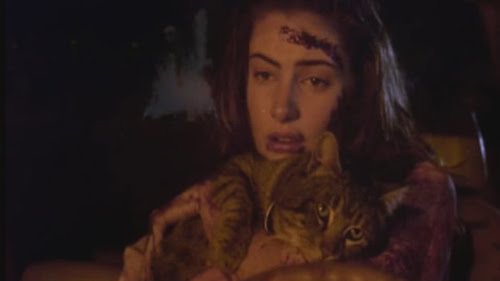
You see, there are several humans and humanoids in Sleepwalkers. The film is about two energy vampires — Charles (Brian Krause) and his mother Mary (Alice Krige) — who have an icky incestuous relationship and who need to suck energy from virgins in order to survive. Charles, who appears to be a teenager, has selected Tanya (Madchen Amick) as his latest target. Tanya has loving parents (Lyman Ward and Cindy Pickett, who also played Ferris Bueller‘s parents) and there’s also a creepy English teacher (Glenn Shadix) who tries to blackmail Charles and ends up losing a hand as a result. There’s several police officers, one of whom is killed when a corncob is driven into his spine. And Steven King appears in an awkward cameo, along with Clive Barker and Tobe Hooper.
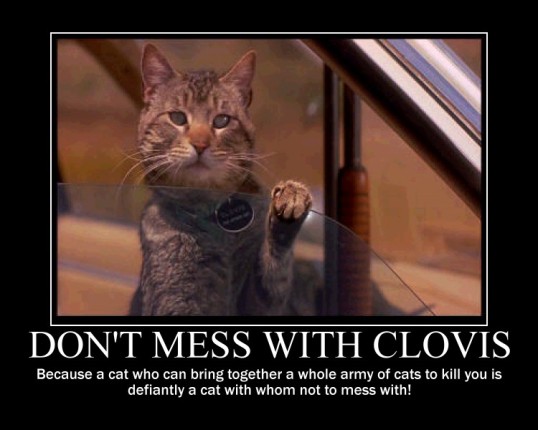
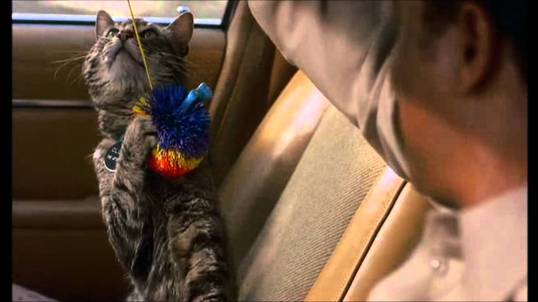
That’s right — there’s a lot of people in this movie but none of them made as big an impression as Sparks, the talented little kitty who plays Clovis. Seriously, check Clovis out!
You see, there’s only one thing that can kill Charles and Mary and that’s the scratch of a cat. From the minute that Charles and Mary move into their latest home, cats start to gather outside the house, meowing and just waiting for their chance to pounce. And, when it comes time for the cats to finally make their movie, who is their leader?
CLOVIS!
After Charles kills Clovis’s owner, Clovis gathers every other cat around and we watch as, in slow motion, they run through the streets of the town. That’s right — whatever else you may want to say about Sleepwalkers, this is a movie where cats finally get to kick some ass.
And who is the main ass kicker?
Little Clovis, of course!
At the end of the film, Tanya might not have many people left in her life but she’s got Clovis and, because of that, you know that everything’s going to be okay.
As for the rest of Sleepwalkers … well, it’s watchable but it still really doesn’t make a huge impression. And, to be honest, that really is the fault of the script. It’s hard to know who (out of the humans) you’re supposed to care about. Charles and Mary are pure evil and Charles has a really bad habit of speaking in lame one liners. Tanya, meanwhile, is well-played by Madchen Amick but, as written, she’s a bit of a nonentity. There is one fun scene when Tanya dances but then again, you have to wonder why movies, regardless of when they were made, always insist on making teenagers dance to songs that were written decades before they were born.
Fortunately, the film has Clovis. Not only does he save the day but he saves the movie as well!
Those were some of the most terrifying words I’ve ever heard growing up. It’s all because of one scene from the tv mini-series which adapted Stephen King’s vampire novel, Salem’s Lot. It was a scene in the novel that terrified me as a young boy reading King for the first time.
I’ve always been gifted (or I sometimes say cursed) with having a very overactive imagination. This is why horror has always been such a fascinating genre for me. Even where the horror is all up in one’s face with it’s gore and messy aftermath my mind’s eye would make things worst or just constantly play it on repeat in my head days after the film has ended. It’s even worst when the horror comes across less through gore and more through atmosphere and built-up dread moving towards a jump-scare or something more insidious.
This particular scene is my second favorite from the Salem’s Lot mini-series. The first one I had posted a couple years back which just barely lags behind this one for third. What made this scene so effective despite it’s tv-style production was Tobe Hooper’s direction. Despite working with the censorship inherent in broadcast tv, Hooper was able to create a palpable sense of dread as the old English teacher Matt Burke senses a presence up in one of his house’s rooms. It was the same room where one of his former students had passed away in his sleep.
As the audience we already have an idea who or what is in that second floor room. Matt Burke has an idea as well, but his morbid curiosity wins out as he decides to investigate. Yet, despite such a lack in judgement he does come armed with a crucifix in hand. The way the scene builds and builds as Burke climbs the stairs and hesitating before opening the door to the room was almost too much to bear.
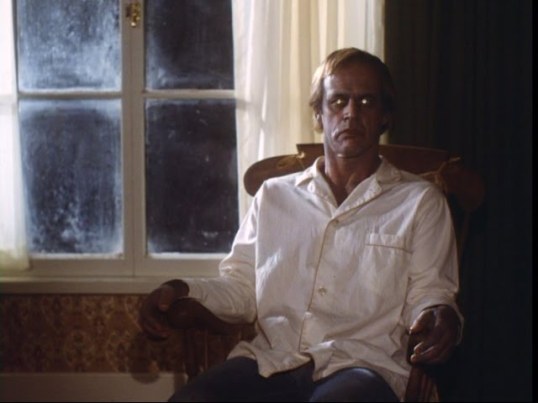
The reveal of his former student, Mike Ryerson, back in the room sitting in the rocking chair as one of the undead only increases the horror of the scene. His snake-like mannerisms was a new take on the vampire behavior. It’s not the usual silk and lace bloodsucker we grew up watching. This was a vampire that behaved like a predator beguiling it’s next prey. From the way Ryerson (played by Geoffrey Lewis) hissed his words and undulated his body as he stood to face his former teacher was disturbing at the very least.
Just writing about it and seeing the scene for the umpteenth time still gives me the shakes.
There is exactly one effective sequence to be found in Maximum Overdrive, a horror film from 1986 that attempts to show us what would happen if all of Earth’s machines decided to destroy humanity.
It takes place at the end of a little league game. The coach, happy that his team has won, declares soda for everyone! He walks over to the soft drink machine and puts in his coins and…nothing happens. The coach stares at the machine perplexed. His team gathers around him.
Suddenly, a can flies out of the machine and hits the coach in the groin. Coach falls to his knees, just to get another can driven straight into his skull, leaving him with a big bloody hole in his head. As the coach twitches, his teams starts to run away. Suddenly, the machine is shooting cans out at them. Some of the kids escape but quite a few don’t.
Suddenly, as the kids flee, a driverless steamroller crashes through a fence and drives across the field, graphically flattening one of the players…
It’s over-the-top, it’s kind of scary, it’s fun in a naughty sort of way, and it’s exciting to watch. It’s totally absurd and yet it’s effective at the same time. It’s a really brilliant scene, one that hints at what Maximum Overdrive could have been. It hints that Maximum Overdrive‘s first-time director did have some potential and watching it, one is tempted to feel a pang of regret over the fact that he never directed another film after this one.
However, then you watch the rest of Maximum Overdrive and you realize that one effective scene was a total fluke. To your horror, you realize that this film’s director (and screenwriter) has decided to set nearly the entire film in the ugliest and most disgusting truck stop in the world. You realize that the director has no idea how to maintain suspense and that his idea of horror appears to be having a lot of trucks constantly circling the truck stop. And then, worst of all, you realize that the unlikable caricatures inside the truck stop are meant to be our heroes!
And you find yourself wondering if things could possibly get any worse. Well, believe me — they can.
First off, a guy named Camp Loman (Christopher Murney) shows up and reveals himself to be a total lech and then starts trying to sell bibles and really, what do you expect from someone named Camp Loman? And, what’s annoying, is that the film’s director seems to think that he’s blowing our mind by presenting us with an hypocritical bible salesman. I mean, seriously — the amount of time devoted to Camp Loman will make you nostalgic for scenes of a steamroller crushing a child.
And then Emilio Estevez shows up as our hero but he scowls through the entire movie and delivers all of his lines through gritted teeth, as if he’s pissed off about appearing in Maximum Overdrive and really, who can blame him? That said, it doesn’t really make for an enjoyable performance.
But hey — Emilio’s not the only person in the truck stop. There’s also Pat Hingle, playing the owner of the truck stop. He’s overweight, wears a tie, smokes a cigar, and speaks with a vaguely Southern accent. Hmmmmm, do you think he’s going to be a bad guy?
Oh! And let’s not forget the waitress played by Ellen McElduff. “WE MADE YOU!” she shouts at the machines and then she shouts it again and again and again and again and it’s almost as if the film is being directed by a guy so in love with his own dialogue that he doesn’t realize how annoying the same line gets when it’s screeched over and over again.
And I haven’t even gotten to the helium-voiced newlyweds yet…
When I recently watched Maximum Overdrive on Encore, there were a lot of things that annoyed me, such as the bad pacing, the bad acting, the bad dialogue, the bad special effects, the bad cinematography, and the bad everything else. But what really got to me was just how inconsistent this movie was. Some machines turned into killers but oddly, others did not. At one point, a machine gun starts shooting at the people in the truck stop but the weapons that Pat Hingle keeps in the truck stop never turn on their human masters. Seriously, if you’re going to make a terrible movie, at least be consistent.
So, you may be asking, why is this an Icarus File? Well, it was directed by Stephen King, the writer who is routinely called the “master of horror.” King may be a great writer but, judging from this movie, he was a really crappy director. I imagine, when the film was in pre-production, the logic was that if King could write a scary book then he could definitely direct a scary movie.
Nope.
It turns out that, just as Icarus should never have gotten so close to the sun, Stephen King should never have directed a movie.
With just minutes left til the end of the day I thought it was time to wish one of my favorite a happy birthday.
I pretty much spent my junior high and high school years reading everything that Stephen King had written and published up to that point. The habit followed me after high school graduation and I’ve picked up on other authors since.
While Stephen King has slowed down some when it comes to the amount of novels he has released in the last decade or so, he is still one of the few authors whose books I will buy without even knowing what it’s about.
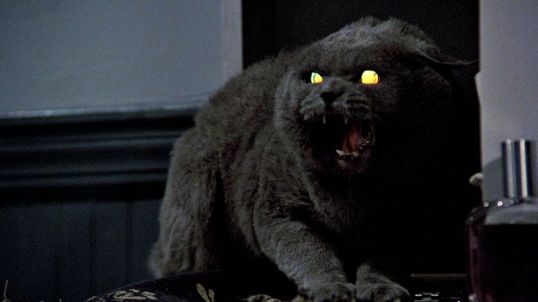
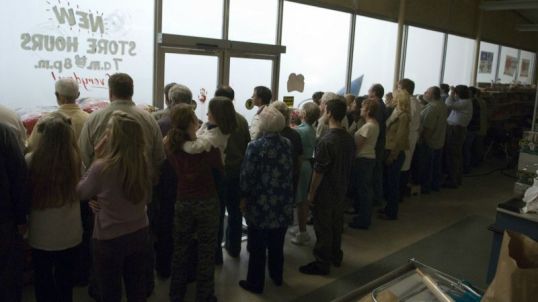
Here are just four films adapted from his stories that I consider favorites of mine. They’re just stories about a boy’s first car, a man waking up from a long sleep, a cat named Church and a grocery store full of people.
So, it seems like every time that I write a review of any film based on a novel by Stephen King, I always have to start out by explaining that I think, while King’s success is undeniable, the fact that he’s overrated is also undeniable. It’s a comment that I always make and then I have to deal with people going, “But, Lisa, everyone loves Stephen King! He’s the most commercially successful author ever! He’s a modern-day Charles Dickens!”
Bleh.
Make no mistake, I think that Stephen King is a talented writer. However, I don’t think that he’s the greatest writer that has ever lived and that’s where I often come into conflict with King’s fans. (Stephen King fans tend to be like religious fanatics when it comes to defending their belief.) Having read both King’s earlier work and his more recent books, it’s hard for me not to feel that Stephen King has been growing steadily complacent. There’s a certain self-importance to his prose and his plotting that, for me, is the literary equivalent of nails on chalk board. If anyone is guilty of believing the most fawning praise of his biggest fans, it would appears to be Stephen King who, to judge from his twitter feed, appears to also believe that he’s our most important cultural critic as well.
(To be honest, I’d probably have more tolerance for King’s attempts at cultural and political criticism if he wasn’t so predictable about it all. Stephen King may write best sellers but that doesn’t mean he has anything interesting or unique to say about current events.)
Anyway, since I don’t feel like having to deal with all of that shit all over again, I’m not going to start this review by saying that I think Stephen King is overrated. In fact … whoops.
Okay, so much for that plan.
Even I have to admit that The Dead Zone is one of Stephen King’s better books. First off, it’s less than a 1,000 pages long. Secondly, the hero isn’t a writer who spends all of his time whining about the political preferences of his neighbors. Third, it deals with all of the “big” issues of faith, destiny, and morality but it does so in a far less heavy-handed manner than most of King’s books.
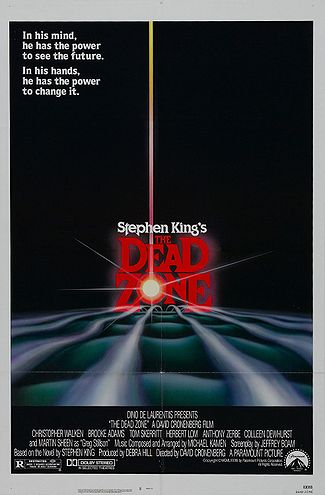
The Dead Zone is also the basis for one of the better films to be adapted from a Stephen King novel. Directed by David Cronenberg and starring Christopher Walken, the film’s plot closely follows the novel. Johnny Smith (Christopher Walken) is a high school teacher who, after a horrific car crash, spends five years in a coma. When he finally wakes up, he discovers that his girlfriend, Sarah (Brooke Adams), has married another man. His mother has become a religious fanatic. And, perhaps most importantly, whenever Johnny touches anyone, there’s a good chance that he’ll see either the person’s past or a possible future.
Needless to say, Johnny struggles with how to deal with his new powers. After he helps to catch a local serial killer, Johnny goes into seclusion. However, when he discovers that Sarah is now volunteering for ambitious politician Greg Stillson (Martin Sheen), Johnny goes to a Stillson rally, shakes the man’s hand, and has a vision. Johnny discovers that, if Stillson is elected to the senate, he’ll eventually become President and then he’ll destroy the world.
Much like The Shining, The Dead Zone benefits from being directed by a filmmaker who was both confident and strong enough to bring his own individual style to the material. (Usually, when a King adaptation fails, it’s because it followed the source material too closely, as if the film’s producers were scared of upsetting any of King’s constant readers.) Though the film’s plot may closely follow the novel, the movie itself is still definitely more of a product of David Cronenberg than Stephen King. Whereas King’s novel devoted a good deal of time to Johnny and Sarah’s relationship, it’s treated as almost an afterthought in Cronenberg’s film. Whereas King’s novel presented Johnny Smith as being an everyman sort of character, Cronenberg’s film gives us a Johnny who, from the start of the film, is a bit of an outsider even before he starts to see the future. Whereas King put the reader straight into Johnny’s head, Cronenberg approach is a bit more detached and clinical. Cronenberg’s Johnny is a bit more of an enigma than King’s version.
Fortunately, Cronenberg was fortunate enough to be able to cast Christopher Walken in the role of Johnny Smith. King’s preference for the role was Bill Murray. As odd as it may sound, you can actually imagine Bill Murray in the role when you read King’s book. But, for Cronenberg’s more detached vision, Walken was the perfect choice. People tend to spend so much time focusing on Christopher Walken’s quirky screen presence that there’s a tendency to forget that he’s actually a very talented actor as well. He’s very likable and sympathetic as Johnny and brings a humanity and a sense of humor to the role, which provides a good balance to Cronenberg’s sense of detachment.
The Dead Zone is a good book and it was later turned into an occasionally good (and, just as often, not-so-good) television series. However, the film is still the best.