Playing Catch-Up: The Big Short (dir by Adam McKay)


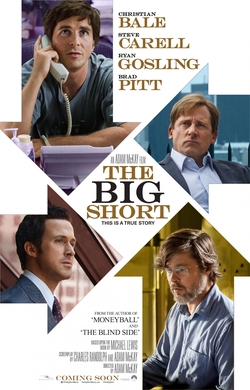
The_Big_Short_teaser_poster

The Big Short is a film that is so critically acclaimed and that has been so passionately embraced by those who enjoyed it that it’s a bit intimidating to admit that it really didn’t do much for me.  (It’s even more intimidating for me to admit that I nearly included it on my list of the 16 worst films of 2015.)  It’s a big, angry movie and, even though it’s not really that good, it definitely taps into the zeitgeist.  It captures the anger, the frustration, and the fears that people (including me) are feeling right now.  It didn’t do much for me but I can understand why others have so passionately embraced it.

As for the film itself, it’s about the housing collapse and the financial crisis of 2008.  The main characters are all people who realized that the economy was about to collapse and who managed to make a profit off of the crisis.  For the most part, everyone gets at least two scenes where they get to rail about how angry they are that they’re making a profit off of other people’s misery.  However, they all still collect their money at the end of the film.

For the most part, our main characters are the type of quirky eccentrics who always tend to pop up in ensemble films like this.  They’re all played by recognizable actors and they all have an identifiable trait or two so we can keep them straight.  For instance, Christian Bale has trouble relating to people socially, plays drums, and looks like he probably has terrible body odor.  Steve Carell has a bad haircut and spends a lot of time yelling at people.  He’s also haunted by the suicide of his brother and he’s married to Marisa Tomei but she only gets to appear in two scenes and doesn’t really do much because this is a film about menfolk, dagnabit.  (I love Steve Carell but this is probably the least interesting performance that he’s ever given.)  John Magaro and Finn Wittrock are two young investors and they especially get upset when they realize that the economy is about to collapse.  Their mentor is played by Brad Pitt.  Since this is an important film, Brad Pitt plays his role with his important actor beard.

And then there’s Ryan Gosling.  Gosling plays a trader and he also narrates the film.  And really, Gosling probably gives the best performance in the film, perhaps because his character is the only one who is actually allowed to enjoy making money.  I think we’re supposed to be outraged when he brags about making money while people lose their houses but Gosling’s so charismatic and the character is so cheerful that it’s hard to dislike him.

(Of course, listening to Gosling’s narration, it’s impossible not to be reminded of The Wolf of Wall Street.  And it’s appropriate because The Big Short is kind of like The Wolf of Wall Street for people who don’t want to have to deal with ambiguity or nuance.)

The film has gotten a lot of attention for Adam McKay’s direction, which is flashy and always watchable but, at the same time, also rather shallow.  For the most part, McKay’s directorial tricks only served to remind me of other movies.  The narration, of course, made me think about The Wolf of Wall Street.  The scenes where characters look straight at the camera and say, “This isn’t the way it really happened,” only reminded me of how much more effective it was when the same thing happened in Michael Winterbottom’s 24 Hour Party People.

And then there’s the celebrity cameos.  These are the scenes where a special guest celebrity is brought on screen to explain to us how Wall Street actually works.  The first time, it’s Margot Robbie in a bubble bath and it works well because it admits the debt that The Big Short owes to Wolf of Wall Street.  (Plus, it ends with Robbie telling the viewers to “fuck off,” which is probably what I would do if a huge group of strangers interrupted my bubble bath.)  If McKay had limited himself to just doing it once, it would have been brilliant.  But McKay drags out three more celebs and, with repeated use, the technique gets less and less interesting.

But I guess it’s debatable whether any of that matters.  The Big Short taps into the way people are feeling now.  It’s a zeitgeist film.  People are rightfully angry and The Big Short is all about that anger.  A decade from now, it’ll probably be as forgotten as Gabriel Over The White House.  But for now, it’s definitely the film of the moment.

Here Are The Winners of The 2015 Hollywood Film Awards, Whatever The Hell Those Are.


The_Martian_film_poster

Oh my God, y’all — the Hollywood Film Awards were held on Sunday and a bunch of potential Oscar contenders were honored!  Which all leads to one very important question:

What the Hell are the Hollywood Film Awards?

As I pondered that question, I realized that I had vague memories of sitting through the Hollywood Film Awards last year.  The ceremony was broadcast on CBS and it was distinguished from other awards shows in that there were no nominees.  Instead, only the winners were announced.  It was so amazingly dull and I can remember watching it and thinking, “Awards season has finally jumped the shark.”

(And this was even before Sasha Stone and Jeff Wells had their annual breakdowns…)

Anyway, the Hollywood Film Awards for 2015 were given out on Sunday and I’m assuming they weren’t televised.  (I was busy watching A Student’s Obsession anyway…)  You can find the winners below.  For the most part, it’s a pretty boring list (and why give out awards in November?) but it does allow us an early glimpse into some of the films and performers that are contending for Oscar gold.

Here’s the list.  Along with a gif of a kitty showing just how excited he is over Awards Season…

YAY! AWARDS! I'M SO EXCITED..I'M SO EXCITING...I'M SO ... SCARED!"

“YAY! AWARDS! I’M SO EXCITED..I’M SO EXCITED… I’M SO … SCARED!”

Career Achievement Award presented to Robert De Niro by David O. Russell.

Producer Award presented to Ridley Scott (“The Martian) by Russell Crowe.

Director Award presented to Tom Hooper (“The Danish Girl”) by Amber Heard.

Actor Award presented to Will Smith (“Concussion”) by Jamie Foxx.

Actress Award presented to Carey Mulligan (“Suffragette”) by Jake Gyllenhaal.

Supporting Actor Award presented to Benicio Del Toro (“Sicario”) by Reese Witherspoon.

Supporting Actress Award presented to Jane Fonda (“Youth”) by Laura Dern.

Breakout Actor Award presented to Joel Edgerton (“Black Mass”) by Johnny Depp, Dakota Johnson.

Breakout Actress Award presented to Alicia Vikander (“The Danish Girl”) by Armie Hammer.

New Hollywood Award presented to Saoirse Ronan (“Brooklyn”) by Ryan Gosling.

Ensemble Award presented to “The Hateful Eight” by Quentin Tarantino.

Breakout Ensemble Award presented to “Straight Outta Compton” by Ice Cube.

Comedy Award presented to Amy Schumer (“Trainwreck”) by Selena Gomez.

Breakthrough Director Award presented to Adam McKay (“The Big Short”) by Steve Carell.

Screenwriter Award presented to Tom McCarthy, Josh Singer (“Spotlight”) by Mark Ruffalo.

Blockbuster Award presented to “Furious 7” by Kurt Russell.

Song Award presented to “Furious 7” (“See You Again”) by Vin Diesel.

Animation Award presented to Pete Docter (“Inside Out”) by Amy Poehler.

Cinematography Award presented to Janusz Kaminski (“Bridge of Spies”).

Composer Award presented to Alexandre Desplat (“The Danish Girl,” “Suffragette”).

Documentary Award presented to Asif Kapadia (“Amy”).

Editor Award presented to David Rosenbloom (“Black Mass”).

Visual Effects Award presented to Tim Alexander (“Jurassic World”).

Sound Award presented to Gary Rydstrom (“Bridge of Spies”).

Costume Design Award presented to Sandy Powell (“Cinderella”).

Make-Up and Hair Styling Award presented to Lesley Vanderwalt (“Mad Max: Fury Road”).

Production Design Award presented to Colin Gibson (“Mad Max: Fury Road“).

"Yawn. These awards are boring..."

“Yawn. These awards are predictable and boring.  You disappoint me…”

Film Review: Lost River (dir by Ryan Gosling)


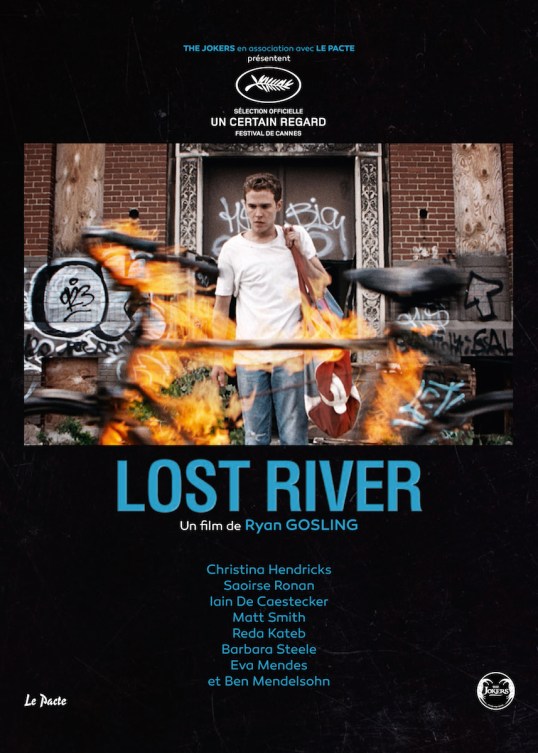
Lost River

I had high hopes for Lost River.  Not only is it the directorial debut of one of my favorite actors, Ryan Gosling, but it was also booed at Cannes.  Some of the best and most interesting films ever made have been booed at Cannes.  The reviews that I had read of Lost River indicated that the film was a mess but it was, at the very least, a visually intriguing mess.  I was expecting the film to be pure style over substance but you know what?  I like style.

So, with all that in mind, I finally got a chance to sit down and watch Lost River last night and … bleh.  It’s not a terrible film.  You can watch it and feel that Ryan Gosling does have some promise as a director, if not as a writer.  (Along with directing, he also wrote the film’s screenplay.)  There are some nicely surreal images, though almost all of them appear to have been borrowed from other better films and, as a result, even the strangest of images are rather familiar.  (To be truly impressed by Lost River, it helps to have never seen anything directed by Mario Bava, Dario Argento, David Lynch, or Terrence Malick.)  He gets a memorably unhinged performance from the great Ben Mendelsohn but then again, when hasn’t Mendelsohn given a memorably unhinged performance?

Anyway, Lost River takes place in Detroit, presumably because Detroit features a lot of dilapidated neighborhoods that look interesting on film and allow Gosling to pretend that his film is about America urban decay.  Billy (Christina Hendricks) is on the verge of losing her house but, with the help of sleazy bank manager Dave (Ben Mendelsohn), Billy gets a job working as a performer at a club.  At the club, she and Cat (Eva Mendes) perform elaborate routines which always end with them pretending to die in some excessively brutal and bloody way.  The club’s largely affluent audience loves it.  Dave loves it so much that he’s inspired to sing a song on stage.  Later on in the film, Dave does an elaborate dance because every independent film has to feature an out-of-nowhere elaborate dance.

Meanwhile, Billy’s son, Bones (Iain De Caestecker), is trying to raise money to save the house by stealing copper out of abandoned buildings.  However, this gets him in trouble with Bully (Matt Smith, struggling to speak with an American accent), a psychopath who has declared his section of Detroit to be “Bullytown.”  Bully rides around in a convertible, sitting on a throne that’s been attached to the back seat.  When Bully discovers that Bones has been stealing copper from buildings in Bullytown, Bully declares that Bones must die.

(At some point, you have to wonder if Bully was doomed from the minute that his parents decided to name him Bully.  Maybe if they had named him The Doctor, he could have lived a very different life.)

Living next door to Billy and Bones is Rat (Saorise Ronan, who gives a good performance and deserves better than this role).  Rat is called Rat because she owns a pet rat that’s named Nick.  Got all that?  Rat also lives with her grandmother (Barbara Steele), who never speaks but spends all of her time watching old home movies.  Why would you cast an icon like Barbara Steele and then not allow her to do anything other than sit in a chair and silently stare at a television?

If Lost River was just an exercise in pure style, I probably would have enjoyed it a lot more.  I would much rather a film be too obscure as opposed to being too obvious.  Unfortunately, while Gosling the director is having a lot of fun being as stylish as he can be, Gosling’s the screenwriter proves himself to be heavy-handed and patronizing.  By setting the film in Detroit and having random characters show up to talk about how America is dying and the poor are getting poorer while the rich get richer, Gosling lets us know that Lost River is meant to be more than just an exercise in technique.

The problem is that, as well-intentioned as Gosling may be, you can’t help but get the feeling that he has absolutely no idea what it’s like to be poor or what it’s like to live in a dying American city.  According to the 2010 census, 82.7% of Detroit’s population is African-American.  If you’re making a movie the deals, no matter how strangely, with what it’s like to be poor and desperate in Detroit, why would you decide to exclusively cast affluent-looking Caucasians in all of the main roles?  The few black characters who appear in Lost River are largely there to either comfort or share wisdom with the main white characters before then quickly moving on, never to be seen again after their minute or so of screen time.  It comes across as being condescending in only the way something written by a wealthy white guy can be.

Lost River is a misfire, an attempt by a filmmaker to try to make a statement about something that he really doesn’t seem to know much about.  Judging from the film’s visuals, Gosling has some promise as a director but, in the future, he should probably try to work with a better screenwriter.  If you don’t listen to the dialogue and just consider the film as an exercise in visuals, it’s mildly diverting.  (That said, even the nonstop parade of surreal images gets boring after a while.)  Lost River is not terrible.  It’s just bleh.

Here’s the trailer for Lost River!


Last year, Ryan Gosling’s directorial debut Lost River premiered in Cannes.  And, the film’s reception was not exactly positive.  However, judging from the trailer below, Lost River may be enough of a pretentious mess that it simply has to be seen.  The film will finally be available for viewing on April 16th!

Embracing the Melodrama #58: The Place Beyond The Pines (dir by Derek Cianfrance)


The-Place-Beyond-The-Pines

First released in 2013, the underrated (and, as far as end-of-the-year awards ago, underappreciated) The Place Beyond The Pines is actually three cinematic melodramas in one.  Much like a great novel, this movie is split into multiple pieces with each part telling a different part of a larger story.  It’s an interesting and ambitious concept, the type that we sometimes fear that audiences are no longer capable of appreciating.

The first third of the story centers on Luke Glanton (Ryan Gosling), a motorcycle stuntman who performs at state fairs.  During one such fair in upstate New York, he meets and has a brief affair with Romina (Eva Mendes, giving an excellent performance).  When he returns to New York a year later, Luke discovers that he is now a father.  Luke quits the fair and decides that he wants to be a part of his son’s life but Romina, who is now in a stable relationship with a good man named Kofi (Mahershala Ali), asks him to stay away.  Determined to be part of his son’s life and also looking to win back Romina, Luke stays in town and gets a job working with Robin (the always excellent Ben Mendelsohn).  Robin owns an auto garage and, as he explains to Luke, he also used to be a bank robber.  Soon, with Robin’s help, Luke is robbing banks and sending the money to Romina.

Place

Luke’s story is probably the strongest in the film.  Ryan Gosling is charismatic as the dangerous yet likable Luke and he and Eva Mendes have a lot of on-screen chemistry.  Ben Mendelsohn brings yet another one of his trademark burned out characters to life and Mahershala Ali is sympathetic as Kofi, a man, who despite being good and responsible, is simply no Ryan Gosling.

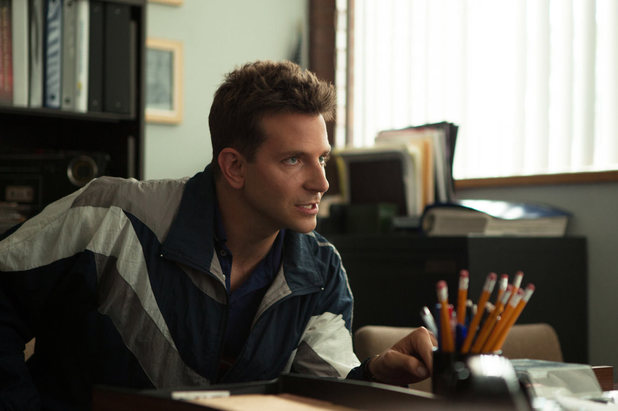
The second part of the story deals with Avery Cross (Bradley Cooper), the cop who chases Luke after one of his bank robberies.  Avery is the politically ambitious son of a former judge (Harris Yulin) and, much like Luke, he also has newborn son.  When Avery is originally hailed as hero for his pursuit of Luke, Avery’s feelings are far more ambivalent.  It gets even more difficult for him when he catches some of his fellow cops (led, of course, by Ray Liotta) stealing the money that Luke sent to Romina.  When Romina rejects Avery’s attempt to return the money to her, Avery is left with little choice but to try to take down the crooked cops himself.  It’s the only way for him to clear his conscience.

movies-the-place-beyond-the-pines-still-7

And, finally, in the third part of the story, teenager Jason Cankham (Dane DeHaan) meets and befriends Avery’s son, AJ (Emory Cohen).  What neither one of them realizes is that Jason is Luke’s son.  The interesting thing here is that the two sons have, on the surface at least, turned out to be the exact opposites of their father.  Jason is the good kid while AJ is probably one of the most despicable movie teenagers of all time.  When Jason learns the truth about both of their fathers, he has to decide whether he’s his father’s son or if he is his own human being.

the-place-beyond-the-pines03

As you might be able to guess from the above plot description, The Place Beyond the Pines is a big epic of a film and, perhaps not surprisingly, the end results are intriguing if occasionally uneven.  The film starts out so strongly with Ryan Gosling roaring down empty roads on his motorcycle that it’s hard for the rest of the movie to live up to that opening’s promise.  And yet somehow, the film manages to do just that.  Even the parts of the film that didn’t particularly intrigue me — like the whole subplot with the corrupt cops — were saved by the efforts of a perfectly chosen cast.  The third and final part of the film provides the perfect climax, helping us to both understand the legacy of Luke Glanton and Avery Cross but also to understand why both of their stories are important, both as individual tales and as parts of a greater whole.

The Place Beyond The Pines may not be perfect, not in the way that a film like Winter’s Bone is perfect.  However, we should still be glad that films like it are being made.

Place-Beyond-the-Pines

Here’s the Teaser Clip For Ryan Gosling’s Lost River!


Here is the teaser clip for Ryan Gosling’s directorial debut, Lost River, which was released ahead of the film’s premiere at Cannes.

So far, the majority of the reviews out of Cannes have been mixed.  The film has been called self-indulgent, incoherent, and pretentious and, perhaps worst of all, it has been compared by more than one reviewer to Richard Kelly’s Southland Tales.

Peter Bradshaw of the Guardian, a reviewer whose opinion I usually respect, writes: “Ryan Gosling’s Lost River is a conceited clunker – and yet there are great images and mad energy.”  That gave me some hope — I can forgive self-indulgence if it’s at least interesting to watch.  But then Jeff Wells had to pop up and start comparing it to Beasts of the Southern Wild.  As usual, Sasha Stone over at Awards Daily has some very strong feelings about the film, despite the fact that — as she readily admits — she hasn’t actually seen it.  (But Sasha’s so much smarter than the rest of us common people, so who are we to question her, right?)

Well, as you can probably guess, I don’t care what the critics think or say.  I’m still going to see it and judge it for myself.  Not only is the film directed by Ryan Gosling but it also stars three of my favorite actresses — Eva Mendes, Saoirse Ronan, and Barbara Steele.  Dr. Who fans will be happy to see Matt Smith while those of you who enjoy Agents of SHIELD can get a chance to apparently see a new side of Iain De Caestecker.

As for the teaser below — well, who knows what the Hell’s going on?  But aren’t you just a little bit intrigued to find out?

Documentary Review: Seduced and Abandoned (dir by James Toback)


I recently watched James Toback’s 2013 Seduced and Abandoned on HBO.  This documentary failed to seduce me but it certainly left me feeling abandoned.

Seduced and Abandoned follows James Toback and Alec Baldwin as they wander around the Cannes Film Festival, interviewing filmmakers and attempting to raise money for Toback’s latest film.  That film, incidentally, is a remake of  Last Tango In Paris.  Though neither Toback nor Baldwin goes into too much detail about the film (and I’m not exactly convinced that they’re all that serious about it to begin with), we do learn that this remake would be set in Iraq.  Alec Baldwin would play a right-wing CIA agent while Neve Campbell  would play a leftist journalist.  We watch as Baldwin and Toback pitch this film to a countless number of potential producers and ask for twenty million dollars.  Without fail, every producer replies that he loves Alec Baldwin but he’s not willing to spend that type of money on him because Baldwin is not a bankable star.  As Baldwin and Toback frequently lament, nobody seems to care what the film is about.  Instead, they’re only interested in making money.

And this brings us to this documentary’s main problem.  It would be easier to agree with them about businessmen sacrificing art for greed if not for the fact that the movie that Toback and Baldwin are talking about making sounds like perhaps the worst fucking film ever pitched.  A remake of Last Tango in Paris starring Alec Baldwin, directed by James Toback, and taking place in Iraq?  Are you freaking kidding me?  I would never pay money to see a movie that sounded that pretentious.  I would never ask anyone else to buy me a ticket for this movie.  If I saw this movie on HBO, I would cancel my cable subscription.  Seriously, no way.

And yes, I do understand Baldwin and Toback’s point.  They’re arguing that a politically-themed, Iraq-set remake of Last Tango In Paris could not be made today because the system has been set up to silence the voice of artists. The industry is more concerned with making money than making an artistic statement.  I happen to agree 100% but that still doesn’t change the fact that Toback and Baldwin’s film sounds terrible.

Toback and Baldwin interview everyone from Ryan Gosling to Jessica Chastain to Martin Scorsese to Francis Ford Coppola and the one thing that every interview has in common is the sound of Toback’s braying laughter.  It’s a very forced and calculating laugh, one that seems almost as fake as Toback’s pseudo-intellectual persona.  And that’s the other big problem with Seduced and Abandoned.  Toback and Baldwin never really come across as being the rebels that they obviously believe themselves to be.  Even when Toback is talking to the financiers that he and Baldwin appear to blame for ruining the movies, it’s obvious that Toback wants us to impressed by the fact that he knows so many fabulously wealthy people.  In the end, the film feels self-congratulatory in the most undeserving of ways.

And yet, there are occasional moments where the film, almost despite itself, manages to escape from the suffocating egos of James Toback and Alec Baldwin.  The section of the film that deals with the history of Cannes Film Festival is fascinating and Martin Scorsese is such a lively and sincere artist that it’s impossible not to enjoy his interview.  (In many ways, Scorsese seems to be the anti-Toback.)  For a few seconds, Alec Baldwin stops being insufferable long enough to do a reasonably humorous impersonation of Woody Allen.  If you’re a student of Italian cinema, you’ll be happy to see a brief appearance from Mark Damon, a former actor turned producer who appears in several Italian spaghetti westerns in the late 60s.  Damon is the first producer to have to sit through Toback’s pitch and its fascinating to watch just how indifferent he is to idea of remaking Last Tango In Paris with Alec Baldwin and James Toback.

Mark Damon aside, Seduced and Abandoned is a documentary that fails to do the former and will probably inspire many viewers to do the latter.

Film Review: Gangster Squad (dir by Ruben Fleischer)


Gangster Squad

Do you remember Gangster Squad?

This film, which tells the story of hard-boiled cops and psychotic gangsters in 1940s Los Angeles, was originally meant to be released in September of 2012 but the release date was moved back because the film originally featured a gun battle in a movie theater.  After the real-life movie theater shooting in Aurora, Colorado, that scene was reshot and the release of Gangster Squad was delayed until January of this year.  The critics absolutely hated it, audiences stayed away, and Gangster Squad was the first high-profile flop of 2013.

I was among those who ignored the film when it was first playing at theaters.  After all, it was January and I was more interested in following the Oscar race than going to see a film that, by all accounts, was somewhat terrible.  However, now that Gangster Squad is showing up on a nearly nightly basis on Cinemax, I recently got a chance to see the movie and you know what?

The critics were wrong.

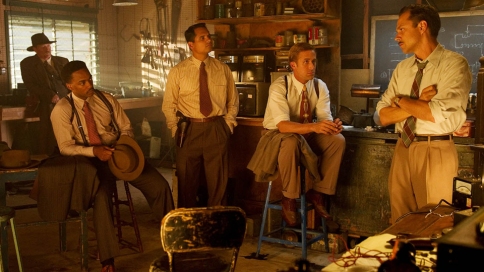
Gangster Squad tells a familiar story.  In fact, the film features not a single character or plot twist that hasn’t shown up in another movie.  The setting is Los Angeles in the 1940s.  Ruthless gangster Mickey Cohen (a totally over-the-top Sean Penn) is the king of the city’s underworld.  How crazy is Mickey Cohen?  He’s so crazy that, when we first see him, he’s watching as another gangster is literally ripped in half.  He’s so crazy that, in the middle of a gun battle, he yells, “Here comes Santy Claus!” as he fires his machine gun.  That’s how crazy Mickey Cohen is.

Sean Penn in Gangster Squad

Seriously crazy.

Fortunately, righteous police chief William H. Parker (Nick Nolte) refuses to allow a little thing like due process to keep him from pursuing Mickey.  Parker calls Sgt. John O’Mara (Josh Brolin) to his office and, after delivering a long and flowery monologue that verges on incoherence, he finally explains that O’Mara’s mission is to put together an elite squad of cops and to take Mickey out by any means necessary!  (Usually, I try to exercise some restraint when it comes to punctuation but Gangster Squad is one of those films that demands exclamation points.)

This is followed by a series of properly colorful scenes in which O’Mara recruits his gangster squad.

Jerry Wooters (Ryan Gosling) is a cynical World War II veteran who is, at first, skeptical of O’Mara and his squad.  Wooters, however, changes his mind after a saintly shoeshine boy is gunned down in front of him.  Wooters is also having an affair with Grace Faraday (Emma Stone), who happens to also be Cohen’s girlfriend.

Coleman Harris (Anthony Mackie) is a black cop who is good with a knife and who lost his cousin to the heroin distributed by Cohen’s mob.  Watching the friendly and playful interaction between Harris and all of the film’s white characters provides us with one of our first clues that Gangster Squad is not necessarily aiming to be a historically accurate portrait of America in the 1940s.

Conway Keeler (Giovanni Ribisi) is a wiretapper and a family man.  Keeler’s fate is pretty much sealed the minute that he tells O’Mara that he’s willing to risk death just to make the world a better place for his son.

Max Kennard (Robert Patrick) is a former old west gunslinger who now spends his time killing gangsters.  Max, we’re told, may be old but he’s also personally shot over a 100 gangsters.  Max also has a younger partner, an honest cop named Navidad Ramirez (Michael Pena).

GANGSTER SQUAD

The Gangster Squad

As you can probably guess at this point, there’s not a single cliché that is not employed by Gangster Squad.  However, and this is what I think several critics missed, the film deliberately takes its clichés to such an extreme that they go from being flaws to being strengths.  By so enthusiastically going overboard in its embrace of the conventions of the gangster film genre and, at the same time, acknowledging the fact that the audience is also familiar with those clichés, Gangster Squad creates its own vibrant and compulsively watchable fantasy world.  The world of Gangster Squad has little to do with any sort of historical reality.  Instead, it’s a  world constructed solely out of other gangster movies.

Taking all of this (and the fact that the film is directed by Ruben Fleischer of Zomieland and 30 Minutes or Less fame) into consideration, it’s pretty obvious that Gangster Squad is not a film that’s meant to be taken seriously.  And yet, that’s what so many critics did when the film was first released in January.  Instead of appreciating the film for paying over-the-top homage to the gangster films of the past, critics attacked it for being an example of style over substance.

And, to give the critics their due, they were exactly right.  There is no substance to Gangster Squad.  Instead, the film is a total celebration of style.

And what style!  In Fleischer’s hands, 1940s Los Angeles is a colorful wonderland of pure excess, a vibrant landscape of dark alleys and swanky nightclubs that literally glow on-screen and are populated by tough men and sultry women in clothing that might not have been found hanging in every closet in the 40s but should have been.  (Seriously, when Emma Stone first appears on-screen, she’s wearing a red gown that is simply to die for.)

This Christmas, I want both Ryan Gosling and the dress.

This Christmas, I want both Ryan Gosling and the dress.

For the viewer who is willing to give themselves over to the film’s over-the-top aesthetic and are willing to appreciate it for what it is (as opposed to condemning it for what it isn’t), Gangster Squad is a watchable, entertaining, and fun movie.  And what’s so bad about that?

I’m glad that I finally got a chance to see Gangster Squad.  Is it one of the great gangster films?  No.  The great gangster films have both style and substance but, quite frankly, if I can only have one than I would prefer something stylish and fun like Gangster Squad to something like Killing Them Softly.

(Then again, I would prefer just about anything to sitting through Killing Them Softly for a second time.)

So, enjoy Gangster Squad.  Watch it for the style.  Have fun.  And most importantly, remember that critics are as often wrong as they are right.

Emma Stone in Gangster Squad

Song of the Day: “In The Room Where You Sleep”


On my way out of James Wan’s “The Conjuring” last night, I noticed Ryan Gosling’s name in the credits. A bit of curiosity led me to his band, Dead Man’s Bones. I wasn’t aware he sung, but he’s pretty good at it. Feeling like a mix of The Doors & Roy Orbison, this song really matches with some of the creepiness of the film. Here, the band plays “In The Room Where You Sleep” , with kids as the background vocals. Enjoy.

Trailer: Only God Forgives (Red Band)


OnlyGodForgives

It looks like we the makings of a new Scorsese/DeNiro combination with Nicolas Winding Refn and Ryan Gosling partnering up once again for another film after their critically-acclaimed neo-noir crime thriller with Drive.

Only God Forgives transplants Refn and Gosling away from the smog and seedy glamour of Los Angeles to the anything-goes locales of Thailand. Refn has described this follow-up to Drive as a modern Western set fully in the Far East with Gosling in the role of the cowboy antihero. The red band trailer once again shows that Refn will not be skimping on the beautifully shot violence and ramps up on the film’s look of heightened reality that made his previous film such a unique viewing experience.

There’s still no announced release date for Only God Forgives, but we will surely be on the look out for when it does finally come out.