After watching The Spirit of Christmas, it time to continue cleaning out the DVR by watching The Flight Before Christmas. The Flight Before Christmas originally aired on December 5th on the Lifetime network. I was at a Christmas party and I totally missed it.
The Flight Before Christmas is perhaps the epitome of your typical Lifetime holiday movie. Stephanie (Mayim Bialik) has never had much luck in love but things are finally starting to look up! She is planning on moving in with her boyfriend and she has already called her mother and let her know that she won’t be home for Christmas this year. But then Stephanie’s boyfriend shows up and says that he’s changed his mind. Not only will they not be moving in together but he wants to break up as well.
That’s it! Stephanie decides. No more love, no more romance, no more risk of heart-break! And, since she’s not going to be having hot, just-moved-in-together-sex this holiday season, she might as well just go back home to Connecticut. She rushes to the airport and manages to get tickets on a flight back home. Also, at the airport, she meets a jolly fat man with a twinkle in his eye. His name is Noel Nichols (and is played by Bill Murray’s older brother, Brian Doyle-Murray) and … well, if you can’t guess what’s going on with Noel Nichols then you really haven’t seen that many Christmas movies.
Meanwhile, Michael Nolan (Ryan McPartin) is on the same flight as Stephanie. Originally, he had seats in first class but, acting out of holiday generosity, he suddenly decides to switch seats with Noel Nichols! (Are you sensing a pattern here?) Michael ends up sitting right next to Stephanie.
Well, immediately, Michael and Stephanie don’t get along and we all know that means that they’re destined to fall in love. However, Michael is flying to Boston so that he can ask his girlfriend, Courtney (Trilby Glover), to marry him. No, Michael, she’s not right for you!
Fortunately, the plane runs into turbulence and is forced to land at the most romantic place on Earth … Bozeman, Montana. Seeing as how they’re going to be stranded for a day or two, Stephanie finds a room at a local Bed and Breakfast. She manages to get the last available room and then, despite claiming not to like him that much, she invites Michael to share the room with her…
Okay, so you’ve read the plot and you already know what’s going to happen. There’s nothing surprising about The Flight Before Christmas but then again, holiday movies aren’t supposed to be surprising. They’re light-hearted and somewhat silly and hopefully, you’ll feel good after you watch one. The Flight Before Christmas is a sweet film that, for me, didn’t quite work. Try as I might, I simply could not imagine Michael and Stephanie as a couple. However, I did think that Brian Doyle-Murray did a great job as Noel Nichols. If I ever meet Santa, I hope he’s just like Brian Doyle-Murray,
(Incidentally, this film ended with a dedication to Mayim Bialik’s father, Barry, who passed away earlier this year. It was a sweetly sincere moment.)
After watching Becoming Santa, it was time to continue cleaning out the DVR by watching The Spirit of Christmas, which originally premiered on Lifetime on December 19th.
According to the imdb, The Spirit of Christmas was originally titled Hollygrove. I imagine that, as often happens when Lifetime picks up a film, the network changed the title to make it a little more “Lifetimey.” And The Spirit of Christmas is a totally appropriate title. It takes place during Christmas and some of the main characters are spirits. However, I have to say that I really prefer Hollygrove as a title. Hollygrove sounds like the title of one of those gothic romances that my sisters and I love to read, the type where the covers always feature a woman in a nightgown staring back at a big dark house. (The house is usually sitting on a cliff and waves are crashing below.) This film may technically be a Christmas film but, at heart, it’s really a tribute to those wonderful paperback novels.
Kate (Jen Lilley) is a broker who, when we first meet her, is relieved that her boyfriend is breaking up with her. Kate doesn’t have time for love. Instead, she’s all about her career. She also doesn’t have time for Christmas and, therefore, she doesn’t complain when her boss asks her spend the early part of her holiday driving out to a deserted inn and assessing the property.
The inn’s pretty nice but nobody wants to spend too much time there because, according to local legend, it’s haunted by its former owner, a bootlegger named Daniel (Thomas Beaudoin). Well, you should never be too quick to dismiss local legend because, in this case, it’s true! Spending the night at the Inn, which she believes to be deserted, Kate is shocked when she runs into Daniel wandering around the hallways!
Daniel, as she soon learns, was murdered 90 years ago on Christmas. Daniel is hanging out around the Inn, still trying to figure out who murdered him and mourning his lost love, Lily (Kati Salowsky). As Kate helps Daniel try to solve his murder, she finds herself falling in love with the spirit with the hipster beard. But the holidays are nearly over, and with them Daniel’s time on Earth. And, of course, Kate’s boss is demanding that she wrap up her appraisal and get back to work…
Anyway, I totally loved The Spirit Of Christmas. Unlike some of the other Lifetime holiday movies, The Spirit of Christmas managed to mix the holidays with everything that we love about Lifetime movies — there was romance, there was murder, there was interior design, and most importantly, there were elaborate historical flashbacks. Thomas Beaudoin had great chemistry with both Jen Lilley and Kati Salowsky and the whole film ended with a wonderfully romantic dance scene. (And I absolutely loved that red dress that Kate was wearing!) This was the perfect mix of Lifetime and the holidays.
Definitely, keep an eye out for The Spirit of Christmas!
Happy holidays! Well, the year is almost over and soon, it will be time to look back upon all of the films that Lifetime aired over 2015 and announce my picks for the best. However, before I do that, I need to take a look at the many Lifetime holiday movies that I currently have recorded on the DVR. (I also need to clear up some space for 2016 because, seriously, that DVR fills up quickly!)
That’s right, it is the season for Lifetime Christmas movies! And I’m not complaining. (Or, at the very least, I’m not complaining too much.) Myself, I love Lifetime movies because of the melodrama, the outrageous plot twists, the out-of-control teenagers, and the psycho boyfriends. Lifetime Christmas movies tend to be a bit more life-affirming than your typical Lifetime film. After spending 11 months watching films like Stolen From The Suburbs, Cleveland Abduction, The Bride He Bought Online, and A Deadly Adoption, it takes a bit of adjustment to then watch something like Becoming Santa. It’s not that Becoming Santa doesn’t have its own merits. It’s just that it’s so dramatically different from what we usually expect to see on Lifetime.
Becoming Santa was the first movie that I rewatched in my attempt to clean out the DVR for the holidays. It originally aired on Lifetime on December 12th.
Conner (Jesse Hutch) works for a toy company and is frustrated by the fact that he can’t get children to put down their phones long enough to get excited over a toy horse that he wants to mass produce. However, despite his work frustrations, Conner is still happy because he’s in love with Holly Claus (Laura Bell Bundy). In fact, he’s decided that the Christmas holiday would be the perfect time to ask Holly to marry him. But first, he wants to get the blessing of Holly’s father.
That might be difficult, Holly explains, because her parents live up north. Way up north.
However, Conner will not be dissuaded. And, before you can say Meet The Parents and Little Fockers, Conner is heading up north to meet Holly’s parents. Of course, on the way up north, Conner is conveniently passed out while Holly takes him through the secret portal that leads to the North Pole…
That’s right! Holly Claus is the daughter of Santa Claus (Michael Gross) and Mrs. Santa (Meredith Baxter). It takes Conner a while to realize this, though the fact that his future father-in-law has a big white beard and employs an elf named Mario (Gabe Khouth) should have been a big clue. However, once Conner does figure it out, he’s okay with it.
But will he be okay with the fact that, if he marries Holly, he’ll be expected to take over the role of Santa Claus? And, for that matter, how can klutzy Conner hope to compete with Holly’s ex-boyfriend, Jack Frost (Tony Cavalero)? After all, Jack and Holly have so much in common…
As far as Lifetime holiday movies are concerned, I thought Becoming Santa was actually really cute. The entire cast had a really sweet chemistry, Gabe Khouth brought an unexpected edge to the character of Mario the Elf, and Tony Cavalero was a lot of fun as Jack Frost. Yes, I did have a hard time believing that Conner would miss so many obvious clues as to who Holly’s parents truly were but then again, it’s a Christmas movie on Lifetime. It’s probably not too much to ask us to suspend our disbelief just a little bit!
Becoming Santa was a sweet movie. It’s scheduled to be rebroadcast on Lifetime on Christmas Day.
Last night, I watched the premiere of A Fatal Obsession on the Lifetime Movie Network!
Why Was I Watching It?
So, for the past month, Lifetime has exclusively been showing holiday movies. And don’t get me wrong — I love the holidays, I enjoy holiday movies, and I’m certainly not complaining. I can understand why Lifetime has made the programming choice that they have and, during this week, keep an eye out for my reviews of all of those Lifetime Christmas movies. But, at the same time, I have been missing the melodrama that made Lifetime famous. So, when I saw that the Lifetime Movie Network would be premiering a movie that had nothing to do with Santa Claus, I simply had to watch!
What Was It About?
Michael Ryan (Eric Roberts) is a horror author who is not just famous for giving his readers nightmares. He’s also famous for being a recovering alcoholic. Except, he’s not really in recovery. Instead, he’s still drinking, he’s still violent, and he’s still dangerous abusive. When his wife, photographer Christie (Tracy Nelson), and teenage daughter, Miri (Remington Moses) finally leave him, Michael spirals into madness. Soon, Michael has vanished and Christie’s best friend turns up dead.
Could Michael still be out there, trying to track down his wife and daughter? He could be. Then again, Christie and Miri have met a lot of other strange characters since starting their new life. Their neighbors, Ben (George Saunders) and his sullen son, Kyle (Colin Chase), seem to be a little bit off. And then, of course, there’s Harrison (David Winning), the aspiring actor who has hired Christie to take his headshots….
What Worked?
Oh my God, this is one of the most melodramatic, over-the-top, implausible films that I’ve ever seen so, of course, I had to love it. Improbable plot twists? Gloating villains? Forbidden love? Questionable life choices? This film had it all and thank the television Gods for that!
I also really liked the look of the film. The snowy and overcast images were wonderfully chilly and atmospheric, giving the entire movie a dream-like atmosphere.
And, on top of all that, you had Eric Roberts doing his Eric Roberts thing. Roberts is such an eccentric actor that he’s always interesting to watch, regardless of the role. And he actually did a pretty good job, creating a frighteningly plausible portrait of a serial abuser.
What Did Not Work?
It all worked.
“Oh my God! Just like me!” Moments
Naturally, I related to the character of Meri, the intelligent but rebellious daughter who was struggling to deal with all the ugliness around her. Remington Moses did a good job and was believable in her struggle to deal with her family’s legacy of abuse.
Lessons Learned
Just because your paranoid, that doesn’t mean that people aren’t out to get you.
Yesterday, in order to help some of our readers get into the holiday spirit, I shared a film from 1905. Well, tonight’s film was made four years before The Night Before Christmas! Produced by R.W. Paul and directed by Walter Booth, Scrooge (or Marley’s Ghost) was produced in 1901 and it is apparently the oldest known cinematic adaptation of Charles Dickens’s A Christmas Carol.
Of course, when watching, it’s important to remember that this movie was made during the infancy of film. If it seems primitive, that’s because it is. However, it’s also a true piece of history and you know how much I love history!
(Also keep in mind that, while this 6-minute film looks surprisingly good for its age, it’s reportedly incomplete. It also greatly condenses the original story. Let’s just say that Marley ends up doing a lot more in this film than he does in others.)
From 1901, we present to you Scrooge (Or Maley’s Ghost)!
I love the holiday so much and it’s not just because I usually get lots of presents, though I do love the excitement of waking up on the morning of the 25th and looking at all those wrapped presents sitting underneath the tree I also love getting to spend time with my family and friends. For me, the holidays are all about love, happiness, togetherness, and everything else that should be observed all year, as opposed to just one day.
Plus, sometimes, it snows! I love snow.
So, are you in the Holiday spirit yet? I know that TSL contributor Patrick Smith is because he’s been tracking down scary Christmas films for me and the other members of the Late Night Movie Gang to check out. Seriously, just try to watch Santa and the Ice Cream Bunnyor whatever it’s called. Agck!
Well, if you’re not in the spirit yet, don’t worry! I’m here to help! This week, I will be sharing 6 holiday classics that just happen to be on YouTube! For instance, check out the adorable film below. The Night Before Christmas was made 110 years ago, in 1905. It was directed by film pioneer Edwin S. Porter and it’s based on the famous poem. In this 11-minute silent film, we watch as both Santa and a family get ready for Christmas. Watching this film, it’s amazing to see how little Christmas tradition has changed.
We’ve reviewed a lot of science fiction and we’ve got a lot more left to go. (Keep an eye out for my reviews of Starcrash and The Humanoid over the upcoming few days.) However, from the beginning, this month has always been centered around Star Wars. You may have heard that there’s a little movie called Star Wars: The Force Awakens and it’s opening this week. Apparently, a few people are excited about it. Since we love reviewing little known art films here at the Shattered Lens, we decided why not review all of the previous Star Wars films during the week leading up to the release of The Force Awakens? Jeff (a.k.a. the blogger known asJedadiah Leland) started us off by reviewing The Phantom Menace.Then Alexandre Rothier took a look at Attack of the Clones, followed by Jeff’s look at Revenge of the Sith.Leonard Wilson was the next to step up to the plate, reviewing both A New Hope and The Empire Strike Back.
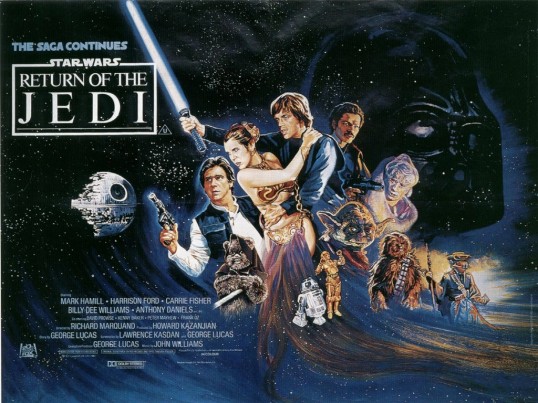
And now, it’s my turn to add my thoughts to this project. It’s time to review the 1983 film, Return of the Jedi. And I have to admit that, when I first thought about what I wanted to say in this review, I was totally intimidated. Unlike my fellow writers here at the Shattered Lens, I’m hardly an expert when it comes to Star Wars. Don’t get me wrong — I know the basics. I know that Darth Vader is Luke’s father. I know that Han Solo flies the Millennium Falcon and that Princess Leia is in love with him. I know there’s an evil Empire and I know that there are rebels. I’m not a virgin when it comes to Star Wars but, at the same time, I’m definitely not as experienced (with Star Wars) as most of my friends and fellow movie bloggers.
“Dang, Lisa, get over it!”
So, late this afternoon, when I sat down to watch Return of the Jedi, it was with more than a little trepidation. My obvious panic and welling tears convinced Jeff to watch the movie with me and I was happy for that. He loves Star Wars so I knew he could explain to me what was going on.
Finally, we watched Return of the Jedi and I discovered that I was panicking over nothing. Return of the Jedi may be the third part of trilogy and I may not be an expert on the films that came before it. But, even with all that in mind, Return of the Jedi is not a difficult film to figure out. As opposed to the finales of Harry Potter, The Hobbit, and The Hunger Games, Return of the Jedi keeps things simple. A good guy has been kidnapped by a bad guy. The other good guys come to the rescue and then go to another planet so that they can fight an even bigger bad guy. It’s not complicated.
As I watched Return of the Jedi and realized that I was having absolutely no problem following the film’s plot, I also realized that the Star Wars films are such a huge part of our culture that, regardless of how many of them we’ve actually sat through, everyone has absorbed them by osmosis. Bits and pieces of it are everywhere, showing up in everything from TV sitcoms to political commentary. (Remember how everyone used to compare Dick Cheney to Darth Vader?) The Star Wars franchise is almost biblical in that respect. At the same time, the fact that everyone knows about these movies makes them a little difficult to review. You don’t so much watch a Star Wars film as you join in a universal experience. As a reviewer, you definitely find yourself wondering what you can add to a conversation that everyone else has already had.
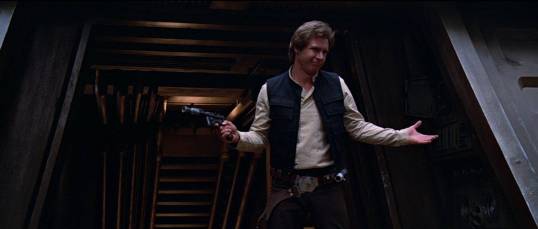
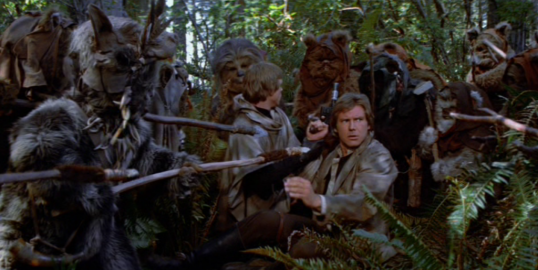
As a stand alone movie, Return of the Jedi is actually three separate films mixed together. The first film deals with Luke Skywalker (Mark Hamill) showing up at Jabba the Hutt’s palace and rescuing Han Solo (Harrison Ford), Princess Leia (Carrie Fisher), Chewbacca (Peter Mayhew), and two robots from being tossed into a creature called the Sarlacc, which is basically a giant vagina out in the middle of the desert. The second film deals with the rebels teaming up with a bunch of teddy bears and fighting the Empire on a jungle planet. And the third film features Luke and Darth Vader (body of David Prowse, voice of James Earl Jones, face of either Sebastian Shaw and Hayden Christensen, depending on which version of the film you’re watching) dealing with their family issues while the Emperor (Ian McDiarmid) cackles in the background. Some parts of the film work better than others. The end result is entertaining but definitely uneven.
Jedi‘s heart belongs to that third film, the one dealing with Luke and Darth Vader. I’ve read some pretty negative online comments about Mark Hamill’s performance in New Hope and Empire Strikes Back but, in Return of the Jedi, he brings an almost haunted intensity to the role of Luke. In theory, it’s easy to be snarky about all the talk about the “Dark Side of the Force,” but, when you look in Hamill’s eyes, you totally understand what everyone’s going on about. You see the fire and the anger but, even more importantly, you see the struggle between good and evil. There’s a very poignant sadness to the scenes where he and his father prepare to meet the Emperor.
And speaking of the Emperor, he is pure nightmare fuel! AGCK!
As for the other two films to found within Return of the Jedi, the jungles of Endor didn’t do much for me. Don’t get me wrong. I thought the action scenes were handled well and, unlike apparently everyone else in the world, I was not annoyed by the inclusion of the Ewoks, the killer teddy bears who helped to the Rebels to take down the Empire. I thought the Ewoks were cute and I actually got pretty upset when one of them was killed in battle. If I had been alive when Return of the Jedi had been released, I probably would have wanted a stuffed Ewok and, I imagine, that was the main reason they were included in the film. (I also imagine that’s the main reason why a lot of people can’t stand them.)
So, no, the Ewoks did not bother me. What did bother me was that under-construction Death Star floating out in the middle of space. It bothered me because I really couldn’t imagine any reason why — after the first Death Star was apparently such a colossal failure — the Empire would insist on trying to do the exact same thing all over again. This, along with the fact that they were rather easily defeated by a bunch of teddy bears, leads me to wonder whether the effectiveness of the Empire was just a little overrated. I mean, the Emperor was scary but otherwise, everyone involved with the Empire was pretty incompetent.
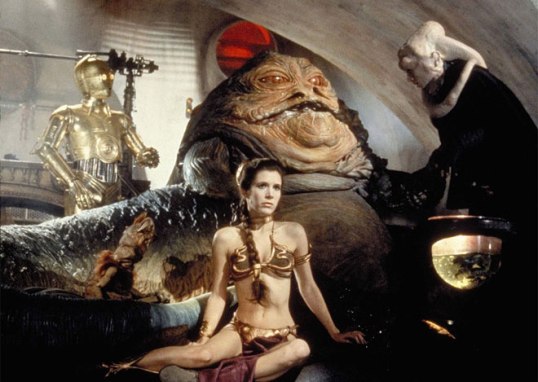
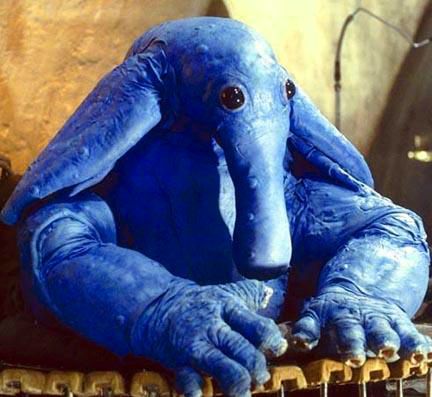
Far more impressive, as far as villains go, was Jabba the Hut. In fact, Jabba and his decadent entourage were so memorable and colorful and evil and icky that they pretty much overshadowed almost everything else in the film. I mean, Jabba even had a blue elephant playing music for him! And I know that I’m supposed to be critical of the film for putting Leia in that gold bikini but you know what? Leia may have been forced to wear a gold bikini but she never gave up her dignity or her defiance. And when it came time to take out Jabba, Leia used the tools of her oppression to do so, strangling him with his own chains. In that one scene, Leia proved herself to be a true rebel.
There’s a lot that’s good about Return of the Jedi but, as I said earlier, it’s definitely an uneven film. Richard Marquand’s direction is perhaps the epitome of workmanlike. It’s efficient and it’s dependable and there’s absolutely nothing surprising or particularly challenging about it.
It’s interesting to note that, before Richard Marquand was selected as director, the job was offered to both David Lynch and David Cronenberg, two directors who are all about surprising and challenging the audience. What would David Lynch’s Return of the Jedi been like? Well, here’s one possibility:
As for David Cronenberg’s Return of the Jedi, it might have looked something like this:
For better or worse, the world got Richard Marquand’s Return of the Jedi, which I imagine was pretty close to what George Lucas wanted the film to be.
As I sit here finishing up this review and wondering just why exactly I was so intimidated earlier (seriously, this turned out to be one the easiest reviews that I’ve ever written), I estimate that 75% of the people that I know are currently sitting in a theater and watching The Force Awakens. Keep an eye out for Arleigh’s review in the next few days!
And in closing, here’s that blue elephant that I mentioned earlier. Dance!
— Big Ape (George Eastman), asking the question that everyone’s wondering in
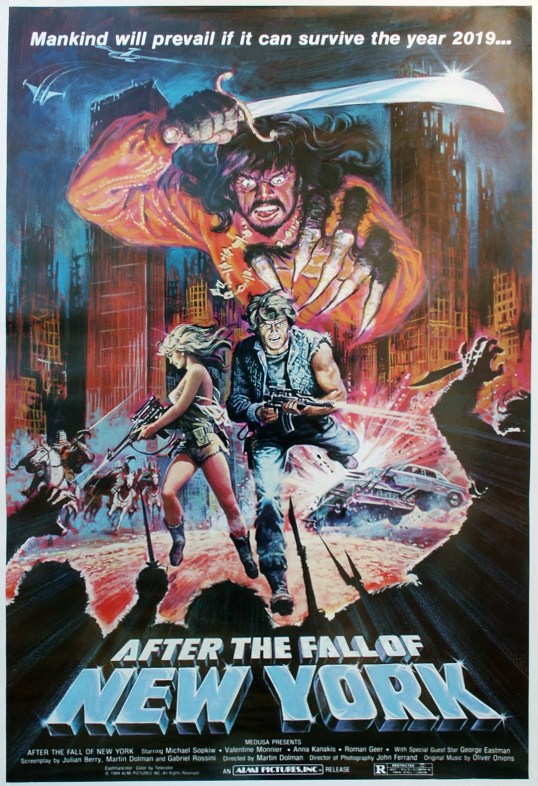
2019: After The Fall Of New York (1983)
“Giara, if love had any meaning in the world, you would be the one I love.”
— Parsifal (Michael Sopkiw) in 2019: After The Fall of New York (1983)
New York City was a frequent location for Italian exploitation films and why not? Seeing as how most of the Italian exploitation films of the 70s and 80s were specifically designed to pass for an American product (with the actors and directors often credited under Americanized pseudonyms), it would only make sense to use America’s best-known city. Interestingly enough, these films rarely portrayed New York as being a very pleasant place. There was always either a mob war or a zombie invasion or police corruption or a madman with a knife to deal with. This portrayal of New York as Hell-on-Earth reached its logical conclusion with Lucio Fulci’s The New York Ripperbut even films less extreme than Fulci’s still presented New York as representing every negative thing that has ever been thought about Americans.
After the international success of the first two Mad Max films and John Carpenter’s Escape From New York, there was a handful of Italian films that were meant to portray what life would be like in New York after a nuclear apocalypse. (In most cases, life would not be pleasant.) Of the films that made up this odd, yet undeniably energetic genre, 1983’s 2019: After The Fall of New York is one of the best.
Every post-apocalyptic film opened with the task of explaining who went to war with who. In this case, the war was started 19 years earlier by the European-Asian Alliance. After reducing America to atomic rubble, the Euracs (as they’re called) set up their headquarters in New York. When 2019: After the Fall of New York opens, the few radiation-scarred survivors have been reduced to living in the sewers and eating rats. The Eurac army rides through the streets atop white horses, capturing survivors and subjecting them to terrible medical experiments. Consider this: 2019: After The Fall of New York was an Italian-made film about evil Europeans (including, presumably, soldiers recruited from Italy) invading America. If you ever had any doubt about how determined the Italian film industry was to appeal to American audiences, 2019: After The Fall of New York should erase them.
Despite losing the war, there is still an American government. The President of the Pan-American Confederacy (played by Edmund Purdom, who regularly showed in strange movies like this one and Don’t Open Til Christmas) is determined to savage what he can of American society before relocating to either Alaska or the moon. Just in case you had any doubt that this movie was made a long time ago, the supporters of the Pan-American Confederacy are called the Confederates. And they’re the heroes of the film…
It turns out that there is only one fertile woman left on Earth. And the Confederate President is determined to take her to the moon to harvest her eggs and use in vitro fertilization to restart the human race. However, she is currently in a state of hibernation in New York (which, we are told, protects her from the radiation. That doesn’t really sound quite right but we’ll just go with it). President Purdom wants her rescued before the Euracs track her down!
Meanwhile, Parsifal (Michael Sopkiw) is in Nevada, where he makes his living by winning violent car races. After his latest race, he is rewarded with a sex slave but, because he’s a good guy, he lets the slave go free. (Before leaving, the slave does tell Parsifal about the existence of cyborgs, which is information that comes in useful later on.) No sooner has Parsifal done his good dead then he’s grabbed by some Confederate soldiers and taken to see President Purdom. Purdom doesn’t quite say, “I heard you were dead,” but he might as well.
Working with the one-eyed Ratchet (Roman Geer) and a bitter former academic named Bronx (Vincent Scalondro), Parsifal enters New York and tries to find the woman while staying on step ahead of the Eurac commander (Serge Feuillard). Along the way, Parsifal gains allies like a little person named Shorty (Louis Ecclesia), a kickass warrior named Giara (Valentine Monnier), and former circus performer turned gang leader, Big Ape (George Eastman).
That’s right, George Eastman is in this movie. If you know the least bit about Italian exploitation cinema, you will not be surprised when George Eastman shows up. You also won’t be disappointed. Eastman (whose real name is Luigi Montefiori) was a regular presence in everything from Spaghetti Westerns to grisly thrillers like Anthropophagus to flamboyant gialli like Deliriumto post-apocalyptic thrillers like Raiders of Atlantis and this one. As always, Eastman is a lot of fun to watch in the role of Big Ape. Nobody played hulking menace with quite the flair of George Eastman at his best.
Along with Eastman, 2019: After the Fall of New York also some cult appeal because it starred Michael Sopkiw. The handsome Sopkiw had a short film career, starring in four Italian films and working with directors like Lamberto Bava and Sergio Martino, before retiring from acting. The briefness of his career and his backstory as a former sailor-turned-marijuana smuggler-turned-model have given Sopkiw a certain enigmatic mystique among fans of Italian exploitation. 2019: After the Fall of New York was Sopkiw’s first role and he brings a lot of enthusiasm to the role.
As directed by Sergio Martino, 2019: After The Fall of New York is full of interesting oddities that set it apart from your typical Italian post-apocalyptic thriller. For instance, a radiation-scarred man is occasionally seen wandering through the rubble, playing a trumpet and, at one point, serving as a chorus to the action. Another character, in a scene reminiscent of a Fulci film, has his eyes graphically ripped from their sockets and spends the rest of the film preparing for an eye transplant. Two of Big Ape’s followers are dressed up as gorillas and Big Apes even gets a chance to show off his skills with a scimitar. Perhaps my favorite random detail is that the Euracs do their evil plotting in front of a reproduction of Picasso’s Guernica. It’s just so wonderfully weird.
In fact, the whole movie is wonderfully weird. 2019: After The Fall of New York is Italian exploitation at its best!
Attack of the Clones is, at least in my opinion, the worst Star Wars film ever made. Hands down. That is not to say it’s not mildly entertaining, but it demands a great deal of good will from its viewer to keep him from sneering at the movie constantly, especially if said viewer is a fan.
Christ, where do I even begin.
It’s important to note that Episode II is a transition movie. If that’s not clear enough, what I mean is that it’s a movie that exists to connect both the childish, yet potentially endearing Episode I, and the much darker and edgier Episode III. Episode II is somewhere inbetween these two moods, trying to make the transition smoother, disastrously so. It’s catastrophic in many levels, but mostly because of Hayden Christensen’s Anakin Skywalker. We’ll get there soon.
Episode II starts as a movie about politics. Now, I like fictional world politics as much as the next person. I honestly do. Especially in a space opera setting. But in Star Wars the politics are dull and barely explained. Padmé Amidala’s two terms as democratically elected Queen of Naboo (wait, what?) are now over, and she continues her career as a politician by becoming a senator. The story begins by trying to make it interesting that people are trying to kill Amidala, on what appears to be politically motivated crimes. We don’t get much context, except that she opposes some other senators. Palpatine, being the super trustworthy guy everyone always knew he was, assigns the Jedi Order to protect her, and finds that Obi-Wan is a suitable bodyguard for Padmé, considering their friendship way back in Episode I. Of course, Obi-Wan must take his apprentice, Anakin Skywalker, with him. And hilarity ensues.
Now, you’re probably familiar with whom Anakin is to become, and you probably know whose father he is, so this movie must establish one very important thing; an origin to the affection between future Lord Vader and an unwitting woman, so that we can learn whose womb was it that those guys from the original trilogy came from. Therefore, in addition to being about lackluster politics, this is a movie about love.
DAMN SON.
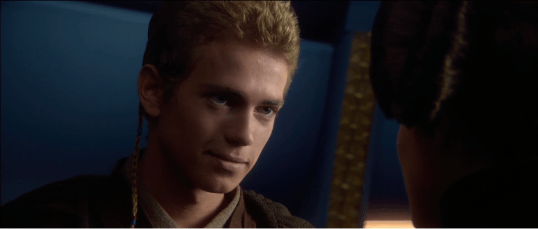
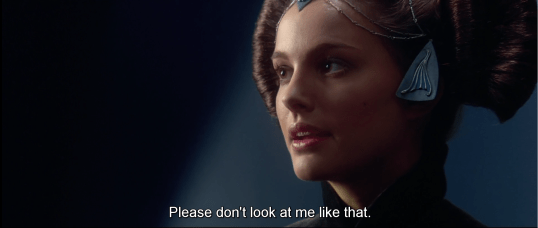
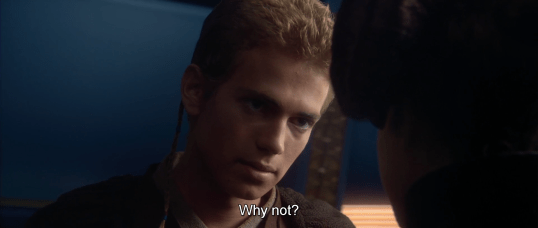
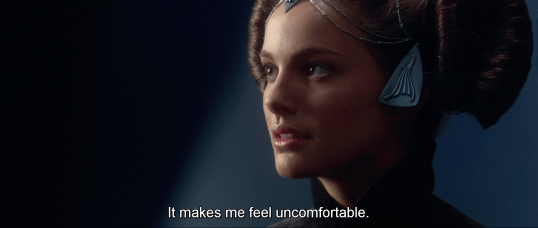
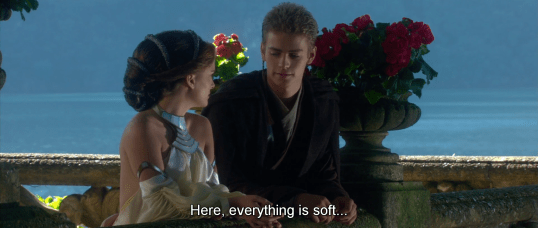
Now, I have to agree with Padmé. You can preach all you want about how you have a massive crush on Hayden Christensen’s mini braid, but that piercing sex offender gaze made me uncomfortable. Throughout the first act, Anakin goes from flirting with the poor woman to actively doing stuff very similar to sexual harassment. I mean, seriously, look at this lecherous, leering asshole.
Darth Vader has always been regarded as one of the greatest villains of cinema, but I never figured that he was also one of the sleaziest.
I wish this was the only problem with Anakin. Maybe it’s not Mr. Christensen’s acting, but the poor writing (though I suspect that, considering his absence in major movies this decade, his acting was definitely a factor). Young Skywalker is a very gifted Jedi, being immaculately conceived by midi-chlorians and all (I can’t stop laughing), and he is painfully aware of his skills, which he shows through an overpowering arrogance. Now, arrogance when done right can be charming, and perhaps that was the intention; to make Darth Vader a badass even as a teenager, a daredevil, someone who just barely succeeds, but does it with style. Anakin, however, comes across as impudent, annoying, and exceedingly stupid. It seems Anakin can’t go two scenes without doing something that would displease the Jedi council, and entirely aware of it too. ‘Cause that’s just how he rolls. James Dean from a galaxy far far away.
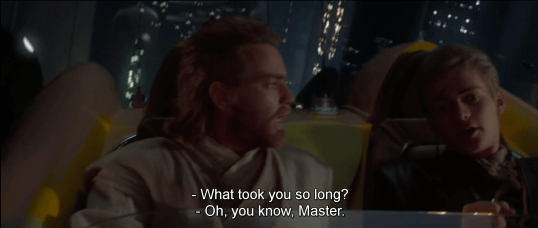
Second act comes. Anakin grows more and more adolescent and fascist. More politics happen. Then there are some cool action scenes that seem to save the film. Obi-Wan is written as barely having a personality, aside from comments that try to make it evident that he is growing older and grumpier, even though he can’t be much more than 30. Regardless, he is arguably the saving grace in the main cast, at the very least as far as really cool fights go. He pilots fighter ships, he fights with a lightsaber; the man sees some action. It’s almost depressing to see an actor of Ewan McGregor’s caliber being reduced to action hero and grumpy mentor to an angsty teenager.
Their dynamic is oddly reminiscent of Gran Torino
Jar Jar also appears. Fan favourite Jar Jar. I feel this is worth mentioning because in an extremely important scene he proposes (as stand-in senator for Amidala) to convey supreme power to Chancellor Palpatine. Yes, that Chancellor Palpatine, and I have to wonder why they couldn’t task this burden to an unnamed senator. Don’t people hate the poor gungan enough? It’s as if George Lucas is just fucking with his public to see how far they can go, at this point.
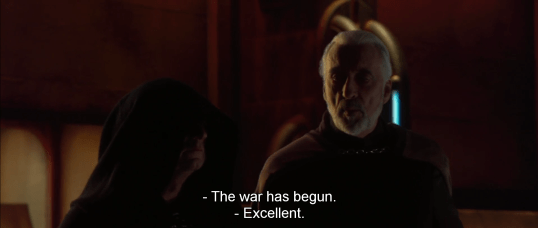
And then, in the third act, we are introduced to the big bad: Count Dooku, played by the late Sir Christopher Lee. You’d think that bringing this legend of acting might infer that this character is the highlight of the cast. Might have been. Dooku is a character full of potential. He’s obviously evil, but with just the right amount of idealism to seem more shades of grey than the cruel, pure black villains the series are accostumed to. But apparently all he does is some exposition, then pave the way for the epic arena fight scene that kind of defines this movie as a Star Wars film (perhaps one of the only things that defines this as a Star Wars film), some more exposition, a lightsaber duel (a really cool one, wrapping up the whole two things that make this a Star Wars film), and then he’s gone, apparently having started a war. The movie is over, without fully explaining why things escalated, and who exactly Count Dooku represents that the Republic is at war with.
WAR AGAINST WHOM???
I’m serious when I say this can be an entertaining movie. The fight scenes can be fun and you can laugh at what ridiculous situations the actors are subjected to. But it’s mostly incredibly dull. It’s a film that throws you into an extended torrent of politics you need to understand beforehand to appreciate, and that lead to Clone Wars, a pretty cool spin-off that most people never got to see and that might as well have been properly included as crucial to the continuity since it’s much better than this. As a standalone film, the story is a confusing, rushed mess even at two hours long. As a Star Wars film, Attack of the Clones makes it obvious that the series is not infallible. Horribly, gapingly, obviously not infallible.
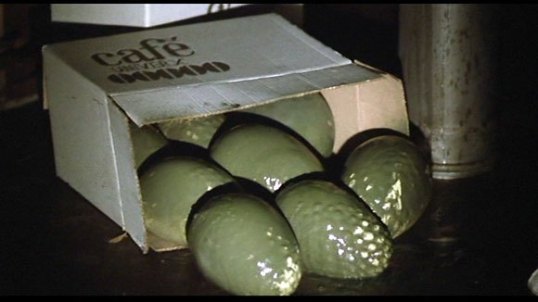
See those green things in the picture above? You’re probably looking at them and you’re thinking to yourself, “Those are the biggest avocados that I’ve ever seen!”
Well, they’re not avocados.
No, instead they are green eggs from Mars. They may look harmless but if they start glowing, pulsating, and making an eerie womping noise, you might want to get away from them. When those eggs explodes, they spray out a green goo. Any living creatures that is so much as even splashed by this goo will then explode in a mass of blood and guts. It’s messy. I would not want to clean up after anyone is sprayed with green goo.
Those eggs are at the center of this week’s daily sci-fi grindhouse, the 1980 Italian film, Contamination. How much you enjoy Contamination will largely depend on how much you like old school Italian exploitation films in general. If you’re the type who rolls your eyes at bad dubbing and who demands that a film follow some sort of narrative logic, you are not the ideal audience for this movie. However, if you’re like me and you enjoy the pure shamelessness of Italian exploitation, you’ll probably have an easier time enjoying Contamination.
It won’t come as a surprise to any student of Italian or grindhouse cinema to learn that Contamination was ripped off from several films that were popular in the late 70s. The eggs are largely lifted from Alien and, whenever the goo-sprayed bodies explode, it’s reminiscent of that ugly little thing bursting out of John Hurt’s chest. The second half of the film feels like a secondhand James Bond film, complete with a sinister conspiracy, a mysterious mastermind who earlier faked his own death, and a femme fatale. The conspiracy is headquartered on a coffee plantation in South America. It’s not difficult to imagine Baron Samedi or some other villain from Live and Let Die showing up and laughing before throwing an exploding egg at someone.
Contamination opens with a seemingly deserted ship floating into New York harbor. Fans of Italian cinema will immediately think about the opening of Lucio Fulci’s Zombi 2. Just as Zombi 2 opened with the New York City police investigating an abandoned boat and getting attacked by a zombie, Contamination features the New York City police investigating an abandoned boat and getting sprayed with green goo. The only cop who doesn’t explode, a tough New Yawker named Tony (Marino Mase), works with Col. Stella Holmes (Louise Marleau) to figure out why those eggs were on that boat.
Helping them out is an alcoholic former astronaut named Commander Ian Hubbard (Ian McCulloch). Somewhat appropriately, McCulloch was also in Zombi 2. (And let’s not forget about his role in Zomie Holocaust…) I once read an interview with McCulloch (in Jay Slater’s overview of Italian zombie cinema, Eaten Alive) in which he said that he didn’t feel he did a very good job in Contamination but I think he’s being too hard on himself. Is the very British and slightly uptight Ian McCulloch miscast as a cynical, alcoholic, American astronaut who can’t even walk to his front door without stumbling over discarded beer cans? Sure, he is. But he’s so miscast that it actually becomes rather fascinating to watch him in the role. He may be miscast but you can tell he’s really trying and he’s just so damn likable that you almost feel like it would be a disservice to him not to watch the film.
Anyway, Stella, Tony, and Hubbard have to discover out why the green eggs are on Earth and they eventually do figure out what’s going on. I’ve watched the film multiple times and I have to admit that I’m still not sure what they figured out. It’s a confusing movie and I doubt that there’s really any way that it could have ever made any sort of coherent sense but then again, that’s part of the film’s charm.
So, here’s what does work about Contamination. The exploding green eggs are both scary and wonderfully ludicrous. Ian McCulloch is a lot of fun as drunk Commander Hubbard. Goblin provides an excellent and propulsive score. And finally, there’s an alien monster who simply has to be seen to be believed. To his credit, director Luigi Cozzi realized that the monster looked cheap and he uses all sorts of creative editing and employed an arsenal of jump cuts to try to keep you from noticing. Much as with McCulloch’s performance, you can’t help but appreciate Cozzi’s effort.
As I said before, you’re enjoyment of Contamination will probably be determined by how much you enjoy Italian exploitation films in general. If you’re not familiar with the Italian grindhouse, Contamination is not the film to use for an introduction. However, if you are already a fan, you might appreciate Contamination.
Contamination is in the public domain and, as such, very easy to track down.