Film Review: Short Cuts (dir by Robert Altman)


Opening with a swarm of helicopters spaying for medflies and ending with an earthquake, 1993’s Short Cuts is a film about life in Los Angeles.

An ensemble piece, it follows several different characters as they go through their own personal dramas.  Some of them are married and some of them are destined to be forever single but they’re all living in varying states of desperation.  Occasionally, the actions of one character will effect the actions of another character in a different story but, for the most part, Short Cuts is a portrait of people who are connected only by the fact that they all live in the same city.  There are 22 principal characters in Short Cuts and each one thinks that they are the star of the story.

Jerry Kaiser (Chris Penn) cleans the pools of rich people while, at home, his wife, Lois (Jennifer Jason Leigh), takes care of their baby and works as a phone sex operator.  Jerry’s best friend is a makeup artist named Bill (Robert Downey, Jr.) who enjoys making his wife, Honey (Lili Taylor), looks like a corpse so that he can take her picture.  One of her photographs is seen by a fisherman (Buck Henry) who has already discovered one actual corpse that weekend.  He and his buddies, Vern (Huey Lewis) and Stuart (Fred Ward), discovered a dead girl floating in a river and didn’t report it until after they were finished fishing.  (The sight of Vern unknowingly pissing on the dead body is one of the strongest in director Robert Altman’s filmography.)

Stuart’s wife, Claire (Anne Archer), is haunted by Stuart’s delay in reporting the dead body.  A chance meeting Dr. Ralph Wyman (Matthew Modine) and his wife, artist Marian (Julianne Moore), leads to an awkward dinner between the two couples.  Claire works as a professional clown and Ralph ends up wearing her clown makeup while his marriage falls apart.

Earlier, Claire was stopped and hit on by a smarmy policeman named Gene Shepard (Tim Robbins), who just happens to be married to Marian’s sister, Sherri (Madeleine Stowe).  Gene is already having an affair with Betty Weathers (Frances McDormand), the wife of a helicopter pilot named Stormy (Peter Gallagher).  When Stormy discovers that Betty has been cheating, he takes a creative revenge on her house.

Doreen Pigott (Lily Tomlin) lives in a trailer park with her alcoholic husband, Earl (Tom Waits).  Driving home from her waitressing job, Doreen hits a young boy.  The boy says he’s okay but when he gets home, he passes out.  His parents, news anchorman Howard Finnegan (Bruce Davison) and his wife, Anne (Andie MacDowell), rush him to the hospital, where his doctor is Ralph Wyman.  As Howard waits for his son to wake up, he has a revealing conversation with his long-estranged father (Jack Lemmon, showing up for one scene and delivering an amazing monologue).  Meanwhile, a baker named Andy (Lyle Lovett) repeatedly calls the Finnegan household, wanting to know when they’re going to pick up their son’s birthday cake.

Based on the short stories of Raymond Carver and directed by Robert Altman, Short Cuts can sometimes feel like a spiritual descendent of Altman’s Nashville.  The difference between this film and Nashville is that Short Cuts doesn’t have the previous film’s satiric bite.  As good as Nashville is, it’s a film that can be rather snarky towards it character and the town in which it is set.  Nashville is used as a metaphor for America coming apart at the seams.  Short Cuts, on the other hand, is a far more humanistic film, featuring characters who are flawed but, with a few very notable exceptions, well-intentioned.  If Nashville seem to be a portrait of a society on the verge of collapse, Short Cuts is a film about how that society ended up surviving.

It’s not a perfect film.  There’s an entire storyline featuring Annie Ross and Lori Singer that I didn’t talk about because I just found it to be annoying to waste much time with.  (The Ross/Singer storyline was the only one not to be based on a Carver short story.)  The conclusion of Chris Penn’s storyline wasn’t quite as shocking as it was obviously meant to be.  But, flaws and all, Altman and Carver’s portrait of humanity does hold our attention and it leaves us thinking about connections made and sometimes lost.  Seen today, Short Cuts is a portrait of life before social media and iPhones and before humanity started living online.  It’s a time capsule of a world that once was.
14 Days of Paranoia #6: The Player (dir by Robert Altman)


1992’s The Player tells the story of Griffin Mill (Tim Robbins).

It’s not easy being Griffin Mill.  From the outside, of course, it looks like he has the perfect life.  He’s a studio executive with a nice house in Hollywood.  He’s young.  He’s up-and-coming.  Some people, especially Griffin, suspect that he’ll be the president of the studio some day.  By day, he sits in his office and listens to pitches from respected screenwriters like Buck Henry.  (Henry has a great idea for The Graduate II!)  During the afternoon, he might attends dailies and watch endless takes of actors like Scott Glenn and Lily Tomlin arguing with each other.  Or he might go to lunch and take a minute to say hello to Burt Reynolds.  (“Asshole,” Burt says as Griffin walks away.)  At night, he might go to a nice party in a big mansion and mingle with actors who are both young and old.  He might even run into and share some sharp words with Malcolm McDowell.

But Griffin’s life isn’t as easy as it seems.  He’s constantly worried about his position in the studio, knowing that one box office failure could end his career.  He fears that a new executive named Larry Levy (Peter Gallagher) is after his job.  Two new screenwriters (Richard E. Grant and Dean Stockwell) keep bugging him to produce their downbeat, no-stars anti-capitol punishment film.  His girlfriend (Cynthia Stevenson) wants to make good movies that mean something.  Even worse, someone is sending Griffin threatening notes.

It doesn’t take long for Griffin to decide that the notes are coming from a screenwriter named Dave Kahane (Vincent D’Onofrio).  Griffin’s attempt to arrange a meeting with Dave at a bar so that Griffin can offer him a production deal instead leads to Griffin murdering Dave in a parking lot.  While the other writers in Hollywood mourn Dave’s death, Griffin starts a relationship with Dave’s artist girlfriend (Great Scacchi) and tried to hide his guilt from two investigating detectives (Whoopi Goldberg and Lyle Lovett).  Worst of all, the notes keep coming.  The writer, whomever they may be, is now not only threatening Griffin but also seems to know what Griffin did.

After spend more than a decade in the industry wilderness, Robert Altman made a critical and commercial comeback with The Player.  It’s a satire of Hollywood but it’s also a celebration of the film industry, featuring 60 celebrities cameoing as themselves.  Everyone, it seems, wanted to appear in a movie that portrayed studio execs as being sociopathic and screenwriters as being whiny and kind of annoying.  The Player both loves and ridicules Hollywood and the often anonymous men who run the industry.  Largely motivated by greed and self-preservation, Griffin may not love movies but he certainly loves controlling what the public sees.  In the end, only one character in The Player sticks to her values and her ideals and, by the end of the movie, she’s out of a job.  At the same time, Griffin has a social life that those in the audience can’t help but envy.  He can’t step out of his office without running into someone famous.

The Player is one Altman’s most entertaining films, with the camera continually tracking from one location to another and giving as a vision of Hollywood that feels very much alive.  Tim Robbins gives one of his best performances as Griffin Mill and Altman surrounds him with a great supporting cast.  I especially liked Fred Ward as the studio’s head of security.  With The Player, Altman mixes melodrama with a sharp and sometimes bizarre comedy, with dialogue so snappy that the film is as much a joy to listen to as to watch.  That said, the real attraction of the film is spotting all of the celebrity cameos.  (That and cheering when Bruce Willis saves Julia Roberts from certain death.)  Altman was a director who often used his films to explore eccentric communities.  With The Player, he opened up his own home.

Previous entries in 2025’s 14 Days Of Paranoia:

  1. The Fourth Wall (1969)
  2. Extreme Justice (1993)
  3. The Lincoln Conspiracy (1977)
  4. Conspiracy (2007)
  5. Bloodknot (1995)

Film Review: The Caine Mutiny Court-Martial (dir by Robert Altman)


In the 1980s, director Robert Altman found himself even more outside of the Hollywood system than usual.  A series of films that confused critics and repelled audiences had led to Altman becoming something of a pariah.  As no studio was willing to give Altman a chance to make the type of quirky feature films that he made his name with in the 70s, Altman instead directed a series of low-budget theatrical adaptations.  These films may not have gotten the attention of his earlier films but they allowed Altman to show off his talents, especially when it came to working with actors.

1988’s The Caine Mutiny Court-Martial was one of those films.  Made for television and based on the play by Herman Wouk, The Caine Mutiny Court-Martial was a courtroom drama that Altman brought to life with his usual flair.  Anyone who has read either the play or Herman Wouk’s original novel (or who has seen the 1953 film version, The Caine Mutiny) will know the story.  In the final days of World War II, Lt. Steven Maryk (Jeff Daniels) has been court-martialed for mutiny.  During a particularly violent storm, Maryk took command of the USS Caine away from Lt. Commander Queeg (Brad Davis).  Maryk and his fellow officers, including aspiring novelist Lt. Thomas Keefer (Kevin J. O’Connor), claim that, after several incidents that indicated he was mentally unstable, Queeg froze up on the bridge and had to be relieved of command.  Queeg claims that everything he did was to enforce discipline on the ship and that he never froze.  Prosecuting Maryk is Lt. Commander John Challee (Peter Gallagher).  Defending him is Lt. Barney Greenwald (Eric Bogosian), who is determined to win the case even though he doesn’t necessarily agree with Maryk’s actions.

The Caine Mutiny Court-Martial is very much a filmed play.  Almost all of the action takes place in one location, a gymnasium that has been converted into a court of military law.  We don’t actually see what happened on the Caine when Maryk took control.  Instead, we just hear the testimony of those involved.  Queeg defends himself, ably at first but soon he starts to show signs of the pressure of being in command.  Maryk explains his actions and we want to believe him because he’s played by fresh-faced Jeff Daniels but, at the same time, there’s something a little bit too smug about his declaration that Queeg was not fit for command.  The other officers on the Caine testify.  Under Greenwald’s skillful cross-examination, Queeg is continually portrayed as being a flawed officer.  But only Greenwald understand that Queeg was isolated not only by the loneliness of being in charge but also by members so his own crew, like Keefer, who hated the Navy and didn’t want to take their part in the war effort seriously.  As a Jew who is very much aware of what’s at stake in the war, Greenwald has mixed feelings about the way that Queeg was treated.  It ends with a party, where a drunk Greenwald calls out the true architect of The Caine Mutiny.  As opposed to the way the scene was portrayed in the 1953 film or in Willam Friedkin’s recent adaptation), Altman focuses not so much on Greenwald but on the party occurring around him.  If the other versions of this story ended on a note of triumph for Greenwald, this one ends on a note of sadness with Greenwald’s words being almost unheard by the officers of the Caine.

Altman gets excellent performances from the entire cast and, even more importantly, he avoids the downfall of so many other theatrical adaptations.  The Caine Mutiny Court-Martial may be a talky film and it may largely take place in only one location but it’s never boring.  Altman’s camera is continually prowling around the makeshift courtroom, reflecting the tension of the case in every movement.  The end result is one of Altman’s best theatrical adaptations.

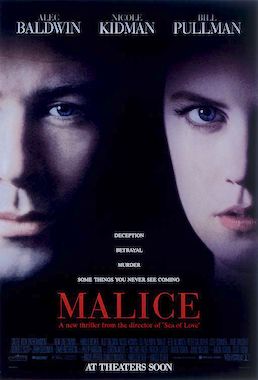
Insomnia File #48: Malice (dir by Harold Becker)


What’s an Insomnia File? You know how some times you just can’t get any sleep and, at about three in the morning, you’ll find yourself watching whatever you can find on cable or Netflix? This feature is all about those insomnia-inspired discoveries!

If you were having trouble getting to sleep last night around 12 midnight, you could have turned over to the Cinemax and watched the 1993 thriller, Malice.  And then you could have spent the next few hours trying to figure out what you just watched.

Seriously, there’s a lot going on in Malice.  The screenplay is credited to Aaron Sorkin and Scott Frank and while it has enough overly arch dialogue and untrustworthy women to plainly identify it as being a product of Sorkin’s imagination, it’s also filled with a mini-series worth of incidents and subplots and random characters.  This is also one of those films where no one can simply answer a question with a “yes” or a “no.”  Instead, it’s one of those movies where everyone gets a monologue, giving the proceedings a rather theatrical feel.  It’s the type of thing that David Mamet could have pulled off.  (Check out The Spanish Prisoner for proof.)  Harold Becker, however, was a far more conventionally-minded director and he often seems to be at a loss with what to do with all of the film’s Sorkinisms (and, to be fair, Frankisms as well).

The film starts out as a thriller, with a serial rapist stalking a college campus and Prof. Andy Safian (Bill Pullman) becoming an unlikely suspect.  Then it turns into a domestic drama as Andy and his wife, Tracy (Nicole Kidman), talk about starting a family.  Then Andy meets a brilliant surgeon named Jed Hill (Alec Baldwin) and the film turns into a roommate from Hell story after Jed moves in with them.  Then it becomes a medical drama after a mistake by Dr. Hill leaves Tracy unable to have children.  Then it returns briefly to the campus rapist story before then turning into a modern-day noir as Andy discovers that Tracy has secrets of her own.  (Whenever one watches a film written by Aaron Sorkin, you can practically hear him whispering, “Women are not to be trusted….” in the background.)  Even as you try to keep up with the plot, you find yourself distracted by all of the cameos.   George C. Scott glowers as Jed’s mentor.  Anne Bancroft acts the Hell out of her role as a drunken con artist.  Peter Gallagher is the lawyer you distrust because he’s Peter Gallagher.  Tobin Bell shows up as a handyman.  Gwynneth Paltrow, in one of her first roles, plays dead convincingly

It’s a big and busy and messy film and it too often mistakes being complicated for being clever.  Bill Pullman is a likable hero but you have to be willing to overlook that the script requires him to do some truly stupid things.  Nicole Kidman is always well-cast as a femme fatale but again, the script often lets her down.

Surprisingly enough, it’s Alec Baldwin who comes out of the film unscathed.  Watching Baldwin in this film, it’s hard to believe that he’s the same actor who has since become something of a bloated self-parody.  Yes, he’s playing an arrogant character (which is pretty much his trademark) but, in Malice, he actually brings a hint of subtlety and wit to his performance.  Baldwin does very little bellowing in the film, despite playing a role that one would think would naturally appeal to all of his bellowing instincts.  Malice is a mess but it’s nice to see the type of actor that Alec Baldwin once was.

Previous Insomnia Files:

  1. Story of Mankind
  2. Stag
  3. Love Is A Gun
  4. Nina Takes A Lover
  5. Black Ice
  6. Frogs For Snakes
  7. Fair Game
  8. From The Hip
  9. Born Killers
  10. Eye For An Eye
  11. Summer Catch
  12. Beyond the Law
  13. Spring Broke
  14. Promise
  15. George Wallace
  16. Kill The Messenger
  17. The Suburbans
  18. Only The Strong
  19. Great Expectations
  20. Casual Sex?
  21. Truth
  22. Insomina
  23. Death Do Us Part
  24. A Star is Born
  25. The Winning Season
  26. Rabbit Run
  27. Remember My Name
  28. The Arrangement
  29. Day of the Animals
  30. Still of The Night
  31. Arsenal
  32. Smooth Talk
  33. The Comedian
  34. The Minus Man
  35. Donnie Brasco
  36. Punchline
  37. Evita
  38. Six: The Mark Unleashed
  39. Disclosure
  40. The Spanish Prisoner
  41. Elektra
  42. Revenge
  43. Legend
  44. Cat Run
  45. The Pyramid
  46. Enter the Ninja
  47. Downhill

White Mile (1994, Directed by Robert Butler)


In this HBO movie, Alan Alda plays the biggest asshole in the world.

Alda is cast as Dan Cutler, an ad exec who books a corporate retreat to Canada’s White Mile.  He tells the nine men who accompany him, some of whom are clients and some of whom work for him, that it’s going to be a weekend of fishing and male bonding.  What he doesn’t reveal is that the trip is also going to require whitewater rafting.  Despite the fact that the majority of the men are out-of-shape and hardly any of them have any rafting experience, Dan insists that they all take part.  When their guide says that they’re going to need to take two boats, Dan refuses.  He wants everyone in one boat, the better so they can all work together to prove their manhood by conquering the river.

The trip starts out well but, when the raft hits a rock and turns over, five of the men end up dead.  Despite injuring his leg, Dan survives and, when he returns to work, he’s hailed as a hero.  However, one of the widows of the men who didn’t survive is now suing the company.  While Dan tries to cover his own ass, one of the survivors — Jack Robbins (Peter Gallagher) — is faced with a dilemma of his own.  As one of the few people who knows that Dan demanded that the guide only use one boat, will Jack testify to the truth at the trial or will he follow Dan’s orders and keep quiet about what really happened?

Based on a true story, White Mile features some brief but exciting (and harrowing) rafting scenes but the film is less about what happened in the wilderness and instead about what’s happening behind the closed doors of corporate America.  White Mile does a good job of taking Alda’s sensitive male persona and pushing it through the looking glass.  As played by Alda, Dan is the type of tyrannical boss who we’ve all had to deal with.  His friendly smile barely disguises a bullying streak.  Even after the accident leaves five of his colleagues dead, Dan is still convinced that the trip was a good idea and that everyone was having the best day of their lives until they hit that rock.  When the river guide initially finds Dan stranded on a rock, Dan makes a show of telling the guide to come back for him later and to find the others.  When Dan later comes across one of the dead men, he says, “He must have had a bad heart,” as he grasps at any way to avoid taking responsibility.  Though White Mile is dominated by Alda’s villainy, it also features good performances from Gallagher, Robert Loggia, Bruce Altman, and Jack Gilipin.  When Gilpin demands to know if anyone at the ad agency has shown any true remorse for what happened, he is speaking for the entire audience.

White Mile was an early HBO film and, because it was released before HBO became known for its original programming, it’s often unfairly overlooked.  When it was released on DVD, it was advertised as being an action-adventure film, which it definitely is not.  Instead, it’s a look at the type of head games that far too often act as a substitute for responsible and ethical management in corporate America.  It’s a good movie and you’ll never look at Alan Alda the same way again.

Film Review: After (dir by Jenny Gage)


After, which was released back in April, tells the story of the world’s most boring college romance.

Tessa (Josephine Langford) is a beautiful, intelligent, but shy good girl who has just started college and who is struggling to fit in with her fellow students.  Her new roommate has tattoos and a nose ring and Tessa’s just not sure if she can keep up with a group of campus rebels who drink, vape, and play extremely anodyne games of truth or dare.  Tessa’s roommate demands to know why Tessa has so many old books.  It’s because Tessa loves to read but we soon discover that her literary tastes seem to be dominated by her old high school reading list.  In her lit class, she says that Pride and Prejudice is a “revolutionary feminist novel,” in a tone of voice that indicates that she googled “revolutionary feminism” for the first time the previous night.

Hardin (Hero Fiennes-Tiffin) is a bad boy because he has tattoos and he tends to smirk before leaving a room.  Hardin seems like he’s …. well, I guess he’s supposed to be dangerous.  He’s cynical and he says there’s no such thing as love but actually, he just needs someone to help tend to his emotional wounds.  We know that he’s not really a bad dude because he likes Jane Austen and he has a copy of Wuthering Heights in his room, one that’s full of book marks, indicating that he is an actual serious student of literature.  He also says that The Great Gatsby was all a dream.  (Seriously, you know he’s serious about literature when he owns copies of both Wuthering Heights and The Great Gatsby.  I imagine if the movie had lasted a few minutes longer, he would have said, “Hemingway was the poor man’s Hemingway,” and everyone’s mind would have been totally blown.)

Anyway, from the minute that a towel-clad Tessa returns to her dorm room from taking a shower and discovers Hardin sitting in the corner (and reading, of course!), it’s pretty obvious that they’re destined to fall in love.  (Of course, considering that Hardin refused to leave the room so Tessa could get dressed, it was perhaps just as likely that she would end up filing a harassment complaint.)  Of course, the path to true love never runs smoothly.  Tessa has a sweet boyfriend that she’ll need to dump.  Hardin has all sorts of emotional baggage that he needs someone to unpack for him.  Still, while Hardin and Tessa are swimming in the nearby lake, Hardin says, “We could never be just friends….”

If this all sounds like bad fanfic, that’s because it is.  After is based on a novel by Anna Todd.  The novel started out as fan fiction and Hardin was originally named Harry Styles.  Anyway, the novel sold a lot of copies and developed a reputation for being an innocent version of Fifty Shades of Grey so I guess it’s inevitable that it would later be adapted into an amazingly bad movie.  I mean, the sex was the only good thing about Fifty Shades so I’m not sure why someone would say, “Let’s make a chaste version of this book!”

The main problem with After is that both Tessa and Hardin are such inherently boring characters and all the soft-focus shots in the world can’t make them interesting.  It doesn’t matter how much time they spend interlocking their fingers, they never seem like people who you’d want to get stuck in a conversation with.  Tessa may claim to be into “revolutionary feminism” but she only exists to find a man.  She’s defined by how she feels about Hardin and Hardin seems to be the only thing she’s interested in.  Meanwhile, Hardin is the worst type of phony intellectual, the self-centered rich boy who has a convenient tragedy for every occasion.  Josephine Langford and Hero Fiennes-Tiffin are both attractive in a “I just shot a pilot for the CW” sort of way but neither has much screen presence and, together, they generate so little chemistry that they might as well be two wax figures staring into each other’s glass eyes.

“I’m a mess,” Hardin says and Tessa agrees, “I think we’re both a mess,” and everyone who is a real mess replies, ‘Oh, fuck off, you two.”

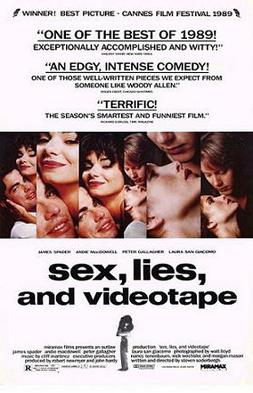
Sundance Film Review: sex, lies, and videotape (dir by Steven Soderbergh)


The Sundance Film Festival is currently taking place in Utah so, for this week, I’m reviewing films that either premiered, won awards at, or otherwise made a splash at Sundance!  Today, I take a look at 1989’s sex, lies, and videotape, which won both the Audience Award at the 1989 Sundance Film Festival and the Palme d’Or at Cannes!

The directorial debut of Steven Soderbergh, sex, lies, and videotape is considered by many to be one of the most important independent American films ever made.  Not only was it a  success at the box office and nominated for an Oscar but it also won the Palme d’Or at Cannes.  According to Peter Biskind’s Down and Dirty Pictures, the success of sex, lies, and videotape is what convinced Hollywood that independent films could be big business.  The marketing of the film would set the template for almost every independent release that followed.

(One person who was definitely not a fan of sex, lies, and videotape was director Spike Lee.  When Lee’s Do The Right Thing lost the Palme to Soderbergh’s film, Lee was informed that the Canne jury felt Lee’s film wasn’t “socially responsible.”  “What’s so socially responsible about a pervert filming women!?” Lee reportedly responded.)

sex, lies, and videotape tells the story of four people in Baton Rouge, Louisiana.

Ann (Andie MacDowell) has a nice house, a successful husband, and an absolutely miserable marriage.  When the film opens, she’s having a session with her therapist (Ron Vawter) and talking about how unfulfilled she feels.  When the therapist asks her questions about her sex life, Ann laughs nervously.  She says that she likes sex but she doesn’t like to think about it.  She says she doesn’t see what the big deal is.  Later, she reveals that she’s never had an orgasm.

John (Peter Gallagher) is Ann’s husband.  He’s a lawyer.  He’s also a materialistic jerk and … well, that’s pretty much the sum total of John’s entire personality.

Cynthia (Laura San Giacomo) is John’s mistress.  She’s a bartender at a rather sleazy little establishment, where she apparently spends all of her time listening to a local drunk (Steven Brill) do a Marlon Brando impersonation.  She is uninhibited and fiercely sexual.  She’s the opposite of Ann, which is why John likes her.  Of course, she’s also Ann’s sister.  Cynthia and Ann have a strained relationship.  Ann describes Cynthia as being “loud.”  Cynthia views Anne as being judgmental.  Secretly, both wish that they could be more like the other.

And then there’s Graham (James Spader).  Graham was John’s friend in college, though it’s difficult to understand why.  Graham has recently returned to Baton Rouge and John, without talking to Ann, has invited Graham to visit them.  Graham is apparently a drifter.  (Ann describes him as being “arty.”)  While Ann is helping him find an apartment, Graham informs her that he’s impotent.  He can’t get an erection if anyone else in the room.

Ann subsequently discovers that Graham deals with his impotence by videotaping women discussing their sex lives.  The video camera allows Graham to keep his distance and not get emotionally involved.  (Of course, it also serves as a metaphor for directing a movie.)  Ann is freaked out by all of Graham’s tapes.  Cynthia is intrigued.  And John … well, John’s just a jerk.

sex, lies, and videotape is a film that’s largely saved by its cast.  Graham is a role that literally only James Spader could make intriguing.  Meanwhile, Peter Gallagher actually manages to bring some charm to John, who is the least developed character and who gets all of the script’s worst lines.  That said, the film really belongs to MacDowell and San Giacomo, who are totally believable as sisters and who, again, bring some needed depth to characters that, as written, could have been reduced to being mere clichés.  (In the scenes between MacDowell and San Giacomo, it was less about what they said than how they said it.)

As I already stated, this was Steven Soderbergh’s feature debut.  Soderbergh was 26 years old when he made this.  Seen today, it’s an uneven but ultimately intriguing film.  There are a few scenes where Soderbergh’s inexperience as a filmmaker comes through.  For instance, John is written as being such a complete heel (and, in his final scene, he wears a ludicrous bow tie that practically screams, “EVIL,”) that it occasionally throws the film off-balance.  You never believe that Graham would have been his friend, nor do you believe that Ann would have spent years putting up with his crap.  The film’s final scene between Cynthia and Ann also feels a bit rushed and perfunctory.  That said, this film shows that, from the start, Soderbergh was good with actors.  Visually, Soderbergh takes a low-key approach and allows the cast to be the center of attention.  It’s an actor’s film and Soderbergh wisely gets out of their way.  In particular, Spader and San Giacomo have a way of making the most heavy-handed dialogue sound totally and completely natural.

It’s hard to imagine Soderbergh directing something like sex, lies, and videotape today.  If the film were made today, Soderbergh wouldn’t be able to resist the temptation to use overexposed film stock and to give cameos to George Clooney as Ann’s therapist and Matt Damon as the drunk.  sex, lies, and videotape is a film that Soderbergh could only have made when he was young and still struggling to make his voice heard.  It’s a flawed by intriguing film.  If just for its historical significance, it’s a film that every lover of independent cinema should see at least once.

Previous Sundance Film Reviews:

  1. Blood Simple
  2. I Don’t Feel At Home In This World Anymore
  3. Circle of Power
  4. Old Enough
  5. Blue Caprice
  6. The Big Sick
  7. Alpha Dog
  8. Stranger Than Paradise

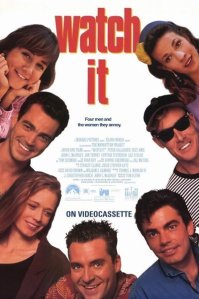
A Movie A Day #298: Watch It (1993, directed by Tom Flynn)


In Chicago, three men all live in the same house and try to avoid growing up.  Rick (John C. McGinley) and Mike (Jon C. Tenney) are old friends while Danny (Tom Sizemore) works on stolen cars.  When Mike’s estranged cousin, John (Peter Gallagher), moves in with them, John is drawn into a steadily escalating game of pranks.  The game is called “Watch It” and the rules are simple.  No one can take anything personally and each prank must be followed by another, bigger prank.  While the four men takes turns trying to one up each other, they also deal with women who wish that they would all just grow up.  When John starts to date Mike’s ex-girlfriend, Anne (Suzy Amis), the men are forced to come to terms with their extended adolescence.
Watch It is an awkward combination of two stories.  One half of the film deals with the pranks, which get so outlandish that it is impossible to believe that a group of blue collar roommates in Chicago could pull them off.  One of John’s pranks involves imitating a police detective on a local news broadcast and saying that Danny has had a warrant issues for his arrest.  Even if John could pull that off, it seems like he would get in so much trouble that it would not be worth the effort.  (Never mind that the city of Chicago now thinks that Danny is wanted by the police.)  At the same time, Watch It also wants to be a fairly realistic relationship dramedy, with Suzy Amis and Cynthia Stevenson trying to get Gallgher and McGinley to grow up.  Despite some very good performances, Watch It is too uneven to work.  The best thing about Watch It is that it offers a chance to see actors like McGinley, Tenney, Sizemore, and Gallagher all playing quasi-normal, relatable people for once.

Cleaning Out The DVR, Again #38: Center Stage: On Pointe (dir by Director X)


(Lisa is currently in the process of trying to clean out her DVR by watching and reviewing all 40 of the movies that she recorded from the start of March to the end of June.  She’s trying to get it all done by the end of July 11th!  Will she make it!?  Keep visiting the site to find out!)

CSOP

The 38th film on my DVR was Center Stage: On Pointe, which premiered on Lifetime on June 25th.

Center Stage: On Pointe is the third film in the Center Stage series.  The first film, which was released in 2000, is one of those films that, at the time, you pretty much had to see if you were into ballet.  The second film, Center Stage: Turn It Up, aired on the Oxygen Network in 2008 and laid much of the groundwork for what happens in On Pointe.

At the start of On Pointe, Jonathan Reeves (Peter Gallagher), the head of the American Ballet Academy, has a problem.  The Academy is still doing great work but it’s not bringing in much money.  Unfortunately, the ABA has developed a reputation for being stodgy.  It needs to be shaken up.  It needs new dancers who are going to challenge the teachers even as the teachers challenge them.  Over the objections of just about everyone else at the ABA, Reeves decides that it’s time to bring modern dancers into the Academy.

Reeves and his choreographers (including Kenny Wormald’s Tommy Anderson, the male lead from Turn It Up) set out to recruit dancers to compete at a camp where the winners will be invited to join the Academy.  Among those dancers: Bella Parker (Nicole Munoz).  Bella is the younger sister of Kate Parker (Rachele Brooke Smith), whose story was previously told in Turn It Up.  Seeking to escape from her famous sister’s shadow, Bella auditions under a false name.  However, everyone immediately knows who she is.  It’s not easy being Kate Parker’s sister.

The camp turns out to be absolutely beautiful (even if it did remind me a bit of Camp Crystal Lake from Friday the 13th) but the dance world is a competitive and often unforgiving one.  Not only is there tension between the ballet students and the modern dancers (and that tension is one of the most realistic aspects of the film) but one of the instructors appears to be obsessed with trying to destroy Bella.  Will Bella and her fellow dancers survive the grueling camp?  Will Bella ever escape her sister’s shadow?  And will the ABA manage to change with the times?

You already know the answers.  There’s not a surprising moment to be found in Center Stage: On Pointe but the film is well-shot, the music is great, and the dancing is amazing.  Yes, some of the performances could be better but when you’ve got dancers who can move as well as the ones in this cast, it really doesn’t matter whether or not they’re the greatest actors in the world.  This is a dance movie, after all.  The dance scenes are amazing and that’s what is important.

(By the way, fans of Dance Moms may be interested to know that Chloe Lukasiak has a small role in Center Stage: On Pointe.  And, though she may no longer be a member of ALDC, she’s still a great dancer.)

So You Want To Be A Rock’n’Roll Star: The Idolmaker, Breaking Glass, That’ll Be The Day, Stardust


So, you want to be a rock and roll star?  Then listen now to what I say: just get an electric guitar and take some time and learn how to play.  And when your hair’s combed right and your pants fit tight, it’s gonna be all right.

If you need any more help, try watching these four films:

Idolmaker

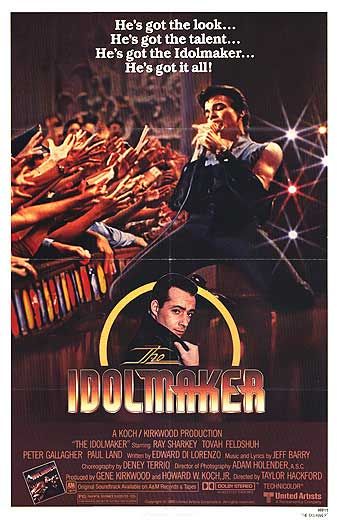
The Idolmaker (1980, directed by Taylor Hackford)

The Idolmaker is a movie that asks the question, “What does it take to be a star?  Who is more interesting, the Svengalis or the Trilbys?”  The year is 1959 and Vinny Vacari (Ray Sharkey, who won a Golden Globe for his performance but don’t let that dissuade you from seeing the movie) is a local kid from New Jersey who dreams of being a star.  He has got the talent.  He has got the ambition and he has got the media savvy.  He also has a receding hairline and a face like a porcupine.

Realizing that someone who looks like him is never going to make hundreds of teenage girls all scream at once, Vinny instead becomes a starmaker.  With the help of his girlfriend, teen mag editor Brenda (Tovah Feldshuh) and a little payola, he turns saxophone player Tomaso DeLorussa into teen idol Tommy Dee.  When Tommy Dee becomes a star and leaves his mentor, Vinny takes a shy waiter named Guido (Peter Gallagher) and turns him into a Neil Diamond-style crooner named Cesare.  Destined to always be  abandoned by the stars that he creates, Vinny continually ends up back in the same Jersey dive, performing his own songs with piano accompaniment.

The Idolmaker is a nostalgic look at rock and roll in the years between Elvis’s induction into the Army and the British invasion.  The Idolmaker has some slow spots but Ray Sharkey is great in the role of Vinny and the film’s look at what goes on behind the scenes of stardom is always interesting.  In the movie’s best scene, Tommy performs in front of an audience of screaming teenagers while Vinny mimics his exact moments backstage.

Vinny was based on real-life rock promoter and manager, Bob Marcucci.  Marcucci was responsible for launching the careers of both Frankie Avalon and Fabian Forte.  Marcucci served as an executive producer on The Idolmaker, which probably explains why this is the rare rock film in which the manager is more sympathetic than the musicians.

breakglass_lrg

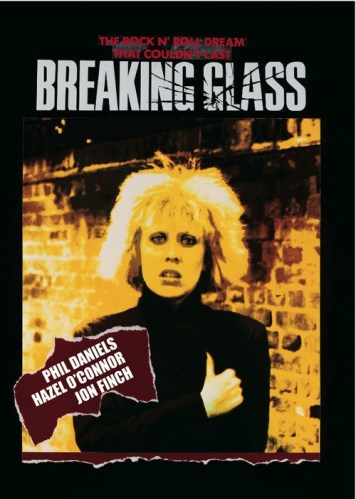
Breaking Glass (1980, directed by Brian Gibson)

At the same time that The Idolmaker was providing American audiences with a look at life behind-the-scenes of music stardom, Breaking Glass was doing the same thing for British audiences.

In Breaking Glass, the idolmaker is Danny (Phil Daniels, who also starred in Quadrophenia) and his star is an angry New Wave singer named Kate (Hazel O’Connor).  Danny first spots Kate while she is putting up flyers promoting herself and her band and talks her into allowing him to mange her.  At first, Kate refuses to compromise either her beliefs or her lyrics but that is before she starts to get famous.  The bigger a star she becomes, the more distant she becomes from Danny and her old life and the less control she has over what her music says.  While her new fans scare her by all trying to dress and look like her, Kate’s old fans accuse her of selling out.

http://www.youtube.com/watch?v=8ALdL8oV_sY

As a performer, Hazel O’Connor can be an acquired taste and how you feel about Breaking Glass will depend on how much tolerance you have for her and her music.  (She wrote and composed all of the songs here.)  Breaking Glass does provide an interesting look at post-punk London and Jonathan Pryce gives a good performance as a sax player with a heroin addiction.

thatll-be-the-day-poster

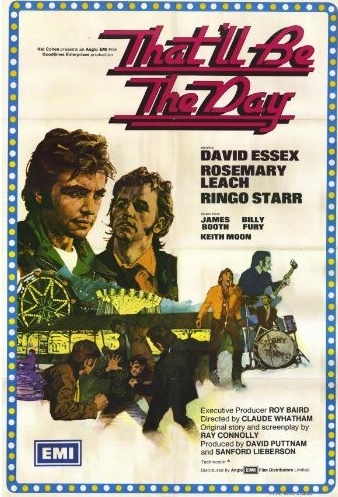
That’ll Be The Day (1973, directed by Claude Whatham)

Real-life teen idol David Essex plays Jim MacClaine, a teenager in 1958 who blows off his university exams and runs away to the Isle of Wright.  He goes from renting deckchairs at a resort to being a barman to working as a carny.  He lives in squalor, has lots of sex, and constantly listens to rock and roll.  Eventually, when he has no other choice, he does return home and works in his mother’s shop.  He gets married and has a son but still finds himself tempted to abandon his family (just as his father previously abandoned him) and pursue his dreams of stardom.

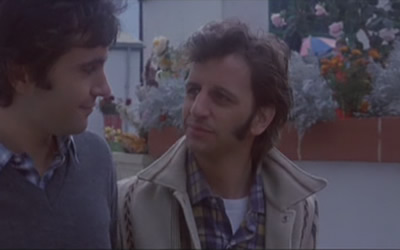
David Essex and Ringo Starr

Based loosely on the early life of John Lennon, the tough and gritty That’ll Be The Day is more of a British kitchen sink character study than a traditional rock and roll film but rock fans will still find the film interesting because of its great soundtrack of late 50s rock and roll and a cast that is full of musical luminaries who actually lived through and survived the era.  Billy Fury and the Who’s Keith Moon both appear in small roles.  Mike, Jim’s mentor and best friend, is played by Ringo Starr who, of all the Beatles, was always the best actor.

That’ll Be The Day ends on a downbeat note but it does leave the story open for a sequel.

stardust-1

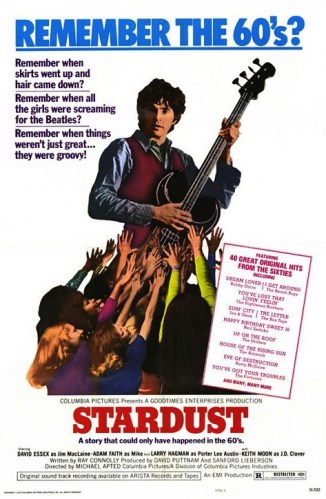
Stardust (1974, directed by Michael Apted)

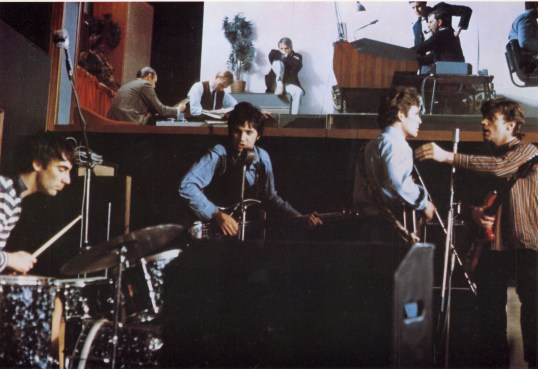
Stardust continues the story of Jim MacClaine.  Jim hires his old friend Mike (Adam Faith, replacing Ringo Starr) to manage a band that he is in, The Straycats (which includes Keith Moon, playing a far more prominent role here than in That’ll Be the Day).  With the help of Mike’s business savvy, The Stray Cats find early success and are signed to a record deal by eccentric Texas millionaire, Porter Lee Austin (Larry Hagman, playing an early version of J.R. Ewing).

When he becomes the breakout star of the group, Jim starts to overindulge in drugs, groupies, and everything that goes with being a superstar.  Having alienated both Mike and the rest of the group, Jim ends up as a recluse living in a Spanish castle.  Even worse, he gives into his own ego and writes a rock opera, Dea Sancta, which is reminiscent of the absolute worst of progressive rock.  Watching Jim perform Dea Sancta, you understand why, just a few years later, Johnny Rotten would be wearing a homemade “Pink Floyd Sucks” t-shirt.

Stardust works best as a sad-eyed look back at the lost promise of the 1960s and its music.  Watch the movie and then ask yourself, “So, do you really want to be a rock and roll star?”

21494_2