Welcome to Retro Television Reviews, a feature where we review some of our favorite and least favorite shows of the past! On Mondays, I will be reviewing Miami Vice, which ran on NBC from 1984 to 1989. The entire show can be purchased on Prime!
This week, Gina’s in trouble again!
Episode 4.19 “Blood & Roses”
(Dir by George Mendeluk, originally aired on April 1st, 1988)
Frank Mosca (Stanley Tucci) is back!
In case you’ve forgotten, Mosca was the villain from the fourth season premiere, Contempt of Court. That episode ended with Mosca getting away with everything. This episode finds him killing a rival drug lord (Michael Wincott) and trying to kill Crockett. Because Mosca knows who Crockett and Tubbs are, it falls on Gina to go undercover. This becomes yet another episode where Gina starts to fall for the bad guy and ends up having sex with the target of a Vice investigation. As often happens with these type of episodes, Gina ends up shooting Mosca to keep him from shooting Sonny. Mosca’s body plummets down an air shaft and it’s hard not to notice that Stanley Tucci has suddenly become a mannequin with painted hair.
Stanley Tucci gave a magnetic performance as the charismatic but evil Frank Mosca. Watching Tucci, it’s easy to see why the show brought him but Mosca was such a memorable character that it’s shame that he was given a standard Miami Vice death scene. Mosca deserved to go out with a bit more style. Saundra Santiago gave a good performance as Gina but it’s hard not to notice that every time she’s at the center of an episode, it’s pretty much the same basic plot. As a character, Gina deserved better than to constantly be used as a sex toy by every bad guy she went undercover to investigate.
Watching this episode, I found myself wondering if the show’s writers remembered that Crockett was supposed to be married. Between his jealousy over Gina getting close to Mosco and a scene where he and Gina shared a brief but intense kiss, it was hard not to notice that Crockett didn’t seem to be thinking about his wife. Perhaps this episode was originally meant to air earlier in the season, before Crockett’s somewhat improbable wedding. Who knows? It’s been a while since anyone asked Crockett about Caitlin. Maybe they got a quickie divorce offscreen.
This episode was typical of season 4. It was well-made but everything just felt a bit too familiar. to be effective.
If you grew up in the 80s or 90s, you probably had at least one friend whose father kept a pool table in the garage. This movie was probably the reason why.
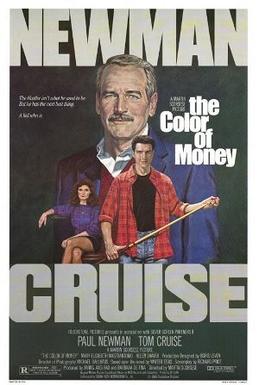
Fast Eddie Felson (Paul Newman) was once The Hustler, the legendary pool player who recovered from having his fingers broken with a bowling ball and went on to defeat the legendary Minnesota Fats. That was a long time ago. Now, Fast Eddie is a slick liquor salesman in Chicago. Eddie stills hangs out at the pool halls, despite his bad memories of the game. When he sees a cocky young player named Vincent (Tom Cruise) and his girlfriend Carmen (Mary Elizabeth Mastrantonio), he takes them under his wing and teaches them how to hustle. It’s not always easy because Vincent doesn’t like to lose, even if it means a chance to score an even bigger victory later on. Eddie finds himself being drawn back into the game, even as he starts to wonder who is hustling who.
I always forget that TheColorofMoney is a Martin Scorsese films. It’s a film that Scorsese made at a time when he had a reputation for only being able to make art films that critics loved but audiences stayed away from. After the box office failure of The King of Comedy and his abortive first attempt to make The Last Temptation of Christ, Scorsese took The Color of Money to prove that he could work with a studio. This is a Disney Scorsese film, with his signature camera moves but not much of his religious torment. Even if it’s not one of his personal films, Scorsese makes pool look exciting, a battle that is as much about psychology as physicality. Watching TheColorofMoney, you can smell the chalk on the tip of the pool cue.
Scorsese brings the seedy pool halls to life but it’s Paul Newman’s performance that dominates. TheColorofMoney won Newman his first and only Oscar and he deserved it. Newman had first played Fast Eddie Felson in 1961, in TheHustler. Returning to the role twenty-five years later allowed Newman to show what would eventually happen to the angry young men that he played in the 60s. Eddie has grown up and he’s got a comfortable life but he’s not content. He finally has stability but he misses the game. He needs the thrill of the hustle. Newman is at his best in TheColorofMoney, building on TheHustler but also revealing new sides of Eddie Felson.
Newman is so good that Tom Cruise often gets overlooked but both Cruise and Mastrantonio hold their own against Paul Newman. Cruise especially does a good job as Vincent, playing him as someone who is too cocky for his own good but also not as dumb as he looks. Just when you think you’ve got Vincent figured out, Cruise surprises you. TheColorof Money came out the same year as TopGun and Cruise’s Vincent feels like a commentary on the talented, troubled, but cocky characters that Cruise was playing at that time. Cruise, Scorsese, and Newman make a good team in this more-than-worthy sequel.
Though the Academy of Motion Picture Arts and Sciences claim that the Oscars honor the best of the year, we all know that there are always worthy films and performances that end up getting overlooked. Sometimes, it’s because the competition too fierce. Sometimes, it’s because the film itself was too controversial. Often, it’s just a case of a film’s quality not being fully recognized until years after its initial released. This series of reviews takes a look at the films and performances that should have been nominated but were, for whatever reason, overlooked. These are the Unnominated.
First released in 1995, Heat is one of the most influential and best-known films of the past 30 years. It also received absolutely zero Oscar nominations.
Maybe we shouldn’t be too surprised that Academy — especially the Academy of the 1990s — didn’t shower the film with nominations. For all of its many strengths, Heat is still a genre piece, an epic three-hour crime film from director Michael Mann. It’s a film about obsessive cops and tightly-wound crooks and it’s based on a made-for-TV movie that Mann directed in the late 80s. While the Academy had given a best picture nomination to The Fugitive just two years before, it still hadn’t fully come around to honoring genre films.
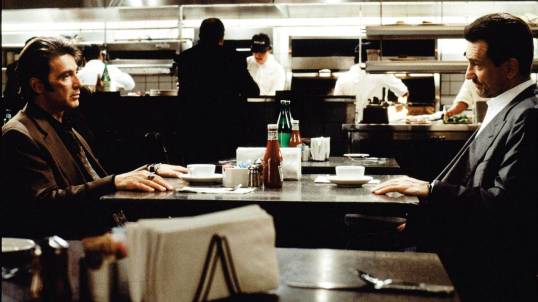
And yet one would think that the film could have at least picked up a nomination for its editing or maybe the sound design that helps to make the film’s signature 8-minute gun battle so unforgettable. (Heat is a film that leaves you feeling as if you’re trapped in the middle of its gunfights, running for cover while the cops and the crooks fire on each other.) The screenplay, featuring the scene where Al Pacino’s intense detective sits down for coffee with Robert De Niro’s career crook, also went unnominated.
Al Pacino was not nominated for playing Vincent Hanna and maybe we shouldn’t be too surprised at that. Pacino yells a lot in this movie. When people talk about Pacino having a reputation for bellowing his lines like a madman, they’re usually thinking about the scene where he confronts a weaselly executive (Hank Azaria) about the affair that he’s having with Charlene (Ashley Judd), the wife of criminal Chris Shiherlis (Val Kilmer). And yet, I think that Pacino’s performance works in the context of the film and it’s often forgotten that Pacino has quite scenes in Heat as well. Pacino’s intensity provides a contrast to Robert De Niro’s tightly controlled career criminal, Neil McCauley. McCauley has done time in prison and he has no intention of ever going back. But, as he admits during the famous diner scene, being a criminal is the only thing that he knows how to do and it’s also the only thing that he wants to do. (“The action is the juice,” Tom Sizemore says in another scene.) If any two actors deserved a joint Oscar nomination it was Pacino and De Niro. In Heat, they’re the perfect team. Pacino’s flamboyance and De Niro’s tightly-controlled emotions come together to form the heart of the picture.
No one from the film’s supporting cast was nominated either, despite there being a wealth of riches to choose from. Ashley Judd and Val Kilmer come to mind as obvious contenders. Kilmer is amazing in the shoot-out that occurs two hours into the film. Ashley Judd has a killer scene where she helps her husband escape from the police. Beyond Judd and Kilmer, I like the quiet menace of Tom Sizemore’s Michael Cheritto. (Just check out the look he gives to an onlooker who is getting a little bit too curious.) Kevin Gage’s sociopathic Waingro is one of the most loathsome characters to ever show up in a movie. William Fichtner, Jon Voight, Danny Trejo, and Tom Noonan all make a definite impression and add to Michael Mann’s portrait of the Los Angeles underworld. In an early role, Natalie Portman plays Hanna’s neglected stepdaughter and even Amy Brenneman has some good moments as Neil’s unsuspecting girlfriend, the one who Neil claims to be prepared to abandon if he sees “the heat coming.”
I have to mention the performance of Dennis Haysbert as Don Breedan, a man who has just been released from prison and who finds himself working as a cook in a diner. (The owner of the diner is played by Bud Cort.) Haysbert doesn’t have many scenes but he gives a poignant performance as a man struggling not to fall back into his old life of crime and what eventually happens to him still packs an emotional punch. For much of the film’s running time, he’s on the fringes of the story. It’s only by chance that he finds himself suddenly and briefly thrown into the middle of the action.
Heat is the ultimate Michael Mann film, a 3-hour crime epic that is full of amazing action sequences, powerful performances, and a moody atmosphere that leaves the viewer with no doubt that the film is actually about a lot more than just a bunch of crooks and the cops who try to stop them. Hanna and McCauley both live by their own code and are equally obsessed with their work. Their showdown is inevitable and, as directed by Michael Mann, it takes on almost mythological grandeur. The film is a portrait of uncertainty and fear in Los Angeles but it’s also a portrait of two men destined to confront each other. They’re both the best at what they do and, as a result, only one can remain alive at the end of the film.
I rewatched Heat yesterday and I was amazed at how well the film holds up. It’s one of the best-paced three-hour films that I’ve ever seen and that epic gunfight is still powerful and frightening to watch. Like Martin Scorsese’s Casino, it was a 1995 film that deserved more Oscar attention than it received.
Heat (1995, dir by Michael Mann, DP: Dante Spinotti)
Ray Mercer (Peter Weller) has just gotten out of prison and already, he and his wife Rebecca (Tia Carrere) are heading to Nevada for a quicky divorce. However, a stopover in Las Vegas leads to Ray having a run of luck in a casino owned by Charles Atlas (Dennis Hopper). Ray and Rebecca start to reconsider their divorce but their reconciliation is temporarily put on hold when the casino is robbed by a bunch of thieves led by Martin Kove. Because of Ray’s criminal history, the police (led by David Alan Grier) consider Ray to be the number one suspect. Ray and Rebecca try to escape from the casino and clear Ray’s name, leading to a night on nonstop action and an explosive climax at the Hoover dam.
One thing that you can say about Top of the World is that it certainly isn’t boring. The action starts earlier and lasts nonstop until the end of the movie. No sooner has Ray escaped from one scrape than he finds himself in another. Despite the low-budget, the action scenes are often spectacularly staged and exciting to watch. Another thing that you can say about Top of the World is that, for a B-movie, it certainly has a packed cast. Along with Weller, Carrere, Hopper, Grier, and Kove, the movie also finds room for Peter Coyote, Joe Pantoliano, Ed Lauter, Gavan O’Herlihy, Eddie Mekka, Cary-Hiroyuki Tagawa, and even Larry Manetti of Magnum P.I. fame. This movie paid off a lot of mortgages and probably funded more than a few vacations.
One thing you can’t say about Top of the World is that it makes any sense. It doesn’t. There are so many holes in the plot that you could fly a helicopter through them and that’s exactly what this film does. But with the nonstop action and the entertaining cast, most people won’t mind. I certainly didn’t!
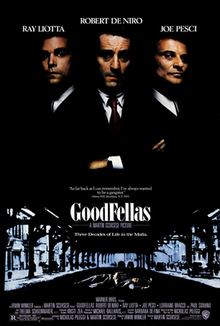
First released in 1990 and continuously acclaimed ever since, Goodfellas did not win the Oscar for Best Picture.
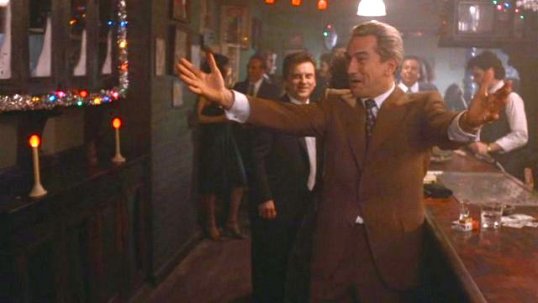
I’m always a bit surprised whenever I remember that. Goodfellas didn’t win Best Picture? That just doesn’t seem right. It’s not the other films nominated that year were bad but Goodfellas was so brilliant that it’s hard to imagine someone actually voting for something else. Seriously, it’s hard to think of a film that has been more influential than Goodfellas. Every gangster film with a soundtrack of kitschy tunes from the 6os and 70s owes huge debt to Goodfellas. Every actor who has ever been cast as a wild and out-of-control psycho gangster owes a debt to Joe Pesci’s performance as Tommy DeVito. When Ray Liotta passed away two years ago, we all immediately heard him saying, “I always wanted to be a gangster.” Robert De Niro’s Jimmy Conway remains the epitome of the ruthless gangster. For many, Paul Sorvino’s neighborhood godfather redefined what it meant to be a crime boss. Lorraine Bracco made such an impression as Karen Hill that it somehow seemed appropriate that she was one of the first people cast in The Sopranos, a show that itself would probably have not existed if not for Goodfellas. Frank Sivero, Samuel L. Jackson, Tobin Bell, Debi Mazer, Vincent Gallo, Ileana Douglas, Frank Vincent, Tony Sirico, Michael Imperioli, Tony Darrow, Mike Starr, Chuck Low, all of them can be seen in Goodfellas. It’s a film that many still consider to be the best of Martin Scorsese’s legendary career. Who can forget Robert De Niro smoking that cigarette while Sunshine of Your Love blared on the soundtrack? Who can forget “Maury’s wigs don’t come off!” or “Rossi, you are nothing but whore!?” Who can forget the cheery Christmas music playing in the background while De Niro’s Jimmy Conway grows more and more paranoid after pulling off the biggest heist of his career?
Plus, it’s a Christmas movie!
And yet, it did not win Best Picture.
Myself, whenever I’m sitting behind a garbage truck in traffic, I immediately start to hear the piano coda from Layla. For that matter, whenever I see a helicopter in the sky, I flash back to a coke-addled Henry Hill getting paranoid as he tries to pick up his brother from the hospital. Whenever I see someone walking across the street in the suburbs, I remember the scene where Henry coolly pistol-whips the country club guy and then tells Karen to hide his gun. I always remember Karen saying that she knows that many of her best friends would have run off as soon as their boyfriend gave them a gun to hide but “it turned me on.” It would have turned me on as well. Henry might be a gangster and his friends might be murderers but he doesn’t make any apologies for who he is, unlike everyone else in the world.
But it did not win Best Picture.
How many people have imitated Joe Pesci saying, “How am I funny?” How many times did Pesci and Frank Vincent have to listen to people telling them to “go home and get your fucking shinebox?” A lot of people remember the brutality of the scene where Pesci and De Niro team up to attack Vincent’s crude gangster but I always remember the sound of Donavon’s Atlantis playing on the soundtrack.
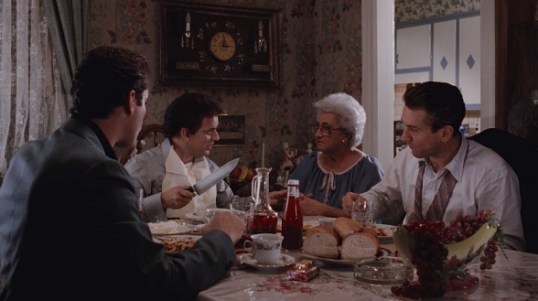
And then there’s Catherine Scorsese, showing up as Tommy’s mom and cooking for everyone while Vincent struggles to escape from the trunk of a car. “He is content to be a jerk,” Tommy says about Henry Hill. Just a few hours earlier, Tommy was apologizing to Henry for getting blood on his floor.
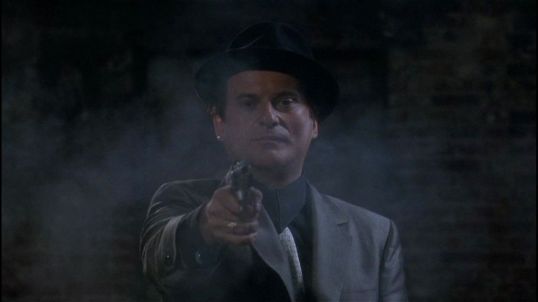
Goodfellas is a fast-paced look at organized crime, spanning from the 50s to the early 80s. Ray Liotta plays Henry Hill, who goes from idolizing gangsters to being a gangster to ultimately fearing his associates after he gets busted for dealing drugs. It’s a dizzying film, full of so many classic scenes and lines that it feels almost pointless to try to list them all here or to pretend like whoever is reading this review doesn’t remember the scene where the camera pans through the club and we meet the members of the crew. (“And then there was Pete The Killer….”) Goodfellas is a film that spend two hours showing us how much fun being a gangster can be and then thirty minutes showing us just how bad it can get when you’re high on coke, the police are after you, and you’ve recently learned that your associates are willing to kill even their oldest friends. No matter how many times I watch Goodfellas, I always get very anxious towards the end of the film. With the music pounding and the camera spinning, with Henry looking for helicopters, and with all of his plans going wrong over the course of one day, it’s almost a relief when Bo Dietl points that gun at Henry’s head and yells at him, revealing that Henry has been captured by the cops and not the Gambinos. Karen desperately running through the house, flushing drugs and hiding a gun in her underwear, always leaves me unsettled. It’s such a nice house but now, everything is crashing down.
There’s a tendency to compare Goodfellas to The Godfather, as their both films that re-imagine American history and culture through the lens of the gangster genre. I think they’re both great but I also think that they are ultimately two very different films. If The Godfather is sweeping and operatic, Goodfellas is the film that reminds us that gangsters also live in the suburbs and go to cookouts and that their wives take care of the kids and watch movies while the FBI searches their home. If The Godfather is about the bosses, Goodfellas is about the blue collar soldiers. The Godfather represents what we wish the Mafia was like while Goodfellas represents the reality.
Goodfellas is one of the greatest films ever made but it lost the Best Picture Oscar to Dances With Wolves, a film that left audiences feeling good as opposed to anxious. To be honest, Martin Scorsese losing Best Director to Kevin Costner feels like an even bigger injustice than Goodfellas losing Best Picture. One can understand the desire to reward Dances With Wolves, a film that attempts to correct a decades worth of negative stereotypes about Native Americans. But Scorsese’s direction was so brilliant that it’s truly a shame that he didn’t win and that Lorraine Bracco didn’t win Best Supporting Actress. It’s also a shame that Ray Liotta wasn’t nominated for playing Henry Hill. At least Joe Pesci won an Oscar for redefining what it meant to be a gangster.
Goodfellas is proof that the best film doesn’t always win at the Oscars. But it’s also proof that a great film doesn’t need an Oscar to be remembered.
Of the many films that have been made about people desperately trying to get the Hell out of New York City, Quick Change is one of the funniest. The appropriately-named Grimm (Bill Murray) works in the city planning office and has had all that he can take of New York’s crime and rudeness. His solution is to dress up like a clown and rob a bank. His girlfriend Phyllis (Geena Davis) and best friend Loomis (Randy Quaid) are already inside the bank, disguised as customers. When Grimm, who claims to be a “crying on the inside” type of clown, takes everyone in the bank hostage and forces them into the vault, Phyllis and Loomis grab as much of the money as they can. Talking on the phone to police chief Rotzinger (Jason Robards), Grimm makes a series of pointless demands. Each demand that is met leads to Grimm releasing a group of hostages. By removing his clown makeup, Grimm is able to join Phyllis and Loomis when they are “released.” Rotzinger, who has even managed to procure a monster truck, thinks that the robber is still in the bank while Grimm, Phyllis, and Logan head for the airport.
Of course, things don’t go as planned. What starts out as a energetic and good-natured Dog Day Afternoonparody quickly becomes an increasingly surreal journey through New York. The streets are in terrible condition. The signs that would have provided directions to the airport have been taken down by a road construction crew. (They explain that they’re only taking down the signs today and it will be a few days before they get around to putting them back up.) One of the few polite people they meet turns out to be a thief who steals four dollars from Grimm’s wallet but fails to notice that he’s got a million dollars taped around his waist. Stanley Tucci shows up as a mobster. Tony Shalhoub plays a well-meaning taxi driver who speaks his own indecipherable language. Grimm keeps running into rude cops who, despite being on the hunt for the bank robbers, are frequently too busy being rude to notice what’s happening in front of them.
Best of all, Grimm, Phyllis, and the increasingly addled Loomis board a bus being driven by the film’s greatest character. Played by Philip Bosco, the bus driver is a wonderful comedic creation. “That’s not exact change,” the driver says when Loomis attempts to pay him with a hundred dollar bill. “Behind the white line,” he says before starting the bus. When Loomis, who has a habit of running into things and appears to be suffering from a concussion, tries to sit down, the bus driver informs him that he’s not allowed to sit until he receives exact change. The driver has a schedule to keep and, to his credit, he largely manages to do so. Bosco plays him with such deadpan determination that it’s hard not to admire his dedication to following every single regulation to his job. As opposed to Grimm, the driver has learned to deal with living in New York by obsessively making every scheduled stop.
Quick Change struggles sometimes to balance its moments of humor and drama. Scenes of Loomis running like a cartoon character are mixed with scenes of Phyllis worrying that Grimm might actually be a hardened criminal and struggling with whether or not to tell him that she’s pregnant. This was Bill Murray’s first and only film as a director and sometimes, he does struggle to maintain a consistent tone. But, in the end, what’s important is that it’s a funny film. Bill Murray is one of those actors who can make you laugh just by existing and, as a director, he’s smart enough to give Jason Robards enough room to make Rotzinger into something more than just a standard comedic foil.
Quick Change is a comedic nightmare, one that made me laugh even as it also made me glad that I don’t have to drive in New York. I get lost just driving around the suburbs of Dallas. There’s no way I’d ever be able to find my way out of New York.
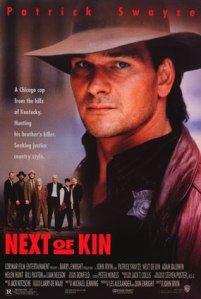
Truman Gates (Patrick Swayze) may have been raised in Appalachia but, now that he lives in Chicago, he’s left the old ways behind. He has a job working as a cop and his wife (Helen Hunt) is pregnant with their first child. When Truman’s younger brother, Gerald (Bill Paxton), shows up in town and asks for Truman’s help, Truman gets him a job as a truck driver. But, on his first night on the job, Gerald’s truck is hijacked by a Sicilian mobster named Joey Rosellini (Adam Baldwin) and Gerald is killed. Truman’s older brother, Briar (Liam Neeson), soon comes to Chicago and declares a blood feud on the mob.
Of the many action films that Patrick Swayze made between Dirty Dancing and Ghost, Roadhouse may be the best known but Next of Kin is the best. Next of Kin spends as much examining the family dynamics of Rosellini’s family as it does with Truman’s, suggesting that there is not much of a difference between the two groups. There’s even a scene where Joey’s uncle (played by Andreas Katsulas) tells Joey that the Sicily was the Appalachia of Italty. Next of Kin also has a better supporting cast than most of the films that Swayze made during this period. Along with Paxton and Neeson, the hillbillies are represented by actors like Ted Levine and Michael J. Pollard while Ben Stiller has an early role as Joey’s cousin. Patrick Swayze gives one of his better performances as Truman but the entire movie is stolen by Liam Neeson, who is a surprisingly believable hillbilly.
I have always been surprised by how much some people hate the 2013 best picture nominee, American Hustle. Even two years after the film was first released, you’ll still find people whining that the film felt like David O. Russell’s attempt to remake Goodfellas (yes, I have actually seen more than a few people online making this idiotic claim) or claiming that the movie was overrated or that there wasn’t anyone in the film that they could root for. While every film has its detractors, I’m always a little bit taken aback by just how passionately some people dislike this film.
Some of it, of course, is because the film that beat American Hustle for best picture was the universally acclaimed 12 Years A Slave. As hard as it may seem to believe now, there were a lot of people who thought that American Hustle might actually beat 12 Years A Slave. Strangely enough, a lot of online film bloggers tend to take a Manichaen approach to the Oscars, viewing each year’s race in terms of good and evil. The film that they want to win represents good and, therefore, every competing film must represent evil. It’s a pretty stupid and immature way of looking at things but, then again, the stupid and immature approach has worked pretty well for Sasha Stone and Ryan Adams over at AwardsDaily.com so who am I to criticize?
Of course, I don’t think it’s a coincidence that the majority of American Hustle‘s most strident online critics have been male. I imagine that they watched the film and, in Amy Adams and Jennifer Lawrence, they saw every unresolved crush of their adolescence. When Amy Adams successfully fooled Christian Bale and Bradley Cooper, these critics saw themselves being fooled. When Jennifer Lawrence called Bale a “sick son of a bitch,” these critics felt that they were being called a sick son of a bitch. American Hustle is a film about men who don’t know how to talk to women and that probably struck a little too close to home for a lot of those online critics.
(I imagine that the majority of online American Hustle haters probably preferred Rooney Mara’s version of the Girl with the Dragon Tattooto Noomi Rapace’s.)
Of course, the truth of the matter is that American Hustle was one of the best films of a very good year. Of all the films nominated for best picture of 2013, American Hustle was my personal favorite.
Based, very loosely, on true story, American Hustle is a period piece. It takes place in the late 70s, which of course means that we get a lot of great music, a scene in a disco, and clothes that are both somehow ludicrous and to die for at the same time. It’s a glamorous film about glamorous people doing glamorous and not-so-glamorous things and how can you not love that?
Irving (Christian Bale, giving a brave performance) is a generally nice guy who also happens to be a con artist. His unlikely partner is Sydney (Amy Adams), a former stripper turned Cosmo intern. When Sydney is working with Irving, she takes on a totally different identity and tells people that she’s Lady Edith Greensly, a British aristocrat who has international banking connections. When Sydney plays Edith, she speaks in a posh British accent and what’s interesting is that her accent is often (deliberately) inconsistent. However, as Irving points out, it doesn’t matter whether her accent is a 100% convincing or not. What’s important is that people want her to be Lady Edith Greensly and people will make excuses for almost anything as long as it confirms what they want to believe.
Eventually, Irving and Sydney are arrested by ambitious and highly strung FBI Agent Richie DiMaso (Bradley Cooper). Richie, who spends a good deal of the film with curlers in his hair, lives with his mother and has a boring fiancée who he doesn’t seem to like very much. (Richie is also briefly seen sniffing coke, which might explain a lot of his more extreme behavior.) Richie wants to make a name for himself and he views Irving and Sydney as his way to do so. He blackmails them into helping him set up and arrest crooked politicians and businessmen. Richie also finds himself growing obsessed with Sydney, who he believes to be English even after she tells him that she isn’t.
All of this eventually leads to Irving and Richie setting up the Mayor of Camden, New Jersey, Carmine Polito (Jeremy Renner). Polito, who may be corrupt but who also seems to sincerely care about helping the citizens of his town, wants to revitalize gambling in Atlantic City. Irving and Richie introduce him to FBI agent Paco Hernandez (Michael Pena), who is disguised as Sheik Abdullah and who they claim is interested in investing in Carmine’s plans. This, of course, leads to a meeting both with a local Mafia don (Robert De Niro) and with several politicians who agree to help out the Sheik out in exchange for money.
Complicating things is the fact that Irving himself comes to truly like the generous and big-hearted Carmine and how can you not? When the film was first released, Jeremy Renner was a bit overshadowed by Bale, Cooper, Adams, and Jennifer Lawrence. However, Renner gives the best performance in the film, playing Carmine with a disarming mix of innocence and shrewdness. He’s the type of guy who is smart enough to walk out on the first meeting with the fake sheik’s associates but who is still naive enough that he can be charmed by Irving. When the fake sheik gives Carmine an equally fake knife as a gift, the look of genuine honor on Carmine’s face is heart-breaking.
The other big complication is Irving’s wife, Rosalyn (Jennifer Lawrence). Rosalyn is jealous, unstable, unpredictable, and, in her own way, one of the smarter people in the film. She’s also a bit of pyromaniac and, when she accidentally blows up a new microwave, you’re really not surprised. (And, when Rosalyn starts to obsessively clean the house while singing Live and Let Die at the top of her lungs, I felt like I was watching a blonde version of myself.) When Rosalyn starts to have an affair of her own, it leads to American Hustle‘s satisfying and twisty conclusion.
(Again, a lot of the same online toadsuckers who irrationally hate American Hustle seem to hold a particular contempt to Jennifer Lawrence’s performance in this film, as if to acknowledge that Lawrence — as always — kicks ass would somehow be a betrayal of Lupita Nyong’o’s award-winning performance in 12 Years A Slave.)
Don’t listen to the haters. American Hustle is a great film, a stylish and frequently funny look at politics, corruption, and the ways that people con themselves into believing what they want and need to be true.


 Truman Gates (Patrick Swayze) may have been raised in Appalachia but, now that he lives in Chicago, he’s left the old ways behind. He has a job working as a cop and his wife (Helen Hunt) is pregnant with their first child. When Truman’s younger brother, Gerald (Bill Paxton), shows up in town and asks for Truman’s help, Truman gets him a job as a truck driver. But, on his first night on the job, Gerald’s truck is hijacked by a Sicilian mobster named Joey Rosellini (Adam Baldwin) and Gerald is killed. Truman’s older brother, Briar (Liam Neeson), soon comes to Chicago and declares a blood feud on the mob.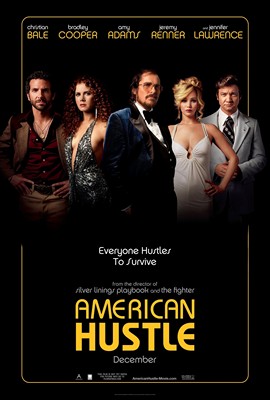
 Through the Shattered Lens