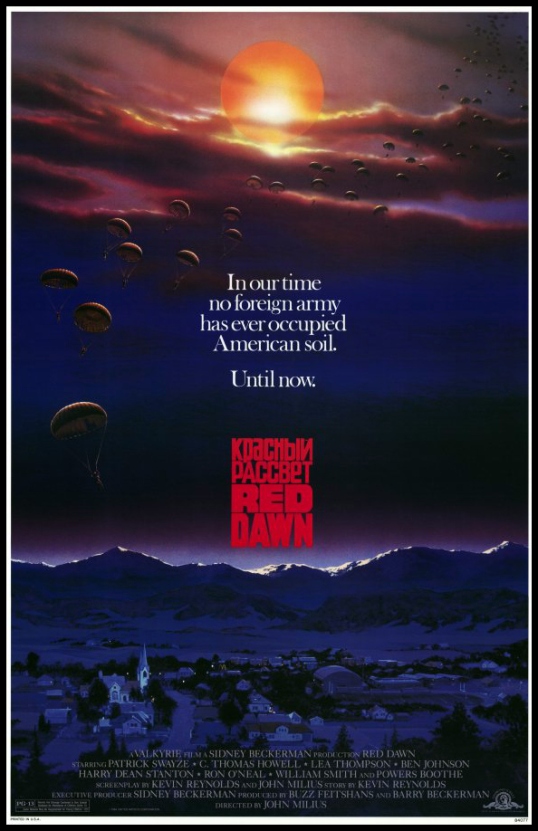
Today, the Shattered Lens wishes a happy birthday to a true Hollywood iconoclast, John Milius! In honor of Milius and his career and his legacy, today’s scene that I love comes from Milius’s 1984 film, Red Dawn.
After their small town is taken over by a combination of Cuban and Russian soldiers, a group of teenagers flee to the hills. After a few months, they sneak back into town. In this scene, two brothers (Patrick Swayze and Charlie Sheen) discover that their father (Harry Dean Stanton) is one of the many townspeople who have been sentenced to a reeducation camp. Their dad says a few final words to them, knowing that he’ll probably never see them again. He leaves them with one final instruction: “AVENGE ME!” Not even the propaganda film playing in the background can cover the sound of their father demanding vengeance.
And, of course, they do get their revenge, sacrificing their lives so that America might once again be free. It’s a classic John Milius moment and an appropriate scene with which to celebrate his birthday.
Welcome to Retro Television Reviews, a feature where we review some of our favorite and least favorite shows of the past! On Sundays, I will be reviewing the made-for-television movies that used to be a primetime mainstay. Today’s film is 1981’s Return of the Rebels! It can be viewed on YouTube!
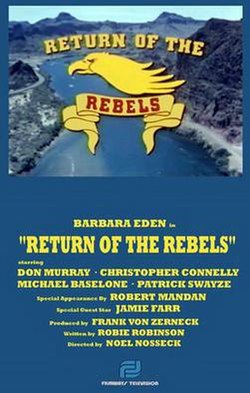
Mary Beth Allen (Barbara Eden) used to be the wife of the leader of Rebels, Arizona’s toughest motorcycle gang. She’s now a widow and she operates a Colorado River campground. Her teenager daughter, Amy (Deanna Robbins), has got a crush on a local boy named K.C. Barnes (Patrick Swayze) and that’s a problem because K.C. is kind of a jerk.
Every weekend, K.C. and his gang descend on the campground and proceed to have a good time, redneck-style. They set up a few kegs of beer. They water ski. They play loud music. They get into fights. They drive their vans all over the property. They are so disruptive that Mary Beth is losing customers. For reasons that are not quite clear, the police refuse to help her. For some reason, K.C. seems to be determined to drive Mary Beth out of business. And when I say “for some reason,” what I mean is that there’s absolutely no reason for K.C. to be as obnoxious as he is. It’s not like he owns a rival campground or anything. He’s not going to gain a thing by running Mary Beth out of business. K.C.’s only motivation seems to be that he’s a jerk. Unfortunately, he’s played by a young Patrick Swayze, who was a bit too likable to be believable as someone who would be a jerk just for the Hell of it. Swayze smirks and sneers and laughs whenever Mary Beth yells at him but, up until the last few moments of the film, he still comes across more as being an overgrown teenager who is too dumb to realize how annoying he’s being than a true villain. When K.C. does suddenly reveal himself to be a true villain, it’s a bit jarring. It’s like seeing the neighborhood bully suddenly pick up a gun and rob a bank. Swayze’s character was definitely bad but he didn’t seem that bad,
Regardless of K.C.’s level of villainy, his antics are threatening to put Mary Beth out of business. She goes into the city and pays a visit on Sonny (Don Murray). Sonny used to be a member of the Rebels. Now, he’s a fairly successful auto mechanic. He’s also always been in love with Mary Beth. When he finds out that Mary Beth needs help, he decides that it’s time to get the old Rebels back together so that they can put some young punks in their place.
The problem, of course, is that some of the old Rebels are really, really old. Al Williams (Robert Mandan) was once the most fearsome dude on a motorcycle but now he sells used cars and collapses after he’s challenged to run down to the end of the street. Mickey Fine (Jamie Farr) is now more concerned with taking care of his family than riding motorcycles. Jay Arnold Wayne (Christopher Connelly) is a wealthy businessman who …. well, he doesn’t get much of a personality beyond that. “Wild” Bill Karp (Michael Baseleon) is still wild but he’s also middle-aged and out-of-shape.
Can Sonny get the gang back together before K.C. takes over the campground? And even if he can, will he able to gather enough former Rebels to take on K.C.’s surprisingly large gang? Seriously, when K.C. and his gang show up at the campground, K.C. appears to be leading a convoy. It’s almost as if the entire population of Arizona is following K.C. around for the weekend.
As you may have already guessed, Return of the Rebels struggles to find a consistent tone. On the one hand, the battle between the old bikers and the young rednecks is a dangerous one and the film tries to generate some suspense over whether everyone will survive. On the other hand, the film’s cast is full of sitcom veterans who often deliver their lines as if they’re waiting for a laugh track to punctuate their point. On the one hand, Patrick Swayze’s gang is supposed to be dangerous. On the other hand, they’re Patrick Swayze’s gang. For a bunch of delinquents, it seems like all they really want to do is spend the weekend water skiing and drinking beer. Obviously, beer and motorboats don’t always go well together but Swayze and his friends still never come across as being quite as dangerous as they’re supposed to be.
Return of the Rebels is a film about getting old. The members of the Rebels have all found success but all of them are nostalgic for their days of being “outlaw” bikers and they get one final chance to show everyone what they can do. It’s not a bad theme but again, the film can never quite make up its mind how seriously it wants us to take either the Rebels or Swayze’s gang. It’s a bit of a mess. That said, the scenery was gorgeous and I’m enough of a country girl that I definitely got a little thrill out of watching scenes of various pickup trucks and vans driving through the river. I have a weakness for rebels and reformed bikers. It’s an amiable film, even if it doesn’t make much sense in the end.
As some of our regular readers undoubtedly know, I am involved in a few weekly live tweets on twitter. I host #FridayNightFlix every Friday, I co-host #ScarySocial on Saturday, and I am one of the five hosts of #MondayActionMovie! Every week, we get together. We watch a movie. We tweet our way through it.
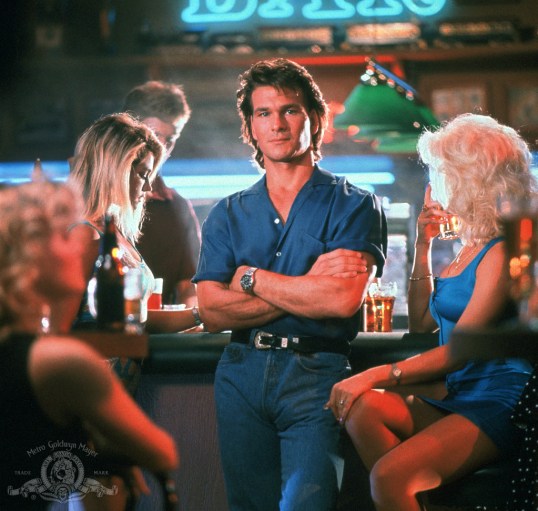
Tonight, at 10 pm et, I will be hosting #FridayNightFlix! The movie? 1989’s Road House!
The name is Dalton! Everyone thought that Dalton would be bigger but he’s the second best bouncer in the world and if anything happens to Wade Garrett, he’ll be the absolute best. He’s a legend but can he clean up the wildest bar in Missouri? Will Ben Gazzara convince him to switch sides? Will Doc convince him to give peace a chance? And will Tinker ever get over his fear of polar bears? Just remember, pain don’t hurt. Be nice until it’s time not to be nice. And always check the boots for blades.
If you want to join us this Friday, just hop onto twitter, start the movie at 10 pm et, and use the #FridayNightFlix hashtag! I’ll be there tweeting and I imagine some other members of the TSL Crew will be there as well. It’s a friendly group and welcoming of newcomers so don’t be shy.
This is NOT a drill! This Friday, we have got …. DALTON! Join us as we watch 1989's ROAD HOUSE! The film is available on Prime, Netflix, and Paramount Plus and we start at 10 pm et on Friday! pic.twitter.com/JheJ2l1O5e
Continuing yesterday’s Dirty Dancing theme, today’s music video of the day is for Michael Spaulding’s cover of She’s Like The Wind. She’s Like The Wind was written and originally performed by Patrick Swayze and, while there’s official video for the original on YouTube, I think Spaulding’s cover serves as an acceptable substitute.
In this scene, Sparkle Motion performs onstage while, miles away, Donnie Darko (Jake Gyllenhaal) burns down the house of creepy motivational speaker, Jim Cunningham (Patrick Swayze). Playing throughout this scene: Duran Duran’s “Notorious.”
And what better way to start things off than with the Head Over Heels scene from 2001’s Donnie Darko. Directed by Richard Kelly, this scene not only makes brilliant use of the Tears For Fears song, Head Over Heels, but it also manages to introduce every character and set up almost every important relationship in the film.
It’s brilliant but I always find myself wondering what Drew Barrymore had against Sparkle Motion.
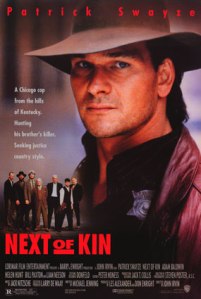
Truman Gates (Patrick Swayze) may have been raised in Appalachia but, now that he lives in Chicago, he’s left the old ways behind. He has a job working as a cop and his wife (Helen Hunt) is pregnant with their first child. When Truman’s younger brother, Gerald (Bill Paxton), shows up in town and asks for Truman’s help, Truman gets him a job as a truck driver. But, on his first night on the job, Gerald’s truck is hijacked by a Sicilian mobster named Joey Rosellini (Adam Baldwin) and Gerald is killed. Truman’s older brother, Briar (Liam Neeson), soon comes to Chicago and declares a blood feud on the mob.
Of the many action films that Patrick Swayze made between Dirty Dancing and Ghost, Roadhouse may be the best known but Next of Kin is the best. Next of Kin spends as much examining the family dynamics of Rosellini’s family as it does with Truman’s, suggesting that there is not much of a difference between the two groups. There’s even a scene where Joey’s uncle (played by Andreas Katsulas) tells Joey that the Sicily was the Appalachia of Italty. Next of Kin also has a better supporting cast than most of the films that Swayze made during this period. Along with Paxton and Neeson, the hillbillies are represented by actors like Ted Levine and Michael J. Pollard while Ben Stiller has an early role as Joey’s cousin. Patrick Swayze gives one of his better performances as Truman but the entire movie is stolen by Liam Neeson, who is a surprisingly believable hillbilly.
Now that I’ve fully recovered from the trauma of writing about Grease, let me tell you about a little movie from 1979. It’s a movie about teenagers, love, and competition. It’s also a movie about disco and some actors who had some extra time on their hands. It has a great soundtrack and the whole movie is pure 70s. It even features the debut performance of a future movie star!
What film am I talking about?
SKATETOWN, USA, of course!
But before I talk about the movie, check out the trailer. This is one of my favorite trailers of all time. It pretty much tells you everything that you need to know about the movie. There’s not a deceptive moment to be found in this preview:
Skatetown, U.S.A. is one of those movies that you watch and think, “This could only have been made in the 70s.” Remember how watching Hollywood High caused me to doubt whether or not the 70s were actually all they were cracked up to be? Well, Skatetown USA has renewed my faith! Skatetown is such a 70s film that I personally think someone should send me an honorary coke spoon to reward me for watching it.
(Maureen McCormick, who is best known for playing Marcia Brady and who had a small role in Skatetown, wrote in her autobiography that the main thing she remembers about Skatetown is all the cocaine on the set.)
Skatetown USA doesn’t really have a traditional plot. Instead, it’s a collection of “comedic” skits mixed in with roller skating performances and a nonstop soundtrack. There is not a second that music is not playing in the background and, for what appears to be a low-budget film, the soundtrack is truly impressive. Basically, almost every great disco song from the 1970s is heard at some point during Skatetown USA. (Even that “Boogie Nights” song that Paul Thomas Anderson was apparently not allowed to actually use in Boogie Nights! Imagine being the copyright holders who said yes to Skatetown but no to Paul Thomas Anderson…)
The film’s main character appears to be an unnamed DJ (Denny Johnston). The DJ wears a big white afro wig and is always dancing in his booth. Occasionally, he shoots a lightning bolt from his middle finger and suddenly, professional roller dancers appear and do a routine. At the end of the movie, he looks at the camera, says that it’s all a fantasy, and winks.
Skatetown is the most popular disco roller rink in town. Clean-cut teenager and all around nice guy Stan Nelson (Greg Bradford) wants to win Skatetown’s roller dancing contest. (The prize is $1,000 and a moped!) His best friend, Richie (Scott Baio), accompanies him and hopes to win a lot of money by betting on the outcome of the contest. Stan angrily reprimands him, “This isn’t the streets! This is Skatetown, U.S.A!”
That’s right — don’t mess with the good name of Skatetown!
Anyway, Stan’s actually a pretty good performer and he does this trick where he rides a skateboard while wearing roller skaters so you would think he would be a sure bet to win.
BUT NO!
The reigning Skatetown champion is Ace Johnson (Patrick Swayze, making his film debut) and we know that Ace is a bad guy because he wears all black and he occasionally snaps a whip while he’s rolling around! Ace isn’t above cheating to win but really he doesn’t have to cheat! Ace may be the bad guy but, seriously, he totally kicks ass while wearing roller skates. As soon as he rolls out there, you understand why he’s the reigning champion.
See, here’s the thing with Skatetown: We’re supposed to be rooting for Stan but Ace really is a hundred times better than him. There’s a reason why Patrick Swayze went on to have a career after Skatetown while Greg Bradford only has 8 credits on the imdb. Swayze, even in this silly role, had movie star charisma whereas Bradford — well, he’s comes across as a nice guy but there’s nothing special about him. Swayze, meanwhile, is dangerous and smoldering.
For instance, when Stan does his routine, his background music is The Village People singing “Macho Man” and you can’t help but snicker a little. Whereas, when Ace performs, his background music is a slightly menacing cover of Under My Thumb. Stan is the Village People. Ace is the Rolling Stones.
Anyway, the film might not be good in the traditional sense but I absolutely loved Skatetown, U.S.A. Why? Because it’s a total time capsule! Watching it is such a totally 70s experience that I was even tempted to get a frizzy perm, start wearing bell bottoms, and stop wearing a bra. Fortunately, the temptation passed but still, I enjoyed getting to use my cinematic time machine.
Add to that, the film itself is just so over-the-top and silly that … well, you can really believe that everyone involved in the movie was snorting mountains of cocaine in between takes. There’s not a subtle moment to be found in Skatetown, U.S.A. Instead, it’s all bright neon, loud music, flamboyant characters, silly melodrama, and corny humor.
(My personal theory is that Skatetown, U.S.A. was taking place in the same cinematic universe of A Clockwork Orange and it was showing what normal teenagers were doing while Alex and his droogs were seeking out the ultraviolence. The over-the-top design of Skatetown reminded me of the similar flamboyance of the Korova Milk Bar and the droogs’s bowlers and oversized codpieces weren’t that different from some of the costumes worn by the cast of Skatetown.)
Anyway, Skatetown is one of those films that everyone should see once. Unfortunately, because of all the music in the film, it’s never been released on DVD or Blu-ray and it probably never will be because life sucks. It is on YouTube, though it was recorded off an old VHS tape so the transfer is not the best.
Here’s Skatetown, USA:
One final note: Skatetown, USA was directed by the same William Levey who also directed Blackenstein, Hellgate, and The Happy Hooker Goes to Washington. It was written Nick Castle, who played Michael Myers in the original Halloween and directed a film that is well-liked by several of the writers here at the Shattered Lens, The Last Starfighter.
Secondly, my Aunt Kate absolutely loves this movie. Ever since she first found out that I obsessively love movies, she has recommended that I watch this movie. And she hasn’t been alone. A lot of people both in and outside of my family have recommended this film to me. And, since I tend to be a bit of a contrarian know-it-all, I originally assumed that any film loved by that many people had to be terrible. However, because I love mi tia, I decided to watch Ghost.
I have to admit that I started to laugh when I saw Demi Moore sitting at her pottery wheel because I’ve seen that scene parodied in so many different TV shows and movies. As soon as a shirtless Patrick Swayze sat down behind her and joined his hands to hers to help shape a ceramic phallic symbol, I started to giggle. As Unchained Melody played in the background, I wanted to be snarky. But then I realized something. If you can manage watch the scene without comparing it to all the parody versions, it actually works. Patrick Swayze looked good and he and Demi Moore had the type of amazing chemistry that more than made up for the fact that neither one of them was a very good actor. (That said, Patrick was very good at projecting decency and Demi was very good at crying and that’s really all that Ghost required.) And, if the scene has proven easy to parody, that doesn’t change the fact that it’s a very sincere scene. It’s so sincere that it’s even willing to risk coming across as being silly.
Of course, the entire film isn’t just Demi, Patrick, and a pottery wheel. There’s also Whoopi Goldberg as a fake medium-turned-real-medium and Tony Goldwyn as the best friend who turns out to be a sleazy villain. And, of course, there’s the cartoonish demons who pop up every once in a while so that they can literally drag the recently deceased down to Hell.
Sam Wheat (Patrick Swayze) is the world’s most unlikely New York City-based banker. He owns a beautiful apartment with his girlfriend Molly (Demi Moore) but he has commitment issues. He can’t bring himself to say that he loves Molly. Instead, he just says, “Ditto.” And, from the minute he first utters those words, you know that his habit of saying “Ditto,” is going to be an important plot point. Anton Chekhov told us that any gun introduced during the first chapter must be fired by the third chapter. Ghost tells us that any “Ditto” uttered during the first 10 minutes must be repeated by the end of the first hour.
Sam’s best friend and co-worker is Carl (Tony Goldwyn). At the start of the film, Sam and Carl have a sweet bromance going and some of the best scenes are just the two of them acting like guys. (There’s a fun little scene where they freak out a group of strangers on an elevator.) Goldwyn is so likable as Carl that it’s actually genuinely upsetting to discover that he’s arranged for Sam to be murdered. (Why? It all involved a lot of financial stuff that basically went right over my head. Greed is not only the root of all evil but it leads to narrative confusion as well.) When Sam dies, he comes back as a ghost but nobody can see him but his fellow ghosts. Vincent Schiavelli has a great cameo as a very angry subway ghost who teaches Sam how “life” works when you’re dead.
(Of course, Schiavelli isn’t on screen for too long because he’s almost too angry for the world of Ghost.)
Eventually Sam discovers that only one living person can communicate with him. Oda Mae Brown (Whoopi Goldberg) is a fake medium who is just as shocked as anyone to discover that she can speak with the dead. Whoopi won an Oscar for her performance here and she’s certainly does bring some needed humor and life to Ghost. With Swayze, Moore, and Goldwyn all giving extremely and sometimes overly dramatic performances, you’re happy to have Whoopi there.
Ghost is designed to appeal to your emotions and it succeeds in doing just that. If you look at the film logically, you’re missing the point. In many ways, the film is undeniably silly but I still got some tears in my eyes when I heard that “Ditto.”
As I mentioned in my review of Diary of a Hitman, I’ve been trying to watch as many obscure and forgotten films as possible. For that reason, earlier tonight, I watched, via Movieplex OnDemand, a 1986 film called Youngblood.
Youngblood is one of those films that is so unbelievably predictable that I’m dreading having to detail the film’s plot because there is seriously no way to make it sound interesting.
Okay, let’s give it a shot.
Dean Youngblood (Rob Lowe) is a 17 year-old farmhand in upstate New York who also happens to be one of the state’s best hockey players. He’s also lucky enough to have a plot-specific last name. Just imagine if his name had been Dean Bloodthinner or Dean Oldboy. You’d have a much different movie. But anyway — Youngblood dreams of playing in the National Hockey League. His father tells Youngblood to forget about his dreams. His brother says, “Go for your dreams!” Perhaps not surprisingly, Youngblood decides to go for his dreams because, otherwise, there wouldn’t be a movie.
Youngblood ends up playing in the Canadian Junior League. (I should mention that the only reason I even know that there is a Canadian Junior League is because I watch Degrassi.) After being taken under the wing of fellow player Derek Sutton (Patrick Swayze), Youngblood becomes one of the best players on the team. However, he’s not comfortable beating up the opposing players, which leads his coach (Ed Lauter) to wonder if Youngblood lacks the killer instinct needed for professional hockey. Youngblood also happens to be dating the coach’s daughter (Cynthia Gibb). Anyway, as you can probably guess, the film concludes with a big game and a lot of shots of people shouting, “GO, YOUNGBLOOD!”
Youngblood is not a very good movie but its memorable for being perhaps the most aggressively male movie ever made. Youngblood, for instance, has no mother. He just has an older brother to learn from and a father to impress. Indeed, to judge from Youngblood, upstate New York is apparently a female-free zone. As opposed to New York, there are women in Canada and, in the world of this film, they all exist for one and only one reason: to validate the existence of Dean Youngblood. The coach’s daughter does it by assuring him that he’s worthy of being loved. All the other female characters — from his landlady to two groupies that he meets in a bar — do so by being sexually available. When Youngblood has sex with his landlady, they’re watched by two other hockey players (one of whom is played by Keanu Reeves and says, “She do me last year.”). After Youngblood has sex with the coach’s daughter, the first thing he does is track down Derek so he can tell him all about it.
Make no mistake about it. Youngblood is a love story but it’s about the love between Youngblood and his teammates. When Youngblood first makes the team, Derek holds him down and proceeds to shave his testicles with a dull razor. When Youngblood finally starts fighting on the ice (and, in the process, becomes a man or something), he does it to defend his fellow teammates. Poor Cynthia Gibb can only watch from the stands and cheer. She’s finally realized that, by encouraging Youngblood to embrace peace over violence, she was holding him back from embracing his destiny. Or something.
On a positive note, Rob Lowe looks as good in this film as he did earlier in Class and later in Parks and Recreation. For that matter, a young and athletic Patrick Swayze looked pretty good in this film too. However, the characters that they’re playing are so hyper-masculine that they quickly go from being sexy to just being obnoxious. I’ll admit that, unlike the TSL’s own Leonard Wilson, I do not know much about hockey. But I do know that if I ever have to suggest a hockey film to a friend, I will always suggest that they see Goonand forget about Youngblood.