I’ve reviewed two movies about witches today and I should be posting a review of a movie about Rasputin in a few more hours. Needless to say, all of this witch talk might be disturbing to some. Well, fear not! Today’s scene that I love is for you!
This 1964 Italian horror film takes place in a feudal village in the 15th century. It’s a time of fear, corruption, and ignorance, which is a dangerous combination. The village is ruled over by the corrupt Count Humboldt (Giulliano Raffaelli). With his villagers panicking about every day problems like poor crops, banditry, and disease, the Count understand that the best thing to do is just blame it all on a witch. Of course, it doesn’t do much good to blame a witch unless you also burn her and that’s exactly what the count decides to do Adele Karnstein. When Adele’s daughter, Helen (Barbara Steele), goes to the castle to make an appeal for her mother’s life, the Count responds by raping her and then tossing her over the edge of a cliff.
Adele’s other daughter, Lisabeth (Halina Zalewska), is adopted by the Count and grows up in his castle. Eventually she is married off to the count’s evil and greedy nephew, Kurt (George Ardisson). Knowing fully well what Kurt’s family did to her mother and her sister, Lisabeth is not all happy about the arrangement but what can she do? She has absolutely no one to help her.
And then, one night, lightning strikes Helen’s grave. Not only does the grave fly open but Helen is now suddenly walking around the village and heading for the castle. Except, of course, she is now calling herself Mary. When Mary arrives at the castle, Kurt is immediately taken with her, so much so that he starts to plot the murder of Lisabeth. However, is it possible that this is all a part of Mary’s plan?
Meanwhile, the black plague has once again struck the village and again, the villagers are starting to demand a sacrifice….
Obviously, the main reason to see The Long Hair of Death is for Barbara Steele’s performance in the dual roles of Helen and Mary. In the early 60, Steele appeared in several Italian gothics and she almost inevitably always seemed to play a character who, after being unjustly killed by a member of the upper class, returned from the dead to get revenge. (This was a template that was set down by her best-known Italian film, Mario Bava’s Black Sunday.) While I’ve read that it’s a role that Steele got tired of playing, that doesn’t change the fact that she was very good at it. Steele’s characters always returned to punish the men who had previously used and abused her, which is one reason why her performances remain popular to this day.
That’s certainly the case with The Long Hair of Death, in which the entire film is basically leading up to Kurt being punished for both his sins and the sins of his uncle. George Ardisson gives a wonderful performance as Kurt, effortlessly going from arrogant and lecherous to terrified and helpless without missing a beat. Director Antonio Margheriti plays up the story’s gothic atmosphere, giving the film an occasionally dream-like feel. He emphasizes not just the villainy of the Humboldts but also the superstition of the villagers, making clear that evil cannot prosper without ignorance.
The Long Hair of Death is hardly perfect. The middle part of the film drags and the low-budget is occasionally a hindrance. (The village often looks like it’s made out of cardboard.) But the film comes alive whenever Barbara Steele is on-screen and the ending is a brilliantly macabre. Lovers of Italian gothic horror will find much to appreciate about The Long Hair of Death.


Strange things are happening in Grovetown, Maryland.
Sitting out on the dock, Sean (Shiloh Fernandez) reads from a book while his girlfriend, Natalie (Rumer Willis), waits. After he finishes reading, he promptly shoots himself in the head.
Natalie staggers back to her father’s dress shop and says that someone is following her. She then ducks into a backroom and stabs herself in the neck with a pair of scissors.
The next day, Natalie father (Jared Harris) hangs himself in the back of his shop.
And the deaths continue, one after another. One girl crashes her car while screaming that someone is following her. Another cuts her wrists on a broken window. A recovering alcoholic drinks drain cleaner….
Normally, all of this death would be a cause for panic (or, at the very least, a sudden surge of people moving out of town) but the citizens of Grovetown are all confident in their ability to survive. That’s because almost all of them are members of the same megachurch, led by the charismatic Pastor Joe (Steven Culp). They believe that the deaths are the results of witch’s curse. Perhaps all they have to do is kill the witch’s descendants….
Now, the witch’s son, Aidan (Thomas Dekker), is willing to admit that yes, it’s possible that his mother put a curse the town. And it’s also possible that it was the suicide of his brother Sean that unlocked the curse and activated all of the deaths. But Aidan still swears that it’s the townspeople themselves who are choosing to commit suicide. If anything, the curse is just pushing them toward the inevitable….
Of course, complicating things is the fact that Aidan has kind of fallen in love with Lindsay (Elizabeth Rice) and Lindsay is dating Dylan (Kelly Blatz), the fanatical son of Pastor Joe. Aidan and Lindsay think that they may have found a way to stop the curse but Dylan is more interested in just killing Aidan. Working with Dylan is a white trash pyromaniac named Roy (Adam Goldberg) and you really haven’t lived until you’ve seen Adam Goldberg play a white trash pyromaniac.
Anyway, From Within is a film about which I have mixed feelings. On the one hand, the film is full of creepy moments. On the other hand, it keeps getting bogged down in its attempt to say something meaningful about religious fanaticism. I mean, we know that Pastor Joe, Dylan, and Roy are all bad news as soon as they start talking about how religious they are because this is a movie and religious people are always evil hypocrites in movies. At times, this movie comes across as if it thinks it’s the first movie to ever suggest that maybe not all religious people are as perfect as they claim.
Far more effective are the scenes involving the curse. Whenever someone falls victim to the curse, they find themselves being chased by their own doppelgänger, which leads to some incredibly creepy moments. (When the doppelgänger appeared in a mirror and compelled one woman to drink bleach, it totally freaked me out.) These scenes reminded me a bit of It Follows, though it’s important to note that From Within was released in 2008, seven years before It Follows.
From Within is an uneven film, a bit frustrating in its pretensions but undeniably effective in its scares.
What waits below?
Find out in today’s horror on the lens!
First released in 1984, What Waits Below is a film about a bunch of soldiers and explorers that make the mistake of exploring a cave system in Central America. Needless to say, they’re not alone in that cave!
This film, to be honest, starts a bit slow but things do pick up once they get underground. Included in the cast is Richard Johnson, who all good horror fans remember for his role as Dr. Menard in Lucio Fulci’s Zombi 2.
Enjoy!

You’re sitting down and you’re watching the 1985 slasher film Bits and Pieces on YouTube.
“The Bits and Pieces Murderer has struck again!” a television news reporter solemnly intones after a homeless woman finds a dismembered body in a trash bag.
Meanwhile, in a dark bedroom, a phone rings and wakes up Lt. Carter (Brian Burt), a balding man with a mustache. He answers it and is told that the murderer has struck again. “SHIT!” he yells….
A few blocks away, a sweaty man named Arthur (S.E. Zygmont) sits in a filthy basement, surrounded by plastic mannequin heads, half-eaten breakfasts, and flies. He hears a voice telling him to kill and he says, “Yes, mommy…”
Down the street, in a club that appears to be populated largely by elderly woman, the world’s greasiest male strippers perform while a deathless song plays in the background. Do you want/want my body/do you like it like that....
The next morning, college student Rosie Talbot (Suzanne Snyder) tells her mother about the strip club. “I was surprised by the wide variety of the routines,” she says as her mom nods along. Rosie says she never would have had the courage to go to the club if not for her best friend, Tanya (Sheila Lussier). However, for some reason, Tanya is not answering her phone….
That night, Arthur has flashbacks to being abused by his mother so he kills again. When the latest body is found, Lt. Carter receives that call. “SHIT!” Lt. Carter yells….
The next morning, Rosie looks at the newspaper and sees a drawing of the girl who was found in the trash bag and she immediately screams because it looks just like Tanya! She meets Lt. Carter who asks her if Tanya had any strange sexual proclivities. “What type of sexist question is that!?” Rosie shouts….
Later, Rosie walks through a strip mall and runs into her friend Jennifer (Tally Chanel). Rosie tells Jennifer about Tanya but then mentions that she did meet a really handsome policeman and that’s been the only good thing about her day. “That sounds promising!” Jennifer says….
Meanwhile, Arthur lurks behind them, unnoticed despite his unwashed hair, his skinny black tie, and the look on his face that practically screams, “I am a psychopathic murderer and I’m stalking you.” A random man bumps into Arthur and Arthur falls to the ground. “Watch it, apple ass,” the man snaps….
A few hours later and Lt. Carter calls Rosie at home. Carter tells her that this is a social call. Would she like to spend the day at the beach with him? That seems like a great way to forget about all the dead people who are piling up around the city. “I’m really looking forward to it!” Rosie says….
Meanwhile, Arthur flashes back to his mother’s boyfriend forcing him to put on lipstick….
And so it goes.
There’s actually a pretty charming little story about this film. It was told by a student who had just completed a film class. On the last day of class, the professor announced that he was going to show the class an example of how “not to make a good movie.” The movie that he showed was Bits and Pieces and the professor was the also the film’s director. (For the record, the director also appears in the film, as the guy who calls Arthur an apple ass.)
Bits and Pieces may be a bad movie but it’s so amazingly inept that it becomes oddly fascinating. The night scenes were clearly filmed at night, meaning that it’s often next to impossible to see what anyone’s actually doing for at least 10% of the movie. In the role of Arthur, S.E. Zygmont gives a performance that’s so over-the-top that it bring to mind the “Egyptian feast” scene in Herschell Gordon Lewis’s Blood Feast. (“You waaaaaaant to plaaaaaay….” Arthur hisses, at one point.) As well, I don’t know if there’s many other movies out there that mix scenes of brutal murder with scenes of a middle-aged police detective and a young college student happily frolicking on the beach. I guess brutal murder and intense emotional pain brings out the romantic side in some people. The fact that the blood and gore looks real while everything else feels fake gives the film a strangely surreal feel.
Bits and Pieces is currently on YouTube, proving that even inept movies will live forever.
Since I reviewed Robert Bloch’s Night of the Ripper earlier today, it only seems appropriate that Jack the Ripper should play a role in today’s horror scene that I love.
In the 1929 silent German film, Pandora’s Box, Louise Brooks plays Lulu who, through a series of misfortunes, goes from being the mistress of an upper middle class newspaper publisher to living in squalor in London. Reduced to working as a prostitute, Lulu picks up her first client on Christmas Eve. Little does she know that her client is actually the infamous murderer known as Jack the Ripper. At first, Jack attempts to resist his urges by throwing away his knife but once they reach Lulu’s apartment, he discovers another.
This scene, which served as the film’s finale, was considered to be so controversial in 1929 that it was edited out of some prints, which had the effect of turning a tragic story about a woman forced into prostitution into a story about a woman who, following some bad luck, moves to London and is redeemed by volunteering for the Salvation Army.
Here is the original conclusion of Pandora’s Box:

Did you know that today is World James Bond Day?
It certainly is! Today is the 55th anniversary of Dr. No and therefore, it’s the day when we celebrate all things Bond!
Now, it may seem strange to start a review of a classic giallo like 1972’s Who Saw Her Die? by talking about the James Bond franchise but the two do have something in common.
George Lazenby.
George Lazenby was the Australian model who was selected to replace Sean Connery in the role of 007. It was Lazenby’s first big break and it also nearly destroyed his career. Lazenby played the role only once, in On Her Majesty’s Secret Service. Though many modern critics have come to recognize that film as one of the best installments in the franchise, contemporary critics were far less impressed. After the disappointing reception of OHMSS, it was announced that Lazenby would be leaving the role and, in Diamonds Are Forever, Connery returned to the role.
What happened? Why did George Lazenby exit one of the biggest film franchises in the world? In my research, I’ve come across several different theories. Some say that Lazenby voluntarily quit because he either wasn’t happy with the direction of the franchise or he didn’t get want to get typecast. Others say that Lazenby was fired from the role because he was difficult to work with and was viewed as being a diva. Others have said that Lazenby was viewed as being too stiff of an actor to continue in the role of James Bond.
Obviously, I can’t say whether Lazaneby was difficult to work with or not. Nor can I even begin to speculate on what he thought of the franchise’s direction. But, as far as this idea that Lazenby wasn’t a good actor goes … well, all I can say is have you even seen Who Saw Her Die?
As you can probably tell from the trailer, Who Saw Her Die? might as well take place on a totally different planet from the Bond films. Who Saw Her Die? is an atmospheric and, at times, nightmarish giallo. A murderer of children — complete with black gloves and a black veil, because this is a giallo film, after all — is stalking Venice. When the daughter of architect Franco Serpieri (George Lazenby) is murdered, Franco and his ex-wife (Anita Strinberg) search for the murderer and discover a connection to a previous murder that occurred, years before, at a French ski resort.
It’s a dark and disturbing film, perhaps the most emotionally intense giallo film that I’ve ever seen. A year before Nicolas Roeg did the same thing with Don’t Look Now, director Aldo Lado captures Venice as a city of both great beauty and great decay. Every scene features the ominous shadow of death hanging over it and, after the murder of Roberta Serpieri (Nicolette Elmi), the viewer is painfully aware that everyone that we see is a potential child murderer. Is it the artist? Is it the priest? Or is it some random passerby? This film keeps you guessing.
And holding the entire film together is George Lazenby. At the time, I’m sure that some said it was a step down to go from playing James Bond to appearing in a low-budget Italian thriller but Lazenby gives such an emotional and empathetic performance that it should silence anyone who has ever said that Lazenby was a stiff actor. It’s not just that Franco wants justice for his daughter. It’s also that he’s haunted by his own guilt. Franco abandoned his daughter, leaving her on the streets of Venice, so that he could get laid. If he had been with there, the killer never would have targeted her. As played by Lazenby, Franco is motivated not just by rage but also by a need to redeem himself. He is equally matched by Anita Strindberg, who perfectly captures the raw pain and rage of a mother who has lost her child. Perhaps the film’s strongest moment features Franco and his ex-wife making love after their daughter’s funeral. The scenes of their love-making are intercut with scenes of them crying in bed afterwards, a technique that, a year later, Nicolas Roeg would also use for Don’t Look Now‘s famous sex scene. Together, Stindberg and Lazenby make Who Saw Her Die? into the rare whodunit where you care as much about the future of the characters as you do the solution to the mystery.

Who Saw Her Die? is an excellent and powerful giallo and proof that George Lazenby was more than just someone who once played James Bond.

George Lazenby (center) in Who Saw Her Die?
4 Shots From 4 Films is just what it says it is, 4 shots from 4 of our favorite films. As opposed to the reviews and recaps that we usually post, 4 Shots From 4 Films lets the visuals do the talking.
Today, we celebrate the horrors of the London Fog!
4 Shots From 4 Films About The London Fog

The Lodger (1927, dir by Alfred Hitchcock)

The Lodger (1944, dir by John Brahm)

A Study in Terror (1965, dir by James Hill)

Murder By Decree (1979, dir by Bob Clark)
Oh, Steven Soderbergh.
Seriously, I know that everyone in the world is always going on about how brilliant he is but I have to admit that I always approach his film with a bit of trepidation.
I mean, yes, Soderbergh can be brilliant. He’s made some legitimately great films, some of the best that I’ve seen. The Informer! holds up brilliantly. So does Traffic and The Girlfriend Experience. Even a film like Logan Lucky remains amusing on a second viewing.
And yet, at the same time, he can be one of the most annoyingly pretentious directors around. Contagion was a raging bore and, with Haywire, Soderbergh squandered the potential of Gina Carano. Che started out strong before turning into a dull Marxist tract. With the exception of Out of Sight, his friendship with George Clooney always seems to bring out the worst instincts in both men. And don’t even start with me about the Ocean’s films. Have you tried to rewatch any of them lately?
Whenever I start a new Soderbergh film, I find myself wondering which Stephen Soderbergh am I going to get. Am I going to get the Soderbergh who is a crafty storyteller and a good director of actors? Or am I going to get the pretentious Soderbergh who always seems to think that he’s doing all of us favor by lowering himself to make a genre film?
With Unsane, which was released way back in March, I got both.
Claire Foy plays Sawyer Valentini. A year ago, Sawyer was working at a hospice when the son of one of her patients became obsessed with and started stalking her. Fearing for her life and realizing that the police weren’t going to be much help, Sawyer moved away from home and tried to restart her life.
Seeking help for dealing with her trauma, Sawyer makes an appointment with a counselor at the Highland Creek Behavioral Center. What she doesn’t realize is that Highland Creek is a scam. The papers that she signed at her appointment allow her therapist to hold her for a 24-hour evaluation. When Sawyer resists and attempts to call the police, her stay is extended by seven more days. Every time that Sawyer demands to be released, she’s judged to be a threat to herself and others and more days are added to her stay. As another patient explains it, Highland Creek basically holds onto its patients until their insurance runs out.
If that wasn’t bad enough, things get worse when Sawyer meets the new orderly (Joshua Leonard). He says that his name is George Shaw but Sawyer swears that he’s David, the man who has been stalking her. Of course, no one listens to her when she tries to tell them. After all, she voluntarily committed herself to Highland Creek….
Unsane received a lot of attention because Soderbergh shot the film in secret with an iPhone. The end results of Soderbergh’s experiment were mixed. At its best, this technique gives the film a gritty look and it visually captures the shaky state of Sawyer’s sanity. At its worse, it’s a distraction that leaves you feeling that you’re supposed to be more impressed by how Soderbergh made the film than by the story being told.
Fortunately, Soderbergh gets two wonderful performances from Claire Foy and the reliably creepy Joshua Leonard. Foy brings just the right combination of fragility and strength to the role of Sawyer and she gives such an empathetic performance that you get involved in her story even if Soderbergh’s style is often distracting. As for Leonard, you’ll recognize him as soon as you see him. He’s a character actor who specializes in playing off-balance people and he’s memorably menacing in this film.
I probably would have liked Unsane more if I didn’t always have the feeling that the movie was mostly made so that Soderbergh could show off. Whenever I see one of Soderbergh’s “genre” films, I get the feeling that he’s looking down on the material and that my reaction is supposed to be one of, “Soderbergh’s such a genius that he can even make crap like this entertaining!” (You get the feeling that Soderbergh might be willing to make a B-movie but he’d never be caught dead actually watching one.) That said, regardless of the motives behind it, Unsane was actually an effective and twisty psychological thriller.
If nothing else, it was better than Haywire….

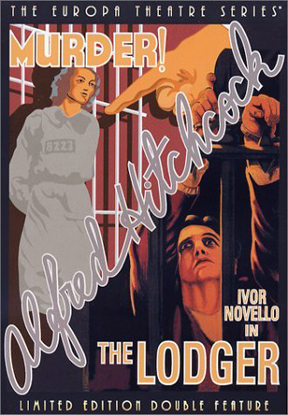
A serial killer known as “The Avenger” is murdering blonde women in London (which, once again, proves that its better to be a redhead). And while nobody knows the identity of the Avenger, they do know that the enigmatic stranger (Ivor Novello), who has just recently rented a room at boarding house, happens to fit his description. They also know that the lodger’s landlord’s daughter happens to be a blonde…
Released in 1927, the silent The Lodger was Alfred Hitchcock’s third film but, according to the director, this was the first true “Hitchcock film.” Certainly it shows that even at the start of his career, Hitchcock’s famous obsessions were already present — the stranger accused of a crime, the blonde victims, and the link between sex and violence.
Also of note, the credited assistant director — Alma Reville — would become Alma Hitchcock shortly before The Lodger was released.

