4 Shots From 4 Films is just what it says it is, 4 shots from 4 of our favorite films. As opposed to the reviews and recaps that we usually post, 4 Shots From 4 Films lets the visuals do the talking.
Today, the Shattered Lens gets a little bit spooky with….
As we all know, October is the month when we usually ignore everything but the horror genre here at the Shattered Lens. However, I’m going to briefly interrupt our horrorthon to say a few words about The 15:17 to Paris.
Directed by Clint Eastwood, The 15:17 to Paris is a film about the 2015 Thalys train attack. This was when a terrorist named Ayoub El Khazzani opened fire on a train that was heading from Amsterdam to Paris. He wounded three passengers and probably would have killed countless more (there were over 500 people on the train) if he had not been subdued by three American friends, one British passenger, and a French train driver. The 15:17 to Paris focuses on the three Americans, Spencer Stone, Anthony Sadler, and Alex Skarlatos.
When the film was released on February 9th, it got middling reviews and was considered to be a box office disappointment. Myself, I saw it the first week of March, just a few days before Jeff and I left for a two-week stay in the UK. I meant to review it when we returned to America but I just never got around to it. However, about a week ago the film made its cable debut and seeing as how Clint Eastwood has a second film coming out this year that might be the Oscar contender that his first film probably won’t be, I figured now is as good a time as any to defend The 15:17 To Paris.
Now, don’t get me wrong. The 15:17 to Paris is not a great film by any stretch of the imagination. In fact, the film’s first line of dialogue — in which Anthony Sadler, in voice over, says that he knows we’re probably wondering why “a brother like me” is hanging out with two white guys — made me cringe so hard that I was worried I might sink into my seat and never be able to escape. Sadler, Spencer Stone, and Alex Skarlatos all play themselves in the movie and none of them comes across as being a natural actor. They may be heroes but they aren’t movie stars.
And yet, the fact that none of them are stars is also the film’s greatest strength. Throughout the film, Eastwood emphasizes how totally and completely average Sadler, Skarlatos, and Stone are. None of them really get the type of “hero shots” that one normally expects to see in a film like this. Instead, Eastwood continually reminds us that they’re just three friends who happened to be on the train when the shooting started. They put their own lives at risk to take the shooter down and they also provided first aid to a man who had been shot. Whether they have movie star charisma or not, they still saved countless lives. The film’s point is that you don’t have to be Chris Pratt or Chris Evans to be a hero. You can just be Chris from across the street. You just have to be someone willing to do the right thing at the right time. It’s a sincere and heartfelt message and it’s one that comes across specifically because Eastwood cast three nonprofessionals.
The film starts with a lengthy sequence that depicts the childhoods of the three lifelong friends. It’s kind of a strange sequence, largely because almost all of the supporting roles are filled by talented actors who are best known for their comedic work on television. Thomas Lennon plays a high school principal while Tony Hale shows up as a coach. Even Jaleel White (!) has a role as a teacher who gives the boys advice on self-defense. When the childhood scenes work, it’s largely due to the performances of Jenna Fischer and Judy Greer, who plays the mothers of Alex and Spencer. But whenever Fischer and Greer aren’t around, the childhood scenes are a bit too slow and awkward.
However, once Sadler, Skarlatos, and Stone are on that train, the film definitely picks up. Whatever awkwardness that the three nonprofessionals may have exhibited earlier in the movie disappears as they spring to action and they recreate their responses to the attack on the train. It’s here that Eastwood’s no-nonsense approach to storytelling definitely pays off, as he recreates the train attack without any of the showy tricks that you might expect from other directors. Instead, Eastwood allows things to play-out naturally. Like the passengers on that train, all we can do is watched as the three men rush the gunman.
The 15:17 to Paris may not be one of Eastwood’s best films but it’s hardly the disaster that it was made out to be. Instead, it’s a sincere and unapologetically old-fashioned celebration of heroism and doing the right thing.
Halloween is the perfect time for a good ghost story and, with that in mind, here is today’s movie.
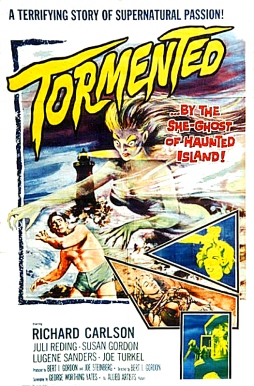
Released in 1960 and directed by Bert I. Gordon, Tormented tells the sad story of Tom Stewart (Richard Carlson). Now, Tom might look like a pretty regular guy but we know that he’s a little bit crazy because he’s a jazz pianist and you know how dangerous those beatnik-types are. Tom is happily engaged to Meg but one day, his ex-girlfriend Vi shows up. Vi is obsessed with Tom and swear that she’s going to end his engagement.
So, naturally enough, Tom throws her off of a lighthouse.
Problem solved, right?
Not quite. Vi may be dead but she’s not out of Tom’s life. Instead, her disembodied head tends to pop up at random moments and taunt Tom. Meanwhile, Tom is having to deal with Meg’s suspicious sister and a beatnik (Joe Turkel, who years later played Lloyd the Bartender in The Shining) who is determined to collect the $5 that he claims Vi owes him.
Between the beatniks and the raging ocean and the disembodied head popping up whenever it’s least convenient, Tormented is a lot of fun and the perfect film for some retro Halloween fun.
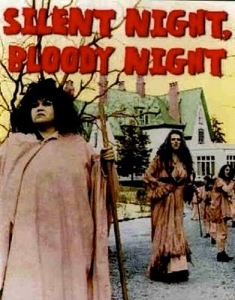
The 1974 film Silent Night, Bloody Night is an oddity.
On the one hand, it’s pretty much a standard slasher film, complete with a menacing mansion, a horrible secret, a twist ending, and John Carradine playing a mute newspaper editor.
On the other hand, director Ted Gershuny directs like he’s making an underground art film and several of the supporting roles are played by actors who were best known for their association with Andy Warhol.
Personally, I like Silent Night, Bloody Night. It has a terrible reputation and the film’s star, Mary Woronov, has gone on record calling it a “terrible movie” but I like the surreal touches the Gershuny brought to the material and the sepia-toned flashbacks have a nightmarish intensity to them. The film makes no logical sense, which actually makes it all the more appealing to me. As the saying goes, your mileage may vary.
Seriously, those little wooden things totally freak me out. You know how some of you feel about the painted smile on the clowns ‘face? Well, that’s how I feel whenever I see the big eyes of a ventriloquist dummy or that mouth with the fake teeth. And don’t even get me started on those tiny little legs that some of them have! AGCK!
I mention this because there is a ventriloquist’s dummy in the 1980 film, Humanoids From The Deep. There’s really no reason for it to be in the film but suddenly, out of nowhere, there it is. It belongs to a teenager named Billy who, when we first see him, is relaxing in a tent on the beach, trying to get his girlfriend to undress for him and the dummy. Of course, they’re promptly interrupted by a seaweed-covered monster, who rips open the tent, kills Billy, and chases after his girlfriend. The whole time, the dummy watches with a somewhat quizzical expression on his face. It’s a strange scene.
Now, I’ve done some research and I’ve discovered that Billy was played by David Strassman, who was (and still is) a professional ventriloquist and his dummy was named …. I do not kid …. Chuck Wood. So, the whole tent scene was kind of a celebrity cameo. Roger Corman, who produced the film, said, “You know what? This movie has blood, nudity, killer fish-men, and rampant misogyny but it’s still missing something! How about that ventriloquist that I saw on the Tonight Show last night!?”
Anyway, Humanoids From The Deep is basically about what happens when you try to mutate salmon. You end up with a bunch of pervy fish monsters swarming the beach and trying to make like human/fish babies. You end up with a lot of dead teens and unplanned pregnancies. You also end up with the local redneck fisherman (led by Vic Morrow) blaming the local Native Americans, accusing them of killing all of the dogs in town. Jim Hill (Doug McClure) and his wife, Carol (Cindy Weintraub), try to keep the peace but their efforts are continually tripped up by the fact that almost everyone in town is an idiot.
For instance, despite the fact that there’s been a countless number of murders and rapes and that they’ve all been committed a group of monsters that nobody knows how to fight, the town still decides to hold their annual festival on the pier. Of course, as soon as the obnoxious DJ starts broadcasting, the humanoids from the deep show up and basically, the entire festival goes to Hell. And here’s the thing. The film itself is ugly and mean-spirited and misogynistic but the attack on the festival is totally and completely brilliant. I mean, it’s one of the greatest monster sieges of all time, largely because the monsters are apparently unstoppable and that humans are so obnoxious that you don’t mind seeing them all die. I mean, if nothing else, the monster deserve some credit for taking out that DJ.
It all leads to a “surprise” ending, which isn’t particularly surprising but which is so batshit insane that it somehow seems appropriate.
Humanoids From The Deep is an incredibly icky movie, one that has some effective scare scenes but which is way too misogynistic to really be much fun. (Roger Corman hired Barbara Peeters to direct the film but reportedly brought in a male director to film the movie’s more explicit scenes.) Oh well. At least the ventriloquist died.
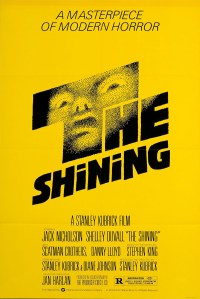
This scene, of course, is from 1980’s The Shining.
Technically, this is before Jack Torrance met the ghosts and started to lose his mind but, in this scene, you can tell that Jack’s already getting a little bit tired of his family. Jack Nicholson’s delivery of, “See? It’s okay. He heard it on the television,” gets me every time.
There’s a beachside resort town, one whose survival is pretty much dependent upon tourists and big business. If you give the tourists a reason to not show up, the town dies. If you give big business a reason to build their factories and their underground tunnels somewhere else, the town dies.
Unfortunately, something bad is happening in this little town. People are going in the water and they’re never returning. It appears that they’re being killed by some sort of giant sea monster, even though the authorities swear that it’s simply impossible. The town’s leaders are putting pressure on the sheriff to cover up the crimes. A scientist shows up and thinks that everyone he meets is an idiot.
It’s not safe to go in the water but people keep doing it!
Now, you may be thinking that it sounds like I’m describing the plot of Jaws but actually, I’m talking about an Italian film called Tentacles. Released in 1977, Tentacles was one of the many films that was directly inspired by the success of Spielberg’s film. Jaws was such a phenomenal success that it was ripped off by filmmakers across the world. That said, of all the people ripping off Spielberg’s film, the Italians brought an undeniable and frequently shameless flair to the Jaws knockoffs.
Tentacles is a bit different from other Italian Jaws films in that, this time, the threat does not come from a shark. Instead, it comes from a giant octopus! That’s actually a pretty good twist because, in real life, an octopus is actually more dangerous than a shark. Not only are they bigger and considerably smarter than most sharks but if they get enough of their eight arms around you, they can literally squeeze you to death! I mean …. agck! Say what you will about sharks, I imagine getting eaten by one would suck but at least it wouldn’t take long to die. Whereas if an octopus gets you, you would actually be aware of it squeezing you to death and oh my God, I’m never getting in the water.
Anyway, in Tentacles, the octopus is snatching babies off of piers and sailors off of boats and it’s using its octopus powers to rip their skin from their bones. It also attack scuba divers by firing ink at them. The sheriff (Claude Akins) says that it’s nothing to worry about but Ned Turner (John Huston), a hard-boiled reporter, thinks that there’s a story here. Ned’s in town visiting his sister (Shelley Winters). She has a ten year-old son who enjoys sailing. Uh-oh….
Henry Fonda shows up for a few very brief scenes, playing the head of a company that built the underwater tunnel that somehow mutated the octopus. Fonda looks incredibly frail in his scenes (and apparently, he filmed his part while recovering from heart surgery) but his performance in Tentacles still isn’t as cringe-inducing as his performance in The Swarm.
Also showing up is a marine biologist named Will Gleason (Bo Hokpkins). Fortunately, Gleason owns two killer whales so, after the octopus kills his wife, Gleason sends out the orcas to track it down. Before doing so, he gives them a pep talk. Apparently, killer whales respond to positive reinforcement.
Tentacles is unique in that it’s an Italian production that managed to rope in a few well-known American actors. It’s an odd film to watch because, on the one hand, the film is full of risible dialogue and it’s painfully slow whenever the octopus isn’t attacking anyone and no one really seems to be that invested in any of their characters. (When the octopus kills a baby, the actress playing the baby’s mother underacts to such an extent that the scene becomes almost surreal.) This isn’t like Jaws, where you actually care about Brody, Quint, Hooper, and the Kintner boy. On the other hand, the octopus itself is actually kind of frightening so, on that very basic level, the film works.
In the end, Tentacles is one of the lesser Jaws rip-offs but you’ll never forget that octopus.
4 Shots From 4 Films is just what it says it is, 4 shots from 4 of our favorite films. As opposed to the reviews and recaps that we usually post, 4 Shots From 4 Films lets the visuals do the talking.
Today, we celebrate horror on the beach with….
4 Shots From 4 Beach Horror Films
The Horror of Party Beach (1964, dir by Del Tenney)
The Beach Girls and the Monster (1966, dir by Jon Hall)
“Nom nom nom nom,” says that monster under the sand.
“Agck! Agck! Agck! Agck!” says the people above the sand.
And that’s all you really need to know about the 1981 film, Blood Beach.
Blood Beach takes place on a beach that also happens to be a hunting ground for this mutated worm thing that lives underground. Basically, whenever anyone takes a stroll on the beach, they get sucked down into the sand and, for the most part, they’re never seen again. Sometimes that’s not a bad thing, as in the case of a wannabe rapist who ends up getting castrated while being pulled down into the sand. But, far too often, the victims are innocent people who were just walking their dog, chasing after their hat, or searching for buried treasure.
The beach becomes so well-known for being a death trap that the locals start to call it Blood Beach but, for some reason, that doesn’t seem to stop people from wandering out on the sand at inopportune times. I mean, it would just seem logical to me that if there’s a monster killing people on the beach then maybe it would be a good idea to avoid the beach for a while. I mean, you could go see a movie or you could lay out and work on your tan in your back yard. Believe it or not, you do have the option of not going to a monster-infested location.
Strangely, there’s one person who is always on the beach but never gets killed. That’s Mrs. Selden (Eleanor Zee), a somewhat odd woman who always seems to be nearby whenever someone is getting dragged into the sand but who never gets attacked herself. Interestingly, Mrs. Selden never seems to be particularly concerned by all the carnage around her. (One victim is even killed while specifically checking to make sure Mrs. Selden is okay.) I kept expecting some sort of major twist where it was revealed that Mrs. Selden was a witch or something but it never happened.
Now, you would think that the presence of an underground monster would be the perfect excuse to call in the national guard but instead, the local police (led by John Saxon’s Captain Pearson) handle it. Sgt. Royko (Burt Young) heads up the monster investigation, which in this film means that he kinda of stumbles from scene-to-scene, never looking particularly impressed by or interesting in anything that’s happening around him. If anything, Royko seems to be annoyed that he’s having to give up time that he could be using to drink beer and watch TV and that attitude makes Royke the hero of this film. Forget the scientist who wants to understand where the monster came from. Forget the habor cop who wants to rekindle things with an old flame. Royko doesn’t care about science or love. He just wants to blow stuff up, which makes him the perfect audience surrogate
Anyway, Blood Beach sounds like it should be a fun movie but it’s not. The movie delivers a lot of beach but very little blood. There’s a lot of “nom nom” but very little “agck!” Blood Beach is almost as much of a misfire as spending spring break in West Texas.
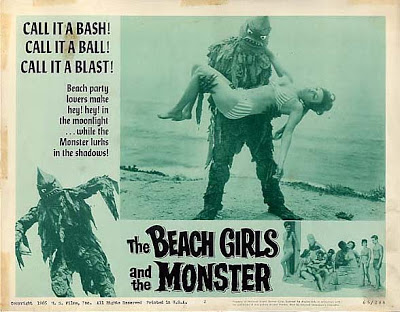
For today’s horror on the lens, we offer up 1965’s The Beach Girls and the Monster. In this one, a monster that might be a mutated barracuda is hiding out on the beach and killing teenagers. Can Dr. Otto Lindsay (played by the film’s director, Jon Hall) figure out how to defeat the monster? Will Otto’s son Richard (Arnold Lessing) ever stop surfing long enough to get back to studying science? Will Otto’s much younger wife Vicky (Sue Casey) seduce the troubled and crippled sculptor Mark (Walker Edmiston)? And will it ever occur to anyone to just go to a different beach?
Complete with a ludicrous monster, a great soundtrack, tons of dancing, melodramatic acting, and a twist ending that will surprise no one, The Beach Girls and the Monster is low-budget favorite of mine. It’s also, I think, a perfect movie to watch on a rainy October Saturday.