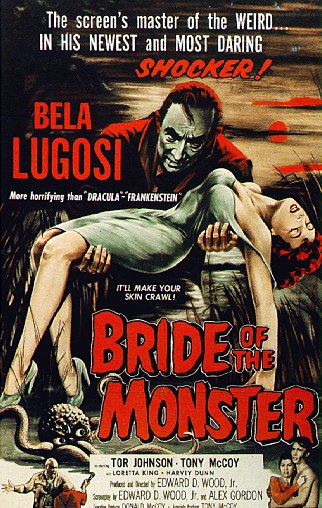
So begins the monologue that serves as the centerpiece of the 1955 Ed Wood film, Bride of the Monster. The monologue is delivered by Bela Lugosi, appearing in one of his final roles.
Far too often, people tend to be snarky about the work that Lugosi did under the direction of Ed Wood. But you know what?
He actually delivers a pretty good performance in Bride of the Monster.
Ignore all of the stuff about atomic supermen and instead, just pay attention to the way Lugosi delivers the lines. Pay attention to the pain in his voice as he says that he has no home. Pay attention and you’ll discover that Lugosi actually gave a good performance in Bride of the Monster. He delivers the lines with such wounded pride that you can’t help but think that maybe we should let him create a race of atomic supermen.
Among the old horror icons, Lugosi has always been the most underrated actor. He got typecast early and he appeared in some unfortunate films but Bela Lugosi had real talent and you can see it in this scene.
4 Shots From 4 Films is just what it says it is, 4 shots from 4 of our favorite films. As opposed to the reviews and recaps that we usually post, 4 Shots From 4 Films lets the visuals do the talking.
Today is Tor Johnson’s birthday so it just seems appropriate to present….
4 Shots From 4 Tor Johnson Films
Bride of the Monster (1955, directed by Edward D. Wood, Jr.)
The Unearthly (1957, dir by Boris Petroff)
Plan 9 From Outer Space (1959, dir by Edward D. Wood, Jr.)
The Beast of Yucca Flats (1961, dir by Coleman Francis)
Oh my God, what is the thing with Ouija boards in movies?
Seriously, nothing good ever comes from using one. I have seen hundreds of movies featuring people foolishly using Ouija boards and, without fail, it always seems to lead to someone getting possessed by an evil spirit and then killing all of their friends. Whenever I see anyone using a Ouija board in a movie, I always want to ask them if they’ve never seen a horror movie before.
Then again, despite knowing all the of the terrible things that can happen as a result, I have had a few Ouija board experiences. For instance, when I was like 13, I asked a Ouija board if a boy named Diego liked my friend Jenny. The board replied that Diego liked me and Jenny needed to deal with it. Jenny accused me of manipulating the pointer and basically never spoke to me again but I suppose that’s better than either one of us getting possessed by a homicidal spirit. Myself, I don’t even believe in ghosts but I still find it difficult to resist a séance.
I guess my point is that it’s easy to laugh at movie characters who foolishly use Ouija boards but the main reason were laughing is because we know that we’re just as stupid as they are.
I recently watched one of the better Ouija board movies, 1988’s Witchboard. It’s about an angry spirit that might be named David, a skeptic named Jim (Todd Allen), a believer named Brandon (Stephen Nichols), and the woman who they both love, Linda (Tawny Kitaen). When I watched the movie, I immediately related to Linda, mostly because we both have red hair and everyone in the kept talking about how Linda hardly ever curses. That’s pretty much the way I am too, though there are exceptions. For instance, on Monday, the internet was down for 12 hours and I cursed up a storm. Linda, meanwhile, starts cursing after she has a bad experience with a Ouija board.
Jim (who is Linda’s current boyfriend) and Brandon (who is Linda’s ex) spend a lot of time debating who is to blame for Linda potentially getting possessed. Personally, I hold them both responsible. Brandon is the one who brought his Ouija board to Jim and Linda’s party. Brandon is also the one who contacts the spirit of a boy named David. At the same time, Jim’s the one who insulted the spirit, which led to Brandon’s tires getting slashed and Brandon storming out of the party. Brandon left behind his Ouija board, which Linda then used unsupervised. (Apparently, that’s something you should never do.) Basically, Jim and Brandon came together to form a perfect storm of testosterone-driven incompetence in this movie.
Soon, people are dying and Linda’s acting weird. When one of Jim’s friends is killed in a construction accident, Linda is upset to see that Jim didn’t even cry. Brandon informs her that Jim has “ice water in his veins.” For his part, Jim just wants to know why Linda is suddenly using so much profanity. Brandon brings in a medium named Zarabeth (played by Kathleen Wilhoite), who is one of those extremely flamboyant and outspoken characters that you’ll either totally love or thoroughly hate. (Personally, I liked the character. Even if she was somewhat annoying, she brought a jolt of life to the film.) Zarabeth attempts to exorcise the spirit of David and ends up getting tossed out a window as a result.
It’s tempting to just shrug and say, “Well, this is what happens when you mess around with the spirit world,” but Witchboard actually does a pretty good job of developing its characters and getting you to care about what happens to them. The fact that Jim and Brandon are both in love with Linda adds a bit of unexpected depth to the film’s story. Does Brandon really believe that Linda is being stalked by a spirit or is he just trying to win her back for himself? Even the seemingly throw-away detail about Jim’s emotional reticence pays off later in the movie. And, when that evil spirit does finally actually make a physical appearance, he’s just as creepy as you would hope he would be.
Witchboard is a definitely a film that will be appreciated by anyone who has ever used a Ouija board and felt kind of nervous about it afterwards.
The original The House on Haunted Hill is a classic and one that we make it a point to share every Halloween. And since Erin shared the film’s poster earlier today, now seems like the perfect time to do so!
The 1989 Italian zombie film, After Death, takes place on a Caribbean island. I’m not sure if the island was actually given a name in the film. If they mentioned it, I either didn’t hear it or I didn’t bother to jot it down in my notes. But, to be honest, the island doesn’t really need a name. If you’ve ever seen an Italian zombie film, you’ll recognize the island immediately. It features the same lush tropical jungle that was used in Hell of the Living Dead and there’s the usual voodoo-loving island natives. Whether it was in Zombi 2 or Zombie Holocaust, you’ve seen this island before.
Years ago, Jenny grew up on the island. Her parents were scientists, working to discover a cure for cancer. But, after one of them shot and killed the local voodoo priest, all of the scientists on the island ended up getting eaten by zombies. Jenny would have been eaten as well, except for the fact that she owns a magic necklace.
Now an adult, Jenny (Candice Daly) is returning to the island with a group of mercenaries. We know that they’re meant to be mercenaries because they have guns and grenades and headbands. They’re not exactly the most impressive paramilitary crew that’s ever appeared in a movie. I mean, if this was a Predator movie, it would be a contest to see which one of them ended up getting killed first.
Jenniy and the mercenaries are heading to island to discover why her parents were killed. As soon as they arrives at the island, their boat’s engine dies, which is really rotten luck because now they’re stranded. Of course, their luck is about to get even worse….
But first, we cut to some hikers. They’re hiking the island and you have to wonder why Jenny and the mercenaries were acting like this island was so isolated when apparently, anyone can just hire a guide and hike it anytime they want to. Anyway, the hikers stumble into a cave that they shouldn’t have stumbled into. This leads to the zombies once again coming to “life” and proceeding to attack anyone who they perceive as not belonging on the island.
Only one of the hikers survives. Fortunately Chuck (played by Jeff Stryker, a porn star who appeared in this film under the name Chuck Peyton) manages to find the mercenaries and together, they all hide out in a deserted laboratory. Unfortunately, one of the mercenaries has been injured by the zombies and is slowly dying. Soon, everyone is under siege as the undead surround the lab….
So, After Death is a totally ludicrous film that I can’t help but kind of like. It doesn’t quite rise to the level of being a guilty pleasure but, for the most part, the cast fully commits to their thinly-written roles and, from the minute the dead come back to life, the action is nonstop. These aren’t your typical mindless zombies, just wandering about and randomly eating people. Instead, these zombies are on a mission and their determination makes them a bit more menacing than the typical decaying cannibal. While director Claude Fragasso never creates the type of ominous atmosphere that distinguished the zombie films of Lucio Fulci, he still keeps the action moving at a steady pace. Even the fact that the ending makes no sense adds to the film’s weird charm.
After Death is also known as Zombi 4: After Death. When Dawn of the Dead was released in the Italy, it was called Zombi. It’s success led to Lucio Fulci making a film called Zombi 2, which, while being a fantastic horror film, had nothing to do with George Romero’s classic. The success of Zombi 2 led to Zombi 3, which was started by Fulci but completed by Claudio Fragasso’s frequent collaborator, Bruno Mattei. (Fragasso also wrote the screenplay for Zombi 3.) Beyond the undead and the island setting, After Death has nothing to do with the previous Zombi films. It has even less to do with the subsequent Zombi 5: Killing Birds. However, you have to give the Italian exploitation film industry some credit. They never allowed a good title to go to waste.
In this 1936 film (which has absolutely no relation to the AMC zombie show), Boris Karloff plays John Ellman. John Ellman is perhaps one of the unluckiest guys ever. Seriously check this out:
John Ellman was once an acclaimed concert pianist. However, he was wrongly convicted of killing his wife and spent ten years in prison. Now that he’s finally been paroled, he can’t get anyone to hire him. Meanwhile, the judge who originally sent him to prison is in the news for having defied the mob and sentenced a well-known gangster to prison. The mob is out for revenge but, rather than take the fall themselves, they’d rather frame a patsy. And who could be a better patsy than a man who everyone already knows has a grudge against the judge?
Nolan (Ricardo Cortez), a crooked lawyer, arranges for Ellman to be given a job. Ellman is told that he simply has to spy on the judge for a few nights to determine whether the judge is having an extramarital affair. Ellman agrees and soon finds himself being set up. The gangsters kill the judge and plant the body in Ellman’s car. Ellman is arrested and sentenced to die. It doesn’t matter that there are witnesses who know that Ellman’s innocent. No one is willing to cross the mafia.
Ellman is convicted and promptly executed but his story isn’t over. A scientist named Dr. Beaumont (Edmund Gwenn, who later played the man who might be Santa Claus in Miracle on 34th Street) knows that Ellman is innocent. He takes Ellman’s body and, through an artificial heart and a bunch of other science-y things, he manages to revive Ellman. John Ellman lives again! Of course, he’s a bit of a zombie now and he doesn’t have any memory of his former life. And yet, he instinctively knows who set him up to be executed and he sets out for revenge.
What’s interesting is that Ellman doesn’t kill anyone. Even after he’s revived and presumably has no concept of right and wrong, John Ellman remains a rather passive zombie. For the most part, the racketeers die because of how they react to the sight of the previously dead Ellman coming towards them. For that matter, Beaumont isn’t the typical mad scientist that you might expect to turn up in a film like this. He’s a benevolent man who was simply doing what he thought was the right thing. Though the film ends with a warning about playing God, one can’t hep but get the feeling that, unlike Frankenstein, the film is overall very supportive of the idea of reviving the dead.
Directed by Michael Curtiz (who also did Casablanca, Mildred Pierce, The Adventures of Robin Hood, and countless other classic films), The Walking Dead is a combination horror/gangster film. The film’s plot is a bit too convoluted for its own good but, overall, The Walking Dead works because of Boris Karloff’s performance. He’s poignantly pathetic as the living John Ellman and then rather chilling as the vengeance-driven, recently revived Ellman. The film’s most effective scenes are the ones where he just stares at his enemies, fixing them with a gaze that takes no prisoners and offers no hope. It’s a great performance that elevates an otherwise uneven film.
In this scene, Conal Cochran (Dan O’Herlihy) explains not only the origins of Halloween but he also discusses how he’s going to make Halloween great again. This scene is probably the best in the film and it’s almost entirely due to O’Herlihy’s wonderfully menacing performance as Conal Cochran.
It’s really not Halloween without at least one mummy film!
With that in mind, here’s a 1957 film called Pharaoh’s Curse. In this film, a team of archeologists foolishly enter a mummy’s tomb and you can probably guess the rest. Honestly, you would think that archeologists would eventually learn that it’s never a good idea to test a curse but apparently, it never happened.
Anyway, if you’ve got an hour to kill, enjoy Pharaoh’s Curse!
1965’s Attack of the Eye Creatures is an odd little movie.
It starts, as so many bad sci-fi movies do, with Peter Graves narrating about how the government has been keeping an eye on a flying saucers that’s apparently been hovering over the Earth for quite some time. However, a quick visit to Project Visitor reveals that the soldiers assigned to protect us are more interested in using their monitoring equipment to spy on teenagers making out in their cars!
Agck!
EWWWWWW!
Total invasion of privacy!
Of course, what’s particularly sad about the whole thing is that you know that’s totally what would happen in real life as well. Give a group of people the power to spy on anyone in the world? Of course they’re going to end up spying on people fooling around in cars! That’s one reason why Earth is just as doomed today as it was in 1966.
Anyway, the flying saucer does eventually land. Unfortunately, our government is too incompetent to do anything about it. The aliens inside turn out to be …. well, not that impressive. For one thing, they don’t speak. There are none of the grandiose threats to conquer the world that we’ve come to expect from aliens. At the same time, we also don’t have to hear about how the rest of the universe is disappointed in us for polluting our planet and blowing each other up so that’s a good thing. So often, intergalactic visitors can be so judgmental! Anyway, these aliens are lumpy and gray and they’ve got several eyes. They don’t really look that impressive. Seriously, check this jerk out:
As I said, the government turns out to be pretty useless when it comes to battling the aliens and the local police are skeptical that any intergalactic visitors would bother to land in their crappy little town. Fortunately, as always happens whenever the controlling legal authorities fail to do their job, there are teenagers and they’re willing to do what needs to be done to protect the world!
Of course, if Stan (John Ashley) and Susan (Cynthia Hull) are going to rally the troops against the aliens, they’re going to have to borrow someone’s phone. That’s going to mean convincing the local old man to let them use his phone. The old man, who has had enough of those crazy kids with all their kissing and the jazzy lingo, is more interested in using his shotgun to keep people off his lawn.
Meanwhile, two drunks decide that they want to get in on all this alien business. They both later die and no one in the movie seems to care. That’s just the type of movie that this is….
….and if it sounds familiar, that’s probably because you’ve seen the 1957 drive-in classic, Invasion of the Saucer Men! Basically, in the mid-60s, American International Pictures commissioned Texas filmmaker Larry Buchanan to remake some of their most successful drive-in films. Apparently, the plan was to sell them to television. So, Buchanan took the script for Saucer Men, tossed in some scenes of the government spying on people (Buchanan was a noted conspiracy theorist who previously directed The Trial of Lee Harvey Oswald), and called his film Attack Of the Eye Creatures!
Yet, while Invasion of the Saucer Men was a genuinely clever sci-fi satire, Attack of the Eye Creatures is done in by Buchanan’s inability to keep his story moving at a steady pace and it doesn’t help that the iconic Saucer Men have been replaced by men who appear to be wearing trash bags. Attack of the Eye Creatures is an unfortunate remake and one that should be viewed only after you’ve watched Invasion of the Saucer Men and maybe every other public domain sci-fi film that’s currently on YouTube.
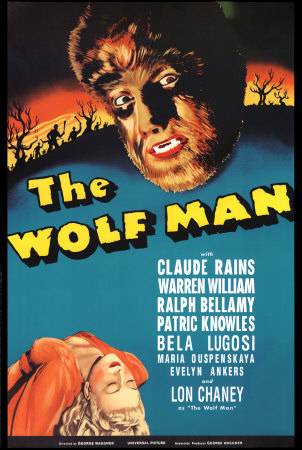
Today’s horror scene that I love comes from 1941’s The Wolf Man.
In this scene, poor, unfortunate Larry Talbot (Lon Chaney, Jr) visits a gypsy camp and learns that sad truth of his fate from Maleva (Maria Ouspenskaya). I love this scene not only for the iconic dialogue but also for George Waggner’s atmospheric direction and Maria Ouspenskaya’s performance. Even Lon Chaney, Jr. gives it his all in this scene. Larry Talbot may have been a dumb lug but he was our dumb lug!