Yes, The Cinema Audio Society Does Exist and So Do Their Nominations


Big-Hero-6-Funny-Cute-Wallpaper-2014-Disney-1412893206157

Is anybody going to be happy when the Oscar nominations are revealed on Thursday and all of us self-declared award divas will no longer have to pay attention to any of the precursors?  Seriously, I never thought I could get sick of awards seasons but oh my God!

Listen, I love foreplay but sometimes, you just need have to get to the point.

ANYWAY, here are the Cinema Audio Society nominees for the best achievements in sound mixing in 2014.  Before anyone dismiss the importance of these nominees, consider that correctly guessing the nominees for the Academy Award for Best Sound Mixing could make the difference in your Oscar pool.

Or, it might not.

(By the way, Arleigh, when I’m tempted to fanatically follow next year’s awards season, remind me of this post.  It might make all the difference!)

Anyway, here are the film nominees!

BEST ACHIEVEMENT IN SOUND MIXING — LIVE ACTION:

American Sniper

Birdman

Guardians of the Galaxy

Interstellar

Unbroken

BEST ACHIEVEMENT IN SOUND MIXING — ANIMATED:

Big Hero 6

The Boxtrolls

How To Train Your Dragon 2

The LEGO Movie

Penguins of Madagascar

Here are the DGA Nominations!


The DGA nominations were announced today and the big news will probably be that Ava Duvernay was not nominated for Selma.  Though I’m sure that Sasha Stone will claim this is because the Tea Party has somehow taken over Hollywood, others are suggesting that it could be that the majority of the DGA members did not receive a screener for Selma.

(I haven’t seen Selma yet so I can’t say anything about whether it deserves to be nominated or not.  I have to admit that it worries me to see how stridently the people at Awards Daily are pushing it because I have a theory that the editor of that site promotes films that she knows won’t be nominated so she’ll have an excuse to be all holier-than-thou as a result.  Case in point: the site’s  fanatic insistence that David Fincher’s offensively sexist rehash of The Girl With The Dragon Tattoo was best picture-worthy,  which needless to say is an interesting position for someone who claims to be a feminist to take.)

Anyway, here are the directors who were nominated:

Wes Anderson for The Grand Budapest Hotel

Clint Eastwood for American Sniper

Alejandro Gonzalez Inarritu for Birdman

Richard Linklater for Boyhood

Morten Tyldum for The Imitation Game

Eastwood


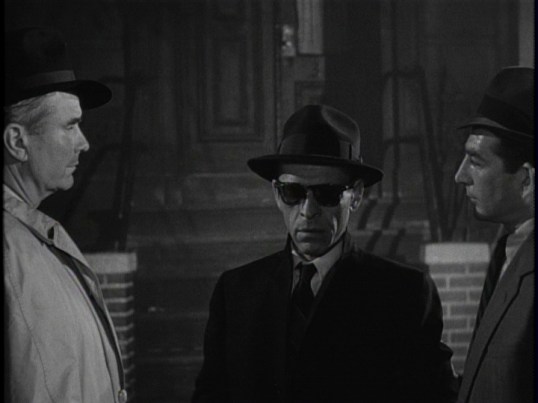
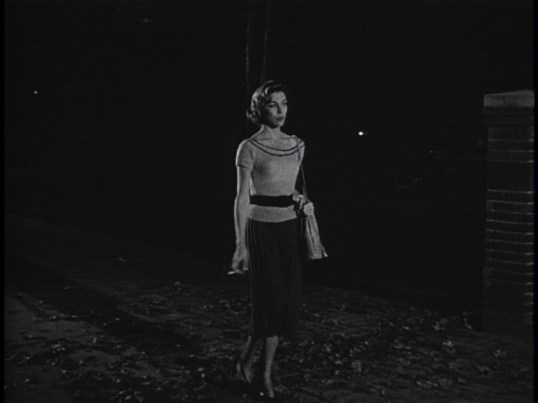
Netflix Noir #4: The Mugger (dir by William Berke)


The Mugger 2

For my final Netflix Noir, I watched The Mugger, a film from 1958.

The Mugger is a police procedural.  Taking place in an unnamed city, it stars Kent Smith as Dr. Pete Graham.  Pete’s both a psychiatrist and a cop and, needless to say, he has a lot to deal with.

For one thing, his girlfriend, Claire (Nan Martin) is also a cop.  In fact, she’s apparently the only female cop on the entire force!  (“Woman cops?” another detective is heard to say, “Do we really need them?”)  Claire spends most her time working undercover on the dance hall circuit.  Pete wants to get married.  Claire wants to solve a few more cases before making that commitment.  Pete says that’s okay, as long as her plans “include me, a home, and children.”

Pete has also been forcefully recruited to counsel a Jeannie (Sandra Church), the sister-in-law of a local taxi driver.  As the driver explains it, Jeannie is “about 18 and is she built!”  Pete replies, “You shouldn’t get excited about a kid who wants to have a good time,” which seems like an unusually progressive attitude for a cop in the 1950s.  Still, Pete agrees to try to encourage Jeannie to be a little bit less rebellious.  Jeannie, by the way, is my favorite character in the film because she is never in a good mood and she gets to dismiss her older sister’s concerns by saying, “Maybe she’s getting a little old, a little jealous.”

It also turns out that Jeannie’s neighbor, Nick Greco (George Maharis), has a crush on her and apparently, just hangs out in her house all day.  While this seemed rather creepy to me, the film seemed to suggest that this was just normal 50s behavior.  Apparently, since nobody bothered to lock their doors back then, it was also totally appropriate to just hide in someone’s house and listen in on private conversations.

Peter’s other big problem is that there’s a mugger who is robbing women and cutting their cheek with a knife.  I have to give the film some credit here because it doesn’t shy away from discussing the sexual subtext to these attacks, which I imagine was quite daring for a film in the 50s.  Pete comes up with a detailed profile of the attacker, the sort of thing that would make the cast of Criminal Minds jealous.  Claire goes undercover to catch the mugger and there’s a great scene where a drunk sailor tries to harass her and she threatens to shoot him in the knee caps.  Again, this is not the sort of thing that we typically associate with a 50s film…

Which is not to say that The Mugger is not clearly a product of its time.  For one thing, just check out the police force in this city, which is all white, all middle-aged, and — with the exception of Claire — all male.  As well, this is one of those old movies where any woman who walks down a street will be leered at by every guy she passes, including the film’s heroes.  One of the reasons why it was so great to see Claire threaten to cripple that soldier was because it came after 50 minutes of watching Pete and every other man in the film do a double take whenever she entered a room.

Clocking in at a little over 70 minutes and obviously low-budget, The Mugger is an undeniably obscure film.  Checking with the imdb, I discovered only two reviews that had been previously written for this film and one of them was in Turkish!  When I went onto YouTube to look for a trailer, I found nothing.  The Mugger is forgotten and hardly a lost classic but I still enjoyed watching it.  What can I say?  I love my history and, if nothing else, The Mugger is definitely a time capsule.

Watch it on Netflix while you can!

The Mugger

Netflix Noir #3: Crime of Passion (dir by Gerd Oswald)


CrimepassionPosterThe third Netflix Noir that I watched was 1957’s Crime of Passion.

In Crime of Passion, Barbara Stanwyck plays Kathy Ferguson, a San Francisco-based advice columnist.  She is approached by two homicide detectives who request her help tracking down a fugitive who they think might read her column.  Charlie (Royal Dano) is aggressive and outspoken.  When he first meets Kathy, he tells her, “You’re work should be raising a family and having dinner ready when your husband comes home from work.”  His far more passive partner is Detective Bill Doyle (Sterling Hayden).

Kathy writes a column that convinces the fugitive to turn herself in.  (The power of Kathy’s column is shown in an amusing montage where woman after woman is seen reading the column aloud.  Significantly, no men are seen to ever read anything that Kathy has written.)  The resulting fame leads to Kathy getting a job offer in New York.

However, before Kathy can leave, she gets a phone call from Bill.  He asks her out on a date and, one scene later, they’re getting married in the shabby office of a justice of the peace.  Kathy sacrifices her career to be a suburban housewife.

From the minute that Kathy first looks at the small and anonymous house and the boring neighborhood that she’ll be sharing with Bill, it’s obvious that things are not going to work out well.  Even though Kathy even tells Bill, “I hope all your socks have holes in them and I can sit for hours darning them,” the life of domestic servitude is not for her.

Every day, she stays home while Bill goes to work.  At night, she reluctantly plays hostess to the constant gatherings of Bill’s colleagues and their wives.  The women stay in one room while the man gather in another.  Kathy is quickly bored with the inane chattering of the other wives but whenever she tries to go into the other room, she finds herself treated like an unwanted intruder.

And worst of all is the fact that Bill has absolutely no ambition of his own.  He’s got his house.  He’s got his wife.  He’s got his friends.  And he doesn’t feel that he needs anything else.

Kathy takes it into her own hands to advance Bill’s career, first by having an affair with Bill’s boss (Raymond Burr) and finally by trying to find a spectacular crime that Bill can solve.  And, as the suburbs continue to drive her mad, Kathy is not above creating a few crimes on her own…

In many ways, Crime of Passion reminds of another 50s film, Nicholas Ray’s Bigger Than Life.  Both films use the conventions of melodrama to present a surprisingly subversive look at the horrors of suburban conformity.  Unfortunately, Crime of Passion never quite reaches the heights of Bigger Than Life, largely because Sterling Hayden gives such a dull performance as Bill that you never believe that Kathy would have married him in the first place.  (The film would have been far more impressive if Bill had started out as an apparently dynamic character whose dullness was then revealed after Kathy married him.)  However, Barbara Stanwyck is well-cast as Kathy and Raymond Burr plays up his character’s ambiguous morality.  If nothing else, Crime of Passion is one of those film to show anyone who is convinced that nothing subversive was produced in the 1950s.

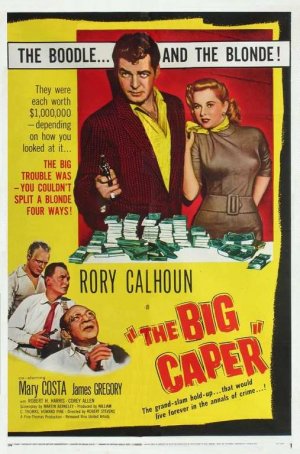
Netflix Noir #2: The Big Caper (dir by Robert Stevens)


The Big Caper Poster

For our next Netflix Noir, we take a look at a heist film from 1957, The Big Caper.

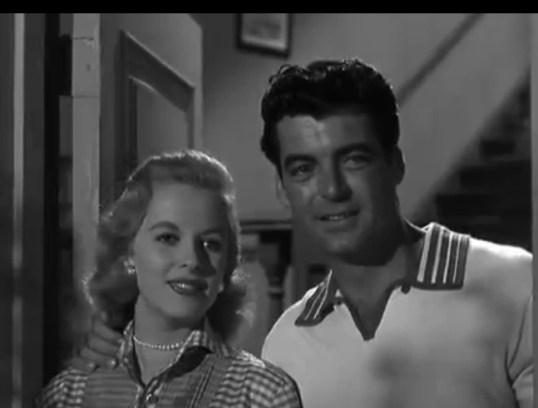
Frank (Rory Calhoun) is a small time criminal with a plan.  He knows that there’s a Marine base near the small town of San Felipe, California and he also knows that, during the weekend before payday, the San Felipe bank will be holding a million dollar payroll for those Marines.  He proposes  to Flood (James Gregory), a wealthy crime boss whom Frank idolizes, that they should find a way rob that bank over the weekend.  Flood agrees to the plan.

While Flood recruits some help for the robbery, Frank and Flood’s girlfriend, Kay (Mary Costa), move into the town and set themselves up as a part of the community.  Using Flood’s money, Frank buys a gas station and he and Kay move into a nice suburban house.  At first, Frank resents being forced to live like a “square.”  He bitterly complains that the local San Felipe newspaper doesn’t even tell him “how the horses did.”

But then something odd happens.  Frank starts to enjoy being a member of the community.  Soon, the gas station is making a profit and Frank is even thinking about buying a second one.  Oddly enough, his becomes best friends with the local cop.

As for Kay, she transitions to respectability even before Frank does.  As she eventually confesses to Frank, she’s tired of being treated like Flood’s property.  She wants to stay in San Felipe and make a life for herself.  Wearily, Frank tells her that she better hope that Flood doesn’t find out…

Meanwhile, Flood has recruited together his gang and they’re not exactly the most impressive bunch of criminal masterminds.  There’s Roy (Corey Allen), a physical fitness fanatic who is almost childlike in his devotion to Flood.  There’s Harry (Paul Picerni), who demands that his girlfriend Doll (Roxanne Arlen) be a part of the scheme.

And then there’s Zimmer (Robert H. Harris), a bald, sweating pyromaniac who spends most of his time begging for alcohol and lighting matches.  Zimmer arrives at Frank’s house unannounced and Frank is forced to pretend that Zimmer is his uncle.

Once Flood and the rest of the gang arrive, Frank starts to prepare for the robbery but he soon discovers that he’d rather be barbecuing with the neighbors.

The Big Caper is a clever little film, one that features excellent performances (especially from Gregory, Calhoun, Allen, and Harris) and tons of hard-boiled dialogue.  What makes this film especially memorable is the way that it contrasts the fake respectability of the wealthy Flood with the newfound, but genuine, respectability of Frank and Kay.

If The Big Caper was made today, it would probably be directed by the Coen Brothers and Ben Affleck and Ray Liotta would play Frank and Flood respectively.  However, the film works just as well with Rory Calhoun and James Gregory and is totally worth seeing.

The Big Caper

Netflix Noir #1: Crime Against Joe (dir by Lee Sholem)


Crime_Against_Joe_poster

After watching Inherent Vice last weekend, I decided to get on Netflix and do a search for film noirs.  This led to me watching four film noirs from the 50s, all of which were previously unknown to me.

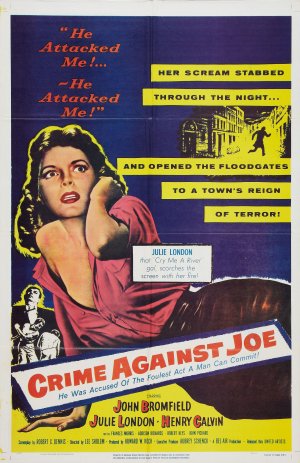
For my first Netflix Noir, I watched a little something called Crime Against Joe.  It’s a 69 minute film from 1956.  It’s about a guy named Joe.  There’s been a crime.  Oddly enough, the crime really against Joe.  Instead, he’s been wrongly accused of committing a crime against a nightclub singer named Irene.  So, perhaps a better title for this film would have been It Sucks To Be Joe.

But anyway —

Crime Against Joe was directed by Lee Sholem.  According to Wikipedia, Lee Sholem had a 40 year career as a director.  During that time, he directed over 1,300 television episodes and feature films and he finished every single one of them either on time or early.  And you can certainly see evidence of that in Crime Against Joe, a film that starts out in a rush and pretty much never slows down until the final fade out.

Joe (John Bromfeld) was voted “most likely to succeed” in high school but — surprise!  surprise! — he’s failed to live up to the expectations set for him by the 1945 yearbook.  Instead, he enlisted in the army, served in the Korean War, and was diagnosed with “battle fatigue.”  (I assume that battle fatigue was the 1950s version of PTSD.)  He spent a while in a mental hospital and it was there that he first started painting.  When he was released, he moved in with his widowed mother (Frances Morris).  While she works to support him, Joe spends his time drinking and painting.

As the movie begins, a drunken Joe has just destroyed his latest painting.  (“I can see it in my head but it doesn’t come out on canvas!” Joe shouts, which is actually a pretty good way to describe the dark feeling that all artists occasionally get.)  He wanders around town, drunk.  He talks to a waitress named Slacks (Julie London), who is obviously in love with him.  He gets some sage advice from Red (Henry Calvin), a taxi driver.   He stumbles into a nightclub where he harasses a singer (Alika Louis) before finally getting thrown out of the club.  In the parking lot, as he stumbles away, a mysterious cowboy (Rhodes Reason) glares at him.

Joe stumbles about until, around two in the morning, he runs into a young woman wearing a nightgown.  He tries to talk to her but she only stares at him, her placid face frozen in a zombie-like state.  Joe leads her to a nearby house where the woman’s father thanks him for his help and then slams the door in his face.

Later that night, the nightclub singer is found dead on the side of the road.  Found near her body is a high school pin that belonged to someone from the class of 1945.  Knowing that Joe was drunk that night and had been seen in the nightclub, Detective Hollander (Robert Keys) goes to Joe’s house.  Hollander demands to see Joe’s high school pin.  Joe says he doesn’t know where it is.  Hollander stares at Joe’s paintings.  “You always paint half-naked women?” Hollander sneers before arresting Joe for murder.

At the station, Joe says that he was leading the woman back to her house at the same time that the singer was murdered.  The woman’s father shows up at the police station.  No, he says, Joe was nowhere near his house at two in the morning.  Joe is arrested for murder…

Fortunately, Slacks is willing to risk her life to prove that Joe is innocent.  And Joe knows that the murderer had to have been someone who he went to high school with…

Crime Against Joe is one of those low-budget, obscure B-movies that actually a lot more interesting than you might think.  John Bromfeld does a good job as Joe and the character’s PSTD gives the film a bit more depth than you might otherwise expect.  Julie London is great in the role of brave and selfless Slacks (though it’s interesting that this film felt the need to give a masculine nickname to a strong female character) and Rhodes Reason is genuinely menacing as the mysterious cowboy.  Crime Against Joe is also full of unexpected and occasionally surreal details.  The most obvious example would be the zombie-like woman who Joe runs into on the night of the murder.  However, my favorite little oddity is the fact that signs reading “Corey for Councilman” keep popping up in the strangest locations.

(It eventually turns out that Joe went to high school with Corey and the scene where Joe confronts his old classmate is a fun little piece of political satire.  That said, there was a part of me that hoped the significance of the sings would just remain an odd and unexplained little detail.)

There’s actually a surprisingly subversive streak running through Crime Against Joe.  We usually tend to think of the 50s as being a time when authority figures (like the police) were viewed with blind trust.  In Crime Against Joe, however, nobody in power is portrayed positively.  The police, for instance, come across like a bunch of close-minded bullies who are prepared to convict Joe based solely on his paintings and his less-than-sterling war record.  The scenes where Hollander interrogates Joe are full of menace.  In the end, this film is on the side of those living on the margins of respectable society.  When Joe and Slacks try to prove Joe’s innocence, they’re also attempting to prove their own right to exist in a society that has rejected both of them.

Crime Against Joe may not be a well-known film but there’s a lot more going on under its surface than you might originally think.  It’s on Netflix so check it out when you’ve got 70 minutes to spare.

Here’s What Won At The Golden Globes!


Film Awards

Best Film (Drama) — Boyhood

Best Drama Actor — Eddie Redmayne in The Theory of Everything

Best Drama Actress — Julianne Moore in Still Alice

Best Film (Comedy) — The Grand Budapest Hotel

Best Comedy Actor — Michael Keaton in Birdman

Best Comedy Actress — Amy Adams in Big Eyes

Best Supporting Actor — J.K. Simmons in Whiplash

Best Supporting Actress — Patricia Arquette in Boyhood

Best Director — Richard Linklater for Boyhood

Best Screenplay — Birdman

Best Animated Feature — How To Train Your Dragon 2

Best Score — The Theory of Everything

Best Original Song — “Glory” from Selma

TV Awards

Best Drama Series — The Affair

Best Drama Actor — Kevin Spacey in House of Cards

Best Drama Actress — Ruth Wilson in The Affair

Best Comedy Series — Transparent

Best Comedy Actor — Jeffrey Tambor in Transparent

Best Comedy Actress — Gina Rodriguez in Jane the Virgin

Best TV Movie/Limited Series — Fargo

Best TV Movie/Limited Series Actor — Billy Bob Thornton in Fargo

Best TV Movie/Limited Series Actress — Maggie Gyllenhaal in The Honourable Woman

Best TV Supporting Actor — Matt Bomer in The Normal Heart

Best TV Supporting Actress — Joanne Froggatt in Downton Abbey

Scenes That I Love: Anita Ekberg and Marcello Mastroianni In The Trevi Fountain


La_Dolce_Vita_(1960_film)_coverart

Anita Ekberg, RIP

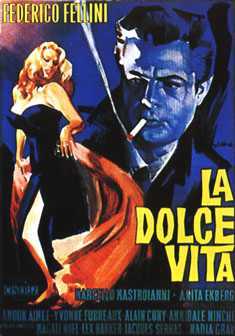
This famous and iconic scene is taken from Federico Fellini’s 1960 film, La Dolce Vita.  The film follows tabloid journalist Marcello (Marcello Mastroianni) over the course of 7 days and 7 nights.  He spends the 2nd day pursuing a famous actress named Sylvia (Anita Ekberg).  As the day comes to an end, he finds Anita wading into the Trevi Fountain.

As famous and celebrated as this scene is, it’s often forgotten that it ultimately ends with Sylvia being slapped by her loutish boyfriend, Robert (Lex Barker).  That slap is not included in the video below but that’s okay.  For today, at least, let’s allow Sylvia her happiness.

What Lisa Watched Last Night #109: Sugar Daddies (dir by Doug Campbell)


On Saturday night, I watched the latest Lifetime film, Sugar Daddies!

Sugar Daddies

Why Was I Watching It?

Because it was on Lifetime and it didn’t have a thing to do with football.

What Was It About?

College is expensive and law school even more so.  Can you blame Kara (Taylor Gildersleeve) for agreeing to become the mistress of the wealthy and considerably older Grant (Peter Strauss)?  Grant pays Kara $5,000 dollars a month, gives her a new car, and flies her around in a private jet.  All Kara has to do is be available whenever he demands her presence.

Except, of course, this is a Lifetime movie and nothing is ever that simple…

What Worked?

To be honest, Sugar Daddies is just a fun film.  Yes, it is dealing with a serious subject and, ultimately, it does come down on the side of being poor but honest.  But, before that, you get to look at all the nice clothes and all the well-decorated mansions and you get to enjoy all of the decadence that comes from being a rich man’s mistress.  Sugar Daddies may be a cautionary tale but it definitely knows how to enjoy itself.

This movie was directed by Doug Campbell, who has previously directed such Lifetime classics as Death Clique, The Cheating Pact, and Betrayed at 17.  As a director, Doug Campbell obviously knows how to make the perfect Lifetime film and how to strike just the right balance of melodrama and social commentary.  He knows exactly how far he can push things without going over-the-top and that skill is on full display in Sugar Daddies.

Plus, the film is really well cast.  Taylor Gildersleeve is a sympathetic and relatable as Kara.  Peter Strauss seems to be having a lot of fun playing his sleazy role.  Timothy Brennan is perfectly intimidating in the role of Peter, Grant’s bodyguard who is willing to do anything to protect his boss.  Ashley McCarthy and Samantha Robinson are also well-cast as Kara’s friends.

What Did Not Work?

Are you kidding?  This was Lifetime at its finest!  It all worked.

“Oh my God!  Just like me!” Moments

I know this where you’re probably expecting me to talk about how I used to have an old, rich boyfriend who helped to pay my way through college but instead, I’d rather point out that Kara and I both own the exact same white dress with black trim!  I was beyond excited when I saw that and plus, it really made me root for Kara because she was someone who I could go shopping with.

Lessons Learned

Private jets are the bomb and we could all use an extra $5,000 dollars a month but sometimes, it’s better to just stick with that demeaning waitressing job.

And, if you do get an old, rich boyfriend, don’t let him talk you into playing the choking game.

Because that never ends well!

Film Review: Inherent Vice (dir by Paul Thomas Anderson)


Inherent-Vice-poster

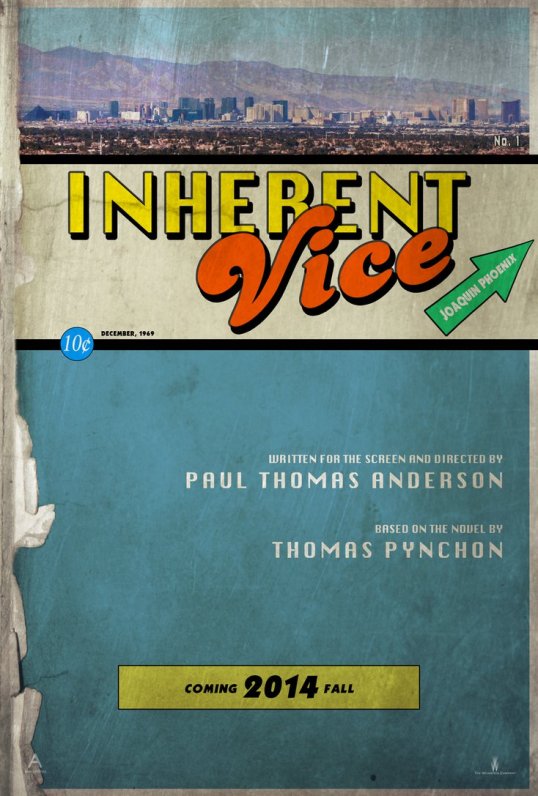
One of the best things about Paul Thomas Anderson’s latest film, Inherent Vice, is that Doc Sportello, the private detective played by Joaquin Phoenix, is a real stoner.  He’s not one of those weekend smokers, who gets high on Saturday, brags about it on Sunday, and then spends the rest of the week interning at Vox.  For the entire 2 hour and 20 minute running time of Inherent Vice, Doc is stoned.  From the minute we first meet him to the end of the film, there is never one moment where Doc is not stoned.  Most stoner comedies feature a scene where the main character shocks everyone by turning down a hit because he’s dealing with something so important that he has to “keep his mind straight.”

Not so with Doc!

And, in Doc’s case, it definitely helps him out.  Inherent Vice tells a story that is so full of paranoia, conspiracy, and random connections that only a true stoner could follow it.  Much like Doc, the film often seems to be moving in a haze but occasionally, out of nowhere, it will come up with a scene or a line of dialogue or a detail that is so sharp and precise that it will force you to reconsider everything that you had previously assumed.

To be honest, if you are one of the people who watched Inherent Vice this weekend and could actually follow the film’s plot, then you’ve got a leg up on me.  (That said, I’ve still got pretty good legs so it all evens out.)  But, that’s not necessarily a complaint.  As befits a film based on a novel by Thomas Pynchon and directed by one of the most idiosyncratic filmmakers around, the twists and turns of Inherent Vice are deliberately meant to be obscure and confusing.  Characters appear and then vanish.  Clues are discovered and then forgotten.  Connections are hinted at but then never confirmed.  Inherent Vice ultimately serves a tribute to stoner’s paranoia and, as a result, the plot’s incoherence leads to a certain contact high.

The film takes place in California in the 1970s.  Doc is both a hippie and a private detective. His current girlfriend (Reese Witherspoon) works for the district attorney’s office and doesn’t seem to like him much.  His ex-girlfriend, Shasta (Katherine Waterston), reenters his life and asks him to help protect her new boyfriend, real estate developer Mickey Wolfman (Eric Roberts).  Mickey has disappeared.  Shasta disappears.  As Doc investigates, he wanders through a psychedelic Los Angeles and deals with an ever growing collection of eccentrics.

For instance, there’s Hope Harlingen (Jena Malone), a former heroin addict who now runs a group that aims to promote “responsible drug use” among children.  She believes that her husband, Coy (Owen Wilson), is dead but actually Coy is a government informant who keeps popping up in the strangest places.

There’s Rudy Blatnoyd (Martin Short), a decadent dentist who may or may not be responsible for all of the heroin entering California.

There’s Sauncho Smilax (Benicio Del Toro), Doc’s lawyer who specializes in maritime law.

There are Nazi bikers, new age doctors, a formerly blacklisted actor turned right-wing spokesman, a black revolutionary whose best friend was a member of the Aryan brotherhood, three FBI agents who keep picking their noses, the decadent rich, and, of course, the endlessly clean-cut and bullying officers of the LAPD.

And then there’s Detective “Big Foot” Bjornsen (Josh Brolin), a celebrity cop and occasional television extra who seems to admire Doc, except for when he’s trying to frame Doc for everything from murder to drug smuggling.  Bjornsen is probably the most interesting character in the entire film and Brolin plays the character perfectly.  His scenes with Phoenix crackle with a comedic energy that bring the film to life.

As for the movie itself, it’s not for everyone.  A lot of very smart people are going to dislike it, much as many of them did with The Master.  In some ways, Inherent Vice truly is an endurance test.  Speaking as someone who enjoyed the film, even I occasionally found myself saying, “Okay, does everyone have to have a silly name?”  Inherent Vice is a long, rambling, and occasionally frustrating film but, for me, it still worked because of the strong cast and Anderson’s attention to detail.

Unbroken is a film that seems to take place in an entirely different world from Inherent Vice but these two films do have one big thing in common.  Both of them have been victims of the expectation game.  Many of the same people who thought Unbroken would be a surefire Oscar nominee also assumed, sight unseen, that Inherent Vice would be right there with it.  Much as how Unbroken has suffered for merely being good as opposed to great, Inherent Vice is also suffering for failing to live up to the expectations that were thrust upon it.  Inherent Vice is not an awards movie.  Instead, it’s a fascinatingly idiosyncratic film that was made by a director who has never shown much concern with playing up to the audience.  While Unbroken is enough of a crowd pleaser to still have a shot at some Oscar glory, Inherent Vice is the type of film that will probably never get nominated.  (I do have some hope that Brolin will get a supporting actor nomination but, even there, it appears likely that Brolin’s spot will be given to The Judge‘s Robert Duvall.)

Well, no matter!  Flaws and all, Inherent Vice will be a film that people will still be debating and watching years from now.