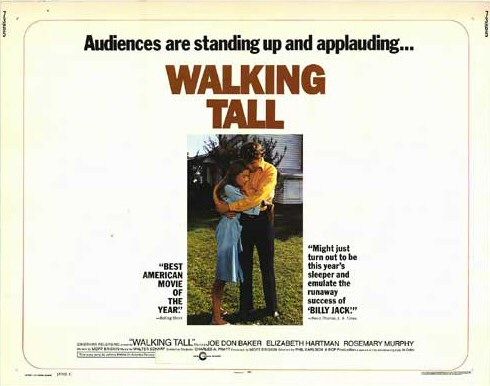
Embracing the Melodrama Part II #46: Walking Tall (dir by Phil Karlson)


Walking_Tall_(1973_film)About 50 minutes into the 1973 film Walking Tall (not to be confused with the 2005 version that starred Dwayne Johnson), there’s a scene in which newly elected sheriff Buford Pusser (Joe Don Baker) gives a speech to his deputies.  As the deputies stand at attention and as Pusser announces that he’s not going to tolerate any of his men taking bribes from the Dixie Mafia, the observant viewer will notice something out-of-place about the scene.

Hovering directly above Baker’s head is a big, black, almost phallic boom mic.  It stays up there throughout the entire scene, a sudden and unexpected reminder that — though the film opens with a message that we’re about to see the true story of “an American hero” and though it was filmed on location in rural Tennessee — Walking Tall is ultimately a movie.

And yet, somehow, that phallic boom mic feels oddly appropriate.  First off, Walking Tall is an almost deliberately messy film.  That boom mic tells us that Walking Tall was not a slick studio production.  Instead, much like Phil Karlson’s previous The Phenix City Story, it was a low-budget and violent film that was filmed on location in the south, miles away from the corrupting influence of mainstream, yankee-dominated Hollywood.  Secondly, the phallic implications of the boom mic erases any doubt that Walking Tall is a film about men doing manly things, like shooting each other and beating people up.  Buford does have a wife (Elizabeth Hartman) who begs him to avoid violence and set a good example of his children.  However, she eventually gets shot in the back of the head, which frees Buford up to kill.

As I said earlier, Walking Tall opens with a message telling us that we’re about to watch a true story.  Buford Pusser is a former football player and professional wrestler who, after retiring, returns to his hometown in Tennessee.  He quickly discovers that his town is controlled by criminals and moonshiners.  When he goes to a local bar called The Lucky Spot, he is unlucky enough to discover that the bar’s patrons cheat at cards.  Buford is nearly beaten to death and dumped on the side of the road.  As Buford begs for help, several motorists slow down to stare at him before then driving on.

Obviously, if anyone’s going to change this town, it’s going to have to be Buford Pusser.

Once he recovers from his beating, Buford makes himself a wooden club and then goes back to the Lucky Spot.  After beating everyone up with his club, Buford takes back the money that he lost while playing cards and $50.00 to cover his medical bills.  When Buford is put on trial for armed robbery, he takes the stand, rips off his shirt, and shows the jury his scars.  Buford is acquitted.

Over his wife’s objections, Buford decides to run for sheriff.  The old sheriff, not appreciating the competition, attempts to assassinate Buford but, instead, ends up dying himself.  Buford is charged with murder.  Buford is acquitted.  Buford is elected sheriff.  Buford sets out to clean up his little section of Tennessee.  Violence follows…

On the one hand, it’s easy to be snarky about a film like Walking Tall.  This is one of those films that operates on a strictly black-and-white world view.  Anyone who supports Buford is good.  Anyone who opposes Buford is totally evil.  Buford is a redneck saint.  It’s a film fueled by testosterone and it’s not at all subtle…

But dangit, I liked Walking Tall.  It’s a bit like a right-wing version of Billy Jack, in that it’s so sincere that you can forgive the film’s technical faults and frequent lapses in logic.  Walking Tall was filmed on location in Tennessee and director Phil Karlson makes good use of the rural locations.  And, most importantly, Joe Don Baker was the perfect actor to play Buford Pusser.  As played by Baker, Pusser is something of renaissance redneck.  He’s a smart family man who knows how to kick ass and how to make his own weapons.  What more could you ask for out of a small town sheriff?

In real life, Buford Pusser died in a mysterious car accident shortly after the release of Walking Tall.  Cinematically, the character of Buford Pusser went on to star in two more films.
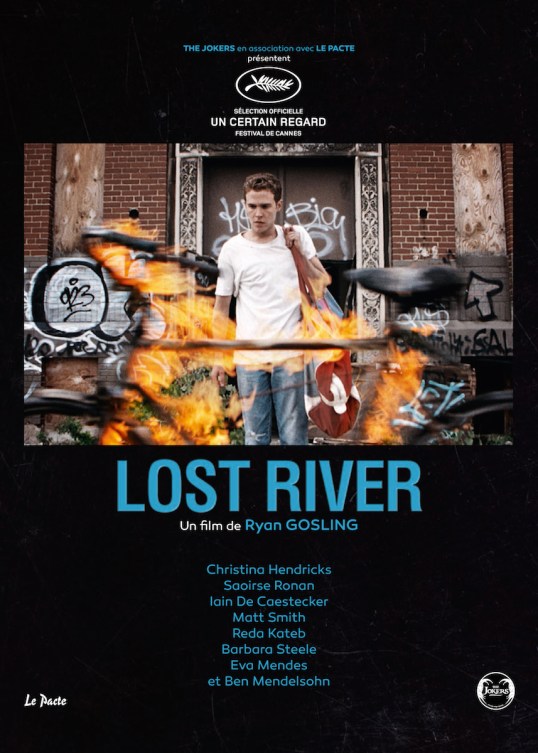
Film Review: Lost River (dir by Ryan Gosling)


Lost River

I had high hopes for Lost River.  Not only is it the directorial debut of one of my favorite actors, Ryan Gosling, but it was also booed at Cannes.  Some of the best and most interesting films ever made have been booed at Cannes.  The reviews that I had read of Lost River indicated that the film was a mess but it was, at the very least, a visually intriguing mess.  I was expecting the film to be pure style over substance but you know what?  I like style.

So, with all that in mind, I finally got a chance to sit down and watch Lost River last night and … bleh.  It’s not a terrible film.  You can watch it and feel that Ryan Gosling does have some promise as a director, if not as a writer.  (Along with directing, he also wrote the film’s screenplay.)  There are some nicely surreal images, though almost all of them appear to have been borrowed from other better films and, as a result, even the strangest of images are rather familiar.  (To be truly impressed by Lost River, it helps to have never seen anything directed by Mario Bava, Dario Argento, David Lynch, or Terrence Malick.)  He gets a memorably unhinged performance from the great Ben Mendelsohn but then again, when hasn’t Mendelsohn given a memorably unhinged performance?

Anyway, Lost River takes place in Detroit, presumably because Detroit features a lot of dilapidated neighborhoods that look interesting on film and allow Gosling to pretend that his film is about America urban decay.  Billy (Christina Hendricks) is on the verge of losing her house but, with the help of sleazy bank manager Dave (Ben Mendelsohn), Billy gets a job working as a performer at a club.  At the club, she and Cat (Eva Mendes) perform elaborate routines which always end with them pretending to die in some excessively brutal and bloody way.  The club’s largely affluent audience loves it.  Dave loves it so much that he’s inspired to sing a song on stage.  Later on in the film, Dave does an elaborate dance because every independent film has to feature an out-of-nowhere elaborate dance.

Meanwhile, Billy’s son, Bones (Iain De Caestecker), is trying to raise money to save the house by stealing copper out of abandoned buildings.  However, this gets him in trouble with Bully (Matt Smith, struggling to speak with an American accent), a psychopath who has declared his section of Detroit to be “Bullytown.”  Bully rides around in a convertible, sitting on a throne that’s been attached to the back seat.  When Bully discovers that Bones has been stealing copper from buildings in Bullytown, Bully declares that Bones must die.

(At some point, you have to wonder if Bully was doomed from the minute that his parents decided to name him Bully.  Maybe if they had named him The Doctor, he could have lived a very different life.)

Living next door to Billy and Bones is Rat (Saorise Ronan, who gives a good performance and deserves better than this role).  Rat is called Rat because she owns a pet rat that’s named Nick.  Got all that?  Rat also lives with her grandmother (Barbara Steele), who never speaks but spends all of her time watching old home movies.  Why would you cast an icon like Barbara Steele and then not allow her to do anything other than sit in a chair and silently stare at a television?

If Lost River was just an exercise in pure style, I probably would have enjoyed it a lot more.  I would much rather a film be too obscure as opposed to being too obvious.  Unfortunately, while Gosling the director is having a lot of fun being as stylish as he can be, Gosling’s the screenwriter proves himself to be heavy-handed and patronizing.  By setting the film in Detroit and having random characters show up to talk about how America is dying and the poor are getting poorer while the rich get richer, Gosling lets us know that Lost River is meant to be more than just an exercise in technique.

The problem is that, as well-intentioned as Gosling may be, you can’t help but get the feeling that he has absolutely no idea what it’s like to be poor or what it’s like to live in a dying American city.  According to the 2010 census, 82.7% of Detroit’s population is African-American.  If you’re making a movie the deals, no matter how strangely, with what it’s like to be poor and desperate in Detroit, why would you decide to exclusively cast affluent-looking Caucasians in all of the main roles?  The few black characters who appear in Lost River are largely there to either comfort or share wisdom with the main white characters before then quickly moving on, never to be seen again after their minute or so of screen time.  It comes across as being condescending in only the way something written by a wealthy white guy can be.

Lost River is a misfire, an attempt by a filmmaker to try to make a statement about something that he really doesn’t seem to know much about.  Judging from the film’s visuals, Gosling has some promise as a director but, in the future, he should probably try to work with a better screenwriter.  If you don’t listen to the dialogue and just consider the film as an exercise in visuals, it’s mildly diverting.  (That said, even the nonstop parade of surreal images gets boring after a while.)  Lost River is not terrible.  It’s just bleh.

Embracing the Melodrama Part II #45: Double Indemnity (dir by Jack Smight)


di3vh6

Nothing can make you appreciate a classic film more than by watching a really bad remake.  As proof, I would offer up the 1973 made-for-television version of the classic 1944 film Double Indemnity.  The original Double Indemnity is a classic example of film noir, one that remains intriguing and powerful over 70 years since it was first released.  The remake features the exact same plot as Double Indemnity and a few of the original’s scenes are recreated shot-by-shot but it just does not work.

Part of the problem is that the remake is in color.  In fact, since it was made in 1973 and for television, it’s in very bright and somewhat tacky color.  Bright and vibrant doesn’t work for film noir.  You need the shadows and the visual ambiguities that are unique to black-and-white.  If the original Double Indemnity was full of secrets and mysteries, the remake is all on the surface.  There are no secrets to be found in this remake.

That goes for the cast as well.  In the original, Fred MacMurray made Walter Neff into the epitome of the bored, post-war American male.  You watched him with a certain sick fascination, trying to figure out what was going on behind the blandly friendly facade.  In the remake, you know that Richard Crenna is a serpent from the minute he first appears.  If MacMurray’s Walter was motivated by ennui, Crenna’s Walter is just bad and therefore, far less interesting.  Meanwhile, in the role of Phyllis, Samantha Eggar has none of Barbara Stanwyck’s ferocious determination.  Instead, Eggar’s performance is curiously refined (which is another way to say boring).

Probably the most interesting thing about the remake of Double Indemnity is that the role of Keyes is played by Lee J. Cobb.  Cobb actually gives a pretty good performance and, unlike Crenna and Eggar, he’s actually entertaining to watch.  In the original film, Keyes was played by Edward G. Robinson and was roughly around the same age as Walter.  They were contemporaries and friends and that made the original’s ending all the more poignant.  In the remake, Cobb is quite a bit older than Crenna and, as a result, their relationship feels more paternalistic.  It’s almost as if Crenna is the prodigal son who has betrayed his father and who tells his story as a way of begging for forgiveness.

But that’s probably reading too much into the remake!  For the most part, the remake of Double Indemnity is bland and boring.  The best thing about it is that it’ll make you love the original even more.

As for how I ended up watching the remake of Double Indemnity, it was included as an extra on my DVD of the original.  Watching them back-to-back, as I did, really serves to make you appreciate Billy Wilder as a filmmaker.

Trailer: The Connection


They played this trailer at the Alamo Drafthouse shortly before the start of Ex Machina.  It appears to be a French version of The French Connection.  Who knows?  It might be good.  At the very least, it’s a reminder for American audiences that Jean Dujardin is capable of playing someone other than a silent film star.

Dance Scenes That I Love: Ex Machina


Earlier today, Jeff and I saw Ex Machina and we thought it was brilliant!  Now, before I (among others here at the TSL) get around to posting a full review later this week, I thought I would share a scene that I loved from the film.  This is the scene that, when it happened, everyone in the theater suddenly realized that they were watching a movie that they would never forget.

I’m not going to go into the details of just why Oscar Isaac and his “friend” are dancing in this scene.  For now, all that’s important is that they are.

See Ex Machina!

Embracing the Melodrama Part II #44: The Poseidon Adventure (dir by Ronald Neame)


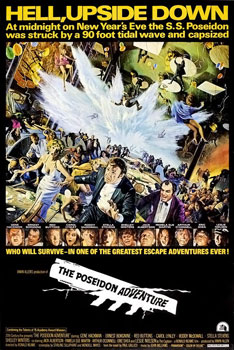
PoseidonAdventure

A few years ago, when I first told Arleigh that I had recently watched the 1972 film The Poseidon Adventure, I remember him as being a bit shocked and amazed that I had made it through the entire film.  This was because Arleigh knows that I have a morbid obsession with drowning and that the mere sight of someone struggling underwater is enough to send me into a panic attack.

And The Poseidon Adventure is a film that is totally about drowning.  The majority of the cast drowns over the course of the film.  The few who survive spend all of their time trying not to drown.  The main villain in The Poseidon Adventure is the ocean.  The Poseidon Adventure is a film specifically designed to terrify aquaphobes like me.

And there are certain parts of The Poseidon Adventure that freaked me out when I first watched it and which continue to freak me out whenever I rewatch it.

For instance, just the film’s plot freaks me out.  On New Year’s Day, an ocean liner is capsized by a huge tidal wave.  With the boat upside down, a small group of survivors struggle to make their way up to the hull where, hopefully, they might be rescued.  That involves a lot of fighting, arguing, climbing, and drowning.

It freaks me out whenever I see the huge tidal wave crash into the bridge and drown Captain Leslie Nielsen.  That’s largely because it’s impossible for me to look at Leslie Nielsen without smiling.  (I’ve already written about my reaction to seeing him in the original Prom Night.)  When he suddenly drowns, it’s not funny at all.

It freaks me out when the boat turns over and hundred of extras are tossed around the ballroom.  I always feel especially bad for the people who vainly try to hold onto the upside down tables before eventually plunging to their deaths.  (Did I mention that I’m scared of heights as well?)

It freaks me out when Roddy McDowall plunges to his death because who wants to see Roddy McDowall die?  Whenever I see him in an old movie, he always come across as being such a super nice guy.  (Except in Cleopatra, of course…)  Plus, Roddy had an absolutely chilling death scream.  They need to replace the Wilhelm Scream with the Roddy Scream.

It freaks me out when survivor Shelley Winters has a heart attack right after swimming from one part of the ship to another.  Because seriously, Shelley totally deserved the Oscar nomination that she got for this film.

And it really freaks me out when Stella Stevens plunges to her death because I related to Stella’s character.  Stella was tough, she didn’t take any crap from anyone, and she still didn’t make it.  If Stella Stevens can’t make it, what hope would there be for me?

And yet, at the same time, The Poseidon Adventure is such an entertaining film that I’m willing to be freaked out.  The Poseidon Adventure was one of the first of the classic disaster films and it’s so well done that even the parts of the film that don’t work somehow do work.

For instance, Gene Hackman plays the Rev. Frank Scott, the leader of the group of survivors.  And Hackman, who can legitimately be called one of the best actors ever, gives an absolutely terrible performance.  His performance is amazingly shrill and totally lacking in nuance.  When, toward the end of the film, he starts to angrily yell at God, you actually feel sorry for God.  And yet, Hackman’s terrible performance somehow works perfectly for the film.  It’s such an over-the-top performance that it sets the tone for the whole film.  The Poseidon Adventure is an over-the-top film and, if Hackman had invested his character with any sort of nuance, the film would not have worked as well as it did.

And then there’s Ernest Borgnine, who plays Stella Stevens’s husband.  Borgnine spends the entire film arguing with Gene Hackman.  Whenever something bad happens, Borgnine starts acting like Edward G. Robinson in The Ten Commandments.  He never actually says, “Where is your God now!?” but it wouldn’t have been inappropriate if he had.  And yet, again, it’s exactly the type of performance that a film like this needs.

And finally, there’s that theme song.  “There has to be a morning after…”  It won an Oscar, defeating Strange Are The Ways Of Love from The Stepmother.  And is it a good song?  No, not really.  It’s incredibly vapid and, while it does get stuck in your head, you don’t necessarily want it there.  But you know what?  It’s the perfect song for this film.

The Poseidon Adventure is not a deep film, regardless of how many times Hackman and Borgnine argue about the role of God in the disaster.  It’s an amazingly shallow film about people drowning.  But it’s so well-made and so perfectly manipulative that you can’t help but be entertained.

The Poseidon Adventure totally freaks me out.  But I will probably always be willing to find time to watch it.

Embracing the Melodrama Part II #43: The Stepmother (dir by Howard Avedis)


stepmotherJust looking at the poster for the 1972 film The Stepmother, I bet you think it’s a pretty scandalous and sordid film.  I mean, there’s a picture of a woman wearing a black bra and there’s a tagline that reads, “She forced her husband’s son to commit the ultimate sin!”

CIP_Logo

Well, perhaps not surprisingly considering that this is a Crown International film, The Stepmother‘s poster and tagline have very little do with the actual film.  Yes, the film does feature a stepmother and, during the final 20 or so minutes of the film, her stepson does finally show up and she does end up sleeping with him.  It’s consensual.  There’s no forcing involved.  And, as far as the ultimate sin part is concerned — well, her husband has been doing a lot worse.

The film itself is actually about the husband.  Frank Delgado (Alejandro Rey) is a wealthy architect who is also insanely jealous of his new wife, Margo (Katherine Justice).  Whenever he suspects that Margo is cheating on him, he ends up killing someone.  And, as a matter of fact, even when he doesn’t think Margo is cheating on him, he ends up killing someone.  Frank, of course, has to find a way to cover up all of his various murders.  It doesn’t help that Inspector Darnezi (John Anderson) is constantly snooping around.  And then, once he discovers that his stepson actually has slept with Margo (as opposed to all the people he killed just because he assumed they had slept with Margo), Frank is forced to decide whether or not to kill his own son.

The Stepmother is available in about a dozen Mill Creek boxsets and it’s fun in a 1972 sort of way.  Frank and all of his friends are decadent rich people so you could argue that the film is meant to be a portrait of the immorality of the 1%.  (That would actually be a pretty stupid argument but it’s one that you could make if you’re trying to impress someone who hasn’t read this review.)  Director Howard Avedis tries to liven up the plot by including a lot of artsy touches that don’t really add up to much but which are still fun to watch.  Occasionally, he’ll toss in a freeze frame for no particular reason.  As well, Frank has a habit of hallucinating.  He continually sees his first victim running across the beach in slow motion.  Make a drinking game out of it.  Every time it’s obvious that The Stepmother was trying to fool people into thinking it was a European art film, take a drink.

To be honest, the most interesting thing about The Stepmother is that it is the only Crown International film to have received an Oscar nomination!  That’s right!  The Stepmother was nominated for Best Original Song.  The name of the song was Strange Are The Ways Of Love.  You can listen to it below if you want.  Feel free to dance.

Anyway, that’s The Stepmother for you.  It’s not my favorite Crown International film but, as a historical oddity, it’s still worth watching.

Embracing the Melodrama Part II #42: An American Hippie In Israel (dir by Amos Sefer)


American_Hippie_in_Israel_Grindhouse_Releasing

I had to rewatch the 1972 film An American Hippie In Israel before I understood that it’s one of the best films ever made.  I know that may seem like a bold statement.  I know that there are critics who have declared the exact opposite and have said that An American Hippie In Israel is actually one of the worst films of all time.  Those critics are wrong and, as always, I am right.

I’ll say it again.

An American Hippie In Israel is one of the best films ever made.

Now, when I first saw the movie, I will admit that I was a little bit disappointed.  This was largely because I had been waiting for nearly seven years for a chance to see An American Hippie.  I first saw the trailer as an extra on the Grindhouse Releasing DVD of I Drink Your Blood.  The trailer was so bizarre and the film’s title held such promise (come on, who wouldn’t want to see a movie called An American Hippie In Israel?) that I found myself obsessed with seeing the film.  Unfortunately, reality can never measure up to the promise of obsession.

So, when I finally saw An American Hippie In Israel on TCM, I was initially disappointed.  It was not the film that I had imagined it would be.  But then, for this review, I rewatched it.  And freed from my own expectations and demands, I discovered that I could now appreciate An American Hippie In Israel as one of the greatest films of all time.

Why is it so great?

Because it tells the truth.  Everyone in the world says that they want peace.  We give out awards for promoting peace.  Politicians gives speeches about the importance of peace.  Every religion is help up as being a peaceful religion.  On twitter, after every atrocity, people talk about how much they wish we could just live in peace.  We are encouraged to use hashtags like #peace and #love and we’re told that this is somehow going to change the world.  People talk about dropping out of society, rejecting all of the demands of the establishment, and somehow, this is going to end all war and destruction.

And what we all know and are far too often scared to admit is that none of this is going to make a bit of difference.

There will never be any peace.  There will always be war.  Evil will always exist.  All new societies are destined to become just as corrupt and fucked up as the old society.  Eventually, humanity will end up destroying itself and there’s nothing that we can do to stop that from happening.  The world is doomed and all we can hope for is that we’ll already be gone whenever things fall apart for the last time.

It’s not a happy picture, I know.  But it’s a reality that few films are willing to truly embrace.  Except, of course, for An American Hippie In Israel.  At first glance, An American Hippie In Israel may look like a typical psychedelic oddity but scratch underneath the surface and you’ll discover one of the darkest and most morbid films ever made.

Mike (Asher Tzarfati) is an American who is hitchhiking through Israel.  When an actress named Elizabeth (Lily Avidan) gives him a ride, she asks, “Are you a hippie?”

Mike thinks for a minute and then replies, “Yeah…right on, baby.”

As Mike explains to Elizabeth, he became a hippie after serving in the Vietnam War.  Mike tells her that he was only 19 years old when he was drafted and he was a virgin.  Before Mike had even had a chance to make love for the first time, the Army had turned him into a murderer.  And you know what?  Asher Tzarfati totally nails this monologue.  In fact, Tzarfati gives a good and heartfelt performance throughout the film.

Elizabeth and Mike take a walk around Tel Aviv and, as they do, they’re joined by more and more hippies.  Soon, all of the hippies are gathered in one warehouse and they listen as their new leader, Mike, gives a speech about how they’re leaving society and rejecting war and greed.  Instead, they’re just going to dance and love.  All of the hippies cheer.  All of the hippies smile.  All of the hippies dance!

However, there’s two mimes who have been following Mike around Israel.  We never learn who they are and neither one of them ever says a word.  Mike claims that they’ve been following him since before he even arrived in Israel.  The mimes suddenly appear at the hippie gathering and gun everyone down.  The only survivors of the massacre are Mike, Elizabeth, Komo (Shmuel Wolf), and Komo’s girlfriend, Francoise (Tzila Karney).

Fleeing in Elizabeth’s blue convertible, the four of them drive down to the coast.  Mike suggests that the four of them take a boat out to a small island and start their own society.  However, after getting to the island and spending a night celebrating, they wake up to discover that the boat has vanished and so has a goat that they brought along with them.  Elizabeth’s car sits on the mainland and when Mike tries to swim out to it, he discovers that the water is full of sharks.

Trapped on the island, the four of them quickly turn against each other.  Soon, Mike and Komo are building a wall down the middle of the island.  However, when the goat mysteriously reappears, Mike and Komo are forced to face each other.

All the while, those mimes watch from the mainland…

An American Hippie In Israel is a pretentious film but its pretentious in the best possible way.  While the film is usually cited as being a psychedelic film in the style of Electric Shades of Grey, An American Hippie In Israel actually plays out more like a satire on hippie culture.  No matter how much Mike and his friends declare that they’re changing the world, they continually prove themselves to be incapable of living up to their high ideals.  For all of his self-righteous fury, Mike is ultimately just as destructive as those two mimes.

Surprisingly well-acted, visually impressive (the Israeli landscape looks beautiful and the film features a wonderfully surreal dream sequence), and wonderfully defiant of both the establishment and the counterculture, An American Hippie In Israel is one of the best films of which you may have never heard.

Embracing the Melodrama Part II #41: Ciao! Manhattan (dir by John Palmer and David Weisman)


Ciao_posterI recently watched the 1972 film Ciao! Manhattan on TCM and it left me with incredibly mixed feelings.  The specific reason that I was watching Ciao! Manhattan was because it was the last film to feature the legendary model and actress Edie Sedgwick.  Tragically, at the age of 28, she died merely weeks after completing work on Ciao! Manhattan.  And while the film is dedicated to her memory and was apparently meant to be a tribute to her, it instead feels incredibly exploitive.  Watching the movie, I was aware that Edie was literally dying on screen and, as so often happened in her life, nobody was willing to step forward and help her.

In the late 60s, Edie Sedgwick was a model who was briefly the beautiful face of the underground.  Vogue called her a “youthquaker.”  She made films with Andy Warhol, she dated the rich and the famous and for a brief time, she was one of the most famous women in America.  But a childhood full of tragedy and abuse had left Edie fragile and unprepared to deal with the pressures of being famous.  She was fed drugs by those who claimed to care about her, she had numerous mental breakdowns, and, when she was at her most vulnerable, she was pushed away and rejected by the same people who had loved her when she was on top of the world.  Edie died because, when she asked for help, nobody was willing to listen.

Edie

I guess I should explain something.  I don’t believe in reincarnation but if I did, I would swear that I was Edie Sedwick in a past life.  Of all the great icons of the past, she, Clara Bow, and Victoria Woodhull are the ones to whom I feel the closest connection. (Edie is the reason why, for the longest time, I assumed I would die when I was 28.  But now I’m 29, so lucky me.)  When I watched Ciao! Manhattan, I felt as if I was watching myself (or, at the very least, a close relation) on-screen.

Ciao! Manhattan opens with Susan Superstar (Edie Sedgwick), standing topless on a street corner and hitchhiking.  She’s picked up by an aimless drifter named Wesley (played by Wesley Hayes).  Wesley gives Susan a ride back to the mansion that she shares with her mother (Isabell Jewell) and her servant, a rather disgusting guy named Geoff (Jeff Briggs).  Her mother hires Wesley to help take care of Susan.  It turns out that Susan used to be a world-famous model but now she spends her time sitting in an empty swimming pool, drinking and doing drugs.  While Wesley and Geoff listen, Susan talks about her past in New York.  While Susan talks, we see black-and-white footage of Susan (and Edie’s) past.

337224340_f1a0a57d44

Ciao! Manhattan began life in 1967 as an underground parody of a spy film.  When Edie had a nervous breakdown and was sent to rehab, filming was abandoned.  When she was finally released in 1970, filming began again.  The 1967 footage was now used for flashbacks to the wonderfully glamorous life that Susan (and Edie) had lost.

And, when viewed as a documentary of how Edie was exploited and then subsequently abandoned by everyone that she cared about, Ciao! Manhattan works.  The contrast between the happy and vibrant Edie of 1967 and the barely coherent and visibly unhealthy Edie of 1970 is heartbreaking.  Whereas the 1967 footage features an existence that is in constant motion, the 1970 footage shows us an existence that is slow and drenched in sadness.  The film makes no effort to pretend that Susan Superstar is anyone other than Edie Sedgwick and, when Edie talks about her past, no names are changed to protect the guilty.  And the film shows that, even after surviving a literal Hell, Edie Sedgwick was still a natural-born star.  Even when she’s slurring her words and staring at the world with poignantly sad eyes, Edie demands and gets the audience’s attention.

Edie2

When Ciao! Manhattan allows Edie to tell her own story, it works.  But, unfortunately, the film spends too much time with Wesley and Geoff, who are two of the most repulsive characters that I’ve ever seen.  Geoff is written to be offensive whereas the character of Wesley is done in by the very bad performance of the guy playing his role.  (Wesley Hayes was reportedly not a professional actor and it certainly shows.)

This is a film that provides evidence that, even in her last days, Edie Sedgwick was a talented and unique presence and, for that, I’m glad.  But, ultimately, it’s hard not to feel that Ciao! Manhattan was the final case of Edie and her tragic life being exploited for someone else’s profit.

Edie Sedgwick

Usually, I would end a review like this by including either a scene or the film’s trailer.  But, instead, I’m going to end this review with Edie Sedgwick’s silent Warhol screen test.  This is how I prefer to think of Edie Sedgwick — hopeful and curious with the promise of her entire life ahead of her.

Johnny Depp Acts (!!!!) In This Trailer For Black Mass!


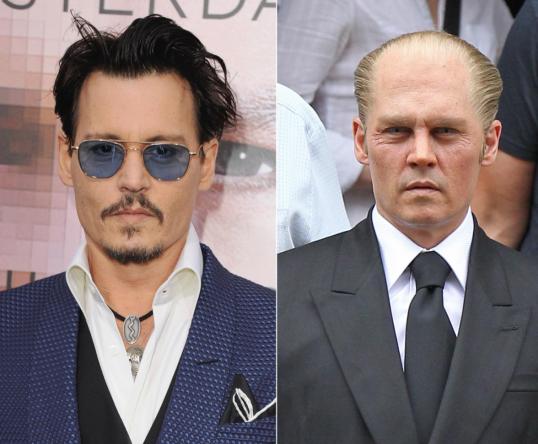
johnny-depp-black-mass

Here’s the first trailer for Black Mass, the upcoming film in which Johnny Depp plays notorious Boston crime boss and most wanted fugitive, Whitey Bulger.  Judging from this trailer, this looks like it might be Depp’s Oscar performance.

Seriously, check this out!

(And after you watch the trailer, read my review of a documentary about Whitey and his reign of terror.)