Horror Film Review: Patrick (dir by Richard Franklin)


Patrick_(film)

Patrick, a 1978 horror film from Australia, opens with the title character (played by Robert Thompson) watching as his mother makes love to her boyfriend.  The first thing that we notice about Patrick is his stare.  It’s intense and more than a little unsettling.  (Actually, to be honest, the first thing we notice about Patrick is his head of blonde hair.  But that stare is a close second.)  The next thing that we notice about Patrick is that he doesn’t speak.  Instead, he just stares.  Eventually, when his mother and her boyfriend are taking a bath, Patrick drops a heater into the water and electrocutes both of them.

Yes, Patrick has some issues.

When we next meet Patrick, three years have passed.  He’s in a coma now and spends all of his time laying in a bed in a private hospital.  Everyone says that he’s brain dead, despite the fact that he still reflexively spits.  The head nurse, the bitter Matron Cassidy (Julia Blake), hates the fact that Patrick is being kept alive.  As she tells a new nurse, she feels that he is a waste of space and she wishes that she could just turn off the machines that are keeping Patrick alive.

Strangely, Patrick shows no physical signs of having been in a coma for three years.  (One doctor points out that Patrick hasn’t even lost any weight during his time in the hospital.)  And then, there’s the fact that Patrick’s eyes are always open.  Even in a coma, he has the same intense stare.

An idealistic new nurse named Kathie (Susan Penhaligon) takes an interest in Patrick.  Over the objections of Matron Cassidy, Katie tries to talk to Patrick.  Kathie becomes convinced that Patrick’s spitting is not merely a reflex action but it’s actually his attempt to communicate.  Kathie becomes obsessed with proving the Patrick can still respond to the outside world.

And, in any other film, this is the type of storyline that would ultimately lead to a very inspiring conclusion, in which the idealistic nurse’s faith is validated and the stricken patient is finally allowed to find a measure of happiness and dignity.

However, Patrick is a horror film.

Kathie does eventually discover that Patrick can see and hear.  Patrick does know what’s going on in the outside world.  But what Kathie doesn’t expect is that Patrick turns out to be a bit of an obsessively jealous pervert.  Also, it turns out that Patrick has the power of telekinesis.  Soon, he’s using a typewriter to send Kathie messages like, “It’s time for Patrick’s handjob.”

Patrick also uses his powers to punish any man who he feels is getting too close to Kathie.  This includes Kathie’s husband, Ed (Rod Mullinar).  First, Patrick causes Ed to seriously burn his hands on a hot casserole dish.  Then he traps Ed in an elevator, forcing Kathie to beg for her husband’s life.

Patrick is a surprisingly well-acted and effective little horror film, one that spends as much time on maintaining the proper melancholy atmosphere as it does on trying to shock the audience.  The end result is an intelligent little gem that will make you think even as it attempts to scare you.  That said, my main memory of Patrick will always be that stare.  Seriously, it was so creepy!

A remake was released in 2013 but I have yet to see it.  However, I have seen the film’s unofficial Italian sequel and that’s what I’ll be reviewing next!
 

A Very Short Review of Tooken


Why am I even reviewing Tooken?

That’s a good question.  I’m about to tell you that this film sucked but the thing is, you probably know that it sucked just by the fact that the movie is named Tooken.  I mean, do I even need to tell you that it’s supposed to be a parody of the Taken films?  Bleh!

Originally, I was going to include this film as one of my Insomnia Files but then it occurred to me that Tooken is the type of film that gives insomnia a bad name.  Seriously, go tell someone that you couldn’t sleep last night so you turned on the TV and watched Tooken.

Really?  they’ll say, You stayed up all night so you could watch that crap?

And it doesn’t even matter that insomnia is something that you have no control over.  Instead, it’ll all come down to the fact that you were actually awake at 4 in the morning and you were watching Tooken.

And you’ll hate yourself for it.  Oh, the shame that you will feel….

Anyway, the depressing thing about Tooken is that it stars Lee Tergesen, who actually does a pretty good Liam Neeson imitation and who proved, in a short film called Into The Dark, that he deserves better than Tooken.  Tergesen plays Bryan Millers, a former CIA agent who is now a mall security guard and the main joke of the film is that he’s always losing stuff and reacting to it in the style of Liam Neeson discovering that Kim has, once again, been taken.  And I know that sounds like it has the potential to be funny but the joke actually wears thin pretty quickly.

(How thin?  Thinner than the fabric of the nightie that I’m wearing as I type up this review it at 3 in the morning!  And that’s pretty thin!)

Part of the problem with Tooken is that the Taken films don’t take themselves that seriously to begin with.  In many ways, Tooken is a parody of a parody.  Whenever Liam Neeson growls into that phone and lets the kidnappers know that he’s coming, he does so with just the slightest twinkle in his eye.  He’s letting us know that he’s in on the joke and he understands that the entire franchise is ludicrous.  There’s really not a single joke that you can make about the Taken franchise that the franchise hasn’t already made itself.

Of course, the other problem with Tooken is that it’s just not funny.  In fact, it’s painfully unfunny.  Watching this movie is like listening to a 3rd grader try to tell a joke and realizing, with a feeling of deepening horror, that not only have you heard the stupid joke before but the kid is totally going to screw up the delivery as well.

Back to the question that started this review.  Why am I reviewing Tooken?  Well, at the start of this year, I swore that I was going to make sure that this site had a review for every movie that I watched in 2015.  Tooken is a film that I watched so I had to review it.

That’s right — I did it for the site.

And I did it for you, my loves.

Y’all owe me big time.

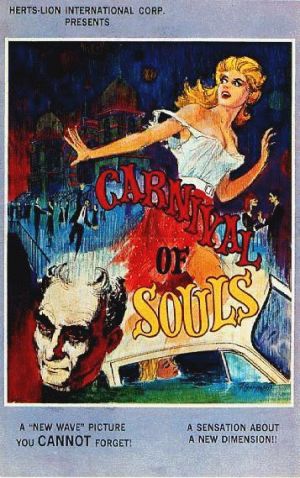
Horror on the Lens: Carnival of Souls (dir by Herk Harvey)


Carnivalofsoulsposters

Much like watching Plan 9 From Outer Space, Night of the Living Dead, Treevenge, or Santa Claus Conquers The Martians, watching the 1962 independent film Carnival of Souls is a bit of a holiday tradition here at the Shattered Lens.

And you know how much I love tradition!

Directed in a dream-like fashion by Herk Harvey (who also directed several of the educational short films that I’ve occasionally shared on this site, including Cheating, The Show-Off, and The Gossip), Carnival of Souls tells the story of Mary (Candace Hilligoss) who, after a car accident, finds herself haunted by visions of ghostly figures.  Independently produced and distributed, Carnival of Souls did not get much attention when it was originally released but it is now generally acknowledged as a horror classic.  Reportedly, David Lynch loves this movie and, when you watch it, you’ll be able to see why!

It’s October.  It’s 11 more days ’til Halloween.  It’s time to watch Carnival of Souls.

The Daily Horror Grindhouse: Nightmares in a Damaged Brain (directed by Romano Scavolini)


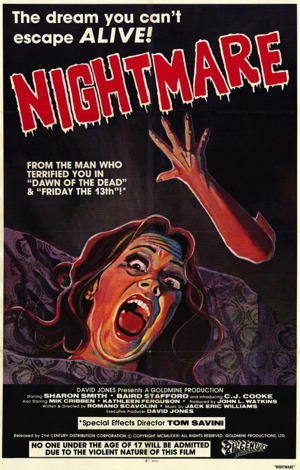
Nightmare_FilmPoster

I once read about a low-budget horror film that was released in the mid-70s.  The film was advertised as being “a film that could only have been made in South America … where life is cheap!”  That little bit of advertising hyperbole has always stuck with me and sometimes, when I see a particularly nasty exploitation or horror film, I find myself saying, “They must have made this movie somewhere where life is cheap!”

This, of course, brings us to Nightmares in a Damaged Brain, an Italian film that was originally released in 1981, at the height of the slasher movie boom.  Nightmares is infamous as one of those gore-filled horror films that has achieved a certain amount of immortality by being banned in several different countries.  It’s only been within the past few years that Nightmares has been released on DVD in the U.S.  That DVD is supposedly the “uncut” version of the film but there are rumors of scenes so bloody and disturbing that they have still not seen the light of day.  Usually, it’s something of a let down to finally see a film as infamous as Nightmares in a Damaged Brain.  It’s rare that a film’s reality ever lives up to the rumors surrounding it.  However, having seen Nightmares in a Damaged Brain, I can truly say that, if nothing else, this film had to have been made in a place where life is cheap.

Nightmares in a Damaged Brain concerns itself with George (Baird Stafford), a violent inmate at a New York insane asylum who is given an experimental drug that seems to control his violent impulses.  He’s released from the hospital and, after spending some time wandering around some of the seediest sections of New York ever captured on film, he ends up at a sex club, writhing on the floor and foaming at the mouth.  Apparently, that drug’s not working as well as everyone thought…

Soon, George has stolen a car and he is relentlessly driving across the country.  George, it seems, is obsessed with a young boy who lives in Florida along with his loud, white trash family.  Along the way to Florida, George has several gore-filled nightmares (the majority of which feature him as a bowtie-wearing child, murdering two people with an axe) and kills a few random people as well.

While the film was released to take advantage of the early 80s slasher boom, director Romano Scavolini rejected many of the conventions of slasher genre.  Instead of emphasizing pretty teenagers and slick production values, Scavolini instead emphasized the sordid “reality” of the film’s rather trashy cast of characters.  There’s not a likable character to be found anywhere within this film nor is there a single scene that doesn’t feel as if it’s been drenched in sleaze.  An ominous atmosphere of impending, relentless doom hangs over every second of the film.  This doesn’t necessarily make for an enjoyable viewing experience but it is a film that, once you start watching, is difficult to look away from.

The film’s opening credits (and the poster pictured above) claim that the gore effects were done by the famous Tom Savini.  Savini has always denied having anything to do with the film and, at one point, threatened to sue the filmmakers to get his name removed from the credits.  Regardless of whether Savini did them or not, the film’s gore effects are memorable and rather disturbing.

I had to take a shower after sitting through Nightmares In A Damaged Brain and I doubt I’ll ever watch it a second time.  Still, I’m glad that I did watch it because this brutally effective film is truly a part of horror film history.  If nothing else, I can now honestly say that I’ve seen a film that truly must have been made somewhere where life is cheap.

Horror Film Review: Bride of the Monster (directed by Edward D. Wood, Jr.)


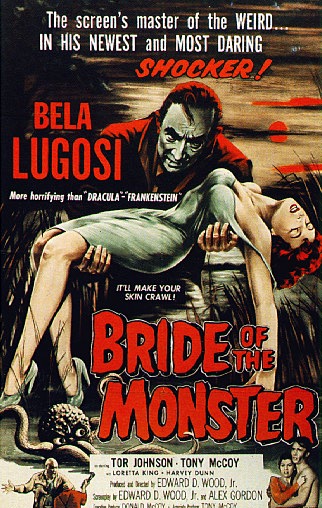
Bride_of_the_Monster_(1956_movie_poster)

A few nights ago, I watched the infamous 1955 horror film, The Bride of the Monster.

This was not the first time that I had seen Bride of the Monster. (Nor is it the first time that I’ve talked about this film on this site.) As a fan of the work of the legendary director Ed Wood, I’ve seen the majority of his films, many of them several times. Bride of the Monster is not only the closest that Wood ever got to making a “legitimate” movie but it’s also my personal favorite of his films.

(Plan 9 may be fun but it has nothing on Bride of the Monster.)

As for the film’s plot — well, the story is typical Ed Wood. By that, I mean that it doesn’t make a bit of sense. There’s an old mansion in the middle of nowhere. There’s a gigantic Octopus who apparently lives in a pool of stagnant water that sits somewhere near the old mansion. There are hunters, who have a habit of vanishing whenever they wander too close to the house.

There’s also Lobo (Tor Johnson), the hulking mute who we’re assured is “harmless as a kitten.” Lobo develops a crush on Janet (Loretta King), the intrepid reporter who wanders too close to the mansion while looking for a story. Janet reminded me a lot of me, in that she wasn’t going to let a little thing like common sense get in the way of an experience.

And then, there’s Dr. Varnoff (Bela Lugosi). Dr. Varnoff is the owner of the mansion. He’s a scientist who was chased out of his home country by … well, by somebody. To be honest, it’s not always easy to figure out how Varnoff ended up in America with Lobo and a big octopus. It’s also difficult to understand why Varnoff is conducting experiments and killing people. Varnoff talks and talks about his reasons but just because a man talks doesn’t mean that he’s going to say anything.

Yes, Bride of the Monster is one of those films that makes absolutely no sense but you know what? That’s exactly why I love it. Like all of Wood’s film, it is unique. And I’d rather watch a film that is uniquely bad than one that is generically competent any day!

You have to respect the dedication of the actors who bravely pretended that they were being attacked by that octopus. For most of them, this meant laying in a shallow pool of water while grabbing hold of some rubber tentacles and thrashing about for a bit. Yes, it looks silly but that doesn’t change the fact that the actors really threw themselves into it. Even the film’s worst performances feel as if they’re being given by very dedicated actors.

It should also be noted that this was Bela Lugosi’s final film (with the exception of his posthumous appearance in Plan 9 From Outer Space). And people always seem to make fun of Lugosi’s performance here but you know what? He’s not bad at all. He brings a tragic weariness to even the most ludicrous of lines. I’m sure that Lugosi was not hoping that his career would end with something like Bride of the Monster. But he still gave it his all.

As bad as Bride of the Monster may be, Bela Lugosi is very, very good. When you watch the film, don’t judge it too harshly. Don’t focus on the awkward line readings or the nonsensical plot or …. well, just don’t focus on all the things that you usually think of as indicating whether or not a film is good or bad.

Instead, when you watch it, watch it for Bela.

You won’t be disappointed!

Horror on the Lens: Diary of a Madman (dir by Reginald Le Borg)


For today’s horror on the lens, check out the 1963 film, Diary of a Madman!

It’s simply not October without at least one film featuring the great Vincent Price.  In Diary of a Madman, Price plays Simon Cordier, a French magistrate.  What is it that’s causing Simon’s personality to change?  What is making him suffer from greater and greater delusions?  Is he just going insane?  Or is he being haunted by a malevolent spirit known as a horla!?

Any film that features Vincent Price being sinister is worth watching and Diary of a Madman actually features one of his better performances.  Overall, Diary of a Madman is an enjoyable attempt at psychological horror.

Enjoy it below!

What Lisa Watched Last Night #142: Are You My Daughter? (dir by Jason Bourque)


Last night, I watched the latest Lifetime movie premiere, Are You My Daughter?

top-promo-are-you-my-daughter-460x290

Why Was I Watching It?

Because it was on Lifetime, of course!  Of course, I was only able to watch the 1st hour before I had to change the channel over to SyFy so I could watch They Found Hell.  But, fortunately, Lifetime always shows their movies twice so, once They Found Hell was over with, I was able to turn back to Lifetime and catch the final hour of Are You My Daughter?

What Was It About?

14 years ago, Laura Paddington’s (Brooke Langton) 3 year-0ld daughter disappeared.  In the years since, Laura has suffered from a lot of guilt.  She’s also seen her marriage to Richard (Mike Dopud) end in divorce.

At first, when Laura meets Jacob (Peter Benson) is a support group, he seems like the perfect guy.  Jacob tells Laura that she has to move on from the disappearance of her daughter and, under Jacob’s guidance, Laura finally decides to clean out her daughter’s old bedroom.

However, when Laura attempts to donate her daughter’s clothes to the local shelter, she is shocked when she meets Rebecca (Stephanie Bennett).  Rebecca not only looks like a teenage version of her daughter but she also has the same birthmark on the back of her neck!  After Rebecca gets a DNA test, it is confirmed that she is Laura’s daughter!

Or is she?  When Richard meets her, he is immediately suspicious of both Rebecca and Jacob.  Is Richard being paranoid or is Laura the victim of a very cruel con?

What Worked?

There are certain directors who I’m always happy to see listed in the opening credits of a Lifetime or a SyFy movie.  Whenever I see that a film was directed by Doug Campbell, Grant Harvey, or Griff Furst, I always know that I’m going to see a movie that’s better than the average Lifetime melodrama.  The director of Are You My Daughter, Jason Bourque, is another one of those directors.  He’s directed and written his share of films for both Lifetime and SyFy and his films are always very entertaining and well-done.  That’s definitely the case with Are You My Daughter, which is a fun and twisty little melodrama.  (Bourque also directed a film called Black Fly, which I reviewed on this site a few months ago.)

As well, Stephanie Bennett did a good job as Rebecca/Zoe.  She kept you guessing.

What Did Not Work?

It all worked.  This was a fun and enjoyable Lifetime movie.

“Oh my God!  Just like me!” Moments

I’m not a mother yet but once I am, I am going to be so overprotective.  Seriously, my kids are never going to be out of my sight.  It’s hard for me to think of anything more terrifying than having your child disappear.

Lessons Learned

Keep an eye on your children.


TSL’s The Daily Horror Grindhouse: They Found Hell (dir by Nick Lyon)


They Found HEll 2

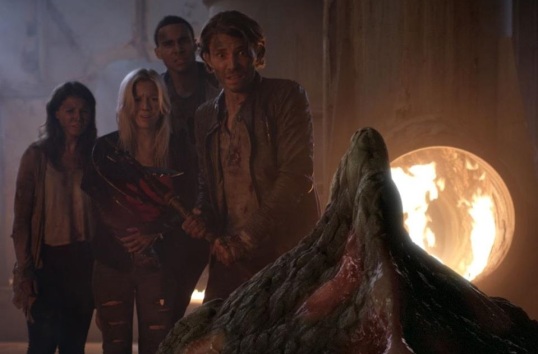
They Found Hell, which premiered last night on the SyFy channel, deserves a lot of credit.  In the tradition of the best grindhouse films (and, make no mistake, this was definitely a grindhouse film even if it was made for TV), They Found Hell delivers exactly what it promises.  The title tells us that “they” will find Hell and that’s exactly what happens.

“They” refers to a group of college students who, through some questionable use of science, manage to not only open up a portal into Hell but get sucked into it as well.  One student does manage to avoid getting sucked into the portal but he turns out to be pretty ineffective.  When he goes to the local crazy professor (James Sobol Kelly), he tells him what has happened, and then suggests maybe calling the police.  (I assume so that the police could read Hell its rights?)  The professor responds by tying the student up.  The professor has a plan of his own.

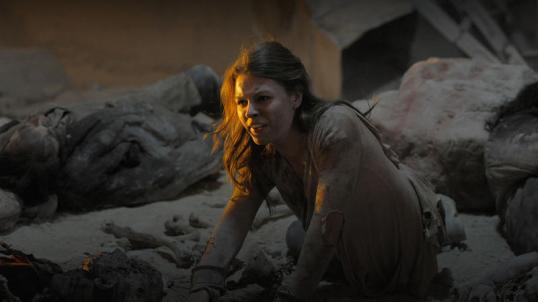
As for the students actually went down the portal … well, they’re in Hell.  One student insists that there’s no such thing as Hell and therefore, this must all be a dream.  Of course, he’s the first to die.  This, of course, leads to an interesting theological question: if an atheist dies in Hell, does he just come back to life?  I mean, he’s already in Hell.  What else can be done to him?

Anyway, the remaining students soon find themselves split up and each exploring a different section of Hell.  And this is really where the movie triumphed because this was a very convincing and very memorable Hell.  One student found himself in a desolate forest and ended up getting attacked by a bunch of vines.  Another found herself wandering through the hallways of what appeared to be the ruins of a Tuscan castle.  Another student found himself in a burning city while two others found themselves chained to a wall while a pendulum swung back and forth.  (I assume they were in the Edgar Allan Poe Wing of Hell.)  It was all surprisingly well-done and quite creepy.

At first, it seemed that Hell was nearly deserted and I guess we should be happy about that.  (I mean, humanity must be doing something right if there’s hardly anyone on the streets of Hell.)  But, as we quickly learn, the students are not alone.  There are lizard creatures that jump through windows.  There are snarling dogs that eat men who have been tied to the trees in a dark forest.  And, of course, there’s the succubus…

And then there’s Charon, the boatman.  In Greek mythology, Charon is the ferryman who takes souls across the River Styx.  Of course, he’ll only take you if you can pay the toll.  Charon’s always been one of my favorite mythological characters so I was definitely excited when he made an appearance here, looking all spooky and ghastly.

When They Found Hell started, I noticed that a lot of Hell seemed to look like other horror movies.  There were some scenes that had a Saw feel to them.  And then there were others that felt like they could have been lifted from a zombie movie.  At first, I assumed the film was just ripping off other horror films and I was totally okay with that.  But, as we discover, there’s actually a very clever reason why the various sections of Hell resemble other horror movies.  I’m not going to spoil it but it really is pretty clever.

And really, that’s a great description of They Found Hell.  It’s a surprisingly clever little horror film, one that is full of spooky atmosphere and scary moments.  It’s also surprisingly well-acted, with the entire cast bringing a lot of conviction to their roles.  This is a fun movie, one that you should definitely watch with a group of your best, snarkiest, and smartest friends.

So, keep an eye out and, the next time that They Found Hell is on SyFy, be sure to watch!

They Found Hell

Horror Film Review: Crimson Peak (dir by Guillermo Del Toro)


CrimsonPeak

The fact that Crimson Peak, Guillermo Del Toro’s wonderful new film, is only getting mixed or grudgingly positive reviews tells you everything that you need to know about the sorry state of modern film criticism.

Taking place at the turn of the 19th Century, Crimson Peak tells the story of Edith Cushing (Mia Wasikowska).  The daughter of industrialist Carter Cushing (Jim Beaver), Edith is haunted by a childhood memory, in which her mother’s ghost appeared to her and told her to never go to Crimson Peak.  Edith grows up to be an aspiring writer.  She writes stories about ghosts, though she is always quick to point out that the ghosts are just meant to be a “metaphor for the past.”  Her publishers tell her that no one wants to read a ghost story written by a woman and they recommend that she concentrate on writing a nice romance.

Following the violent death of her father, Edith marries the charming inventor Sir Thomas Sharpe (Tom Hiddleston) and moves to his family home in England.  Still in shock over the death of her father, Edith struggles to make things work in England.  Tom is nearly penniless and seems to be more interested in his inventions than with her.  (Not only did they not consummate the marriage during the honeymoon but Tom sleeps in a separate bedroom.)  Meanwhile, Tom’s older sister, Lucille (Jessica Chastain), does little to hide the disdain that she feels towards her new sister-in-law.

As for the house itself, it is on the verge of collapsing.  At one point, Tom mentions that, because of the red clay that sits underneath the mansion, their new home is sometimes called Crimson Peak.  If that wasn’t enough to panic Edith, she keeps seeing mysterious figures wandering through the halls.  Edith swears that she is seeing ghosts and that they are trying to tell her something.  Tom and Lucille tells her that she’s imagining things and continue to insist that she drink a special tea.  Could that tea be the reason why Edith finds herself coughing up blood?

(Actually, there’s a lot of blood spilled over the course of Crimson Peak.  It’s not just the clay that makes the ground red.  If Edith Wharton had written a horror movie, the end result would probably be a lot like Crimson Peak.)

And let’s just get this out of the way right now — Crimson Peak is an absolutely brilliant movie.  Those critics who have complained that Crimson Peak doesn’t have any of the expected “shock” scares are totally missing the point.  Crimson Peak is not about cheap scares.  Del Toro is not looking to make you jump by having a cat jump out of a closet.  Instead, Crimson Peak is all about atmosphere.  Del Toro maintains an atmosphere of consistent unease throughout the entire film.  The scares come less from what is shown and more from what is implied.  In that way, Crimson Peak pays homage to the great gothic horror films of the past.

And remember when I complained about how terrible Jessica Chastain was in The Martian?  Well, she absolutely brilliant in Crimson Peak.  The role of Lucille is not one that demands a lot of subtlety and Chastain appears to be having a great time getting to play such a menacing character.  If anything, this is one of Chastain’s best performances.  (One need only consider how overly mannered Meryl Streep would have been in the role to realize just how great an actress Jessica Chastain truly is.)  Mia Wasikowska is the epitome of fragile loveliness as Edith and Tom Hiddleston is perfectly cast as a handsome, slightly decadent aristocrat with a secret.  In fact, all three of them are perfectly cast.  Taking their roles too seriously would have been a mistake but so would have not taking the movie seriously enough.  The entire cast strikes a perfect balance, embracing the melodrama without going too far over the top.

So, why are so many film critics having such a hard time embracing Crimson Peak?  It’s pretty much for the same reason that a lot of them had a hard time with Pacific Rim.  Guillermo Del Toro’s films are masterpieces of the pulp imagination.  As such, he exposes the condescending attitude that most contemporary critics take towards “genre” films.  When mainstream critics dismiss Crimson Peak as just being “a horror film that isn’t scary enough,” all they’re really doing is revealing how ignorant they are of the horror genre.

So, in other words, don’t listen to those mainstream critics.  They are not worth your trouble.  Crimson Peak is a wonderfully acted and visually gorgeous gothic romance and it needs to be seen on the big screen.

Reportedly, Crimson Peak struggled at the box office this weekend.

Well, you know what?

If you haven’t seen Crimson Peak, you need to go out and see it this week.  It’s a great film and what good are we if we let the great ones go unseen?

Horror Scenes That I Love: The Solarmite Speech From Plan 9 From Outer Space


“You see!  You see!  You’re stupid minds!  Stupid!”

You tell ’em, Eros!

And for that matter, way to go with that punch, Jeff!  We don’t have to take that type of talk from someone who wasn’t even born on this planet!

In case you somehow didn’t know, the scene below is from Ed Wood’s 1959 science fiction epic, Plan 9 From Outer Space.  And if you’ve never seen Plan 9 before, watch it now!  The future of the universe may depend upon it…