Here’s a good example of why I need to clean out my DVR more regularly:
I recorded the 1983 legal thriller, The Star Chamber, off of Starz on March 14th. I know what you’re saying. “Big deal! That wasn’t that long ago.” Well, did I mention that it was March 14th, 2017?
That’s right! The Star Chamber sat on my DVR for over a year before I finally got around to watching it last night. You’d be justified in asking why it took me so long and I’m afraid that I really couldn’t give you a definite answer. I can, however, tell you the four main reasons why I recorded it in the first place:
I’m always intrigued whenever I come across a movie of which I haven’t previously heard.
The movie was described as being about a conflicted judge and I just happen to love legal films.
I really, really liked the title. The Star Chamber? Did that mean it took place in a room full of stars?
Before I recorded The Star Chamber, I only had 55 films on the DVR. Since I don’t like odd numbers, recording The Star Chamber took care of that problem.
As for the film itself, The Star Chamber is another one of those movies where a group of vigilantes end up getting pissed off because liberal California judges are letting too many murderers go free because of pesky, constitutional technicalities. The twist here is that the vigilantes are the same judges who keep tossing out evidence and ruling that confessions are inadmissible in court. After spending their day setting free the dregs of society, the judges all gather in a nearby house and review the evidence before voting on whether or not they believe the accused was actually guilty. If the verdict is guilty, the judges promptly hire a hit man who proceeds to clean up the streets.
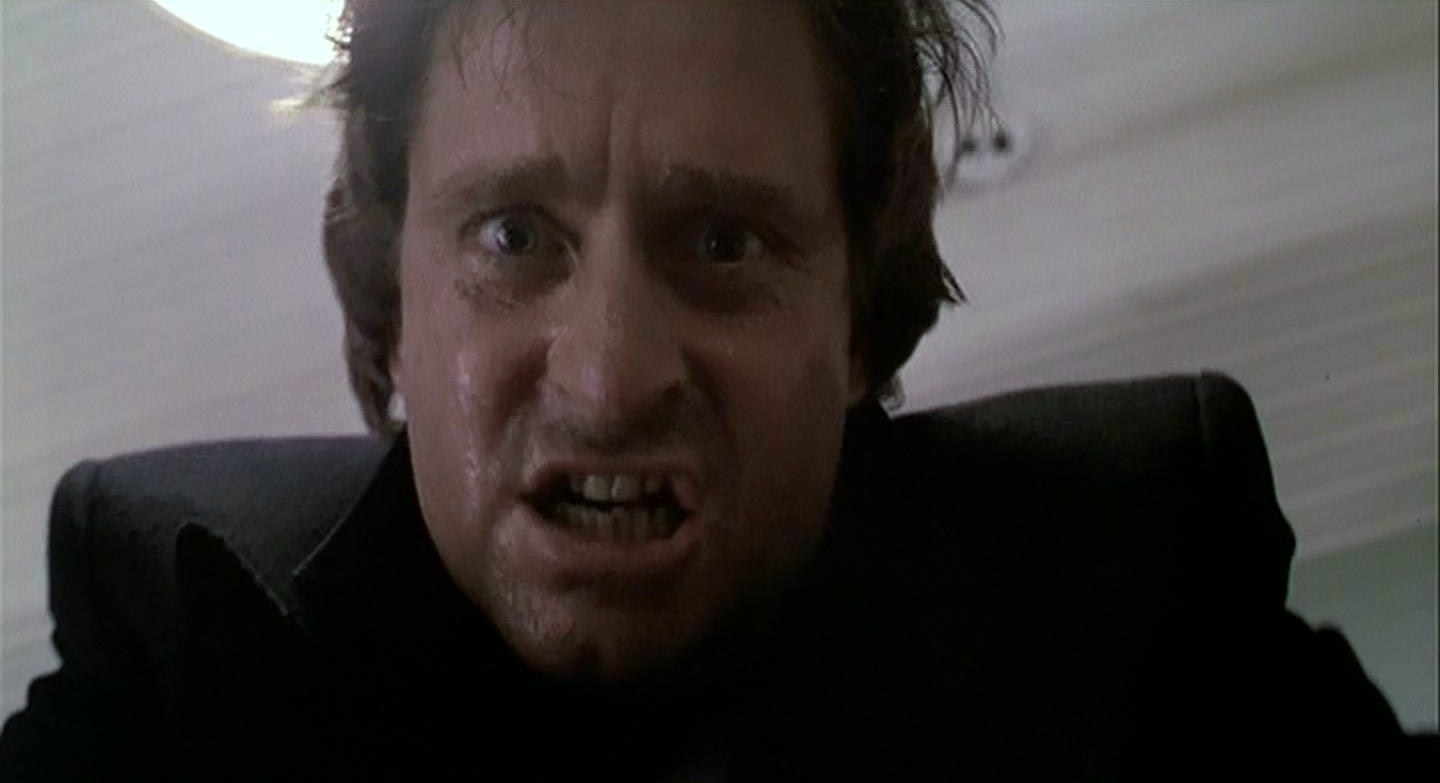
The newest member of this tribunal is Judge Steven R. Hardin (Michael Douglas). Hardin is haunted by the technicalities that forced him to toss out a case against two accused of child murderers. (Making things even worse, the child’s father commits suicide afterward.) Despite his initial reservations, Judge Hardin signs off on hiring an assassin to take the two men out. But, when it becomes apparent that the two men actually were innocent, Judge Hardin is horrified to discover that there’s no way to call off the hit…
The Star Chamber is an oddly constructed movie. When the movie starts, it feels like a typical police procedural. From there, the movie turns into a rather talky examination of the U.S. legal system, with Judge Hardin trying to balance his idealism with the often frustrating reality of what it takes to uphold the law. The movie then briefly turns into a conspiracy film, featuring middle-aged men in suits holding secret meetings and debating whether or not they’re serving the greater good. And then, towards the end of the movie, it turns into an action film, with Judge Hardin being chased by two drug dealers, a contract killer, and a suspicious police detective (Yaphet Kotto). Judge Hardin may start the movie as a conflicted liberal but he ends at someone who can blow up the entire second floor of a drug lab. In many ways, The Star Chamber is a deeply silly film but, as directed and co-written by Peter Hyams, it’s also just pulpy enough to be entertaining. The dialogue may be over-the-top but so is Michael Douglas’s performance so it all evens out in the end.
It may have taken me a while to get around to watching The Star Chamber but I’m glad that I finally did. It’s a ludicrous film and all the more entertaining as a result.
What can I say about this that isn’t already all over the Internet? This is one of the most well-documented music videos and songs I have come across so far.
The only thing I can’t find is somebody mentioning that it sure sounds like Damon Albarn was listening to Dumb by Nirvana when he wrote this song. That, and the whole In Utero album. I know the shirt is most likely a reference to the T-Virus from Resident Evil, but it could just as easily be a reference to the song Pennyroyal Tea since the lyrics are similar to that one as well. That one I could find somebody else thinking of. It’s some sort of fan fiction apparently written about 2D after they woke up at 2 in the morning and listening to Pennyroyal Tea. I find it humorous that this wasn’t in Wikipedia or Songfacts. Maybe it’s just me and that fan fiction writer.
I’m positive the shirt is also a reference to Thriller seeing as the apes do the Thriller dance and the opening title card is drawn from Thriller as well. They just took out the ridiculous line about Michael Jackson not believing in the occult for a line from Dawn of the Dead (1978).
So, it’s that time of year! 2015 is nearly over and soon, it will be time for me to make out my best-of and worst-of lists. That means that now is the time that I look over all the films that I have watched up to this point, I realize how many of those films I have yet to review ,and I think, “Oh my God, how did I get this far behind?”
So, here are 6 capsule reviews, designed to help me get caught up!
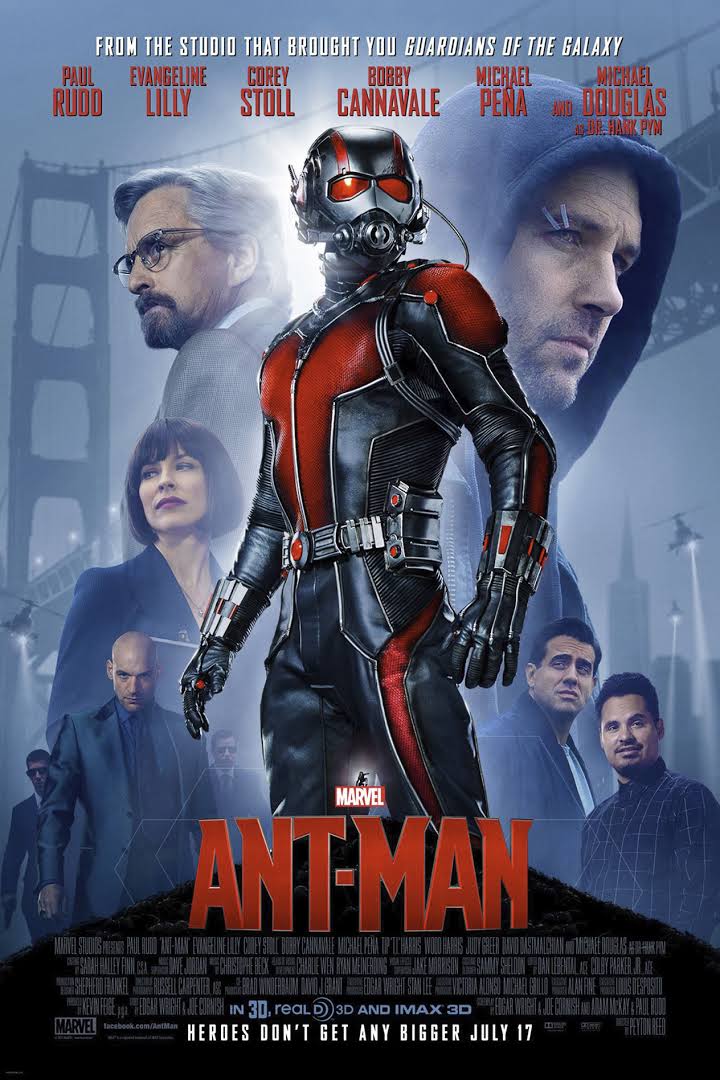
Ant-Man (dir by Peyton Reed)
Ant-Man has already been reviewed twice on this site, once by Leonard Wilson and once by Ryan The Trashfilm Guru. Leonard liked it. Ryan did not. As for me, my reaction was somewhere in between. I enjoyed Ant-Man, though not as much as I’ve enjoyed some of the previous Marvel films. Ant-Man was better than the second Thorfilm but nowhere close to being as good as Captain America: Winter Soldier.
What I did like about Ant-Man were the performances of Paul Rudd, Evangeline Lilly, and Michael Pena. I even enjoyed Michael Douglas’s performance, which is saying something when you consider the fact that, as of late, Michael Douglas has really been making my skin crawl. I also thought that the film did a good job creating Ant-Man’s microscopic world, even if I’m still not totally sold on the character as a dynamic hero. I do wish that the film had a stronger villain. Corey Stoll is such a good actor and capable of doing so much and it was hard not to regret that he was stuck playing such a generic bad guy.
Cinderella (dir by Kenneth Branagh)
Oh, how I loved Cinderella! The film, a live-action retelling of the Cinderella story, was a gorgeous fairy tale and a wonderful reminder that a film doesn’t have to be dark and depressing to be good. (In many ways, Cinderella serves as an antidote to not only Into The Woods, but countless Tim Burton films as well.) Lily James is beautiful in the title role, Richard Madden is wonderfully charming as the prince, and Cate Blanchett and Helena Bonham Carter are perfectly cast as the stepmother and the fairy godmother.
Jurassic World (dir by Colin Trevorrow)
Jurassic World was previously reviewed by Ryan the Trashfilm Guru. I hate to admit it but I was, initially, one of those people who watched Jurassic World and got annoyed because the film was predictable and the script was a bit clunky. Traditionally (and, if you doubt me, just read my review of Avatar), it bothers me when a film devotes so much time special effects that it can’t seem to be bothered with character development and clever dialogue.
But then I thought about it somewhat and I thought to myself, you know what? This movie had Chris Pratt and it had some very convincing dinosaurs! And, especially when it comes to a summer blockbuster, that is sometimes all you need.
(Why I enjoyed Jurassic World while disliking Avatar largely comes down to the difference between Chris Pratt and Sam Worthington.)
Magic Mike XXL (dir by Gregory Jacobs)
Oddly enough, I had the roughly the same reaction to Magic Mike XXL that I had to Jurassic World. Yes, there are certain things — mostly concerning the film’s script — about which I could nitpick but what’s truly important is that Channing Tatum, Joe Manganiello, and most of the original cast of Magic Mike is back and they’re stripping again. Magic Mike XXL is a huge (heh heh) crowd pleaser, a film that delivers exactly what it promises.
Though Steven Soderbergh served as cinematographer for Magic Mike XXL, he did not return to serve as director and perhaps that’s why Magic Mike XXL feels like a far less pretentious film than the first Magic Mike. Out of the original cast, both Matthew McConaughey and Alex Pettyfer both declined to appear in the sequel. McConaughey is missed, Pettyfer less so.
The Man From UNCLE (dir by Guy Ritchie)
The Man From Uncle is one of the many stylish spy films to be released this year. Henry Cavill is an American spy, Armie Hammer is a Russian spy, and Hugh Grant is the Englishman who tells them both what to do. The Man From Uncle was entertaining. It took place in the 60s, so there was a lot of wonderful retro fashion and the whole movie moved at a nice, breezy pace. Ultimately — and I’ll be the first to admit that this isn’t exactly fair — The Man From UNCLE suffered because it was released in the same year as Kingsman and Mission Impossible: Rogue Nation. Man From UNCLE was entertaining but rather generic. At no point did it reach the lunatic high of Kingsman’s Free Bird sequence.
Terminator: Genisys (dir by Alan Taylor)
You can read Ryan’s review of Terminator: Genisys here. I have to admit that Terminator: Genisys confused the Hell out of me. Not being a huge fan of the entire Terminator franchise (though, yes, I do know what Skynet is and I have seen the first two films), I do have to admit that I sometimes felt lost while watching Genisys.
But you know what? If you just sit back and relax and try not to think about the film too much — if you just accept it as an action film and watch for the stunts and the explosions — Terminator: Genisys is not the disaster that many critics made it out to be. I mean, let’s just be honest here. Most critics would die before they gave a good review to any film featuring Arnold Schwarzenegger. (Just check out all the negativity that greeted the brilliant zombie film, Maggie.) After all, Schwarzenegger is an outspoken, confident, cheerfully arrogant Republican and most film critics can only relate to the arrogant part. (And even then, they don’t ever seem to be very cheerful about it…) Terminator: Genisys is a well-made and perfectly adequate action film, one that works as long as you don’t spend too much time dwelling on it. It’s cinematic junk food and there’s nothing wrong with that.
*** Wait a minute! Before checking this out, be sure to read TrashFilmGuru’s thoughts on Ant-Man and then if you like, double back here. Two opinions are better than one! ***
I walked into Ant Man with a bias.
As a fan of Edgar Wright, his departure on the film due to creative differences left me wondering if it was worth seeing. Mix that with the idea that Marvel diverged from the character’s comic book origins for a better fit into the Marvel Cinematic Universe, and it all seemed like a recipe for failure. This was going to be the Cars 2 of the MCU, I was sure of it.
Ant-Man isn’t as large a tale as Captain America: The First Avenger or as star spanning as Guardians of the Galaxy. At times, it feels like it the story would be better suited for an extended Agents of S.H.I.E.L.D. Crossover or a Netflix one shot instead of a big screen event. It actually reminded me of Jon Favreau’s Iron Man in many ways, back when all of this was so small that audiences weren’t searching for tie-ins to next film in the line up or homages to The Story So Far. Ant-Man comes with the MCU connections (and comic book ones too), but if you walk in expecting revelations as big as Captain America: The Winter Soldier, the film may be a disappointment. It’s just a hero, and idea that even small actions can have big effects. It’s easily the film’s greatest strength, that it’s so personal. The film’s best components are it’s casting (particularly in House of Cards & The Strain’s Corey Stoll and Fury’s Michael Pena), and the effects themselves. It’s a movie that’s well worth the 3D treatment, if you can catch it that way.
Ant-Man focuses on Scott Lang (Paul Rudd), a former thief who is just trying to spend more time with his daughter, or at least be a hero in her eyes. Scott ends up meeting with Dr. Hank Pym (Michael Douglas) and his daughter Hope (Evangeline Lilly) who brings him on board for a job that just happens to cover his particular skill set. The job comes with a special suit that allows Lang to shrink down to about the size of an Ant, while at the same time allowing him to be much stronger. When Pym’s protege and rival Cross (Stoll) discovers another way to possibly make the shrink ability work, it’s up to Lang to try to stop the progress.
The film had 4 writers during it’s creation. It had Edgar Wright, who many moviegoers know from the Cornetto Trilogy (Shaun of the Dead, Hot Fuzz, The World’s End) and Scott Pilgrim vs. The World. Adam McKay worked with Rudd in the past on the Anchorman films, and was responsible for Talladega Nights & Step Brothers. Both McKay and Rudd had a hand in writing Ant-Man. Finally, Attack the Block’s Joe Cornish was on board. The end result of all this is a film with a great deal of comedy influences in it, though not all of them hit the mark. I felt there were at least 2 moments in the film where Rudd’s character had a one liner that just didn’t hit the mark, or elicit a response from the audience. This isn’t a terrible thing, at most it’s just nitpicking. Overall, you could consider Ant-Man a comic caper with superhero moments.
Additionally, the writers had to also figure out how to make the character of Dr. Hank Pym useful in a storyline where one of his biggest arcs in the comics – creating Ultron – was already handled in a previous story. I like to think this was handled pretty well, as comic readers will already recognize Scott Lang as being the 2nd Ant-Man – or least this is what I learned from the Marvel Encyclopedia. They’ve managed to keep familiar storylines in place while still anchoring it to the larger tale at hand.
The performances in Ant-Man are good, though it’s the co-stars that potentially steal the film from the leads. Lang’s heist buddies, played by David Dastmalchian (The Dark Knight), Cliff “T.I.” Harris (Takers), and Michael Pena (Fury) were indeed funny in this. Pena in particular stood out as someone who gets ahold of information through some pretty wild sources. Michael Douglas was a strange pick for me when I first heard about it, but he’s actually a fantastic fit for the whole story. Evangeline Lilly looked like she had a lot of fun with this, though her character served as a second mentor for Lang. I wanted to see her do a bit more in the film, actually. Bobby Canavale (Chef, Third Watch) and Judy Greer (Jurassic World) both have nice supporting roles in this.
Corey Stoll has played an ass so much on-screen that I’m not entirely sure he isn’t that way off camera. Between Non-Stop, House of Cards, Midnight in Paris and now Ant-Man, he’s plays the kind of characters that were historically set aside for character actors like Jeff Kober or Michael Ironside. Honestly, they couldn’t have made a better choice here. Cross comes off like a variant of Iron Man’s Odebiah Stane, resentful, evil, and maybe a little crazed. Rudd, on the other hand, handles the Hero’s Journey with ease, bringing his own sense of comedy that works almost as well as it did for Chris Pratt in Guardians of the Galaxy. It’s not perfect, but the character’s lighthearted nature is a good contrast from the serious gloom and doom that most of the Avengers are going through these days, and I feel Rudd did well here.
That’s another aspect of Ant-Man that needs to be recognized. The story in this may have a larger impact in things to come, but it felt really compact. Since the focus on the story involves Lang getting back to his daughter and stopping this one small thing, it takes a step back from the escalation we’ve been getting in previous MCU films. To me, since Phase Two started, every film’s been a stepping stone with at least one huge revelation somewhere that shows this is all much bigger than any one hero can take on. Discovery of the Infinity Stones, the big reveal of S.H.I.E.L.D. In the Winter Soldier and the events in Age of Ultron cover a large area. Maybe it’s better to say that they have an impact that’s covers a wide distance. With Ant-Man being the first film of Phase Three, it feels almost as if a step back it taken to something more personal. It’s not bad, but it’s different. It has the potential to leave viewers with a bad taste in their mouths if they were expecting something grand.
The effects in Ant-Man are good, really, really sweet. Quite honestly, it may be one of the first times where I haven’t found myself annoyed by what I call “The Zoic Effect” – that technique used in almost every film these days where you’re watching something and the director decides “Hey, let’s do a maximum level quick zoom on that target right there!”, because there’s a chance the audience might not see the subject. I believe Zoic Studios were the first to do that with Firefly and Battlestar Galactica, though I could be wrong. In Ant-Man, that rapid intense zoom is almost a welcome requirement when watching a little figure run and leap up and over objects. Add a 3D effect to all that, and I found myself enjoying that on the big screen. From a directing standpoint, it’s all very straightforward and you get an idea of the influences from all of the writers involved. Still, Peyton Reed (Down With Love) keeps from the film from straying too far away from it’s intended focus. Additionally, though the help of CGI, Disney/Marvel was able to digitize a younger Michael Douglas, and the look of this was even better than what they accomplished with Jeff Bridges in Tron: Legacy.
Overall, Ant-Man is a great addition to the MCU and on it’s own, it’s strong. I suppose Thor will still have to stay as the Cars 2 of that movie library. Note to viewers: If you’re planning to see this, be sure to stay until after the end credits. There’s a mid scene during the credits and one at the very end.
Will Marvel Studios have it’s first misstep when Ant-Man arrives in theaters this July? Or will it surpass many people’s expectations the way Guardians of the Galaxy did when it came out late summer of 2014? These are questions that fans and critics alike have been pondering since the rather underwhelming teaser trailer which was released earlier this year.
Now, with Avengers: Age of Ultron just weeks away from bulldozing over everything in it’s way it looks like Marvel and Disney have turned their attention to getting the Ant-Man hype train up to speed. If any film needs some fueling up it would be this one which has had a more than contentious production. It loses it’s original director in Edgar Wright after he and the heads at Marvel Studios (Kevin Feige) disagreed on how to proceed with the film. The search for a director to replace Wright became a game of which comedic filmmaker would pass on the project next (Peyton Reed finally was the last man standing).
When the teaser finally came out the tone it gave seemed too serious for a film that was being billed as a sort of action-comedy or, at the very least, an action film that included more than the usual comedic beats than past films in the MCU.
Today we see the first official trailer for Ant-Man and gone is the super serious tone of the teaser and in comes a mixture of action and comedy. It’s a trailer that actually gives us an idea of the sort of powers the title character has outside of being just being tiny. Then we get more than just a glimpse of Scott Lang’s main antagonist with Corey Stoll in the role of Darren Cross aka Yellowjacket.
Maybe this film will still end up giving Marvel Studio it’s very first black-eye, but this trailer goes a major way in making sure it doesn’t happen.
I have mixed feelings about Steven Soderbergh. On the one hand, his talent cannot be denied and you have to respect the fact that he’s willing to take chances and make films like The Girlfriend Experience and The Informant. On the other hand, he’s also the director who has been responsible for overrated messes like Contagionand utter pretentious disasters like Haywire. And it doesn’t help that Soderbergh’s fanbase seems to be largely made up of the type of hipsters who end up leaving comments under the articles at The A.V. Club. Some people mourned Soderbergh’s retirement. Personally, I think he made the right decision. He retired before his misfires ended up outnumbering all of his masterpieces.
The thing about Soderbergh is that his good films are so good that it makes it all the more frustrating to watch his failures. If Soderbergh was just your typical bad director than a film like Contagion wouldn’t be as annoying. But this is the man who also gave us Traffic!
And Traffic is a very good film.
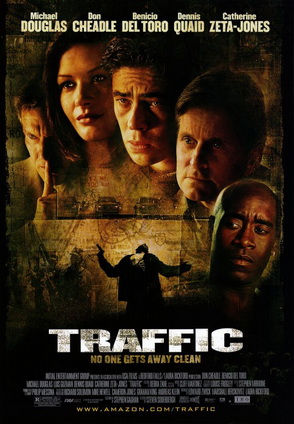
First released in 2000, Traffic attempted to deal with the American war on drugs, a war that the film suggests might not even be worth fighting. (Full disclosure: I support the legalization of drugs and, for that matter, just about everything else. And yes, I am biased towards films that agree with me. So is every other film critic out there. The difference is that I’m willing to admit it.) Traffic won four Oscars, including Best Director and Best Supporting Actor for Benicio Del Toro. It was also nominated for best picture but lost to Gladiator.
Traffic tells three, barely connected stories. Each story is given its own distinct look, feel, and color scheme. And while it takes a few minutes to get used to film’s visual scheme, it ultimately works quite well. Though all of the film’s characters share the same general existence, they live in different worlds. The only thing linking them together is drugs.
Judge Andrew Wakefield (Michael Douglas) is a judge on the Ohio Supreme Court who has recently been named as the new drug czar. However, while Judge Wakefield is going around the country and talking to politicians (Harry Reid shows up playing himself and is just as creepy as always), his daughter Caroline (Erika Christensen) is dating Seth (Topher Grace) and getting addicted to cocaine and heroin. When Caroline run away, Judge Wakefield recruits Seth and, using him as a guide, searches the ghetto for his daughter.
The Wakefield scenes are bathed in cold and somber blues. They’re beautiful to look at but, in some ways, they’re also some of the weakest in the film. The whole plotline of Caroline going from being an innocent honor’s student to being a prostitute who sells her body for heroin feels a lot like the notorious anti-drug film Go Ask Alice. At the same time, it’s interesting and a little fun to see Topher Grace playing such a little jerk. Grace gets some of the best lines in the film, especially when he attacks Wakefield’s feelings of smug superiority.
In the film’s second storyline, two DEA Agents (Don Cheadle and Luis Guzman) arrest drug trafficker Eddie Ruiz (Miguel Ferrer). Eddie works for the Ayala syndicate and, once he’s arrested, he turns informant. Drug lord Carlos Ayala (Steven Bauer) is arrested. While Carlos sits on trial, his pregnant wife (Catherine Zeta-Jones) and his sleazy business associate (Dennis Quaid) struggle to hold together the business and find a way to kill Ruiz before he can testify.
This storyline is filmed in bright and vibrant colors and why not? The Ayalas are rich and, unlike the Wakefields, they don’t feel the need to hide their material wealth. This is actually probably my favorite storyline, largely because it’s the best acted and the most entertaining. Miguel Ferrer, in particular, steals every scene that he’s in. The scene where he explains the economics of being a drug trafficker is fascinating to watch.
The Ayala storyline may be my favorite but the film’s most thought-provoking storyline is the third one. Taking place in Mexico, it stars Benicio Del Toro as Javier Rodriguez, a casually corrupt police officer who gets recruited to work for General Salazar (Tomas Milian), who is heading up Mexico’s war on the cartels. Following the orders of Salazar, Javier captures assassin Frankie Flowers (Clifton Collins, Jr.) who is then savagely tortured by Salazar until he turns informer. Javier comes to realize that Salazar is actually working for one of Mexico’s cartels. When he decides to inform on Salazar, he puts his own life at risk.
The Mexico storyline is also the harshest and visually, it reflects that fact. The heat literally seems to be rising up from the desert and the streets of Tijuana. It takes a few minutes to adjust to the look of the Mexico scenes but, once you do, they become enthralling.
And Traffic, as a film, is undeniably enthralling as well. Soderbergh deftly juggles the multiple storylines and brings them together to create a portrait of a society that’s being destroyed by the efforts to save it. Hopefully, if Soderbergh ever does come out of retirement, he’ll give us more films like Traffic and less films like Contagion.
Way back in October, around the same time that I first decided that I would do a series of reviews of political films and that I would call it Lisa Gets Preachy (subsequently changed to Shattered Politics), I noticed that the 1995 film The American President was scheduled to be shown on TVLand.
“Hey,” I said, “I’ve definitely got to watch and review that!”
So, I set the DVR and I recorded The American President.
And then, I just left it there.
You have to understand that it’s rare that I ever leave anything unwatched on my DVR. Usually, within an hour of recording a program, I’ll be watching it. I have even been known to go so far as to make out very long lists of everything that I have on the DVR, just so I can make check them off after I’ve watched. As a general rule, I am way too obsessive compulsive to just leave anything sitting around.
But, for whatever reason, I could never work up any enthusiasm for the prospect of actually watching The American President. I knew that, eventually, I would have to watch it so that I could review it. Unlike those folks criticizing American Sniper on the basis of the film’s trailer, I never criticize or praise a film unless I’ve actually watched it. But I just couldn’t get excited about The American President.
Can you guess why? I’ll give you a hint. It’s two words. The first starts with A. The second starts with S.
If you guessed Aaron Sorkin, then you are correct! Yes, I do know that Sorkin has a lot of admirers. And, even more importantly, I know that it’s dangerous to cross some of those admirers. (I can still remember Ryan Adams and Sasha Stone insanely blocking anyone who dared to criticize the underwritten female characters in Sorkin’s script for The Social Network.)
But what can I say? As a writer, Aaron Sorkin bothers me. And since Sorkin is such an overpraised and powerful voice, he’s that rare scriptwriter who can actually claim auteur status. The Social Network, for instance, was not a David Fincher film. It was an Aaron Sorkin film, through and through.
And, after having to deal with three seasons of the Newroom and countless Aaron Sorkin-penned op-eds about why nobody should be allowed to criticize Aaron Sorkin, I’ve reached the point where dealing with all of Aaron Sorkin’s signature quirks is a bit like listening to the drill while strapped into a dentist’s chair. I am weary of pompous and egotistical male heroes who answer every question with a sermon. I am tired to endless scenes of male bonding. I have had enough with the quippy, quickly-delivered dialogue, all recited as characters walk down an endless hallways. I have no more sympathy for Sorkin’s nostalgic idealism or his condescending, rich, white dude version of liberalism.
Most of all, I’m sick of people making excuses for an acclaimed, award-winning, highly-paid screenwriter who is apparently incapable of writing strong female characters. I’m tired of pretending that it doesn’t matter that Aaron Sorkin is apparently incapable of viewing female characters as being anything other than potential love interests or silly distractions who need to be told to go stand in a corner while the menfolk solve all the problems of the world.
Fortunately, as a result of The Newsroom, quite a few critics are finally starting to admit what they always knew to be the truth. Aaron Sorkin is not the messiah. Instead, he’s a somewhat talented writer who doesn’t understand (or, in my opinion, particularly like) women. At his best, he’s occasionally entertaining. At his worst, he’s pompous, didactic, and preachy.
And, of course, Aaron Sorkin is the man who wrote The American President.
So, The American President just sat there until a few days ago when I sighed to myself and said, “Okay, let’s watch this thing.” As I watched it, I promised myself that I would try to see past the fact that it was an Aaron Sorkin-penned film and just try to judge the film on its merits.
But here’s the thing. It’s nearly impossible to separate one’s opinion of Sorkin from The American President. If you didn’t know that Sorkin had written The American President, you’d guess it after hearing the first few lines of dialogue. The film, itself, was directed by Rob Reiner but it’s not as if Reiner is the most interesting of directors. (What’s odd is that Reiner’s first films — This Is Spinal Tap, The Princess Bride, Stand By Me — are all so quirky and interesting and are still so watchable decades after first being released that you have to wonder how Reiner eventually became the man who directed The Bucket List.) In short, The American President is totally an Aaron Sorkin film.
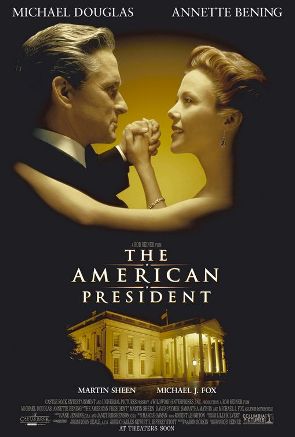
President Andrew Shepherd (Michael Douglas) is a liberal Democrat who, as he prepares to run for a second term, has a 63% approval rating. However, when Shepherd decides to push through a gun control bill, he finds that approval rating threatened. And then, when he listens to environmental lobbyist Sydney Wade (Annette Bening) and tries to push through legislation to reduce carbon emissions, his approval rating is again threatened. And then, to top it all off, he starts dating Sydney. It turns out that Sydney has protested American policy in the past. And, since this is an Aaron Sorkin film, everyone outside of the Northeast is scandalized that President Shepherd is having premarital sex in the White House.
And, to top it all off, there’s an evil Republican named Bob Rumson (Richard Dreyfuss) who wants to be President and is willing to use the President’s relationship with Sydney to further his own evil Republican ambitions.
But, ultimately, it’s not just those evil Republicans who make it difficult for Sydney and the President to have a relationship. It’s also the fact that the President agrees to a watered down crime bill and that he does not hold up his end of the bargain when it comes to reducing carbon emissions.
“You’ve lost my vote!” Sydney tells him.
But — fear not! There’s still time for President Shepherd to give a speech that will be so good and so brilliant that it will, within a matter of minutes, totally change every aspect of American culture and save the day. How do we know it’s a great speech? Because it was written by Aaron Sorkin!
Actually, I’m being too hard on the film and I’ll be the first admit that it’s because I’m personally not a huge fan of Aaron Sorkin’s. But, to be honest, The American President is Aaron Sorkin-lite. This film was written before the West Wing, before the Social Network, before that Studio Whatever show, and before The Newsroom. In short, it was written before he became THE Aaron Sorkin and, as such, it’s actually a lot less preachy than some of his other work. It’s true that, much like The Newsroom, The American President is definitely Sorkin’s fantasy of how things should work but at least you don’t have to deal with Jeff Daniels throwing stuff or Emily Mortimer not knowing how to properly forward an email.
Instead, it’s a film that will probably be enjoyed by those who share its politics. (And, make no mistake, The American President is more interested in politics than it is in the love story between Andrew and Sydney.) Michael Douglas does well in the role of the President. Meanwhile, Annette Bening is so likable and natural as Sydney that it almost make up for the fact that she’s yet another Sorkin woman whose existence is largely defined by looking up to her man while inspiring him to do the right thing and forgiving him when he doesn’t. Personally, I would have been happy if the film had ended with Sydney telling the President, “Thanks for finally doing the right thing but I have a life of my own to lead.”
First they said that Guardians of the Galaxy will be the first misstep in the rolling juggernaut train that is the Marvel Cinematic Universe. How could a film adaptation of a comic book that even hardcore readers barely know ever hit it big with the general public. Yet, it more than shot down detractors and nyasayers to become the biggest hit of 2014 and help usher in a major change in how people will now look at the MCU.
So, Guardians of the Galaxy wasn’t the first mistake. Then it has to be 2015’s Ant-Man starring Paul Rudd and a film already known for being the one where Edgar Wright was forced to leave as director. Yes, this will be Marvel Studios first misstep and it will show that Kevin Feige’s producer-driven plan will never trump the creative-driven director tradition.
So, during the season premiere of Agent Carter, we finally have the first official trailer for Ant-Man. Time will tell if this does become Marvel’s first bump in their road to world domination or will it surprise everyone the way Guardians of the Galaxy did this part summer of 2014.
(This review has spoilers because I felt like it and I’ll do whatever the Hell I want.)
Today, we continue embracing the melodrama by taking a look at the 1987 best picture nominee, Fatal Attraction.
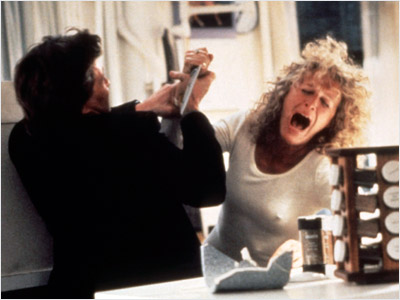
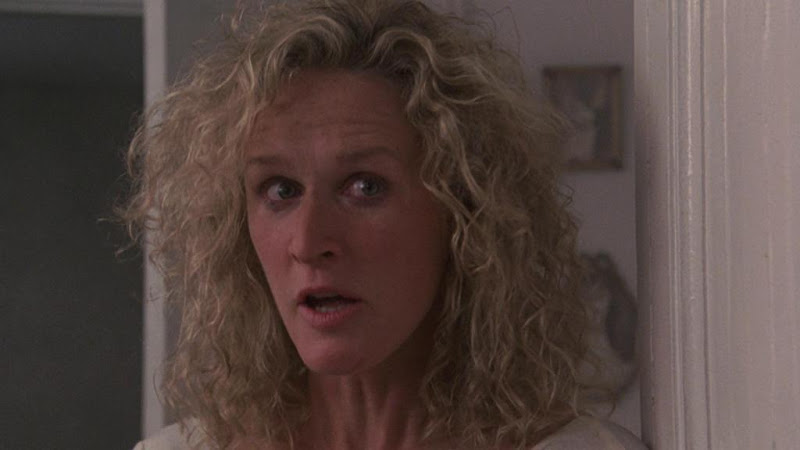
Fatal Attraction opens on a scene of domestic bliss, with lawyer Dan Gallagher (Michael Douglas) and his wife Beth (Anne Archer) in their luxurious Manhattan apartment, getting ready to go out for the night and waiting for the babysitter to arrive. Dan would appear to have it all: a successful career, a fat best friend, and a beautiful wife. However, when Beth and their daughter go out of town for the weekend, Dan ends up having an affair with Alex (Glenn Close). Dan assumes that it was just a weekend thing but Alex is soon stalking Dan. Trying to escape her, Dan moves his family out to the suburbs but Alex follows them. Soon, pet rabbits are being killed, Alex is breaking into the house with a knife, and it’s up to Beth to step up and reclaim her man.
I have to admit that I have mixed feelings about Fatal Attraction. On the one hand, it’s an undeniably well-made film. It’s well-acted and director Adrian Lyne pushes all of the right emotional buttons and keeps the action moving quickly. That the film is predictable doesn’t make it any the less effective. As a lover of horror movies, I appreciated the skill with which Lyne crafted the film’s scare scenes. Watching the movie, it was easy to see why Fatal Attraction was a huge box office success and why it continues to influence our culture to this very day.
And yet, at the same time, Fatal Attraction really annoys me.
The film is so well-made and so manipulative that it’s easy to miss the fact that Dan Gallagher is not only never punished for betraying his wife but he’s actually not held responsible for his actions in any way. Instead, the only person who is truly punished for their transgression is Alex. The film, after all, makes clear that Alex is the one pursuing Dan. In fact, it could be argued that when it comes to Dan and Alex, the traditional gender roles have been reversed. Alex (who, as opposed to the idealized Beth, has a name that is both masculine and feminine) is the aggressive one while Dan is the passive one who gives into temptation and, afterwards, feels guilty. After admitting his transgression, Dan is allowed to reclaim his manhood and continue on with his perfect life. However, Alex has no place in conventional society and therefore, she must be destroyed.
And so much the better if she’s destroyed by Beth, a woman who has no problem with accepting a traditionally domestic role.
Far too often, in the past, I know that my girl friends and I always assumed that men were simply incapable of resisting temptation. Therefore, if your boyfriend cheated on you, it really was not his fault. He was just being a guy. Instead, it was the other woman’s fault because she was the one who tempted him. (And, though we acknowledged this a lot less, it was also his girlfriend’s fault for allowing him to get into a position where he could be tempted in the first place.) But it was never truly guy’s fault and, as long as you made him suffer for a bit, it was always expected that you would forgive him and take him back.
That’s the same mentality that runs through Fatal Attraction (not to mention countless daytime talk shows where girlfriends and wives always beat up mistresses while their boyfriend or husband stands over to the side and watches, untouched). Yes, Dan did cheat on his perfect wife and yes, he feels terrible about it. But the real threat comes from the woman who pursued him despite knowing that he was married and then, afterwards, had the nerve to demand not to be ignored. (If anything, the film seems to be suggesting that everything would have been okay if Dan had just fucked someone who works in his office, as opposed to someone who he can’t control through money or the threat of societal shaming.) When, at the end of the film, Beth shoots Alex, it’s a crowd-pleasing moment but it’s also Beth’s way of reclaiming her man. Since Dan — being male — can’t be expected to exercise any sort of self-control, it’s the responsibility of Beth to step up and destroy the temptation.
For not respecting the vows of marriage, Alex is a monster who must be destroyed. Dan, on the other hand, is merely inconvenienced and ultimately, he ends up with a far stronger marriage as a result of having strayed.
In Fatal Attraction, the only thing more dangerous than sex with Alex is examining subtext.