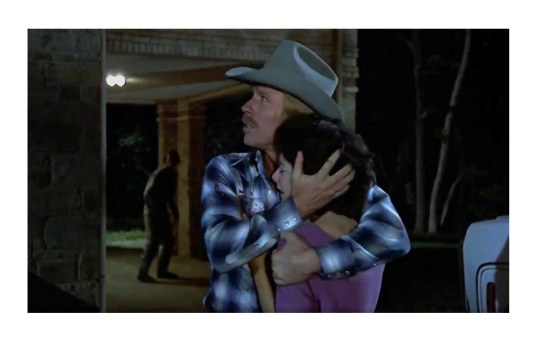
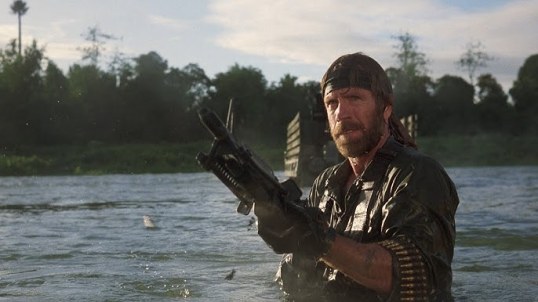
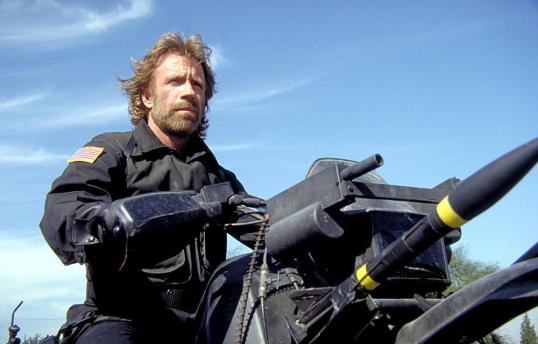
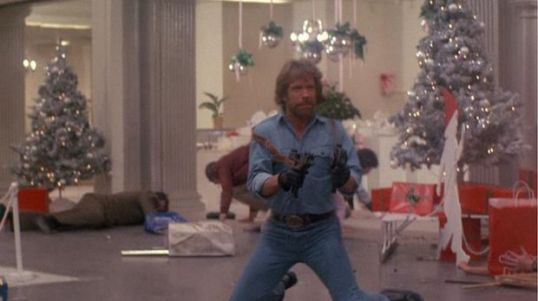
4 Shots From 4 Films is just what it says it is, 4 shots from 4 of our favorite films. As opposed to the reviews and recaps that we usually post, 4 Shots From 4 Films lets the visuals do the talking!
Today, we celebrate the birthday of Chuck Norris. It’s time for….
4 Shots From 4 Chuck Norris Films
Silent Rage (1982, dir by Michael Miller, DP: Robert Jessup and Neil Roach)
Missing In Action (1984, dir by Joseph Zito, DP: João Fernandes)
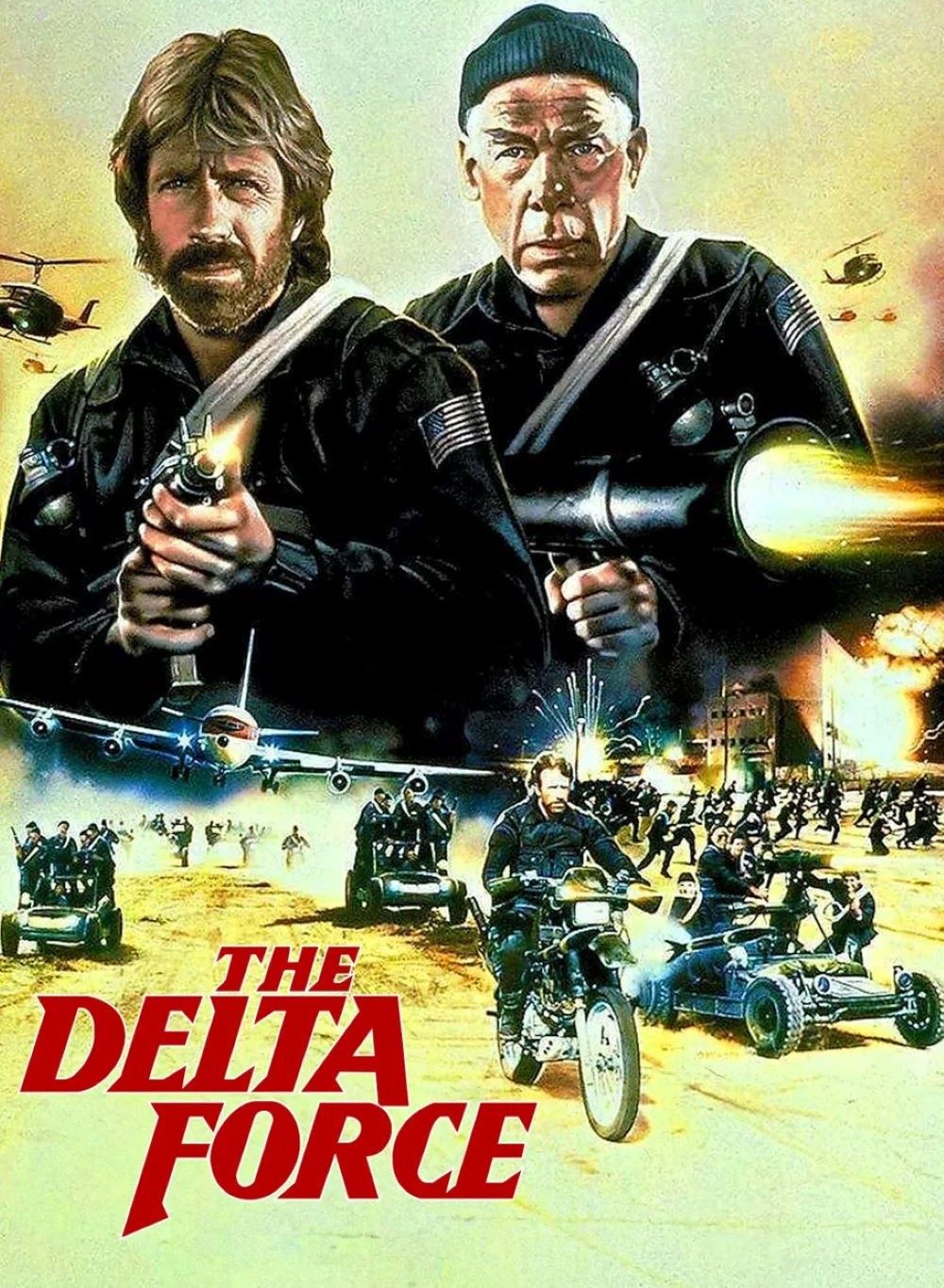
The Delta Force (1986, dir by Menahem Golan, DP: David Gurifinkel)
Invasion USA (1985, dir by Joseph Zito, DP: João Fernandes)
When it comes to reviewing mob movies, I usually describe them as either being “an offer you can refuse” or “an offer you can’t refuse.”
Usually, it’s not that difficult to decide which ranking I should use. If the film is well-acted and if the action unfolds at a steady pace and if there’s plenty of tommy gun action and/or a stylish recreation of the Golden Age of American Gangsterism, chances are that the film will be an offer that you can’t refuse.
Now, if it’s a movie that just features a bunch of guys sitting around trying to sound tough and if it doesn’t really do much to recreate the gangster milieu and if the dialogue sounds like it was cribbed from a hundred other gangster films, it’ll probably be an offer you can refuse.
It’s simple and usually, it only takes me a few minutes to realize which description I’m going to use. But I have to admit that I went back and forth on 1975’s Lepke. To refuse or not to refuse, that was the question.
Lepke is a biographic film about Louis “Lepke” Buchalter, an early American gangster who came to prominence in the early days of the National Crime Syndicate. An ally of Lucky Luciano’s, Lepke was the mastermind behind what became known, in the press, as Murder, Inc. (Lepke himself was smart enough not to name the organization.) If the Mob wanted someone killed, they would contact Albert Anastasia who would then contact Lepke who would then assign the job to someone else. The actual assassin rarely knew who had actually ordered the hit and Lepke was such a feared figure that it was assumed that no one was ever going to turn informant. Lepke was responsible for some of the most infamous gangland killings of the 20s and 30s, including the murder of Dutch Schultz. Unfortunately, for Lepke, someone eventually did turn informant and he ended up as one of the few gangster to meet his end in the electric chair.
Lepke features Tony Curtis as the title character. The film follows him from his youth as a member of a street gang to his early days with the National Crime Syndicate and eventually to his final days at Sing Sing. Michael Callan plays Lepke’s childhood friend, who goes straight. Gianni Russo plays Albert Anastasia while Vic Tayback plays Lucky Luciano. Lepke’s wife, Bernice, is played by Anjanette Comer. Though the beefy and rather loud Tayback is miscast as Luciano, the cast does a fairly good job. Comedian Milton Berle gives a surprisingly strong performance as Lepke’s father-in-law. There’s a great scene in which he interrogates his future son-in-law about what he’s going to get in exchange for giving away his daughter. Curtis is convincingly tough and menacing as Lepke, who this film presents as being a working class family man whose job just happens to be killing people. (Tony Curtis later wrote that he was on a cocaine high while filming Lepke, which perhaps explains the intensity of his performance.)
Lepke definitely holds your interest. There’s enough mob hits and bursts of gunfire to satisfy most gang movie aficionados. At the same time, the film’s recreation of the 20s and 30s is almost too generic and clean. For all the tough talk and the gangland violence, there’s a definite lack of grittiness to the film’s recreation of one of the most violent eras in American history, which is why I found myself conflicted on whether to recommend it or not. I decided that, in the end, the film does enough right to make it worth watching, even if it does still feel more like a made-for-TV crime flick than the gangster epic that so obviously aspires to be,
Historically, this film is important because it was the first American film to be directed by Menahem Golan and produced by Golan and Yoram Globus. Four years after Lepke, Golan and Globus would purchase Cannon Films and go on to make some of the most deliriously entertaining films of all time.
In 1997, a 27 year-old man named Andrew Cunanan went on a killing spree, one that took him from San Diego to Miami Beach. Though the FBI were already looking for him, Cunanan did not receive national attention until July 15th, 1997. That was the day that Cunanan shot and killed fashion designer Gianni Versace in front of Versace’s mansion. By that time, Cunanan had already killed at least four other people. A week after killing Versace, Cunanan would take his own life, shooting himself on a houseboat that he had broken into.
Andrew Cunanan’s motives have remained a mystery. It is known that at least two of the victims, Jeff Trail and David Madson, was acquainted with Cunanan. Madson had a long-distance relationship with Cunanan that he ended a year before he was murdered. Cunanan reportedly described Madson as being “the love of his life,” though Cunanan also apparently had a history of lying. Whether Cunanan knew Chicago businessman Lee Miglin before killing him is a matter of some controversy. It’s agreed that cemetery caretaker William Reese was only killed because he came across Cunanan stealing his truck. Whether or not Cunanan had ever met Versace before in not known. Cunanan claimed he had but, again, Cunanan had a history of lying.
In 2018, Cunanan and his crimes were the focus of the second season of Ryan Murphy’s American Crime Story. Darren Criss won an Emmy for playing Cunanan and the series itself was critically acclaimed. Personally, I thought the series started out strong but ran out of gas about halfway through as it became clear that Andrew Cunanan, much like the Menendez brothers, wasn’t really that interesting of a character. Indeed, watching the show, I got the feeling that Cunanan’s main motivation was bitterness over the fact that he was essentially a fairly boring and uninteresting person. He didn’t have much of a personality so he tried to fill that void by going after people who did.
American Crime Story may be the best-known dramatization of Cunanan’s crimes but it was hardly the first. In 1998, less-than-a-year after Cunanan’s suicide, Menahem Golan’s The Versace Murder was released on video. Shane Perdue played Andrew Cunanan. A sad-eyed Franco Nero played Gianni Versace. Steven Bauer and Renny Roker played the two FBI agents who pursued Cunanan across the country. The film was shot in 20 days and watching it, it’s easy to see that it was a rush job. Some scenes run too long, some scenes run too short. Occasionally, the background music is so overwhelming that it’s a struggle to hear what anyone’s saying. It’s definitely an exploitation film, made quickly as to capitalize on the interest in the case before everyone moved on.
And yet, it’s a strangely effective film. A lot of that is due to the performance of Franco Nero, who doesn’t get a lot of screen time but who still makes a definite and even poignant impression as Versace. The film’s strongest moments come towards the end, when the two FBI agents come across as a vigil being held in front of Versace’s mansion and they realize just how much Versace meant to the people of Miami Beach. Matt Servitto and David Wolfson are also sympathetic as David Madson and Jeff Trail. These three performances capture the tragedy of Cunanan’s crimes. In the end, the fact that Shane Perdue is a bit bland in the role of Andrew Cunanan feels almost appropriate. Whether it was intentional or not, Menahem Golan’s The Versace Murder reminds us that Andrew Cunanan’s victims deserve to be remembered far more than the man who killed them.
Well, actually, it takes place in 1994. The film imagines that, by the year 1994, the world would be a decadent, cynical, and soulless place where everyone listened to the mindless corporate music of Mr. Boogalow (Vladek Sheybal). Really, the film’s version of the future wasn’t that far off. It was more 2014 than 1994 but still….
Anyway, at the 1994 Worldvision Music Contest, Boogalow cheats to make sure that the latest shallow offering from BIM defeats a painfully earnest love song that is performed by Alphie (George Gilmour) and his girlfriend, Bibi (Catherine Mary Stewart). Boogalow decides to sign Alphie and Bibi to a recording contract. Alphie has visions of earthquakes and imagines being taken to Hell by Boogalow. Alphie refuses to sign the contract. Bibi, having had no such visions, signs the contract and soon, she is a part of the decadent Boogalow world. Alphie, meanwhile, ends up living in a park with Mr. Topps (Joss Ackland) and a bunch of overage hippies. Eventually, the Rapture occurs, largely because something had to happen to finally end this stupid movie.
The Apple was a film that I had heard a lot about before I actually sat down and watched it. Just from what I had heard, I expected it to be bad-but-enjoyable, a disco campfest in the style of Sgt. Pepper’s Lonely Hearts Club Band. In fact, I would have been happy if it had just been as silly as Skatetown USA. Unfortunately, The Apple can’t compare to either of those two films. The Apple may be campy but it’s also mind-numbingly dull. It’s only has an 87 minute running time but it feels considerably longer. With one big exception, the music is forgettable. Catherine Mary Stewart probably gives as good a performance as could be expected under the circumstances but George Gilmour is a bland hero. Even Vladek Sheyball, who was so memorable as the villainous chess master in From Russia With Love, makes for a forgettable bad guy.
Now, I did mention that there is one big exception when it comes to the forgettable music and that’s a song that Bibi sings after she’s signed with Boogalow and given up her soul to be a star. The song is called Speed. “America, the land of the free/Is shooting up with her energy/and everyday she has to take more/…. SPEEEEEED!” Bibi performs the song on a stage while a bunch of backup dancers writhe on motorcycles and, for about three minutes, The Apple actually becomes the spectacle that it so obviously wants to be. The song may be about drugs but it’s also about American culture. America is a country that is on the mood. We don’t need any of that fashionable European ennui. We’re all about speed, which is one reason why I love this country. At our most mellow, we still get more done in a day than the average European. No trains for us! We’re a motorcycle nation!
Other than that one scene, though, The Apple feels like a middle school production. We’re told that Boogalow International Music is a decadent company but, in this film, that just means that people speak in an arch tone. It’s a teenager’s impression of what it means to be decadent. We’re meant to turn against BIM when its employees laugh at Alphie for being a boring straight guy. But the fact of the matter is that Alphie is a boring straight guy and his music sucks. The film takes a stand about corporate music but the 0nly alternative that it come up with is boring folk music.
Don’t listen to those who tell you that The Apple is so bad that it’s good. It’s just bad.
The Delta Force is the ultimate guilty pleasure from the ’80s, that rocket-bike-riding, Chuck Norris-kicking fantasy you pop on when you need two hours of unapologetic, brain-off escapism. It’s a hijacking thriller crossed with Cannon Films overkill, blending real Middle East tensions with pure action movie wish fulfillment, and yeah, it’s politically charged and dated as hell, but damn if it doesn’t deliver the kind of dumb-fun thrills that make you grin despite yourself.
Right from the jump, the film sets up its hook with a failed Delta Force raid in Iran, nodding to the real-life Eagle Claw disaster that still stung in 1986. Fast-forward, and Lee Marvin’s grizzled Colonel Nick Alexander gets yanked out of retirement when Lebanese militants hijack an Athens-to-New York flight, forcing it to Beirut and beyond. Enter Chuck Norris as Major Scott McCoy, the brooding ex-operator haunted by that botched op, who’s all too ready to strap on his gear when innocents are on the line. The setup drags you through passenger terror and terrorist demands, then explodes into rescue mayhem—it’s like the movie knows you’re here for the payback, and it serves it up hot.
As a plot, it’s pure popcorn simplicity: plane gets taken, hostages split by nationality and faith, planes hopscotch across terror hotspots, and Delta swoops in for the save. Drawing from the TWA 847 ordeal, the onboard stuff feels eerily real at first—sweaty close-ups of scared folks like Shelley Winters’ kvetching grandma or Martin Balsam’s anxious exec, turning the cabin into a pressure cooker. George Kennedy’s priest adds heart, and you almost buy the drama until Norris’ dirt bike starts spitting missiles, flipping the script to glorious absurdity. That’s the guilty pleasure pivot: from newsreel grit to arcade-game heroics, and you can’t help but love the whiplash.
Once the action ramps, The Delta Force leans into its B-movie soul with reckless abandon. McCoy’s team hits beaches, raids compounds, and yeah, that motorcycle sequence where Norris zips through baddies like a one-man apocalypse? Iconic cheese that screams “turn off your brain and enjoy.” It’s less about realism and more about catharsis—after watching hostages suffer, the third act’s bullet ballet feels like the justice porn we all secretly crave in these flicks. No deep strategy, just explosions and one-liners, perfectly tuned for that “hell yeah” rush that keeps you glued.
The cast is a riot of guilty-pleasure gold. Marvin, in his last role, growls through command with that unbeatable world-weary vibe, making every order land like gravitas wrapped in grit. Norris? Stone-faced perfection—says little, does everything, his quiet rage bubbling just enough to humanize the roundhouse legend. The passenger ensemble shines in panic mode: Winters chews scenery, Balsam frets convincingly, Kennedy prays with soul. Villain Robert Forster? Over-the-top terrorist glee, accent thick as plot armor, stealing scenes with gleeful menace that’s so cartoonish, it’s addictive.
Sure, the politics are a time-stamped minefield—terrorists as flat-out monsters, Middle East as villain playground, America as lone savior—but that’s part of the era’s guilty thrill. In a post-9/11 world, the stereotypes jar, yet for ’80s nostalgia buffs, it’s that raw, unfiltered patriotism dialed to eleven, the kind you laugh at now but cheered then. The film doesn’t pretend to balance views; it picks a lane—righteous rage—and floors it, making the righteousness feel perversely fun amid the preachiness.
Technically, it’s rough-around-the-edges charm personified. Menahem Golan directs with propulsive energy, keeping the 126 minutes zipping between dread and dazzle. Action’s shot clean—no shaky cam nonsense—with wide lenses capturing chaos in practical, pre-CGI glory that pops on a big screen. The score? Brass-blasting heroism that’s comically epic, sticking like glue and amping every slow-mo strut. Sets fake Beirut convincingly enough, backlots be damned, all fueling that immersive, low-budget magic.
The Delta Force thrives on its split personality: tense hijack bottle episode crashing into commando wet dream. Plane scenes build real unease, echoing headlines, but then rocket bikes and cheering crowds yank it back to fantasy ad. That clash? Pure guilty pleasure fuel—serious enough to hook you, silly enough to forgive its flaws, never letting tension sag.
Bottom line, embrace The Delta Force as peak time-capsule junk: terrorism tamed by ‘stache and firepower, geopolitics as blockbuster bait. Norris and Cannon diehards will fist-pump through every raid; casual viewers get a hoot from the excess. It’s flawed, fervent, and fantastically rewatchable— the kind of flick where you know it’s ridiculous, but two hours later, you’re humming the theme and plotting your next viewing. Guilty pleasure? Abso-freaking-lutely, and wear that shame badge proud.
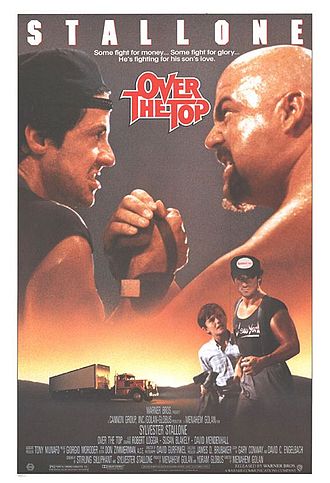
In the wake of Zohran Mamdani’s victory in New York City and Graham Platner’s possible victory in Maine, I’ve become a lot more interested in watching anti-communist films. And really, it doesn’t get more anti-communist than a movie about an independent, non-union trucker who has no interest in being an authoritarian and who only want to be left alone so that he can raise his son and make a little money arm-wrestling.
In this scene from 1987’s Over The Top, Lincoln Hawk (played by Sylvester Stallone) explains the importance of turning his hat. That’s all it takes.
Hi, everyone! Guess is who is guest hosting the #MondayMuggers live tweet tonight? That’s right …. me!
Tonight’s movie will be The Delta Force (1986), starring Chuck Norris, Lee Marvin, Robert Forster, George Kennedy, Robert Vaughn, Steven James, Hanna Schygulla, Shelley Winters, Martin Balsam, Bo Svenson, Joey Bishop, Susan Strasberg, Kim Delaney …. well, you get the idea. There’s a lot of people in this movie! Jedadiah Leland swears that this is the greatest film ever made. We’ll find out tonight!
You can find the movie on Prime and then you can join us on twitter at 9 pm central time! (That’s 10 pm for you folks on the East Coast.) See you then!
93 years ago, on this date, Menahem Golan was born in Israel. After serving in the Israeli Air Force, Golan would attend the Old Vic Theater School in London before returning to Israel and launching his legendary career in film. With his cousin, Yoram Globus, and using Roger Corman as both a mentor and a inspiration, Golan would go on to producer and direct some of the most successful films in Israeli history. Eventually, Golan and Globus would purchase Cannon Films and would be responsible for some of the greatest (in a fashion) films of the 80s.
Though Golan was best-known as a producer, he never stopped directing. Today, on what would have been his birthday, Lisa Marie’s Favorite Grindhouse Trailers presents 6 trailers for 6 Golan films!
Lepke (1975)
After finding great success in Israel, Golan first attempted to break into the American market with this biopic about the head of the Mafia’s Murder, Inc., Louis “Lepke” Buchalter. Though the budget was low, Golan managed to get a name — in this case, Tony Curtis — to play the lead role. As you can tell, the trailer wanted to make sure that you knew that this film was about Lepke.
2. Enter the Ninja (1981)
This was, I think, the first film that Golan directed after buying Cannon Films. How great is Enter the Ninja? It stars Franco Nero as a ninja! Seriously, you don’t get much greater than that. Anyway, as I think I’ve stared on this site before, Enter the Ninja is a lot of fun and Franco Nero was the sexiest ninja of the 80s.
3. The Delta Force (1986)
Chuck Norris was a Cannon mainstay and it seems appropriate that he starred in The Delta Force, a film that was very important to Golan. The Delta Force was essentially a remake of an 1977’s Operation Thunderbolt, an Israeli film that earned Golan his only Oscar nominations when it was nominated for Best Foreign Language Film. The Delta Force did not receive any Oscar nominations but it has a legion of fans. Our own Jedediah Leland has frequently described this film as being the greatest ever made. I don’t know if I’d go that far but still, it is always satisfying to see Chuck blow up the bad guys at the end of the movie.
4. Mack the Knife (1989)
Menahem Golan directs a musical! Unfortunately, this film has never received a proper DVD or Blu-ray release. Though it was a Cannon production, Golan and Globus had a falling out (one that was, at least partially, caused by Golan spending money on films like Mack The Knife) and Golan ended up distributing this film himself. I find the trailer to be intriguing. The film itself is on YouTube so I’ll watch it someday …. maybe.
5. Hit The Dutchman (1992)
Much like Lepke, this film is about a real-life gangster. In this case, the gangster was Dutch Schultz. Interestingly enough, the trailer suggest that Al Capone was active in New York whereas everyone knows that, though Capone did get his start in New York, he didn’t become a prominent gangster until he relocated to Chicago.
6. Crime and Punishment (2002)
Finally, this adaptation of the great novel was a bit of passion project for Golan. He filmed it in Russia in 1993 but, because of financial difficulties, it was not given a release until 2002.
What’s an Insomnia File? You know how some times you just can’t get any sleep and, at about three in the morning, you’ll find yourself watching whatever you can find on cable or Netflix? This feature is all about those insomnia-inspired discoveries!
It’s been nearly a year since I did my last Insomnia File. To be honest, as much as I enjoy writing these posts, I feel like the idea behind the Insomnia File format has become obsolete. The days of people dealing with insomnia by randomly flipping through movies and infomercials have pretty much come to an end. Now, if someone has insomnia, they’re more likely to binge an old show on Netflix.
That said, if you had insomnia at one in the morning last night and you didn’t feel like binging The Office for the hundredth time, you could have turned over to TCM and watched the 1981 film, Enter the Ninja.
What would you have gotten out of Enter the Ninja? Five words: France Nero as a ninja. Seriously, what more do you need? Nero plays Cole, a former mercenary who goes off to Japan, trains to become a ninja, and then heads off for the Philippines, where his old mercenary friend, Frank (Alex Courtney), owns a farm. Frank and his wife, Mary-Ann (Susan George) are having problems because evil businessman Charles Venarius (Christopher George, chewing up the scenery as the bad guy) is determined to force them off of their land. Add to that, Frank is a pathetic drunk.
Soon, Cole is putting on his white ninja suit and fighting to protect the farm and also dealing with Venarius’s ninja, who just happens to be an old rival of Cole’s. Cole is also carrying on an affair with Mary-Ann but that’s not big deal because Frank isn’t much of a man. One of the most interesting things about Enter the Ninja is that it may be a martial arts film but it’s also a modern western and a domestic drama. Cole could just as easily be a gunslinger, protecting the homesteaders. Frank and Mary-Ann could just as easily be a couple on a daytime drama. Instead, they’re all in a ninja film.
The main appeal of Enter the Ninja is Franco Nero, an actor who — in his prime — was one of the sexiest men to ever appear in the movies. He spends a good deal of the film with his face covered but the important thing is that you can still see those beautiful blue eyes. As usual, Nero gives a good performance with so-so material. Nero brings his trademark intensity to the role and he does actually seem to care about whether or not his friends lose their farm.
Enter the Ninja was directed by the legendary Menahem Golan, a filmmaker who understood the importance of never letting the action slow down. Enter the Ninja is dumb, over the top, and entertaining. Plus, it’s got Franco Nero! What else do you need at one in the morning?
On June 27th, 1976, four terrorists hijacked an Air France flight and diverted it to Entebbe Airport in Uganda. With the blessing of dictator Idi Amin and with the help of a deployment of Ugandan soldiers, the terrorists held all of the Israeli passengers hostage while allowing the non-Jewish passengers to leave. The terrorists issued the usual set of demands. The Israelis responded with Operation Thunderbolt, a daring July 4th raid on the airport that led to death of all the terrorists and the rescue of the hostages. Three hostages were killed in the firefight and a fourth — Dora Bloch — was subsequently murdered in a Ugandan hospital by Idi Amin’s secret police. Only one commando — Yonatan Netanyahu — was lost during the raid. His younger brother, Benjamin, would later become Prime Minister of Israel.
A year after the the raid on Entebbe, Menahem Golan would direct a film the recreated that heroic moment. Originally, Operation Thunderbolt was intended to be a Hollywood production, with none other than Steve McQueen playing the role Yonatan Netanyahu. When McQueen withdraw for the project (as he did from a lot of productions in the 70s), Golan and the project returned to Israel, where it was produced with the help of the Israeli military and the Israeli government. (Yitzhak Rabin and Shimon Peres are among the notable Israeli leaders who appear as themselves.) Singer and comedian Yehoram Gaon was cast as Netanyahu while veteran exploitation stars Klaus Kinski and Sybil Danning were cast as the German terrorists.
The end result is a rousing action film that takes a semi-documentary approach to telling its story. Imagine a less flamboyant version of Golan’s The Delta Force, one that tells a similar story but without the oversized personas of Chuck Norris, Robert Forster, and Lee Marvin. Though the film celebrates the bravery of Yonni Netanyahu, the emphasis is more on the IDF working as a team than on individual heroics. (The film open with the IDF running a drill that mirrors the eventual raid on Entebbe, a reminder that Israel and the IDF were determined not to be caught off guard.) The film is not only a celebration of the strength of the Israeli people but, with the Germanic Kinski and Danning cast the villains, it’s only a very loud cry of “NEVER AGAIN!” It may be an exciting action film but it’s an action film with a message: Don’t mess with us.
(At the same time, the hijacker portrayed by Klaus Kinski is not presented as being cardboard villain, which may seem surprising given Kinski’s reputation as an actor and Golan’s reputation as a director. Kinski’s terrorist does get a chance to explain his ideological motivations, with the film presenting him as being more misguided than evil.)
Though I will always consider The Delta Force to be the greatest film ever made (if just for it’s cry of “Beer! America!” at the end), Operation Thunderbolt features Golan’s best work as a director. Menahem Golan was a frequently crass director but, with Operation Thunderbolt, it’s obvious that he was motivated by more than just making a hit movie. Golan’s aim with Operation Thunderbolt was to make a film that would celebrate both Israel and the strength of the Jewish people. With Operation Thunderbolt, Menahem Golan succeeded.


 Through the Shattered Lens