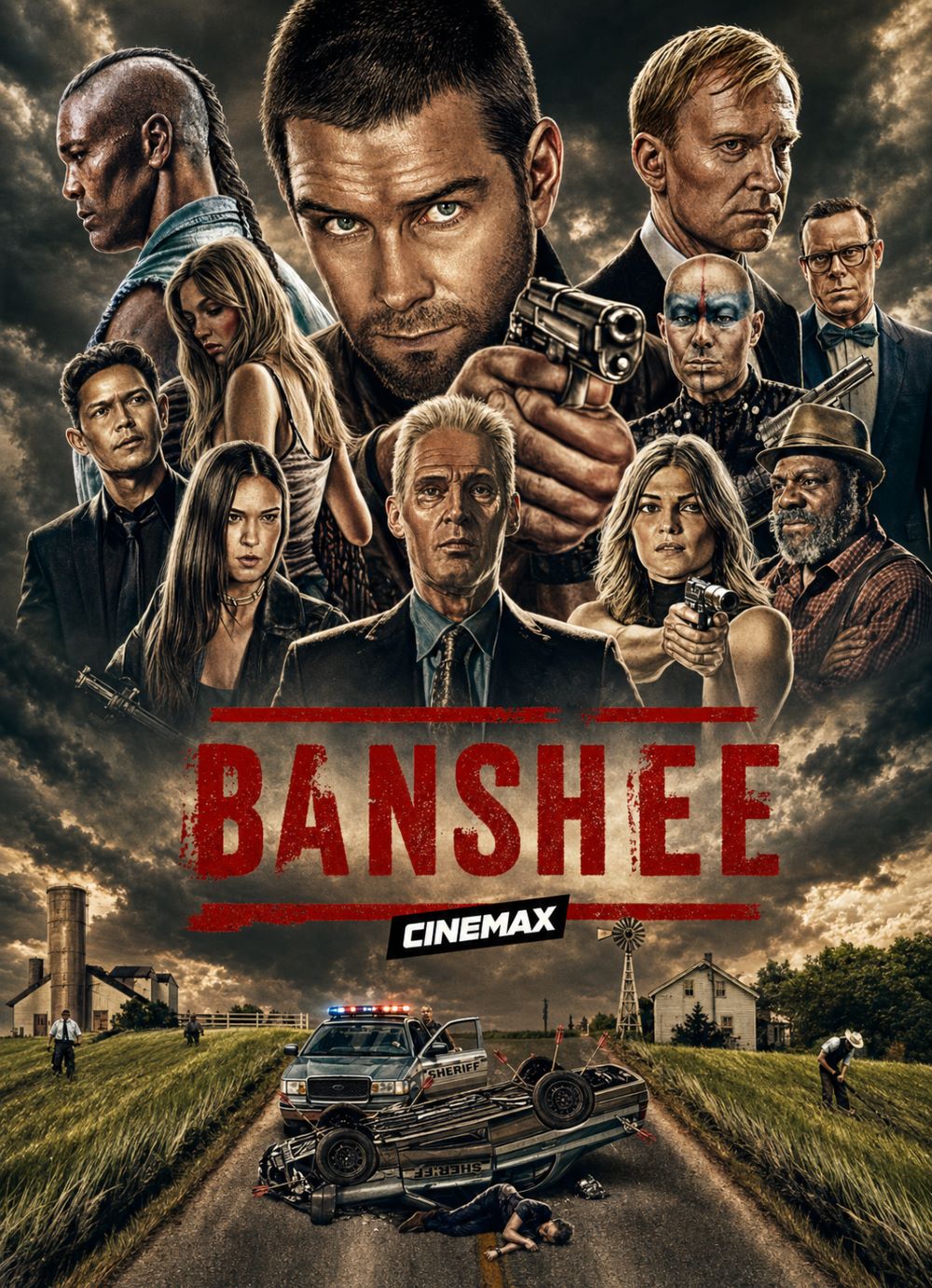
“And behold a Pale Rider, and his name that sat upon him was Death, and Hell followed with him. Revelations 6:8. This is God’s country—you better acquire a taste for it.” — Kai Proctor
There’s a show that’s been criminally underappreciated, standing shoulder-to-shoulder with some of the prestige heavyweights of the last 10-15 years despite its cult-status rabid fans. It’s a gem that blends pulpy noir tropes like antiheroes, femme fatales, and morally gray characters flipping from foes to allies, all fused with brutal action choreography second to none that could hold its own against any big-screen blockbuster. That show is Banshee, delivering action that’s as raw and relentless as it gets, with choreography so tight and brutal it turns every fight into a visceral event you can’t look away from.
The series thrives on that intricate staging, where punches land with bone-crunching impact and chases spill across entire towns. But it’s the core performances anchoring it all that make the violence feel human and the drama stick through four wild seasons. Antony Starr as Lucas Hood, Ulrich Thomsen as Kai Proctor, and Hoon Lee as Job don’t just carry the show—they ground its over-the-top brutality in characters you buy into, making the punches hit harder emotionally as well as physically.
Starr’s Lucas Hood is the beating heart of Banshee, a tattooed ex-con who slips into the skin of a dead sheriff and never quite shakes the impostor vibe, even as he owns the role. This was the role that made him known to TV watchers well before his star turn as the diabolical Homelander in The Boys, showcasing his coiled menace and raw charisma in a way that demanded attention. He’s got this coiled intensity that explodes in the action scenes, where his fights feel like extensions of his fractured psyche—desperate, improvisational brawls that leave him bloodied but standing. You see it in those long-take beatdowns, like the prison riot or the bar fights that turn rooms into war zones, where Starr sells every grunt, stagger, and counterpunch with a physicality that’s equal parts athletic and unhinged.
Over four seasons, he evolves from a smirking thief to a man wrestling his own darkness, but his charisma keeps you rooting for him even when he’s pummeling half the town. It’s a star-making turn that holds the show’s reckless energy together, making Hood’s brutal choreography feel personal and earned. From there, the dynamic shifts seamlessly to his key adversaries and allies.
Then there’s Ulrich Thomsen as Kai Proctor, the ice-cold crime boss whose calm menace makes him the perfect foil to Hood’s chaos. Proctor doesn’t throw punches like a street fighter; he’s calculated, almost surgical, which amps up the brutality when he unleashes. Thomsen plays him with this quiet menace simmering under a polished exterior—think Amish roots clashing with modern savagery—and it pays off in scenes where Proctor’s fights turn primal, like the knife work or those family feuds that escalate into full-on carnage.
His performance anchors the series’ criminal underbelly, giving the action a strategic edge; every beatdown he orders or delivers feels like a chess move in a blood-soaked game. Through the seasons, as Proctor’s empire crumbles and rebuilds, Thomsen’s steely gaze and understated violence keep the stakes feeling lethal, turning what could be a generic villain into a chilling force. Completing this powerhouse trio is the one who brings a wildly different energy.
Hoon Lee’s Job rounds out the core, a brilliant hacker whose razor-sharp intellect makes him indispensable to Hood’s crew, cracking systems and outsmarting foes from the shadows while his loyalty to Lucas remains unshakable. This holds firm even amid the absurdity of his fabulous, urban edge clashing with Banshee’s sleepy countryside vibe. Lee nails Job’s dual nature: the tech wizard who can dismantle security grids or reroute funds with a few keystrokes, turning digital battles into the show’s cerebral counterpoint to the physical brutality.
Yet always backing Hood with a fierce devotion that shines through in clutch moments. But it’s Job’s comedic flair—those sassy one-liners, the glittering outfits and heels that scream big-city glamour in this podunk town of pickup trucks and dive bars—that tempers his seriousness, making him the series’ sparkling wildcard who lightens the grim action without ever undercutting it. Lee plays it with magnetic charm, his fish-out-of-water antics (strutting through cornfields or snarking at rednecks) adding hilarious contrast to the bone-crunching fights.
Those rare physical outbursts—like improvised knife work or quick takedowns—feel earned because they stem from intellect-fueled precision rather than brute force. Across four seasons, as Job’s past traumas surface and alliances strain, Lee keeps the character’s loyalty as the emotional core, blending brainy hacks, loyal grit, and out-of-place humor into a performance that elevates the show’s savage rhythm. Together, these leads create a perfect storm for the action.
These three performances don’t just elevate the fights; they make the choreography sing by tying the physicality to emotional undercurrents. Starr’s raw desperation clashes beautifully with Thomsen’s cold precision and Lee’s brainy, flamboyant flair, powering the series’ best action set pieces—like the multi-man melees where their styles bounce off each other and the stunt team’s work shines. The show’s willingness to let them go full throttle, season after season, without pulling punches (literally) keeps the brutality fresh; you feel the toll on their bodies and souls, which makes the intricate staging hit deeper.
Sure, Banshee can get cartoonishly violent, with limbs snapping and blood spraying in glorious excess, but these actors anchor it, proving that great action needs great performers to make the mayhem matter. That synergy carries the series forward without missing a beat.
It’s that interplay that powers Banshee through its four seasons of escalating insanity. Hood’s barroom demolitions, Proctor’s calculated hits, and Job’s digital disruptions feeding into physical chaos aren’t isolated spectacles—they build in storylines that lead to climactic brawls, like season finales where the whole town becomes a battlefield. The choreography is brutally efficient, using practical effects and minimal cuts to let you track every impact, and these leads sell it with commitment that borders on masochistic.
Starr takes hit after hit, emerging grimier each time; Thomsen’s subtle menace makes his rare outbursts explosive; Lee turns smarts and sass into action catalysts, his hacks setting up the brutal payoffs. They weather the show’s weaker plot detours—those soapier subplots or Native American gang arcs—by keeping the energy dialed up, ensuring the action remains the glue. Even under scrutiny, their work holds strong.
Critically, there’s a slight edge to how they handle the excess: Starr occasionally overplays Hood’s brooding, Thomsen can feel too restrained amid the pulp, and Lee’s comedic beats sometimes flirt with caricature in the rural backdrop, but it rarely derails the momentum. Instead, it adds texture to the brutality, making fights feel like character clashes rather than random violence. Take the recurring motif of improvised weapons—shards of glass, chair legs, car hoods—where their physicality shines, turning everyday objects into extensions of their rage or cunning.
The stunt coordinators deserve props for matching their intensities, crafting sequences that are as punishing as they are precise, with geography and exhaustion playing key roles in every throwdown. This builds to a fitting crescendo by the end.
By season four, as the body count climbs and alliances fracture, these performances reach a peak, culminating in action that’s not just brutal but poignant. Hood’s final stands feel tragic because Starr has made us invest; Proctor’s downfall stings with Thomsen’s quiet devastation; Job’s loyalty and hacks culminate in high-stakes saves, his out-of-place flair making the countryside carnage even more surreal. The choreography evolves too, incorporating more group dynamics and environmental havoc, but it’s always anchored by their work.
Banshee could have been just another forgettable action romp, but these three make its intricate, bone-snapping violence unforgettable, proving that in a show this unapologetically savage, the right actors can turn pulp into something profound.
 New York. The prohibition era. The Coll Brothers, Vincent (Christopher Bradley) and Peter (Jeff Griggs), are sick of working for the Irish gangster, O’Malley (William Anthony La Valle). They want to hang out at the Cotton Club with big time gangsters like Lucky Luciano (Matt Servitto), Legs Diamond (Will Kempe), and Dutch Schultz (Bruce Nozick). Vincent has fallen in love with Lotte (Rachel York), a singer at the club but the club’s owner, Owney Madden (Jack Conley), makes it clear that Lotte is too good for a low-rent thug. After killing O’Malley, Vincent and Peter go to work for Dutch Schultz but soon, they grew tired of the low wages that Schultz pays them. The Colls decide to strike out on their own, leading to all out war with New York’s organized crime establishment.
 Mad Dog Coll was one of two gangster movies that Menaham Golan produced, back-to-back, in Russia. In fact, Mad Dog Coll may be the first American film in which Russia stood in for America instead of the other way around. Though this film was produced after Golan broke up with his longtime producing partner, Yoram Globus, Mad Dog Coll still has a definite Cannon feel to it. It is low-budget, fast-paced, unapologetically pulpy, and entertaining as Hell. For a Golan production, the performances are surprisingly good. Bruce Nozick steals the entire movie as crazy Dutch Schultz. None of it is subtle but it is enjoyable in the way that only a Greydon Clark-directed, Menahem Golan-produced gangster film can be. 1920s New York is recreated on Russian soundstages. The threadbare production design and cardboard cityscape brings a Jon Pertwee/Tom Baker-era Dr. Who feel to the movie. All that is missing is The Master brewing up moonshine and the Daleks exterminating the Chicago Outfit.
