Playing Catch-Up: The Big Short (dir by Adam McKay)


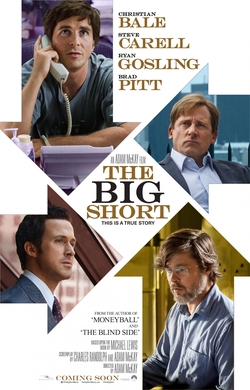
The_Big_Short_teaser_poster

The Big Short is a film that is so critically acclaimed and that has been so passionately embraced by those who enjoyed it that it’s a bit intimidating to admit that it really didn’t do much for me.  (It’s even more intimidating for me to admit that I nearly included it on my list of the 16 worst films of 2015.)  It’s a big, angry movie and, even though it’s not really that good, it definitely taps into the zeitgeist.  It captures the anger, the frustration, and the fears that people (including me) are feeling right now.  It didn’t do much for me but I can understand why others have so passionately embraced it.

As for the film itself, it’s about the housing collapse and the financial crisis of 2008.  The main characters are all people who realized that the economy was about to collapse and who managed to make a profit off of the crisis.  For the most part, everyone gets at least two scenes where they get to rail about how angry they are that they’re making a profit off of other people’s misery.  However, they all still collect their money at the end of the film.

For the most part, our main characters are the type of quirky eccentrics who always tend to pop up in ensemble films like this.  They’re all played by recognizable actors and they all have an identifiable trait or two so we can keep them straight.  For instance, Christian Bale has trouble relating to people socially, plays drums, and looks like he probably has terrible body odor.  Steve Carell has a bad haircut and spends a lot of time yelling at people.  He’s also haunted by the suicide of his brother and he’s married to Marisa Tomei but she only gets to appear in two scenes and doesn’t really do much because this is a film about menfolk, dagnabit.  (I love Steve Carell but this is probably the least interesting performance that he’s ever given.)  John Magaro and Finn Wittrock are two young investors and they especially get upset when they realize that the economy is about to collapse.  Their mentor is played by Brad Pitt.  Since this is an important film, Brad Pitt plays his role with his important actor beard.

And then there’s Ryan Gosling.  Gosling plays a trader and he also narrates the film.  And really, Gosling probably gives the best performance in the film, perhaps because his character is the only one who is actually allowed to enjoy making money.  I think we’re supposed to be outraged when he brags about making money while people lose their houses but Gosling’s so charismatic and the character is so cheerful that it’s hard to dislike him.

(Of course, listening to Gosling’s narration, it’s impossible not to be reminded of The Wolf of Wall Street.  And it’s appropriate because The Big Short is kind of like The Wolf of Wall Street for people who don’t want to have to deal with ambiguity or nuance.)

The film has gotten a lot of attention for Adam McKay’s direction, which is flashy and always watchable but, at the same time, also rather shallow.  For the most part, McKay’s directorial tricks only served to remind me of other movies.  The narration, of course, made me think about The Wolf of Wall Street.  The scenes where characters look straight at the camera and say, “This isn’t the way it really happened,” only reminded me of how much more effective it was when the same thing happened in Michael Winterbottom’s 24 Hour Party People.

And then there’s the celebrity cameos.  These are the scenes where a special guest celebrity is brought on screen to explain to us how Wall Street actually works.  The first time, it’s Margot Robbie in a bubble bath and it works well because it admits the debt that The Big Short owes to Wolf of Wall Street.  (Plus, it ends with Robbie telling the viewers to “fuck off,” which is probably what I would do if a huge group of strangers interrupted my bubble bath.)  If McKay had limited himself to just doing it once, it would have been brilliant.  But McKay drags out three more celebs and, with repeated use, the technique gets less and less interesting.

But I guess it’s debatable whether any of that matters.  The Big Short taps into the way people are feeling now.  It’s a zeitgeist film.  People are rightfully angry and The Big Short is all about that anger.  A decade from now, it’ll probably be as forgotten as Gabriel Over The White House.  But for now, it’s definitely the film of the moment.

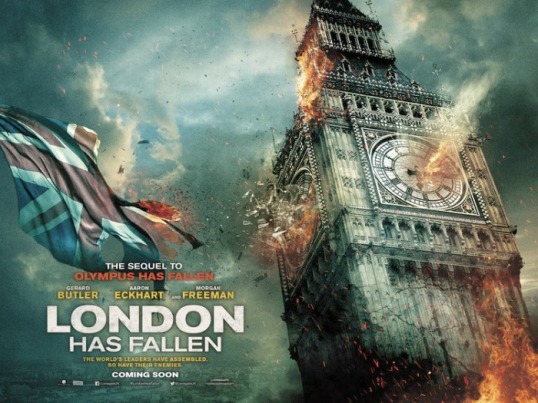
London Has Fallen Official Trailer


London Has Fallen

The White House under siege film Olympus Has Fallen from 2013 was a surprise hit and pretty much took the prize in the match-up between it and the bigger-budgeted White House Down starring Channing Tatum and Jamie Foxx. What the latter didn’t have was the presence of Morgan Freeman, the steadfastness of Aaron Eckhart and the utter badass that is Gerard Butler. Olympus Has Fallen had all three and thus was the better of the two films.

It didn’t take long for the studio who made Olympus Has Fallen to start on a sequel with the three core figures from the first film (Freeman, Eckhart and Butler) back to fight the evil of terrorism on all freedom-loving citizens. I think the studios just thought the audience who saw the first film loved just how much Gerard Butler’s character kept stabbing people in the face.

Here’s to hoping London Has Fallen didn’t try to fix what wasn’t broken…and more Gerard Butler stabbing people in the face.

Embracing the Melodrama Part II #126: Veronika Decides To Die (dir by Emily Young)


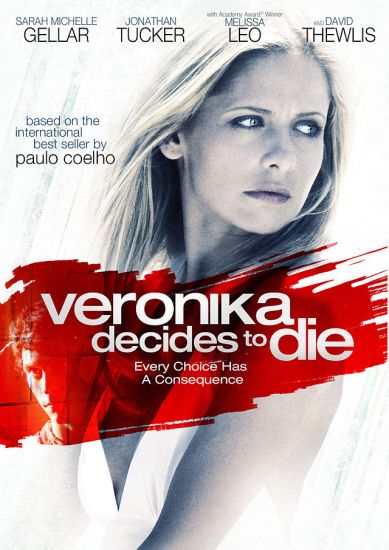
VeronikaDecidesToDie_USPosterWell, here we are!

It’s been 9 weeks since we originally embarked on this journey that I called Embracing The Melodrama Part II.  At that time, my plan was to do 126 reviews in just three weeks.  It didn’t quite work out that way, did it?  But still, I had fun doing this series of reviews and I hope that you’ve had at least a little fun reading them.  If I’ve inspired you take a chance on any of the films that I’ve reviewed — whether it be Sunrise or An American Hippie In Israel or Cocaine: One Man’s Seduction or Calvary — then this has all been worth it!

So, for my final review in this series, I want to take a quick look at one of the most melodramatic films to be released this year so far, Veronika Decides To Die.

Veronika Decides To Die finally got an American release in 2015, six years after it initially premiered on the festival circuit.  Years before it was available here in the States, Veronika played in Europe.  Not surprisingly, the American release felt much like an afterthought, one final attempt to make a little money off the film before moving on.  It’s spent about a week in theaters and two months later, it is now showing up on cable and Netflix.  And while Veronika didn’t get many reviews, the few that it did get were rather dismissive.

But you know what?

I like Veronika Decides To Die.

Don’t get me wrong.  It’s not a great film.  In many ways, it’s a very silly film.  The entire plot hinges on a character doing something that makes no sense.  Frustrated with her life as an anonymous and lonely office worker, Veronika (Sarah Michelle Gellar) attempts to commit suicide.  She survives the suicide attempt and, upon waking in a mental hospital, she’s told by a mysterious psychologist (David Thewlis) that, as a result of her attempt, she now has a heart condition that will kill her in a matter of weeks.  And what does Veronika decide to do after learning that she’s going to die?  She voluntarily remains in the mental hospital and goes to sessions of group therapy!

And you never really believe that Veronika would do that.  But, if you can bring yourself to accept that one implausibility — well, you’ll soon be confronted by a lot of other implausibilities.  You’ll meet Veronika’s glassy-eyed roommate (Erika Christensen) and a mysterious older patient (Melissa Leo).  You’ll also meet Edward (Jonathan Tuker), who is mute but has such a sexy stare that he really doesn’t need to speak.  And as Veronika gets to know her fellow patients, she starts to come to terms with her own issues of anger and regret and she realize that importance of embracing life and doing what you love.

Of course, that’s a little hard to do when you’re in a mental hospital.  Luckily, there’s a piano that Veronika can play while Edward silently watches her.  If you’re guessing that this eventually leads to Veronika sitting naked at the piano and masturbating in front of Edward, well, you’re right…

Listen, Veronika Decides To Die is one of those films that takes itself way too seriously and it ends with a plot twist that you’ll see coming from a thousand miles away.  I can understand why the film’s release was delayed because the film’s tone is all over the place.

But, dammit, I liked Veronika Decides To Die!

When taken on its own defiantly melodramatic terms, it works.  That’s largely because Sarah Michelle Gellar really commits herself to the role.  You forget that you’re watching Buffy.  Instead, Gellar truly becomes Veronika, this tragically sad and lonely young woman who finds inner peace by masturbating at a piano.  Veronika Decides To Die is a movie that really shouldn’t work but Sarah Michelle Gellar saves it.  When the film starts, she beautifully captures Veronika’s lonely desperation, her feelings of isolation and worthlessness.  (I don’t care who you are, we’ve all felt like Veronika at some point in our life.)   As the film progresses, she portrays both Veronika’s anger and her growing appreciation of life.  She has a nice chemistry with Jonathan Tucker and, in the end, Sarah Michelle Gellar probably gives a better performance than the material really deserves.

Of course, another reason that Veronika Decides To Die works is because it is so silly and melodramatic.  This is one of those films that goes so far over-the-top that it creates an almost heightened sense of reality.  It becomes, almost despite itself, compulsively watchable.

It’s also the perfect film with which to complete Embracing the Melodrama Part II.  I hope y’all have enjoyed reading these 126 reviews because I’ve certainly enjoyed writing them!  To everyone who has read these reviews and clicked on the “like” button and occasionally left a comment or two, thank you so much!  Love you!   However much effort or work it may take, all of you make it worth it.

And now I’m going to go pass out for a little while…

Embracing the Melodrama Part II #103: 21 Grams (dir by Alejandro Gonzalez Inarritu)


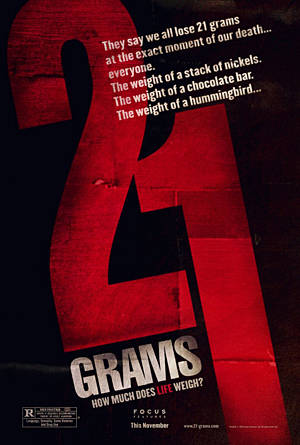
21_grams_movieRemember how shocked a lot of us were when we first saw Birdman?  Well, it wasn’t just because Birdman featured an underwear-clad Michael Keaton levitating in his dressing room.  And it also wasn’t just because Birdman was edited to make it appear as if it had been filmed in one continuous take (though, to be honest, I would argue that the whole “one continuous shot” thing added little to the film’s narrative and was more distracting than anything else.)  No, the main reason we were shocked was that Birdman was directed by Alejandro Gonzalez Inarritu and, when we thought of an Inarritu film, we thought of something like 2003’s 21 Grams.

It’s not easy to explain the plot of 21 Grams, despite the fact that 21 Grams does not tell a particularly complicated story.  In fact, if anything, the plot of 21 Grams feels like something that either Douglas Sirk or Nicholas Ray could have come up with in the 50s.  Indeed, the plot of 21 Grams is far less important than the way the Inarritu tells the story.  (In that, the dark and grim 21 Grams does have something in common with the arguably comedic Birdman.)

Inarritu tells his story out of chronological order.  That, in itself, is nothing spectacular.  Many directors use the same technique.  What distinguishes 21 Grams is the extreme to which Inarritu takes his non-chronological approach.  Scenes play out with deceptive randomness and it is left to the viewer to try to figure out how each individual scene fits into the film’s big picture.  As you watch 21 Grams, you find yourself thankful for little details like Sean Penn’s beard, the varying lengths of Naomi Watts’s hair, and the amount of sadness in Benicio Del Toro’s eyes because it’s only by paying attention to those little details can we piece together how once scene relates to another.

The film tells the story of three people whose lives are disrupted by the type of tragedies that the pre-Birdman Innaritu was best known for.

Sean Penn plays Paul Rivers, who is a sickly mathematician who desperately needs a new heart.  He’s married to a Mary (Charlotte Gainsbourg), who devotes all of her time to taking care of him and is frustrated by Paul’s fatalistic attitude towards his condition.  When Paul does finally get a new heart, he gets a new existence but is haunted by the fact that it has come at the expense of another man’s life.

Christina Peck (played by Naomi Watts) is a former drug addict who is now married with kids and who appears to have the perfect life.  That is until her husband and children are tragically killed and, in her grief, Christina falls back into her old lifestyle.  The formerly stable and happy Christina becomes obsessed with the idea of getting revenge for all that she has lost.  Naomi Watts was deservedly nominated for an Oscar for her work here.  Her vulnerable and emotionally raw performance holds your interest, even when you’re struggling to follow the film’s jumbled chronology.

And finally, there’s Jack Jordan (Benicio Del Toro).  Like Christina, Jack is a former drug addict.  Whereas Christina used the stability of family life to help her escape from her demons, Jack uses his new-found Christianity.  And just as Christina struggles after she loses her family, Jack struggles after tragedy causes him to lose his faith.  Like Paul, he struggles with why he’s been allowed to live while other have not.  Del Toro was nominated for an Oscar here and, like Watts, he more than deserved the nomination.

(While Sean Penn was not nominated for his performance in 21 Grams, he still won the Oscar for his role in Mystic River.)

21 Grams is a powerful and deeply sad film, one that will probably shock anyone who only knows Inarritu for his work on Birdman.  21 Grams is not always an easy film to watch.  Both emotionally and narratively, it’s challenging.  But everyone should accept the challenge.


Review: Oblivion (dir. by Joseph Kosinski)


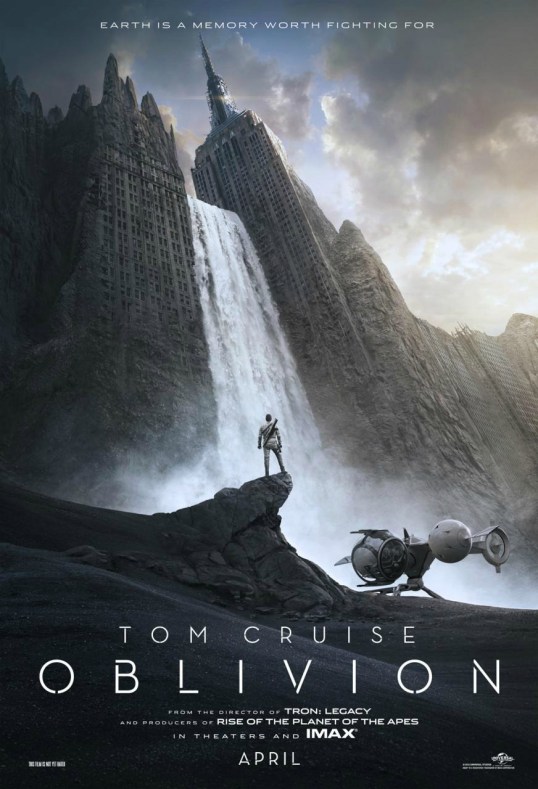
Oblivion-Movie-Poster

Good science-fiction films tend to be far and few between. Most of the time the ideas and ambition to make a good or great science-fiction film are right there on paper, but loses much once people actually have to create it for others to see. This puts the latest sci-fi film from Tron: Legacy filmmaker Joseph Kosinski in a weird position. His follow-up to the underwhelming sequel to the classic sci-fi film Tron is called Oblivion and it manages to be thought-provoking and entertaining, yet also have a sense of a been there and done that to the whole proceeding.

Oblivion quickly gets the introductions to the film’s backstory out of the way. Earth was attacked 60 years ago by aliens who were called “Scavengers” (Scavs for short) who destroyed the moon thus causing massive tectonic upheaval and gigantic tsunamis to ravage the planet. Humanity in its desperation would fight back with the only weapons it had left once the aliens began landing troops and that would be the nuclear kind. The planet is now devastated with the surviving population leaving Earth for a new colony on Saturn’s moon of Titan and in a massive tetrahedron space station orbiting Earth simply called “The Tet”.

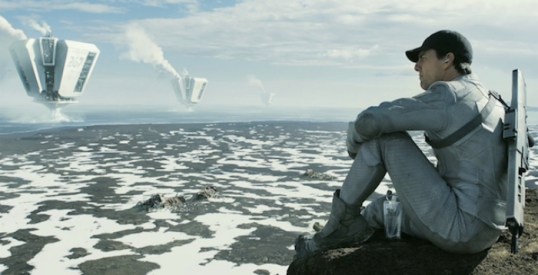
It’s the story of the technician pair left behind to provide support for the array of armed drones who patrol Earth for any remaining Scavs and protect the reclamation factories that has been removing the remaining resources that the planet has to be used as an energy source for the Titan colony. This pair of technician are Jack (Tom Cruise) and Victoria (Andrea Riseborough) who live in a towering base above the clouds. Jack does the dirty work by flying patrols in the area that encompasses what used to be the East Coast of the United States while Victoria (who also happens to be Jack’s lover) provides comm and technical support back at their base.

Oblivion01

Victoria can’t wait to finish their five-year stint on Earth and with two weeks left before they can rejoin the rest of humanity on Titan her dream is coming closer. Yet, Jack doesn’t seem to want to leave Earth behind. He has begun to dream about Earth before the war that he should have no memory of. First they’re dreams while he’s asleep but as the film shows it soon begins to invade and distract his waking hours as well.

It’s during one such mission where he comes across the a sudden arrival of a human spacecraft with surviving humans aboard that his dreams become reality. A woman he has dreamed off that he’s never met is one of the survivors (played by Olga Kurylenko) and she becomes the key to unlocking the secret that’s been kept from him about the true nature of the war that devastated Earth sixty years past and why he continues to have flashes of memories that he should never have had.

Oblivion sounds like it’s original at first glance, but as the story moves along we begin to see influences (at times outright plot point lifts) from past innovative sci-fi films such as Moon and The Matrix. While Kosinski (who co-wrote the film as well as directed it) does put his own spin on these ideas it’s not enough to fully distinguish the film from past sci-fi films which did them better. Oblivion is not bad by any means, but it fails to stretch beyond it’s influences that would’ve made it a great film instead of just being a good one. It doesn’t help that the script lags behind Kosinski’s talent for creating some beautiful images and vistas. The world-building he does with art director Kevin Ishioka manages to make a devastated Earth look serenely beautiful which when paired with cinematographer Claudio Miranda’s panoramic sweeps of the Icelandic location shoot make Oblivion one of the best looking film of 2013.

Yet, the script tries too hard to explore some heavy themes such as the nature of memory and identity. The film doesn’t explore them enough to make this film come off as something heavy sci-fi like Solaris. It just teases the audience enough to start a spark that could lead to conversations afterwards. The action that does punctuate the more introspective sections of the film does come off quite well despite coming only few at a time and not for any extended length.

Oblivion02

What seems to hold the film together outside of it’s visuals would be the performance of the cast which sees Tom Cruise doing a very workman-like performance as Jack. We’ve seen him do this sort of performance time and time again that it seems to be second-nature to him by now and something audiences come to expect now. Even Morgan Freeman as an aged resistance fighter lends a bit of serious gravitas to the film whenever he’s on-screen. But it’s the performances of the two female leads that sells the film despite it’s flaws. Olga Kurylenko has less to work with in the role of Jack’s mystery woman Julia. What she does get she does so with a level of empathy that instantly sells the notion that Jack and her were destined to be together despite the vast gulf of time and space.

The stand-out performance comes from Andrea Riseborough as Jack’s lover and partner Victoria. Where Jack comes off as restrained chaotic glee who marvels at the sight he sees every day he’s out on patrol the opposite is Victoria. Her organized and reserved demeanor comes off as sexy in a cold and calculated way, yet just behind that British reserve we see glimpses of her hanging on by a thread at the chaos she sees in Jack. Andrea Riseborough plays Victoria so well that every scene she’s in she steals it from Cruise. Her performance was all about slight changes to her body movement, a quick glance that speaks volumes of what she’s thinking. While this film may not make Riseborough an outright star it will get her noticed by other filmmakers soon enough.

With the summer blockbuster season of 2013 coming closer like a freight train with the approach of Iron Man 3 it’s a good thing that Oblivion was released weeks before this hectic season. For despite it’s flaws in it’s script and the lack of originality in it’s premise the film does succeed in being entertaining and thought-provoking enough that people should see it on the big-screen. Plus, nothing but the massive screen (especially IMAX) does full justice to some of the vistas shot of Iceland that doubles as devastated Earth. So, while Oblivion may not be the slam-dunk hit for Kosinki after failing with Tron: Legacy it is still a film worth checking out.

Quickie Review: Olympus Has Fallen (dir. by Antoine Fuqua)


OlympusHasFallen

“The most protected building on Earth has fallen.”

Die Hard has become it’s very own subgenre of action films since it was first released in 1988. It was a simple enough story that combined the “one against many” type of story with the “siege tale”. It was a perfect combination that has since been copied, imitated, but truly never duplicated to the highest level of success the original film had upon release. There’s been a few films that added their own unique take on this action film template. There was “Die Hard on a boat” with the underappreciated Under Siege. Then we have Air Force One which was “Die Hard on a plane”. The latest action film to try and put a new spin on the Willias-McTiernan classic is Antoine Fuqua’s latest film, Olympus Has Fallen.

The film pretty much takes what worked with the three films before it that’s been mentioned above and combines them to make a film. We have a lone, highly skilled operative in the form of Secret Service Agent Mike Banning in the role that made Bruce Willis famous and, for a time, resuscitated Steven Seagal’s career. Then we have the Presidential angle but instead of Air Force One it’s the White House this time around. The plot of the film is simple enough that even a person not well-versed in film could follow it. A group of dedicated and highly-trained North Korean terrorists do a surprise attack on the White House as the President of the United States and his South Korean counterpart try to find a way to defuse a situation that’s been growing in the DMZ between the two Koreas. It’s now up to Agent Banning, on his own, to try and stop whatever plans the terrorists have brewing with the President as hostage while also dealing with an inept group of higher-ups trying to deal with it far from the action.

Olympus Has Fallen doesn’t break new ground with the way it’s story unfolds and it’s characters develop. The film was pretty much beat-for-beat and scene for scene lifted from the three other films mentioned above. The characters may be different and the circumstances they find themselves in somewhat different, but the screenwriters played everything safe except the action sequences part of the film. It’s these action scenes which brings Olympus Has Fallen to a new level of violent artistry that the previously mentioned films never reached.

To say that this film was violent would be an understatement. Where other films of this type a certain cartoonish tone to it’s violence this time around Fuqua goes for a much more serious and, at times, disturbingly difficult to watch level of violence to make the film stand out from the rest of it’s kind. The assault on the White House itself and the surrounding area has less a look of a fun action film and more of a war film. People die in droves and it doesn’t matter whether they’re Secret Service, police, terrorists or innocent civilians. All were fair game in this film.

Even the action once we get to Banning playing the Willis role looked more brutal than what Willis and even Seagal ever got to do. Gerard Butler may not have had the charisma and wit of Willis in the same role, but he convincingly played his role as more Jack Bauer than Officer McClane. Butler as Banning was all business and efficiency while Willis as McClane was more the witty, smartass who just keeps finding himself in the wrong place at the wrong time.

Olympus Has Fallen won’t be hailed as one of the best films of 2013. It won’t even be talked about as one of the top action films this year, but despite the story being a derivative of every Die Hard and it’s clones before it the film does succeed in being a very enjoyable piece of popcorn flick. It was full of tension and big action setpieces (though the CG effects looked very cheap at times) that Fuqua has gradually become known for. The characters in the film were just a step above being one-dimensional and the story itself becomes less eye-rolling and more worrisome considering the real tensions coming out of the Korean Peninsula at this very moment.

One thing I’m sure of is that of the two “Die Hard-in-the-White-House” films this year (there’s the bigger-budgeted White House Down later this summer from Roland Emmerich) I have a feeling that Olympus Has Fallen might be the more fun. It’s probably going to be the more violent of the two and that’s an assumption I’m willing to make without even seeing how Emmerich’s film turns out.

Trailer: Oblivion (Official)


Oblivion-Movie-Poster

Every year always has a couple of big genre films that seem to continually fly under the radar. This is surprising since people tend to think that films with huge budgets and a cast headlined by one of the biggest names in Hollywood tend to be overhyped before they even reached the big-screen. While I’ve heard of the upcoming scifi and post-apocalyptic film Oblivion for almost two years now it’s still a film that doesn’t generate much talk.

We know several things about Oblivion that came out before the release of the film’s first trailer: 1. it stars Tom Cruise and 2. it’s the follow-up film for Tron: Legacy director Joseph Kosinski. The second part may be one thing that has kept this film from being one of the biggest anticipated films of 2013. Kosinski’s underwhelming sequel to Tron didn’t make many genre fans excited as to what he might come up with next.

The trailer looks to erase some of those doubts as we get to see Oblivion as a very beautifully-shot film. We get see some great looking art direction for the film if the trailer show’s us anything about Oblivion. Plus, it has Morgan Freeman all decked out like one of David Lynch’s Fremen from Dune.

Oblivion is set for an April 12, 2013 release date.

Source: Apple

Horror Review: Red State (dir. by Kevin Smith)


Kevin Smith’s 2011 film was a major departure for him. It wasn’t the usual comedy (his last one being the very awful buddy-cop comedy, Cop Out) but instead his first foray into one of film’s earliest film genre: the horror film. Say what you want or feel about Kevin Smith (and there’s a huge range of people who either love the man or hate him like the second coming of the Antichrist) but when he decides to make a film he puts everything of himself on display and he wears his emotions on his sleeves when it comes to his films. It’s this aspect of Smith’s personality which has gained him such a loyal following, but has also earned him the scorn and, for some, hate of film bloggers who now constitute the bulk of film criticism in the digital age. This first horror film for Kevin Smith would be called Red State and it would be a film that would continue to expand the gulf between those who hate him and those who support him. Lost in this playground-like tiff was whether the film would be a return to form for Smith or just a continuation of some very bad films in the last half-decade.

Red State could almost be called a coming-of-age story since the film begins with three high school boys joining together to travel to a neighboring town where they  hope to engage in some sexual extracurricular activities. It’s also in this very town that we learn very early on in the film that the Five Points Church calls home. This church and it’s congregation has one Pastor Abin Cooper (Michael Parks) as it’s leader with it’s membership either related by blood to Cooper or by way of marriage. In this picture would arrive an ATF task force led by Special Agent Keenan (John Goodman) to investigate the illegal doings of Cooper and his flock. It’s between these two groups that the three teenage boys would find themselves in a horrific situation with their lives in the balance.

Let’s just say that this film had much potential in it’s plot and how it’s initially set-up. The character of Pastor Abin Cooper and his flock was definitely patterned after the Westboro Baptist Church led by Fred Phelps who’re infamous for picketing funerals of soldiers and for being outright homophobic in their teachings and ideology. The ATF group with Keenan in command looks to be set-up to represent the Federal government and it’s police agencies run amok in their attempt to fight terrorism since Sept. 11, 2001. Then Smith drops in three horny teenage boys in the mix and it sure must’ve read like a surefire story with horror and action.

What we get instead was a film which didn’t seem to know how to proceed with the initial set-up. The film began and played out like something similar to Hostel and films of a similar vein. Unsuspecting teens lured by sex to be made an example of by a group of people extreme in their passions and ideas. If the film had continued with just those two groups as the core of the film’s story then it could’ve made for a decent survival horror film, but the addition of the ATF task force and how they impacted the dynamics between the congregation and the teens unbalanced everything. Now what was suppose to be a horror film turned into an action-drama.

The performances by the cast was also inconsistent. This could be due to the weakness of the screenplay which tried too hard to push Cooper and his people as batshit crazy through overly long sermons. Sermons by Abin Cooper that was delivered by Michael Parks in convincing fashion at times and then mumbled incoherently at others. The three teens were also a problem in that they weren’t sympathetic by any means. Even knowing what awaited them didn’t lessen the fact that these three teens were obnoxious and vulgar to the point that we didn’t care if Cooper and his people tortured and killed them.

One would expect that the addition of John Goodman as the ATF special agent and Kevin Pollak as his assistant would at least bring some serious acting chops to the proceedings, but their characters were so thinly-written and their dialogue so forced that one couldn’t believe them as real characters. It’s a shame that the film’s overall screenplay couldn’t provide the necessary foundation for a cast that had a very good veteran ensemble which included Melissa Leo, James Parks and Stephen Root.

Red State really failed in the very thing that was suppose to make this film the beginning of a shift in Kevin Smith’s career. It failed as a horror film in the most general sense. There was never any true feeling of horror to be had throughout the film. Even the first death of an unnamed homosexual kidnapped by the congregation to be used as an example during one of Cooper’s sermons failed to elicit any form of horror. This was a film which had much potential for some horrific sequences but it never explored it. The film doesn’t even work as a thriller which would be the closest this film ever got to be. Even the ending of the film which tried to inject a semblance of the supernatural didn’t even work as it turned out to be a major bait-and-switch that didn’t come off as creative once it was explained.

Does the film justify some of the venom hurled at it from Kevin Smith’s detractors?

I would say no in that the film wasn’t the worst thing he has made by a long shot. It did have some moments that hinted at something special could’ve been made if someone else was involved or if the film had more time to be worked on. I do believe that if Red State was made by anyone else other than Kevin Smith it would be considered average to good. But having such a polarizing figure as it’s creator and marketer might have blinded some in actually watching this film with an open-mind.

Does this mean Red State was actually a good film?

I would say no with the reasoning I’ve mentioned above. But I will say that the film wasn’t dull or boring. As unnecessary as the ATF task force to the story as a whole their arrival and the subsequent reaction of the congregation to them made for some exciting few minutes. Even Michael Park’s performance was quite good despite some of his line deliveries coming off as incoherent mumblings.

If Red State was to be Kevin Smith’s attempt to try and move away from his history of making comedies then it was a failed one. While it was a failure I wouldn’t mind him going back to the genre to hone his skills in doing more horror. If Uwe Boll could continue making even worst materials then surely Smith could be given another chance to make another and fix the very things which he did wrong with Red State with another horror film project. One thing for sure he would not be lacking in actors wanting to work with him.

What Lisa Watched Last Night: The 83rd Annual Academy Awards


Last night, I watched the 83rd Annual Academy Awards.

Why Was I Watching It?

Why was I watching it?  I was watching it because I love awards shows.  I love them in all of their tacky, silly glory.  I was watching for the clothes, the celebrity meltdowns, and the infamous acceptance speeches.  I was watching because James Franco is hot and Anne Hathaway is adorable.  I was watching because I loved Black Swan and I was only mildly impressed with the Social Network.  I was watching because, as a film lover, my year starts and ends with the Oscar ceremony.  You boys have got your super bowl.  I’ve got my Academy Awards.

What Was It About

This year, the big question was would best picture be taken by the Social Network or by the King’s SpeechI predicted that the Social Network would win and I was wrong.  The Academy gave best picture to The King’s Speech which, unlike Black Swan (my personal choice for best picture), is a film that is very easy to love.  Don’t get me wrong.  I loved The King’s Speech and, seeing as how I wasn’t exactly a huge fan of The Social Network, I can’t complain about the Academy’s decision (though apparently almost everyone else can).

By the way, as far as my Oscar predictions went, I ended up going 15 for 22.  I correctly predicted all of the categories except for Best Picture, Best Director, Best Original Screenplay, Best Foreign Language Film, Best Editing, Best Costume Design, and Best Cinematography.  So, in other words, I correctly predicted all of the awards except for the ones that actually mattered.  However, I am proud to say that, as the broadcast started, I predicted that it would last for 3 hours and 15 minutes and by God, I was right.

So there.

What Worked

Roger Ebert called last night’s ceremony the worst he had ever seen so I guess it’s no surprise that I actually enjoyed it.  I certainly felt it was an improvement over last year’s ceremony which was pretty boring except for when Kathryn Bigelow won best director.  There weren’t any endless tributes, self-congratulatory speeches about how important the film industry is for the survival of the world, and we didn’t have to sit through any pre-scripted, awkward banter between poorly matched presenters. 

As for the hosts, James Franco appeared to have mentally checked out before the show actually started but he was nice to look at.  Anne Hathaway, meanwhile, was a bundle of nervous energy and you know what?  I would have been too.  For the first time in my history of watching the Oscars, I could actually relate on a personal level to what was happening on the stage.  I’ll take the charming awkwardness of Franco and Hathaway over Hugh Jackman any day.  Ebert disagrees.  He apparently tweeted that Kevin Spacey should host.  And, if I ever felt like spending three and a half hours watching some smug jackass singing Under the Sea, I’d agree with him.

I liked the opening film montage, which featured Hathaway and Franco going into Alec Baldwin’s dreams in order to learn how to host the show.  If nothing else, it paid tribute to just how much of a cultural phenomenon Inception actually was last year.  (At the same time, it also pointed out just how ludicrous it is that Christopher Nolan — who is hot along with being a genius, by the way — was not nominated for best director.)

Probably my favorite presenters were Mila Kunis and Justin Timberlake.  Kunis looked great and Timberlake won my heart all over again by announcing that he was actually Banksy.

The In Memoriam Tribute was actually pretty touching this year and I think a lot of that has to do with the fact that the audience has finally figured out how inappropriate it is to break out into applause in the middle of it.  A lot of viewers were apparently angered that Corey Haim wasn’t included.  Personally, I was disappointed (but not surprised) to see that Jean Rollin was left out.

For me, the best acceptance speech came from David Seidler as he accepted his Oscar for writing The King’s Speech.  His speech touched me as a former stutterer but on top of that, he delivered it with just the right amount of humility and humor.  Aaron Sorkin could learn a thing or two from Mr. Seidler.

Finally, I said earlier that I was hoping for just one upset win to keep things interesting and, to my surprise, the show provided me one when Tom Hooper beat David Fincher for best director.  Even among those who expected the King’s Speech to take best picture, the general assumption seemed to be that Fincher would win best director.  Personally, I think Fincher would have won best director except for the fact that people tended to think of The Social Network as being an Aaron Sorkin film as opposed to a David Fincher film.  In all of the preliminaries leading up the Oscars (the Golden Globes, the critics awards), the emphasis was always put on Sorkin’s screenplay as opposed to Fincher’s direction.  David Fincher was almost treated as an after thought and, as a result, Tom Hooper won best director.

(Of course, personally, I was rooting for Darren Aronofsky.)

Of the nominated films, Black Swan was my favorite, followed by 127 Hours, Inception, Winter’s Bone, and the King’s Speech.  I thought The Social Network was a good film but certainly not a great film and, to be honest, I’ve come to resent being told again and again by various online, self-appointed film gurus that my refusal to unconditionally love The Social Network is somehow an indication of a character defect on my part.  Seriously, some of these Social Network partisans make the Avatar people look tolerant by comparison.  I’m sure these people have spent last night and today ranting their little hearts out about how the Academy sucks and how The Social Network is clearly the greatest film ever made.  And to them, all I can say is get over it.  If you were watching the Academy Awards because you seriously felt that the awards actually mean anything, then you’ve obviously still got a lot of growing up to do.

That said, I make no apologies for being ticked off over the award for Best Feature Documentary but more about that below.

What Didn’t Work

Well, I’ll get the big one out of the way first.  This was the only time I actually got angry while watching last night’s show.  I’m talking, of course, about Inside Job winning best documentary.  This upset me even though I had actually predicted that Inside Job would defeat Exit Through The Gift Shop.  My objection comes down to this — Inside Job was the Capt. Hindsight of documentaries this year.  Inside Job was basically a documentary that told us what we already know and then encouraged us to pat ourselves on the back for agreeing.  In a year that was actually a pretty good one for documentaries, Inside Job was the least challenging of all of the nominees and therefore, I guess it’s not a shock that it won.  Meanwhile, Exit Through The Gift Shop — a film which should have been nominated for best picture — was ignored.

Add to that, I was really hoping for a chance to see how Banksy would accept the award or if he would even show up at all (or if he would turn out to be Justin Timberlake).  Instead, I got the director of Inside Job going, “You know, nobody’s been arrested for the bad economy yet.”  Well, if that’s what you think should happen then go to talk to the people who make and enforce laws.  But you’re on an awards show, buddy.  And if you think anyone watching an awards show is going to take action just because of some comment you weakly muttered during your acceptance speech, then you really are out of touch with reality.

We were reminded one too many times that we were watching “the young and hip Oscars.”  The young and hip Oscars would not have featured Celine Dion singing.

I really wish the Oscars would stop trying to force some artificial “theme” on each year’s ceremony.  This year, they took time to celebrate “the greatest films” of Oscar Past.  The problem, of course, is that most of the greatest films of Oscar past didn’t win best picture.  Usually, they ended up losing to movies like How Green Was My Valley, The Greatest Show on Earth, and Crash.

Aaron Sorkin won best adapted screenplay as we all knew he would and, as usual, he came across as smug and condescending during his acceptance speech.  The whole, “Daddy’s an Oscar winner now…” thing would have been touching if not for the fact that it’s been used at least once at every single Oscar ceremony in history.

Trent Reznor did not say, “I want to fuck you like an animal” while accepting his award for scoring The Social Network.  However, I must say, Trent cleans up well.

Technically, yes, James Franco was not real impressive as co-host.  The general consensus on twitter was that he was stoned but I can’t say too much against him because he’s James Franco.  Even when he showed up in drag, he was still James Franco.  I know some people looked at Franco last night and thought, He’s not even trying.  I looked at Franco and thought, yum…..

“Oh my God!  Just Like Me!” Moments

There were a few and most of them had to do with Anne Hathaway.  Most of the comments on twitter concerning Hathaway’s performance as host were not kind but I don’t care.  I love her and I think her lack of polish was actually rather adorable.  If I was hosting the Oscars, I would probably take a few moments to brag about my dress as well.  I know I’d certainly probably start giggling at random moments.  I also know that I’d probably get a little bit annoyed with James Franco’s lack of commitment to the show as well but you know what?  I’d still get all sorts of naked with him after the show because he’s James Franco and he just does things to me.

(If anything, last night’s show proved that the difference between a hot guy and all other guys is that a hot guy can get away with it.)

My other big “Oh my God!  Just like me!” moment came when Melissa Leo won for best supporting actress for the Fighter and dropped the F-bomb on national TV.  I would so do that too.  I mean, it’s an Oscar!  God knows what I’d end up saying if I ever got one.

Lessons Learned:

I’ve seriously got a thing for James Franco.

Lisa Marie’s Oscar Predictions


The Oscars are tomorrow and I know I’ll be watching it and tweeting about it over on my twitter page.  That’s assuming, of course, that twitter doesn’t go all screwy and spend the entire night putting up that cute little picture of the fail whale.

Anyway, I guess I’m a bit overdue in posting my predictions of what and who will actually win tomorrow.  I guess that’s because this year’s Oscar race looks to be one of the most predictable ever.  Don’t get me wrong.  I like quite a few of the nominees and Black Swan is a contender for my favorite film of all time.  It’s just that this year, the winner’s are so predictable. 

Let’s be honest, we don’t watch the Oscars because we really think that the best film or performer is going to win.  We watch the Oscars for all of the WTF moments and acceptance speech breakdowns.  We watch the Oscars because we want to see something weird happen, like a shocking upset win that leaves us all outraged and shaking our heads.

This year, though, the only suspense seemed to center around the Best Documentary category.  Will Exit Through The Gift Shop win and if it does, will Banksy be there to accept it?  And if he is there, will he wear a monkey mask while accepting it?

Anyway, here’s my list of predictions.  These are the movies and performers that I think will win.  They’re not necessarily who and what I personally would want to win.  (That list can be found here.)

Best Picture: The Social Network

Best Actor: Colin Firth, The King’s Speech

Best Actress: Natalie Portman, Black Swan

Best Supporting Actor: Christian Bale, The Fighter

Best Supporting Actress: Melissa Leo, The Fighter

Best Director: David Fincher, The Social Network

Best Adapted Screenplay: The Social Network

Best Original Screenplay: The Kids Are All Right

Best Animated Film: Toy Story 3

Best Foreign Language Film: Buitiful

Best Art Direction: Alice in Wonderland

Best Cinematography: True Grit

Best Costume Design: The King’s Speech

Best Documentary Feature: The Inside Job (bleh)

Best Editing: Black Swan

Best Makeup: The Wolf Man

Best Original Score: The Social Network

Best Original Song: “We Belong Together” from Toy Story 3

Best Sound Editing: Inception

Best Sound Mixing: Inception

Best Visual Effects: Inception