Nothing more to say than Star Wars: The Force Awakens is just 5 months away. It’s a wait made to seem even longer after witnessing the behind-the-scenes reel shown during this week’s San Diego Comic-Con.
May the Force be with you.
Nothing more to say than Star Wars: The Force Awakens is just 5 months away. It’s a wait made to seem even longer after witnessing the behind-the-scenes reel shown during this week’s San Diego Comic-Con.
May the Force be with you.
A new feature that I thought was a nice way to introduce not just our readers, but also fellow site writers to some films we love, admire and think worthy of checking out.
It won’t be any sort of review or recap of what the film is about, but just a simple, single shot from the film itself that the individual writer considers an worthy and interesting glimpse of the film.
To start off “4 Shots From 4 Films” here’s the first 4 shots. Moving forward it will be just 4 screenshots and the title of the film they belong to.
4 SHOTS FROM 4 FILMS

Kwaidan (dir. by Masaki Kobayashi – 1964)

Minority Report (dir. by Steven Spielberg – 2002)
 The 2010 film Shutter Island finds the great director Martin Scorsese at his most playful.
Taking place in 1954, Shutter Island tells the story of two detectives, Teddy Daniels (Leonardo DiCaprio, giving an excellent performance that, in many ways, feels like a test run for his role in Inception) and Chuck Aule (Mark Ruffalo, also excellent), who take a boat out to the Ashecliffe Hospital for The Criminal Insane, which is located on Shutter Island in Boston Harbor. They are investigating the disappearance of inmate Rachel Solando, who has been incarcerated for drowning her three children.
Ashecliffe is one of those permanently gray locations, the type of place where the lights always seem to be burned out and the inmates move about like ghostly visions of sins brought to life. It’s the type of place that, had this movie been made in the 50s or 60s, would have been run by either Vincent Price or Peter Cushing. In this case, the Cushing role of the cold and imperious lead psychiatrist is taken by Ben Kingsley. Max Von Sydow, meanwhile, plays a more flamboyantly sinister doctor, the role that would have been played by Vincent Price.
When a storm strands Teddy and Chuck on the island, they quickly discover that neither the staff nor the patients are willing to be of any help when it comes to tracking down Rachel. As Teddy continues to investigate, he finds himself stricken by migraines and haunted by disturbing images. He continually sees a mysterious little girl. He has visions of his dead wife (Michelle Williams). A horribly scarred patient in solitary confinement (Jackie Earle Haley) tells him that patients are regularly taken to a lighthouse where they are lobotomized. When Teddy explores more of the island, he comes across a mysterious woman living in a cave and she tells him of even more sinister activity at Ashecliffe. Meanwhile, Chuck alternates between pragmatic skepticism and flights of paranoia.
And I’m not going to share anymore of the plot because it would be a crime to spoil Shutter Island. This is a film that you must see and experience for yourself.
This is one of Martin Scorsese’s most entertaining films, an unapologetic celebration of B-movie history. He knows that he’s telling a faintly ludicrous story here and, wisely, he embraces the melodrama. Too many directors would try to bring some sort of credibility to Shutter Island by downplaying the film’s more melodramatic moments. Scorsese, however, shows no fear of going over the top. He understands that this is not the time to be subtle. This is the time to go a little crazy and that’s what he does.
Good for him.
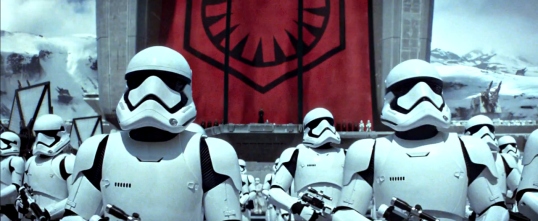
I was at work when this trailer dropped and I can honestly say that I couldn’t wait to go on break so I could watch it and allow myself to react in an honest and proper way. To say that I lost my ever-loving mind once the trailer began playing would be an understatement.
Star Wars: The Force Awakens looks to return to it’s proper space opera roots. Roots as in the first trilogy instead of the much-maligned (deservedly so) prequel trilogy which would end up marking George Lucas’ final work on the franchise he created in 1977. Walt Disney Studios has bought all that is Star Wars and the industry which sprung from it’s creation and are now master of all.
J.J. Abrams now has the tough task of pulling back in the fans that felt disappointed at how the last three films in the franchise turned out. From what this teaser trailer has shown he seems to have come up with a new entry in the franchise that may just delight fans old and new.
Oh yeah, Chewie is back alive and well. No more of that dropping a moon on his head crap.
Star Wars: The Force Awakens set to give the world a fine Christmas 2015.

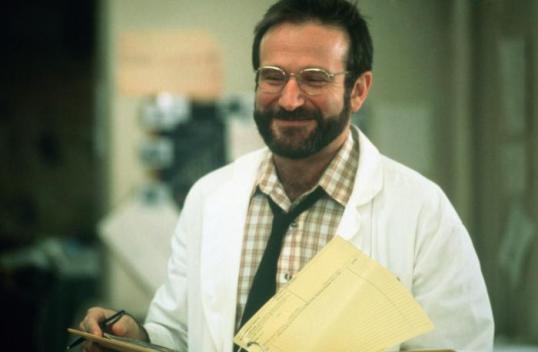
The 1990 Best Picture nominee Awakenings is exactly the type of film that seems to have been designed to make me cry.
Taking place in 1969 and based (very loosely, I assume) on a true story, Awakenings features Robin Williams as Dr. Malcolm Sayer. Dr. Sayer is a dedicated and caring physician but he also suffers from an almost crippling shyness. He’s at his most comfortable when he’s dealing with a group of patients who have spent the last 40 years in a catatonic state, suffering from a tragic disease known as encephalitis lethargica. (One thing that I learned from watching this film was that, from 1917 to 1928, there was an epidemic of this disease, with millions either dying or being left catatonic.) While the rest of the medical establishment (led by John Heard, who always seems to be the embodiment of the establishment in films made in the 90s) assumes that the patients are destined to spend the rest of their lives in a vegetative state, Dr. Sayer is convinced that the patients can be awakened. He soon discovers that, even in their catatonic state, the patients will react to certain stimulii. One woman can catch a baseball. Another appears to react well to music. And finally, Leonard Lowe (Robert De Niro) — who fell ill with this disease when he was a child — tries to communicate with a Ouija board.
Over the objections of his supervisors, Dr. Sayer treats the patients with an experimental drug. Leonard is the first one to get the drug and is also the first one to wake up. While the rest of the patients wake up, Dr. Sayer tries to help Leonard adjust to the 1960s. At first, everything seems to be going perfectly. Leonard even manages to strike up a sweet romance with a woman named Paula (Penelope Ann Miller). However, it soon becomes obvious that the awakening is only going to be a temporary one as Leonard and all the other patients start to descend back into their catatonic states…
It’s easy to criticize a film like Awakenings for being manipulative and sentimental. And the fact of the matter is that the film is manipulative and it is sentimental and undoubtedly, it probably is a massive simplification of the true story. (The character played by John Heard is such an obvious villain that he might as well have a mustache to twirl.) And yes, you know even before it happens that there’s eventually going to be a montage of an amazed Leonard staring at a girl in a miniskirt while Time of the Season plays on the soundtrack.
But, no matter! It’s a tremendously effective film and it earned the tears that I shed while watching it. Both De Niro and Williams give excellent performances which add a good deal of depth to scenes that could otherwise come across as being overly sappy. De Niro has the more showy role but it really but it’s the performance of Robin Williams that really carries the film. As played by Williams, Dr. Sayer is a fragile soul who hides from the world behind his beard and his professional determination. When he finally asks a nurse (Julie Kavner) out to dinner, it’s impossible not to cheer for him.
It’s also impossible not to cheer a little for Awakenings.
When I first decided that I wanted to do the 44 Days of Paranoia, I went on Facebook and I asked my movie-loving friends to name some of their favorite conspiracy-themed films. As the replies came flooding in, one thing that I quickly noticed was that a lot of them were naming films that had been made in the 1970s.
Usually, when I think about the 70s, I tend to assume that everyone in Texas was smoking weed in a high school parking lot, everyone in New York was snorting cocaine in Studio 54, and everyone in America was dancing nonstop. And, to be honest, that doesn’t sound too bad to me. If the 70s were just ten years straight of Dazed and Confused and Saturday Night Fever, then I would be the first one to hook up with anyone who could build a time machine.
However, the 70s were apparently also a very paranoid time. When one looks over the most acclaimed and best-remembered films of the 70s, one is struck by the feeling that nobody trusted anyone and all official institutions were suspect.
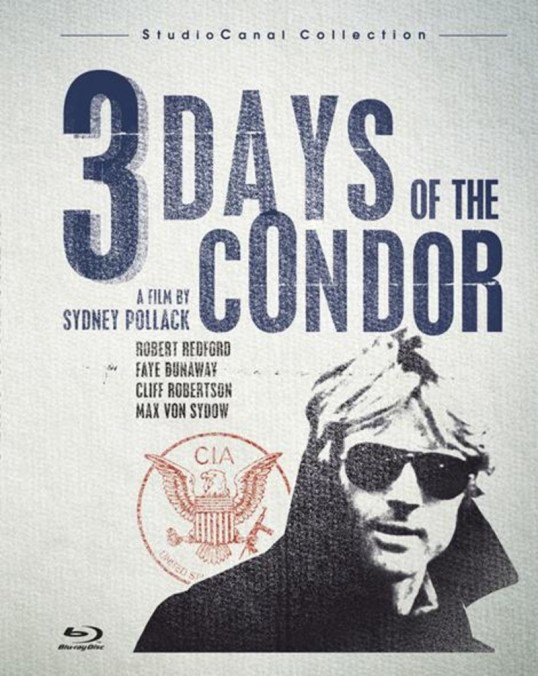
Case in point: 1975’s Three Days of the Condor.
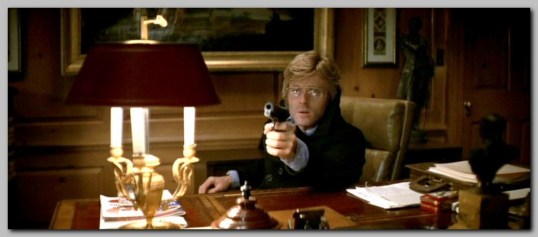
Robert Redford plays Joe Turner, a mild-mannered guy who works for the American Literary Historical Society in New York City. The Society, however, is a CIA front and Turner’s job is to read cheap spy novels and analyze them to see if any real intelligence leaks might be found between the lines. As the film opens, Turner arrives late for work. He jokes with the chain-smoking secretary, shares a few curt words with his superior Martin, and flirts with fellow researcher Janice. Then, Joe goes to lunch and, while he’s gone, Max Von Sydow shows up with a bunch of killers and guns down everyone else at the safe house.
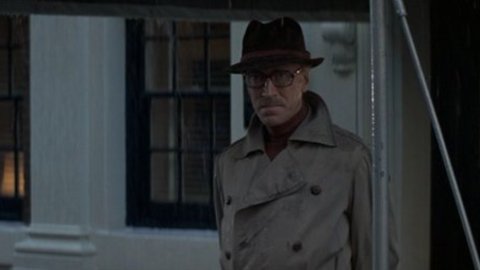
Max Von Sydow’s courtly killer
The scene in which Von Sydow calmly kills all of Joe’s co-workers is one of the most disturbing that I’ve ever seen. As directed by Sydney Pollack, the film’s violence comes in short, brutal bursts that are all the more nightmarish for lacking any of the flashy choreography that we, as viewers, have been conditioned to expect whenever we’re confronted by violent death on-screen. Pollack also makes good use of Von Sydow’s kindly eyes and courtly manner, letting us know that, for him, murder is just a job. Even though we’ve only spent a few minutes with Joe’s co-workers, we’ve still grown to like them and that makes Von Sydow’s matter-of-fact attitude all the more disturbing.
(It’s been a few days since I saw the film and I have to admit that I’m still haunted by the close-up of the burning cigarette still held in the dead secretary’s hand or the way that Martin’s toupee falls off his head after he’s shot. Small as these details may seem, they stick in the mind and create a sickening feeling of life interrupted.)
When Joe returns from lunch, he finds all of his co-workers dead. Fleeing the safe house, Joe calls the New York regional director of the CIA, Higgins (Cliff Robertson). Higgins arranges for Joe to meet up with another agent and to be taken to safety. However, when Joe arrives for the meeting, the other agent attempts to kill him.
Realizing now that the CIA specifically hit its own safe house and is now looking to kill him, Joe ends up kidnapping Kathy Hale (Faye Dunaway), a neurotic photographer, and forcing her to hide him while he desperately tries to figure out why he’s been targeted.
Thanks largely to Sydney Pollack’s thoughtful direction, Three Days of the Condor is an excellent, exciting, and thought-provoking thriller and, despite having been released close to 40 years ago, it features one major plot that’s probably even more relevant today than when the film was first released. Redford and Dunaway both give excellent performances but the film really belongs to Max Von Sydow’s menacing and charming assassin. Most of today’s “action” filmmakers could learn a lot from watching Three Days of the Condor.
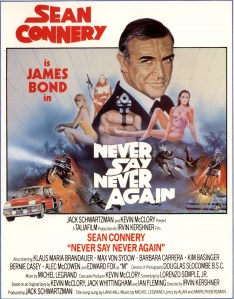
With the release of the latest James Bond yarn, Skyfall, imminent, the Shattered Lens has been looking back at every single James Bond film ever created – the entire history of the franchise. Today’s selection for review is 1983’s Never Say Never Again. Unlike the overwhelming majority of the franchise, this film was not produced by EON productions, but rather by an independent studio. It is an adaptation of Ian Fleming’s Thunderball, much like the 1965 film that shares the novel’s name. It also marks the return of Sean Connery to portray the film’s lead, 00-agent James Bond, 12 years after appearing in Diamonds Are Forever.
I have to say, when I entered into reviewing this film I was certain that I had seen it before, but it took only ten minutes or so of film action before I realized that this film, somehow, had completely flown under my radar.
I have to say, it does not make a strong first impression. We don’t get a cold open with Bond, but rather launch directly into the credit sequence with what I have to admit may be the worst opening theme song of the entire franchise. I haven’t even posted it here, I’m so embarrassed by it, but I’m sure a quick youtube search will yield some results. It’s lengthy, slow, and weirdly incongruous with what proves to be a fairly action-packed Bond adventure.
The story here is sort of needlessly complicated. Addressing the long lapse between Connery appearances as bond, M (Edward Fox) notes that he has recalled James Bond to service against his will, and that after failing a routine training exercise, that Bond is in unacceptable physical condition. His first assignment? To proceed to a health spa to be placed on an exercise and dietary regimen to bleed all of the toxins out of his system, with a strong implication that Bond’s behaviour and mind-set are as much of a problem as his physical condition. While at the spa, of course, Bond becomes privy to a strange interaction between the beautiful nurse Fatima Blush (Barbara Carrera) and an accomplice with a bandaged face, one Jack Petachi (Gavan O’Herlihy). The duo spot Bond, and attempt to have him assassinated, but 007 is able to overcome the assassin and lives to fight another day.
We learn that both Blush and Petachi are agents of the infamous terrorist organization, SPECTER, headed by Ernst Stavros Blofeld (Max Von Sydow). In a convoluted plot, Jack Petachi will use a surgically implanted false eye to replicate the retinal scan of the President of the United States. Using this eye, he is able to arrange for two nuclear warheads to be placed aboard cruise missiles. Using strategically positioned transmitters, SPECTER’s agents then guide the launched missiles remotely, driving them into the sea where their agents can retrieve the nuclear weapons. With the warheads, Blofeld plans to hold the world hostage, forcing world governments into paying an annual tribute to SPECTER, or risk the annihilation of world cities in nuclear fire. Soon after, Jack Petachi is murdered by Fatima Blush, who throws a snake into his speeding vehicle, causing him to lose control and crash through a wall. She then plants a bomb in the vehicle and blows him sky high.
Responding to the crisis presented by SPECTER, M reluctantly reinstates the 00-agents, including James Bond. Bond is immediately assigned to track down the missing warheads.
From there, we’ll travel from the Bahamas, home of SPECTER agent Maximillian Largo (Klaus Maria Brandauer)’s massive yacht, Flying Saucer. Bond meets Domino Petachi, Jack Petachi’s sister, and Largo’s lover (Kim Basinger) and comes into conflict with both Fatima Blush and Largo himself. Bond will chase Largo from the Bahamas to France, into the Mediterranean, and out to the Middle East, with help from noted CIA agent Felix Leiter (Bernie Casey). The action sequences, once they get rolling in the second half of the movie, don’t really let up, and take us to an underwater finale where Domino finally kills Largo in revenge for the needless death of her brother.
For all that this film does right, I have to confess that this was definitely not my favourite James Bond film. The pacing seemed brutally uneven for much of the film, with the action sequences spaced too far apart. The film does spend a little effort winking and nodding at the earlier Connery Bond films, probably in part because Never Say Never Again was not developed by the franchise’s principle producers, EON. Although this film is a far cry from the extremely gadget and superscience-y Bond films that dot the landscape after Connery’s original departure, there is a definitively 80s quality to this film – especially in the film’s score, which at times is loud and invasive, and other times oddly subdued – which prevents it from ever fitting right in with the other Connery films.
The performances are pretty good all around. Sean Connery himself might never have taken a 12 year vacation from playing 007, the women around him are beautiful, and Brandauer is a flamboyant villain in the classic Bond style. Max Von Sydow is excellent in presenting yet another take on supervillain Ernst Blofled, though I thought he was more or less wasted in a very limited role.
If you are waxing nostalgic and just can’t live without one more trip with Connery as James Bond, you probably won’t find this film disappointing. Something about it never really struck a chord with me, however, and I came away thinking of it as a bit of a slog.
Join us tomorrow as we continue our odyssey through the history of James Bond with the slightly-silly but always-fun Octopussy. Until then, against my better judgment, I’ll leave you with the theme song to Never Say Never Again … remember what I said about the music score before you chance it though!
Earlier this month, I finally found the time to see Extremely Loud and Incredibly Close, the critically reviled “prestige” picture that was the center of a minor scandal when it received an Academy Award nomination for best picture back in January.
That nomination, by the way, is the only reason that I made a point of DVRing the film when I saw that it was going to be on HBO. I had already been turned off by the film’s trailer and the subject matter (a little kid trying to make sense of 9-11 by wandering around New York with a mute old man) seemed like the sort of thing that could only have been made effective by a Roberto Rossellini or a Vittorio De Sica. Say what you will about director Stephen Daldry (and I think that both Billy Elliott and The Reader are excellent films), he’s not an Italian neorealist. Extremely Loud and Incredibly Close seemed like just the film to bring out his worst instincts as a filmmaker.
Having now finally seen the film, I am sorry to say that my initial instincts were correct. Extremely Loud and Incredibly Close is the type of film that gives a bad name to good intentions. This is the type of film that you watch and you know that you should be touched by the subject matter but it just all feels so forced, heavy-handed, and ultimately quite empty.
The film tells the story of Oskar (played by Thomas Horn), a brilliant child who is also a bit abrasive and neurotic. At one point, Oskar says that he’s been tested for Asperger syndrome but that the tests were “inconclusive.” What’s interesting about this is that in the book that this film is based on, the possibility that Oskar might be autistic is never stated or even hinted at. Instead, he’s just an abrasive kid and, to be honest, the film’s decision to make Oskar autistic feels less like characterization and more like narrative laziness. It’s hard not to feel that the filmmakers introduced autism as a way to avoid dealing with the fact that Oskar (especially as played by Thomas Horn) is perhaps one of the most abrasive and annoying characters in film history.
Oskar’s life falls apart when his father, Thomas (Tom Hanks), is killed on 9-11. He obsessively listens to the final 6 messages that his father left on the family’s answering machine, even while he hides those messages from his mother (Sandra Bullock).
A year later, Oskar is exploring his father’s closet and finds a vase that has an envelope in it. Inside the envelope is a key and written on the envelope is the word “Black.” Convinced that the key is a final message from his father, Oskar looks up the address of every single person in New York whose last name is Black and sets about tracking each one of them down and demanding to know if they knew his father. Eventually, he’s joined in his quest by a sad-eyed mute (Max Von Sydow) who lives with Oskar’s grandmother.
Extremely Loud and Incredibly Close is based on a novel and the film’s central idea — that Oskar’s quest is his way of trying to make some sort of sense out of the September 11th terrorist attacks — is one that works better as a literary metaphor than as an actual story. While Oskar’s quest might seem poignant on paper, it becomes narcissistic and rather insensitive when seen on film. You find yourself wondering why so many New Yorkers are willing to let this obnoxious and rather annoying little brat into the homes, especially when he usually responds to their hospitality by being rude and condescending.
(In the film’s defense, it does try to address that very issue at the end of the movie but it does so in a way that just doesn’t seem that plausible.)
Ultimately, the film feels like a rather crass exploitation of a true-life tragedy and it’s made even more offensive by Daldry’s heavy-handed approach to the material. This is the type of material that needed more than a hint of realism and instead, Daldry seems to feel that it’s necessary to manipulate us into thinking that 9-11 was a national trauma (as if we didn’t already know that). The all-star approach that Daldry takes to casting his story also serves to undermine the film’s message. At moments when you should be wrapped up in the unfolding melodrama, you find yourself saying, “Hey, it’s John Goodman! There’s Viola Davis! Oh look! Jeffrey Wright!” Extremely Loud and Incredibly Close ultimately feels less like a film about a national trauma and more like a slick Towering Inferno-style disaster flick.
The film’s one saving grace is Max Von Sydow, who dominates this entire film without saying a word or even having that much screen time. One wishes that Daldry had told his 9-11 story through Von Sydow’s sad eyes and just left the kid at home.
Is it too early to declare that Branded is the worst film of 2012?
Probably. After all, there’s still 3 more months left in October and who knows what could happen. I’m still holding out hope that Zero Dark Thirty will be just as bad as I’m expecting it to be and I recently realized that I find the trailer for The Sessions to be kind of annoying. There’s still a slight chance that I’ll see a film worse than Branded before 2013.
However, I do think that it’s safe to say that Branded is the worst film of 2012 so far.
At the very least, Branded deserves the award for 2012’s most deceptive trailer.
On the basis of the trailer, you would be perfectly justified in expecting Branded to be a rip-off of John Carpenter’s classic They Live. You would be justified in expecting that the film would be a thriller, involving aliens using advertising to control people’s minds.
What you would not expect is that Branded would turn out to be an overlong, extremely preachy and didactic film about a Russian advertising guru who, after producing an ill-fated reality show, spends 6 years living as a shepherd until he happens to ritualistically sacrifice a red cow and is therefore inspired to lead an advertising war against fast food companies. You wouldn’t expect the film to be such a confused mess that, while watching it, you actually find yourself standing up to leave the theater because you’ve mistakenly assumed that the film is over (as I did several times). You also probably wouldn’t expect that the entire film would be narrated by yet another cow, this one floating around in the night sky and sending down lightning bolts to both enlighten and destroy various advertising gurus.
All of that happens and more! And you know what? As interesting as it may appear to be in writing, it’s all unbelievably dull when watched on-screen. The Russian advertising genius is played by Ed Stoppard and his American girlfriend is played by Leelee Sobieski and, as a couple, they have absolutely zero chemistry. You never believe their relationship and, as such, it’s difficult to understand why Sobieski’s character is so determined to make things work with a guy who appears to be insane. Sobieski’s father is played by Jeffrey Tambor. Whereas everyone else in the film underplays to the point that they sometimes appear to be sleepwalking, Tambor overplays every scene, as if he thought he was appearing in an episode of Arrested Development instead of this movie. In the end, the best performance in the film comes from the talking cow in the sky, even if she seems awfully proud for a character who spends the entire movie spouting banal clichés.
(Seriously, did you know that advertising is a form of manipulation? Well, you do now! Thanks, Space Cow!)
For no particular reason, Max Von Sydow is in the film as well. His role is really just a cameo and the entire time he’s on-screen, he’s got a small smile on his lips as if he’s saying, “Did you really pay money to watch this crap?”
In its defense, there is one — and only one — impressive scene in Branded but you can see that scene in the trailer for free.
There might be a worse film than Branded released this year.
But I doubt it.
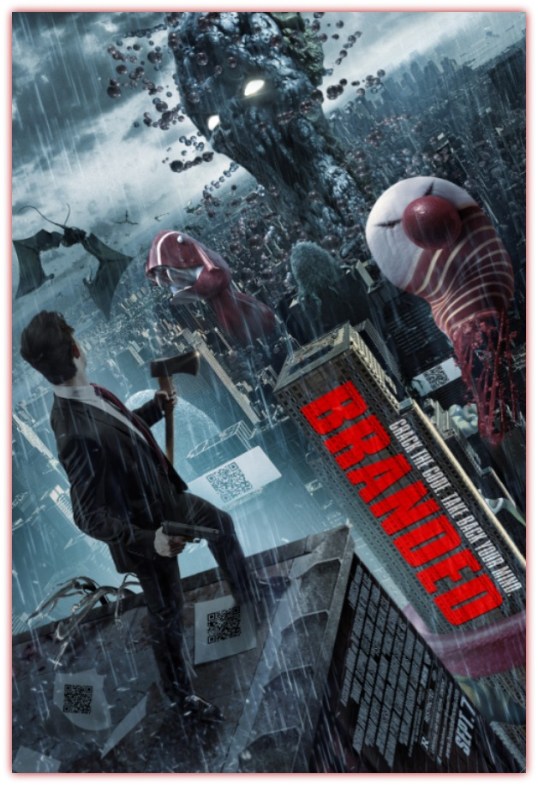
Lisa Marie mentioned a particular film trailer that she sawfor a film coming out soon that reminded her of a classic John Carpenter scifi film. This film was Brandedand from looking at it’s official trailer one does see some major similarities between this Russian/American scifi production with the Carpenter subversive scifi film.
The premise looks and sounds interesting but I must admit that the CG aliens/monsters/overlords look to be very subpar in comparison to most CG-effects work nowadays. Another note of interest is that it stars Leelee Sobieski who was once seen by Hollywood as a rising superstar when she first hit the scene over a decade ago. I don’t think I’ve seen her in anything of note until this trailer came along.
Now I won’t say that this film is a straight rip-off of Carpenter’s They Livebut if it includes an extended scene between two men fighting it out in an alley then I shall declare shenanigans.
Branded is set for a September 7, 2012 release date.

 Through the Shattered Lens