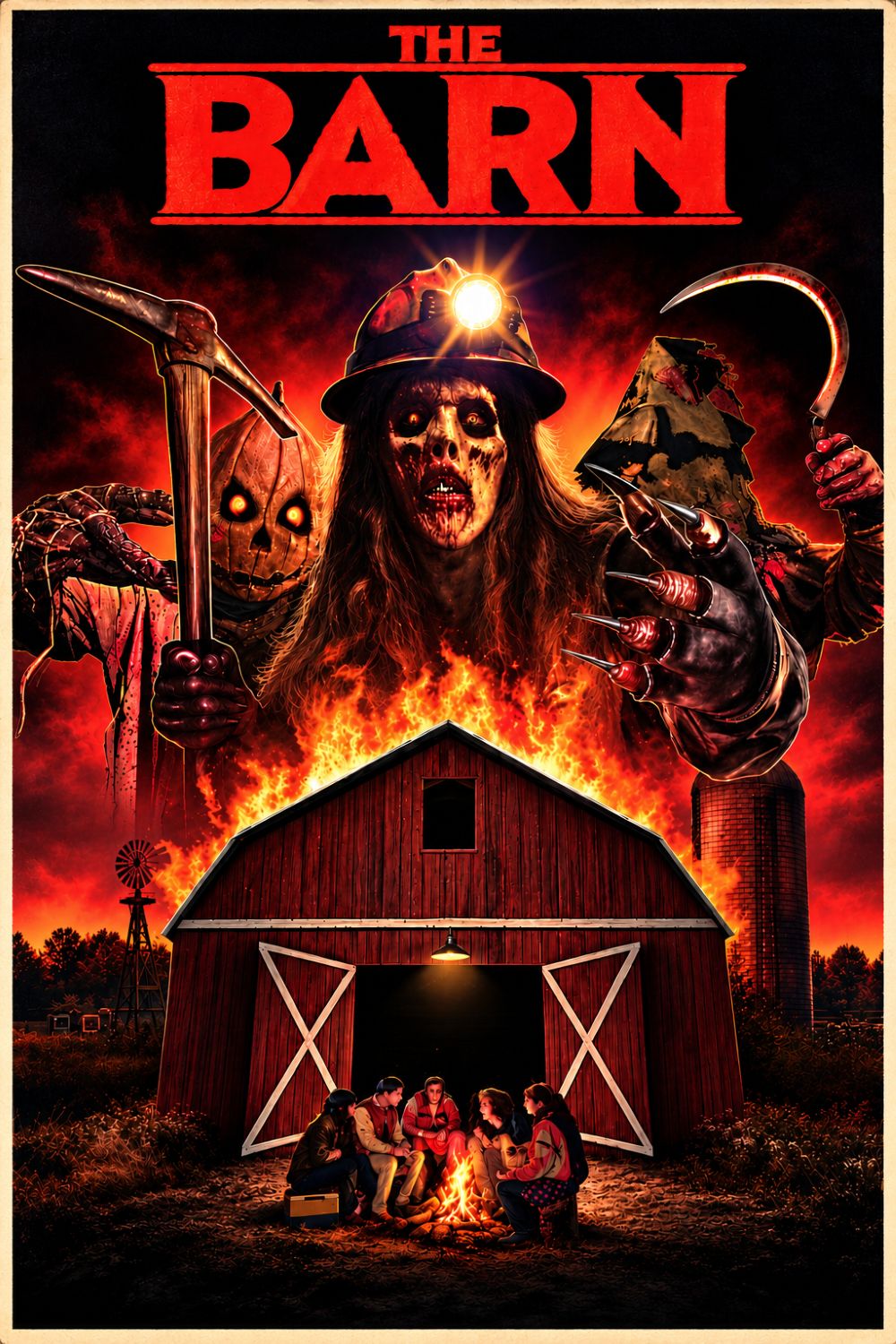
Horror Film Review: The Barn (dir. by Justin M. Seaman)


“Never trick the treat. You never break a deal in Halloween because it’s the one night the devil can come for you.” — Sam Daniels

Horror fans who grew up renting VHS tapes from the local video store will find a lot to love in The Barn, a 2016 indie horror film that wears its ’80s influences on its sleeve with pride. Directed by Justin M. Seaman, this scrappy, affectionate throwback to the VHS-era Halloween slasher is built from rural legends, practical monsters, teenage misadventures, and a small-town setting soaked in October. It is not flawless, but it is sincere, energetic, and far more fun than its rough production values might initially suggest.

The story begins long before the main events of the film, in the small town of Wheary Falls, where a local tragedy involving children and a church sets the stage for an evil that has been waiting in an old barn. Decades later, it is Halloween 1989, and high school seniors Sam and Josh are determined to make the most of their final Devil’s Night before graduation. Their plan involves a road trip to a rock concert, but as often happens in horror movies, the night takes a turn. They and their friends encounter the forbidden barn, ignore the obvious danger, and awaken three supernatural killers: a scarecrow, a pumpkin-headed creature, and a miner boogeyman. What follows is a night of stalking, chasing, and bloodletting as the group realizes that the local legend is very real.

The premise is intentionally simple, and that simplicity is both a strength and a limitation. On one hand, it gives the movie a clear, classic horror structure: teenagers venture somewhere they should not, ancient evil awakens, and survival becomes the only goal. On the other hand, the plot does not offer many surprises. You can probably guess who will die, when the monsters will strike, and how the final confrontation will unfold. But The Barn does not seem especially interested in subverting expectations. It wants to deliver a familiar kind of Halloween fun, and in that respect, it succeeds more often than not.

The film’s greatest asset is its atmosphere. Seaman clearly understands that Halloween horror is about more than just a masked killer or a bloody kill scene. It is about the feeling of the season: dead leaves, cold nights, cornfields, porch decorations, costumes, campfires, and the sense that the world becomes a little stranger after dark. The Barn captures that feeling with impressive commitment. The rural Pennsylvania setting gives the movie a natural autumnal texture, while the period details help establish its late-’80s identity. The film does not have a huge budget, but it uses its resources well, creating a world that feels handmade and lived-in rather than sterile or overly polished.

The monsters are another major highlight. The three creatures at the center of the film are not especially complex, but they are memorable. The scarecrow has the classic rural-horror menace of a figure that should be harmless but is anything but. The pumpkin man is goofy in the best possible way, with a design that feels like it came straight from an old horror poster or a particularly ambitious haunted attraction. The miner is perhaps the most unsettling of the three, bringing a grimy, folkloric quality to the group. Together, they form a fun monster squad that gives the movie its personality. They are not trying to be terrifying in a modern, realistic sense; they are trying to be the kind of creatures you would rent a VHS tape to see, and they absolutely achieve that.

The practical effects and makeup work add a lot to their appeal. The blood and gore are not especially sophisticated, but they are tangible, messy, and playful. There is a physicality to the kills that modern horror often loses when it relies too heavily on digital effects. You can tell that people built these costumes, applied this makeup, and staged these effects with limited money but plenty of enthusiasm. That handmade quality gives The Barn a charm that bigger productions often lack. Even when a gag does not fully work, it feels like it was made by people who care about what they are doing.

The soundtrack also deserves praise. Rocky Gray’s score blends synth-driven horror music with a rock and metal edge that fits both the film’s setting and its tone. The music gives the movie momentum, especially during the early stretches when the group is heading toward the barn and the sense of danger is still building. It also reinforces the retro feel, echoing the kind of pulsing, atmospheric scores that defined so much of 1980s horror. The soundtrack helps The Barn feel less like a modern movie set in the past and more like an actual artifact from the era it is imitating.

The cast also gives the film some genuine ’80s horror credibility, most notably through the appearance of Linnea Quigley. As one of the definitive scream queens of the era, thanks to roles in films like The Return of the Living Dead and Night of the Demons, Quigley brings an instant connection to the kind of horror The Barn is trying to honor. Her presence may be brief, but it gives the movie real genre bona fides and makes the retro homage feel more authentic. Ari Lehman, the original Jason from Friday the 13th, adds another layer of fan-friendly horror history to the proceedings. These appearances do not transform the film, but they reinforce the sense that Seaman knows exactly whose legacy he is celebrating.

The acting is where the film’s limitations become most apparent. Mitchell Musolino and Will Stout, as Sam and Josh, have a likable enough friendship, but the performances around them vary in quality. Some lines are delivered awkwardly, some characters feel more like archetypes than people, and the dialogue occasionally lands with a thud. However, this is not necessarily a dealbreaker for a movie like this. The Barn is not aiming for naturalistic drama. It is aiming for the heightened, slightly wooden energy of low-budget ’80s horror, where teenagers often speak in a way that feels more like a movie version of teenagers than real people. If you accept that style, the acting becomes part of the movie’s charm rather than a distraction.

The screenplay is similarly uneven. Seaman gives the characters more personality and backstory than many microbudget horror films bother with, which is admirable. Sam and Josh are not just anonymous victims; they have goals, frustrations, and a sense of history with each other. The supporting characters also get enough definition to make their fates matter, at least a little. However, the movie sometimes tries to do too much. The road trip to a metal concert and the subplot involving a church food drive add texture and opportunities for cameos, but they also slow the pacing and make the story feel a little loose. The film is strongest when it focuses on the group, the barn, and the monsters. When it spreads its attention across too many threads, it loses some of its momentum.

The first two acts are where The Barn really comes alive. The buildup is fun, the atmosphere is strong, and the movie has a playful sense of discovery as the teens stumble deeper into danger. There is genuine excitement when the creatures begin appearing, and the film does a good job of making the barn and surrounding countryside feel like a place where bad things have always happened. The kills are inventive enough to keep things lively, and the movie’s sense of humor prevents it from becoming too grim. It is not trying to frighten you on a deep psychological level. It is trying to entertain you with spooky monsters, Halloween chaos, and a healthy dose of nostalgia, and for most of its runtime, it does exactly that.

The final act is where the movie loses some of its steam. The last half hour feels longer than it should, partly because the film keeps teasing an ending before gearing up for another confrontation. The methods the characters use to fight back are not as creative or satisfying as the buildup promised. Instead of escalating into a truly wild climax, the movie becomes more straightforward, and some of the fun drains out of it. The pacing issues are noticeable, especially after such an energetic first hour. It is not a disastrous ending, but it is the weakest part of the film, and it keeps The Barn from reaching the level of the best Halloween-themed horror movies.

Still, it is hard to stay mad at a movie this sincere. The Barn was made on a very small budget, and you can see the limitations in the production values, sound, and acting. But you can also see the passion in every frame. Seaman is not cynically imitating the ’80s to cash in on nostalgia; he is building the kind of movie he clearly wishes had existed on his shelf growing up. That enthusiasm matters. It gives the film a warmth that many more technically competent horror movies lack. The flaws feel like the flaws of a friend’s homemade haunted house: crooked signs, questionable acting, cheap props, but undeniable fun.

Comparisons to Trick ’r Treat are inevitable because both films treat Halloween as a night governed by rules, legends, and supernatural consequences. But The Barn is smaller, rougher, and more rooted in the slasher tradition. It is less polished than Michael Dougherty’s film, but it has its own scrappy personality. It is also more focused on monsters and practical effects than on anthology-style storytelling. If Trick ’r Treat is the polished Halloween party, The Barn is the slightly chaotic neighborhood haunt run by someone who really loves scaring people.

By the time the credits roll, The Barn has proven that a horror movie does not need a huge budget or a flawless script to leave a lasting impression; it just needs heart, atmosphere, and a clear sense of what it loves about the genre. Seaman’s film delivers all three, wrapping its flaws in enough retro charm, practical effects, and Linnea Quigley-powered ’80s credibility to make them feel like part of the package rather than detractions. It is a movie that knows what it wants to be and delivers it with a grin, even when the acting or pacing stumbles. The Barn may not replace the classics in your annual rotation, but it earns a place alongside them as a fun, scrappy Halloween treat.
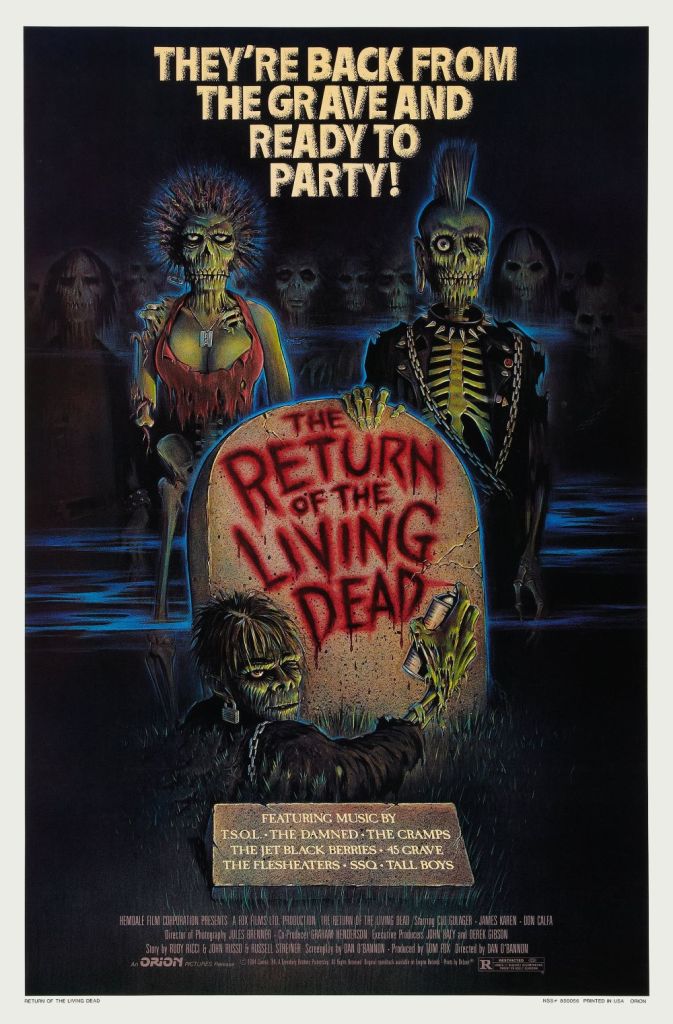
Brains, Laughs, and Decline: The Uneven Legacy of Return of the Living Dead


Subverting the Zombie Canon: Satire, Genre-Bending, and Decay in the Return of the Living Dead Series

When talking about cult horror films, the Return of the Living Dead series holds a special place—not only as a spin-off from George A. Romero’s seminal Night of the Living Dead, but as a unique creative force in its own right. Thanks to a legal split between Romero and co-writer John Russo over rights to the “Living Dead” name, Russo and director Dan O’Bannon got to imagine a parallel zombie universe. This franchise quickly carved out its own identity, mixing horror, black comedy, and punk spirit in a way that both paid tribute to and upended zombie tropes.

Reinventing Zombie Lore with a Wink

The original Return of the Living Dead (1985) starts with a clever “what if” twist: what if Romero’s Night wasn’t just a movie, but a dramatized cover-up of a real government disaster? This meta idea instantly frames the film as self-referential and playful, setting a tone unlike anything out at the time.

Central to the film’s identity is the invention of 2-4-5 Trioxin, a fictional military chemical designed to clear marijuana crops which instead raises the dead—zombies with surprising new abilities. Unlike the slow, drooling zombies Romero popularized, these ghouls sprint, talk, and set traps. Their hunger is peculiar as well: they crave brains exclusively, as it eases the pain of being undead. And the old rules of zombie combat? Forget shooting them in the head. These zombies resist it, raising the stakes and scare factor.

This refreshing rewrite of zombie rules allowed the movie to be both frightening and fun. The zombies were smart but still monstrous, turning classic horror expectations on their head in a way that invited both laughter and fear—a tricky balance that few horror comedies manage.

Playing with Comedy, Panic, and Punk Rock

One of the greatest strengths of the original film is how it embraces horror-comedy so naturally. It doesn’t shy away from being funny while still delivering tension. James Karen and Thom Mathews excel as the main pair—Karen’s frantic, over-the-top panicked man paired with Mathews’ straight, slowly succumbing counterpart create a perfect comedic rhythm. Their slow transformation into zombies adds a tragic dimension to what could have been simple slapstick. Meanwhile, Don Calfa’s mortician character and Clu Gulager’s warehouse owner provide a grounded center amidst chaos.

The punk subculture flavor adds another unique texture. Linnea Quigley’s famous graveyard striptease encapsulates the 1980s’ blend of irreverence, sexuality, and horror obsession. The scene is shocking, hilarious, and iconic—one of those moments that encapsulates everything this film is about: having fun with taboos while not losing the darker undercurrents of mortality and decay.

Beyond laughs, there’s biting satire here. The film skewers the government and military’s hubris—scientists create a superweapon they can’t control, leading to chaos and destruction. This reflects 1980s American anxieties about bioweapons, government cover-ups, and nuclear fears. Horror and comedy collide to reflect cultural distrust and paranoia.

The Problem of the Sequel: Part II’s Familiar Ground

When Return of the Living Dead Part II came out in 1988, it felt like the franchise was stuck in a loop. With much of the original cast returning in near-identical roles, and lines and situations seemingly recycled, the film circles back to the same story. This self-copying invites a mix of amusement and disappointment: it seems the filmmakers didn’t believe they could improve on the original and decided to replicate it instead.

While it has its moments—good practical effects and a rollicking tone reminiscent of the first film—it leans harder into comedy, sometimes at the expense of the horror. The suburban setting and clearer military lockdown raise the action stakes, but the humor feels broader and less sharp, which can make the movie seem a bit cartoonish.

In a way, Part II comments on the pitfalls of horror franchises: once you’ve struck gold with an unexpected idea, sequels often struggle to regain that freshness. This installment is entertaining, but signals the beginning of the franchise’s creative plateau.

Much Darker Territory: Part III’s Horror and Romance

With Return of the Living Dead 3 in 1993, things take a major tonal shift. Brian Yuzna’s direction removes much of the comedy and replaces it with body horror, gore, and a genuinely tragic romance. The story centers on Curt and Julie, two teenagers tragically pulled into the military’s secret zombie experiments. After Julie is accidentally killed and resurrected, she becomes a zombie who feeds on brains but manages her hunger through extreme self-inflicted pain.

This grim take pushes the franchise into more serious, intense horror territory, with heavy themes of love, loss, and bodily autonomy threaded throughout. Julie’s tortured transformation is both tragic and unsettling, symbolizing not only the loss of life but also the torment of trying to hold onto humanity while losing it from within.

Yuzna’s effects are grisly in the finest tradition of ‘90s practical SFX. The film revives the franchise’s sense of danger and stakes by mixing romance with horror, delivering something emotionally resonant and viscerally impactful. While it diverges sharply from the earlier comedic tone, Part III proves the series’ flexibility and capacity for reinvention.

Creative Collapse: Parts IV and V’s Direct-to-Cable Downfall

Sadly, the wheels come off with Return of the Living Dead 4: Necropolis and 5: Rave to the Grave, both made in 2005 and directed by Ellory Elkayem. Shot back-to-back and released direct-to-cable, these films are pale shadows of the earlier entries.

They ditch the original’s clever mix of horror and humor entirely. Instead, we get generic corporate conspiracies, confusing Eastern European settings, weak scripts, and inconsistent zombie characterizations. The zombies lose their unique “brains only” horror and instead act like run-of-the-mill undead. Even the acting is amateurish, with only Peter Coyote standing out briefly as a sinister scientist.

Part 5 further muddies continuity by introducing Trioxin as a rave drug, leading to a chaotic rave/zombie apocalypse scenario that is both baffling and poorly paced. The low-budget effects and uneven pacing betray the exhaustion and lack of passion behind these entries.

These final two films underscore a common fate for franchises that outlive their creative spark—once inventive mythology becomes shallow cliché, and attempts to cash in feel uninspired. Instead of honoring their roots, they become muddled and forgettable.

Why the Series Matters

Despite its uneven legacy, Return of the Living Dead remains important for what it dared to do in horror cinema. The first film’s originality influenced countless horror comedies and redefined how zombies could be portrayed. Its self-awareness and invention paved the way for postmodern horror, where genre is as much about commentary as it is fear.

The third film’s daring shift to tragic body horror further demonstrated the potential for zombie films to explore complex emotional and societal themes beyond gore or giggles.

While the later sequels falter, their failure serves as a cautionary tale about the dangers of diluting distinct voices and creative risks in franchise filmmaking.

Ultimately, Return of the Living Dead survives in cultural memory as a zombie series that captured the spirit of its time—punk rebellion, Cold War paranoia, and genre self-mockery—with flashes of brilliance that continue to entertain and inspire.

October Hacks: Tourist Trap (dir by David Schmoeller)


1979’s Tourist Trap opens in the same way that many slasher films have opened.  A group of friends — young, attractive, and not particularly bright — are driving through a secluded, rural area when they have car trouble.

Now, I have to say that, if I was driving through a rural secluded area or even if I was just a passenger in the vehicle, I would totally freak out if the car broke down.  I mean, seriously, you’re in the middle of nowhere.  You have no idea who or what might be hiding behind those trees.  Even if you don’t get attacked by a bunch of inbred hillbilly cousins, you might get eaten by a bear or, even worse, you might get mauled by a deer and end up with Lyme Disease.  Or you might just end up with a bunch of flies buzzing around your face, which is really even worse than getting attacked by a wild animal.

(Pro-tip: One way to deal with flies is to combine the open flame of a lighter with a can of hairspray.)

I’ve seen enough slasher films to know that bad things happen when you get lost in the woods.  However, up until everything started getting all self-referential in the 1990s, old school slasher films were infamous for featuring characters who had apparently never seen a slasher film or really any other type of movie before.

Your car broke down in the woods?  One member of your party has already disappeared while looking for a gas station?  You have no way of letting anyone know where you are?  Sure, why not go skinny dipping?  For that matter, why not check out Slausen’s Lost Oasis, a run-down shack that is the home of a lot of wax figures and which is owned by the shotgun-toting Mr. Slausen (Chuck Connors).  Mr. Slausen is pretty bitter about the new freeway.  It took away all of his business.

Of course, it turns out that there’s more to this tourist trap than meets the eyes.  For one thing, the mannequins often seem to randomly come to life and murder anyone who spends too much time alone with them.  Secondly, things in the tourist trap often move on their own, as if someone has psychic powers.  And then there the enigmatic man who wears a wax mask and likes to take people hostage before transforming them into wax figures….

Tourist Trap has a totally ludicrous plot but Slausen’s Oasis is such a creepy location and Chuck Connors plays his role with such unnerving intensity that it doesn’t matter that things don’t always make sense.  At its best, Tourist Trap plays out like a filmed nightmare, one in which the rules of normal physics often don’t seem to apply.  The victims are interchangeable (though I did like Tanya Roberts’s energetic performance as Becky) but the kills are imaginative and memorable gruesome.  Researching the film, I was surprised to discover that Tourist Trap was given a PG-rating, despite the skinny dipping and the blood and all of the terrifying wax figures.  Don’t let that rating fool you.  This is genuinely scary slasher film and one that everyone should see before going on an impulsive road trip to the middle of nowhere.

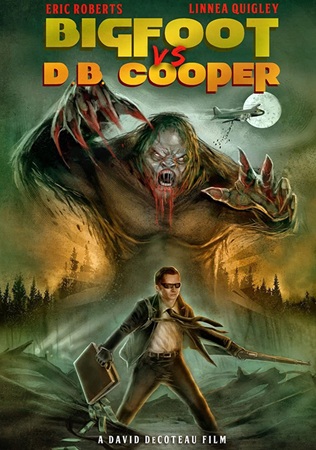
The Eric Roberts Collection: Bigfoot vs D.B. Cooper (dir by David DeCoteau)


2014’s Bigfoot vs DB Cooper tells what happens when a bunch of shirtless frat boy types go turkey hunting in the Washington wilderness in 1971.  One of them is planning on getting married and this weekend is going to be their last chance to all get together and stare at each other in their underwear.  One-by-one, each member of the group strips down to his underwear and then poses with his rifle and then flexes in front of a mirror.  Finally, the groom takes a shower and starts to….

What?

You’re right.  This is indeed a David DeCoteau film.

Now, the title is not a lie.  Bigfoot is in the movie and receives a “….as himself” credit.  He’s big and covered in red fur and he spends a lot of time voyeuristically watching the frat boys while they run around the woods in their underwear.  His dialogue consists of growls and I will admit that I smiled whenever the captioning read, “GROWLING!”

D.B. Cooper is also in the film.  The film gives us the details of skyjacking and his subsequent jump into the night over Washington.  In this film, he lands just in time for a climatic fight with Bigfoot.  Of course, that fight last for one minute and it features Cooper saying, “The most successful skyjacking in aviation history can’t end like this!”

That said, the film is mostly just a collection of scenes featuring the handsome but oddly sexless frat boys wandering around in their underwear and standing in front of mirrors.  The camera lingers on them to such an extent that it almost starts to feel like David DeCoteau is intentionally parodying himself.  For the record, I’ve enjoyed quite a few DeCoteau films.  I love the “Wrong” films that he’s done with Vivica A. Fox.  He’s a director who is willing to embrace the melodrama and who has a good sense of humor and healthy self-awareness about the films that he’s making.  (And again, I think it can be argued that there’s some intentional self-parody at work in this one.)  Unfortunately, Bigfoot vs D.B. Cooper is incredibly dull.

Eric Roberts and Linnea Quigley are top-billed, though neither actually appears on screen.  Roberts narrates the film and talks about Vietnam.  Quigley provides the voice of the unseen flight attendant who speaks to D.B. Cooper.

Previous Eric Roberts Films That We Have Reviewed:

  1. Star 80 (1983)
  2. Runaway Train (1985)
  3. Best of the Best (1989)
  4. Blood Red (1989)
  5. The Ambulance (1990)
  6. The Lost Capone (1990)
  7. Best of the Best II (1993)
  8. Love, Cheat, & Steal (1993)
  9. Voyage (1993)
  10. Love Is A Gun (1994)
  11. Sensation (1994)
  12. Dark Angel (1996)
  13. Doctor Who (1996)
  14. Most Wanted (1997)
  15. Mercy Streets (2000)
  16. Raptor (2001)
  17. Rough Air: Danger on Flight 534 (2001)
  18. Strange Frequency (2001)
  19. Wolves of Wall Street (2002)
  20. Border Blues (2004)
  21. Mr. Brightside (2004)
  22. Six: The Mark Unleased (2004)
  23. We Belong Together (2005)
  24. Hey You (2006)
  25. Depth Charge (2008)
  26. Amazing Racer (2009)
  27. In The Blink of an Eye (2009)
  28. Bed & Breakfast (2010)
  29. Enemies Among Us (2010)
  30. The Expendables (2010) 
  31. Sharktopus (2010)
  32. Beyond The Trophy (2012)
  33. The Dead Want Women (2012)
  34. Deadline (2012)
  35. The Mark (2012)
  36. Miss Atomic Bomb (2012)
  37. Assault on Wall Street (2013)
  38. Bonnie And Clyde: Justified (2013)
  39. Lovelace (2013)
  40. The Mark: Redemption (2013)
  41. The Perfect Summer (2013)
  42. Self-Storage (2013)
  43. A Talking Cat!?! (2013)
  44. This Is Our Time (2013)
  45. Inherent Vice (2014)
  46. Road to the Open (2014)
  47. Rumors of War (2014)
  48. Amityville Death House (2015)
  49. Deadly Sanctuary (2015)
  50. A Fatal Obsession (2015)
  51. Las Vegas Story (2015)
  52. Stalked By My Doctor (2015)
  53. Enemy Within (2016)
  54. Hunting Season (2016)
  55. Joker’s Poltergeist (2016)
  56. Prayer Never Fails (2016)
  57. Stalked By My Doctor: The Return (2016)
  58. The Wrong Roommate (2016)
  59. Dark Image (2017)
  60. Black Wake (2018)
  61. Frank and Ava (2018)
  62. Stalked By My Doctor: Patient’s Revenge (2018)
  63. Clinton Island (2019)
  64. Monster Island (2019)
  65. The Reliant (2019)
  66. The Savant (2019)
  67. Seven Deadly Sins (2019)
  68. Stalked By My Doctor: A Sleepwalker’s Nightmare (2019)
  69. The Wrong Mommy (2019)
  70. Exodus of a Prodigal Son (2020)
  71. Free Lunch Express (2020)
  72. Her Deadly Groom (2020)
  73. Top Gunner (2020)
  74. Deadly Nightshade (2021)
  75. The Elevator (2021)
  76. Just What The Doctor Ordered (2021)
  77. Killer Advice (2021)
  78. Megaboa (2021)
  79. Night Night (2021)
  80. The Poltergeist Diaries (2021)
  81. The Rebels of PT-218 (2021)
  82. A Town Called Parable (2021)
  83. Bleach (2022)
  84. My Dinner With Eric (2022)
  85. 69 Parts (2022)
  86. D.C. Down (2023)
  87. Aftermath (2024)
  88. Bad Substitute (2024)
  89. Devil’s Knight (2024)
  90. The Wrong Life Coach (2024)
  91. When It Rains In L.A. (2025

Horror Scenes That I Love: Linnea Quigley in Return of the Living Dead


Everyone likes Linnea Quigley!

The 80s scream queen who brought an uninhibited attitude and an often underrated wit to countless horror films, Linnea Quigley is a true icon of horror.  Unfortunately, it’s difficult to find any scenes of Linnea Quigley that are safe to share on this site.  Most of them have been slapped with age restrictions on YouTube, for obvious reasons.

Still, I did find this scene from 1984’s Return of the Living Dead, in which Quigley’s Trash talks about her love of cemeteries.  It’s a short scene, have no doubt.  But it shows everything that has made Linnea Quigley such a popular figure amongst horror fans.  Plus, I used to be the same way about cemeteries!

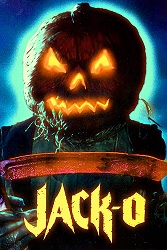
Jack-O (1995, directed by Steve Latshaw)


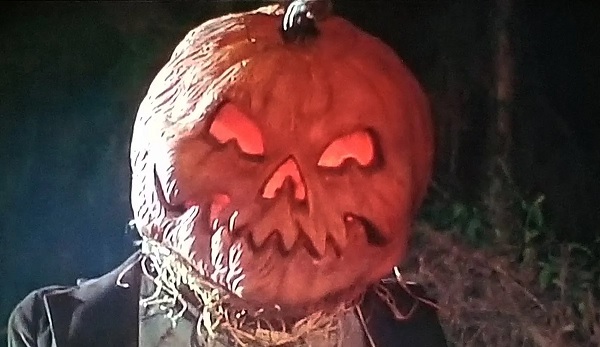
Back in frontier times, a warlock named Walter Machden (John Carradine) terrorized the citizens of the town of Oakmoor Crossing so they tracked him down and lynched him.  Before he was hung, Machden cursed the town.  A demon with a jack-o-lantern for a head terrorized the town until the Kelly Family defeated him and buried him underneath a cross.

Jump forward one hundred years.  It is Halloween night and some drunk teenagers knock over the cross.  Jack-O comes back to life and kills the teenagers.  Jack-O sets out to get revenge on the Kelly family but, for some reason, he decides to kill their neighbors, some more teenagers, and a TV cable guy before going after his targets.  It’s up to young Sean Kelly (Ryan Latshaw) to figure out how to defeat Jack-O for a second time.

The most interesting thing about Jack-O is that it features John Carradine, even though he died a full seven years before the movie was released.  That either means that Jack-O had an unusually long post-production period or the Carradine scenes were shot for another movie and were clumsily inserted into Jack-O.  Carradine was not the only deceased star to make an appearance in Jack-O.  Cameron Mitchell, who passed away in 1994, also makes an appearance as a horror movie host.  Because you can’t have a movie with Carradine and Cameron Mitchell without including Linnea Quigley, she appears as a babysitter who takes a lengthy shower.  Fortunately, Linnea Quigley is still with us.

Overall, Jack-O is regrettable.  The demon, with his Jack-O-Lantern head, is more likely to inspire laughs than screams and it never makes sense that Jack-O would take so much time to kill everyone except for the people that he is actually looking to kill.  The best death involves a toaster but Jack-O doesn’t do anything with the toaster.  Instead, someone just slips and sticks a utensil in the toaster, leading to a shocking death.  Combine the poor acting with the poor special effects with notably ragged editing that often makes it unclear how much time has passed between scenes and you have a Halloween film that is no holiday.

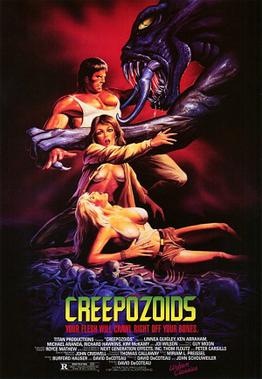
Creepozoids (1987, directed by David DeCoteau)


In 1992, society collapses due to a nuclear war.  In 1998, a group of army deserters are looking for a place to hide from the authorities when they come across an underground bunker in Los Angeles.  The bunker was once home to a research lab.  Even though all of the scientists are dead, the monster that they created is not and soon, the deserters are fighting for their lives, battling not just the monster but also giant rats.

Creepozoids is a low-budget Alien rip-off.  It’s actually a little incredible just how closely Creepozoids copies Alien, right down to a monster that can spit acid and a scene where someone has a fatal seizure while eating dinner.  The monster itself is not badly realized but the giant rats are obviously just stuffed animals that are being tossed on the cast by crew members standing off-camera.  Though the film takes place in what was then the “near future,” it’s an 80s production all the way through.  The top secret government lab as a bulky computer that only one of the deserters knows how to use.  The secrets to genetic modification are stored on a 8-inch floppy disk.  Most 80s and 90s kids will get nostalgic watching this movie.

One of the deserters is played by Linnea Quigley, which is the main reason why Creepozoids retains a cult following.  While the rest of the deserters want to search the bunker and look for supplies, Linnea’s main concern is trying out the facility’s shower.  (Good news, it works!)  Linnea Quigley appeared in many bad films but she always brought a lot of sincerity and good humor to her performances.  In Creepozoids she gamely wrestles with a stuffed rat and proves herself to be one of the best screamers of the 80s DTV horror industry.  The rest of the cast is interchangeable but, as always, Linnea earns her screen queen crown.

Creepozoids is a lesser imitation of Alien but, seen today, it benefits from nostalgia.  I can still remember Creepozoids showing up on Cinemax, late at night and with a warning that the movie featured not only adult language but also nudity and violence.  (Was anyone ever dissuaded by the Cinemax content warnings?)  This is one of the B-movies that made being an 90s kid fun!

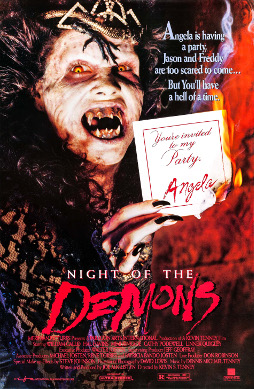
Horror Film Review: Night of the Demons (dir by Kevin S. Tenney)


“Where are you going?  The party’s just begun.”

Sorry, Angela, the party kind of sucks.  Beyond the strange guest list — like seriously, why would any of these people be hanging out together — and the weird decision to hold it in the deserted old funeral home, there’s the fact that people are getting possessed and people are dying.  There’s a lot that I can tolerate from a party but once people start dying, it’s usually time to leave.

(Unless, of course, it’s a theme party.  I went to a Halloween murder party last year and I had a lot of fun watching as each guest was “killed off” until the eventual killer was revealed.  I drew a card telling me that I had been murdered in the master bathroom while stepping out of the shower so I ran upstairs, changed into a towel, and let out the loudest scream possible.  Now, that was a party!  That said, I can’t remember who the actual killer was so they’re still out there, probably breaking into your house at this very moment.)

As Jeff, Leonard, and I watched Night of the Demons last week as a part of the #ScarySocial live tweet, Jeff mentioned that this 1988 film had apparently been very popular on late night cable back in the day.  I could certainly see why, what with it’s combination of boobs, blood, and Linnea Quigley.  It’s about two outcasts — Angela (Amelia Kinkade) and Suzanne (Quigley) — who throw a Halloween party in a funeral parlor.  It’s a pretty boring party but it’s also an 80s party so we get to see some silly dancing before the spirits end up possessing Suzanne and Angela.  Angela does a wild dance.  Suzanne sticks a tube of lipstick into her breast.  I guess you can do that when you’re possessed by a demon.  That said, that scene still made cringe just because it made me think about all of the lipstick that I shoplifted when I was in high school and how much it would have upset to me to have gone to all that trouble just to have some possessed girl waste it by shoving it inside her boob.  One-by-one, the partiers die.  Soon, only good girl Judy (Cathy Podewell) and good guy Rodger (Alvin Alexis) are left alive but will they be able to figure out a way to escape the funeral home?  Not only do they have to climb a wall but they have to do it while dressed, respectively, like Alice in Wonderland and a pirate.  Good luck, kids!  You’re so fucking dead.

Anyway, Night of the Demons is pretty stupid but it’s a film that people have fun watching.  There’s none of the nuance that one found in Kevin Tenney’s other classic horror film, Witchboard.  Instead, this one is entertainingly over-the-top and enjoyably weird.  This is a film that was made for people who enjoy making snarky comments while watching horror movies.  As a result, it’s an ideal live tweet movie because it doesn’t require a lot of thought as much as it just requires a group of friends who are willing to validate your every comment by clicking the like button.  It’s not a particularly scary film but both Amelia Kinkade and Linnea Quigley deserve a lot of credit for throwing themselves into their roles and, at the very least, it’s got some dancing.  It’s a crowd pleaser and, I’ve recently been told, some people feel that’s the most important thing that a film can do.  Personally, being a film snob, I don’t quite agree with the assessment that it’s the most important thing but, still, one should probably never discount the importance of keeping the audience entertained.

The point is, I had fun with Night of the Demons.  Watch it with your friends.

Not A Sequel: Witchtrap (1989, directed by Kevin Tenney)


“This is NOT a sequel to Witch Board!”

It may be directed by the same director and have a suspiciously similar title and it might feature a ghost that seems a lot like the malevolent spirit from Witch Board but Witchtrap is most assuredly not a sequel to Witch Board!  Got that?  Just in case you missed thr point, this VHS version of this movie opens with a credit that repeats “This NOT a sequel to Witch Board!”  On the version I saw, this was followed immediately by a trailer for Witch Board.

Witch Trap takes place in a haunted bed and breakfast.  The owner wants to make a lot of money with but first he wants a group of psychics to spend the night and determine whether or not the place is really haunted by the ghost of a magician and serial killer named Avery Launder.  (Avery Launder is played by J.P. Luebsen, who also played the evil spirit in Witch Board, to which this film is definitely not a sequel.)  Accompanying the psychics is a former cop named Tony Vincente (James W. Quinn) and an A/V technician named Ginger Kowalski (Linnea Quigley).  Ginger’s there so she can set up a tripod and take a shower.  Guess who is the first to die?

Witchtrap is the type of movie that used to show up all the time on late nighy Cinemax in the early to mid-90s.  There’s not much of a story but there’s boobs and plenty of blood and, back then, that’s all that a teenager secretly staying up late and watching cable really needed.  Watching it today, Witchtrap is mostly dull but it does try to be about something more than just ghosts and Linnea Quigley shower scenes.  The psychics spend a surprisingly large amount of time debating the universe and the concept of morality.  It doesn’t add up too much but at least it’s there.

As far as Kevin Tenney horror movies are concerned, Witchtrap can’t hold a candle to Night of the Demons and rumor has it that it’s not a sequel to Witchboard.  It’s forgettable but worth watching if you’re having early Cinemax nostalgia pains.

Clownado: Movie preview, review and trailer.


Yes, you saw that movie title correctly: Clownado

And if you don’t believe it is a real movie: Here is the poster to prove it.

poster

WARNING: This movie contains extreme language, nudity, strong sexual content, and very intense scenes of gore. Not at all recommended for people who are sensitive to that!

Credits:

Directed by: Todd Sheets (Zombie Bloodbath franchise)

Stars:

Rachel Lagen, Joel D. Wynkoop Linnea Quigley and Eileen Dietz

Preview:

Cursed demonic circus clowns set out on a vengeful massacre using tornadoes. A stripper, Elvis impersonator, truck driver, teen runaway, and a dude get caught in the supernatural battle between femme fatal and the boss clown from hell.

Review:

Seriously, as some one who suffers from coulrophobia, I could not help but laugh at this movie. The plot is so ridiculous. The acting is beyond bad. The clowns are no more than juggalo wannabes in bad makeup. The writing seemed like it was made up on the spot by a really bad improve troop. The special effects were neither special nor effective. It, however, could have been a quality horror movie if they had spent a bit more money on the movie than they did on the opening credits.

I guess, as the press release says, “The Joke’s on you when Clownado blows in” and I did spend 1 hour and 34 minutes of my life watching this movie. pic

When can you see Clownado?

Wild Eye Releasing along with Extreme Entertainment will let the clowns blow thru your VOD September 3rd and touch down on your DVD’s September 17th!

Oh, you are still reading this preview / review and want to see the trailer for Clownado? Ok, but don’t say I didn’t send you a Clownado warning!