“Never trick the treat. You never break a deal in Halloween because it’s the one night the devil can come for you.” — Sam Daniels
Horror fans who grew up renting VHS tapes from the local video store will find a lot to love in The Barn, a 2016 indie horror film that wears its ’80s influences on its sleeve with pride. Directed by Justin M. Seaman, this scrappy, affectionate throwback to the VHS-era Halloween slasher is built from rural legends, practical monsters, teenage misadventures, and a small-town setting soaked in October. It is not flawless, but it is sincere, energetic, and far more fun than its rough production values might initially suggest.
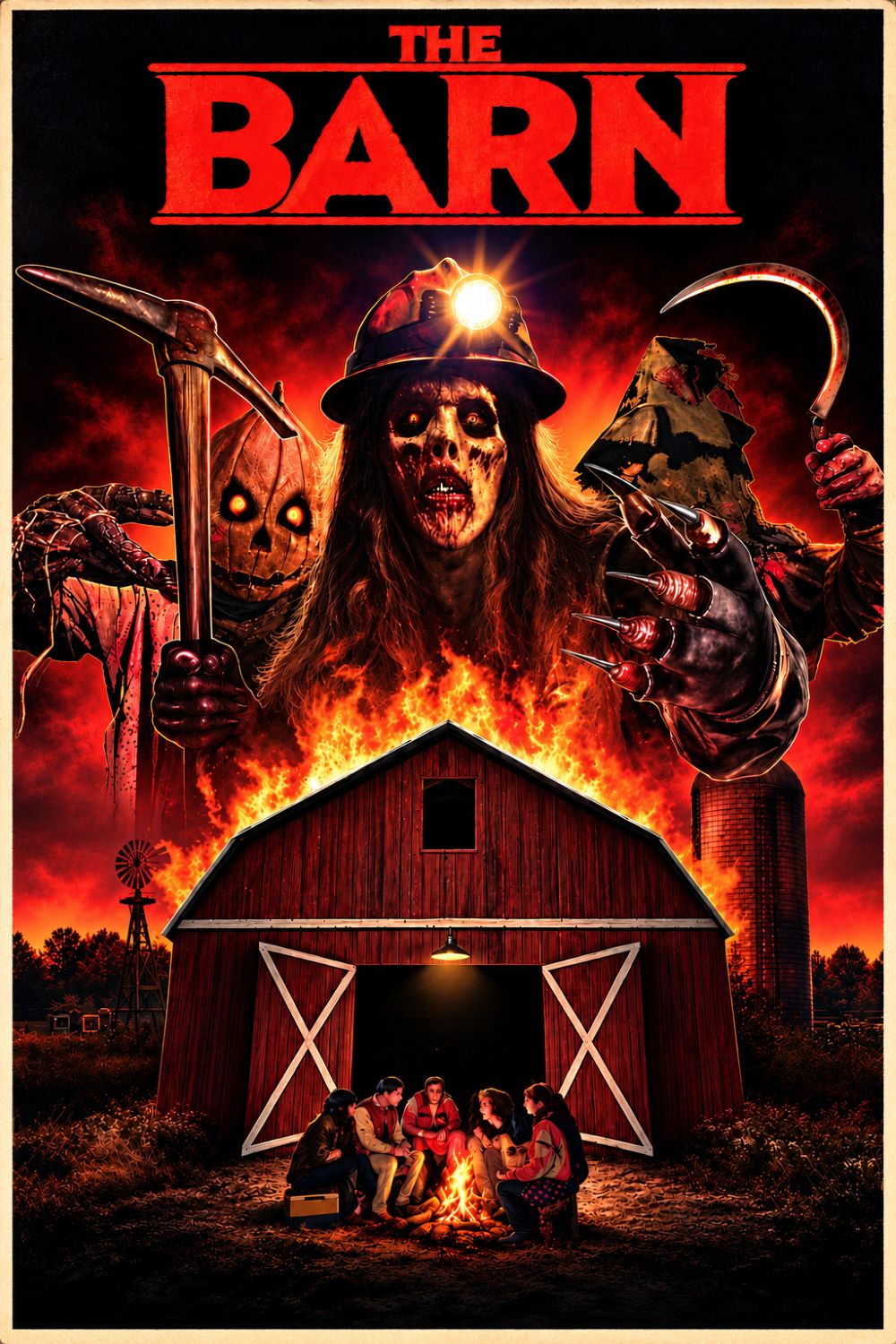
The story begins long before the main events of the film, in the small town of Wheary Falls, where a local tragedy involving children and a church sets the stage for an evil that has been waiting in an old barn. Decades later, it is Halloween 1989, and high school seniors Sam and Josh are determined to make the most of their final Devil’s Night before graduation. Their plan involves a road trip to a rock concert, but as often happens in horror movies, the night takes a turn. They and their friends encounter the forbidden barn, ignore the obvious danger, and awaken three supernatural killers: a scarecrow, a pumpkin-headed creature, and a miner boogeyman. What follows is a night of stalking, chasing, and bloodletting as the group realizes that the local legend is very real.
The premise is intentionally simple, and that simplicity is both a strength and a limitation. On one hand, it gives the movie a clear, classic horror structure: teenagers venture somewhere they should not, ancient evil awakens, and survival becomes the only goal. On the other hand, the plot does not offer many surprises. You can probably guess who will die, when the monsters will strike, and how the final confrontation will unfold. But The Barn does not seem especially interested in subverting expectations. It wants to deliver a familiar kind of Halloween fun, and in that respect, it succeeds more often than not.
The film’s greatest asset is its atmosphere. Seaman clearly understands that Halloween horror is about more than just a masked killer or a bloody kill scene. It is about the feeling of the season: dead leaves, cold nights, cornfields, porch decorations, costumes, campfires, and the sense that the world becomes a little stranger after dark. The Barn captures that feeling with impressive commitment. The rural Pennsylvania setting gives the movie a natural autumnal texture, while the period details help establish its late-’80s identity. The film does not have a huge budget, but it uses its resources well, creating a world that feels handmade and lived-in rather than sterile or overly polished.
The monsters are another major highlight. The three creatures at the center of the film are not especially complex, but they are memorable. The scarecrow has the classic rural-horror menace of a figure that should be harmless but is anything but. The pumpkin man is goofy in the best possible way, with a design that feels like it came straight from an old horror poster or a particularly ambitious haunted attraction. The miner is perhaps the most unsettling of the three, bringing a grimy, folkloric quality to the group. Together, they form a fun monster squad that gives the movie its personality. They are not trying to be terrifying in a modern, realistic sense; they are trying to be the kind of creatures you would rent a VHS tape to see, and they absolutely achieve that.
The practical effects and makeup work add a lot to their appeal. The blood and gore are not especially sophisticated, but they are tangible, messy, and playful. There is a physicality to the kills that modern horror often loses when it relies too heavily on digital effects. You can tell that people built these costumes, applied this makeup, and staged these effects with limited money but plenty of enthusiasm. That handmade quality gives The Barn a charm that bigger productions often lack. Even when a gag does not fully work, it feels like it was made by people who care about what they are doing.
The soundtrack also deserves praise. Rocky Gray’s score blends synth-driven horror music with a rock and metal edge that fits both the film’s setting and its tone. The music gives the movie momentum, especially during the early stretches when the group is heading toward the barn and the sense of danger is still building. It also reinforces the retro feel, echoing the kind of pulsing, atmospheric scores that defined so much of 1980s horror. The soundtrack helps The Barn feel less like a modern movie set in the past and more like an actual artifact from the era it is imitating.
The cast also gives the film some genuine ’80s horror credibility, most notably through the appearance of Linnea Quigley. As one of the definitive scream queens of the era, thanks to roles in films like The Return of the Living Dead and Night of the Demons, Quigley brings an instant connection to the kind of horror The Barn is trying to honor. Her presence may be brief, but it gives the movie real genre bona fides and makes the retro homage feel more authentic. Ari Lehman, the original Jason from Friday the 13th, adds another layer of fan-friendly horror history to the proceedings. These appearances do not transform the film, but they reinforce the sense that Seaman knows exactly whose legacy he is celebrating.
The acting is where the film’s limitations become most apparent. Mitchell Musolino and Will Stout, as Sam and Josh, have a likable enough friendship, but the performances around them vary in quality. Some lines are delivered awkwardly, some characters feel more like archetypes than people, and the dialogue occasionally lands with a thud. However, this is not necessarily a dealbreaker for a movie like this. The Barn is not aiming for naturalistic drama. It is aiming for the heightened, slightly wooden energy of low-budget ’80s horror, where teenagers often speak in a way that feels more like a movie version of teenagers than real people. If you accept that style, the acting becomes part of the movie’s charm rather than a distraction.
The screenplay is similarly uneven. Seaman gives the characters more personality and backstory than many microbudget horror films bother with, which is admirable. Sam and Josh are not just anonymous victims; they have goals, frustrations, and a sense of history with each other. The supporting characters also get enough definition to make their fates matter, at least a little. However, the movie sometimes tries to do too much. The road trip to a metal concert and the subplot involving a church food drive add texture and opportunities for cameos, but they also slow the pacing and make the story feel a little loose. The film is strongest when it focuses on the group, the barn, and the monsters. When it spreads its attention across too many threads, it loses some of its momentum.
The first two acts are where The Barn really comes alive. The buildup is fun, the atmosphere is strong, and the movie has a playful sense of discovery as the teens stumble deeper into danger. There is genuine excitement when the creatures begin appearing, and the film does a good job of making the barn and surrounding countryside feel like a place where bad things have always happened. The kills are inventive enough to keep things lively, and the movie’s sense of humor prevents it from becoming too grim. It is not trying to frighten you on a deep psychological level. It is trying to entertain you with spooky monsters, Halloween chaos, and a healthy dose of nostalgia, and for most of its runtime, it does exactly that.
The final act is where the movie loses some of its steam. The last half hour feels longer than it should, partly because the film keeps teasing an ending before gearing up for another confrontation. The methods the characters use to fight back are not as creative or satisfying as the buildup promised. Instead of escalating into a truly wild climax, the movie becomes more straightforward, and some of the fun drains out of it. The pacing issues are noticeable, especially after such an energetic first hour. It is not a disastrous ending, but it is the weakest part of the film, and it keeps The Barn from reaching the level of the best Halloween-themed horror movies.
Still, it is hard to stay mad at a movie this sincere. The Barn was made on a very small budget, and you can see the limitations in the production values, sound, and acting. But you can also see the passion in every frame. Seaman is not cynically imitating the ’80s to cash in on nostalgia; he is building the kind of movie he clearly wishes had existed on his shelf growing up. That enthusiasm matters. It gives the film a warmth that many more technically competent horror movies lack. The flaws feel like the flaws of a friend’s homemade haunted house: crooked signs, questionable acting, cheap props, but undeniable fun.
Comparisons to Trick ’r Treat are inevitable because both films treat Halloween as a night governed by rules, legends, and supernatural consequences. But The Barn is smaller, rougher, and more rooted in the slasher tradition. It is less polished than Michael Dougherty’s film, but it has its own scrappy personality. It is also more focused on monsters and practical effects than on anthology-style storytelling. If Trick ’r Treat is the polished Halloween party, The Barn is the slightly chaotic neighborhood haunt run by someone who really loves scaring people.
By the time the credits roll, The Barn has proven that a horror movie does not need a huge budget or a flawless script to leave a lasting impression; it just needs heart, atmosphere, and a clear sense of what it loves about the genre. Seaman’s film delivers all three, wrapping its flaws in enough retro charm, practical effects, and Linnea Quigley-powered ’80s credibility to make them feel like part of the package rather than detractions. It is a movie that knows what it wants to be and delivers it with a grin, even when the acting or pacing stumbles. The Barn may not replace the classics in your annual rotation, but it earns a place alongside them as a fun, scrappy Halloween treat.

