Guilty Pleasure No. 94: Revenge of the Nerds (dir. by Jeff Kanew)


Revenge of the Nerds captures the wild, unfiltered spirit of 1980s college comedies, blending underdog triumph with over-the-top raunchiness that feels both nostalgic and awkwardly dated today. Released in 1984, this Jeff Melman-directed flick stars Robert Carradine and Anthony Edwards as Lewis and Gilbert, two freshmen nerds who face relentless bullying from the jock-dominated Alpha Beta fraternity at Adams College. What starts as a straightforward tale of misfits fighting back evolves into a chaotic mix of pranks, parties, and questionable morals, making it a polarizing watch that still packs a punch for fans of the era’s humor.

The story kicks off with Lewis and Gilbert arriving full of optimism, only to have their dreams torched—literally—when the Alpha Betas accidentally burn down their dorm during a hazing gone wrong. Relocated to a rundown gym with other campus outcasts, the nerds band together under the banner of Tri-Lam, turning their rejection into fuel for clever retaliation. From panty raids to talent show showdowns, the film barrels through a series of escalating antics, peaking at the Greek Games where brains battle brawn in absurd competitions like tricycle races and tug-of-war twists. It’s pure 80s escapism, with a runtime under 100 minutes that keeps the energy high and the laughs coming in rapid-fire succession, even if not every gag is a home run.

The nerd ensemble steals the show, each character a walking stereotype brought to vivid life. Carradine’s Lewis is the slick-talking instigator with a knack for schemes, while Edwards’ Gilbert provides the earnest heart, delivering a pivotal speech about acceptance that gives the movie unexpected emotional depth. Curtis Armstrong as Booger delivers unforgettable gross-out moments, from belching symphonies to shameless flirtations, and Larry B. Scott’s Lamar brings flamboyant athletic flair that subverts expectations. The jocks, led by Ted McGinley’s smug Stan, serve as perfect foils—arrogant, muscle-bound villains who embody the era’s macho excess. Supporting turns, like Julia Montgomery’s Betty navigating boyfriend drama, John Goodman’s boorish Coach Harris, or Bernie Casey’s wise U.N. Jefferson, add layers to the campus power struggle.

Humor-wise, Revenge of the Nerds leans hard into juvenile territory: fart jokes, streaking, and wild panty raid sequences filmed with hidden cameras that push boundaries even for the time. The film’s climax involves Lewis impersonating Stan to woo Betty, a plot point that plays as triumphant revenge but lands as deeply problematic through today’s lens, highlighting consent issues amid the cheers. Similarly, the sorority spying and casual objectification reflect 80s attitudes toward women and minorities that feel crass now, contributing to its mixed modern reception. Yet, these elements are balanced by genuine camaraderie among the nerds, fostering a sense of belonging that resonates as a counter to real-world bullying.​

Technically, the movie holds up as a product of its time. The soundtrack, featuring the iconic title track by The Rubinoos and funky cues during party scenes, amps up the fun, while practical effects like the nerds’ gadget-filled house add quirky charm. Cinematography emphasizes the divide between polished frat row and the nerds’ scrappy turf, with wide shots of campus chaos underscoring the rebellion. Written by Tim Metcalfe, Steve Zacharias, and Jeff Buhai, the script zings with quotable lines—”We are the sons of the sons of bitches”—and smartly flips the slobs-vs-snobs formula by rooting for the geeks.

Culturally, Revenge of the Nerds helped define the “nerd pride” archetype, paving the way for films like PCU and influencing pop culture’s embrace of geek culture from The Big Bang Theory to Marvel dominance. It spawned three sequels, a musical adaptation, and endless references, cementing its place as a time capsule of Reagan-era college life—rowdy, rebellious, and unapologetically politically incorrect. For balance, its strengths lie in infectious energy, memorable characters, and a pro-outsider message, but weaknesses include uneven pacing in setup scenes and humor that too often punches down rather than up.

The film continues the trend of 80s raunchy teen comedies first popularized by Bob Clark’s Porky’s, ramping up the gross-out gags and frat-house antics while shifting the focus to nerd empowerment over sexual hijinks. The nerds’ talent show finale, uniting misfits in a joyous medley, delivers pure catharsis, proving brains and heart can topple bullies. It’s not flawless—some jokes bomb, and the ending rushes a bit—but its scrappy spirit endures for those who grew up quoting Booger’s lines or cheering Tri-Lam’s win. Fans of Animal House or Old School will find familiar thrills, while modern audiences might prefer the cleaner satire of The Good Place. Ultimately, Revenge of the Nerds earns a solid recommendation with caveats: a rowdy good time if you roll with the 80s vibe, but skip if consent gags are deal-breakers.

Previous Guilty Pleasures

  1. Half-Baked
  2. Save The Last Dance
  3. Every Rose Has Its Thorns
  4. The Jeremy Kyle Show
  5. Invasion USA
  6. The Golden Child
  7. Final Destination 2
  8. Paparazzi
  9. The Principal
  10. The Substitute
  11. Terror In The Family
  12. Pandorum
  13. Lambada
  14. Fear
  15. Cocktail
  16. Keep Off The Grass
  17. Girls, Girls, Girls
  18. Class
  19. Tart
  20. King Kong vs. Godzilla
  21. Hawk the Slayer
  22. Battle Beyond the Stars
  23. Meridian
  24. Walk of Shame
  25. From Justin To Kelly
  26. Project Greenlight
  27. Sex Decoy: Love Stings
  28. Swimfan
  29. On the Line
  30. Wolfen
  31. Hail Caesar!
  32. It’s So Cold In The D
  33. In the Mix
  34. Healed By Grace
  35. Valley of the Dolls
  36. The Legend of Billie Jean
  37. Death Wish
  38. Shipping Wars
  39. Ghost Whisperer
  40. Parking Wars
  41. The Dead Are After Me
  42. Harper’s Island
  43. The Resurrection of Gavin Stone
  44. Paranormal State
  45. Utopia
  46. Bar Rescue
  47. The Powers of Matthew Star
  48. Spiker
  49. Heavenly Bodies
  50. Maid in Manhattan
  51. Rage and Honor
  52. Saved By The Bell 3. 21 “No Hope With Dope”
  53. Happy Gilmore
  54. Solarbabies
  55. The Dawn of Correction
  56. Once You Understand
  57. The Voyeurs 
  58. Robot Jox
  59. Teen Wolf
  60. The Running Man
  61. Double Dragon
  62. Backtrack
  63. Julie and Jack
  64. Karate Warrior
  65. Invaders From Mars
  66. Cloverfield
  67. Aerobicide 
  68. Blood Harvest
  69. Shocking Dark
  70. Face The Truth
  71. Submerged
  72. The Canyons
  73. Days of Thunder
  74. Van Helsing
  75. The Night Comes for Us
  76. Code of Silence
  77. Captain Ron
  78. Armageddon
  79. Kate’s Secret
  80. Point Break
  81. The Replacements
  82. The Shadow
  83. Meteor
  84. Last Action Hero
  85. Attack of the Killer Tomatoes
  86. The Horror at 37,000 Feet
  87. The ‘Burbs
  88. Lifeforce
  89. Highschool of the Dead
  90. Ice Station Zebra
  91. No One Lives
  92. Brewster’s Millions
  93. Porky’s

Horror Film Review: C.H.U.D. (dir by Douglas Cheek)


There’s something living under the streets of New York City.

That’s the basic idea behind 1984’s C.H.U.D., a film that opens with an upper class woman and her little dog being dragged into the sewers by a creature the reaches out of a manhole.  People are disappearing all over the city but the authorities obviously aren’t revealing everything that they know.  Even after the wife of NYPD Captain Bosch (Christopher Curry) disappears, the city government doesn’t seem to be too eager to dig into what exactly is happening.

Instead, it falls to two activists.  Photographer George Cooper (John Heard) specializes in taking picture of the homeless, especially the one who live underground in the New York subways.  He’s like a well-groomed version of Larry Clark, I guess.  Social activist A.J. “The Reverend” Shepherd (Daniel Stern) runs a homeless shelter and is convinced that something is preying on the most vulnerable citizens of New York.  When the police won’t do their job, George and the Reverend step up!

So, what’s living in the sewers?  Could it be that there actually are cannibalistic humanoid underground dwellers out there?  Everyone in New York City has heard the legends but, much like stories of the alligators in the Chicago sewers, most people chose not to believe them.  Or could the disappearance have something to do with the cannisters labeled Contamination Hazard Urban Disposal that are being left in the sewers by the Nuclear Regulatory Commission?  Wilson (George Martin) of the NRC says that they would never purposefully mutate the people living underground but Wilson works for the government so who in their right mind is going to trust him?

C.H.U.D. is a horror film with a social conscience.  It’s very much an 80s films because, while you have Shepherd running around and attacking everyone for not taking care of the most vulnerable members of society, the true villain is ultimately revealed to be the members of a regulatory agency.  Instead of finding a safe way to get rid of their nuclear waste, they just found a sneaky way to abandon it all in New York and obviously, they assumed no one would care because …. well, it’s New York.  Everyone in the country knows that New York City isn’t safe so who is going to notice a few underground monsters, right?

The idea behind C.H.U.D. has a lot of potential but the execution is a bit lackluster.  For every good C.H.U.D. kill, there’s long passages where the story drags.  Considering that Heard spent most of his career typecast as the type of authority figure who would dump nuclear waste under New York City, it’s actually kind of interesting to see him playing a sympathetic role here.  Daniel Stern, on the other hand, is miscast and rather hyperactive as Shepherd.  You really do want someone to tell him to calm down for a few minutes.  Watching C.H.U.D., one gets the feeling that it’s a film with an identity crisis.  Is it a horror film, an action flick, a work of social commentary, or a dark comedy?  There’s no reason why it can’t be all four but C.H.U.D. just never really comes together.  It ultimately feels more like a mix of several different films instead of being a film made with one clear and coherent vision.

In the end, Death Line remains the film to see about underground cannibals.

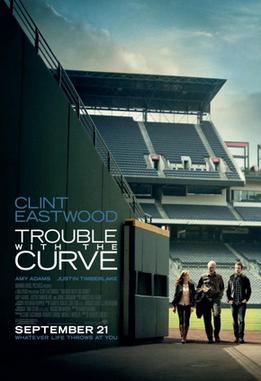
I Watched Trouble With The Curve (2012, Dir. by Robert Lorenz)


I love baseball  and all of its traditions.

I love the idea that a pitcher has a mental connection with his catcher.  I love the stories of the minor leaguers who get their chance in the majors and who stun the world by coming out of nowhere to hit a home run on their first at bat.  I love all the stories about which batters corked their bats and which pitchers could still manage to get away with throwing a spitball.  I love baseball because watching it is a relaxing way to spend an afternoon but at the same time, the game is unpredictable.  Just one hit can change the momentum of an entire game and, until that final out, the game could be won by anyone.  I especially have a place in my heart for the legendary baseball scouts, the grouchy old men who would drive out to the middle of nowhere to watch a game and search for the next great homerun hitter.

That’s one reason why I hated Moneyball.  I thought Brad Pitt, Philip Seymour Hoffman, Chris Pratt, and Jonah Hill all did a good job and I loved Brent Jennings’s performance as Ron Washington but I hated the idea that the scouts and their instincts weren’t necessary because everything could just be determined by sabermetrics.  The idea that an algorithm could tell you everything you needed to know about how to put a team together felt like a crime against everything that makes baseball special and it deeply offended me as a fan.  Moneyball may feature a baseball team but it’s a movie about business, not the game.

That’s why I’m thankful for Trouble With The Curve.

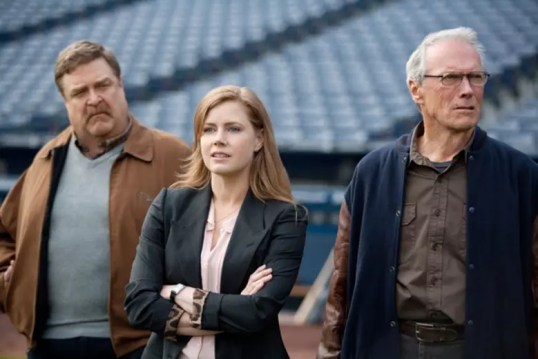
Clint Eastwood stars as Gus Lobel, one of those plain-spoken, no-BS scouts that I love so much.  All of the team owners might be into sabermetrics but Gus knows that the best way to scout a player is to actually hit the road and see him play.  For Gus, scouting is all about instincts and his own gut feeling.  Gus is everything that I love about baseball.  He’s knows the game, he knows the players, and he doesn’t need an algorithm to tell him whether or not someone should be on the field.

The movie is about Gus scouting a player who has trouble hitting the curve.  That’s something that Gus notices but the algorithm overlooks.  Accompanying Gus is his daughter, Mickey (Amy Adams), who is proud to have grown up surrounded by plain-spoken, unpretentious baseball scouts like her father and who doesn’t understand why Gus never took her on the road when she was younger.  Mickey falls for a younger scout named Johnny (Justin Timberlake), their love based on their shared knowledge of baseball.  I liked Mickey and Johnny as a couple and I appreciated the scenes where Mickey and Gus worked on their strained relationship but the best thing about this movie is that  Gus gets to prove that he knows more about baseball than all the young whipper-snappers who think they understand the game.

Trouble With The Curve is a tribute to everything that baseball is truly about.  It’s a movie that loves the game as much as I do.  Clint Eastwood and Amy Adams are a perfect father/daughter duo.  Who needs an algorithm when you’ve got Clint and Amy?

Film Review: Patriots Day (dir by Peter Berg)


On April 15th, 2013, a terrible crime was committed.

Two brothers, Tamerlan and Dzokhar Tsarnaev, bombed the Boston Marathon.  I can remember the exact moment when I looked up at the television and I saw the footage of the bomb going off as a group of runners ran across the finish line.  Instinctively, I found myself hoping that the explosion looked worse than it actually was and that no one had been seriously injured.  However, I was then flooded with images of people running in fear while other lay injured and bleeding on the ground.  A photograph of  man who had lost his both his legs was seared into my mind, the nightmarish image of those exposed and shattered bones coming to represent the pure evil that was unleashed on that day.

At first, there was a lot of speculation about who was responsible for the bombing.  Despite the fact that it had all the earmarks of an al-Qaeda operation, many people on the news insisted that the bomb had been set by their favorite boogeymen, the right-wing militias.  (The initial theory was that it was a tax day protest, which is one of the dumbest things I’ve ever heard.)  Three days after the bombing, the first photographs of the Tsarnaev Brothers were released.  Looking at the security footage of Tamerlan placing a bomb on the ground right next to a child who was subsequently killed in the blast, I started to rethink my opposition to the death penalty.

Boston was shut down until the Tsarnaev brothers were tracked down and, along with hating the Tsarnaevs, I found myself fearing that the search for them would normalize the idea of suspending civil liberties.  Tamerlan was gunned down in a fight with police and hopefully, he felt each bullet.  Dzokhar was captured after he attempted to hide in a homeowner’s boat while whining like a little bitch.  Dzokhar is one of three people on the Federal Death Row.  He also has a truly creepy fan club online, though they haven’t been as active as they were in the past.

2016’s Patriots Day is about that tragic day and the subsequent manhunt for the Tsarnaev brothers.  This is another one of Peter Berg’s films about professional, no-nonsense men who have a job to do and who do it well.  Mark Wahlberg plays a cop.  Kevin Bacon plays the FBI agent who heads up the investigation.  John Goodman plays the Boston police commission while Michael Beach makes an appearance as Deval Patrick, the then-governor of Massachusetts who ran a bizarrely overlooked presidential campaign in 2020.  Just as he did with Deepwater Horizon, Berg emphasizes the human cost of the tragedy along with the official efforts to track down the men responsible.  The ensemble comes together impressively, recreating those scary few days and also paying tribute to a city that refused to allow itself to be defeated.  Patriots Day follows the common, blue collar citizens of Boston as they deal with a horrific act of evil.  Even though we all know how the story turned out, the film manages to create a decent amount of suspense as the authorities search for the Tsarnaevs.  As for the brothers themselves, the film portrays them as being initially cocky and eventually pathetic.  To the film’s credit, it doesn’t ask us to consider things from the point of view of the terrorists.  There’s no moral relativism here.  The film knows who deserves to be heard.

Patriots Day is a tribute to the first responders and the citizens of Boston who refused to allow the Tsarnaevs to win.  With so many people now making excuses for terrorism, Patriots Day is a powerful reminder of the human cost of such actions.  The Tsarnaevs through they were striking a blow for their ideology.  Instead, they just reminded us how strong people can be.


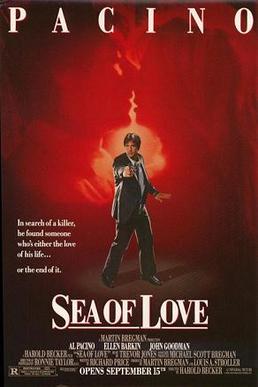
Sea of Love (1989, directed by Harold Becker)


In New York City, someone is ritualistically murdering the men who are placing rhyming personal ads in a tabloid newspaper.  Assigned to the case is Frank Keller (Al Pacino), an alcoholic burn-out whose wife just left him for another cop.  Keller and his partner (John Goodman) decide to go undercover.  Frank places a rhyming personal ad of his own and then goes to a restaurant to see who shows up.  When Helen Cruger (Ellen Barkin) answers the ad, it leads to a relationship between Frank and Helen.  Frank is falling for Helen but what if she’s the murderer?

Sea of Love is a superior thriller, even though it doesn’t really work as a mystery.  As soon as you see a certain person’s name in the cast list, you’re going to guess who the killer is because that person is always the killer.  Sea of Love isn’t really about the mystery, though.  It’s about people looking something that’s missing from their lives and realizing that the world is passing them by.  The movie works because of the performances of Al Pacino and Ellen Barkin, cast as two lonely middle-aged people who are desperately looking for some sort of connection.  Helen and Frank are both in their 40s and wondering if their current situation is really as good as it’s going to get.  The film uses Frank’s fear that Helen could be the killer as a metaphor for the fear that anyone feels when they are first starting to open up to someone.  Both Pacino and Barkin give emotionally raw and poignant performances.  I don’t think I’ve ever seen Al Pacino look as miserable as he did for the majority of Sea of Love.  This was Pacino’s first film role after the disaster of Revolution and the movie’s box office success was revived Pacino’s career and convinced him to give movies a try again.

Director Harold Becker captures the feel of New York at its grittiest and least welcoming and Richard Price’s script is full of priceless dialogue.  This is one of the rare films in which everyone has something intelligent or meaningful to say.  Featuring a strong supporting cast and career-best performances from Ellen Barkin and Al Pacino, Sea of Love is much more than just another cop film.

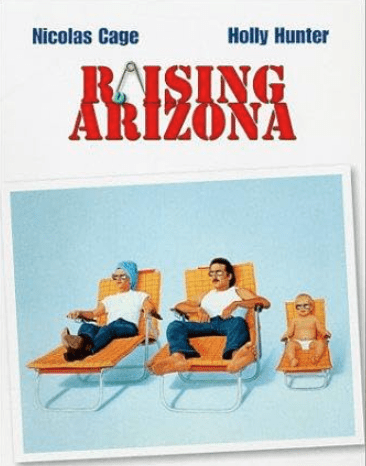
Raising Arizona (Dir Joel & Ethan Coen), Review by Case Wright


Happy Birthday, Nicolas Cage. If you’re an older Millennial or Young Gen X, you saw “Raising Arizona” about 100 times on Showtime and HBO because I believe that it was very inexpensive to license. The film was a hard left turn for the Coen Brothers who had major success with “Blood Simple” – a brutal thriller- that turned all women off to Fat Southern Murderers forever. The Coen thrillers tended to have comedic edge after Raising Arizona, but never just a comedy again- until The Big Lebowski. This film is also responsible for John Goodman. Prior to this film he was in mostly small parts, then after this picture- he became a household name in Roseanne.

Nicolas Cage is a made up name. He is Francis Coppola’s nephew and I can’t fault him for mayonnaising his name because my Italian ancestors did as well. However, I believe that he was trying to hide the Coppola name more than his heritage. Speaking of Italian heritage, try “Groking” “Italian American Jersey Girl” in grok. The lady who appears is beautiful, but doesn’t look like any of my Aunts. I feel that I should advocate for my people- We trend good looking and gave you Pizza Friday! Come on, show some love!

The film’s premise is that H.I. McDonnough (Nicolas Cage) is an ex con who is addicted to robbing the same convenience store again and again and again. This may seem strange, but in another life, I did criminal defense and I had a client who would steal the same jacket from the same store every year. Edwina “Ed” (Holly Hunter) is a cop who processes H.I. again and again. Each time, he flirts with her. His last time as a convict in front of her- her fiancé left her. H.I. realizes that he must go straight to get her love.

After his jail time, he returns as a free man to get his love- “Ed”. It works! They have a great life, but they want a child and yet she can’t conceive. The solution: they will kidnap a baby from the owner of Gallery Furniture! If you were from Texas, you would’ve laughed! They get the kid and are pursued by all sorts of people who want to claim the reward for the kidnapped baby.

This very intricate plot is just the first 30 minutes of the film. It is truly funny. I always felt for these character because good people should have LOTS OF KIDS- as many as possible! They shouldn’t have to pay taxes or anything. This film is special to me for another reason: it is when the Boomers were still young and filled with hope. Now, we are losing them and it hurts. This film is a glimpse of what they were like before the grey and how much they yearned for a good family on their own terms.

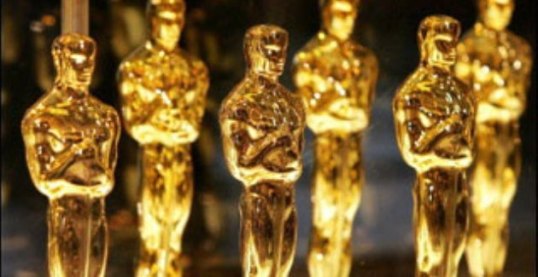
10 Oscar Snubs From the 1990s


Ah, the 90s. Some would say that this was the last good decade that the world would ever experience. It was certainly a good decade for films!  Still, there were some notable Oscar snubs during this decade.  Here are ten of them.

1990: Ray Liotta Is Not Nominated For Goodfellas

The fact that Ray Liotta did not even receive a nomination for playing Henry Hill in Goodfellas will always astound me.  While the film did receive several nominations (and really, it should have won the majority of them), Ray Liotta was snubbed despite the fact that it was his performance that pretty much held the film together.  Alec Baldwin, Tom Cruise, and Val Kilmer were among those who were considered for the role before Liotta received it.  They’re all fine actors but it’s hard to imagine any of them bringing Henry to life quite as well as Ray Liotta.

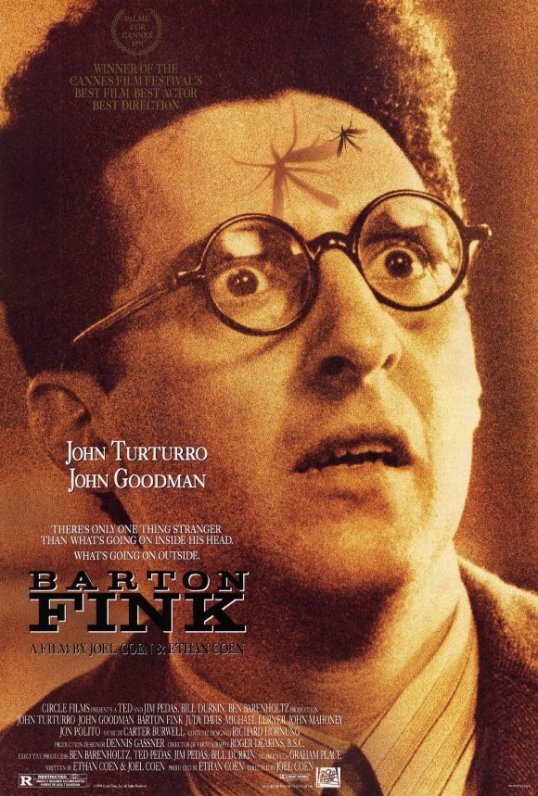
1991: John Goodman is Not Nominated for Barton Fink

“I WILL SHOW YOU THE LIFE OF THE MIND!”

It’s a little bit amazing that John Goodman has never received an Oscar nomination.  I don’t think he’s ever been scarier (and, in his way, more poignant) than when he played Charley “Mad Man Mundt” Meadows in Barton Fink.

1993: The Age of Innocence Is Not Nominated For Best Picture

While we’re on the subject of Scorsese films that were snubbed by the Academy, it’s amazing to me that Scorsese’s witty, smart, and visually stunning adaptation of The Age of Innocence did not receive a Best Picture nomination.

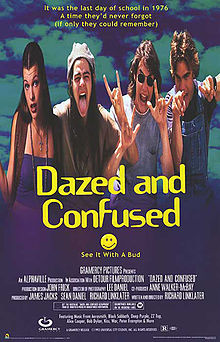
1993: Dazed and Confused Is Completely Snubbed

Okay, maybe this one isn’t as surprising as the Academy snubbing as Scorsese picture.  Even today, it’s doubtful that the Academy would embrace a film about a bunch of stoned Texas high school kids.  Still, it bothers me that Dazed and Confused received not a single nomination.  It’s certainly better remembered than many of the films that were nominated that year.

1995: Heat Is Completely Ignored

Considering that the film is now regularly cited as one of the best crime films ever made, it’s interesting to note that the Academy totally ignored Heat.  The film received no acting nominations.  Michael Mann was not nominated for his skill in juggling several different storylines.  The film didn’t even receive any technical nominations.  The cinematography was ignored.  You would think that the massive shoot-out would have gotten the film a nomination for Best Sound Editing but, even in that category, Heat was ignored.

Needless to say, Heat was not nominated for Best Picture.  The 1995 Best Picture line-up has always seemed like an odd mix of films, with Babe, Apollo 13, Sense and Sensibility, and Il Postino all losing out to Mel Gibson’s Braveheart.  Apollo 13 and Sense and Sensibility didn’t even receive nominations for their directors, Ron Howard and Ang Lee.  It was an odd year, I guess.  Heat was not the only acclaimed film to miss out on a Best Picture nomination but at least Casino, Leaving Las Vegas, and Dead Man Walking still received nominations in other categories.  Heat was totally snubbed.

1996: Steve Buscemi Is Not Nominated For Fargo

Despite being a cultural institution, Steve Buscemi has never received an Oscar nomination.  I would have nominated him for Fargo.

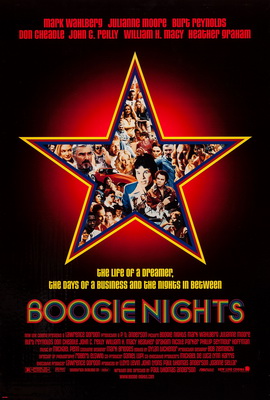
1997: Boogie Nights Is Not Nominated For Best Picture, Best Director, or Best Actor

Despite receiving two acting nominations for Burt Reynolds and Julianne Moore and a screenplay nomination, Boogie Nights missed out on the big award.  To be honest, I have a feeling that the film would have been nominated if it had been released today.  But, in the year of Titanic, the Academy may not have been ready to embrace a film about the Golden Age of Porn.  And they certainly weren’t ready to embrace Mark Wahlberg, despite his award-worthy performance of The Touch.  Given a choice, the Academy will always embrace the James Camerons of the world before it embraces the Jack Horners.  That said, as we saw in the film, Dirk and Angels Live In My Town swept the AFAA awaards and that’s the important things.

1997: Billy Zane Is Not Nominated For Titanic

C’mon, he was the best thing about the movie!  If Billy Zane can’t receive a nomination for shouting, “I hope you’ll be very happy together!” while chasing Leo and Kate through a sinking ship, what is the point of even having the Oscars?

1999: Reese Witherspoon Is Not Nominated For Best Actress For Election

Reese Witherspoon’s performance as Tracey Flick is iconic precisely because it feels so real.  Everyone has known as Tracey Flick.  Everyone has been annoyed by a Tracey Flick.  Everyone has hoped for a Tracey Flick to fail.  And everyone has inwardly lost a little faith in karma as the Tracey Flicks of the world have continued to find work as mid-level bureaucrats.  In fact, I imagine that might be the reason why Reese Witherspoon was not nominated for her outstanding performance in Election.  No one wanted to reward Tracey Flick.

1999: Bruce Willis Is Not Nominated For Best Actor For The Sixth Sense

Seriously, everyone really took him for granted.  Just try to imagine The Sixth Sense with someone else in his role.

Agree?  Disagree?  Do you have an Oscar snub that you think is even worse than the 10 listed here?  Let us know in the comments!

Up next: A new century brings new snubs!

Lisa Reviews A Palme d’Or Winner: Barton Fink (dir by Joel and Ethan Coen)


With the Cannes Film Festival underway in France, I decided that I would spend the next few days watching and reviewing some of the previous winners of the Palme d’Or.  Today, I got things started with the 1991 winner, Barton Fink.

Directed by the Coen Brothers and taking place in the mythological Hollywood of 1941, Barton Fink tells the story of a writer.  Played by John Turturro, Barton Fink is a playwright who has just had a big hit on Broadway.  We don’t see much of the play.  In fact, we only hear the final few lines.  “No,” one the actors says, in exaggerated “common man” accent, “it’s early.”  From what we hear of the reviews and from Barton himself, it seems obvious that the play is one of those dreary, social realist plays that were apparently all the rage in the late 30s.  Think Waiting for Lefty.  Think Hand That Rocks The Cradle.  Think of the Group Theater and all of the people that Elia Kazan would later name as having been communists.  These plays claimed to tell the stories of the people who couldn’t afford to see a Broadway production.

Barton considers himself to be the voice of the common man, an advocate for the working class.  He grandly brags that he doesn’t write for the money or the adulation.  He writes to give a voice to the voiceless.  When his agent tells him that Capitol Pictures wants to put Barton under contract, Barton resists.  His agent assures Barton that the common man will still be around when Barton returns from Hollywood.  There might even be a few common people in California!  “That’s a rationalization,” Barton argues.  “Barton,” his agent replies with very real concern, “it was a joke.”  Barton, we quickly realize, does not have a sense of humor and that’s always a huge problem for anyone who finds themselves in a Coen Brothers film.

In Hollywood, Barton meets the hilariously crass Jack Lipnik (Oscar-nominated Michael Lerner).  Lipnik is the head of Capitol Pictures and he is sure that Barton can bring that “Barton Fink feeling” to a Wallace Beery wrestling picture.  Barton has never wrestled.  He’s never even seen a film.  The great toast of Broadway finds himself sitting in a decrepit hotel room with peeling wallpaper.  He stares at his typewriter.  He writes three or four lines and then …. nothing.  He meets his idol, Faulknerish writer W.P. Mayhew (John Mahoney), and discovers that Mayhew is a violent drunk and that most his recent work was actually written by his “secretary,” Audrey (Judy Davis).  He seeks help from producer Ben Geisler (Tony Shalhoub), who cannot understand why Barton is having such a difficult time writing what should be a very simple movie.  Barton sits in his hotel room and waits for inspiration that refuses to come.

He also gets to know Charlie Meadow (John Goodman).  Charlie is Barton’s neighbor.  Charlie explains that he’s an insurance agent but he really sells is “peace of mind.”  At first, Barton seems to be annoyed with Charlie but soon, Barton finds himself looking forward to Charlie’s visits.  Charlie always brings a little bottle of whiskey and a lot of encouragement.  Charlie assures Barton that he’ll get the script written.  Barton tells Charlie that he wants to write movies and plays about “people like you.”  Charlie shows Barton a wrestling move.  Barton tells Charlie to visit his family if he’s ever in New York.  Charlie tells Barton, “I could tell you some stories” but he never really gets the chance because Barton is usually too busy talking about his ambitions to listen.  Charlie tells Barton, “Where there’s a head, there’s hope,” a phrase that takes on a disturbing double meaning as the film progresses.  Just as Barton isn’t quite the class warrior that he believes himself to be, Charlie isn’t quite what he presents himself to be either.  Still, in the end, Charlie is far more honest about who he is than Barton could ever hope to be.

When it comes to what Barton Fink is actually about, it’s easy to read too much into it.  The Coens themselves have said as much, saying that some of the film’s most debated elements don’t actually have any deeper meaning beyond the fact that they found them to be amusing at the time.  At its simplest, Barton Fink is a film about writer’s block.  Anyone who has ever found themselves struggling to come up with an opening line will be able to relate to Barton staring at that nearly blank page and they will also understand why Barton comes to look forward to Charlie visiting and giving him an excuse not to write.  It’s a film about the search for inspiration and the fear of what that inspiration could lead to.  Towards the end of the film, Barton finds himself entrusted with a box that could contain his worst fears or which could cpntain nothing at all.  There’s nothing to stop Barton from opening the box but he doesn’t and it’s easy to understand why.  To quote another Coen Brothers film, “Embrace the mystery.”

There’s plenty of other theories about what exactly is going on in Barton Fink but, as I said before, I think it’s easy to overthink things.  The Coens have always been stylists and sometimes, the style is the point.  That said, I do think that it can be argued that Barton Fink’s mistake was that he allowed himself to think that he was important than he actually was.  Self-importance is perhaps the one unforgivable sin in the world of the Coen Brothers.  Like most Coen films, Barton Fink takes place in a universe that is ruled by chaos and the random whims of fate.  Barton’s mistake was thinking that he could understand or tame that chaos through his art or his politics.  Barton’s mistake is that he tries to rationalize and understand a universe that is irrational and incapable of being explained.  He’s a self-declared storyteller who refuses to listen to the stories around him because those stories might challenge what he considers to be the “life of the mind.”

Barton Fink is a film that people either seem to love or they seem to hate.  Barton, himself, is not always a  particularly likable character and the Coens seem to take a very definite joy in finding ways to humiliate him.  Fortunately, Barton is played by John Turturro, an actor who has the ability to find humanity in even the most obnoxious of characters.  (As obnoxious as Barton can be, it’s hard not to want to embrace him when he awkwardly but energetically dances at a USO club.)  Turturro has great chemistry with John Goodman, who gives one of his best performances as Charlie.  It’s putting it lightly to say that most viewers will have mixed feelings about Charlie but the film makes such great use of Goodman’s natural likability that it’s only on a second or third viewing that you realize that all of Charlie’s secrets were pretty much out in the open from the start.  Michael Lerner deserved his Oscar nomination but certainly Goodman deserved one as well.  The rest of the cast is full of Coen Brothers regulars, including Jon Polito as Lerner’s obsequies assistant and Steve Buscemi as Chet, the very friendly front deskman.  And finally, I have to mention Christopher Murney and Richard Portnow, who play two of the worst cops ever and who deliver their hardboiled dialogue with just the right mix of menace and parody.

Barton Fink won the Palme d’Or at Cannes, defeating such films as Spike Lee’s Jungle Fever and Lars Von Trier’s Europa.  It also won awards for the Coens and for John Turturro.  It’s perhaps not a film for everyone but it’s one that holds up well and which continues to intiruge.  Don’t just watch it once.  This isn’t a film that can fully appreciated by just one viewing.  This isn’t a Wallace Beery wrestling picture.  This is Barton Fink!

Horror Film Review: Fallen (dir by Gregory Hobilt)


“Time is on my side….” sings an ancient Sumerian demon, who is apparently a huge fan of the Rolling Stones.

“Do you like cream?” asks a possibly crooked detective who is played by a slightly less heavy than usual James Gandolfini.

Donald Sutherland walks through a shadowy police station and flashes his big smile.

A detective played by John Goodman talks on the phone and makes cheery jokes while investigating a brutal murder.

A demon jumps from person to person, possessing everyone for a matter of seconds, just so he can freak out one specific person.

“Beware my wrath,” a white-haired businessman says to Denzel Washington.

There’s no way to deny it.  1998’s Fallen is a film that’s full of strange moments.  Some of it works and some of its doesn’t but it’s never boring.  Denzel Washington plays John Hobbes, a Philadelphia detective who has achieved a small amount of fame as the result of capturing serial killer Edgar Reese (Elias Koteas).  Reese asks to see Hobbes before he’s executed and it turns out that, for a man about to pay the ultimate price for his crimes, he’s in a surprisingly good mood.  Before he goes in the gas chamber, Reese chants something in Aramaic.

Soon, new murders are being committed in Phladelphia.  Hobbes and his partner, Jonesey (John Goodman at his most Goodmanesque), suspect that the killer is a copycat, trying to capture some of Reese’s notoriety for himself.  Gretta Milano (Embeth Davidtz), the daughter of a detective who committed suicide after being accused of committing a series of murders, tells Hobbes that the new killings are actually being committed by a demon named Azazel.  Azazel can jump from body to body and can compel people to do terrible things.  Gretta asks Hobbes if he belives in God.  Hobbes says it’s hard to have faith when you deal with murder every day, a somewhat clichéd line that Washington makes work through the absolute conviction of his delivery,

Denzel Washington is the key to this film’s success.  Sure, there’s a lot of murders and a lot of twists and a lot of possessions and there’s a lot of scenes that are shot from the point of view of the demon but, in the end, Fallen works because Washington is absolutely convincing as a man who is facing an evil that is beyond human understanding.  Washington gives a very naturalistic and grounded performance, one that keeps an element of reality in Fallen regardless of how messy the story may get.  When it becomes apparent that the demon is going to try to harm his brother and his nephew, Washington’s fury feels real.  When Hobbes discovers that the demon has gotten to one of them, Washington’s underplayed reaction makes the scene even more poignant and painful.  It’s hard to imagine Fallen being anywhere near as effective with an actor other than Denzel Washington in the lead role.

Fallen is a twisty movie.  The demon moves quickly and it always seems to have a backup plan.  He manipulates Hobbes into doing some things that are so terrible that you’re not sure that Hobbes is every going to recover, even if he does somehow manage to defeat Azazel.  Hobbes and Azazel are worthy adversaries and, as a result, the film gets away with a lot of stuff that wouldn’t otherwise work.  Even the use of Time Is On My Side pays off, as the one character who you don’t want to hear sing the song suddenly starts doing a Mick Jagger impersonation and you’re just like, “Oh no, what’s going to happen now?”  The film’s high point is a lengthy sequence where Hobbes stands on a busy street and watches as Azazel jumps from body to body.  Everyone who passes Hobbe gives him a death glare.  It’s a frightening moment, one in which Fallen captures the intensity of a nightmare.

I watched Fallen earlier today.  I can’t really say that I was expecting much from it but I was surprised.  It’s actually one of the better horror films that I’ve watched for the first time this month.  It’s big and strange and creepy and it’s got Denzel Washington doing what he does best.  What more could you ask for?