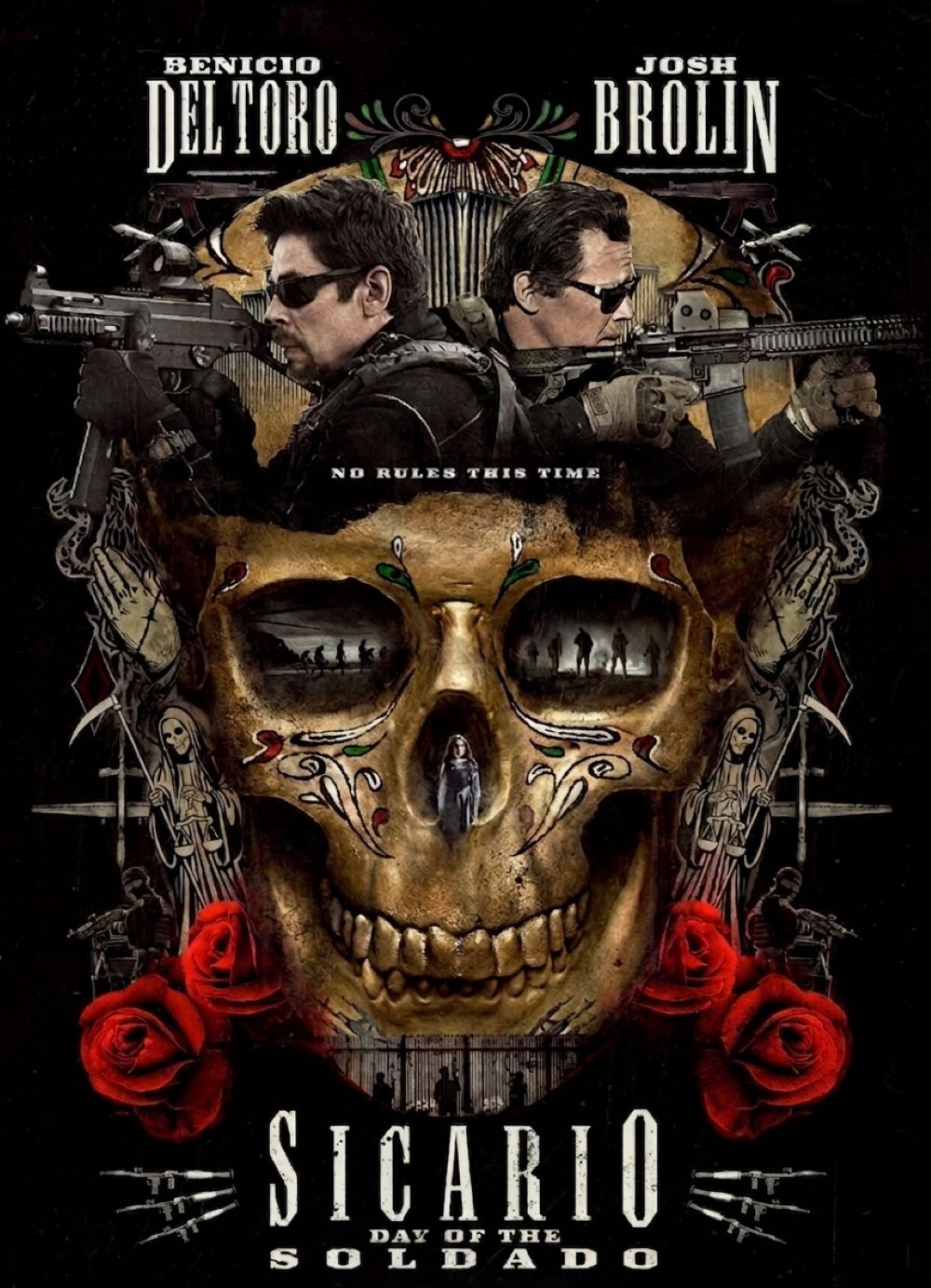
Sicario: Day of the Soldado (dir. by Stefano Sollima) Review


“I mean, I wouldn’t take out a cartel leader. Turn one cartel into 50. Besides, killing kings doesn’t start wars, it ends them.” — Matt Graver

Sicario: Day of the Soldado is a tense, often entertaining follow-up that never quite reaches the same level of dread, complexity, or visual identity as the first Sicario. It’s a movie that knows how to hit hard in the moment, but it doesn’t linger in the mind the same way, and a big reason for that is how much it shifts from being a layered border thriller into something more like a blunt-force crime action movie.

What stands out right away is that the film still has strong ingredients. Taylor Sheridan’s script gives Josh Brolin and Benicio Del Toro plenty of room to do what they do best, and both actors make this thing watchable even when the movie itself starts feeling thinner than it should. Brolin brings that loose, swaggering menace to Matt Graver, making him feel like the kind of guy who smiles while ordering something morally awful. Del Toro, meanwhile, gives Alejandro a cold, haunted intensity that fits the character perfectly. He doesn’t need much dialogue to sell the idea that this man is basically a weapon walking around in human form.

But that’s also where the movie’s biggest issue starts to show. For all the credit Sheridan deserves for keeping the world of Sicario alive, the absence of Denis Villeneuve in the director’s chair is obvious. The first film had this slow-burning, oppressive grip on you; every scene felt like it was pulling you deeper into a nightmare that had structure, purpose, and a real sense of moral unease. Here, that layered feeling is much weaker. The sequel becomes more interested in forward motion, shootouts, and tension-by-incident than in developing the deeper political and thematic weight that made the original so memorable.

That doesn’t mean Sicario: Day of the Soldado is empty. It just feels like it has less on its mind than the first film. The original Sicario was about systems, corruption, compromise, and the way law enforcement and criminal violence blur together until nobody gets to stay clean. This sequel touches on similar territory, but it often feels like the movie is more focused on creating a harsh atmosphere around its two lead men than on really digging into what all of it means. In that sense, it starts to feel like a vehicle for Brolin and Del Toro first, and a larger statement second.

Stefano Sollima does a solid job with the action, and to his credit, he understands that this world should feel mean, chaotic, and stripped of comfort. There’s a gritty professionalism to the violence that works well enough, and the film certainly doesn’t shy away from brutality. Still, the action doesn’t always carry the same weight as it did in the first movie because the buildup isn’t as rich. The tension is there, but the emotional and thematic buildup behind it is thinner, so some of the set pieces land more as effective genre beats than as moments that actually deepen the story.

The film’s biggest strength, beyond the performances, is its atmosphere of moral corrosion. Nobody in Day of the Soldado feels especially noble, and that’s part of what keeps it interesting. Brolin’s Graver is still the kind of operator who treats human lives like pieces on a board, while Del Toro’s Alejandro remains a deeply damaged figure who seems to exist somewhere between avenger, assassin, and ghost. Their relationship gives the movie a sharp edge, because you’re never really sure whether these guys are working together, manipulating each other, or simply following the same dark logic from different angles.

Still, the movie’s structure is less satisfying than the first one’s. It leans harder into a straightforward escalation of events, and once that happens, some of the mystery and suspense gives way to a more familiar crime-thriller rhythm. That isn’t automatically a bad thing, but it does mean the film loses some of the special quality that made Sicario feel so bracing. The sequel is darker in tone, sure, but not necessarily deeper. It’s more aggressive than observant, more kinetic than reflective.

A lot of this is why the movie works best when it keeps its focus on the two men at the center. Brolin and Del Toro are compelling enough to hold attention even when the screenplay starts feeling a little schematic. Their characters are so insulated by violence and secrecy that they almost seem to belong to a different kind of movie than everyone else around them. The downside is that this also makes the surrounding story feel less important. The first film balanced character and theme in a way that felt inseparable; this one often feels like it is using theme as a backdrop for the characters rather than letting the ideas shape the entire film.

Even so, Sicario: Day of the Soldado isn’t a failure. It’s a good-looking, well-acted, often tense sequel that knows how to stay nasty and efficient. It just doesn’t have the same confidence in its own ideas. The result is a film that is entertaining in a hard-edged, grim way, but also one that makes you think about what it could have been with a stronger directorial voice pulling everything together. Taylor Sheridan’s fingerprints are still all over it, but Villeneuve’s absence leaves a noticeable gap in the film’s pulse and perspective.

In the end, the movie feels like a solid but diminished return to a brutal world. It gives you Brolin and Del Toro doing sharp, controlled work inside a story that never fully rises to match them. That’s enough to make it worthwhile, but not enough to make it essential. Compared to the first Sicario, this one is more of a hard-nosed spin-off in spirit than a true continuation of the original’s power, and that difference is felt in almost every scene.

Film Review: Patriots Day (dir by Peter Berg)


On April 15th, 2013, a terrible crime was committed.

Two brothers, Tamerlan and Dzokhar Tsarnaev, bombed the Boston Marathon.  I can remember the exact moment when I looked up at the television and I saw the footage of the bomb going off as a group of runners ran across the finish line.  Instinctively, I found myself hoping that the explosion looked worse than it actually was and that no one had been seriously injured.  However, I was then flooded with images of people running in fear while other lay injured and bleeding on the ground.  A photograph of  man who had lost his both his legs was seared into my mind, the nightmarish image of those exposed and shattered bones coming to represent the pure evil that was unleashed on that day.

At first, there was a lot of speculation about who was responsible for the bombing.  Despite the fact that it had all the earmarks of an al-Qaeda operation, many people on the news insisted that the bomb had been set by their favorite boogeymen, the right-wing militias.  (The initial theory was that it was a tax day protest, which is one of the dumbest things I’ve ever heard.)  Three days after the bombing, the first photographs of the Tsarnaev Brothers were released.  Looking at the security footage of Tamerlan placing a bomb on the ground right next to a child who was subsequently killed in the blast, I started to rethink my opposition to the death penalty.

Boston was shut down until the Tsarnaev brothers were tracked down and, along with hating the Tsarnaevs, I found myself fearing that the search for them would normalize the idea of suspending civil liberties.  Tamerlan was gunned down in a fight with police and hopefully, he felt each bullet.  Dzokhar was captured after he attempted to hide in a homeowner’s boat while whining like a little bitch.  Dzokhar is one of three people on the Federal Death Row.  He also has a truly creepy fan club online, though they haven’t been as active as they were in the past.

2016’s Patriots Day is about that tragic day and the subsequent manhunt for the Tsarnaev brothers.  This is another one of Peter Berg’s films about professional, no-nonsense men who have a job to do and who do it well.  Mark Wahlberg plays a cop.  Kevin Bacon plays the FBI agent who heads up the investigation.  John Goodman plays the Boston police commission while Michael Beach makes an appearance as Deval Patrick, the then-governor of Massachusetts who ran a bizarrely overlooked presidential campaign in 2020.  Just as he did with Deepwater Horizon, Berg emphasizes the human cost of the tragedy along with the official efforts to track down the men responsible.  The ensemble comes together impressively, recreating those scary few days and also paying tribute to a city that refused to allow itself to be defeated.  Patriots Day follows the common, blue collar citizens of Boston as they deal with a horrific act of evil.  Even though we all know how the story turned out, the film manages to create a decent amount of suspense as the authorities search for the Tsarnaevs.  As for the brothers themselves, the film portrays them as being initially cocky and eventually pathetic.  To the film’s credit, it doesn’t ask us to consider things from the point of view of the terrorists.  There’s no moral relativism here.  The film knows who deserves to be heard.

Patriots Day is a tribute to the first responders and the citizens of Boston who refused to allow the Tsarnaevs to win.  With so many people now making excuses for terrorism, Patriots Day is a powerful reminder of the human cost of such actions.  The Tsarnaevs through they were striking a blow for their ideology.  Instead, they just reminded us how strong people can be.


The Films of 2020: Horse Girl (dir by Jeff Baena)


Horse Girl tells the story of a lost woman named Sarah (played, in a bravely committed performance, by Alison Brie).

Sarah is an introvert who works in a craft store, where she can tell the customers exactly the right type of paint to buy and where she’s watched over by her friendly co-worker, Joan (Molly Shannon).  During the day, she occasionally visits the grave of her mother, who committed suicide.  Sometimes, she might have a conversation with her wealthy stepfather (Paul Reiser).  She enjoys going out to the stables and watching a horse named Willow.  When she was a little girl, she rode Willow and she still thinks of him as being her horse.  The owners of the stable, however, are never particularly enthused to see Sarah hanging around.  In one scene, Sarah attempts to give advice to the girl who was just riding Willow, despite the fact that the girl obviously has no idea who Sarah is.  Despite her good intentions, Sarah tends to be so awkward in her attempts to socialize that she just leaves people feeling uncomfortable.

When she’s not at work or at the stables or trying to fit in with the other students at her zumba class, Sarah lives in an apartment with her roommate, Nikki (Debby Ryan).  While Nikki has a boyfriend, Sarah spends most of her nights in her living room, watching a cheesy sci-fi adventure show called Purgatory.  She knows every detail about the show and is always shocked when no one else is as interested in it as she is.

In short, Sarah is a misft but she’s a familiar misfit.  We all probably know someone like Sarah.  At the very least, we all follow someone on twitter who is like Sarah, someone who always seems to be trying to make a connection but who can never quite get comfortable enough to just relax and be herself.

Strange things start to happen to Sarah.  She hears voices in the apartment.  She has dreams in which she’s lying on the floor of what appears to be a spaceship.  Sarah starts to sleepwalk and is soon waking up to find herself in random locations.  When she sees a picture of her grandmother, she wonders if it’s possible that she’s a clone.  Strange scratches start to appear on the walls of her apartment.  Did Sarah put them there or are they result of something coming after her?

Horse Girl is a surprisingly effective film, one that keeps you guessing as to whether or not what we’re seeing is really happening or if it’s all just occurring in Sarah’s head.  Horse Girl was produced by Duplass Brothers Productions and it really does feel like a mumblecore version of Repulsion, with Alison Brie stepping into Catherine Deneuve’s role of the repressed young woman who finds herself a prisoner of her own fears.  Whereas Repulsion featured arms growing out of the walls, Horse Girl features alien abductions and clones.

It’s a film that is sometimes heart-breaking and occasionally darkly funny.  As much as we care and worry about Sarah, the people around her are interesting as well.  The world that Horse Girl creates feels very real and very familiar and even the actors in the smallest roles create an indelible impression.  This is one of those rare movies where it actually seems like the characters in the film all have a life even when they’re not in a scene.  Every performance and every character feels real and authentic.  I particularly liked the performance of Molly Shannon, who brings a very natural and sincere kindness to the role of Sarah’s co-worker.  Playing Sarah’s father and Sarah’s gently humorous doctor, Paul Reiser and David Paymer shine in small roles.

That said, the film works best as a showcase for Alison Brie, who is both sympathetic and, eventually, more than a little frightening in the role of Sarah.  Brie gives such an emotionally vulnerable performance as Sarah that there are times when you really wish that you could step into the film yourself and assure her that everything’s going to be okay.  It’s also a rather brave performance, one that wins our sympathy while also showing why the increasingly manic Sarah might be too much for some people to take.

I have to admit that I wasn’t necessarily expecting much when I started watching a film called Horse Girl but it turned out to be one of my favorite films of 2020 so far.