Brad’s reflections on STAND BY ME (1986), directed by Rob Reiner!


“I was twelve going on thirteen the first time I saw a dead human being.”

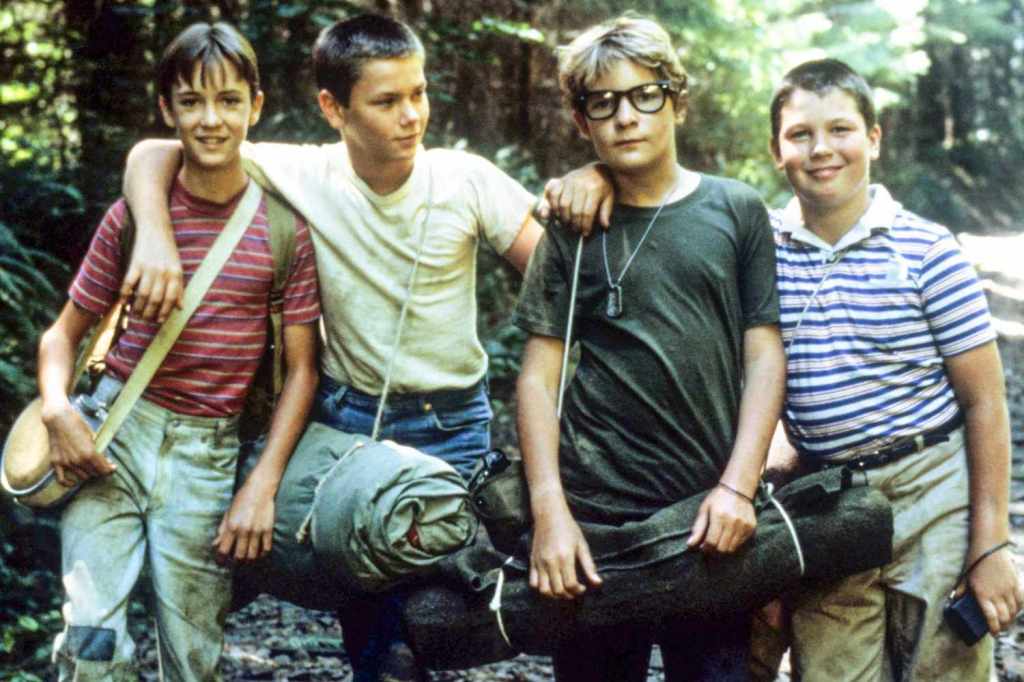
These are the first words spoken in director Rob Reiner’s classic coming of age film, STAND BY ME, which received its widespread theatrical release in the United States on August 22nd, 1986. Actor Richard Dreyfuss spoke words that gave an exact description of my own age in the summer of 1986 when the film was released, and I certainly felt a connection to the characters in Reiner’s film. I watched STAND BY ME many times as a teenager, and with a humble and hurting heart, I decided to watch it again last night. On its surface, it’s a pretty simple story… 

After accidentally learning of the location of the body of a local boy who’s been missing for several days, four boys (played by Wil Wheaton, River Phoenix, Corey Feldman, and Jerry O’Connell) set off on a weekend adventure to find the body in hopes of becoming local heroes. Along the way, they dodge trains, get sucked on by leeches, tell gross-out stories around a campfire, tackle traumatic personal issues, and eventually stand up to a group of older bullies (led by Kiefer Sutherland)! When the weekend is over, they move on with their own lives, lives that are never quite the same again.                   

The main reason I have a real personal connection to STAND BY ME is the fact that I recognize myself and some of my friends in its young characters. I grew up in a very small rural community in Arkansas called Toad Suck. It wasn’t even a town; it was more of just a spot in the road where a few homes built up near a dam and bridge on the Arkansas River. Often when I’d spend the night with my best friend, we’d go walking down the railroad track that ran through our community, carrying our BB guns and hanging out on the railroad bridges where we could take aim at rocks, sticks, turtles, and, at times, the dreaded water mocassin! Like the boys in the movie, we’d always have to be on the lookout for the oncoming trains. As a very naïve and sheltered kid of the mid-80’s who was raised in a strict religious household, I tended to be somewhat judgmental. STAND BY ME forced me to think deeper thoughts and try to find a more mature empathy for those kids I hung out with and saw at school every day. While none of the characters in the film are an exact replica of me or my friends, we knew of people who were probably experiencing abuse, who were looked down upon as “less than,” and who were neglected by their parents. And I think we have all experienced times when we felt insecure, lacked confidence, or were afraid and didn’t have the maturity to handle it in a positive manner. I felt compassion for these characters, which in turn helped me feel more understanding towards those around me in my real life! As a filmmaker in complete control of his craft, Rob Reiner made a movie that even affected someone like me, and I’ve never forgotten those feelings. 

My feeling of kinship with the actors who played in STAND BY ME didn’t end when the movie ended either. Wil Wheaton, River Phoenix, Corey Feldman and Jerry O’Connell were all very close to my age when they filmed the movie, and I’ve followed each of their careers fairly closely my entire life. My two favorites were River Phoenix and Corey Feldman. It was painful to me when River Phoenix died in 1993 at just 23 years of age. I remember all the issues Corey Feldman had with drug addiction. I’m so glad that he’s been able to overcome that addiction and achieve sobriety for multiple decades. I’m not a Star Trek completist, but I always got a kick out of seeing Wil Wheaton on THE BIG BANG THEORY. And then Jerry O’Connell definitely lost his baby fat and has gone on to a solid acting career! The common thread, of course, is the fact that Reiner got great performances from each of these young actors in STAND BY ME. Combine those performances with the quality of the film and the time in my own life when the film came out, and you can start to get the idea of why the film has a position of reverence in my life. You can also see why I have such respect for Rob Reiner as a filmmaker. 

Overall, STAND BY ME is simply one of my favorite films of all time. It has some of the most memorable on-screen moments of my childhood. The pie eating barf-o-rama and the crotch leeches are scenes that are burned into my psyche. Along with the great cast of boys, Kiefer Sutherland gives one of his solid, bully performances in an 80’s film. Sutherland would go on later in his career and play one of my all-time favorite TV characters, Jack Bauer, in 24. More important than all of that, though, is the fact that the coming-of-age film STAND BY ME helped 12-13 year-old me grow up a little bit myself by making me feel something. I guess the greatest compliment you can give any director is to tell them that their film made you think about things more important than yourself and made a difference in your own life. Today, I pay you that great compliment and say Rest in Peace, Mr. Reiner! 
The trailer for DETECTIVE CHINATOWN 1900, a new movie co-starring Chow Yun-Fat!


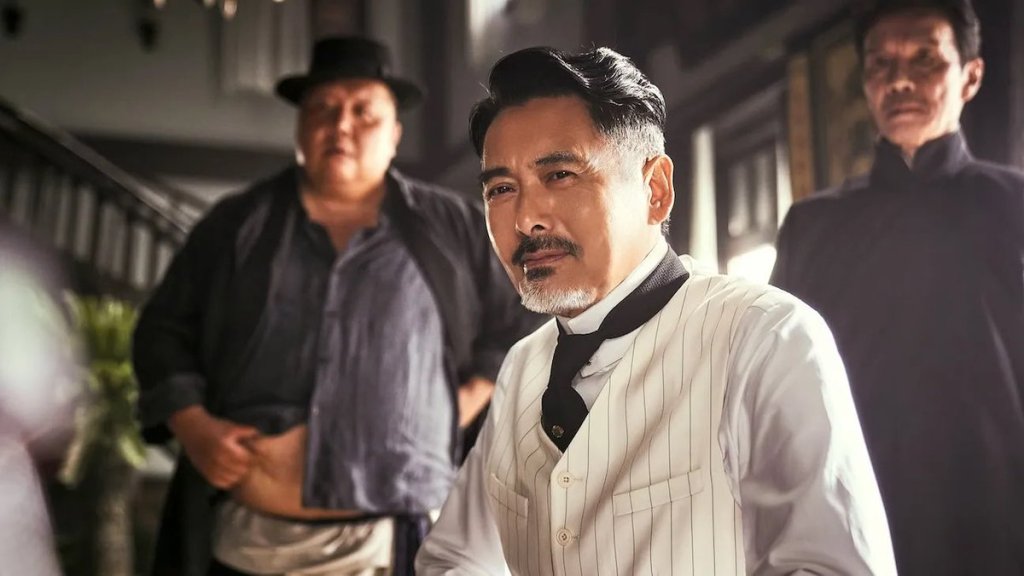
I was pleasantly surprised when I saw that a new movie co-starring Chow Yun-Fat was released in time for the Chinese New Year. Chow doesn’t work that much these days, so anytime he’s in a new movie, it’s an important event for me. And just look how cool he still looks in the picture above. The man is turning 70 on May 18th, for pete’s sake!

I was unaware of the DETECTIVE CHINATOWN franchise when I noticed Chow’s participation in this film on IMDB. It has been a huge box office hit as part of this year’s Chinese Lunar New Year festivities. DETECTIVE CHINATOWN 1900 is the 4th installment in the series that actually stars actors Baoqiang Wang and Liu Horan as Gui and Qin Fu, respectively. In this installment, the duo investigates the murder of a white woman in San Francisco’s Chinatown in 1900. Chow seems to be playing some sort of Chinatown boss in this film that also features John Cusack as the U.S. Congressman whose daughter is murdered. It looks kind of silly, but hopefully it’s also a lot of fun. I’ll definitely be checking this film out, and at least one of the other installments in preparation.

Enjoy this trailer for DETECTIVE CHINATOWN 1900!

14 Days of Paranoia #6: The Player (dir by Robert Altman)


1992’s The Player tells the story of Griffin Mill (Tim Robbins).

It’s not easy being Griffin Mill.  From the outside, of course, it looks like he has the perfect life.  He’s a studio executive with a nice house in Hollywood.  He’s young.  He’s up-and-coming.  Some people, especially Griffin, suspect that he’ll be the president of the studio some day.  By day, he sits in his office and listens to pitches from respected screenwriters like Buck Henry.  (Henry has a great idea for The Graduate II!)  During the afternoon, he might attends dailies and watch endless takes of actors like Scott Glenn and Lily Tomlin arguing with each other.  Or he might go to lunch and take a minute to say hello to Burt Reynolds.  (“Asshole,” Burt says as Griffin walks away.)  At night, he might go to a nice party in a big mansion and mingle with actors who are both young and old.  He might even run into and share some sharp words with Malcolm McDowell.

But Griffin’s life isn’t as easy as it seems.  He’s constantly worried about his position in the studio, knowing that one box office failure could end his career.  He fears that a new executive named Larry Levy (Peter Gallagher) is after his job.  Two new screenwriters (Richard E. Grant and Dean Stockwell) keep bugging him to produce their downbeat, no-stars anti-capitol punishment film.  His girlfriend (Cynthia Stevenson) wants to make good movies that mean something.  Even worse, someone is sending Griffin threatening notes.

It doesn’t take long for Griffin to decide that the notes are coming from a screenwriter named Dave Kahane (Vincent D’Onofrio).  Griffin’s attempt to arrange a meeting with Dave at a bar so that Griffin can offer him a production deal instead leads to Griffin murdering Dave in a parking lot.  While the other writers in Hollywood mourn Dave’s death, Griffin starts a relationship with Dave’s artist girlfriend (Great Scacchi) and tried to hide his guilt from two investigating detectives (Whoopi Goldberg and Lyle Lovett).  Worst of all, the notes keep coming.  The writer, whomever they may be, is now not only threatening Griffin but also seems to know what Griffin did.

After spend more than a decade in the industry wilderness, Robert Altman made a critical and commercial comeback with The Player.  It’s a satire of Hollywood but it’s also a celebration of the film industry, featuring 60 celebrities cameoing as themselves.  Everyone, it seems, wanted to appear in a movie that portrayed studio execs as being sociopathic and screenwriters as being whiny and kind of annoying.  The Player both loves and ridicules Hollywood and the often anonymous men who run the industry.  Largely motivated by greed and self-preservation, Griffin may not love movies but he certainly loves controlling what the public sees.  In the end, only one character in The Player sticks to her values and her ideals and, by the end of the movie, she’s out of a job.  At the same time, Griffin has a social life that those in the audience can’t help but envy.  He can’t step out of his office without running into someone famous.

The Player is one Altman’s most entertaining films, with the camera continually tracking from one location to another and giving as a vision of Hollywood that feels very much alive.  Tim Robbins gives one of his best performances as Griffin Mill and Altman surrounds him with a great supporting cast.  I especially liked Fred Ward as the studio’s head of security.  With The Player, Altman mixes melodrama with a sharp and sometimes bizarre comedy, with dialogue so snappy that the film is as much a joy to listen to as to watch.  That said, the real attraction of the film is spotting all of the celebrity cameos.  (That and cheering when Bruce Willis saves Julia Roberts from certain death.)  Altman was a director who often used his films to explore eccentric communities.  With The Player, he opened up his own home.

Previous entries in 2025’s 14 Days Of Paranoia:

  1. The Fourth Wall (1969)
  2. Extreme Justice (1993)
  3. The Lincoln Conspiracy (1977)
  4. Conspiracy (2007)
  5. Bloodknot (1995)

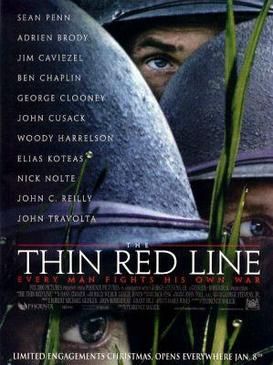
Lisa Marie Reviews An Oscar Nominee: The Thin Red Line (dir by Terrence Malick)


Based on a novel by James Jones (and technically, a sequel of sorts to From Here To Eternity), 1998’s The Thin Red Line is one of those Best Picture nominees that people seem to either love or hate.

Those who love it point out that the film is visually stunning and that director Terrence Malick takes a unique approach to portraying both the Battle of Guadalcanal and war in general.  Whereas Steven Spielberg’s Saving Private Ryan told a rather traditional story about the tragedy of war (albeit with much more blood than previous World War II films), The Thin Red Line used the war as a way to consider the innocence of nature and the corrupting influence of mankind.  “It’s all about property,” one shell-shocked soldier shouts in the middle of a battle and later, as soldiers die in the tall green grass of the film’s island setting, a baby bird hatches out of an egg.  Malick’s film may have been an adaptation of James Jones’s novel but its concerns were all pure Malick, right down to the philosophical voice-overs that were heard throughout the film.

Those who dislike the film point out that it moves at a very deliberate pace and that we don’t really learn much about the characters that the film follows.  In fact, with everyone wearing helmets and running through the overgrown grass, it’s often difficult to tell who is who.  (One gets the feeling that deliberate on Malick’s point.)  They complain that the story is difficult to follow.  They point out that the parade of star cameos can be distracting.  And they also complain that infantrymen who are constantly having to look out for enemy snipers would not necessarily be having an inner debate about the spirituality of nature.

I will agree that the cameos can be distracting.  John Cusack, for example, pops up out of nowhere, plays a major role for a few minutes, and then vanishes from the film.  The sight of John Travolta playing an admiral is also a bit distracting, if just because Travolta’s mustache makes him look a bit goofy.  George Clooney appears towards the end of the film and delivers a somewhat patronizing lecture to the men under his command.  Though his role was apparently meant to be much larger, Adrien Brody ends up two lines of dialogue and eleven minutes of screentime in the film’s final cut.

That said, The Thin Red Line works for me.  The film is not meant to be a traditional war film and it’s not necessarily meant to be a realistic recreation of the Battle of Guadalcanal.  Instead, it’s a film that plays out like a dream and, when viewed a dream, the philosophical voice overs and the scenes of eerie beauty all make sense.  Like the majority of Malick’s films, The Thin Red Line is ultimately a visual poem.  The plot is far less important than how the film is put together.  It’s a film that immerses you in its world.  Even the seeming randomness of the film’s battles and deaths fits together in a definite patten.  It’s a Malick film.  It’s not for everyone but those who are attuned to Malick’s wavelength will appreciate it even if they don’t understand it.

And while Malick does definitely put an emphasis on the visuals, he still gets some good performances out of his cast.  Nick Nolte is chilling as the frustrated officer who has no hesitation about ordering his men to go on a suicide mission.  Elias Koteas is genuinely moving as the captain whose military career is ultimately sabotaged by his kind nature.  Sean Penn is surprisingly convincing as a cynical sergeant while Jim Caviezel (playing the closest thing the film has to a main character) gets a head start on humanizing messianic characters by playing the most philosophical of the soldiers.  Ben Chaplin spends most of his time worrying about his wife back home and his fantasies give us a glimpse of what’s going on in America while its soldiers fight and die overseas.

The Thin Red Line was the first of Terrence Malick’s films to be nominated for Best Picture and it was one of three World War II films to be nominated that year.  However, it lost to Shakespeare In Love.

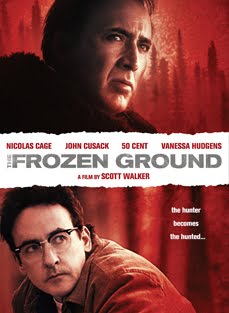
October True Crime: The Frozen Ground (dir by Scott Walker)


In the early 80s, Robert Hansen was a respected businessman in Anchorage, Alaska.  He owned a restaurant.  He was known for being a family man.  He held several local hunting records.  Almost everyone who met him described him as being friendly and good-natured.  In those days before the Internet, it wasn’t as if someone could do a Google search and discover that Hansen had a long criminal record in both Iowa and Alaska.  There was no way to know that Hansen had been a teenage arsonist and that had been arrested and charged with rape in the early 70s.  (The charges were ultimately plea bargained down to assault.)  Even those who did know about his background felt that Hansen had turned his life around and was now an upstanding member of society.

At the same time that Hansen was a respected member of the Anchorage community, he was abducting young women and, after holding them prisoner and raping him at his cabin, flying them into the Alaskan wilderness where he would then hunt them in his own version of The Most Dangerous Game.  It’s known, for sure, that Hansen murdered at least 18 women.  It’s felt that the number is much higher.  Along with his own good reputation, Hansen was protected by the fact that many of his victims were transients and sex workers.  Their disappearances were rarely reported to the police and, when they were, the police didn’t go out of their way to find them.  Much as happened with the Green River Killer in Washington State, Hansen was able to get away with his crimes for over 20 years not because he was particularly clever but because his victims were considered to be on the fringes of society.

The 2011 film, The Frozen Ground, is a fictionalized account of the investigation that led to Hansen’s arrest.  John Cusack plays Robert Hansen.  Nicolas Cage plays Jack Holcombe, a weary Alaskan state trooper who has to deal with uncooperative witnesses and beaurocratic indifference while investigating Hansen’s crimes.  Vanessa Hudgens plays Cindy Paulson, a 17 year-old sex worker who survives her encounter with Hansen but whose story is originally ignored by the police because of what Cindy does for a living.  Both Jack and Hansen comes to realize that Cindy is the only person who can positively identify the killer but Cindy has disappeared into the Anchorage underworld, working as a stripper and being manipulated by her pimp, Clate Johnson (50 Cent).

Taking full of advantage of the chilly atmosphere and the isolation of the Alaskan wilderness, The Frozen Ground is an effective journey into the heart of darkness, featuring excellent performances from Nicolas Cage and John Cusack.  Cusack smoothly alternates between being the arrogant hunter and the desperate prey while Cage’s weary expression captures the psychological toll of investigating the crimes of someone like Robert Hansen.  Of course, when the film came out, it received a lot of attention for featuring Vanessa Hudgens in a dramatic role.  Hudgens’s performance here continues the tradition of former Disney (and Nickelodeon) actresses trying to prove their range by playing an edgy role.  Though there’s a few scenes where she does seem to be trying too hard to make sure that we all know she’s capable of more than High School Musical, Hudgens is convincing for the most part.

As for the real-life Robert Hansen, he was sentenced to spend 461 years in prison for his crimes.  (Alaska has no death penalty.)  In 2014, three years after the release of this film, the 75 year-old Hansen died of natural causes while still incarcerated.

Music Video of the Day: Blister in the Sun by Violent Femmes (1997, directed by Evan Bernard)


When Blister in the Sun was first released in 1983, there were no music video.  In fact, there weren’t many listeners.  While the song was an immediate hit on college radio, it wasn’t until the late 80s and the 1990s, when all of those people who worked at the college stations got jobs programming “alternative” and “modern rock” stations, that Blister in the Sun really became a radio mainstay.

It wasn’t until John Cusack decided that he wanted to use the song in Grosse Pointe Blank that Blister in the Sun finally got a music video.  The video combines clips of John Cusack and Alan Arkin from the film with a totally new story involving the lead singer of Violent Femmes, Gordon Gano, attempting to assassinate Socks the Cat.  Socks was the White House pet during the Clinton years and it says something about the difference between 1997 and 2019 that this video could be made at all.  At the end of the video, Gano is arrested in a theater showing Grosse Pointe Blank, in much the same way that Lee Harvey Oswald was arrested in a theater that was showing War Is Hell.

As for the song’s lyrics, Gano has said that they were about drug abuse and not, as many listeners speculated, masturbation.  The famous “Big Hands” line was a reference to Gano’s insecurity about his small hands and his fear that his girlfriend would leave him for someone who had bigger hands.  As Gano once told the Village Voice, “I don’t think there’s a whole lot to understand with the lyrics.”

Enjoy!

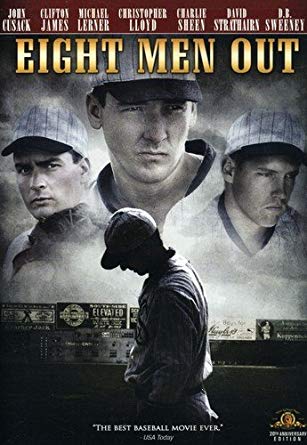
Scenes That I Love: The Ending of Eight Men Out


In just a few more hours, the 2019 MLB regular season will begin when the Mariners’s Ichiro Suzuki tosses out the first pitch of the season.  The Mariners and the A’s will be playing a pair of games in Japan, at the Tokyo Dome.  In America, it will be around four in the morning when that first pitch is thrown so I’ll probably miss it.

Even if I might not be able to watch the opening pitch, I can still watch my favorite baseball movie, Eight Men OutEight Men Out is about the 1919 World Series and how eight members of the Chicago White Sox were accused of conspiring with gamblers to throw the championship.  While everyone agrees that most of the players were guilty, Eight Men Out suggests that both Shoeless Joe Jackson and Buck Weaver were wrongly accused and, unlike the other players, should not have been banned from playing in the major leagues.

The final scene of Eight Men Out takes place several years after the scandal.  A group of baseball fans think that they’ve spotted Shoeless Joe playing for a semi-professional team.  While they debate whether or not that’s really Shoeless Joe, Jackson’s old teammate, Buck Weaver, tells them that there will never be another player as great as Joe Jackson.  John Cusack plays Weaver while D.B. Sweeney plays Jackson.

Finally, it’s time for baseball!

GO RANGERS!


Here’s The Trailer For Never Grow Old!


As I watching the trailer for Never Grow Old, I thought to myself, “Hmmmm.  A Western starring John Cusack and Jack Black….”

Then I realized that I was actually incorrect and this is a western starring John Cusack and Emile Hirsch.

That, of course, leads to one very important question.  WHEN DID EMILE HIRSCH TURN INTO JACK BLACK!?

Anyway, this trailer makes it look like this film is either going to be very good or very bad.  I guess it depends on whether or not Cusack’s performance is going to be as eccentric as the trailer makes it appear that it might be.  The trailer, itself, is full of atmosphere and I like that final shot of the American flag so I hope this film lives up to its potential.


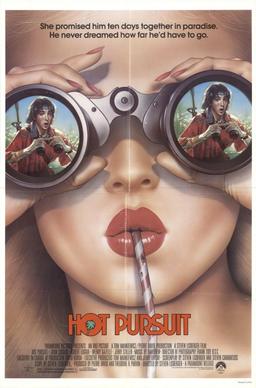
A Movie A Day #341: Hot Pursuit (1987, directed by Steven Lisberger)


When high school student Dan Bartlett (John Cusack) is late arriving at the airport, he finds himself watching as the plane taking his girlfriend (Wendy Gazelle) and her parents (Monte Markham and Shelley Fabares) to the Caribbean takes off without him.  Dan catches the next available flight and tries to track down his girlfriend and her family.  Helping him out is a Ganja-smoking islander (Keith David) and a crusty sea captain (Robert Loggia).  Complicating matters is that Dan’s girlfriend has been kidnapped by pirates (Jerry Stiller and his son, Ben)!
John Cusack got his start appearing in dopey 80s teen comedies and Hot Pursuit shows why he eventually declared that he would never appear in another one.  Hot Pursuit relies on the idiot plot.  If everyone in the movie didn’t act like an idiot, there wouldn’t be much of a movie.  Cusack seems bored in his role, only waking up towards the end of the movie when he gets to pick up a machine gun and blow away the pirates’ hideout.  (Cusack even gets to do a Rambo-style yell while riddling the building with bullets.)  This was Ben Stiller’s film debut and he has a few funny scenes.  The movie probably would have worked better if Stiller and Cusack had switched roles.

One final note; Hot Pursuit was produced by Pierre David, who also produced several of David Cronenberg’s early films.  It’s probably not a coincidence that Wendy Gazzelle’s character is named Lori Cronenberg.

Insomnia File #31: Arsenal (dir by Steve C. Miller)


What’s an Insomnia File? You know how some times you just can’t get any sleep and, at about three in the morning, you’ll find yourself watching whatever you can find on cable? This feature is all about those insomnia-inspired discoveries!

http://www.youtube.com/watch?v=G_Qq2DWiTCw

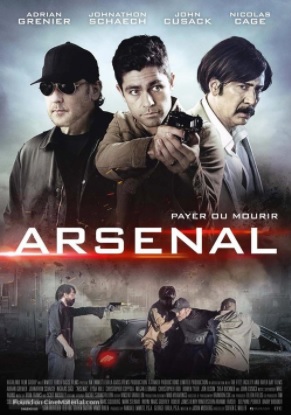
If you were having trouble getting to sleep last night around midnight, you could have turned over to Showtime and watched Arsenal, a film that had a brief theatrical run in January and which has now made its way to cable.

Arsenal tells the story of two brothers.  When we first meet them, they’re kids and they’re living with their uncle.  But then their uncle kills himself and the two brothers find themselves going down very different paths.  JP (who is played, as an adult, by Adrian Grenier) turns a part-time job mowing lawns into a full-time job as the owner of a construction company.  Meanwhile, Mikey (played, as an adult, by Jonathon Schaech) stumbles across gangster Eddie King (Nicolas Cage) while Eddie is busy killing a man.  JP heads for a life of respectability.  Mikey heads for a life of crime.  Much like the Bulger brothers, they remain close despite their differing lifestyles.

But who cares about the brothers?  Adrian Grenier and Jonathon Schaech both do the best that they can with these two underwritten parts but ultimately, neither JP nor Mikey is that interesting.  If anything, they’re like the guys who you keep around as backups in case the guy you really like never works up the courage to talk to you.  Instead, let’s discuss about Eddie King.

As I said before, Eddie King is played by Nicolas Cage.  As you can probably guess, Cage does not exactly show anything resembling restraint when he plays King.  That may not be surprising but what is surprising that, after twenty years or going totally overboard in almost every role that he’s played, Cage can still surprise audiences by just how far he’s willing to go.  Every time that you think Cage’s performances can’t get any more bizarre, something like Arsenal comes out and proves you wrong.

There is so much to love about Cage’s batshit crazy performance as Eddie King.  For one thing, it makes absolutely no sense.  If you look at real-life mobsters, one thing that becomes clear very quickly is that the best ones may have been sadistic but they were usually smart enough to know when to lay low.  Eddie, on the other hand, never lays low.  He’s so crazy that he might as well be wearing a shirt that reads, “I kill people and then laugh about it.”  So, not only do you have Cage giving one of his most over-the-top performances but, for some reason, he’s also wearing this extremely fake nose and the movie doesn’t really make much of an effort to disguise the fact that it’s a fake nose.  I mean, you can literally see the glue that’s holding the fake nose over the old nose.  And then there’s Cage’s haircut, which would appear to suggest that Eddie King shares a barber with every pervy humorist who has ever had a job working for Minnesota public radio.  When we first see Eddie, he’s gruesomely killing a man and Cage gets so into it and there’s so much blood flying that I was half-expecting Eddie to then turn into Pennywise the clown.  Eddie gets another scene where he writes a letter to his dead brother.  Cage acted the Hell out of that scene.  It’s as if he was saying, “You thought my Left Behind performance was strange?  CHECK THIS OUT, DAMN YOU!”

Of course, Cage isn’t the only good actor acting weird in Arsenal.  John Cusack plays a cop.  He always wears sunglasses and a cap and he also keeps his shoulder slouched.  Was it a character thing or was Cusack sincerely hoping no one would recognize him in the movie?  I’m not really sure but it’s still fun to try to figure out.

Anyway, Arsenal is your typical low-budget gangster film, where there’s a lot of yelling and people getting shot and tortured and all the rest of the usual crap.  There are thousands of these films and they tend to blend together into one tedious mass of pointless mass of sadism.  One of the brothers gets kidnapped.  The other one has to shoot a lot of people.  Bleh.  Boring.  Outside of the people who need something to watch while at the Russian mafia sleepover, who cares?  WAKE ME WHEN THE BULLETS HAVE STOPPED FLYING AND IT’S ALL OVER!  But at least Cage and Cusack are around to keep things kind of interesting.

Previous Insomnia Files:

  1. Story of Mankind
  2. Stag
  3. Love Is A Gun
  4. Nina Takes A Lover
  5. Black Ice
  6. Frogs For Snakes
  7. Fair Game
  8. From The Hip
  9. Born Killers
  10. Eye For An Eye
  11. Summer Catch
  12. Beyond the Law
  13. Spring Broke
  14. Promise
  15. George Wallace
  16. Kill The Messenger
  17. The Suburbans
  18. Only The Strong
  19. Great Expectations
  20. Casual Sex?
  21. Truth
  22. Insomina
  23. Death Do Us Part
  24. A Star is Born
  25. The Winning Season
  26. Rabbit Run
  27. Remember My Name
  28. The Arrangement
  29. Day of the Animals
  30. Still of The Night