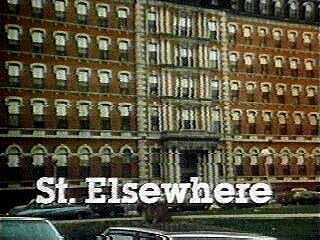
Retro Television Review: St. Elsewhere 3.21 “Murder, She Rote”


Welcome to Retro Television Reviews, a feature where we review some of our favorite and least favorite shows of the past! On Fridays, I will be reviewing St. Elsewhere, a medical show which ran on NBC from 1982 to 1988.  The show can be found on Daily Motion.
This week, we’ve got a great episode of St. Elsewhere.

Episode 3.21 “Murder, She Rote”

(Dir by Mark Tinker, originally aired on February 27th, 1985)

This week, Mrs. Hufnagle dies!

  • After spending the entire season getting on the nerves of the doctors and the nurses, Mrs. Hufnagle died in this episode.  She is found dead and apparently crushed in her bed.  (Hufnagle could never figure out how to properly lower and raise the front and back of it.  In this episode, it appears that she raised both at the same time.)  “Hufnagle in a half-shell,” Ehrlich says.  Meanwhile, the perpetually angry Nurse Lucy (Jennifer Savidge) blames herself for not responding when Hufnagle was desperately pushing her help button.  Gee, Lucy, you think?  Isn’t it your job to respond?
  • Now, I should note that this episode features both Westphall and Craig calling out the doctor for the treatment that Hufnagle received.  Both let it be known that doctors can’t just take care of the likable patients.  Everyone who enters the hospital deserves quality care.
  • What did Hufnagle die of?  That’s what Craig is determined to find out.  His first instinct is to blame Ehrlich.  Then he tried to blame Kochar (former serious regular Kavi Raz, making a guest appearance).  He tries to blame the nurses.  But, in the end, Craig examines his notes from Hufnagle’s heart surgery and he discovers that he’s the one who made a mistake.
  • In a wonderfully acted moment, Craig tells the residents that the mistake was his.  William Daniels does an excellent job of showing that Craig, for all of his arrogance, is not one to shirk responsibility.  When he explains how he made the mistake that led to Hufnagle’s death, it’s a brave moment for both the character and the actor.
  • That said, Craig is lucky Hufnagle didn’t have a family or he would definitely be getting sued.

While Hufnagle died, Shirley Daniels returned to the ER:

  • Given that Shirley has confessed to killing Peter White (even though she hasn’t gone to trial yet), clearing her to work at a hospital seems …. odd.  That said, a psychiatrist says that Shirley is not a threat to others and Auschlander seems to be oddly eager for her to get to work.
  • It doesn’t take long before Shirley pulls a gun on a patient.  She also points the gun at Fiscus and then Morrison.  She pulls the trigger and a little flag pops out that says, “Bang!”
  • It was a joke!  Oh, Shirely!
  • Shirley laughs and then leaves the hospital.

Elliot has a date:

  • Dr. Axelrod goes out on a date with Nurse Rosenthal’s odd daughter, Marcy (Jeannie Elias).
  • Marcy is impressed with Elliot’s goofy sense of humor.
  • Elliot takes her to the same Hawaiian restaurant that Ehrlich took the Craigs.
  • A sudden fire breaks out.  Elliot heroically saves the life of the restaurant’s owner.
  • Marcy explains that she liked Elliot because he seemed goofy and harmless.  Now that he’s a hero, she respects him too much to sleep with him.

This was a great episode!  William Daniels gave his best performance in the role of Dr. Craig so far.  Ellen Bry, in the role of Shirley Daniels, got one of the all-time great exits.  And the underused Stephen Furst got a storyline where he did something more than just get insulted.  I do feel sad for Mrs. Hufnagle, though.  She wasn’t that bad.

Retro Television Review: St. Elsewhere 3.20 “Amazing Face”


Welcome to Retro Television Reviews, a feature where we review some of our favorite and least favorite shows of the past! On Fridays, I will be reviewing St. Elsewhere, a medical show which ran on NBC from 1982 to 1988.  The show can be found on Daily Motion.

The drama continues in Boston.

Episode 3.20 “Amazing Face”

(Dir by Janet Greek, originally aired on February 20th, 1985)

This week, at St. Eligius:

  • Nurse Rosenthal thinks that she’s pregnant.  That sound you hear is me sighing.  Seriously, I liked Nurse Rosenthal during the first season but now I’m kind of sick of her and her sanctimonious attitude, her homewrecking affair with Richard, and her annoying children.  Obviously, the show’s writers really liked Nurse Rosenthal but I’m tired of her.  A pregnant Nurse Rosenthal?  I don’t think I could handle that.  Fortunately, it turns out that Nurse Rosenthal is actually starting menopause.
  • When is Rosenthal going to dump Richard?  We all know it’s going to happen.
  • Dr. Westphall has put his house on the market and boy, is he glum about it.  Westphall continues to be the most depressing human being on the planet.
  • Mrs. Hufnagle has heart surgery.  Before that, however, she steals some scrubs and wanders in on an operation.
  • Fiscus wants to hook back up with Cathy Martin.  When a macho patient makes a misogynistic comment about Cathy, Fiscus throws a punch and gets his ass kicked.  Luckily, Cathy has learned kung fu.
  • The bandages are removed and Andrea Fordham (Ann Hearn) sees her new face.  She now looks like an average teenager.  She tells Dr. Caldwell that she’s still not ready to face the world.
  • Shirley Daniels is a patient at St. Eligius.  She tells everyone who she meets that she killed Peter White and that she can’t wait to go to jail for it.  She promises Doctors Wade and Morrison that she’ll never shoot anyone else.  She also reveals that she’s the one who sent the baby ski mask to Peter’s widow.  She’s knitting a new ski mask for Morrison’s son.  Oh, Shirley!
  • The episode ends with Shirley going to the morgue and flashing back to the time she shot Peter in the testicles.
  • Considering all the hospitals in Boston, was it really a good idea for her to stay at the same one where she happened to kill a doctor, albeit one who deserved exactly what he got?

This episode felt like filler.  Ehrlich acted like a jackass.  Morrison acted like he had the weight of the world on his shoulders.  Dr. Craig was arrogant.  Dr. Westphall was depressed.  It wasn’t a bad episode but there wasn’t anything terribly memorable about it either.

It was just another day at St. Eligius.

Retro Television Review: Thief (dir by William A. Graham)


Welcome to Retro Television Reviews, a feature where we review some of our favorite and least favorite shows of the past!  On Sundays, I will be reviewing the made-for-television movies that used to be a primetime mainstay.  Today’s film is 1971’s Thief!  It  can be viewed on Tubi and YouTube.

Neal Wilkinson (Richard Crenna) would appear to be living a great life.  He has a nice house in the suburbs.  He has a beautiful girlfriend named Jean Melville (Angie Dickinson).  As he heads into middle-age, he is still fit and handsome and charming.  He dresses well, or at least well by the standards of the early 70s.  (By the standards of today, a few of his ties are a bit too wide.)  Everyone believes that Neal has a nice and comfortable job as an insurance agent.

Of course, the truth is far different.

Neal is a veteran con man and a thief.  He’s just recently been released from prison and his deceptively friendly parole officer (played by the great character actor, Michael Lerner) is convinced that Neal will screw up again eventually.  And, of course, Neal has screwed up.  A gambling addict, he is $30,000 in debt.  Can Neal steal enough jewelry from enough suburban homes to pay off his debt?  Can a man like Neal change his ways?

This is a surprisingly somber made-for-TV movie.  Just from the plot description and the film’s first few minutes, you might expect Thief to be a light-hearted caper film in which Neal and Jean work together to pull off one last heist so that Neal can retire.  Instead, Neal spends almost the entire film lying to Jean and there’s hardly a light moment to be found.  Neal says that he wants to retire from his life of crime but, as the film makes clear, that’s a lie that he’s telling himself.  Neal cannot stop stealing and gambling because he’s as much of an addict as the wild-haired junkie (Michael C. Gwynne) who briefly confronts Neal at the parole office.  At one point, Jean tells Neal, “The more I know you, the less I know you,” but the truth of the matter is that Neal is so deep in denial about the futility of his life that he doesn’t even know himself.

It’s not a particularly happy film.  Richard Crenna is ideally cast as Neal, playing him with enough charm that the viewer can buy that he could talk his way out of being caught in a stranger’s backyard but with also with vulnerability that the viewer can see his fate, even if he can’t.  Thief also provides a rare opportunity to see Cameron Mitchell playing a sympathetic role.  Mitchell is cast as Neal’s attorney, who continually tries to get Neal to stop messing up but who ultimately knows that his attempts to reform Neal are just as futile as Neal’s attempts to go straight.

The movie ends on a surprisingly fatalistic note, one that suggests that there’s only one way to truly escape from a life of crime.  I can only imagine how viewers responded in 1971, when they turned on their television and found themselves watching not a light-hearted caper film but instead a bleak examination of criminal ennui.  It’s not a happy film but it is more than worth watching for Richard Crenna’s lead performance.

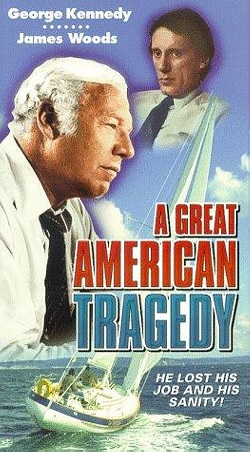
Retro Television Reviews: A Great American Tragedy (dir by J. Lee Thompson)


Welcome to Retro Television Reviews, a feature where we review some of our favorite and least favorite shows of the past!  On Sundays, I will be reviewing the made-for-television movies that used to be a primetime mainstay.  Today’s film is 1972’s A Great American Tragedy!  It  can be viewed on YouTube!

Brad Wilkes (George Kennedy) had a good career, working as an aerospace engineer.  He was able to buy a nice house.  With his wife, Gloria (Vera Miles), he was able to raise a good family.  He was even able to buy a sailboat, one that is the pride of the entire marina.  But then, one day, he’s told that the company is letting him go.

Returning to his home, Brad tells Gloria that he’s lost his job but that everything’s going to be okay because not only does he have a $10,000 pension but he’s sure he can find a new job.  “Of course, I might not be making $35,000 a year….” he says.

(Watching at home, I said, “Pfffft!  I make more than that!”  But, of course, Brad is talking about $35,000 in 1972 money, which would be the equivalent of a quarter of a million today.)

However, Brad soon discovers that getting a new job will not be as easy as he assumed.  It turns out that there are a lot of people out there looking for work and most of them are younger, cheaper, and better educated than Brad.  The bills start to pile up.  His former boss (Robert Mandan) informs Brad that his pension is going to be $7,000 less than he thought.  Brad forces himself to go down to the unemployment office so that he can collect $25 a week and then suffers the humiliation of being offered a loan by his well-meaning son-in-law (played by a youngish James Woods).  Gloria gets a job at the same clothing store where she used to shop and her lecherous boss (Kevin McCarthy) starts to hit on her.

For Brad, the final humiliation comes when he has to sell the boat.  A younger boat owner (Tony Dow, with a huge mustache) puts Brad in contact with a woman named Paula (Natalie Trundy).  Paula wants to buy the boat and, after they take it out on the water, Brad finds himself tempted to cheat on his wife.  It all gets to be too much for Brad and soon, he’s on a plane to Nevada where hopefully one good night at the craps table will be enough to pay his bills….

Watching this film, I found myself feeling very sorry for Brad while, at the same time, becoming very frustrated with him.  On the one hand, his company tossed him out after years of loyal service and then tried to screw him out of his pension.  On the other hand, Brad spent almost the entire movie in denial about how bad things actually were.  It’s one thing to be proud and it’s another to just be stubborn.  Knowing that he has next to no money, Brad still insists on throwing his annual 4th of July party and he even invites his former boss to come over and celebrate.  Brad simply cannot bring himself to admit that his old life is over but really, who can blame him?  He’s not the one who chose to be fired.

A Great American Tragedy was directed by J. Lee Thompson, who also did Cape Fear, The Guns of Navarone, the Planet of the Apes sequels, and several Charles Bronson films.  There are no fight scenes to be found in A Great American Tragedy but Thompson does get good performances from his cast and the film makes great use of George Kennedy’s likability.  The viewer remains sympathetic to Brad, even when he makes mistake after mistake.  A film about a formerly secure family suddenly discovering just how much the economy sucks, A Great American Tragedy remains just as a relevant today as when it was first made.