Film Review: Public Enemies (dir by Michael Mann)


2009’s Public Enemies is a portrait of the battle for the soul and imagination of America.

The films take place during the Great Depression.  With Americans struggling to pay their bills and many citizens out-of-work and feeling desperate, a new breed of folk hero has emerged.  Men like my distant relative Pretty Boy Floyd (Channing Tatum) and Alvin Karpis (Giovanni Ribisi) may be criminals who make their living by robbing banks but, to a nation of angry people who feel like they’ve been forgotten by the government and betrayed by the wealthy, they’re rebels who are challenging the system.  They are viewed as being modern-day Robin Hoods, even though very few of them actually bother to give the money that they steal back to the poor.

John Dillinger (Johnny Depp) is perhaps the most famous of the criminals who have been declared a “public enemy” by the FBI.  The handsome and charismatic Dillinger becomes almost a living legend, the man who cannot be captured by law enforcement.  He becomes a folk hero but with the twist that his own death seems inevitable.  Dillinger lives by his own set of rules and the press loves him even as they hungrily anticipate his violent end.

Pursuing Dillinger and the other so-called public enemies is a young FBI agent named Melvin Purvis (Christian Bale).  Purvis’s job is not only to capture or eliminate men like Dillinger.  It’s also to somehow figure out a way to replace them in the public’s imagination.  Through the use of what was then-considered to be revolutionary techniques (like fingerprinting and phone taps), Purvis tracks down one public enemy after another and soon, he’s becoming as much of a folk hero as the people that he’s pursuing.  If Dillinger and his cohorts represent the ultimate rebellion against an ineffectual system, Purvis and his success suggest that maybe the system actually can get something accomplished.  Unfortunately, for Purvis, he not only has to deal with the challenge of capturing Dillinger but also with the growing jealousy of his publicity-hungry boss, J. Edgar Hoover (Billy Crudup).  As is typical of the heroes of Michael Mann’s film, Dillinger and Purvis may be on different sides of the law but they have more in common than they realize.  Neither one can trust the people that they’re working with.

I remember that I was really excited about Public Enemies when it was first released in 2009.  I’m fascinated by the Depression-era outlaws and Dillinger’s story is certainly an interesting one.  (I’ve always enjoyed the theory that Dillinger faked his death, even though I don’t believe it for a second.)  Michael Mann seemed like the perfect director for the material and Johnny Depp seemed like ideal casting.  I have to admit that I was a little bit disappointed in the film itself, which was poorly paced and stuck so closely to the facts of the case that it led me to realize that Dillinger will always be more interesting as a legend than an actual person.  (I’ll concede that was probably the film’s point.)  There were moments of brilliance in the film.  The scene where Dillinger escaped from custody was wonderfully done.  Stephen Graham’s unhinged performance as Baby Face Nelson was excellent.  Johnny Depp had the right look for Dillinger but I have to admit that I found myself a little bit bored with Christian Bale’s Melvin Purvis.

Looking back today, though, the film feels almost prophetic.  That may seem like an odd thing to say about a film set in the past but Public Enemies portrait of an America caught between celebrating the rule of law and the excitement of rebellion feels very relevant to what’s happening today.  In retrospect, Public Enemies is a portrait of the contradiction at the heart of America, a country with a culture of both rebellion and loyal patriotism.  Public Enemies portrays a battle the continues to this day.
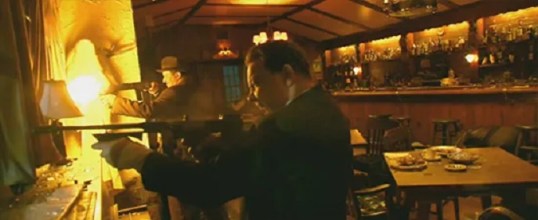
Public Enemies (2009, dir by Michael Mann, DP: Dante Spinotti)

Beverly Hills Cop (1984, directed by Martin Best)


Two years after teaming with Nick Nolte in 48 Hrs., Eddie Murphy returned to the action genre in what remains he best-known action comedy, Beverly Hills Cop.

We all know the story.  Eddie Murphy is Axel Foley, a streetsmart detective in Detroit whose childhood friend, Mickey (James Russo), is murdered because of something that he saw while working as a security guard in Beverly Hills.  Axel plays by his own rules and gets results even as he gives his boss, Inspector Todd (Gil Hill), heartburn.  Todd refuses to allow Foley to investigate Mickey’s death so Axel puts in for some vacation time and catches the first plane to Beverly Hills.

In Beverly Hills, he meets up with another childhood friend, Jenny (Lisa Eilbacher).  Axel thinks that Mickey’s murder was ordered by a shady businessman named Victor Maitland (Steven Berkoff).  The Beverly Hills Police Department orders Axel to leave Maitland alone and to return to Detroit.  Axel won’t go until he gets justice for Mickey.  Lt. Bogomil (Ronny Cox) assigns Taggart (John Ashton) and Rosewood (Judge Reinhold) to follow Axel in Beverly Hills.

Like 48 Hrs., the story is serious but the comedy comes from how the well-drawn characters interact with each other and from seeing how Axel reacts to the strange and wealthy world of Beverly Hills.  Axel has the same reactions that we would have but, because he’s played by Eddie Murphy, he always has the perfect response to everything that he sees, whether it’s dealing with a snooty hotel clerk or with someone like Serge (Bronson Pichot), Jenny’s co-worker who speaks with an unidentifiable accent.  Even more so than in 48 Hrs or Trading Places, Murphy reveals himself to be a natural star here.  One reason why we like Axel is because he’s not just funny but he’s also the type of confident hero that we all wish we could be.  He’s not intimidated by Beverly Hills for a second.

It’s now impossible to picture anyone else in the role of Axel Foley but, when the film’s script was first being shopped around, it was originally offered to Sylvester Stallone, who said the story had potential but was missing something.  He rewrote the script and took out all of the humor, turning it into a grim and serious action film.  (It is rumored that Stallone later turned his version of the script into Cobra.)  Fortunately, Stallone eventually dropped out of Beverly Hills Cop so that he could co-star with Dolly Parton in Rhinestone.  Producers Don Simpson and Jerry Bruckheimer, then at the start of their producing careers, then offered the role to Eddie Murphy, who took Stallone’s script and added back all of the humor.  Murphy also ended up ad-libbing several of the film’s best one-liners, improvising the hotel lobby scene and the meeting with Serge on the spot.

Beverly Hills Cop was a huge success, cementing Murphy’s status as a star and proving that Murphy could carry a movie on his own.  The film still holds up, certainly better than any of the sequels that followed.  Even though Murphy was clearly the main attraction, the movie also gave actors like John Ashton, Judge Reinhold, Ronny Cox, Bronson Pinchot, and even Paul Reiser a chance to shine.  The villainous performances of Steven Berkoff and Jonathan Banks would serve as a model for countless bad guys through the 80s and 90s.  Beverly Hills Cop is a movie that makes you happy that Sylvester Stallone didn’t have a better sense of humor.

The Films of 2024: Horizon: An American Saga: Chapter One (dir by Kevin Costner)


Horizon: An American Saga: Chapter One is the rather unwieldy title of the first part of what Kevin Costner has said will be an epic four-part movie about the settling of the American frontier.

It’s very, very long.

It has a running time of three hours, during which time a lot of characters are introduced and a lot of plotlines are initiated but, because this is the only first chapter, none of them come to a close.  In fact, as the film ends, it’s still a mystery as to how some of the characters are even related.  I watched all three hours and I took my ADD meds this morning so you can be assured that I was actually paying attention.  That said, I still struggled to keep track of who everyone was or even where they were in proximity to each other.  Indeed, it was only towards the end of the film that I realized that several years were supposed to have passed over the course of the first chapter’s running time.

That’s not to say that the film is a disaster.  While it’s not quite the nation-defining epic that Costner obviously envisioned it as being, it’s also not quite the cinematic atrocity that several critics made it out to be.  It’s a throwback of sorts, to the epic westerns of old.  As such, the film features taciturn gunslingers, a woman with a past, dangerous outlaw families, fierce Indian warriors, and a wise Indian chief who has dreamed of the coming of the white man.  The film is full of actors — like Michael Rooker, Sienna Miller, Sam Worthington, Danny Huston, Will Patton, James Russo, Dale Dickey, and Kevin Costner himself — who feel as if they belong to a different era of filmmaking.  Just about everyone in the film is heading to the settlement of Horizon, which sits in Apache territory.  Despite the efforts of the Indians to kill every settler who shows up, they keep coming.  As one army officer explains it, the Indians have made the mistake of thinking that the settlers will come to believe the land is cursed while the settlers, all of whom are full of American optimism, instead chose to believe that the previous settlers were unlucky but that the next wave of settlers will make it work.  Costner has the right visual sensibility for a western.  The film reveals a director who is obviously in love with the Western landscape and the film is at its best when it simply frames the characters against the beauty of the frontier.  But when it comes to actually telling a compelling story, he struggles.  There are a lot of moving parts to the first chapter of Horizon and the problem is not that they don’t automatically connect but instead that Costner never gives us any reason to believe that they’ll ever connect.  There are no visual clues or bits of dialogue to assure the viewer that everything they’re watching is going to eventually pay off.  Costner asks his audience to have faith in him and remember that he directed Open Range and Dances With Wolves while forgetting about The Postman.

The first hour, which features a brutal raid on the settlement by a group of Indians, is the strongest.  It really drives home the brutality of what we now call the old west.  In the style of Michael Cimino’s The Deer Hunter, Costner closely observes the individual customs of the film’s settlers and carefully introduces several appealing characters who leave the viewer feeling as if they’ve met a very special and very unique community of people.  That makes it all the more devastating when the majority of those characters are subsequently wiped out with casual cruelty in a raid led by the Indian warrior Pionsenay (Owen Crow Shoe).  (Later — much later — a tracker played by Jeff Fahey will show similar brutality while wiping out a group of Apaches.)  The first hour establishes the frontier as being beautiful but also dangerous and it also drives home the mix of determination, desperation, and even madness that led so many to follow Horace Greeley’s advice and “Go west!”  Though the film was shot in early 2023, the brutality of the raid brought to mind the terrible images of the October 7th attacks on Israel.  The subsequent scenes in which Pionesenay and his followers ridiculed those in the tribe who wanted peace mirrored the current schism that’s driving apart the worldwide Left.  The U.S. Army, for their part, arrives a day late and can only offer up not-so subtle condescension.  The surviving settlers, however, remain determined to make a home for themselves.

The second hour focuses on Hayes (played by Costner), who rides into a mining town and gets involved with a family of outlaws who are looking for the woman who shot their father.  The second hour is a bit more of a traditional western than the first hour, though some of the violence is still shockingly brutal.  (Even being comedic relief won’t save you in this film.)  Abbey Lee gives a good performance as the woman with a past and a baby and Kevin Costner is  …. well, he’s Costner.  He could play this type of role in his sleep.

The third hour is a mess, introducing a wagon train and featuring a miscast Luke Wilson as the leader of the settlers and Jeff Fahey giving a strong performance as a ruthless tracker.  The third hour meandered as a whole new set of characters were introduced and I was left to wonder why the film needed new characters when the characters from the first two hours were perfectly adequate.  It was during the third hour that I started to really get impatient with the film and its leisurely approach to storytelling.

The film ends with a montage of what we can expect from the next few chapters of Horizon and I will say that the montage actually looked pretty cool.  That’s because the montage was almost totally made up of action scenes, with none of the padding that caused Chapter One to last an unwieldy three hours despite only having 90 minutes worth of story.  Still, one has to wonder if we’ll actually get to see the next three chapters.  The first chapter bombed at the box office and didn’t exactly excite critics.  Costner is producing and financing the films himself and I doubt he’ll give up on them.  The Horizon saga will be completed but will it made it to theaters or will it just end up on streaming?  Personally, I think the whole thing would work best as a miniseries but who knows?  (If Horizon was airing on Paramount, it would probably be a Yellowstone-style hit.)  All I really do know is that Chapter Two has yet to be released.  And that’s a shame because, for all of Chapter One‘s flaws, I’d still like to see how the story turns out.

Mini Late Night Retro Television Review: Friday the 13th: The Series 2.5 “Symphony in B Sharp”


Welcome to Late Night Retro Television Reviews, a new feature where we review some of our favorite and least favorite shows of the past! On Fridays, I will be reviewing Friday the 13th: The Series, a show which ran in syndication from 1987 to 1990. The show can be found on YouTube!

Hi, everyone!  I sprained my wrist yesterday and today, it still hurts to type so, just as with T and T, today’s review is going to be a quick one.  You might even call it a mini-review!

Episode 2.5 “Symphony In B Sharp”

(Dir by Francis Delia, originally aired on October 31st, 1988)

Oh, Ryan!

You would think that, by this point, Ryan would know better than to fall in love with anyone, seeing as how he had to leave one girlfriend behind in a Mennonite village and he lost another girlfriend to an insane news anchorman.  Add to that, Ryan has also seen Micki repeatedly lose the people with which she has fallen in love.  But, once again, the episode finds Ryan falling in love.

This time, his lover is Leslie Reins (Ely Pouget), who plays violin in the local symphony.  Her former boyfriend, Janos Korda (James Russo), was believed to have been killed in a car accident but instead, he’s alive but terribly scarred.  He hangs out in the rafters and the basement of the symphony hall and kills anyone who get too close to Leslie.  He has a cursed violin that is slowly healing his disfigured appearance in return for Janos using a sharpened bow to kill people.  Janos’s newest target is Ryan.

Yep, it’s Phantom of the Opera all over again, with Leslie Reins’s last name deliberately invoking the name of a past actor who played the Phantom, Claude Rains.  It’s not a bad episode.  There’s plenty of atmosphere and James Russo makes for a good villain.  That said, the cursed antique is not that interesting and the whole episode leans a bit too much into the Phantom of the Opera story.  It was a bit predictable, right down Janos accidentally killing Leslie before taking his own life and Ryan ending yet another episode in tears, with a concerned Jack and Micki watching from a distance.  Ryan listens to a recording of Leslie playing her violin and swears that he’ll never fall in love again.  We know that’s not true, Ryan.  I guess we should be glad that Ryan is no longer looking to hook up with his cousin but still, it’s hard to feel that the guy just can’t get a break!

Next week, hopefully, things will look up for Ryan.  (It would seem that they certainly couldn’t get any worse.)  We’ll find out soon enough.

Retro Television Reviews: Miami Vice 2.1 and 2.2 “The Prodigal Son”


Welcome to Retro Television Reviews, a feature where we review some of our favorite and least favorite shows of the past!  On Mondays, I will be reviewing Miami Vice, which ran on NBC from 1984 to 1989.  The entire show is currently streaming on Tubi!

This week, the second season with a two-hour long premiere!  Crockett and Tubbs are going to New York!

Episode 2.1 and 2.2 “The Prodigal Son”

(Dir by Paul Michael Glaser, originally aired on September 27th, 1985)

The second season premiere of Miami Vice opens with a series of set pieces.

In Panama, Crockett and Tubbs visit a secret military base in the jungle and are disgusted to learn how the Panamanian military gets information about drug smugglers.  Tubbs and Crockett find one horribly tortured man in a tent.  Tubbs gives him a drink of water and gets what information he can from the man.  Crockett and Tubbs leave the tent.  A gunshot rings out as the involuntary informant is executed.  When the shot rings out, both Crockett and Tubbs turn back to the tent in slow motion, stunned by the brutality of their allies in the Drug War.  Indeed, it’s hard not to compare the scene to the famous photograph of a South Vietnamese general executing a communist during the Vietnam War.

The Vietnam analogy continues with the next scene.  In the Everglades, Crockett, Tubbs, and the entire Vice Squad work with the DEA to ambush the Revilla cousins as they bring drugs into the U.S.  Sitting in the swamp, Crockett compares the experience to Vietnam, suggesting that the war on the drugs is just as futile and as costly.  And indeed, it’s hard not to notice that every drug dealer that Crockett and Tubbs has taken down over the course of this show has immediately been replaced by another.  The Revillas are just another in a long line of people getting rich off of other people’s addictions.

After the bust goes down, Crockett and Tubbs arrives at a celebratory party, just to discover that almost of all of the undercover DEA agents have been murdered and Gina has been seriously wounded.  There is something very haunting about this scene, with Crockett and Tubbs rushing through a penthouse and seeing a dead body in almost every room.

At a meeting in a stark office, the head DEA agent explains that his agency has been compromised and all of his undercover agents have been unmasked.  Someone has to go to New York and work undercover to take down the Revillas but it can’t be any of his people.  Since the Revillas are smuggling their stuff in through Miami, Miami Vice has jurisdiction.  Paging Crockett and Tubbs!

Working undercover as Burnett and Cooper, Crockett and Tubbs visit a low-level drug dealer (played by Gene Simmons) who lives on a yacht and who gives them the name of a connection in New York City.

From there, Miami Vice moves to New York City, where Crockett and Tubbs meet a low-level criminal named Jimmy Borges (played by an almost impossibly young Penn Jillette) and they try to infiltrate the Revilla organization.  Along the way, Tubbs meets up with Valerie (Pam Grier) and discovers that she has apparently lost herself working undercover.  Meanwhile, Crockett has a brief — and kind of weird — romance with a photographer named Margaret (Susan Hess).

(“I like guns,” she says when Crockett demands to know why she stole his.)

With Crockett and Tubbs leaving Miami for New York in order to get revenge for a colleague who was wounded during an operation, The Prodigal Son almost feels like the pilot in reverse.  Also, much like the pilot, the exact details of The Prodigal Son‘s story are often less important than how the story is told.  This episode is full of moody shots of our heroes walking through New York while songs like You Belong To The City play on the soundtrack.  (There’s also a song from Phil Collins, undoubtedly included to bring back memories of the In The Air Tonight scene from the pilot.)  It’s all very entertaining to watch, even if the story itself doesn’t always make total sense.  Indeed, you really do have to wonder how all of these criminals keep falling for Sonny’s undercover identity as Sonny Burnett.  You would think that someone would eventually notice that anyone who buys from Sonny Burnett seems to get busted the very next day.

Stylish as the storytelling may be, this episode actually does have something on its mind.  Those lines comparing the War on Drugs to the Vietnam Conflict was not just throwaways.  Towards the end of the episode, Crockett and Tubbs follow a lead to the offices of J.J. Johnston (Julian Beck, the ghost preacher from Poltergeist II).  The skeletal Johnston is an investor of some sort.  He has no problem admitting that he’s involved in the drug trade, presumably because he knows that there’s nothing Crockett and Tubbs can do to touch him.  Upon meeting the two cops, he immediately tells them exactly how much money they have in their checking accounts.  He points out that they’re poor and they’re fighting a losing war whereas he’s rich and he’s making money off of a losing war.  Beck gives a wonderfully smug performance as Johnston and it should be noted that, of all of the episode’s villains, he’s the only one who is not brought to any sort of justice.  Val almost loses herself.  Tubbs and Crockett don’t even get a thank you for their hard work.  The somewhat sympathetic Jimmy Borges ends up dead while the Revillas were undoubtedly been replaced by even more viscous dealers.  Meanwhile, J.J. Johnston relaxes in his office and counts his money.  This is the No Country For Old Men of Miami Vice episodes.

This episode is also full of familiar faces.  Charles S. Dutton, Kevin Anderson, Anthony Heald, Miguel Pinero, James Russo, Bill Smtirovich, Zoe Tamerlis, Paul Calderon, and Louis Guzman, they all show up in small roles and add to show’s rather surreal atmosphere.  This is Miami Vice at its most dream-like, full of people you think you might know despite the fact that they’re doing things of which you don’t want to be a part.

As for the title, The Prodigal Son is Tubbs and he is tempted to stay in New York City.  But, in the end, he joins Crockett on that flight back to Miami.  It’s his home.

The Films of Dario Argento: Trauma


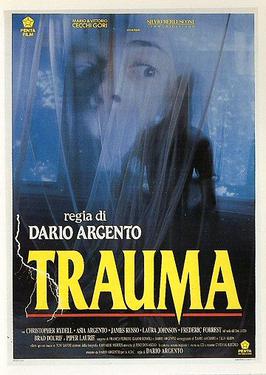
In 1993’s Trauma, Dario Argento tells a story of giallo horror, complete with a killer who wears black gloves, a camera that stalks through the streets of a rainy city, and plenty of eccentric red herrings.  The story is set and was filmed in Minneapolis, Minnesota, making this one of the two Argento films to be completely shot in America.

Trauma was also the first of Argento’s films to star his daughter Asia Argento.  Asia, who was 16 at the time of filming, plays Aura Petrescu, the daughter of Adriana (Piper Laurie) and Stefan (Dominique Serrand).  Aura is a bulimic drug addict, with track marks up and down her arms.  Having recently escaped from a mental hospital run by the eccentric Dr. Judd (Frederic Forrest), Aura is preparing to jump off a bridge and end her life when she’s grabbed by David (Christopher Rydell).  David works as a headline writer and an artist for a local TV news station.  David is also a recovering addict who takes sympathy on Aura and buys her breakfast.  Aura thanks David by stealing his wallet and running out of the restaurant.

After being  caught by the police, Aura is then returned to her home, a baroque mansion where Adriana works as a fake psychic.  When Aura arrives, Adriana is preparing for a séance.  She’s been hired to contact the spirit of a victim of The Head Hunter, a serial killer who has been chopping off people’s heads in Minneapolis.  As a storm rages outside, Aura again flees from the house.  Stefan and Adriana chase after her.  Soon, while a terrified Aura screams in the rain (in a scene that will remind some of Asia’s mother, Daria Nicolodi, freaking out at the end of Tenebrae), the Head Hunter is holding up what appeas to be the heads of her parents.

Terrified for her life, Aura goes through David’s wallet, finds his number, and calls him.  After setting Aura up at his house, David investigates who is chasing her and how those people are connected to The Head Hunter.  David also falls in love with Aura and Aura falls for him.  Unfortunately, as so often happens in the films of Dario Argento, the world is full of people who don’t care how in love two people are.  The people who are after Aura are determined to get her and if that pushes David back into the world of drug abuse, so be it.

Trauma is middle-of-the-road Argento, featuring some scenes that are touched with genius and other scenes that just feel a bit bland.  The cast is an interesting mix of veteran performers like Piper Laurie, Frederic Forrest, and Brad Dourif and younger actors like Christopher Rydell and Asia Argento.  Dario Argento is known for being a director who prefers for his actors to come in, hit their marks, and deliver their lines with a minimum amount of fuss and he’s complained about American method actors (like Tenebrae’s Anthony Franciosa, with whom Argento had a notoriously difficult relationship) who want to discuss every little detail of their character and their performance.  One can only imagine how he handled working with actors as outspoken and creative as Laurie, Forrest, and Dourif.  It must be said that those three actors all give memorable performances but none of them seem to be acting in the same film as Rydell and Asia Argento.  Rydell and Asia give rather earnest and straight-forward performances while Laurie, Forrest, and Dourif are all a bit more eccentric in the way they interpret their characters.  Piper Laurie, in particular, rejects subtlety and delivers her lines with all of the melodramatic force she can summon.  (It should be said that this is absolutely the right approach for the character that she’s playing.)  That said, it’s Fredric Forrest who truly seems to be on a different planet from everyone else, giving a performance that can only be described as weird.  Again, much as with Laurie’s self-aware melodrama, Forrest’s approach works well enough for his odd character, who I assume was named for the Dr. Judd who appears in Cat People.

The most controversial aspect of the film was the casting of Asia Argento as Aura, with some complaining of nepotism and others accusing Dario of exploiting his own daughter.  Personally, I think Asia does a perfectly acceptable job in the lead role, even if it’s obvious that she still had room to develop as an actress.  At the time the film was made, Asia was herself bulimic and the film’s most powerful scenes are the ones dealing with Aura’s own fragile sense of self-worth.  Along with being hunted by a serial killer and having lost her entire entire family, Aura is also an outsider in America.  The film paints a portrait of a society that doesn’t care about those living on the fringes.  The only person that Aura has to look out for her is David, himself a former resident of the fringe.  Christopher Rydell gives a good performance of David, playing him as someone who is trying to do the right thing and protect the victimized, even at the risk of his own sobriety.

(That said, there is one scene in which David receives a panicked phone call from Aura and Rydell’s underreaction suggests that the actor was not informed of just how desperate Asia Argento would sound when she later dubbed in her part of the conversation.)

Argento’s camera glides down dark hallways and through the streets of the city.  He films Minneapolis in the same way that many directors would film New Orleans and, as such, the film becomes a vision of Middle America through European eyes.  Because there’s a few issues with pacing and some clunky dialogue that was probably due to the Italian script being translated into English, Trauma is not Argento’s best.  It’s middle-of-the-road Argento but it remains intriguing, nonetheless.

The (Reviewed) Films of Dario Argento:

  1. The Bird With The Crystal Plumage
  2. Cat O’Nine Tales
  3. Four Flies on Grey Velvet
  4. Deep Red
  5. Suspiria
  6. Inferno
  7. Tenebrae
  8. Phenomena
  9. Opera
  10. Two Evil Eyes

Film Review: Extremities (dir by Robert M. Young)


The 1986 film, Extremities, begins with a woman named Marjorie (Farrah Fawcett) getting into her car and getting attacked by a masked rapist named Joe (James Russo).  Though Marjorie manages to escape, Joe grabs her purse.  Later, we watch as Marjorie gets no help from the police while Joe goes home to his loving family.

One week later, Marjorie is alone at her house when Joe lets himself inside.  At first, Joe pretends that he just needs to use the phone.  When Marjorie lies that her husband is taking a nap upstairs, Joe starts to call for him to come downstairs.  As Joe reveals, he’s been stalking Marjorie for days.  He knows that she’s not married and he knows that her roommates will not be home for a few hours.

However, what Joe doesn’t know is that Marjorie has a can of bug spray and, as soon as Joe lets his guard down, she sprays it in his eyes and his mouth.  When the stunned and temporarily blinded Joe stumbles back, Marjorie pushes him into the fireplace and ties him up.  Realizing that he may have ingested toxic chemicals, Joe begs to be released but Marjorie has other plans….

And I was all for it!  I was really looking forward to watching Marjorie torment her attacker.  Unfortunately, Marjorie’s two roommate show up before Marjorie can really get started.  Terry (Diana Scarwid) is shocked when Marjorie explains that she’s planning on burying Joe alive but, as a rape survivor, Terry also knows that, even after all of this, the police will still not be of any help.  Meanwhile, Pat (Alfre Woodard) is a social worker, which means that she has to be the tedious voice of moderation.  She’s the one who says that they can’t kill Joe and that Joe might not even actually be the man who attacked Marjorie….

And that, right there, is one of the main problems with Extremities.  We spend a lot of time listening to Pat argue that it’s not right to torture anyone and that Marjorie might be mistaken and maybe Joe really was just some innocent guy who needed to use the phone.  However, we know that Marjorie’s right, Pat’s wrong, and Joe’s the attack.  As a result, it’s impossible not to get annoyed when Pat keeps going on and on.  We know exactly who Joe is and what we want is to see Marjorie get both justice and her revenge.  We want to see Joe suffer.  What we don’t want to do is spend 30 minutes listening to two thinly drawn characters debate the ethics of what Marjorie’s doing.  Perhaps if the film had begun with Pat and Terry coming home and discovering Joe already trapped in the fireplace, Pat’s concerns would have carried more weight.  There would have been a hint of ambiguity and we’d have to decide if we believed the word of the obviously traumatized Marjorie or the obviously desperate Joe.   But we already know that Marjorie’s right about who Joe is so who cares what Pat thinks?

If you didn’t already know that Extremities was based on a stage play, you’d be able to guess it after watching the movie.  With the exception of the film’s opening scenes, Extremities plays out in one location and, as a result, the film feels very stage-bound.  While the late Farrash Fawcett gives a brave and emotionally raw performance as Marjorie, Alfre Woodard, Diana Scarwid, and James Russo all give overly mannered performances that add to the film’s staginess.

In both its visual aesthetic and its cultural outlook, Extremities is very much a film of its time.  With the exception of Fawcett’s harrowing performance, Extremities feels like a relic of the past.  If the film were made today, there’d be no question that Joe would end up dying in that fireplace.  The only suspense would  be rather Pat or Terry would be the one to dig the grave.

http://www.youtube.com/watch?v=trhDAL-3V78

Insomnia File #35: Donnie Brasco (dir by Mike Newell)


What’s an Insomnia File? You know how some times you just can’t get any sleep and, at about three in the morning, you’ll find yourself watching whatever you can find on cable? This feature is all about those insomnia-inspired discoveries!

Last night, if you happened to be awake at 2:30 in the morning, you could have turned over to Starz and watched the 1997 film, Donnie Brasco.

Benjamin “Lefty” Ruggiero (Al Pacino) has spent his entire life as a loyal Mafia soldier.  It’s the only life that he knows and he can tell you some stories.  He remembers the early days, back when men like Lucky Luciano, Frank Costello, and Meyer Lansky were in charge of things.  Lefty is proud to say that, over the years, he’s successfully carried out over 20 hits.  Lefty is lucky enough to be an associate of an up-and-comer nicknamed Sonny Black (Michael Madsen).  While Sonny was in prison, Lefty kept an eye on Sonny’s family.  Lefty feels that Sonny owes him.  Whether Sonny feels the same way isn’t always quite clear.

Lefty’s problem is that everyone loves him but few people respect him.  The aging Lefty is viewed as being a relic and, at most, they merely tolerate his constant bragging.  Lefty may fantasize about the big bosses knowing who he is but, when he tries to greet one of them at a party, it becomes clear that he doesn’t have the slightest idea who Lefty is.  Lefty spends his time worrying that he’s dying and dreaming of one last opportunity to make a name for himself.

In fact, perhaps the only really good thing that Lefty has going for him is his friendship with Donnie Brasco (Johnny Depp).  Donnie is a jewel thief, a tough and volatile orphan who Lefty introduces to Sonny.  Sonny is immediately impressed with Donnie.  In fact, Sonny thinks so highly of Donnie that he assigns Donnie to look over his operations in Florida.  Lefty can only watch as his protegé’s star starts to eclipse his own.  But that’s not necessarily a bad thing.  As Lefty explains it, Donnie’s success is also Lefty’s success because Lefty is the one who brought Donnie into the crew.  Of course, if Donnie ever fails, the failure will be on Lefty as well.

As for Donnie … well, his name isn’t actually Donnie.  His real name is Joe Pistone and he’s a FBI agent.  When he first agreed to work undercover, he was told that the assignment would only last for a few months.  Instead, the months turn into years and, piece by piece, Joe vanishes as he transforms into Donnie.  The formerly soft-spoken college graduate is soon beating up waiters and chopping up bodies in basements.  His wife (Anne Heche) fears that her husband may no longer exist.  “I  am not becoming like them,” Joe/Donnie says at one point, “I am them.”

Donnie Brasco is hardly the first film to examine life in the Mafia.  It’s not even the first movie about an undercover FBI agent who manages to worm his way into the mob’s hierarchy.  What sets Donnie Brasco apart are the performances of Pacino, Depp, Heche, Madsen, and, as a talkative mob associate, Bruno Kirby.  As played by Pacino, Lefty may be a hardened killer but he’s also just a working class guy who wishes that his boss would just show him a little appreciation.  Lefty may be capable of casually shooting a guy in the back of the head but, at the same time, there’s something heartbreakingly sad about the sight of him tearing up a greeting card that he hoped to personally deliver to the big boss.  As for Johnny Depp, he gives a surprisingly restrained performance, rarely raising his voice except when he’s yelling at his family.  Donnie may appear outwardly calm but the stress of losing his identity is always present in his eyes.

Interestingly, for a mob movie, there’s little violence to be found in Donnie Brasco.  It’s not until 90 minutes in that we get the expected scene of rival mobsters getting ambushed and gunned down.  Donnie Brasco isn’t about violence.  Instead, the film’s heart is to be found in the  story of Lefty and Donnie’s odd friendship.  Instead of being about who is going to kill who, this film is about Lefty’s desire to be something more than he is and Joe’s struggle to remember who he used to be before he became Donnie.  It’s a touching and effective gangster film and one to keep an eye out for.

Previous Insomnia Files:

  1. Story of Mankind
  2. Stag
  3. Love Is A Gun
  4. Nina Takes A Lover
  5. Black Ice
  6. Frogs For Snakes
  7. Fair Game
  8. From The Hip
  9. Born Killers
  10. Eye For An Eye
  11. Summer Catch
  12. Beyond the Law
  13. Spring Broke
  14. Promise
  15. George Wallace
  16. Kill The Messenger
  17. The Suburbans
  18. Only The Strong
  19. Great Expectations
  20. Casual Sex?
  21. Truth
  22. Insomina
  23. Death Do Us Part
  24. A Star is Born
  25. The Winning Season
  26. Rabbit Run
  27. Remember My Name
  28. The Arrangement
  29. Day of the Animals
  30. Still of The Night
  31. Arsenal
  32. Smooth Talk
  33. The Comedian
  34. The Minus Man

A Movie A Day #336: The Bronx Bull (2017, directed by Martin Guigui)


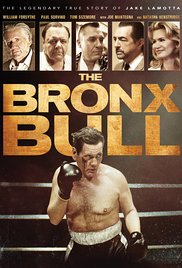
New York in the 1930s.  Jake LaMotta (Morean Aria) is a tough street kid who is pushed into fighting by his abusive father (Paul Sorvino) and who is taught how to box by a sympathetic priest (Ray Wise).  When Jake finally escapes from his Hellish home life, it is so he can pursue a career as a professional boxer.  Ironically, the same violent nature that nearly destroyed him as a youth will now be the key to his future success.
In the late 60s, a middle-aged Jake LaMotta (William Forsythe) testifies before a government panel that is investigating that influence of the Mafia in professional boxing.  LaMotta testifies that, during his professional career, he did take a dive in one of his most famous matches.  LaMotta goes on to pursue an entertainment career which, despite starring in Cauliflower Ears with Jane Russell, never amounts too much.  He drinks too much, fights too much, and gets into arguments with a ghost (Robert Davi).  He also gets married several times, to women played by everyone from Penelope Ann Miller to Alicia Witt.  The movie ends with Jake happily walking down a snowy street and a title card announcing that Jake is now 95 years old and married to his seventh wife.  (The real Jake LaMotta died on September, 9 months after the release of The Bronx Bull.)

The Bronx Bull is a largely pointless movie about the later life of the antisocial boxer who was previously immortalized in Martin Scorsese’s Raging Bull.  In fact, The Bronx Bull was originally announced and went into production as Raging Bull II.  Then the producers of the original Raging Bull found out, filed a lawsuit, and the film became The Bronx Bull.  Because of the lawsuit, The Bronx Bull could cover every aspect of Jake’s life, except for what was already covered in Raging Bull.  In fact, Scorsese’s film (which undoubtedly had a huge impact on LaMotta’s later life) is not even mentioned in The Bronx Bull.

William Forsythe does what he can with the role but, for the most part, Jake just seems to be a lout with anger issues.  With a cast that includes everyone from Tom Sizemore to Cloris Leachman to Bruce Davison, the movie is full of familiar faces but none of them get too much of a chance to make an impression.  Joe Mantegna comes the closest, playing Jake’s best friend.  The Bronx Bull was not only shot on the cheap but it looks even cheaper, with studio backlots unconvincingly filling in for 1930s Bronx.  The film’s director, Martin Guigui, occasionally tries to throw in a Scorsesesque camera movement and there are a few black-and-white flashbacks but, for the most part, this is the mockbuster version of Raging Bull.

Film Review: Black Mass (dir by Scott Cooper)


Black_Mass_(film)_poster

You know how sometimes you watch a movie and you’re happy because you know it’s a good movie but, at the same time, you end up feeling slightly disappointed because, as good as it may be, it never quite becomes the great movie that you were hoping for?

That was kind of my reaction to Black Mass.

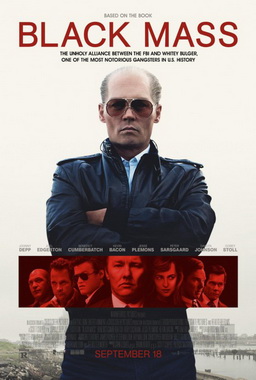
Black Mass tells the true story of James “Whitey” Bulger, the gangster who controlled the Boston underworld from the late 70s to the mid-90s.  Bulger was both famous and feared for his ruthless brutality and his willingness to murder just about anyone.  Bulger was also famous for being the brother of Billy Bulger, a powerful Democratic politician.  When it appeared that Whitey was finally on the verge of being indicted, he vanished into thin air and, for 2 decades, remained missing until he was finally captured in Florida.  Whitey Bulger is now serving two life sentences.

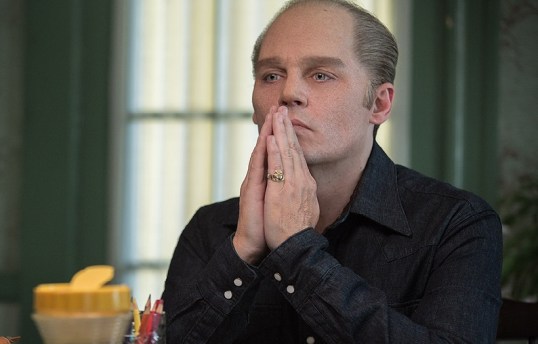
Black Mass is a solid gangster film.  We watch as Whitey (Johnny Depp) takes over Boston and essentially murders anyone who gets on his nerves.  Helping Whitey out is a local FBI Agent, John Connolly (Joel Edgerton), who grew up in South Boston with the Bulger brothers.  While Connolly originally only appears to be using Whitey as an informant to help take down the Italian mob, it quickly becomes obvious that Connolly envies the power and influence of both Whitey and Billy (played by Benedict Cumberbatch).  Soon, Connolly has become something of a Bulger groupie and is protecting Whitey from prosecution and even leaking him the names of anyone who attempts to inform on Bulger’s crime.

Indeed, the film’s best scenes are the ones in which it is shown how the FBI’s determination to take down the Mafia allowed the far more violent Bulger to move into their place.  Bulger was a criminal who worked for and was protected by the U.S. government and, as such, his story serves as a metaphor for a lot of what is currently messed up about America.  While I appreciated the time that Black Mass devoted to exploring Whitey’s relationship with the FBI, I do wish it had spent more time exploring his relationship with his brother, Billy.  The film places most of the blame for Whitey’s reign of terror on the FBI but it defies common sense not to assume that Whitey was also protected by his well-connected, politically powerful brother.

Black Mass contains all of the usual gangster film tropes.  There are sudden and violent executions.  There are drug addicted criminals who turn out to be less than trustworthy.  (Poor Peter Sarsgaard.)  There’s the usual talk of honor and respect.  Beefy men with pockmarked faces stand in the shadows and shout random insults at each other until someone finally snaps.  And, of course, we get the countless scenes where Bulger’s demeanor goes from friendly to threatening and we’re left wondering if he’s going to smile or if he’s going to kill someone.  It may all be a little bit familiar but director Scott Cooper handles it all well and keeps things watchable.

In this 122-minute film, there are exactly two scenes in which Whitey is in any way sympathetic.  In one scene, he breaks down after the death of his son and, in the other, he deals with the death of his mother.  These are the only two scenes in which Whitey shows any hint of humanity.  Otherwise, Bulger is presented as being almost pure evil.  He’s no Michael Corleone, trying to go straight and making excuses for the family business.  Nor does he possess the enjoyable flamboyance of Scareface‘s Tony Montana or The Departed‘s Frank Costello.  Instead, he’s a pure sociopath and  the film’s most effective shots are the ones that focus on Whitey’s expressionless gaze.  They say that the eyes are the windows to the soul and one only has to look into Bulger’s to see that they are windows without a view.

johnny-depp-2

Johnny Depp deserves all the credit in the world for making Whitey into a compelling character.  Wisely, Depp underplays Whitey’s most threatening scenes.  He rarely raises his voice and the only time he loses control of his emotions is when he’s confronted with something — like the death of his son — that even he can’t change.  Otherwise, Depp plays Whitey as always being in control.  (It’s mentioned, at one point, that Whitey was the subject of 50 LSD experiments while serving time in prison and Depp plays Whitey as if he’s always staring at something that nobody else can see.)  It’s his confidence that makes Whitey Bulger an interesting character.  You may not like him but you can’t look away because you know that he’s literally capable of anything.  Ever since the trailer for Black Mass was first released, Depp has been at the center of awards speculation.  Having seen the film, I can say that the Oscar talk is more than deserved.  He’s even better than people like me thought he would be.

Depp is so good that he overshadows the rest of the cast.  There’s a lot of good actors in this film, including Kevin Bacon, James Russo, Peter Sarsgaard, Corey Stoll, Jesse Plemons, and Rory Cochrane.  But few of them get as much of a chance to make an impression as Johnny Depp.  Much as Whitey dominated Boston, Depp dominates this film.  Joel Edgerton has several great moments as the not-as-smart-as-he-thinks-he-is Connolly but even he is thoroughly overshadowed by Depp’s performance.  (That said, I did appreciate the fact that Edgerton’s too-eager-to-please Connolly came across like he might be a cousin to The Gift‘s Gordo the Weirdo.)

As I said at the beginning of this review, Black Mass is good but it was never quite as great as I was hoping it would be.  There’s a few too many scenes where you get the feeling that Scott Cooper woke up the day of shooting and said, “Let’s Scorsese the shit out of this scene.”  As a result, Black Mass sometimes struggles to escape from the shadow cast by Goodfellas, Casino, The Departed, American Gangster, and the countless other mob films that have been released over the past few decades.  Black Mass is well-made and will forever be remembered for Johnny Depp’s amazing lead performance but it never quite reaches the status of a classic.

Finally, on a personal note, I did enjoy the fact that Black Mass dealt with the Irish mob.  I’m a little bit torn in my loyalties because I’m Irish-Italian but, if I ever had to pick a mob to which to serve as a cheerleader, I would go Irish Mafia all the way!

Sláinte!

bm