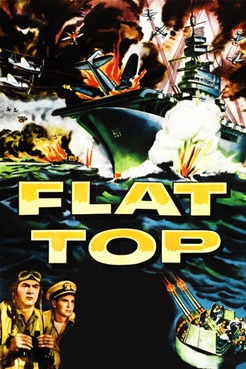
 During the Korean War, Navy Commander Dan Collier (Sterling Hayden) reminisces about World War II. In 1944, he was newly assigned to the USS Princeton and dealing with a collection of hotshot pilots who had no idea about the realities of war. His executive officer, Joe Rogers (Richard Carlson), was everyone’s friend. Collier, however, had to be their commander. At first, everyone in that ship resented Collier and his emphasis on discipline. But eventually, the men came to learn that war wasn’t a game.
There’s little about the plot of Flat Top that will take anyone by surprise. Of course, the stern and by-the-book Dan Collier is proven to be correct when it comes to the proper way to fight a war. This film was made during the Korean War so there was no way it was going to suggest that the Navy could be incorrect about anything. The film was produced by tiny Monogram Pictures, who actually found enough money to film in Cinecolor. Monogram also got permission to shoot on an actual carrier, which brought some authenticity to the proceedings. The film makes heavy use of stock footage. A lot of the footage will be familiar from the countless number of World War II documentaries that have been put together over the years but it’s still seamlessly combined with the footage of the actors sitting in the cockpits of their planes. It’s probably not a coincidence that the movie features the characters fighting in support of Douglas MacArthur’s return to the Philippines. When this film went into production, Truman had just ended his hopes for reelection by removing MacArthur from command in Korea.
The cast is uniformly good and it’s full of familiar faces. William Schallert, Todd Karnes, James Best, and Phyllis Coates all appear in supporting roles. Sterling Hayden is believably gruff and no-nonsense as Dan Collier. Thanks to them and the actual combat footage, Flat Top is watchable albeit predictable.