Have you ever woken up and thought to yourself, “I’d love to see a movie where a youngish Jack Nicholson played a French soldier who, while searching for a mysterious woman, comes across a castle that’s inhabited by both Dick Miller and Boris Karloff?”
Of course you have! Who hasn’t?
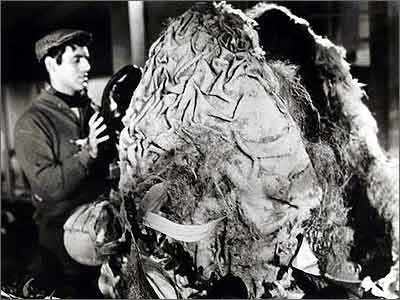
Well, fortunately, it’s YouTube to the rescue. In Roger Corman’s 1963 film The Terror, Jack Nicholson is the least believable 19th century French soldier ever. However, it’s still interesting to watch him before he became a cinematic icon. (Judging from his performance here and in Cry Baby Killer, Jack was not a natural-born actor.) Boris Karloff is, as usual, great and familiar Corman actor Dick Miller gets a much larger role than usual. Pay attention to the actress playing the mysterious woman. That’s Sandra Knight who, at the time of filming, was married to Jack Nicholson.
Reportedly, The Terror was one of those films that Corman made because he still had the sets from his much more acclaimed film version of The Raven. The script was never finished, the story was made up as filming moved alone, and no less than five directors shot different parts of this 81 minute movie. Among the directors: Roger Corman, Jack Hill, Monte Hellman, Francis Ford Coppola, and even Jack Nicholson himself! Perhaps not surprisingly, the final film is a total mess but it does have some historical value.
(In typical Corman fashion, scenes from The Terror were later used in the 1968 film, Targets.)
I record a LOT of movies. Probably around ten per week, more or less. And since I also have to do little things like work, exercise, cook, clean, breathe, etc etc, I don’t always have time to watch them all (never mind write full reviews), so I’ve decided to begin a series of short, capsule reviews for the decades covered here at Cracked Rear Viewer. This will be whenever I find my DVR getting cluttered, which is frequent! I’ll try to make CLEANING OUT THE DVR a bi-weekly series, but there are no guarantees. Monthly is more realistic. Anyway, here are five films from the 1930s to the 1970s for your reading pleasure.
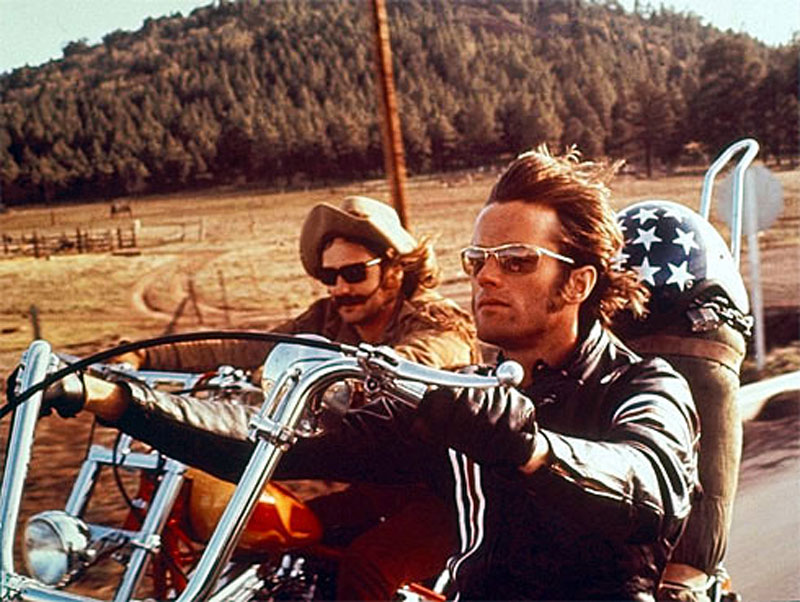
1969 was a watershed year for both America and the movies. While the war in Viet Nam dragged on and turmoil raged at home, movie audiences watched as two generations of Fondas appeared in movies about the American dream. In Sergio Leone’s Once Upon A Time In The West, Henry Fonda played Frank, a gunslinger so ruthless that he shoots a child during his first scene. In They Shoot Horses, Don’t They?, daughter Jane Fonda played a woman struggling to survive the Great Depression. And, in Easy Rider, Peter Fonda played Captain America.
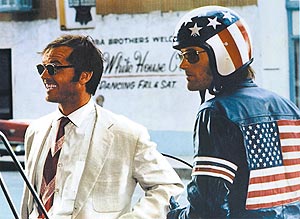
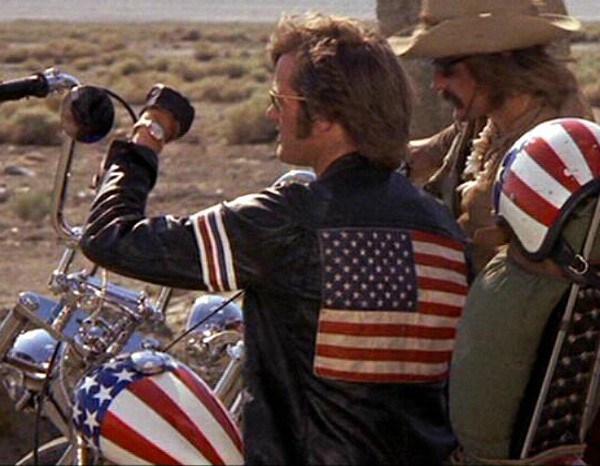
The Captain America of Easy Rider should not be mistaken for the super soldier played by Chris Evans. Instead, this Captain America is actually Wyatt Williams, a motorcycle rider who is planning on going to Mardi Gras with his friend Billy (Dennis Hopper, who also directed). Wyatt is nicknamed Captain America because he wears a leather jacket with an American flag on the back. It is an appropriate nickname because Wyatt represents everything that is good about America.
When we first meet Captain America, he and Billy are engaged in a business transaction, bringing to mind the old saying that the business of America is business. They are selling cocaine to none other than Phil Spector. Taking Spector’s money, Wyatt stuffs it into a plastic tube that he keeps hidden in his motorcycle’s fuel tank. It is no coincidence that the fuel tank is decorated with the stars and bars.
Having made their money, Wyatt and Billy ride across the country to celebrate. At the start of their journey, Wyatt takes off his watch and leaves it on the ground, declaring that time has no meaning to a man who has freedom. If you replaced their motorcycles with horses, there would be little to distinguish Wyatt and Billy from the American outlaws who might show up in an old Henry Fonda western.
On their way to New Orleans, Wyatt and Billy interact with many different people. If the always paranoid and nervous Billy represents America’s worst impulses, Wyatt represents the best. When Wyatt and Billy eat dinner with a rancher and his family, Wyatt alone appreciates what the rancher has accomplished and says, “You’ve got a nice place. It’s not every man that can live off the land, you know. You do your own thing in your own time. You should be proud.” When they later stop off at a ramshackle hippie commune, Wyatt is the one who says, in the best tradition of American optimism, that “They’ll make it.”
When they stop to pick up a hitchhiker and then later when alcoholic lawyer George Hanson (Jack Nicholson) joins them on their trip, it’s always Wyatt who volunteers to share his bike. (Billy always rides alone.) Whenever they stop for the night, it is always the generous Wyatt who offers to share his grass with whomever is traveling with them. When George smokes for the first time, Wyatt is the one who teaches him. It is the stoned George who tells Wyatt and Billy that they represent freedom.
It is only after George is beaten to death by a group of rednecks that Wyatt loses his optimistic outlook and his generous spirit. George’s death opens Wyatt’s eyes in much the same way that the turmoil of the 1960s did for the rest of America. After George’s murder, Wyatt loses his faith in himself. When he and Billy reach New Orleans, Mardi Gras is a letdown. When he takes the acid that was given to him by the hitchhiker, Captain America’s journey becomes a bad trip both figuratively and literally.
While Billy insists that they had a great time in New Orleans (in much the same way that some insist that America is just as strong a nation as it has ever been), Wyatt knows the truth. “We blew it,” Wyatt says, speaking for the entire nation.
Despite his mistakes and despite having blown it, Wyatt, much like America itself, remains good at heart. When Captain America dies at the end of the film, it is because he is trying to protect his friend Billy. In the best American tradition, he sacrifices himself to protect another.
This Independence Day, let us all take a few moment to appreciate Wyatt Williams, the man known as Captain America.
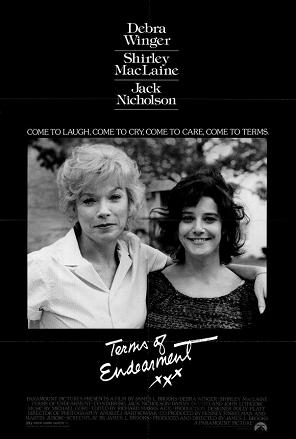
I have to admit that, when I first sat down and watched the 1983 best picture winner Terms of Endearment, I was actually taken by surprise. Before I actually saw it, I was under the impression that Terms of Endearment was considered to be one of the weaker films to win best picture. I had read a few reviews online that were rather dismissive of Terms, describing it as being well-made but overrated.
But then, a few weeks ago, I watched Terms of Endearment on Netflix. The film started with a scene of new mother Aurora Greenwood (Shirley MacClaine) obsessively checking on her daughter, Emma. Stepping into the bedroom, Aurora is, at first, scared that Emma’s dead. Without bothering to take off her high heels, Aurora nearly climbs into the crib to check on her. Fortunately, Emma starts to cry.
And I laughed because I’ve been told about how my mom used to obsessively check in on me when I was a baby. And, while my mom was never the type to wear high heels around the house, I could still imagine her climbing into a crib to check on me and my sisters.
And then, when Emma (now played by Debra Winger) married Flap Horton (a very young Jeff Daniels) over the objections of her mother, I smiled but I didn’t laugh because, in this case, I was relating to Emma. Because the fact of the matter is that every girl has known a boy like Flap Horton, the smart and funny guy who is destined to ultimately hurt her.
And when Flap got a job in Des Moines and Emma moved from Houston to Iowa, I knew — as did Aurora — what was going to happen. I knew that Flap would deal with his insecurity over not being a good provider for his wife and children by cheating on his wife. And when he did, I wanted to cry with Emma.
But then I wanted to cheer when Emma has an affair of her own. In the role of Sam, John Lithgow doesn’t have much screen time in Terms of Endearment but he does get the best line. When a rude cashier claims that she doesn’t feel that she was being rude to Emma, Sam replies, “Then you must be from New York.”
Meanwhile, the widowed Aurora is having an affair of her own. Jack Nicholson plays Garrett Breedlove, a former astronaut who now has both a drinking problem and a house with a pool. Garrett gets Aurora to loosen up. Aurora makes Garrett realize that he actually is capable of being a decent guy. MacClaine and Nicholson both won Oscars for their performances here and they deserved them.
And then, Emma was diagnosed with cancer. And I cried and cried because, at this point, I had come to think of Emma and Aurora as being real people. And when Emma told her friends that she was dying and she spent her final days with her children, I sobbed because it made me think about my mom. And now I’m sobbing as I write this review.
But it’s a great film, even if it did make me cry. Because, in the end, you’re glad that you got to know these characters. And, even through the tears, the film leaves you happy that you got to spend some time with them.
And isn’t that what a great film is supposed to do?
Two years ago, there was a rumor that Jack Nicholson had announced his retirement from acting because he was starting to suffer from memory loss. Even though Nicholson’s people later claimed that this was false and that Jack was actively reading scripts, that rumor still left me feeling very depressed. Jack Nicholson is such an iconic actor that it’s difficult to think that there will be a time when he’ll no longer be arching his eyebrows and delivering sarcastic dialogue in that signature voice of his. When you look at a list of his films, you find yourself looking at some of the best and most memorable films ever made. Chinatown, The Shining, The Departed, The Shooting, Easy Rider, One Flew Over the Cuckoo’s Nest; Nicholson has appeared in some truly great films.
But every actor, no matter how iconic he may be, had to start somewhere. For Jack Nicholson, that somewhere was the 1958 Roger Corman-produced film, The Cry Baby Killer. The good news is that the 21 year-old Nicholson starred in his very first film. The bad news is that there’s absolutely nothing about Jack’s performance that would give you any reason to believe that he would eventually become one of the best known and most-honored actors of all time. It’s not that Jack gives a bad performance. In fact, it’s somewhat disappointing that Jack doesn’t do a terrible job in the role. When you’re seeing the obscure film debut of a cinematic icon, you always hope that the first performance will either be amazingly good, shockingly bad, or just embarrassingly inappropriate. But, in Jack’s case, he’s neither good nor bad and he doesn’t really embarrass himself. Instead, he’s just bland.
Yes, you read that right.
Jack “HEEEEEEEEEERE’S JOHNNNNNNNY!” Nicholson was bland in his debut film.
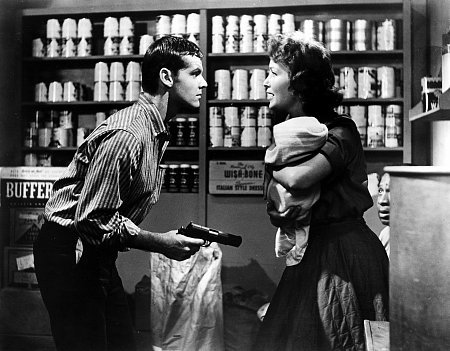
As for the film itself, Jack plays Jimmy. We’re told that Jimmy is 17 years-old and he’s still in high school. (Since Jack Nicholson’s hairline was already receding at 21, we automatically have a difficult believing him in the role of Jimmy.) Jimmy’s a good kid but he’s kind of stupid. Also, his ex-girlfriend Carole (Carolyn Mitchell) is now dating an 18 year-old gangster named Manny Cole (played by Brett Halsey, who would later have a prolific career in Italian exploitation films as well as appearing in The Godfather, Part III). Jimmy confronts Manny. Manny has two of his thugs beat up Jimmy. Jimmy grabs a gun off a thug and shoots someone. Scared of going to jail, Jimmy runs into a store and takes three hostages — a stocker and a young mother with a baby.
The rest of the 70-minute film consists of an understanding policeman (Harry Lauter) trying to convince Jimmy to surrender while the crowd of reporters and observes outside the store hope for a violent confrontation. The film does make a still-relevant point about how the media exploits the potential for tragedy but, for the most part, it’s pretty forgettable.
As I stated above, Jack is adequate but forgettable. If I had seen this movie when it first came out in 1958, I would have expected handsome and charismatic Brett Halsey to become a huge star while I would have predicted that Nicholson would spend the rest of his career in television.
However, we all know that didn’t happen. Jack Nicholson became an icon. Sadly, Jack hasn’t appeared in a film since 2010. Hopefully, he’ll give us at least one more great performance. Who knows? Maybe some aspiring screenwriter will write as script for Cry Baby Killer 2: Jimmy’s Revenge.
So, late Saturday night, I turned over to TCM’s 31 Days Of Oscar and I was watching the 1992 best picture nominee, A Few Good Men, and I noticed that not only was there only one woman in the entire film but she was also portrayed as being humorless and overwhelmed. While all of the male characters were allowed to speak in quippy one liners and all had at least one memorable personality trait, Lt. Commander Joanne Galloway (Demi Moore) didn’t get to do much beyond frown and struggle to keep up.
“Hmmmm…” I wondered, “why is it that the only woman in the film is portrayed as basically being a humorless scold?” Then I remembered that A Few Good Men was written by Aaron Sorkin and it all made sense. As I’ve discussed on this site before, Aaron Sorkin has no idea how to write woman and that’s certainly evident in A Few Good Men. Joanne (who goes by the masculine Jo) is the one character who doesn’t get to say anything funny or wise. Instead, she mostly serves to repeat platitudes and to be ridiculed (both subtly and not-so subtly) by her male colleagues. You can tell that Sorkin was so busy patting himself on the back for making Jo into a professional that he never actually got around to actually giving her any personality. As a result, there’s really not much for her to do, other than occasionally scowling and giving Tom Cruise a “that’s not funny” look.
(“C’mon,” Tom says at one point, “that one was pretty good.” You tell her, Aaron Tom.)
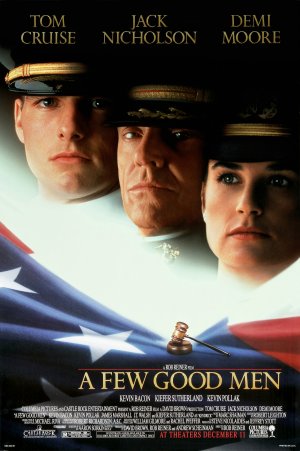
A Few Good Men, of course, is the film where Tom Cruise yells, “I want the truth!” and then Jack Nicholson yells back, “You can’t handle the truth!” At that point in the film, I was totally on Nicholson’s side and I was kinda hoping that the scene would conclude with Cruise staring down at the floor, struggling to find the perfect come back. However, this is an Aaron Sorkin script which means that the big bad military guy is never going to have a legitimate point and that the film’s hero is always going to have the perfect comeback. Fortunately, the scene took place in a courtroom so there was a wise judge present and he was able to let us know that, even if he seemed to be making the better point, Nicholson was still in the wrong.
As for the rest of the film, it’s a courtroom drama. At Guantanamo Bay, a marine (Michael DeLorenzo) has died as the result of a hazing. Two other marines (Wolfgang Bodison and James Marshall) have been accused of the murder. Daniel Kafee (Tom Cruise), Joanne Galloyway (Demi Moore), and Sam Weinberg (Kevin Pollack) have been assigned to defend them. Jack Ross (Kevin Bacon) is prosecuting them. Kafee thinks that the hazing was ordered by Col. Nathan Jessup (Jack Nicholson) and Lt. Kendrick (Kiefer Sutherland).
We know that Kendrick’s a bad guy because he speaks in a Southern accent and is religious, which is pretty much the mark of the devil in an Aaron Sorkin script. We know that Jessup is evil because he’s played by Jack Nicholson. For that matter, we also know that Kafee is cocky, arrogant, and has father issues. Why? Because he’s played by Tom Cruise, of course. And, while we’re at it, we know that Sam is going to be full of common sense wisdom because he’s played by Kevin Pollack…
What I’m saying here is that there’s absolutely nothing surprising about A Few Good Men. It may pretend to be about big issues of national security but, ultimately, it’s a very slick and somewhat hollow Hollywood production. This, after all, is a Rob Reiner film and that, above all else, means that it’s going to be a very conventional and very calculated crowd pleaser.
Which isn’t to say that A Few Good Men wasn’t enjoyable. I love courtroom dramas and, with the exception of Demi Moore, all of the actors do a good job. (And, in Demi’s defense, it’s not as if she had much to work with. It’s not her fault that Sorkin hates women.) A Few Good Men is entertaining without being particularly memorable.
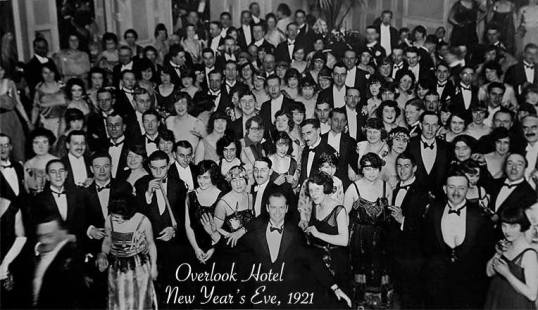
What better way to end 2014 than through one of my favorite scenes from Kubrick’s film adaptation of The Shining.
For those who have watched the film they understand the impact of this scene. For those still needing to see this classic piece of horror filmmaking then what better way to open up the new year than making a resolution to finally sit down and watch The Shining.
Little Shop…Little Shop of Horrors…Little Shop…Little Shop of Terrors…
Watching the original 1960 Little Shop of Horrors is another Halloween tradition here at the Shattered Lens. And why not? It’s a lot of fun! Everyone always mentions the fact that Jack Nicholson pops up in an early role but, for me, the entire film is stolen by the great Dick Miller.
Incidentally, when I was 19, I was a dancer in a community theater production of Little Shop of Horrors. I really should have been cast as Audrey.
For our latest entry in the 44 Days of Paranoia, we take look at the film that the Academy named the best picture of 2006, Martin Scorsese’s The Departed.
The Departed takes the plot of the 2002 Hong Kong film Infernal Affairs and transports it to Boston. For years, crime lord Frank Costello (Jack Nicholson) has ruled South Boston with an iron fist. However, police Captain Queenan (Martin Sheen) and his assistant, Sgt. Dignan (Mark Wahlberg) think that they have finally found a way to take Costello down. They recruit police academy trainee Billy Costigan (Leonardo DiCaprio) to go undercover and infiltrate Costello’s organization. To help establish his cover, Costigan drops out of the academy and does time in prison on a fake assault charge.
Meanwhile, Costello has an agent of his own. Years earlier, Colin Sullivan (Matt Damon) was specifically recruited and trained by Costello to become a mole inside the Massachusetts State Police. Sullivan soon finds himself also working under Queenan.
While the amoral Sullivan finds it easy to deal with his dual role of being both a cop and a criminal, the far more emotionally unstable Costigan has a much more difficult time of it. Not helping is the fact that Costello turns out to be a legitimate madman who spends half of his time dismembering people and the other half serving as a secret informant to the FBI. While Sullivan smoothly works his way up the ranks, Costigan pops pills and becomes more and more paranoid.
Eventually, both Costigan and Sullivan are ordered to uncover the double agents in their respective organizations. What they don’t realize is that, even as they both attempt to learn the other’s identity, they are both seeing the same woman, psychiatrist Madolyn (Vera Farmiga.)
In the scene below, which happens to be my favorite from the entire film, Costigan and Madolyn make love after Madolyn assures Costigan that she doesn’t have a cat. That makes sense when you consider that Costigan is essentially a rat.
I have to admit that, as much as I did appreciate certain parts of the film, I was still disappointed the first time I saw The Departed. It wasn’t so much that the movie itself was bad as much as it was the fact that it didn’t live up to the standard set by previous Scorsese films. The film seemed to somehow be both conventional and overly busy at the same time, with the constantly moving camera and the propulsive soundtrack feeling more like they were more the result of a director trying to be like Scorsese than Scorsese himself. While I appreciated the comedic relief of Alec Baldwin’s performance as Queenan’s rival on the force and I thought that Matt Damon made a compelling villain, both Leonardo DiCaprio and Martin Sheen seemed to have been bitten by the overacting bug. It was hard not to feel somewhat disappointed that, after waiting for over three decades to be honored by the Academy, Scorsese finally won his Oscar for The Departed.
However, with subsequent viewings, The Departed has grown on me. Once I was freed up from the expectations that come from watching a Scorsese film for the first time, I was able to enjoy The Departed for what it actually was, a very well-made and entertaining crime drama that occasionally flirted with being something more.
Watching The Departed for a second time, I was better able to appreciate the sly humor of Jack Nicholson’s performance. As played by Nicholson, Frank Costello becomes both the devil incarnate and a somewhat pathetic relic who is incapable of understanding that his time has passed. Watching Nicholson for a second time also led to me better appreciating Martin Sheen’s performance. Since Nicholson and Sheen are meant to the equivalent of the angel and the devil sitting on Damon and DiCaprio’s shoulders, it was necessary for Sheen to be as virtuous as Nicholson was demonic.
By the time that I watched The Departed for the third time, it was a lot more obvious to me that the entire film was, more or less, meant to be a satire. What Nicholson’s criminal empire and Sheen’s police force have in common is that neither one of them works the way that they’re supposed to. If there’s anything to be learned from the film, it’s that nothing means much of anything. (The Coen Brothers would be proud.)
Finally, after multiple viewings, it becomes obvious that The Departed is very much a Scorsese film. Even if his direction isn’t quite as showy as viewers have come to expect, there’s still enough little touches and details that remind us that this film was made by a master. To cite the obvious example that everyone cites, just watch for the X’s that always somehow manage to appear on the wall or the carpet before anyone in the film dies. With multiple viewings, It also became obvious to me that even if this film was set in Boston and not New York and even if the characters were Irish and not Italian, this film was still thematically pure Scorsese, dealing with themes of guilt, identity, punishment, and martyrdom.
Like all worthwhile films, The Departed is one that grows better with subsequent viewings.
Our latest entry into the 44 Days of Paranoia is a dark masterpiece. Based on a script by Robert Towne, directed by Roman Polanski, and starring Jack Nicholson, 1974’s Chinatown is one of the greatest films ever made.
Chinatown takes place in 1940s Los Angeles. Private Investigator Jake Gittes (Jack Nicholson) is hired by a woman (Diane Ladd) who claims that her name is Evelyn Mulwray. She wants Gittes to follow her husband, Hollis, and discover whether he’s having an affair. Gittes gets some pictures of Hollis with a young woman (Belinda Palmer) and hands them over to Evelyn.
The next day, the pictures are published on the front page of the newspaper and Gittes is confronted by another woman (Faye Dunaway) who explains that she — and not the woman who hired him — is the actual Evelyn Mulwray. Gittes then learns that Hollis has turned up dead, drowned in a reservoir.
Gittes suspects that Hollis was murdered and launches his own investigation. This eventually leads Jake to Hollis’s former business partner, Noah Cross (John Huston). Noah also happens to be the father of Evelyn and he offers double Gittes’s fee if Gittes will track down Hollis’s younger girlfriend.
As his investigation continues, Gittes discovers that Hollis’s murder was connected to both the continued growth of Los Angeles as a city and a truly unspeakable act that occurred several years in the past. Nobody, it turns out, is what he or she originally appears to be. To say anything else about the plot would be unfair to anyone who hasn’t seen Chinatown before.
Since I first started reviewing films for this site, one of the things that I’ve discovered is that it’s actually easier to review a bad film than a good film. It’s easier to be snarky and cynical about the latest film from Michael Bay or Roland Emmerich than it is to explain why a film works. There’s a famous saying about pornography: “I don’t know what it is but I know it when I see it,” and sometimes that’s the way I feel whenever it comes time to try to review a great film.
Consider Chinatown. At its heart, Chinatown is an homage to the old film noirs of the 40s and 50s. Now, I have to admit that I’ve lost track of how many noir homages I’ve seen. It seems like every director has to make at least one hard-boiled, morally ambiguous detective film. Chinatown has all of the familiar elements — the hero is a private investigator, Evelyn Mulwray initially appears to be a classic femme fatale, the dialogue is appropriately cynical, and the plot is full of twist and turns. Even the film’s theme of political conspiracy serves to remind us that most noirs used their detective stories as a way to explore the hidden underbelly of American society.
And yet, with Chinatown, Polanski, Nicholson, Towne, and producer Robert Evans took all of those familiar elements and used them to create one of the greatest films ever made.
Why is Chinatown such a great film?
Some of the credit has to go to Jack Nicholson who, in the role of Jake Gittes, gives perhaps his best performance. As I mentioned above, Gittes is, in many ways, a stock character but Nicholson brings so much nuance and depth to the role that it doesn’t matter. Nicholson’s trademark cynicism and sarcasm are both to be found here but he also brings a cocky recklessness to the role. Gittes is such a charismatic and likable hero and so confident in himself that it makes the film’s ending all the more shocking.
As good as Nicholson is, he’s matched at every turn by John Huston’s Noah Cross. Noah Cross is one of the most vile characters to ever appear on-screen, which is why Huston’s rather courtly performance is all the more disturbing. When Gittes confronts Noah about the worst of his many crimes, Cross simply responds that a man is never sure what he’s capable of until he does it. Huston delivery of the lines leave us with little doubt that Noah believes every word of what he’s just said.
In the end, though, most of the credit has to go to Roman Polanski’s direction and Robert Towne’s script. Towne’s script provides a genuinely challenging and thought-provoking mystery, while Polanski’s stylish direction keeps the view continually off-balance and unsure of who is telling the truth. Reportedly, Polanski and Towne had a contentious relationship, with Polanski changing the ending of Towne’s script to make the film much more downbeat. In the end, Polanski made the right choice. The film ends the only way that it possibly could.