This October, I’m going to be doing something a little bit different with my contribution to 4 Shots From 4 Films. I’m going to be taking a little chronological tour of the history of horror cinema, moving from decade to decade.
Today, we continue the 1960s!
4 Shots From 4 Films
Blood and Black Lace (1964, dir by Mario Bava)
2,000 Maniacs (1964, dir by Herschell Gordon Lewis)
The Cabinet of Dr. Caligari is a film that I’ve shared three times previously on the Shattered Lens. The first time was in 2011 and then I shared it again in both 2014 and 2015. Well, you know what? I’m sharing it again because it’s a classic, it’s Halloween, and everyone should see it!
Released in 1920, the German film The Cabinet of Dr. Caligari is one of those films that we’ve all heard about but far too few of us have actually seen. Like most silent films, it requires some patience and a willingess to adapt to the narrative convictions of an earlier time. However, for those of us who love horror cinema, The Cabinet of Dr. Caligari remains required viewing. Not only did it introduce the concept of the twist ending (M. Night Shyamalan owes his career to this film) but it also helped to introduce German expressionism to the cinematic world.
My initial reaction to The Cabinet of Dr. Caligari was that it simply wasn’t that scary. It was certainly interesting to watch and I was happy that I was finally experiencing this film that I had previously only read about. However, the film itself was obviously primitive and it was difficult for my mind (which takes CGI for granted) to adjust to watching a silent film. I didn’t regret watching the film but I’d be lying (much like a first-year film student) if I said that I truly appreciated it after my first viewing.
But you know what? Despite my dismissive initial reaction, the film stayed with me. Whereas most modern films fade from the memory about 30 minutes after the end credits,The Cabinet of Dr. Caligari has stuck with me and the night after I watched it, I even had a nightmare in which Dr. Caligari was trying to break into my apartment. Yes, Dr. Caligari looked a little bit silly staring through my bedroom window but it still caused me to wake up with my heart about to explode out of my chest.
In short, The Cabinet of Dr. Caligari passes the most important test that a horror film can pass. It sticks with you even after it’s over.
For the curious who have 74 minutes to spare and an open mind to watch with, here is Robert Wiene’s The Cabinet of Dr. Caligari…
Most Likely To Die is a slasher film about a group of old friends who gather at a remote house for the weekend. It’s their high school reunion and almost everyone’s looking forward to getting caught up on old times. What they don’t know is that there is a killer in their midst and that killer is going to kill them one by one. Even worse, he’s going to do it in a way that ironically comments on their senior year superlatives.
Fortunately, everyone received a superlative that lends itself to an ironic death. Seriously, this killer is just lucky that Most Likely To Eat Anything was friends with Most Likely To Break Hearts and Most Likely To Be Put On Ice. Just imagine if Most Likely To Kill A Psycho had shown up for the weekend? And what if he had brought his wife, Most Likely Not To Split Up In The Face Of Danger? That would have screwed everything up!
Who is the killer? Well, the natural suspect is John Daughtery. He was the outcast who all the kids made fun of. They even vandalized his yearbook entry, declaring him to be “Most Likely To Die.” John was pretty upset about that but then it got even worse when a gun was discovered in his locker! That pretty much ruined John’s life!
But maybe it’s not John. Maybe it’s Tarkin, the groundskeeper. Tarkin used to own a liquor store but he lost it when it was discovered that he was selling alcohol to underage kids. Could Tarkin be looking for revenge? Or is he just a perv who obsessively hangs around outside a certain bedroom window? Tarkin, incidentally, is played by Jake Busey and, whenever Busey shows up in a slasher film, you know he’s either going to be the murderer or the film’s biggest red herring.
Then again, maybe this killer is Perez Hilton!
Seriously, Perez Hilton is in this movie and it’s not stunt casting. Perez actually plays a real character and, at no point, does he wink at the audience and go, “It’s me, Perez!” Perez gives a far better performance than you might expect. His work here is, at the very least, on par with Paris Hilton’s performance in House of Wax.
Or maybe the killer is … someone else!
Honestly, if you’ve ever seen a slasher movie before, you’ll guess who the killer is. Most Likely To Die does offer up a typical, last-minute slasher movie twist but it won’t take you by surprise. In fact, there’s really nothing surprising about Most Likely To Die. That said, for fans of the slasher genre, Most Likely To Die is entertaining and fairly well-done. It doesn’t redefine the genre but it’s well-acted, the house is a creepy location, the murders are properly gory and mean-spirited, and the film does what it does with a certain panache. If you’re a horror fan, there are worse (and, it should be noted, definitely better) ways to waste your time.
Most Likely To Die made its premiere at Film4 FrightFest in 2015 and it had a very limited release earlier this year. It’s now available on Netflix, where it can be watched by anyone with 80 minutes to kill.
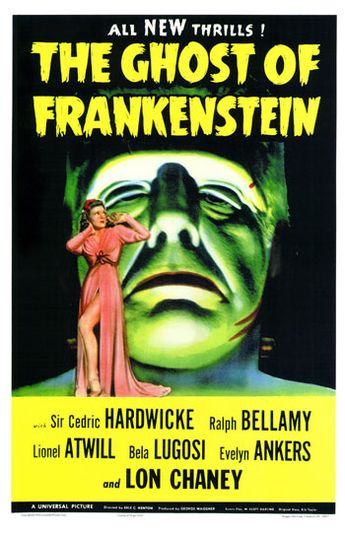
In 1942, three years after Son of Frankenstein, Universal Pictures continued the story of the Frankenstein family with The Ghost of Frankenstein!
However, The Ghost of Frankenstein was a far different film from the three that came before it. The budget was lower. The story was less complicated. The running time was much shorter. Whereas the previous films in the franchise clearly took place in Germany, the setting for The Ghost of Frankenstein is less easily defined. (Considering that the film was made during World War II, this isn’t surprising.) The biggest change is that, in The Ghost of Frankenstein, the monster is not played by Boris Karloff. Instead, the role is taken by Lon Chaney, Jr. Chaney’s hulking frame was perfect for the monster but his face is never as expressive as Karloff’s. Whereas Karloff turned the monster into as much of a victim as a victimizer, Chaney plays the monster like a … well, a monster.
Returning from Son of Frankenstein, Bela Lugosi is back as Ygor. At the start of the film, we learn that Ygor actually wasn’t killed at the end of Son of Frankenstein. Instead, he was just wounded. He’s spent the last few years hiding out in the old castle, trying to once again revive the monster. When the villagers attempts to blow up the castle, he and the monster flee.
It turns out that there’s one other Frankenstein son. His name is Ludwig and he’s played by a very dignified Sir Cedric Hardwicke. Ludwig, who has been hiding his identity and denying the family legacy, has a successful medical practice in another village. Working with his assistants, Dr. Kettering (Barton Yarbrough) and the bitterly jealous Dr. Bohmer (Lionel Atwill, who played a far different role in Son of Frankenstein), Ludwig has developed a procedure in which a damaged brain can be removed from the skull, repaired, and then stuck back inside the skull…
Uhmmm … wow, I have no idea what to say about that. That’s quite a medical breakthrough, though…
When Ygor and the monster show up in the village, searching for Ludwig, the monster ends up getting arrested. The local prosecutor (played by Ralph Bellamy, Cary Grant’s romantic rival in both The Awful Truth and His Girl Friday) asks Ludwig to examine the prisoner. Ludwig is shocked to discover that the prisoner is his father’s creation!
Ygor wants Ludwig to perform a brain transplant on the Monster. At first, Ludwig is hesitant but then he’s visited by Henry Frankenstein’s ghost. (Since Colin Clive died 5 years before Ghost of Frankenstein went into production, Hardwicke plays both Ludwig and Henry.) The ghost asks Ludwig to perfect the monster.
Ludwig finally relents and agrees to give the monster a new brain. Ludwig wants to use the brain of kindly colleague but Ygor has different plans…
The Ghost of Frankenstein is only 67 minutes long but, oddly, it still feels just a little bit draggy. Director Erle C. Kenton does a workmanlike job but, at no point, does Ghost feature the wit that distinguished James Whale’s films or Rowland V. Lee’s work on Son of Frankenstein. Chaney is not a particularly interesting monster but Bela Lugosi is a lot of fun as Ygor. With Chaney showing even less emotion than he usually did and Hardwicke appearing to be occasionally embarrassed by the whole film, it falls to Lugosi to keep the audience awake and he manages to do just that. Lugosi’s performance may be overly theatrical but that’s exactly what The Ghost of Frankenstein needed.
The Ghost of Frankenstein is occasionally entertaining but ultimately forgettable. It’ll best be enjoyed by Universal horror completists.
This October, I’m going to be doing something a little bit different with my contribution to 4 Shots From 4 Films. I’m going to be taking a little chronological tour of the history of horror cinema, moving from decade to decade.
Today, we start the 1960s!
4 Shots From 4 Films
Psycho (1960, dir by Alfred Hitchcock)
The Pit and the Pendulum (1961, dir by Roger Corman)
Today’s horror on the lens is a science fiction/horror film from 1977!
In The Incredible Melting Man, the first manned spaceflight to Saturn does not go well. Three astronauts went up but only one came down. And that one astronaut is both kinda crazy and melting! Seriously, it’s a big mess.
Apparently, one of the victims of the incredible melting man is played by director Jonathan Demme. See if you can spot him! It’ll be fun.
(I’m not really sure what Jonathan Demme looks like so you’ll probably have better luck with it than me.)
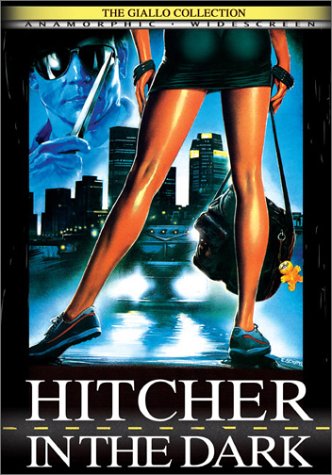
So, I just reviewed a thriller called Road Games, which is about something bad that happens to hitchhikers. And, as I was finishing up that review, I suddenly realized that I now had the perfect excuse to say a few words about Umberto Lenzi’s 1989 horror/thriller, Hitcher In The Dark!
The Hitcher In The Dark is a film that I specifically bought earlier this year so that I could review it in October. I thought that Hitcher In The Dark was a great title. Plus, I haven’t reviewed that many Umberto Lenzi films, despite the fact that he is one of the most prolific directors in the history of Italian cinema. Hitcher in the Dark? I thought, Hell yeah, I’ll review that!
But then I watched the movie and I discovered that there’s really not that much to say about it. There’s a reason why this is one of Lenzi’s more obscure films. (He directed it around the same time that he made the infamous Black Demons.) Not that much happens in Hitcher In The Dark. It tells the story of a psycho rich boy, who is played by Joe Balogh. Joe Balogh was also the lead in Black Demons. In that film, his character was named Dick. All through Black Demons, the other actors were always wandering around and yelling, “Dick! Dick! We need Dick! I need Dick! Please, show me Dick!” Hitcher In The Dark is never that much fun.
Instead, Balogh’s character is named Mitch. He’s obsessed with his dead mother, so he drives around Florida and kills people. Because she resembles a framed stock photo that he keeps on him at all times, Mitch kidnaps Daniela (Josie Bissett) and tries to turn her into his mother. The rest of the film is pretty much made up of Daniela escaping and then getting captured again. Her boyfriend (Jason Saucier) is also searching for her. He goes up into random gas stations and says, “Have you seen a blonde girl?” Eventually, he stumbles across both her and Mitch. Why not? Florida’s not that big!
Anyway, there are three things that set Hitcher In The Dark apart. First off, there’s the fact that Mitch spends almost the entire movie driving the most awkward vehicle imaginable, a gigantic RV. Somehow, Mitch manages to kidnap and kill undetected while driving the most conspicuous thing possible. Seriously, check this monster out:
And there are two lines of dialogue that are so weird that they deserve to be enshrined in some sort of Hall of Fame.
When the police pull Mitch over and notice that he has a cut on his hand (from where Daniela earlier stabbed him with a fork), Mitch smoothly explains, “It’s just a scratch. I was cleaning my spear.”
AND THE POLICE NOD AND LET HIM GO!
The other line comes early in the film. When Mitch ignores a girl who has been hitting on him, she snaps, “Hey! Who do you think you are!? Mickey Rourke!?”
Seriously, Hitcher In The Dark may not be very memorable or good but those three things made it all worthwhile!
Road Games is an odd film. On the one hand, it’s such a slow-moving film that there’s really not a whole lot of plot to describe. On the other hand, what little plot that does exist all hinges on a big twist that I really can’t reveal. Considering how offended some people get when I reveal the end of a Lifetime film on this site, I can only imagine the reaction if I spoiled this film.
Jack (Andrew Simpson) is a depressed British guy who is stranded in France. He’s been hitchhiking across the country, hoping to make his way to Calais so that he can catch a ferry back to the UK. Oddly, he’s traveling with no bags. When we first meet Jack, he’s frustrated because nobody is willing to stop and pick him up.
Jack does eventually meet another hitchhiker, Veronique (Josephine de la Baume). Despite the fact that Jack speaks little French and Veronique speaks little English, they have an immediate chemistry. Veronique even lets Jack know why nobody wants to pick him up. Apparently, there’s a serial killer in the area!
Shortly afterwards, a car actually does stop. The owner of the car, Grizard (Frederic Pierrot), offers them a ride. Jack quickly gets in the car but Veronique is weary of the rough-spoken Grizard and only reluctantly gets in the back seat. They drive. Grizard asks way too many personal questions. He stops to pick a dead rabbit off of the road. He gets mad when Jack tries to turn on the radio. He also mentions that, because of a strike that neither Jack nor Veronique had heard about, there are no ferries from Calais. He offers to let Jack and Veronique stay at his home for the night. Though Veronique is reluctant, Jack readily agrees.
Grizard’s wife is Mary (Barbara Crampton). Grizard insists that Mary is British but Mary tells Jack that she’s actually from the States. Veronique doesn’t trust either Grizard or Mary but Jack says that they’re probably just lonely. Veronique is offended that she and Jack are given separate rooms. Jack replies that they’re probably just old-fashioned…
And that’s all I can tell you about the plot! There’s a really big twist and it’s actually fairly clever. But, my God, it takes forever to get there. Road Games is a very slow film. I know some of that was to build up suspense and the film is certainly not a failure but it’s still hard not to feel that Road Games was basically a terrifically effective 20-minute short film that was unnecessarily padded out to 95 minutes.
Road Games did the festival circuit in 2015 and got a release earlier this year. It’s currently on Netflix and I guess I would give it a partial recommendation, especially if you’re a fan of the horror road genre. There was a lot I did like about the movie: the cinematography is gorgeous and the original score is evocative of the best of giallo. The acting is okay, though Barbara Crampton is really the only stand-out in the cast. Throughout the film, the characters speak in a combination of French and English and Road Games makes good use of the language barrier to keep us off-balance. (How much is Jack understanding? we constantly wonder.) But the film itself is just so slow! I’ll be curious to see what director Abner Pastoll does next. I just hope his next film has a steadier pace.
For those who might have a hard time keeping their Universal monster films straight, 1939’s Son of Frankenstein is the third Frankenstein film, following the original and Bride of Frankenstein. It’s the first one to have been directed by someone other than James Whale. It’s the one that features the one-armed policeman. It’s the one that features Bela Lugosi as a vengeful grave robber named Ygor. It’s also the final film in which Boris Karloff would play the monster.
And, on top of all that, it’s also a pretty good movie, one that holds up as both a sequel and stand-alone work!
Son of Frankenstein opens decades after the end of Bride of Frankenstein. (How many decades is open for debate. I’ve read that the film is supposed to be taking place in 1901 but there’s a scene featuring a 1930s-style car. Let’s just compromise and say that the film is taking place in 1901 but someone in the village owns a time machine. I think that’s the most logical solution.) Henry Frankenstein is long dead, but his name continues to strike fear in the heart of Germans everywhere. Someone has even tagged his crypt with: “Heinrich von Frankenstein: Maker of Monsters.”
Needless to say, everyone in the old village is a little uneasy when Henry’s son, Wolf von Frankenstein (Basil Rathbone) shows up at the castle. In fact, they’re so uneasy that the local constable, Krogh (Lionel Atwill), pays Wolf and his family a visit. Krogh explains that, when he was a child, the Monster ripped his arm out “by the roots.” AGCK!
(That said, that really doesn’t sound like the Frankenstein Monster that we all know and love, does it? I suspect there’s more to the story than Krogh is letting on…)
Wolf explains that he has no plans to bring the Monster back to life. He then sets out to do just that. Wolf wants to redeem Henry’s reputation and the only way to do that is to prove that Henry was not misguided in his quest to play God. Helping Wolf out is Ygor (Bela Lugosi). Ygor is a former blacksmith who was due to be hanged but, because of a malfunction with the gallows, he just ended up with a disfigured neck.
It turns out that Ygor happens to know where the Monster’s body is being hidden. When Wolf brings the Monster back to life, he quickly discovers that Ygor’s motives weren’t quite as altruistic as Wolf originally assumed. It turns out that Ygor wants revenge on the jury that sentenced him to death and now, he can use the Monster to get that revenge.
As for the Monster, he no longer speaks. Instead, he just angrily grunts and he kills. Whatever kindness he developed during the previous film was obviously blown up with Elsa Lanchester at the end of Bride of Frankenstein. On the one hand, it’s fun to see Karloff as the monster. On the other hand, it’s impossible not to regret that he doesn’t get to do much other than stumble around, grunt, and strangle people. There are only two scenes where Karloff gets to show any real emotion and, in both cases, he does such a great job that you can’t help but regret that the monster is such a one-dimensional character in Son of Frankenstein.
But no matter! Regardless of how the film uses (or misuses) the Monster, it’s still an entertaining 1930s monster film. Basil Rathbone does a great job as the imperious but ultimately kindly Wolf von Frankenstein. And Bela Lugosi’s natural theatricality makes him the perfect choice for Ygor. To be honest, I actually think Lugosi does a better job as Ygor than he did as Dracula. I know that’s blasphemy to some but watch the two films side-by-side. Lugosi is clearly more invested in the role of Ygor. Considering that Lugosi reportedly felt that he was mistreated in Hollywood, it’s tempting to wonder if some of his own anger informed his performance as the perennially mistreated and bitter Ygor.
Son of Frankenstein closed out the Karloff Frankenstein trilogy. When Frankenstein’s Monster made his next appearance, he would be played by the same actor who later took over the role of Dracula from Lugosi, Lon Chaney, Jr.
(And interestingly enough, Lugosi would subsequently take over the role of the Monster from Chaney. But that’ll have to wait for a future review…)
This October, I’m going to be doing something a little bit different with my contribution to 4 Shots From 4 Films. I’m going to be taking a little chronological tour of the history of horror cinema, moving from decade to decade.
Today, we reach the end of the 50s and the rise of British horror.
4 Shots From 4 Films
Night of the Demon (1957, dir by Jacques Tourneur)
The Curse of Frankenstein (1957, dir by Terence Fisher)