Lisa Reviews an Oscar Nominee: Roman Holiday (dir by William Wyler)


roman_holiday

The 1953 film Roman Holiday is one that I’ve watched quite a few times.  If you know anything about the film and/or me, you won’t be surprised by that.  I love Audrey Hepburn.  I love Rome.  I love romance.  And I love bittersweet endings.  And Roman Holiday has all four of those!

Speaking of Audrey Hepburn, I’ve shared this picture before but I’m going to share it again:
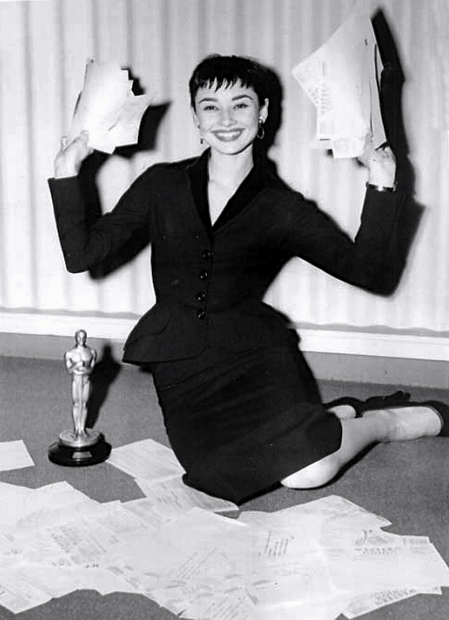
Audrey Hepburn 1954 Roman HolidayThat is Audrey Hepburn, the morning after she won the Best Actress Oscar for Roman Holiday.  Roman Holiday was Audrey Hepburn’s motion picture debut and it continues to hold up as one of the greatest film debuts of all time.  Watching how easily she controls and dominates the screen in Roman Holiday, you would think that she had made over a 100 films previously.

The film tells a simple story, really.  Audrey plays Ann, the crown princess of an unnamed country.  Princess Ann is touring the world.  The press is following her every move.  Her royal handlers are carefully choreographing every event.  Her ever-present bodyguards are always present to make sure that no one gets too close to her.  In public, Ann is the epitome of royal discretion, smiling politely and always being careful to say exactly the right thing.  But, in private, Ann is restless.  Ann knows that she has never been allowed to see the real world and yearns to escape, if just for one night, and live a normal life.  So far, her handlers have managed to keep her under control but then she arrives in Rome and…

…well, who can resist Rome?

Despite having been given a sedative earlier, Ann stays awake long enough to sneak out of her hotel room and see the enchanting Rome night life.  Of course, the sedative does eventually kick in and she ends up falling asleep on a bench.  It’s there that she’s discovered by an American, a cynical reporter named Joe Bradley (Gregory Peck).  Not realizing who she is and, instead, assuming she’s just a tourist who has been overwhelmed by Rome, Joe allows her to spend the night at his apartment.

The next morning, Joe finds out who Ann actually is.  Realizing that getting an exclusive interview with Ann could be his ticket to the big time, Joe and his photographer, Irving (Eddie Albert), rush back to Joe’s apartment.  Joe doesn’t tell her that he’s a reporter.  He just offers to take her on a tour of Rome.  Ann, however, wants to experience Rome on her own.

What follows is a wonderful and romantic travelogue of the glory of Rome.  Though Ann does explore on her own for a while, she eventually does meet back up with Joe and Irving.  Whenever I watch Roman Holiday, I always try to put myself in the shoes of someone in 1953, sitting in the audience during the film’s first week of release.  For many of them, this film may have been their first chance to ever see Rome.  (The opening credits of Roman Holiday proudly announce that the entire film was shot on location, properly acknowledging the Rome is as much a star of this film as Hepburn, Peck, and Albert.)  If you’re not already in love with Rome (and I fell in love with the city — and really, the entire country of Italy — the summer after I graduated high school), you will be after watching Roman Holiday.

(If you truly want to have a wonderful double feature, follow-up Roman Holiday with La Dolce Vita.)

The film’s most famous scene occurs at the Mouth of Truth and… well, just watch…

This scene was improvised, on the spot, by Gregory Peck.  Audrey Hepburn’s scream was very much real as Peck didn’t tell her what he was planning on doing.  As great as this scene is, it’s even better after you’ve actually been to Rome and put your own hand in the Mouth of Truth.

It’s a very sweet movie, one that stands as both a tribute to romance but also proof of what pure movie star charisma can accomplish.  It’s not just that Audrey Hepburn gives a great performance as Princess Ann.  It’s that Gregory Peck gives one of his most natural and surprisingly playful performance as well.  It’s that Peck and Hepburn have an amazing chemistry.  By the end of the film, you know that they deserve Rome and Rome deserves them.

And then there’s that ending, that bittersweet ending that always brings tears my mismatched eyes.  It’s a sad (though not depressing) little ending but somehow, it’s also the only ending that would work.

Roman Holiday was nominated for best picture but it lost to From Here To Eternity.

That’s right — Roman Holiday and From Here To Eternity were released one after another.

1953 was a very good year.

roman_holiday-1

gac_romanholiday

The TSL’s Grindhouse: The Year of the Yahoo! (dir by Herschell Gordon Lewis)


yahoooooooooooooooooooooooo

At the time of his death last year, Herschell Gordon Lewis was credited with having directed 38 films.  Though he’s best known for ground-breaking gore films like Blood Feast and The Gore Gore Girls, Lewis actually dabbled in several different genres.  For instance, he made one of the first psychedelic drug films when he directed Something Weird.  And, as a public service, he warned us all of the dangers of smut peddlers with Scum of the Earth.

And, of course, there was that political films he made…

WHAT!?  A political film directed by Herschell Gordon Lewis!?

Yes, it’s true!  The man who helped to give birth to modern horror also directed one of the most prophetic films ever made.  The Year of the Yahoo! came out in 1972 but it feels even more relevant today.  The Year of the Yahoo! not only predicted the rise of Donald Trump but also predicted the rise of Barack Obama as well, making it one of the few truly bipartisan satires ever made.  That’s not bad for an obscure film directed by a man who was never given much respect from mainstream critics.

The Year of the Yahoo! opens in Texas.  It’s an election year.  The governor (Jeffrey Allen) would love to get rid of liberal U.S. Senator Fred Burwell (Robert Swain) and he thinks that he’s found the candidate to do it.  The Governor wants to nominate an unimpressive congressman, someone who will be easy to control.  However, the President disagrees.  The President (who is obviously meant to be Richard Nixon, even if his name is never specifically mentioned) has decided that the man to defeat Sen. Burwell is a country singer named Hank Jackson (real-life country singer Claude King).

Hank Jackson has a television show, one that he hosts with his girlfriend, Tammy (Ronna Riddle).  Hank sings songs about how America needs to return to traditional values and how people just need to come together and help each other out.  He may be old-fashioned but he’s okay with the counter-culture.  In fact, when we first meet him, he’s at a hippie party.  He turns down an offer of marijuana but he does so with a hearty laugh.  He’s a traditional guy but he’s got no issues with the long hairs.  Not our Hank!  It doesn’t matter whether it’s a Dallas oilman, an Austin hippie, an El Paso policeman, or a Galveston fisherman.  Everyone in Texas loves Hank!

When Sid Angelo (Ray Sager, the star of Lewis’s Wizard of Gore), a political consultant with White House connections, approaches Hank about running against that lefty traitor, Sen. Burwell, Hank is skeptical but intrigued.  Once Sid get Hank to agree, Sid starts to shape Hank’s message.  As a disgusted Tammy watches, Hank starts to sell out.  Soon, Hank is making jokes about people on welfare.  He’s defending law and order.  He’s taking the side of the landlords against the rent strikers.  Everything from his campaign announcement to interviews with the local media is precisely choreographed by Sid.

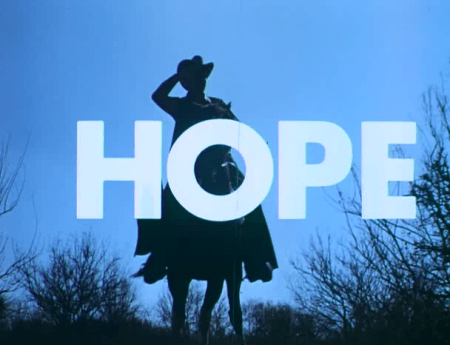
Hank’s message starts to resonate with the voters.  This is largely because he doesn’t have a message.  Instead, he just has a bunch of empty slogans and coded phrases.  Hank’s campaign commercial features him riding on a horse while the word “Hope” appears on the screen.  (I mean, who could possibly vote against hope?)  What’s going to happen when Hank’s elected?  Well, as he explains in the film’s theme song, we’re going to run the nation “like a country store.”  Just vote for Hank and “you’ll see how everyone relaxes.”

(At times, The Year of the Yahoo! almost feels like a musical.  The majority of the songs were written by Lewis, who was a legendary figure in the advertising industry before and after his career as a grindhouse filmmaker, and Claude King had a nice voice.  The songs are surprisingly catchy, even if they often are a bit too on the nose in their satire.)

Now, make no mistake about it.  This is definitely a Herschell Gordon Lewis film, which means that it often appears to have been made with more enthusiasm than skill.  At times, The Year of the Yahoo! moves way too slowly.  There’s a riot scene that is embarrassingly filmed.  The action stops for a stomach-churning sex scene between the hairy Ray Sager and a campaign volunteer.  The entire film, in fact, is full of actors who appeared in Lewis’s other films and it’s a bit weird to see familiar grindhouse performers cast as governors and campaign aides.  This is a Herschell Gordon Lewis production, with everything that implies.  While Lewis’s style was perfect for his semi-comedic gore films (Who can forget the “Have you ever had …. AN EGYPTIAN FEAST!?” scene from Blood Feast?), it feels a bit out of place in a film that is attempting to comment on reality.

And yet, it’s hard not to appreciate and kind of resoect just how serious the film’s intent seems to be.  Watching The Year of the Yahoo!, you get the feeling that Lewis actually was trying to say something important.  In The Year of the Yahoo!, Lewis not only attempted to make an important point but it was a valid point as well.  He may not have had the resources to really pull it off but consider this:

In 1972, Herschell Gordon Lewis predicted that a candidate could shoot the top of the polls by enticing voters with vague promises of hope.

In 1972, Herschell Gordon Lewis predicted that a wealthy TV celebrity, one that claimed to speak for the common man, could be packaged as a populist and sold to angry voters.

The Year of the Yahoo! was incredibly ahead of its time.  Say what you will about the film’s production values but you can’t deny this.  Everything that Herschell Gordon Lewis predicted came true.  That’s quite an accomplishment for someone often dismissed as merely being a gore director.

In fact, it’s such an accomplishment that it should give us all one thing for the future:

yahoooooo

4 Shots From 4 Films: Primary Colors, Dick, FDR: American Badass, Abraham Lincoln vs. Zombies


The greatest President of all time, Rutherford B. Hayes

The greatest President of all time, Rutherford B. Hayes

4 Shots From 4 Films is just what it says it is, 4 shots from 4 of our favorite films. As opposed to the reviews and recaps that we usually post, 4 Shots From 4 Films is all about letting the visuals do the talking.

Happy Rutherford B. Hayes Day!

In honor of my favorite holiday, I wanted to share 4 shots from 4 films about Rutherford B. Hayes.

However, my plan ran into a little problem.  Despite the fact that he’s the best President that this country ever had, there aren’t any movies about Rutherford B. Hayes.  He is literally the most underappreciated leader this country has ever had.  (In 2011, the President joked about Hayes not being on Mount Rushmore.  For that reason, I voted for Gary Johnson in 2012.  Don’t you mess with Rutherford B. Hayes)

So, here are four shots from four films that deal with other people who exist in the shadow of Rutherford B. Hayes.

4 Shots From 4 Films

Primary Colors (1998, dir by Mike Nichols)

Primary Colors (1998, dir by Mike Nichols)

Dick (1999, dir by Andrew Fleming)

Dick (1999, dir by Andrew Fleming)

FDR: American Badass (2012, dir by Garrett Brawith)

FDR: American Badass (2012, dir by Garrett Brawith)

Abraham Lincoln vs. Zombies (2012, dir by  Richard Schenkman)

Abraham Lincoln vs. Zombies (2012, dir by Richard Schenkman)

What Lisa Marie Watched Last Night: FANatic (dir by Jean-François Rivard)


Around 2 a.m. this morning, I watched the latest Lifetime Movie Network premiere, FANatic!

fanatic

Why Was I Watching It?

Okay, so technically, I didn’t watch this last night.  It premiered last night and I recorded it because I was watching the latest episode of The Walking Dead.  However, I don’t think What Lisa Recorded Last Night has quite the same ring to it.

As for why I watched it at 2 in the morning — well, I fell asleep last night around 11:00.  And then I woke up at one.  Seeing as how I had already gotten my usual two hours of sleep, I decided that I might as well watch a movie!

What Was It About?

Nikki Myers (Katy Breier) has finally landed her dream job.  She’s working as an assistant to Tess Daniels (Betsy Brandt), a highly acclaimed actress who happens to be the star of Nikki’s favorite show!  It’s an enjoyably silly sci-fi show, one on which Tess co-stars with her husband, Hunter Clay (Benjamin Arthur).  When the show started, Tess and Hunter were equals and Tess considered her role to be empowering.  But, over the past few seasons, things have changed.  Tess now finds her role to be demeaning and limiting.  While Hunter gets to play the hero, Tess’s role becomes more and more about providing fan service for the show’s male viewers.  Tess wants to leave the show…

But if Tess leaves the show, where does that leave Nikki!?  Nikki’s spent the last few weeks bragging to her two friends about her job!  If the show ends, how will Nikki be able to continue to steal props from the set?  And how will she be able to continue to lie to her friends about the imaginary affair she’s having with Hunter!?

Seriously, when you look at things from her point of view, can you blame Nikki for becoming a little bit homicidal?

What Worked?

Yay!  If nothing else, FANatic showed that the Lifetime-Degrassi conduit still exists!  Perhaps because so many Lifetime films are produced in Canada, it’s not unusual to see former Degrassi actors pop up in supporting (and, sometimes, lead) roles.  On Degrassi, Jake Epstein played the lovable, bipolar, drug addicted musician/photographer Craig Manning.  In FANatic, he plays a slightly less likable character, a misogynistic television producer.  Still, it’s always good to see Jake.

Anyway, FANatic was a lot of fun to watch, mostly because of the loving detail that was put into creating Tess and Hunter’s irresistibly silly sci-fi show.  What’s interesting is that, if that show actually was on the air, it probably would be, at the very least, a cult hit.  I knew more than a few people who would probably watch every episode.

Katy Breier did a good job playing the fanatic of the title.  A film like FANatic is only as good as its villain and Breier brought a lot of life to the role.

What Did Not Work?

Seriously, why are redheads always crazy in Lifetime movies?  Of course, that’s really not something that didn’t work.  That’s just something that I, as a member of the 2% of the world’s population who has red hair, always notice.

But back to the question — hey, it all worked!

“Oh my God!”  Just like me moments!

It’s hard for me to imagine myself ever becoming obsessed with any show to the extent that Nikki does.  Then again, if that show starred James Franco…

Lessons Learned

You can’t spell “fanatic” without “fan!”

Film Review: The Twin (dir by Max Derin and Fred Olen Ray)


twin

According to the imdb, Fred Olen Ray is, as of this writing, credited with directing 148 films.  Few of those films have necessarily been acclaimed by the mainstream critics but almost all of them are a lot of fun when taken on their own terms.

Take The Twin for instance, on which Ray shares a directing credit with screenwriter Max Derin.

Now, in many ways, The Twin is a ludicrous film.  It’s very, very melodramatic and the whole film’s central issue (i.e., which twin is which) could have been very easily resolved if just one person in the movie had used a little common sense.

But you know what?

Criticism like that misses the entire point of the film.  The Twin is a lot of fun and it’s certainly not a film that’s meant to be taken seriously.  This is not a serious look at mental illness, young love, sibling rivalry, or anything else for that matter.  This is an over-the-top and rather silly piece of pure entertainment and, if we can’t enjoy something like that, what hope is there for the world?

The film deals with Tyler (Timothy Granaderos), who would seem to be almost perfect.  He’s handsome.  He’s intelligent.  He’s compassionate.  He’s a wonderful boyfriend, always polite and considerate to his girlfriend, Jocelyn (Jess Gabor).  Even Jocelyn’s overprotective mother, Ashley (Brigid Brannah), seems to like him.

However, Tyler has a secret.  Years ago, his parents were killed in a car accident.  The accident was caused by Tyler’s brother, Derrick.  As you may have guessed from the film’s title, Derrick is Tyler’s twin.  And we all know that, whenever a movie is called The Twin, that means that there’s going to be a good twin and an evil twin.  It turns out that Derrick is the evil twin and that accident was no accident.

Derrick has spent the last few years in a mental asylum.  When Tyler shows up to visit his brother, the staff tells Tyler that Derrick has picked up a strange new habit.  He’s telling everyone that he’s actually Tyler and Tyler is Derrick.  Oh well, Tyler shrugs, that’s what happens when you’ve got a sociopathic twin.

Later, when Tyler is alone with his twin, he’s shocked when Derrick attacks him.  Derrick knocks him out and then switches clothes with him.  Claiming to be Tyler, Derrick walks out of the hospital and into the lives on Jocelyn and Ashley.  Meanwhile, Tyler is stuck in the hospital, begging for someone to just give him a blood test so that he can prove who he is….

Anyway, you can probably guess what happens next but that’s part of the fun.  Derrick (as Tyler) spends a lot of good, quality time with Ashley and Jocelyn, both of whom are surprised by how different “Tyler’s” personality seems to now be.  Ashley, of course, is more suspicious than Jocelyn.  (This film premiered on Lifetime so you better believe that overprotective mom is eventually proven right.)

It may be predictable but, like I said, it’s all a lot of fun.  I don’t know which parts of the film were directed by Derin and which parts by Fred Olen Ray but, as a whole, the film is cheerfully content to be a B-movie and you have to kind of love it for that.  At a time when everyone is taking everything so seriously and so many filmmakers are giving into portentous pretension, it’s nice to see a thriller that’s pure entertainment.

Plus, Timothy Granaderos is a lot of fun as both Tyler and Derrick.  Tyler is nice but kind of dull.  Derrick is exciting but totally batshit crazy.  Granaderos seems to be enjoying himself as he switches back and forth between being good and evil.  An evil twin movie is only as good as its twins and Granaderos is pretty good.

So, keep an eye out for The Twin.  Melodrama this enjoyable should not be missed.

Film Review: Britney Ever After (dir by Leslie Libman) #FreeBritney


britney-ever-after-trailer

Earlier tonight, I watched the latest Lifetime celebrity biopic, Britney Ever After.

Ever since that ill-fated Aaliyah movie, Lifetime biopics have had a reputation for being hot messes and I’m sure that a lot of people will say the same thing about Britney Ever After.  Britney Ever After is about Britney Spears, following her from her first tour with *NSYNC through her relationship with Justin Timberlake through her marriages to both Jason Alexander and Kevin Federline and finally concluding with her well-publicized breakdown in 2008.  As usually seems to happen with these biopics, the whole story is framed by interviews with a documentary crew.  From what I saw, the twitter reaction was pretty savage and I’m sure that there will be all sorts of snarky reviews tomorrow.

But you know what?

As far as Lifetime celebrity biopics go, Britney Ever After was not that bad.

It suffered from some obvious problems.  Since neither Britney nor her management had anything to do with the making of the film, none of Britney’s original music was heard.  That means there was no Oops! I did it again!  There was no Baby One More Time.  No Toxic.  No If U Seek Amy.  There was no Work Bitch, which incidentally is both the greatest song that Britney’s ever done and my favorite song to sing while stuck in traffic.  I think it was mentioned, at one point, that Britney was working on a song called Womanizer but I may have misheard.  When the actress playing Britney sang, it was only to cover songs by other artists.  In the film, Britney performed I Love Rock and Roll and a bit of Walking After Midnight.

For what I presume are legal reasons, the film had to be circumspect.  Yes, Justin Timberlake (played by Nathan Keyes) was a character in the movie but he was portrayed so blandly that he could have been any hyperactive teenager with good hair.  Jason Allen Alexander (Kelly McCabe) shows up just long enough to marry Britney and then be told that the marriage is going to be annulled.  Amazingly, Britney’s entire marriage to Kevin Federline (Clayton Chitty) takes place over less than 10 minutes of screen time.  Adnan Ghalib (Serge Jaswal) and Sam Lufti (Benjamin Arce) get more attention that Kevin but both of them are portrayed so negatively that they probably wish they hadn’t.

(Adnan and Sam both made the mistake of testifying about Britney in court, meaning that their douchebaggery was a part of the public record and free for Britney Ever After to portray.)

As for Britney’s “rivalry” with Christina Aguilera (which, early in their careers, pretty much defined both of their public personas), it goes unmentioned.  Christina is only briefly seen in a long shot.  For those of you hoping for any details about the dark side of life at the Mickey Mouse Club, Britney Ever After is not for you.  Really, the film’s main problem was one of logistics.  Britney Ever After had only 90 minutes to tell the story of a very dramatic and complicated life.  If the film felt rushed, that’s because it had a lot to show and not much time to do it.

But, even with all that in mind, Britney Ever After was not the disaster that some seem to believe that it was.  In the role of Britney, Natasha Bassett did far better than I was expecting.  There were some issues, of course.  Her attempt to duplicate Britney’s Southern accent led to her sounding more like Jessica Simpson than Britney Spears.  During the film’s early scenes, she seemed almost too innocent to be believed but it quickly became apparent that this was intentional on the film’s part.  One of the themes running through the film was how Britney’s image was continually shaped by her parents, her management, and her boyfriends.  In the end, Britney is portrayed as having no control over her own life.  When Britney suffers a break down in 2007, she’s at least trying to live her own life.  When everyone around her panics, are they concerned about her health or are they concerned about her image and their investment in her career?  This unanswered question hangs over the final 30 minutes of Britney Ever After.  If Natasha Bassett never quite seemed to be Britney, she was still very believable as a character living the exact same life and dealing with the exact same issues.

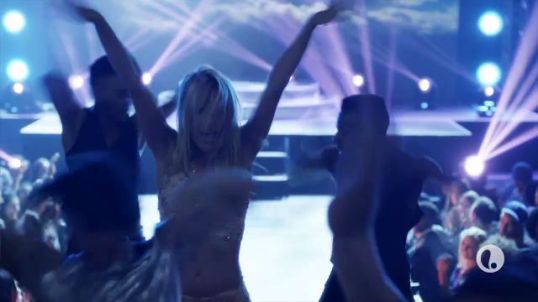
Plus, there was an enjoyably silly scene where Britney ran into Justin in a club and they had an epic dance off.  If only all relationship issues could be solved by a dance off!

That said, I was a bit disappointed that, at no point, was Crossroads mentioned.

(Seriously, a Britney movie with no mention of Crossroads!?)

But give the film some credit.  It did a good job of capturing the suffocating experience of being hounded by paparazzi.  And the film was even-handed and compassionate when it came to portraying Britney’s 2007 breakdown.  Like Britney, I’m bipolar and I’ve always felt that I could understand what she was going through while the rest of the world was finding so much entertainment in her very public struggle.  Since 2008, Britney’s father has had conservatorship over her life and control of all of her assets.  For nearly ten years, Britney Spears has not been allowed to stand on her own and has essentially made a lot of money for everyone but her.  During the documentary segments that provide a wrap-around to the film’s story, Britney Ever After obliquely hints at this sad reality.  In those sequences, there’s a sadness to Bassett’s performance, an acknowledgement that Britney has paid a price for public stability.

Britney Ever After was on Britney’s side, which is more than can be said of many other biopics.

#FreeBitney!


Lisa Reviews an Oscar Winner: All Quiet On The Western Front (dir by Lewis Milestone)


all_quiet_on_the_western_front_1930_film_poster
“When it comes to dying for your country, it’s better not to die at all!”

— Paul Baumer (Lew Ayres) in All Quiet On The Western Front (1930)

Tonight, I watched the third film to ever win the Oscar for Best Picture, the 1930 anti-war epic, All Quiet On The Western Front.

All Quiet On The Western Front opens in a German classroom during World War I.  Quotes from Homer and Virgil, all exalting heroism, are written on the blackboard.  The professor, a man named Kantorek (Arnold Lacy), tells his all-male class that “the fatherland” needs them.  (It’s all very patriarchal, needless to say.)  This, he tells them, is a time of war.  This is a time for heroes.  This is a time to fight and maybe die for your country.  He beseeches his students to enlist in the army.  The first to stand and say that he will fight is Paul Baumer (Lew Ayres).  Soon, almost every other student is standing with Paul and cheering the war.  Only one student remains seated.  Paul and the others quickly turn on that seated student, pressuring him to join them in the army.  That seated student finally agrees to enlist, even though he doesn’t want to.  Such is the power of peer pressure.

A year later, a visibly hardened Paul returns to his old school.  He’s on furlough.  He’s been serving in a combat zone, spending his days and nights in a trench and trying not to die.  He’s been wounded but he hasn’t been killed.  He can still walk.  He can still speak.  He hasn’t gone insane.  He is one of the few members of his class to still be alive.  (That student who didn’t want to enlist?  Long dead.)  When Kantorek asks Paul to speak to his new class, Paul looks at the fresh-faced students — all of whom have just listened to Kantorek describe the glories of war — and Paul tells them that serving in the army has not been an adventure.  It has not made him a hero.  The only glory of war is surviving.  “When it comes to dying for one’s country, it’s better not to die at all!”  Kantorek is horrified by Paul’s words but he needn’t have worried.  The students refuse to listen to Paul, shouting him down and accusing him of cowardice and treason.

(This scene is even more disturbing today, considering that we live in a time when accusations of treason and calls for vengeance are rather cavalierly tossed around by almost everyone with a twitter account.)

What happened between those two days in the classroom is that Paul saw combat.  He spent nights underground while shells exploded over his head.  He watched as all of his friends died, one by one.  One harrowing night, spent in a trench with a French soldier who was slowly dying because of Paul stabbing him, nearly drove Paul insane.  In the end, not even his friend and mentor, Kat (Louis Wolheim), would survive.  From the first sound of bombs exploding to the film’s haunting final scene, the shadow of death hangs over every minute of All Quiet On The Western Front.  By the end of it all, all that Paul has learned is that men like Kantorek and the buffoonish Corporal Himmelstoss (John Wray) have no idea what real combat is actually like.

All Quiet On The Western Front may be 87 years old but it’s still an incredibly powerful film.  There are certain scenes in this pre-code film that, after you watch them, you have to remind yourself that this film was made in 1929.  I’m not just talking about a swimming scene that contains a split second of nudity or a few lines of dialogue that probably wouldn’t have made it past the censors once the production code started to be enforced.  Instead, I’m talking about scenes like the one where a bomb goes off just as a soldier attempts to climb through some barbed wire.  When the smoke clear, only his hands remains.  And then there’s the sequence where the camera rapidly pans by soldier after soldier falling dead as they rush the trenches.  Or the scene where Paul literally watches as one of his friends, delirious and out-of-his-mind, suddenly dies.  Or the montage where a pair of fancy boots is traded from one doomed soldier to another, with each soldier smiling at his new boots before, seconds later, laying dead in the mud.  Or the harrowing scene where Paul tries to keep a French soldier from dying.

All Quiet On The Western Front remains a powerful film.  It’s perhaps not a surprise that, when it briefly played in Germany, the Nazis released live mice in the theaters to try to keep away audiences.  (Both the film and the book on which it was based were later banned by the Nazi government.)  Sadly, we’ll never get to see All Quiet On The Western Front the way that it was originally meant to be seen.  A huge hit in 1930, All Quiet On The Western Front was rereleased several times but, with each rerelease, the film was often edited to appease whatever the current political climate may have been.  Over the years, much footage was lost.  The original version of All Quiet On The Western Front was 156 minutes long.  The version that is available today is 131 minutes long.  But even so, it remains a harrowing and powerful antiwar statement.

With all due respect to both Wings and Broadway Melody, All Quiet On The Western Front was the first truly great film to win the Oscar for Best Picture.  Sadly, it remains just as relevant today as when it was first released.

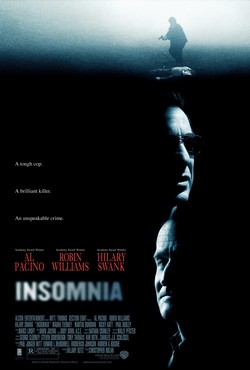
Insomnia File #22: Insomnia (dir by Christopher Nolan)


What’s an Insomnia File? You know how some times you just can’t get any sleep and, at about three in the morning, you’ll find yourself watching whatever you can find on cable? This feature is all about those insomnia-inspired discoveries!

Last night, if you were up at 2 in the morning, you could have turned over to Starz and watched the atmospheric 2002 mystery, Insomnia.

I have to admit that I’m cheating a little bit by including Insomnia in a series about obscure films that you might find on cable late at night.  While Insomnia does seem to often turn up during the early morning hours, it’s hardly an obscure film.  A remake of an acclaimed Norwegian film, it not only stars three Oscar winners (Al Pacino, Robin Williams, and Hilary Swank) but it was directed by Christopher Nolan.  Insomnia got a lot of attention when it was first released in 2002.  But, doing an insomnia file about a movie that’s actually about insomnia was just too good of an opportunity to pass up.

I should also mention that I didn’t have insomnia last night.  I was up because I currently have a cold and I watched Insomnia in a feverish and congested haze.  And yet I couldn’t help but feel that, somehow, that was actually the ideal way to watch Insomnia.  With its ominous atmosphere and Nolan’s eye for the surreal, Insomnia plays out like a semi-lucid fever dream.

A teenage girl has been murdered in a small Alaskan fishing village.  The chief of police (played by the great character actor Paul Dooley) asks his former LAPD partner, Will Dormer (Al Pacino), to come to Alaska and help with the investigation.  Accompanying Dormer is his partner and friend, Hap Eckhart (Martin Donovan).

Dormer has issues that go far beyond anything happening in Alaska.  He’s burned out and he’s plagued by rumors that, in the past, he was a crooked cop.  He’s being investigated by Internal Affairs and, shortly after they arrive in Alaska, Eckhart admits that he’s been given immunity as part of a deal to testify against Dormer.  While pursuing the suspected murderer through the Alaskan fog, Dormer fires his gun.  When the fog clear, Dormer discovers that he’s killed Eckhart.  Was it an accident or did Dormer intentionally shoot  his partner?  Not even Dormer seems to know for sure.  He lies and says that the murderer shot Eckhart.

Working with a local detective (Hilary Swank), Dormer tries to solve the Alaska murder, with the knowledge that, once he does, he’ll have to return to Los Angeles and he’ll probably be indicted.  Because of the midnight sun, night never falls in Alaska and, tortured by guilt, Dormer cannot sleep.  Add to that, the murderer knows that Dormer shot Eckhart.  And now, he’s calling Dormer and cruelly taunting him.

Who is the murderer?  His name is Walter Finch.  He’s a writer and, in a stroke of brilliance, he’s played by none other than Robin Williams.  To me, Robin Williams’s screen presence always carried hints of narcissism and self-destruction.  Even in comedic roles, there was a transparent but very solid wall between Williams the audience.  When he was shouting out a thousand words a minute and rapidly switching from one character to the next, it always seemed as if it was all a technique to keep anyone from figuring out who he really was.  In Insomnia (and, that same year, in One Hour Photo), Robin Williams reveals an inner darkness that he rarely showed before or after.  Finch may possess Williams’s trademark eccentric smile and nervous voice but, underneath the surface, he’s an empty shell who views human beings as being as disposable as the characters in his paperback novels.

Christopher Nolan takes us directly into the heads of these two enemies, with shots of the desolate Alaskan landscape seeming to perfectly capture the inner desolation of two minds destroyed by guilt and paranoia.  (Neither Finch nor Dormer is capable of connecting with the world outside of his damaged psyche.)  As seen through Nolan’s lens, Alaska becomes as surreal and haunting as one of the dream landscapes from Inception.  For those of us who found both The Dark Knight Rises and Interstellar to be so bombastic that they verged on self-parody, Insomnia is a nice reminder that Nolan doesn’t need a pounding Han Zimmer score to make a great movie.  With Insomnia, Nolan gives us not bombast but a deceptively low-key and atmospheric journey into the heart of darkness.

Ironically, for a film about two men who cannot sleep, Insomnia will haunt your dreams.

insomnia2002poster

Previous Insomnia Files:

  1. Story of Mankind
  2. Stag
  3. Love Is A Gun
  4. Nina Takes A Lover
  5. Black Ice
  6. Frogs For Snakes
  7. Fair Game
  8. From The Hip
  9. Born Killers
  10. Eye For An Eye
  11. Summer Catch
  12. Beyond the Law
  13. Spring Broke
  14. Promise
  15. George Wallace
  16. Kill The Messenger
  17. The Suburbans
  18. Only The Strong
  19. Great Expectations
  20. Casual Sex?
  21. Truth

Lisa’s Too Early Oscar Predictions For February


Oscars

Well, it’s that time again!

Every month this year, I am updating my predictions for which films and performers will be nominated for Oscars in 2018.  At this point in the year, this is largely an academic exercise.  The nominees below are a mix of wild guesses, instinctual feeling, and wishful thinking.  Usually, a clear picture of the Oscar race doesn’t start to form until October at the earliest.  (Last year, at this time, nobody had even heard of Moonlight or Hell or High Water.)  In other words, take these predictions with a grain of salt.

This update is heavily influenced by what happened at the Sundance Film Festival last month.  In fact, it’s probably a bit too influenced by Sundance.  If these predictions turned out to be 100% correct, the 2018 Oscars would be the Sundance Oscars.  That said, it seems that there’s always a few successful Oscar campaigns that start during Sundance.  (And then there’s always a few Sundance sensations that totally fizzle during awards season.  Birth of a Nation, anyone?  Or perhaps The End of the Tour.)  But, as of right now, Sundance is pretty much the only thing that we have to go on, as far as future Oscar contenders are concerned.

Again, take all of this with a grain of salt.  Just because I may brag about knowing what I’m talking about, that doesn’t necessarily mean that I do.

Check out January’s predictions here! 

And without further ado…

Mudbound

Mudbound

Best Picture

Battle of the Sexes

The Beguiled

The Big Sick

Blade Runner 2047

Call Me By Your Name

Darkest Hour

Downsizing

Dunkirk

Mudbound

The big additions here are Mudbound, The Big Sick, and Call Me By Your Name, all three of which got a lot of attention and acclaim at Sundance.  Both Mudbound and Call Me By Your Name are already being mentioned, by some Oscar bloggers, as possible winners for best picture.  The Big Sick may seem like more of a dark horse but, from what I’ve read, it sounds like the sort of movie that could emerge as a surprise contender.  With its Muslim protagonist and its mix of comedy and drama, it sounds like it could catch the cultural zeitgeist.

Dropping from the list: T2, All Eyez On Me, and War Machine.  T2 has gotten good but not great reviews in the UK.  As for All Eyez on Me and War Machine — well, it’s just a feeling I have.  Both of them could be good but it’s easier to imagine a scenario in which they’re both disappointments.

Best Director

Luca Guadagnino for Call Me By Your Name

Christopher Nolan for Dunkirk

Alexander Payne for Downsizing

Dee Rees for Mudbound

Denis Villeneuve for Blade Runner 2047

Guadagnino and Rees are new contenders.  Rees would be the first black woman ever nominated for best director.

Best Actor

Chadwick Boseman in Marshall

Timothée Chalamet in Call Me By Your Name

Tom Cruise in American Made

Kumail Nanjiani in The Big Sick

Gary Oldman in Darkest Hour

I’m a little bit iffy on Chadwick Boseman.  In Marshall, he will be playing Thurgood Marshall, which sounds like a good, Oscar baity role.  But Marshall itself sounds like a rather standard biopic.  Timothee Chalamet and, especially, Kumail Nanjiani received a lot of Sundance acclaim.  The fact that Nanjiani has been outspoken in his opposition to Trump’s travel ban will probably help his chances.

Sundance was also responsible for Logan Lerman falling off this list.  Sidney Hall got terrible reviews.

Best Actress

Judi Dench in Victoria and Abdul

Danielle MacDonald in Patti Cake$

Carey Mulligan in Mudbound

Lois Smith in Marjorie Prime

Emma Stone in Battle of the Sexes

Among the new additions, Danielle MacDonald was one of the break-out stars at Sundance.  Carey Mulligan is due to get another nomination (and Mudbound is expected to be a major Oscar contender).  As for Lois Smith, she’s a respected veteran actress who gets to play a rare lead role in Marjorie Prime.  So, why not a nomination?

Best Supporting Actor

James Franco in The Masterpiece

Armie Hammer in Call Me By Your Name

Jason Mitchell in Mudbound

Bill Skarsgard in It

Michael Stuhlbarg in Call Me By Your Name

I’m continuing to predict a nomination for James Franco and yes, it probably is just wishful thinking on my part.  But dammit, I just like the idea of Franco getting a nomination for playing Tommy Wiseau.

Skarsgard is probably wishful thinking as well.  If It works, it will be because of Skarsgard’s performance as Pennywise.

Finally, Hammer, Mitchell, and Stuhlbarg are our Sundance nominees.  Many people think that all three are overdue for some Academy recognition.  (There’s some debate over whether Hammer should go supporting or lead for Call Me By Your Name.  I’m going to assume that he’s going to pull a Viola Davis and go supporting.)

Best Supporting Actress

Mary J. Blige in Mudbound

Holly Hunter in The Big Sick

Melissa Leo in Novitiate 

Kristin Scott Thomas in Darkest Hour

Tilda Swinton in War Machine

As always, this is the most difficult category to predict.  Blige, Hunter, and Leo are all Sundance nominees.  (Hunter is especially said to be award-worthy in her Big Sick role.)  For the second month in a row, Scott Thomas and Swinton are listed more because of who they are than any other reason.

The Big Sick

The Big Sick

Lisa Watches An Oscar Winner: Midnight Cowboy (dir by John Schlesinger)


midnight_cowboy

Tonight, I watched the 1969 winner of the Oscar for Best Picture, Midnight Cowboy.

Midnight Cowboy is a movie about Joe Buck.  Joe Buck is played by an impossibly young and handsome Jon Voight.  Joe Buck — and, to be honest, just calling him Joe seems wrong, he is definitely a Joe Buck — is a well-meaning but somewhat dumb young man.  He lives in Midland, Texas.  He was raised by his grandmother.  He used to go out with Annie (Jennifer Salt) but she eventually ended up being sent to a mental asylum after being raped by all of Joe Buck’s friend.  Joe Buck doesn’t have many prospects.  He washes dishes for a living and styles himself as being a cowboy.  Being a Texan, I’ve known plenty of Joe Bucks.

Joe Buck, however, has a plan.  He knows that he’s handsome.  He’s convinced that all women love cowboys.  So, why shouldn’t he hop on a bus, travel to New York City, and make a living having sex with rich women?

Of course, once he arrives in the city, Joe Buck discovers that New York City is not quite as inviting as he thought it would be.  He lives in a tiny and dirty apartment.  He can barely afford to eat.  Walking around the city dressed like a cowboy (and remember, this was long before the Naked Cowboy became one of the most annoying celebrities of all time) and randomly asking every rich woman that he sees whether or not she can tell him where he can find the Statue of Liberty, Joe Buck is a joke.  Even when he does get a customer (played, quite well, by Sylvia Miles), she claims not to have any money and Joe Buck feels so sorry for her that he ends up giving her his money.

midnight3crowd

As I watched the first part of the movie, it stuck me that the main theme of Midnight Cowboy appeared to be that, in 1969, New York City was literally Hell on Earth.  But then Joe Buck has flashbacks to his childhood and his relationship with Annie and it quickly became apparent that Midland, Texas was Hell on Earth as well.  Towards the end of the film, it’s suggested that Miami might be paradise but not enough to keep someone from dying on a bus.

Seriously, this is a dark movie.

Joe Buck eventually meets Ratso Rizzo (Dustin Hoffman).  Ratso’s real name is Enrico but, after taking one look at him, you can’t help but feel that he’s a perfect Ratso.  Ratso is a con man.  Ratso is a petty thief.  Ratso knows how to survive on the streets but New York City is still killing him.  As a child, Ratso had polio and now he walks with a permanent limp.  He coughs constantly, perhaps because he has TB.  Ratso becomes Joe Buck’s manager and roommate (and, depending on how you to interpret certain scenes and lines, perhaps more) but only after attempting to steal all of his money.

Unfortunately, Ratso is not much of a manager.  Then again, Joe Buck is not much of a hustler.  Most of his customers are men (including a student played by a young but recongizable Bob Balaban), but Joe Buck’s own sexual preference remaining ambiguous.  Joe Buck is so quick to loudly say that he’s not, as Ratso calls him, a “fag” and that cowboys can’t be gay because John Wayne was a cowboy, that you can’t help but suspect that he’s in denial.  When he’s picked up by a socialite played by Brenda Vaccaro, Joe Buck is impotent until she teases him about being gay.  In the end, though, Joe Buck seems to view sex as mostly being a way to make money.  As for Ratso, he appears to almost be asexual.  His only concern, from day to day, is survival.

Did I mention this is a dark movie?

And yet, as dark as it is, there are moments of humor.  Joe Buck is incredibly dense, especially in the first part of the movie.  (During the second half of the film, Joe Buck is no longer as naive and no longer as funny.  It’s possible that he even kills a man, though the film is, I think, deliberately unclear on this point.)  Ratso has a way with words and it’s impossible not to smile when he shouts out his famous “I’m walking here!” at a taxi.  And, as desperate as Joe Buck and Ratso eventually become, you’re happy that they’ve found each other.  They may be doomed but at least they’re doomed together.

warhols-party

There’s a lengthy party scene, one that features several members of Andy Warhol’s entourage.  I was a bit disappointed that my favorite 60s icon, Edie Sedgwick, was nowhere to be seen.  (But be sure to check out Ciao Manhattan, if you want to see what Edie was doing while Joe Buck and Ratso Rizzo were trying not to starve.)  But, as I watched the party scene, I was reminded that Midnight Cowboy is definitely a film of the 60s.  That’s both a good and a bad thing.  On the positive side, the late 60s and 70s were a time when filmmakers were willing to take risks.  Midnight Cowboy could only have been made in 1969.  At the same time, there’s a few moments when director John Schlesinger, in the style of many 60s filmmakers, was obviously trying a bit too hard to be profound.  Some of the flashbacks and fantasy sequences veer towards the pretentious.

Fortunately, the performances of Voight and Hoffman have aged better than Schlesinger’s direction.  Hoffman has the more flamboyant role (and totally throws himself into it) but it really is Voight who carries the film.  Considering that he’s playing a borderline ludicrous character, the poignancy of Voight’s performance is nothing short of miraculous.

Midnight Cowboy was the first and only X-rated film to win best picture.  By today’s standards, it’s a PG-13.