30 Days of Noir #1: Lady Gangster (dir by Robert Florey)


Welcome to Noirvember!

Yeah, yeah, I know.  That sounds kinda silly, doesn’t it?  However, November is traditionally the month that classic film bloggers tend to concentrate on writing about film noir.  It provides a bit of grit and cynicism in between the horror fun of October and the holiday schmaltz of December.

I have to admit that I’m a little bit torn when it comes to taking part in Noirvember.  On the one hand, I love a good film noir and there’s quite a few obscure and underrated ones available on YouTube right now.  On the other hand, as a natural-born contrarian, I don’t like the idea of hopping on any bandwagons.

In the end, my love of film noir won out.  So, welcome to my first entry in 30 Days of Noir.


The 1942 film, Lady Gangster, opens with Dot Burton (Faye Emerson) walking up to a bank.  She’s carrying a small white dog with her.  Though the bank isn’t due to open for another 30 minutes, she explains to the bank guard that she’s got a train to catch and she simply has to deposit a check.  The guard unlocks the door and lets both her and her dog inside.

While filling out her deposit slip, Dot puts the dog down on the floor.  The dogs runs off, distracting the guard just long enough for three men with guns to slip into the bank and rob the place.  Though the police quickly arrive, the men manage to escape, taking $400,000 with them.

The police are immediately suspicious of Dot, especially when she struggles to keep her story straight as to why she’s at the bank.  The lead detective thinks that Dot was in on it.  Dot says that she was merely out for a stroll with her dog.  Dot says that her dog is named Tiny.  The dog, which looks exactly like one that was recently reported missing, is wearing a collar that reads “Boots.”

The district attorney announces that Dot will be prosecuted to the full extent of the law.  However, a crusading radio broadcaster named Ken Phillips (Frank Wilcox) is convinced that Dot is being railroaded.  Once he realizes that he went to high school with her, Ken is even more determined to help Dot.  Using the power of the airwaves, he forces the district attorney to release Dot into his custody.  Once free, Dot promptly confesses to Ken that she was a part of the robbery and that she’s hidden the money.  An indignant Ken turns her into the police.

So now, Dot’s in prison and no one’s sure where the money is.  One of the bank robbers even dresses up like a woman so that he can see Dot on visiting day but she refuses to tell him anything.  Dot isn’t going to reveal where the money is unless it means she can also get parole.  She needs to get released soon because she’s already got two psychotic snitches targeting her.

Fortunately, Ken has had a change of heart and is lobbying for her release.  Unfortunately, Dot has been tricked into believing that Ken has once again betrayed her so, naturally enough, she sets him up to be murdered.  When Dot discovers that she’s been fooled, can she find a way to warn Ken before it’s too late?

Believe it or not, all of this happens over the course of 62 minutes.  With that many betrayals, twists, and crimes packed into that short of a running time, there’s never a dull moment in Lady Gangster.  Though the film itself is full of huge plot holes and Frank Wilcox is a bit of a stiff as Ken, the film is totally worth seeing for Faye Emerson’s ferocious performance as Dot Burton.  Dot is a force of nature.  When the robbers try to steal her money, Dot instead steals from them.  When Dot believes that Ken has betrayed her, she sets him up to be murdered with a moment of hesitation.  When Dot discovers that Ken didn’t betray her, she immediately starts scheming to prevent the murder that she arranged.  Even when Dot confesses to being a part of the robbery, she does it on her own terms.  Nobody tells Dot what to do and, in that way, she represents the best of America.  As Dot herself explains it, “I’ll play ball with anyone but Hitler.”

The film has a rather odd ending, one that makes you wonder just how forgiving people generally were back in 1942.  But no matter!  Lady Gangster is a quickly paced movie that’s just melodramatic enough to be enjoyable.  It’s in the public domain and on YouTube.  Watch it for Faye Emerson’s performance.

Insomnia File #38: Six: The Mark Unleashed (dir by Kevin Downes)


What’s an Insomnia File? You know how some times you just can’t get any sleep and, at about three in the morning, you’ll find yourself watching whatever you can find on cable? This feature is all about those insomnia-inspired discoveries!

If on Sunday night, if you were having trouble getting to sleep around midnight and if you lived in North Texas, you could have turned over to channel 58 and watched a 2004 film called Six: The Mark Unleashed.

Six: The Mark Unleashed is an evangelical film about the end of the world.  By that, I mean there’s a lot of talk about tribulation, the mark of the Beast, and all the rest of that.  The whole world is one big secular dystopia, in which people who refuse to accept the mark of the beast are sent to prison and given the choice of either getting the mark or getting their head chopped off.

I think one reason why so many faith-based films deal with the end of the world is because it allows characters to rebel, break the law, blow stuff up, and steal cars while still getting to remain a believer.  I mean, usually, you run into the problems of turning the other cheek and giving unto Caesar what is Caesar’s but, once you’ve been left behind, you can pretty much do anything you want because you’re fighting against Satan.

Now, admittedly, the car thieves in Six aren’t into religion.  They’re just rebels who didn’t want to get the mark and who are talked into stealing a car by Eric Roberts.  (That’s right, Eric Roberts is in this movie.  Eventually, Eric Roberts will be in every movie.)  Anyway, the two thieves get caught in that stolen car and they get sent to prison.

Also getting sent to prison is Tow Newman, who is a smuggler who was arrested by his own ex-wife!  Tom is given the option of either losing his head or infiltrating a group of Christians and killing their leader.  What’s interesting about this is that Tom is played by Jeffrey Dean Morgan.  That’s right.  Negan is in this movie!  Morgan goes all in and does a pretty good job as Tom.  In fact, I’d say his performance here is more interesting than his work on The Walking Dead.  It helps, of course, that Tom is the only person in the film who actually has a character arc.

Stephen Baldwin’s in the movie, too.  That’s not really a shock because it’s a proven statistic that 9 out of 10 evangelical movies will feature Stephen Baldwin.  Anyway, Baldwin plays Luke, who is a prison preacher and who teaches everyone about peace and forgiveness.  He gets beat up for his troubles.

In the end, it all leads to three characters being tortured until they agree to accept the mark of the beast.  Two of them refuse and lose their heads.  One says yes and regrets it forever.  Try to guess who does what!  It’s fun.

Anyway, I have to admit that I always find these low-budget, independent films to be a little bit fascinating.  It’s always interesting to me to see movies that were obviously made with one very specific audience in mind, whether that audiences is religious, political, or whatever.  Six is the type of film that, quite literally, preaches to the choir.  Those who share its vision of the end of the world will nod in agreement.  Those who do not will roll their eyes.  Both sides will probably end up getting too worked up, since that’s what people tend to do.  Myself, I just find myself wondering if there’s any role that Eric Roberts would turn down.

Previous Insomnia Files:

  1. Story of Mankind
  2. Stag
  3. Love Is A Gun
  4. Nina Takes A Lover
  5. Black Ice
  6. Frogs For Snakes
  7. Fair Game
  8. From The Hip
  9. Born Killers
  10. Eye For An Eye
  11. Summer Catch
  12. Beyond the Law
  13. Spring Broke
  14. Promise
  15. George Wallace
  16. Kill The Messenger
  17. The Suburbans
  18. Only The Strong
  19. Great Expectations
  20. Casual Sex?
  21. Truth
  22. Insomina
  23. Death Do Us Part
  24. A Star is Born
  25. The Winning Season
  26. Rabbit Run
  27. Remember My Name
  28. The Arrangement
  29. Day of the Animals
  30. Still of The Night
  31. Arsenal
  32. Smooth Talk
  33. The Comedian
  34. The Minus Man
  35. Donnie Brasco
  36. Punchline
  37. Evita

Horror Film Review: Buffy the Vampire (dir by Fran Rubel Kuzui)


Watching this movie was such a strange experience.

Now, of course, I say that as someone who grew up watching and loving the television version of Buffy the Vampire Slayer.  Back when Buffy was on TV, I was always aware that the character had first been introduced in a movie but every thing I read about Buffy said that the movie wasn’t worth watching.  It was a part of the official Buffy mythology that Joss Whedon was so unhappy with what was done to his original script that he pretty much ignored the film when he created the show.

So, yes, the 1992 movie version of Buffy the Vampire Slayer showed how Buffy first learned that she was a slayer, how she fought a bunch of vampires in Los Angeles, and how her first watcher met his end.  But still, Joss Whedon was always quick to say that the film should not be considered canonical.  Whenever anyone on the TV show mentioned anything from Buffy’s past, they were referencing Joss Whedon’s original script as opposed to the film that was eventually adapted from that script.  (For instance, on the tv series, everyone knew that Buffy’s previous school burned down.  That was from Whedon’s script.  However, 20th Century Fox balked at making a film about a cheerleader who burns down her school so, at the end of the film version, the school is still standing and romance is in the air.)  In short, the film existed but it really didn’t matter.  In fact, to be honest, it almost felt like watching the movie would somehow be a betrayal of everything that made the televisions series special.

Myself, I didn’t bother to watch the film version of Buffy the Vampire Slayer until several years after the television series was canceled and, as I said at the start of the review, it was a strange experience.  The movie is full of hints of what would make the television series so memorable but none of them are really explored.  Yes, Buffy (played here by Kristy Swanson) has to balance being a teenager with being a vampire slayer but, in the film, it turns out to be surprisingly easy to do.  Buffy is just as happy to be a vampire slayer as she is to be a cheerleader.  In fact, one of the strange things about the film is just how quickly and easily Buffy accepts the idea that there are vampires feeding on her classmates and that it’s her duty to destroy them.  Buffy’s watcher is played by Donald Sutherland and the main vampire is played by Rutger Hauer, two veteran actors who could have played these roles in their sleep and who appear to do so for much of the film.  As for Buffy’s love interest, he’s a sensitive rebel named Oliver Pike (Luke Perry).  On the one hand, it’s fun to see the reversal of traditional gender roles, with Oliver frequently helpless and needing to be saved by Buffy.  On the other hand, Perry and Swanson have next to no chemistry so it’s a bit difficult to really get wrapped up in their relationship.

I know I keep coming back to this but watching the movie version of Buffy is a strange experience.  It’s not bad but it’s just not Buffy.  It’s like some sort of weird, mirror universe version of Buffy, where Buffy starts her slaying career as a senior in high school and she never really has to deal with being an outcast or anything like that.  (One gets the feeling that the movie’s Buffy wouldn’t have much to do with the Scooby Gang.  Nor would she have ever have fallen for Angel.)  Kristy Swanson gives a good performance as the film version of Buffy, though the character is not allowed to display any of the nuance or the quick wit that made the television version a role model for us all.  Again it’s not that Buffy the movie is terrible or anything like that.  It’s just not our Buffy!

The TSL’s Daily Horror Grindhouse: Vampire Circus (dir by Robert Young)


One of the greatest Hammer vampire films didn’t even star Christopher Lee.  In fact, it wasn’t even a Dracula film.  Instead, it was the story of a circus.

1971’s Vampire Circus tells the dark story of a Serbian village called Stetl.  Early in the 19th century, the children of Stetl are dying.  The superstitious villagers believe that Count Mitterhaus (Robert Tayman) might be responsible.  In fact, they suspect that Count Metterhaus might be a vampire!  Why?  Well, first off, he only seems to be around during the night.  Secondly, he lives in a big spooky castle.  Third, he’s a count and don’t all counts eventually become vampires?

Now, it would be nice to say that all this turned out to be a case of the villagers letting their imaginations get the better of them but nope.  It turns out that they’re pretty much right.  One night, the local teacher, Albert Muller (Laurence Payne), sees his own wife, Anna (Domini Blythe) leading a child towards the dark castle.  It turns out that Anna has fallen under the spell of Count Mitterhaus.  The villagers promptly drive a stake through the Count’s heart, though he manages to do two things before dying.  First off, he curses the town and announces that the blood of their children will give him new life.  Secondly, he tells Anna to escape and track down his brother.

Fifteen years later and, as one might expect, Stetl is a town under siege.  However, the town is not being attacked by vampires.  (Not yet anyway.)  Instead, the town has been hit by the plague and, as a result, it’s been isolated from the outside world.  Men with guns have surrounded the town and are under orders to kill anyone who tries to leave or enter.  Some in the village believe that this is the result of the Count’s dying curse while others just see it as more evidence of man’s inhumanity to man.  Regardless, it’s not good situation.

Fortunately, escape arrives in the form of the Circus of the Night!  That’s right, a gypsy carnival suddenly appears in town.  How did it manage to slip by the blockade?  Who knows and who cares?  What’s important is that the villagers, especially their children, need an escape from their grim existence and the Circus seems to offer something for everyone.  There are dancers.  There are acrobats.  There’s the mysterious tiger woman.  There’s a mirror that makes you see strange things.  And, of course, the are vampires….

That’s not really a shock, of course.  The name of the film is Vampire Circus, after all.  What always takes me by surprise is just how ruthless and cruel the vampires are in this film.  Even by the standards of a 1970s Hammer film, this is a blood-filled movie but, even beyond that, the vampires almost exclusively seem to target children.  Fortunately, all of Stetl’s children tend to be a bit obnoxious but it’s still a shock to see two fresh-faced boys get lured into a mirror where they are both promptly attacked by a vampire.  (And don’t even get me started on what happens when one of the vampires comes across a boarding school.)  Make no mistake, this circus is not made up of the type of self-tortured, romanticized vampires that have dominated recent films.  These vampire are utterly viscous and without conscience.  In other words, these vampires are actually frightening.

The members of the circus are, themselves, a memorable bunch.  David Prowse is the hulking strongman.  Lalla Ward and Robin Sachs are the achingly pretty, innocent-faced twin acrobats who greedily drink the blood of anyone foolish enough to wander off with them.  Some members of the circus can transform into animals.  What’s interesting is that not all of the members of the circus are vampires.  Some of them, I guess, are just groupies.

Featuring the reddest blood that you’re ever likely to see and a cast of memorably eccentric character actors, Vampire Circus often feels more like an extremely dark fairy tale than a typical Hammer vampire film.  Clocking in at 87 minutes, Vampire Circus is a briskly paced dream of carnivals and monsters.


Let’s Talk About Killer Under The Bed (dir by Jeff Hare)


Killer Under The Bed aired on the Lifetime network back on October 20th and, at first glance, it might sound like a typical lifetime film.

Recent widow Sarah (Kristy Swanson) has moved into a new house and gotten a new job.  She has two teenage daughters, both of whom are still struggling to deal with the death of their father.  The older daughter is Chrissy (Madison Lawlor), the star athlete who is protective of her younger sister, even if she’s not always willing to admit it.  Kilee (Brec Bassinger) meanwhile is struggling to escape from her sister’s shadow and fit in at her new school.

Consider some of what Kilee has to deal with.  The school’s resident mean girls are determined to destroy her.  She has a crush on one of her teachers and he seems to be growing more and more obsessed with her.  Kilee has a secret that she can’t tell her mother or her sister and Kilee fears that everyone blames her for what happened to her father.

As I said, it sounds like a typical Lifetime situation but here’s the twist.  Almost all of Kilee’s problem can be linked to the rather ugly doll that she stumbled across in her new home.  Much like buying weed in Colorado and then trying to sell it for a profit in Wyomng, having a voodoo doll seemed like a good idea at first.  By making wishes, Kilee not only punished the school bully but she also resolved a conflict between her mom and a co-worker.  And when Kilee wished that her teacher would love her, he went from holding her at a polite distance to suddenly sending her flirtatious texts and photoshopping their faces onto wedding advertisements!

But, much like a Colorado weed dealer spending the night in a Wyoming jail, Kilee soon discovers that nothing’s ever as easy as it seems.  Even the best of ideas have consequences.  For one thing, the doll has the power to drive people crazy.  Secondly, the doll itself is a bit possessive and has a temper.  When Chrissy comes across the doll and tries to throw it away, the doll responds by climbing out of the trashcan and reentering the house.  Later, when the school bully tries to steal the doll, the doll responds by attacking her with a knife.  Soon, the doll is crawling around the house, hiding underneath beds, and creating all sorts of mayhem.

Oh my God, this was such a great movie!  From the minute that doll unzipped Kilee’s backpak so that it could escape to raise havoc, I knew I was watching a great film.  Killer Under The Bed is totally over the top and just so wonderfully ludicrous that there’s no way that you can’t have fun watching it.  Between the killer doll, the bullies that were so evil that seemed like they should be plotting against The Avengers, and the perpetually confused teacher, Killer Under The Bed was way too much fun.

In the past, I’ve been told that Lifetime tends to be resistant to horror movies.  They really should rethink that policy.  Killer Under The Bed is one of the most entertaining Lifetime films that I’ve seen in a while.

Put On Your Silver Shamrock Masks, It’s Time….


It’s time.

Evening approaches.  The sun is setting.  It’s time to start counting treats and perhaps playing a few tricks.  In other words, it’s time to put on your Silver Shamrock masks and gather around the television….

(Actually, its seem like Silver Shamrock would have more success if they had a bigger online presence but I guess they like to do things the old-fashioned way….)


Let’s Talk About Dead In The Water (dir by Sheldon Wilson)


One of the great things about October is that, along with Shark Week, it’s one of the few times during the year that the SyFy channel still shows original horror films.  Unfortunately, I ended up getting a little bit swamped with stuff this month so I didn’t get a chance to review this year’s collection of movies when they originally aired.  Hopefully, I’ll be able to make up for that today and tomorrow.

Dead In The Water, which aired on October 27th, is a nautical horror story that will probably remind you of a few other horror films.  (Of course, if you’ve watched enough SyFy films, you know that’s not necessarily a complaint.)  Like The Descent, it features an almost entirely female cast.  Like Ghost Ship, it takes place within the claustrophobic confines of a boat floating on the ocean and there’s literally no escape to escape to be found.  Like an Alien film, it’s essentially a siege film in which we watch the film’s cast attempts to survive an attack from a relentless enemy that keeps coming and coming.  And finally, much like John Carpenter’s The Thing, the enemy is an alien who jumps from victim to victim.  You’re never quite sure who might be real and who might be possessed.  It’s all about the paranoia.

Dead in the Water follows the crew of a boat that gets lost in a thick bank of fog.  When they come across a man floating in the ocean, they pull him out and start to examine him.  He’s still alive, though barely.  He implores them to kill him and then kill themselves.  He says that the only way to “end this.”  After they oblige the first half of his request, the crew members speculate that may have had a virus but a video on his phone reveals a far different story.  Apparently, the man was the last survivor of a group of scientists who came across an alien life form in the Arctic sea.  With an alien life form now running around the boat, the crew must attempt to survive while a terrible storms rages outside.

Both thematically and visually, Dead In The Water is one of those films where everything is really, really dark.  In fact, the film was so dark that it was sometimes difficult to see just what exactly was happening on the screen.  At times, this was effective.  After all, fear of the dark is one of the big phobias and the darkness made it easier for the alien to do its thing.  That said, I would someday like to see a horror film that takes place in an adequately lit room.  We’re so used to horror in the dark that I think horror in the daylight would probably be an interesting change of pace.

The best thing that Dead In The Water had going for it was its cast.  I liked the fact that not only did this horror film feature an all female cast but that they were all portrayed as being competent professionals.  No one was there just to scream and be a victim, which is something that I always appreciate.  Though the nature of the alien isn’t a huge shock, it’s still an effective little monster.  Director Sheldon Wilson does a good job of keeping the action moving and capturing the desperation of being stranded out in the middle of nowhere.  All in all, Dead In The Water was an effective October offering.

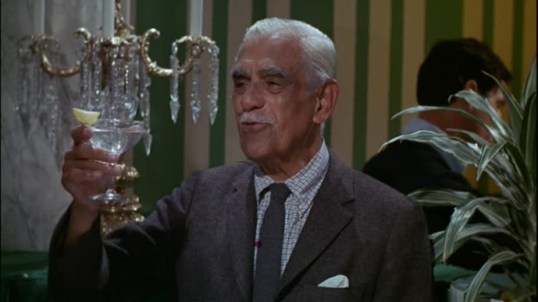
Scenes That I Love: Boris Karloff Tells A Story In Targets


In the 1968 film, Targets, Boris Karloff gave one of his final performances.  It was also one of his best.

Karloff played an aging horror actor named Byron Orlok, a role that was based on Karloff himself.  Though once a huge star, Orlok’s style of horror has gone out of fashion.  As he explains it, the real world has gotten so scary that his horror films are now tame by comparison.  In this scene, Orlok proves that he can still give a compelling performance when he recites a short story about death and fate.

Reportedly, Karloff did this scene in one take and received a standing ovation after director Peter Bogdanovich called cut.


Horror Book Review: Night of the Living Dead: Behind The Scenes of the Most Terrifying Zombie Movie Ever


Where would modern horror be without George Romero’s 1968 masterpiece, Night of the Living Dead?

Well, it’s hard to say.  Perhaps another film would have come along and influenced thousands of future directors and writers.  Maybe another film would have popularized zombies or mixed social commentary with horror.  Perhaps another film would have popularized the concept of body horror.  You never know.

Still, it’s hard not to think that modern horror would be a lot different if not for Romero’s low-budget, independent film.  So many movies have been influenced by Romero’s Dead films that it’s difficult to keep track of them all.  Even if you could discount the influence of Romero, what about the Living Dead films that were later made by John Russo?  Even if they don’t get as much attention as Romero’s films, their combination of comedy and horror continues to be influential to this day.

The 2010 book, Night of the Living Dead: Behind The Scenes Of The Most Terrifying Zombie Movie Ever, not only tells the behind-the-scenes story of Night of the Living Dead but it also examines the film’s lasting influence.  While the majority of the book is taken up with the production and reception of Night, it also discusses Romero’s subsequent Dead films, Russo’s Living Dead films, and all of the unofficial sequels and remakes as well.  Author Joe Kane interviews not only several of the people who worked on Romero’s film but also filmmakers like Danny Boyle, who discuss how Romero’s vision influenced their own.

Finally, the book also contains the original script of Night of the Living Dead!  Written by John Russo, the script makes for an interesting read.  Night of the Living Dead is often described as being some sort of “accidental” masterpiece but the script reveals that many of the film’s themes were there from the beginning.  At the same time, it also makes you appreciate not only the directorial skill of George Romero but also the performances of Judith O’Dea, Duane C. Jones, and even Karl Hardmann.  (If you thought Harry was bad in Night, reading the script will show you just how much Hardmann actually humanized an inherently unlikable character.)

This book is must have for horror fans like you and me.

Italian Horror Showcase: The Vampire and the Ballerina (dir by Renato Polselli)


“If you want to taste the night, come downstairs.”

— The Professor (Pier Ugo Gragnani) in The Vampire and The Ballerina (1960)

A young woman relaxes with her friends at a waterfall.  She sees a funeral procession passing by and cheerfully announces, “A funeral!  It brings good luck!”

One person who would disagree with that would be the girl in the coffin.  She’s just the latest villager to have been found passed out in a field in the middle of the night, lacking blood.  The locals say that there’s a vampire on the loose.  The local doctor insists that the girl is just anemic and will recover in ten days.  Instead, the girl ends up in a coffin, only opening her eyes while being carried to her grave.  From her point of view, we watch as clumps of dirt are tossed onto the coffin, one after another until finally all is dark.

At night, she leaves her grave and runs into the horribly disfigured vampire who previously bit her.  He greets her and tells her to lie down in his coffin.  As soon as she does, he drives a take through her heart and says that he must remain “the master of my world.”

It’s a strange world.  In the village, a dance troupe is, for some reason, staying at a villa belonging to an older man (Pier Ugo Gragnani) who is called both “grandpa” and “The Professor.”  (Despite the film’s title and some of the dialogue, they are clearly a modern dance troupe.)  The professor tells the dancers a story about vampires.  Everyone’s amused.  Interestingly, most of the dancers seem to believe that there is a vampire on the loose but none of them seem particularly concerned about it.  From my own experience, this is probably the most realistic part of the film.  When you’re a dancer, that’s pretty much all you worry about.

Later, two of the dancers, Luisa (Helene Remy) and Francesca (Tina Gloriani), are walking around the woods with Francesca’s fiancée, Luca (Iscaro Ravaiolli) when it starts to rain.  They take refuge in a nearby castle, one which they believe to be deserted.  It turns out that it’s not.  Countess Alda (Maria Luisa Rolando) lives there with her manservant, Herman (Walter Brandi).  Alda explains that she allows the villagers to believe the castle is deserted and haunted because she doesn’t want to be bothered by them.  Luca is immediately enchanted with Alda while Francesca wonders why Alda looks exactly like the woman in a 400 year-old painting that is hanging in the dining room.  Luisa wanders off and gets bitten by the same disfigured vampire who has been preying on the villagers.

That night, Luisa waits in bed until the vampire comes to her.  Meanwhile Luca sneaks back to the castle to see Alda.  Alda claims that Herman is holding her prisoner but, when Herman suddenly shows up, Alda orders Luca away and proceeds to drink Herman’s blood and he goes from being a handsome servant to being the disfigured vampire that we saw earlier in the film.  It turns out that Alda and Herman’s blood-soaked relationship is all about trying to stay young.  When Herman ages, he drinks the villager’s blood to become young again.  Then Alda drinks his blood to retain her youth, which means that the now aged Herman again has to go out and drink more villager blood….

Meanwhile, the dance troupe’s choreographer has a brilliant idea!  Why don’t they do a number about vampires!?

1960’s The Vampire and the Ballerina is a personal favorite of mine.  That really shouldn’t surprise anyone, of course.  I love vampires.  I love to dance.  Of course, I’m going to love a film that brings those two things together!  But beyond that, The Vampire and The Ballerina is just such a strange little film.  From the off-center performances to Angelo Baistrocchi[‘s haunting cinematography, The Vampire and the Ballerina plays out like a filmed fever dream. The fact that the plot often doesn’t make sense only adds to the film’s surreal atmosphere.

Continuing what Hammer started with the Horror of Dracula, The Vampire and the Ballerina takes the sexuality that has always been the subtext of most vampire films and instead puts it front and center.  The formerly repressed Luisia writhes in bed as she waits for the vampire to come to her.  Luca stares at Alda with an obsessive intensity before forcefully kissing her hand.  Alda and Herman torment each other, even though one could not exist without the other, a relationship that is more sado-masochistic than supernatural.

The Vampire and the Ballerina is an Italian horror film that deserves to be better known than it is.  I mean, seriously, how can anyone resist a movie that has this many vampires and this much dancing?

It’s a strange world.