Insomnia File #39: Disclosure (dir by Barry Levinson)


What’s an Insomnia File? You know how some times you just can’t get any sleep and, at about three in the morning, you’ll find yourself watching whatever you can find on cable? This feature is all about those insomnia-inspired discoveries!

On Tuesday, if you were having trouble getting to sleep around one in the morning, you could have turned over to Cinemax and watched the 1994 film, Disclosure.

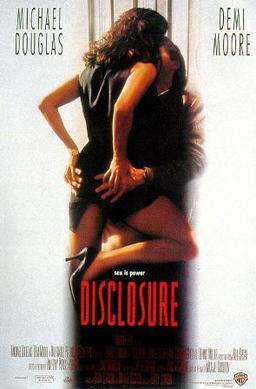
The majority of Disclosure takes place at DigiCorp, which is some sort of technology company that Bob Garvin (Donald Sutherland) founded because, as the movie explains it, he only has $100 million dollars but still dreams of being a billionaire someday.  With a huge merger approaching, Garvin announces that he will be promoting Meredith Johnson (Demi Moore) to run the new CD-ROM division.  This shocks a lot of people, as everyone was expecting the promotion to go to Tom Sanders (Michael Douglas).  However, Garvin explains that, ever since his daughter died, he’s wanted to promote a woman.

(Presumably, if a male relative had died, Tom would have gotten the promotion.  I have to admit that I kept waiting for the film to get back to the subject of Garvin’s dead daughter but, apparently, that was just an odd throw-away line.)

Tom and Meredith have a history.  They were once lovers, though Tom is now happily married to Susan (Caroline Goodall) and has a family.  Meredith takes one look at a picture of Susan and says that Tom must miss being able to take his lover from behind whenever he felt like it.  Tom says, “Mrs. Robinson,  you’re trying to seduce me.”  No, actually, he says, “No, no, no, no, no, no…..”  It all ends with Tom fleeing Meredith’s office while Meredith, in her bra, chases after him, shouting threats all the way.  The only witness to this is a cleaning lady who sadly shakes her head before returning to her dusting.

Tom is so traumatized by the experience that he has a bizarre nightmare in which Donald Sutherland says that he likes his suit and then attempts to lick his face.  Tom’s trauma continues when he goes to work the next day and discovers that Meredith has accused him of sexual harassment!  Tom responds by suing the company and it’s time for an epic courtroom battle, one that will deal with one of the most important issues of our time….

….except that never happens.  Here’s what is weird.  For all the talk about abuse of power and all the scenes of a remorseful Tom apologizing to both his wife and his secretary for his past behavior, the whole sexual harassment plot turns out to be a red herring.

Instead, the film turns into this weird techno thriller, one that involves Tom trying to figure out how to make a better CD-ROM.  That may have been a big deal back in 1994 but today, you watch the film and you think, “Who cares?”  (Even better is a scene where Garvin brags about how his company is on the cutting edge of fax technology.)  Once Tom realizes that Meredith only accused him of sexual harassment to keep him from building the perfect CD-ROM, we get a scene of him using a virtual reality headset to search through the companies files.  At one point, he spots a bot with Demi Moore’s face destroying files and he shouts out, “She’s in the system!”  It’s just strange.

The film’s plot is often incoherent but the cast keeps things amusing.  Michael Douglas spends the first half of the movie looking either annoyed or terrified.  Things pick up for him in the 2nd half of the movie.  Whenever he gets good news from his lawyer, he jumps up in the air and goes, “Yessssssss!” and it’s so dorky that it’s kind of endearing.  Meanwhile, Demi Moore doesn’t even try to make Meredith into a credible character, which is actually just the right approach to take to this material.  There’s no room for subtlety in a film as melodramatic as this.  Finally, Donald Sutherland is his usual avuncular self, smirking at all the right moments and suggesting that he finds the movie to be just as amusing as we do.  For all of its plot holes and problematic subtext, Disclosure is an entertainingly stupid film.  A lot of the credit for the entertaining part has to go to the cast.

As I said, Disclosure is just strange..  As with most films from the 90s, its sexual politics are all over the place.  On the one hand, Tom learns that even inadvertent sexism can make the women who wok with him feel unsafe.  On the other hand, the only woman with any hint of a personality is portrayed as being pure evil.  In no way, shape, or form is this a movie to be taken seriously.  Instead, this is just a weird film that cries out, “1994!”
Previous Insomnia Files:

  1. Story of Mankind
  2. Stag
  3. Love Is A Gun
  4. Nina Takes A Lover
  5. Black Ice
  6. Frogs For Snakes
  7. Fair Game
  8. From The Hip
  9. Born Killers
  10. Eye For An Eye
  11. Summer Catch
  12. Beyond the Law
  13. Spring Broke
  14. Promise
  15. George Wallace
  16. Kill The Messenger
  17. The Suburbans
  18. Only The Strong
  19. Great Expectations
  20. Casual Sex?
  21. Truth
  22. Insomina
  23. Death Do Us Part
  24. A Star is Born
  25. The Winning Season
  26. Rabbit Run
  27. Remember My Name
  28. The Arrangement
  29. Day of the Animals
  30. Still of The Night
  31. Arsenal
  32. Smooth Talk
  33. The Comedian
  34. The Minus Man
  35. Donnie Brasco
  36. Punchline
  37. Evita
  38. Six: The Mark Unleashed

Spring Breakdown #7: FYRE: The Greatest Party That Never Happened (dir by Chris Smith)


So, last night, I finally watched FYRE: The Greatest Party That Never Happened, the Netflix documentary about the infamous Fyre Festial.

As you may remember, the Fyre Festival was supposed to be the greatest party of 2017.  Influencers played it up on Instagram.  A commercial for it, one that featured the world’s top models on a beautiful island, was pretty much inescapable on Facebook.  It was going to be the greatest musical festival of all time, with luxury villas and yachts and private chefs and …. Blink-182?  Even before the entire festival was revealed to be a massive fraud, I have to admit that I was kind of like, “All this for Blink-182?”

Anyway, the festival did turn out to be a disaster.  A lot of people paid a lot of money to end up on the beach, staying in rain-soaked FEMA tents and eating pre-packaged sandwiches.  The bands cancelled so there wasn’t even any music.  After the festival was officially canceled, several people found themselves stranded on the island.  Those of us who weren’t there followed the drama on twitter.  We joked about the Lord of the of Flies.  One of my favorite tweets about the whole mess compared it to an episode of It’s Always Sunny In Philadelphia.  “The Gang Puts On A Music Festival.”

At the time, very few people had much sympathy for anyone involved in the Fyre Festival.  Not only did the organizers seem to be a group of insufferable douchebags but so did the people who paid thousands for dollars for a FEMA tent, a cheese sandwich, and Blink-182.  Having now watched the Netflix documentary …. well, I still don’t have much sympathy for the organizers or the participants.

I do have sympathy for the people who actually lived in the island.  They were taken advantage of and most of them received no financial compensation for the work that they put into the festival.  While we were all laughing on twitter, one poor restaurant owner lost a fortune feeding all of the people who were stranded in the Bahamas.  While we were making jokes, the people who actually did all the work went unpaid.

The documentary starts with festival organizer Billy McFarland and celebrity co-sponsor Ja Rule annoying Bella Hadid, Emily Ratajowski, and Hailey Baldwin on an island that once belonged to drug lord Pablo Escobar and it ends with McFarland heading for federal prison.  Billy McFarland emerges as a professional con man who built his success by exploiting people’s desire to be a part of an “exclusive” club.  Before Fyre, McFarland ran a credit card company.  Even after the disaster of the Fyre Festival, McFarland continued to use the Fyre e-mail list to try to sell VIP access that he couldn’t actually provide.  Even when under indictment, McFarland allows himself to be filmed while he brags about “hustling.”  He really can’t help himself.

Ultimately, this documentary works best as a portrait of the power of fame.  From the start, it’s obvious that the festival is going to be a disaster.  Everyone who is interviewed states that, at no point, did they think Fyre would be a success.  (One person explains that it takes at least a year to set up a successful music festival.  Fyre tried to do it in a matter of weeks.)  But, because Billy McFarland paid Kendall Jenner and a bunch of other social media superstars to promote the festival, people who should have known better paid a lot of money for a tent and a stale sandwich.  McFarland may not have known how to put on a music festival but he definitely knew how to exploit our celebrity-obsessed culture.

During the documentary, one of the festival’s organizers — Andy — tells a story about how he was prepared to give a customs official oral sex in order to get him to release a delivery of Evian water.  Reportedly, due to the success of the documentary and the popularity of that anecdote, Andy will be getting his own reality show.  That seems like a fitting coda for the whole thing.

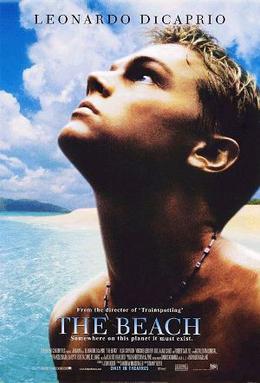
Spring Breakdown #6: The Beach (dir by Danny Boyle)


Here’s a lesson for any and all aspiring film bloggers:

Even if you’ve seen the movie before, always rewatch a film before you write about it.  This is especially true if it’s been a while since you last saw the film.  Often the pressure to say whether a film was bad or good can lead to your memory playing tricks on you.

That was certainly the case with me and the 2000 film, The Beach.  For the longest time, I remembered The Beach as being a gorgeously shot but rather shallow film, one that featured one of Leonardo DiCaprio’s least impressive performances.  Whenever I had to explain my theory that DiCaprio didn’t become a consistently good actor until 2003, The Beach was inevitably one of the film’s that I would cite as proof that, early on in his career, DiCaprio had a tendency to overact.

In short, if I hadn’t rewatched the film on Saturday morning, you would currently be reading a really negative review of The Beach.  However, I did rewatch The Beach and I discovered that both the film and DiCaprio’s performance were a lot better than I initially remembered.  Now, don’t get me wrong.  The Beach is still a frustratingly uneven film and the voice over narration (which DiCaprio recites in a rather overwrought style) still makes me cringe.  But still, it’s hardly the disaster that I initially remembered it being.

DiCaprio plays Richard, a privileged American who finds himself in Bangkok, searching for adventure.  When he meets the appropriately named Daffy (Robert Carlyle), a bemused Richard listens as Daffy talks about an uncharted island in the Gulf of Thailand.  Daffy swears that it’s a paradise that is populated by other travelers.  When Richard smirks and asks Daffy if he’s “fucked in the head,” Daffy responds by drawing Richard a map and then promptly committing suicide.  Richard and his two French friends, Françoise (Virginie Leydon) and Étienne (Guillaume Canet), go searching for the island.

And they find it!  It turns out that Daffy knew what he was talking about.  On the island, they discover a small but thriving commune.  Soon, Richard is killing sharks, having affairs, and becoming close to the leader of the commune, Sal (Tilda Swinton).  Unfortunately, Richard is also starting to lose his mind.  He grows to love paradise so much that he chooses ignore the dangers all around.  When a member of the commune is attacked by a shark, he’s left out in the middle of the jungle because no one wants to deal with the reality of his suffering.  Even more dangerous are the neighboring marijuana farmers, who allow Sal and her followers to live only under the condition that they keep the island a secret.  The problem is that Richard’s not good at keeping secrets.  Before he even knew if the island was real, Richard showed the map to a group of American surfers.  And now, the surfers are coming….

The Beach was directed by Danny Boyle, so it’s not a surprise that the film looks great and that it has an absolutely brilliant soundtrack.  (The film makes great use of both Moby’s Porcelain and Out of Control by the Chemical Brothers.)  At the same time, Boyle is too much of a subversive to fully buy into his film’s vision of paradise.  From the minute that Richard and his friends reach the island, Boyle is offering up hints that utopia isn’t as wonderful as people assume.  When Sal asks for a volunteer to accompany her to the mainland on a supply run, Boyle practically delights in showing everyone freaking out at the idea of having to indulge in responsibility.  Boyle often contrasts Richard’s pretentious narration (which, at times, sounds like it could have been lifted from a Beto O’Rourke medium post) with the rather mundane details of living on the island.  Though it may not be obvious from the start, The Beach works best when viewed as being a satire of middle and upper class ennui.

As for DiCaprio’s performance as Richard ….. well, let’s just say that he spends a lot of time yelling.  During the early part of his career — essentially the pre-Scorsese years — DiCaprio had a tendency to overact.  For all of his obvious talent, it took DiCaprio a while to really get to a point where he seemed as comfortable underplaying as he was just going totally overboard.  The Beach has its moments where DiCaprio gets awkwardly shrill.  (The scene where Richard talks about killing a shark always makes me cringe.)  But, at the same time, DiCaprio’s performance gets better as the film progresses.  (The scenes where DiCaprio is running around the jungle and trying to act like an animal are actually quite good.)  If DiCaprio’s performance sometimes seems shallow or histrionic, that’s because that’s who Richard is meant to be as a character.  (In one scene, Françoise even calls Richard out for being shallow and pretentious.)  Just because Richard’s narrating and is played by the star of the film, that doesn’t meant that we’re necessarily meant to like him.

These are all things that I didn’t really understand until I rewatched the film.  Maybe I was too immature the first time I saw the movie to understand what Boyle was really going for.  Maybe I was just having an off night the first time that I watched The Beach.  Or maybe my memory was just faulty.  For whatever reason, I’m glad that I rewatched this often uneven but still rather interesting film.  For all of its flaws. it was definitely better than I remembered.

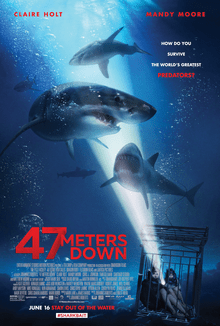
Spring Breakdown #5: 47 Meters Down (dir by Johannes Roberts)


One of the surprise box office hits of 2017, 47 Meters Down tells the story of two sisters.

Kate (Claire Holt) is free-spirited, glamorous, and always up for a new adventure.  Her older sister, Lisa (Mandy Moore) is more serious and responsible.  If Kate craves constant stimulation, Lisa seeks stability.  When we first meet them, they’re on vacation in Mexico.  Lisa has just admitted to Kate that her boyfriend has dumped her because he feels that she’s too safe and that she doesn’t take enough risks.  What is Kate’s solution to all of Lisa’s problems?  How about going on a cage dive and seeing the sharks!?

Now, I should stop right here to point out the main strengths of 47 Meters Down.  The main character is named Lisa.  For me, this made her instantly sympathetic and I was able to relate to her, even though I’ve always been more like Kate.  I can’t even begin to tell you how many movies could have been improved by renaming their main character Lisa.

Anyway, Lisa and Kate find a group of slightly seedy sailors who own a boat and a cage and soon, they’re off to see the sharks.  Before getting into the water, both Lisa and Kate are warned about all the bad things that can happen during a dive.  You can run out of oxygen.  You can get eaten by a shark.  You can resurface too quickly and get “the bends.”  We here a lot about “the bends” over the course of the film.  That’s when you get nitrogen bubbles in your brain and it can cause you to get delirious and hallucinate.  It’s a pretty serious thing but I have to admit that I kept giggling whenever anyone said, “Be careful, you’ll get the bends!” because ….. listen, it just sounds silly, okay?  I get that the bends are a real thing and that they’re really dangerous and that they should be taken seriously but “the bends’ just sounds like a punchline to a vulgar joke.  Whenever I heard anyone in the film use the term, I was just like, “Wasn’t that Beto O’Rourke’s college band?”

Lisa is nervous about going in the water.  Kate isn’t.  It turns out that maybe Lisa had the right idea because, almost immediately after Lisa and Kate are submerged, the cables holding the cage snap and suddenly, the two sisters find themselves trapped 47 meters down.  If they leave the cage and attempt to swim back up to the surface, they might very well get eaten by a shark.  And if the sharks don’t get them, there’s always …. the bends!  The men on the boat swear that they’re going to rescue the two sisters but who knows if they can be trusted.  Meanwhile, the oxygen tanks will soon be empty….

47 Meters Down may have been a surprise box office success when it was released in 2017 but the critics absolutely hated it.  Watching the film, it’s easy to see why.  The critics who complained that the film was predictable had a point.  However, the audiences who didn’t care what the critics thought had a point as well.  Silly as the film may occasionally be, it works.  When that cage sinks down into the murky darkness of the ocean, the film captures some very primal fears.  When Lisa and Kate argue about what to do next, it’s a scene to which anyone who has a sibling should be able to relate.  The relationship between Lisa and Kate felt authentic, which made the film’s final twist far more powerful than it had any right to be.

47 Meters Down is somewhat silly but it’s still an effectively entertaining look at sisters, divers, and the sharks that like to eat them.

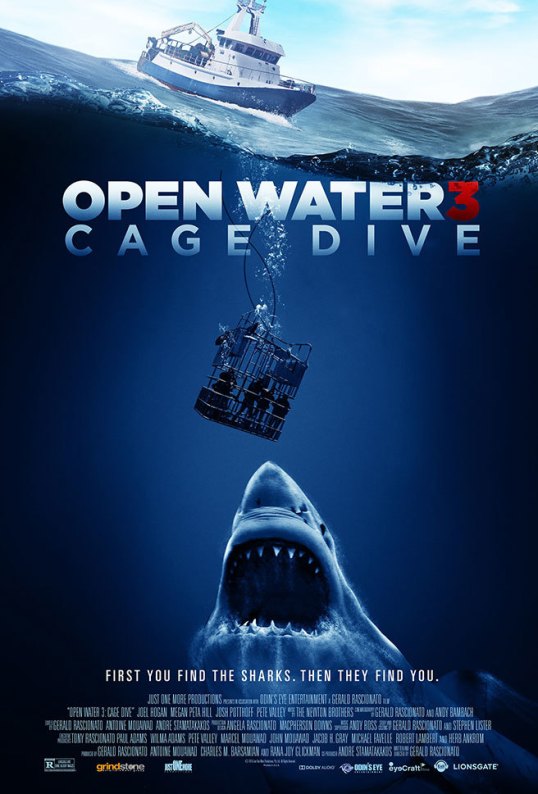
Spring Breakdown #4: Open Water 3: Cage Dive (dir by Gerald Rascionato)


Released in 2017, Cage Dive is the third installment in the Open Water franchise.  Once again, a group of friends are floating out in the middle of the ocean.  Once again, there are sharks.  There’s interpersonal conflict.  There’s death and chattering teeth and plenty of debate about who deserves the  blame and whether or not it’s a good idea to try to swim after a passing boat.  Again, it’s hard not to feel that the whole situation could have been avoided with just a little common sense.

However, there is one big difference.  This time, the story is told through …. found footage!

That’s right!  Not only are Jeff (Joel Hogan), his brother Josh (Josh Potthoff), and his girlfriend Megan (Megan Peta Hill) floating out in the middle of the ocean but Josh is determined to film the whole thing.  “Turn off the camera!” Megan shouts.  “Guys, we said we were going to film the whole thing!” Josh shouts back.  Meanwhile, the sharks are amazed at just how easy their hunt has gotten lately.

Why is Josh filming?  Josh is obsessed with getting on a reality show and he’s making an audition tape.  In order to prove that the three of them are wild and fun enough to get on television, he comes up with the idea of flying to Australia and going on a cage dive.  (A cage dive is when you get in an underwater cage and dare a bunch of sharks to eat you.)  Unfortunately, a sudden tidal wave causes the boat to capsize and …. well, you can guess the rest.

Sharks aren’t the only problem that Jeff, Josh, and Megan have to deal with.  First off, Jeff has a heart condition and he hasn’t been taking his medication.  Secondly, Josh and Megan have been having an affair.  How long can they float in the ocean before all the secrets come out?

Usually, I can’t stand found footage films and the first half of Open Water 3 features everything that drives me crazy about the genre.  There’s way too many scenes of people saying, “Are you filming?” and “Are you getting this?”  It’s hard not to notice that the camera somehow always seems to be in exactly the right location to catch Megan undressing or Jeff’s mother asking him if he’s remembered to take his medication.  With the exception of one clever scene where Josh attempts to keep Jeff from seeing footage of Megan cheating on him, it all feels rather awkward and it seems like it takes forever to actually get them into the water….

However, once they actually get into the water, the film picks up.  It’s not that Jeff, Josh, and Megan somehow become any more likable.  However, director Gerald Rascionato makes good use of the shaky aesthetic of the found footage genre to keep us just as off-balance and confused as the people in the water.  Like them, we find ourselves struggling to figure out where the sharks are coming from.  The film ends with a nice homage to The Blair Witch Project, with the witch replaced by a shark.  It works far better than you might expect.

Even the film’s biggest flaw becomes a strength.  Yes, the three main characters may not be likable and they may not be very smart.  From the minute you hear Josh telling Megan to be careful with a flare, you know that we’re eventually going to get an exploding life raft.  But their stupidity is disturbingly relatable.  I hope I’m never stranded at sea because I’d probably accidentally set off a flair as well.  More importantly, you don’t really regret the fact that none of these people are probably going to survive.  If anyone in the film was likable, Open Water 3 would be unbearably depressing.  Since they’re not, you’re free to root for the sharks.

And believe me, you will.

“Whatever it takes, I know I can make it through” Here’s the new trailer for Avengers: Endgame!


So, I just watched the latest trailer for Avengers: Endgame.  Here are a few of my initial thoughts:

First off, people always make jokes about how, while Thor’s a God and Captain America is basically 100 years old but still looks like Chris Evans, Jeremy Renner pretty much only brings a bow and arrow to the fight.  But you know what?  I was really happy to see Renner return, even if he does have a questionable haircut.  And I was even more happy to see that, after being underused in the previous Avengers film, it looks like Scarlett Johannson has got a decent role.

Plus, for at least some of the film, Scarlett’s a redhead again!

I loved the trailer’s use of black-and-white.  It added a sense of tragic grandeur to the whole thing.

I’m still traumatized by the end of the Infinity Wars.  Yeah, I know that everyone will probably be resurrected and that there’s no way they’d ever kill off Spider-Man for real but seriously, that was hella depressing!  “Mr. Stark, I don’t feel so good….” AGCK!

Captain Marvel shows up at the end and gets Thor’s seal of approval.  One wonder if they waited to see this weekend’s box office numbers before deciding to include that scene at the end.

Speaking of which — where’s my review of Captain Marvel?  I saw it earlier this week.  I’ll be posting it soon.

It’s hard not to notice that Thanos wasn’t in this trailer.  Of course, we did see him in the previous teaser.

Finally, I love the fact that Avengers: Endgame and Degrassi share the same tag line.  “Whatever it takes!”

Here’s the latest trailer for Avengers: Endgame!


Spring Breakdown #3: Open Water 2: Adrift (dir by Hans Horn)


The 2006 film, Open Water 2: Adrift, is a film about a group of people who are literally too stupid to live.

Now, that may sound like a harsh judgment but just consider what this film is about.  A group of shallow friends get together for a birthday party on a yacht.  They head out to the middle of the ocean.  One-by-one, they all get into the water.  One of the friends has been terrified of the water ever since her father drowned in front of her.  She doesn’t want to get in the water so, of course, the owner of the boat picks her up and jumps overboard with her.  With the exception of a sleeping infant, everyone is now in the water.

Oh!  And guess what!

It didn’t occur to anyone to lower the ladder before getting in the ocean.  That means there’s no way to get back on the boat!  And now, everyone’s stuck in the water where they’ll presumably eventually die of either hypothermia or just general stupidity.  They’ll also end up yelling at each other and arguing about whose fault it is.  They’ll all discuss issues of wealth, religion, and envy.  There’s nothing like a weighty theological discussion being conducted by a bunch of idiots floating in the ocean.

Of course, they do make a few attempts to get back on the boat.  One guy tries to use a knife to climb back up the side of the boat but he just ends up getting stabbed instead.  An attempt to grab hold of an American flag just leads to desecrated symbol of patriotism.  One girl decides to pray, just to be reprimanded by the group atheist.  At one point, everyone takes off their swimsuits and they attempt to tie them into a makeshift rope.  It doesn’t work but now everyone’s naked.  This movie knows what it’s doing.

We get a lot of shots of people floating listlessly in the ocean.  In order to pad out the run time, there’s a lot of pointless slow motion.  Amy (Susan May Pratt), the hydrophobe, has a flashback to her father’s death and it’s amazing how little sympathy the film manages to generate for someone who watched helplessly while a parent drowned.  Because Amy’s supposed to be scared of the water, she spends most of the movie floating around with this dumbass look on her face.  I’m a hydrophobe too.  If I found myself in this situation, I’d probably scream until I exhausted myself and drowned.  But I wouldn’t float around with this stupid beatific look on my face.

This film was sold as being a sequel to Open Water, though it actually went into production before Open Water was released.  After Open Water was a surprise box office success, the film’s title was changed from Adrift to Open Water 2: Adrift.  There are obvious similarities between the two films but the major difference is that the couple in Open Water ended up stranded through no fault of their own.  On the other hand, the folks in Open Water 2 were just too dumb to lower a ladder.

Open Water was effective but depressing.  Open Water 2 is just kind of stupid.

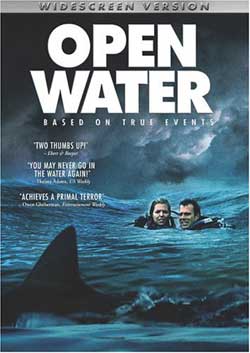
Spring Breakdown #2: Open Water (dir by Chris Kentis)


So, who wants to spend 80 minutes watching two people slowly die?

That’s the question that’s posed by the 2003 film, Open Water.  Apparently, quite a few people had a positive response to that question because Open Water, which was made for about $120,000, went on to gross over 55 million dollars.  It also inspired two sequels and it continues to be something of a mainstay on the SyFy channel, where it usually airs during Shark Week.

I have to admit that, largely because I have a huge phobia about drowning, I didn’t see Open Water until three years after it was initially released.  I watched it with my cousin Paulie.  At the end of the film, he exclaimed, “Oh, nice fucking movie, Lisa Marie!,” and I understand where he was coming from.  There’s not much hope or positivity to be found in Open Water.  It’s not a happy film.  Instead, it’s a movie about a couple who end up getting stranded in the middle of the ocean.  Eventually, one of them gets eaten by sharks while the other one drowns.

That may sound like a spoiler but really, it’s not.  From the minute we first see Daniel (Daniel Travis) and Susan (Blanchard Ryan), we know there’s no way they’re getting out of the movie alive.  They’re both so happy about taking a vacation and finally getting to spend some quality time together that it’s obvious that there’s no way things aren’t going to end in tragedy.  Their vacation takes them to the Caribbean, where they hope to go scuba diving.  Unfortunately, their scuba diving group leaves without realizing that Daniel and Susan are still underwater.  When the two of them resurface, they discover that they’re stranded out in the middle of the ocean.

At first, they assume that someone will notice them missing and come back to rescue them.  They make jokes about how this is a story that they’ll be able to tell for the rest of their lives.  They laugh.  They joke.  They briefly argue.  Daniel gets frustrated and spends a while screaming with splashing water.  Eventually, the jelly fish arrive and they both get stung.  Then. the sharks show up….

It’s all very dark and depressing and the film certainly did not help me with my fear of swimming.  Imagine Jaws if the whole film was just an hour and a half of Chrissie Watkins getting eaten by the Great White and you kind of have an idea of what Open Water was like.  As a result of the film’s low-budget, Open Water has an effectively rough, documentary-like feel to it.  Daniel Travis and Blanchard Ryan seem like any ordinary couple that you might run into while on vacation.  They’re easy enough to relate to that you certainly don’t want to see them die.

Unfortunately, after Daniel and Susan get stranded out in the ocean, the film gets stranded along with them.  At that point, all you can do is watch as they two of them get eaten by undersea life.  It gets a bit tedious.  One imagines that Werner Herzog could probably make this material compelling and, whenever I watch Open Water, I like to imagine the sound of Herzog saying, “I believe the common denominator of the universe is not harmony, but chaos, hostility, and murder.”  However, as it is, Open Water is one of those well-made films that leave you with no desire to ever watch it again.


Spring Breakdown #1: Midnight Express (dir by Alan Parker)


Since it’s currently Spring Break, I figured that I would spend the next two weeks reviewing films about people on vacation.  Some of the films will be about good vacations.  Some of the films will be about bad vacations.  But, in the end, they’ll all be about celebrating those moments that make us yearn for the chance to get away from it all.

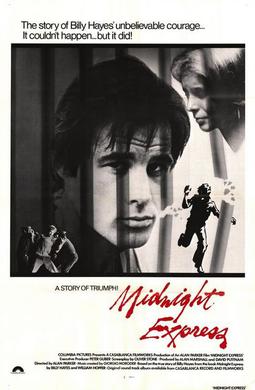
Take Midnight Express, for instance.  This 1978 film (which was nominated for six Oscars and won two) tells the story of what happens when a carefree college student named Billy Hayes decides to spend his holiday in Turkey.

When the film begins, Billy Hayes (played by Brad Davis), is at an airport in Turkey.  He’s preparing to return home to the United States.  His girlfriend, Susan (Irene Miracle), informs him that Janis Joplin has just died.  When Billy responds by making a joke, Susan accuses him of not taking anything seriously.  What Susan doesn’t realize is that Billy actually has a lot on his mind.  For one thing, he’s got several bricks of hashish taped around his waist.  He purchased it from a cab driver and he’s planning on selling it to his friends back in the United States.  Unfortunately, Billy’s not quite as clever as he thinks he is.  Because of recent terrorist bombings, the Turkish police are searching everyone before they board their plane.  Billy finds himself standing out in the middle of the runway with his hands up in the air, surrounded by gun-wielding Turkish policemen.

Billy finds himself stranded in a country that he doesn’t understand, being interrogated by men whose language he cannot speak.  An enigmatic American (Bo Hopkins) shows up and assures Billy that he’ll be safe, as long as he identifies the taxi driver who sold him to the drugs.  Billy does so but then makes the mistake of trying to flee from the police.  In the end, it’s the American who captures him and, holding a gun to Billy’s head, tells him not to make another move.

Soon, Billy is an inmate at Sağmalcılar Prison.  He’s beaten when he first arrives and it’s only days later that he’s able to walk and think clearly.  He befriends some of the other prisoners, including a heroin addict named Max (John Hurt) and an idiot named Jimmy (Randy Quaid).  Billy watches as the prisoners are tortured by the fearsome head guard (Paul L. Smith) and listens to the screams of inmates being raped behind closed doors.  After being told that his original four-year sentence has been lengthened to a 30-year sentence, Billy starts to degenerate.  When Susan visits, Billy end up pathetically masturbating in front of her.  When another prisoner taunts Billy, Billy bites out the man’s tongue, an act that we see in both close up and slow motion.  If Billy has any hope of regaining his humanity, he has to escape.  He has to catch what Jimmy calls the “midnight express…..”

Midnight Express is a brutal and rather crude film.  Though it may have been directed by a mainstream director (Alan Parker) and written by a future Oscar-winner (Oliver Stone), Midnight Express is a pure grindhouse film at heart.  There’s not a subtle moment to be found in the film.  The camera lingers over every act of sadism while Giorgio Moroder’s synth-based score pulsates in the background.  When Billy grows more and more feral and brutal in his behavior, it’s hard not to be reminded of Lon Chaney, Jr. turning into The Wolf Man.  The film may be incredibly heavy-handed but it’s nightmarishly effective, playing out with the intensity of a fever dream.

As for the cast, Brad Davis wasn’t particularly likable or sympathetic as Billy.  On the one hand, he’s a victim of an unjust system, betrayed by his own country and tortured by another.  On the other hand, Billy was an idiot who apparently thought no one would notice all that hash wrapped around his chest.  That said, Davis’s unlikable screen presence actually worked to the film’s advantage.  If you actually liked Billy, the film would be unbearable to watch.  Before Davis was cast, Dennis Quaid and Mark Hamill were both considered for the role.  If either of those actors has been cast, Midnight Express would be too intense and disturbing to watch.  For instance, it would be depressing to watch Dennis Quaid rip a man’s tongue out of his mouth.  You would be like, “No, Mr. Quaid, you’ll never recover your humanity!”  But when Brad Davis does it, you’re just like, “Eh.  It was bound to happen sometime.”

For more effective are John Hurt and Bo Hopkins.  Hurt and Hopkins both have small roles but they both make a big impression, if just because they’re the only two characters in the film who aren’t either yelling or crying all of the time.  While everyone else is constantly cursing their imprisonment, Hurt is quietly sardonic.  As for Hopkins, we’re supposed to dislike him because he’s with the CIA and he sold out Billy.  But honestly, no one made Billy tape all that hash to his chest.  Finally, you’ve got Randy Quaid and Paul L. Smith, who both glower their way through the film.  Smith is wonderfully evil while Randy Quaid is …. well, he’s Randy Quaid, the loudest American in Turkey.

Midnight Express was such a success at the box office that it caused an international incident.  There’s not a single positive Turkish character to be found in the entire film and it’s impossible not to feel that the film is not only condemning Turkey’s drug policies but that it’s also condemning the entire country as well.  The Turkish prisoners are portrayed as being just as bad as the guards and even Billy’s defense attorney comes across as being greedy and untrustworthy.  Watching the film today can be an awkward experience.  It’s undeniably effective but it’s impossible not to cringe at the way anyone who isn’t from the west is portrayed.  In recent years, everyone from director Alan Parker to screenwriter Oliver Stone to the real-life Billy Hayes has apologized for the way that the Turkish people were portrayed in the film.

Despite the controversy, Midnight Express was a huge box office success and it was nominated for best picture.  It lost to another controversial film about people imprisoned in Asia, The Deer Hunter.


Lifetime Movie Review: Suburban Swingers Club (dir by Jessica Janos)


If you’ve seen enough Lifetime films, you know that it’s never a good idea to move to the suburbs.

I mean, sure.  Inevitably, you’ll end up living in a big house.  And you’ll have all the closet space in the world.  And your neighbors will all be really sexy and witty and they’ll always invite you over to have a glass of wine and gossip about everyone’s deep, dark secrets.  I mean, it sounds like a great idea but things never work out as well as they should.

For example, just check out the latest Lifetime movie, Suburban Swingers Club.

Everything you need to know about the film is right there in the title.  It takes place in the suburbs.  There’s a club.  And they’re all swingers.  And when I say swingers, I mean they’re real swingers.  They’re not like Nick Offerman and Megan Mullally in those annoying Sling commercials.  No, these are people who get together and toss their house keys into a punch bowl.  Each night, keys are randomly drawn and neighbors go upstairs together.  Of course, only the really wealthy and attractive neighbors get to take part.  For instance, there’s this old guy who is occasionally seen standing out in his front yard.  He never gets invited.

As soon as Lori (Dana Davis) and Grant (Jesse Ruda) move into the neighborhood, they’re invited to join the club.  Grant is immediately intrigued while Lori is immediately weirded out by the whole idea.  In fact, Lori thinks that Grant might just be looking for an excuse to have an affair.  Their marriage has been rocky ever since the death of their baby.  However, then Lori catches sight of the neighbor across the road, doing manly stuff without his shirt on.  In fact, Noah (James William O’Halloran) doesn’t even seem to own a shirt!  Lori eventually tells Grant that they can swing as long as 1) they’re totally honest about it, 2) they think about each other while having sex with other people, and 3) they stop doing it as soon as one of them objects.  Grant’s like, “That’s a lot of rules but as long as I get laid, I’m happy.”

However, it doesn’t take long until Grant’s no longer happy.  Lori ends up pulling Noah’s key and soon Grant is getting jealous.  Grant says that he’s exercising his right to say “stop.”  Lori explains the situation to Noah and Noah is like, “Well, no one told me about any rules!”  Soon, Noah is stalking Lori and Grant is threatening to kill him.  Of course, when Noah turns up dead, Grant automatically becomes the number one suspect….

Unfortunately, this film doesn’t feature quite as much swinging as I was expecting.  It doesn’t take long for Grant to get jealous and exercise his “stop” option and after that, the film becomes a fairly typical Lifetime stalking film.  But no matter.  I still enjoyed Suburban Swingers Club, if just because the film didn’t waste anytime plunging into its story of suburban melodrama.  This is one of those films where your new neighbors come over, take one look at you, and then invite you to join a swinger’s club.  Lori can’t even look out of her bedroom window without seeing two people having sex across the street and, once morning comes, it’s time for Noah to start casually walking around outside without his shirt on.  Suburban Swingers Club is like the Lifetime version of one of those wonderfully campy 60s sexploitation films where bored housewives seduce the pool cleaner and the whole thing is written, directed, and acted with just enough self-awareness to let us know that the film is cheerfully aware of its excesses.  It’s a lot of fun, as any swinging club should be.  Joe Sarno would be proud.