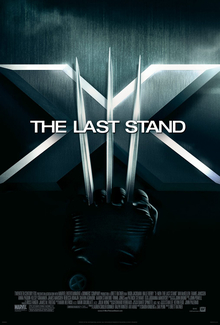
X-Men: The Last Stand (2006, directed by Brett Ratner)


Just as the world seems to be finally on the verge of accepting mutants, industrialist Warren Worthington II (Michael Murphy) announces that he has developed a shot that will suppress the X-gene, therefore “curing” mutants of their mutation. Magneto (Ian McKellen), Mystique (Rebecca Romijn), and a host of other mutants break out of prison to try to stop Worthington from offering up his cure. Meanwhile, at Charles Xavier’s school, Rogue (Anna Paquin) wonders if maybe she should take the shot and become a “normal” person.

Professor Xavier (Patrick Stewart) and Logan (Hugh Jackman) have an even bigger concern than Magneto and the cure. Jean Grey (Famke Janssen), thought to have died at the end of the previous movie, has returned but has given in to her dark side, the so-called Phoenix. She’s already destroyed Scott (James Marsden), and it doesn’t take her long to disintegrate Professor X. Can Logan and the Beast (Kelsey Grammer) rally what’s left of the X-Men to defeat both Magneto and the Dark Phoenix?

I can still remember seeing X-Men: The Last Stand on the day that it was first released. As an X-Men fan, I was excited to see how the Dark Phoenix storyline would be adapted for the big screen. It’s difficult to put into words how disappointed I was when Jean killed Scott. That one scene told me that X-Men: The Last Stand was not going to do the story justice. In the comic books, Jean and Scott’s relationship was the heart of the X-Men. When Jean became the Dark Phoenix, she proved herself capable of destroying an entire planet, but she couldn’t bring herself to kill Scott. She chose to destroy herself rather than him. (Marvel being Marvel, Jean was resurrected a few years later.) The X-Men films never really knew what to do with the characters of Scott and Jean. They weren’t as flamboyant as Logan or even Rogue, but fans of the comic knew who Scott and Jean were and understood their importance to the series, and having Jean destroy Scott showed that, unlike the previous two films, the third X-Men film was not being made for the fans.

A large part of the problem was that director Brett Ratner didn’t seem to be interested in the characters. X-Men: The Last Stand is a collection of action scenes with none of the small character moments that made the first two films memorable. Kelsey Grammer is a welcome addition to the cast as the Beast. (The Beast always was basically Frasier Crane with blue fur.) Otherwise, this is the most forgettable of all the X-Men films.

Even though the Dark Phoenix saga is one of the key X-Men storylines, it’s never really been given its due onscreen. A second attempt to tell the story, in Dark Phoenix, also failed to capture the drama and emotion of Jean’s transformation. The X-Men are now officially a part of the MCU, so I imagine the story will probably be told again. Maybe the third time will be the charm.

The Films of 2025: Borderline (dir by Jimmy Warden)


Every year, Hollywood publishes The Black List.

The Black List is a survey of the unproduced screenplays that are considered the “most-liked” by various studio executive and producers.  It comes out the second Friday of December and it’s always the top news story for at least half the weekend.  After the weekend, everyone promptly forgets about it.

Now, I will admit that some good movies have been made from Black List scripts.  The King’s Speech, Hell or High Water, Argo, Promising Young Woman: they all appeared on the Black List.  But, to be honest, I’m far more interested in the amount of forgettable and downright bad movies that appeared on The Black List, some of them often listed near the top of list.  Anonymous, The Bucket List, Cedar Rapids, The Beaver, Broken City, The Ides of March: they all appeared on the Black List too.  Appearing on The Black List is no guarantee of quality.

That’s bring us to Borderline.  The screenplay for Borderline appeared on the 2020 Black List and evidently that appeared paid off because the script was put into production with screenwriter Jimmy Warden making his directorial debut.  (Undoubtedly, it probably helped that Warden’s wife, Samara Weaving, agreed to star in the film.)  The film was released in March of this year and, if you’re so inclined, you can currently watch it on Peacock.

Borderline takes place in the early 90s.  Weaving plays a vacuous pop star named Sofia.  Ray Nicholson plays Paul Duerson, who is obsessed with Sofia and believes that he’s destined to marry her.  When we first see Paul, he’s stabbing Sofia’s head of security, Bell (Eric Dane), and then dancing around Sofia’s house.  At the time, Sofia is out.  However, when Paul returns 6 months later, Sofia is home.  Paul somehow has managed to gather some crazy associates who are willing to work with him.  Penny (Alba Baptista) is just as unstable as Paul and I’m going to assume that her character was meant to be an homage to Sandra Bernhard’s character in The King of Comedy.  (Indeed, the film seems to owe a lot to The King of Comedy.)  Sofia and a Dennis Rodmanesque basketball player named Rhodes (Jimmie Falls) finds themselves trapped by Paul and his fantasy of marrying Sofia.

It’s easy to see why this screenplay would get the attention of the studio execs who voted on the Black List.  It mixes comedy, drama, and horror in a way that is very trendy right now.  It also features a lot of crazed monologuing on the part of Paul.  Unfortunately, as a director, Jimmy Warden doesn’t seem to know how to manage his own script’s frequent shifts in tone and the film itself drags to such an extent that it could almost be mistaken for a Project Greenlight film.  (Seriously, remember The Leisure Class?)  Add to that, the film features some remarkably bad acting.  There are undoubtedly worst performance out there than Alba Baptista’s but I doubt I’m going to see more annoying one for a while.

For this film really to work, Paul would have to be at least interesting in his insanity.  It’s possible to make a character like Paul compelling but having Ray Nicholson do an imitation of Christian Slater imitating Ray’s father Jack is not the way to go.  Ray Nicholson bears a passable resemblance to Jack and he throws himself into playing Paul as being a nutcase.  What Ray Nicholson doesn’t have is Jack’s screen presence.  Ironically, that means that Ray Nicholson probably gives a pretty realistic performance as the type of anonymous loser who would fantasize about marrying his favorite singer but who wants to spend 90 minutes watching one of those people?

In the end, Borderline is another mediocre Blacklist film.

Spring Breakdown #3: Open Water 2: Adrift (dir by Hans Horn)


The 2006 film, Open Water 2: Adrift, is a film about a group of people who are literally too stupid to live.

Now, that may sound like a harsh judgment but just consider what this film is about.  A group of shallow friends get together for a birthday party on a yacht.  They head out to the middle of the ocean.  One-by-one, they all get into the water.  One of the friends has been terrified of the water ever since her father drowned in front of her.  She doesn’t want to get in the water so, of course, the owner of the boat picks her up and jumps overboard with her.  With the exception of a sleeping infant, everyone is now in the water.

Oh!  And guess what!

It didn’t occur to anyone to lower the ladder before getting in the ocean.  That means there’s no way to get back on the boat!  And now, everyone’s stuck in the water where they’ll presumably eventually die of either hypothermia or just general stupidity.  They’ll also end up yelling at each other and arguing about whose fault it is.  They’ll all discuss issues of wealth, religion, and envy.  There’s nothing like a weighty theological discussion being conducted by a bunch of idiots floating in the ocean.

Of course, they do make a few attempts to get back on the boat.  One guy tries to use a knife to climb back up the side of the boat but he just ends up getting stabbed instead.  An attempt to grab hold of an American flag just leads to desecrated symbol of patriotism.  One girl decides to pray, just to be reprimanded by the group atheist.  At one point, everyone takes off their swimsuits and they attempt to tie them into a makeshift rope.  It doesn’t work but now everyone’s naked.  This movie knows what it’s doing.

We get a lot of shots of people floating listlessly in the ocean.  In order to pad out the run time, there’s a lot of pointless slow motion.  Amy (Susan May Pratt), the hydrophobe, has a flashback to her father’s death and it’s amazing how little sympathy the film manages to generate for someone who watched helplessly while a parent drowned.  Because Amy’s supposed to be scared of the water, she spends most of the movie floating around with this dumbass look on her face.  I’m a hydrophobe too.  If I found myself in this situation, I’d probably scream until I exhausted myself and drowned.  But I wouldn’t float around with this stupid beatific look on my face.

This film was sold as being a sequel to Open Water, though it actually went into production before Open Water was released.  After Open Water was a surprise box office success, the film’s title was changed from Adrift to Open Water 2: Adrift.  There are obvious similarities between the two films but the major difference is that the couple in Open Water ended up stranded through no fault of their own.  On the other hand, the folks in Open Water 2 were just too dumb to lower a ladder.

Open Water was effective but depressing.  Open Water 2 is just kind of stupid.