Since I reviewed the film earlier today, I guess it makes sense that today’s horror scene that I love should be the cemetery scene from Hammer’s The Plague of the Zombies!
Enjoy and watch your step!
Since I reviewed the film earlier today, I guess it makes sense that today’s horror scene that I love should be the cemetery scene from Hammer’s The Plague of the Zombies!
Enjoy and watch your step!
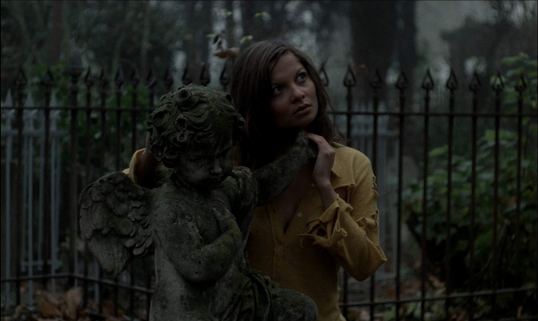
“Let’s go to the cemetery.”
That line is actually from another Jean Rollin film, Requiem for Vampire, but it also perfectly sums up the plot of his 1973 masterpiece, The Iron Rose.
A man (Hugues Quester) meets a woman (Francoise Pascal) at a wedding party. They agree to go on a date, one which includes a railway station, a picnic, bicycling, and finally a walk that leads to a seemingly deserted cemetery. On what seems to be a whim, the two of them enter the cemetery. The woman seems to be fascinated with the place. The man is dismissive, saying that funerals are an expensive, waste of time. The woman believes that there is something after death. The man is cynical, saying that once you’re dead, you’re dead. As any couple would do after having a theological conversation, the two of them enter a crypt and make love.
While they’re busy making love, we discover that there actually are others in the cemetery. There’s a clown that places flowers on a grave. There’s a mysterious man who has been watching the couple as they walk among the graves. (In the credits the man is called “Le vampire,” though he never actually does anything in the film that would indicate that he’s a bloodsucker.) And then there’s the old woman who, as night falls, promptly closes the cemetery gates.
When the man and the woman emerge from the crypt, they discover that they are trapped. There’s no way to open the gate and there’s no way to get out of the cemetery. The two of them start to walk around, searching for either an exit or, at the very least, some sort of shelter for the night. As they walk, strange things start to happen and we’re forced to reconsider our previous assumptions about not only the man and the woman but also the cemetery itself. Did they enter the cemetery on a whim or did one of them specifically lead in the other? As the night progresses, the feeling of impending doom only grows. It all leads to a rather macabre fate for one of our lovers and a dance among the tombstones for another.
The Iron Rose is one of Jean Rollin’s best films and, sadly, it’s also one of his most unjustly obscure. Even by the standards of Rollin’s early vampire films, The Iron Rose is a surreal film, one that is far more interested in creating a haunting atmosphere than in telling a traditional story. What is the real reason that leads to the man and the woman entering the cemetery? The Iron Rose is full of hints but, for most part, it’s left to the audience to answer that question for themselves. The film’s haunting final scenes force us to reconsider everything that we previously assumed by the characters and their actions. Are they obsessed with love or are they just in love with death? There are no easy answers.
Obviously, a 90-minute film about two people walking around a cemetery is going to have some slow spots but, in this case, those occasional moments just add to the film’s ennui-drenched atmosphere. As filmed by Rollin, the cemetery becomes as important a character as both the man and the woman and a reminder that the present is always going to be tied to the past. The Iron Rose is Rollin at his dream-like best.
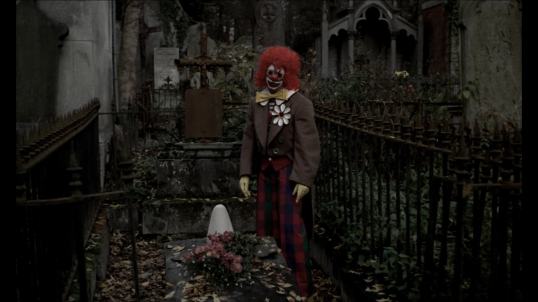
4 Shots From 4 Films is just what it says it is, 4 shots from 4 of our favorite films. As opposed to the reviews and recaps that we usually post, 4 Shots From 4 Films lets the visuals do the talking!
This October, we’re using 4 Shots From 4 Films to look at some of the best years that horror has to offer!
4 Shots From 4 1998 Horror Films

Blade (1998, dir by Stephen Norrington)
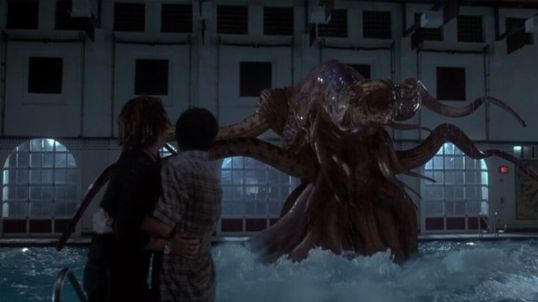
The Faculty (1998, dir by Robert Rodriguez)
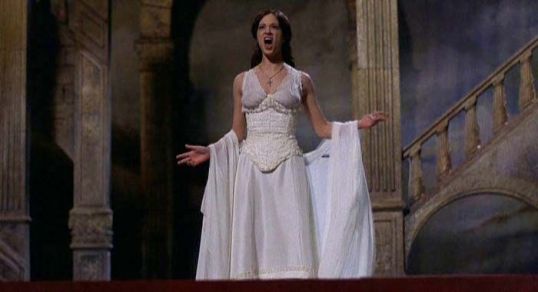
The Phantom of the Opera (1998, dir by Dario Argento)
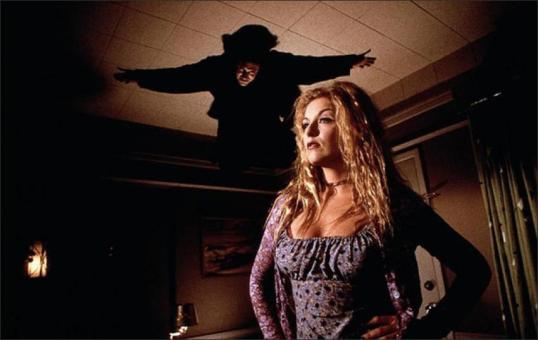
Vampires (1998, dir by John Carpenter)
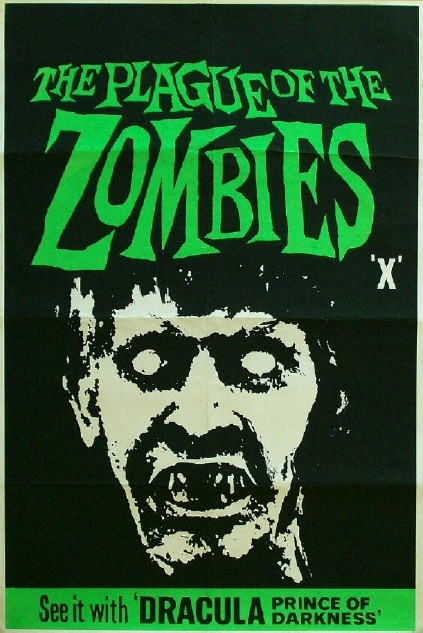
One of the best (and scariest) zombie films of all time came to us from Hammer Studios.
The 1966 film, The Plague of the Zombies, takes place in a small, fog-filled English village. The village has been hit by a plague, one that is wiping out all of the inhabitants. Unable to combat or even diagnose the mysterious illness, Dr. Peter Tomlinson (Brook Williams) calls in his friend, Sir James Forbes (Andre Morrill) for help. Sir James arrives with his daughter, Sylvia (Diane Clare) and suggests that the graves of the recently deceased should be dug up so that he can examine the bodies himself.
Sounds like a reasonable idea, right? There’s only one problem. ALL OF THE COFFINS ARE EMPTY! Now, before anyone asks, they weren’t empty when they went into the ground. There were dead bodies in them when they were originally buried. But now the coffins are empty, the bodies are missing, and that can mean only one thing — ZOMBIES!
And since this is a Hammer film, that also means that a squire is to blame! Seriously, if there’s anything that I’ve learned from watching British horror films, it is to never trust a squire. Squires always seem to end up practicing some sort of black magic. In this case, Squire Clive Hamilton (Jack Carson) has just returned from Haiti, where he apparently spent some time researching the art of zombie creation. Squire Hamilton has a tin mine to manage and undead workers are apparently far less demanding than living workers.
(Of course, today, Squire Hamilton could have just automated the mine and brought in robot workers, who would probably be even less demanding than zombie workers. In fact, with the march of progress, there may soon be no need for zombie workers at all.)
This is a Hammer film so, needless to say, Sylvia eventually gets kidnapped and it’s up to Dr. Tomlinson and Sir James to put an end to the Squire’s evil plans before Sylvia is transformed into a zombie herself. That’s not going to be as easy as it seems, because there’s zombies everywhere!
The Plague of the Zombies is one of Hammer’s best films and it’s also one of the few that, even to a modern viewer, remains frightening. The village is a wonderfully atmospheric location, mixing all of the usual gothic tropes that we’ve come to expect with Hammer films with a very real feeling of decay. Even before the whole zombie plague started, one gets the feeling that the village was already dying a slow, economic death. The tin mine may be the only way to keep the village alive but, at the same time, killing the village is also the only way to keep the tin mine open. The Plague of the Zombies is a moody and rather sad film, one that has a bit more on its mind than just supplying the usual Hammer combination of cleavage and blood.
Speaking of blood, Plague of the Zombies has one of the scariest zombie scenes of all time, in which one of our heroes finds himself wandering through a mist-covered cemetery while the dead rise around him. At one point, he literally steps over a pool of blood. Of course, the scene itself turns out to be a dream but it’s still effectively frightening. Also frightening are the zombies themselves, with their pasty, decaying flesh and their blankly hostile faces. It has been suggested that Plague of the Zombies was an influence on Romero’s Night of the Living Dead and you can definitely see that in its portrayal of the zombies as being a threat not because they’re fast but because they’re so relentless and pitiless.
The Plague of the Zombies is one of the best Hammer films out there so watch it this Halloween!

Today’s horror on the lens comes to us from 1924! In Dante’s Inferno, a businessman visualizes Dante’s trip to Hell while little realizing that his behavior is going to lead him to the same destination.
There’s a lot different prints of this film floating around. The original version ran for 60 minutes. The version below was a 49-minute version that was released on VHS. At the time of its release, it’s vision of Hell was considered to be so frightening and definitive that clips of this film were actually used in other films that depict Hell. In fact, Ken Russell used clips from this film in 1980 to depict a drug-induced hallucination in the film, Altered States.
The quality of the upload is not the best (again, largely because it was taken from an old VHS tape) and it’s impossible not to cringe at the character of the butler (whose portrayal, sadly, is typical of how African-Americans were regularly portrayed in films up until the 1960s) but this is still a bit of cinematic history.
What’s an Insomnia File? You know how some times you just can’t get any sleep and, at about three in the morning, you’ll find yourself watching whatever you can find on cable? This feature is all about those insomnia-inspired discoveries!
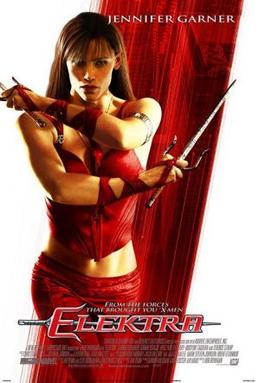
If, around 2 in the morning on Saturday, you were having trouble getting to sleep, you could have turned over to Cinemax and watched the 2005 film, Elektra.
Elektra (Jennifer Garner) used to be dead but now she’s alive again. She was killed during the 2003 film, Daredevil, but, two years later, she was resurrected by a blind martial artist named Stick (Terence Stamp). Stick taught her how to not only fight but also how see into the future, which I guess is helpful if you have to decide whether or not to throw one of those little knife things at someone. (As you can tell, I’m definitely the expert when it comes to martial arts and ninja assassins.)
Elektra uses her training to become the world’s most deadly assassin, which is probably not what Stick had intended but what’s he gong to do, right? However, when Elektra is ordered to kill a totally hot guy and his 13 year-old daughter, she starts to have doubts about whether or not being a murderer-for-hire is really for her. And can you blame her? Not only do you not get to make many friends but I imagine that you’re also constantly having to buy new arrows for your crossbow and that has to get expensive at some point.
So, Elektra decides not to kill the hot guy or his daughter but it tuns out that an evil group of ninjas called The Hand are determined to kill the guy anyway and apparently his daughter is perhaps destined to maintain the balance between the forces of good and evil. (Don’t ask me, I didn’t write the script.) Elektra has to take it upon herself to defeat the Hand and hopefully ensure that the hot guy’s daughter gets to enjoy her adolescence without having to worry about balancing killing people with school work.
Elektra was released with a lot of fanfare back in 2005. It didn’t do particularly well at the box office, which apparently led to Marvel getting into their head that no one would pay money to see a comic book film with a female hero. (This belief was disproven 12 years later, with Wonder Woman.) Today, in the wake of the MCU and whatever DC calls their cinematic universe, Elektra feels almost like a relic. It’s a film that lacks of the self-awareness of the later comic book films but it also never matches them in their scope or their ability to make us feel as if we’ve entered into a separate, fully functioning universe. Elektra is from the age when comic book movie didn’t want to admit that they were comic book movies.
It’s a silly film but, at the same time, it can be kind of fun if you’re in a particularly undemanding mood. Watching it last night, I was shocked to be reminded of the fact that there was a time when Jennifer Garner actually kicked serious ass. The fight scenes are fun to watch, mostly because it’s a woman who gets to beat everyone up. The dialogue is fun to listen to because it’s all so terribly written. (All of the bad guys refer to the title character as being, “the female, Elektra!,” as if it was felt that there was some sort of danger of the audience forgetting who the star of the film was.) It’s an enjoyably dumb movie, which makes it perfect for insomnia-fueled viewing.
Previous Insomnia Files:
“Godzilla says that I have to learn to fight my own battles.”
Well, good for you, Minilla, son of Godzilla. It’s good to see that Godzilla’s raising you well! But can your monster advice possibly contain any useful life lessons for the human world? Let’s watch 1969’s All Monsters Attack and find out!
You may have noticed that I’m specifically calling this a “Halloween review” as opposed to a “horror review.” That’s because it’s just not Halloween without a Godzilla movie or two but, at the same time, it would be really stretching things to describe any of the Godzilla films of the 60s and 70s as being horror films. Certainly, the original, black-and-white Gojira was a horror film, even if it no longer scares audiences. But, by the time the 60s rolled around, Godzilla had gone from being the living equivalent of the bombing of Hiroshima and Nagasaki to becoming a cuddly friend of children everywhere.
All Monsters Attack, for example, is clearly a film made for children and stock footage aficionados. Ichiro (Tomonori Yazaki) is a little kid who has no friends but he does have an active imagination. Whenever he falls asleep, he goes to Monster Island where he watches as Godzilla beats up various monsters. Why exactly does Godzilla stay on Monster Island, I wonder. Like literally everyone else on the island seems to hate his guts and they’re constantly trying to kill him. If I was advising Godzilla, I’d suggest he move to another island.
Anyway, it turns out that Godzilla’s son, Minilla, is being bullied by a red-headed lizard named Gabara. Minilla is a monster who always seems to get a mixed reaction from Godzilla fans. When I first saw him, I was like, “AGCK! BURN IT! KILL IT WITH FIRE!” But actually, Minilla is kind of cute and he does this adorable thing where he breathes radioactive smoke rings at his enemies. Godzilla could protect Minilla but instead, he tells Minilla that he has to fight his own battles.
OH MY GOD, JUST LIKE ICHIRO! Ichiro is so moved by Godzilla’s advice that he decides to stand up to the bullies. But first, he’s going to have to stand up to some bank robbers as well, The bank robbers take Ichiro hostage so he promptly takes a nap so he can hang out on Monster Island with Godzilla and Minilla. Good plan, kid!
Anyway, All Monsters Attack is considered by many to be the worst of the old Godzilla movies and, in many ways, it is. While all of the later Godzilla movies were aimed at kids, most of them at least had a decent fight or two. All Monsters Attack is basically just 69 minutes of the kid getting in trouble and then taking a nap. In fact, Godzilla’s barely in the movie at all. Minilla gets most of the monster screen time. That said, the film’s heart is in the right place and if it made any bullied children feel better then it did some good.
(Listen, I’m always going to give any movie starring Godzilla the benefit of the doubt, okay?)
That said, it does kind of seem like the ultimate message of the film’s final scenes is that the best way to deal with a bully is to pull a mean prank on someone else and then join the bully’s gang. So maybe All Monsters Attack! did more harm than good. I don’t know. As long as Godzilla’s okay, that’s all that really matters.

This is from the original, 1982 version Poltergeist.
It’s just a ghost movie about a mother’s love, suburban conformity, and a guy’s face falling into the sink. For whatever reasons, the ghosts just seemed to take a really intense dislike to this guy.
“The house is clean.”
Not bloody likely.
“You moved the headstone but you left the bodies!? WHY!? WHY!?”
Whoops, different scene.
Anyway, let’s watch Marty lose face:
4 Shots From 4 Films is just what it says it is, 4 shots from 4 of our favorite films. As opposed to the reviews and recaps that we usually post, 4 Shots From 4 Films lets the visuals do the talking!
This October, we’re using 4 Shots From 4 Films to look at some of the best years that horror has to offer!
4 Shots From 4 1997 Horror Films
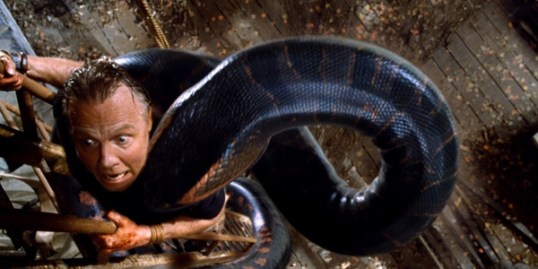
Anaconda (1997, dir by Luis Llosa)
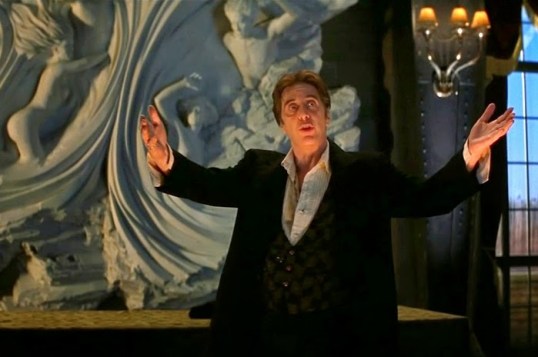
The Devil’s Advocate (1997, dir by Taylor Hackford)
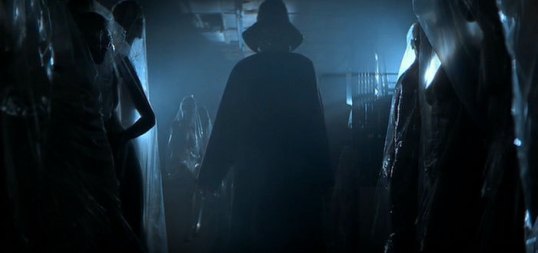
I Know What You Did Last Summer (1997, dir by Jim Gillepsie)
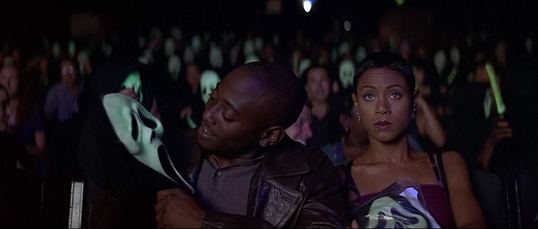
Scream 2 (1997, dir by Wes Craven)
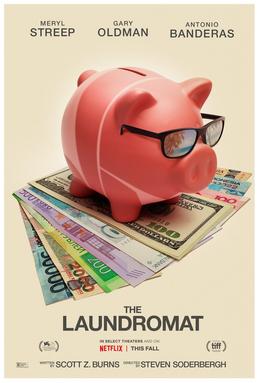
To say that Meryl Streep gives a bad performance in The Laundromat actually does a disservice to your average, run-of-the-mill bad performance.
Meryl Streep instead gives an absolutely terrible performance in The Laundromat, playing not one, not two, but three characters. One of the characters is Ellen Martin, a middle-class widow from Michigan whose attempts to collect a fair settlement after the death of her husband provides a portal in the world of shady con men and corrupt financial institutions. One of the characters is a secret, which means that Meryl wears a lot of make-up and frumpy clothes. That said, from the minute the character appeared on screen, I went, “Oh, there’s Meryl again.” Then, in her third role, Meryl plays herself, demanding campaign finance reform and striking a Statue of Liberty pose while holding a hairbrush instead of a torch.
Really, it’s the type of horrendous performance that could only be delivered by a truly great actress. (If Meryl Streep is the modern Norma Shearer, this is her Romeo and Juliet.) Watching Meryl Streep play the role of Ellen, It occurred to me that Meryl is one of those actresses who is incapable of being authentic but who can certainly act the Hell out of pretending to be authentic. You never forget that Meryl Streep is acting and that’s one reason why her best performances are usually the ones where she’s playing theatrical characters, whether they’re politicians like Margaret Thatcher, celebrities like Julia Child, or the Witch in Into the Woods. But when you cast Meryl as someone who is basically supposed to be a member of the “common people,” it just doesn’t work. Laura Dern, Laurie Metcalf, Allison Janney, even Annette Bening probably could have done a decent job playing Ellen Martin but Meryl is just too Meryl. As for her other two performances in The Laundromat, they don’t work because one is meant to be a joke on the audience and the other is just a retread of her standard “I’m just a middle class woman from New Jersey and I love the little people” awards show speech.
Of course, The Laundromat itself is a remarkably bad film. Again, it takes a lot of talent to make a film this bad. Watching the film, I found myself wondering why, at this point in his celebrated career, Steven Soderbergh would decide to become a second-rate Adam McKay, especially when McKay himself is just a third-rate Jean-Luc Godard? The film is structured so that, while Ellen is obsessing on why she’s getting screwed over by the insurance companies, we’re also treated to scenes of Gary Oldman and Antonio Banderas talking directly to the camera and explaining to use why the poor are always going to get screwed over by the rich. That’s probably true but the film gets so heavy-handed in its execution that the resulting migraine is going to be due less to outrage and more due to the sledgehammer that Soderbergh takes to your head.
Along with Ellen’s story, we also get to see several other stories featuring people and their money. Jeffrey Wright is a crooked accountant who has two families. And then there’s an African businessman who bribes his wife and daughter with shares in a non-existent company and then we take a trip to China, where we learn about cyanide and organ harvesting. And yes, I get it. It shows how a crime committed in China is ultimately felt by a widow living in Michigan. But one can’t help but wish that Soderbergh had just focuses on one story, instead of trying to imitate the worst moments of The Big Short.
Gary Oldman and Antonio Banderas are technically playing the film’s villains but they’re both so charming that The Laundromat at times seems like more of a recruiting film for aspiring money launderers than anything else. (To continue the Adam McKay comparison, it’s a bit like how Vice actually left audiences feeling sympathy for Dick Cheney as opposed to writing petitions to send to The Hague.) It desperately wants to leave us outraged but Soderbegh gets so caught up in his own cutesy storytelling techniques that it just leaves us feeling somewhat annoyed. Watching the film, one gets the feeling that the perfect directors for The Laundromat would have been the Coen Brothers, who are capable of outrage but whose detached style would have kept them from bludgeoning the audience with it. Soderbergh is too angry to be effective.
As I said, there’s a lot of talented people involved in The Laundromat. It’s full of people who have done great work in the past and who will do great work in the future. As for The Laundromat, it’s a legitimate contender for the biggest disappointment of the year.
 Through the Shattered Lens