Lisa Marie Does Murder By Decree (Dir. by Bob Clark)


A week ago, I had a very odd dream, one that was more disturbing than frightening.  I saw myself walking down a fog-covered street in London.  Simply by the way I was dressed and the distant sounds of horses crossing cobblestone streets, I knew that this was towards the end of the 19th century.  I walked down the street, aware that there were people near me who I could hear but couldn’t see because of the thick fog.  Finally, I reached a shabby-looking boarding house.  As I watched myself starting to open the front door, I realized that, in my dream, I was Mary Kelley, the final victim of Jack the Ripper.  And, by stepping into that boarding house, I was heading towards my own death.  That’s when I woke up.

Over on my twitter profile, I describe myself as being a “sweet little thing with morbid thoughts.”  I guess my fascination with the mystery of Jack the Ripper is an example of those morbid thoughts.  Out of all of the Ripper’s victims, Mary Kelley has always been the one that I’ve felt “closest” to.  She was murdered on November 9th, 1888.  I was born on November 9th, 1985.  Like me, she was a fallen Irish Catholic.  Like me, she had red hair.  While the other Ripper victims were all in their 40s, Kelley was only 25 years old and, for the longest time, I believed I was destined to die between my 25th and 26th birthdays.  (I’m 25 years old so hopefully, that was just my imagination working overtime.)  I think what truly made Kelly’s murder stand out in my mind is that she was killed in her own room, probably attacked while she was either asleep or passed out.  Being attacked while asleep has always been one of my phobias, one of the reasons why I’m often happier with insomnia than sleep.

Still, until my dream, I had given much thought to Jack the Ripper or any of his victims for quite some time.  After the dream, I ordered a copy of The Jack The Ripper Encyclopedia from Amazon and then I rewatched my personal favorite of all the Jack the Ripper films, Bob Clark’s Murder By Decree.

Released in 1979, Murder by Decree mixes the facts of the Ripper case and the fictional characters of Sherlock Holmes and Dr. Watson with the same Royal Conspiracy theory that lies at the heart of the better known film From Hell.  Unlike From Hell, Murder By Decree is an almost bloodless film.  Instead of emphasizing the savagery of the Ripper murders, Clark chose to focus on creating an oppresively grim and paranoid atmosphere.  Whether it’s the ominous image of the Ripper’s carriage slowly moving through the London fog or Holmes’ visit to a nightmarish insane asylum, Clark’s London is a grim and forbidding dreamscape that almost seems to have sprung from some lost example of German expressionism.

Into this dark and oppressive atmosphere, Murder By Decree drops the familiar and comforting characters of Holmes and Watson (played, respectively, by Christopher Plummer and James Mason).   I have to admit that I’ve never actually been able to bring myself to read any of the Holmes stories (though I’ve tried) but the characters are both so iconic that I feel as if I had.  Both Holmes and Jack the Ripper are characters that everyone feels they knew about even if they’re not sure when they first heard of them.   Though this might sound rather gimmicky to have these two characters meet, a good deal of the film’s strength comes  from the contrast between the nostalgic innocence of Holmes and Watson and the harsh reality of Jack the Ripper’s London.  By the end of the film, when Holmes’ voice cracks as he describes the conspiracy behind the Ripper movies, he’s gone from being an icon to being a stand-in for everyone who has ever been disillusioned by what they previously believed in.

Plummer makes for a surprisingly physical Holmes but he does a good job with the role, bringing a surprising vulnerability to the detective.  James Mason, meanwhile, makes for a perfect sidekick and he and Plummer both have the type of chemistry that Robert Downey, Jr. and Jude Law could only dream about.  The rest of the cast is made up of familiar English and Canadian character actors and they all give memorable performances.  Donald Sutherland is excellent as a haunted psychic but my favorite supporting performance probably comes from David Hemmings who plays a shadowy police inspector.  This is because every time I see Hemmings on-screen, I’m reminded of Dario Argento’s Deep Red.   

If I do have any issues with this film, it’s that it promotes the long discredited Royal/Masonic Conspiracy as a solution.  (This theory will be familiar to anyone who has seen or read From Hell.)  However, of all the various solutions that have been offered up in an attempt to explain and understand Jack the Ripper, the whole political conspiracy angle is undoubtedly the most cinematic and Clark makes good use of it here.  This is a film in which a growing sense of paranoia and unease seems to pervasively fill every scene just as surely as the London fog.  The viewer, in the end, is thankful to actually have the familiar characters of Holmes and Watson to identify with because otherwise, the worldview of Murder By Decree is almost unbearably dark.

By the way, the role of Mary Kelley in this film is played by a fellow redhead, the Canadian actress Susan Clark who tended to show up in a lot of low-budget, Canadian movies in the 70s.  Though she doesn’t have many scenes, she is sympathetic presence and Plummer’s reaction to his inability to save her from Jack the Ripper is a scene that has haunted me since the first time I watched this movie and every time since.
Scenes I Love: The Room


I’ve never actually seen Tommy Wiseau’s The Room in its entirety but I plan to as soon as I have 99 minutes to kill.  However, I have read countless reviews of this film online and, as a result, I ended up doing a search for the film on YouTube and I came across a few thousand scenes from this film.  And I quickly fell in love with what I saw.

It was hard to narrow down all of the scenes to just one so I decided to include two.  If I could, I would just include every single clip of the Room on Youtube but that would make for an awfully long post.

So, here’s the two scenes —

The first one is only a few seconds long but it features my name. 

For all of you single aspiring filmmakers out there, it’s not difficult to win my heart.  Just name a character after me.  She doesn’t even have to be a good girl.  In fact, I prefer it if she’s not.  Because after all, how else is she going to live up to the line, “YOU’RE TEARING ME APART, LISA!”

Our second scene is about a minute and a half long and I’m thankful for it because, for as long as I can remember, I’ve always wondered what guys talk about when they hang out on the roof.  I always figured they were up there enjoying the view, thinking about life and love, and maybe talking about how one of their friends is so annoying and dresses like he’s 40 and has no idea how bad his hair looks after he did whatever it is that he was trying to do with it.  I mean, that’s what I always do whenever I’m on a rooftop with my friends.  But it turns out I was wrong.

Apparently, they just act like guys.

One reoccurring theme I find whenever I read about The Room is the idea that The Room is one of the worst films ever made.  Having never seen the film, I can’t say whether it is or not.  However, I can say that unlike a lot of “independent” filmmakers Tommy Wiseau actually made his film and now it’s all over Youtube. 

Good for him.

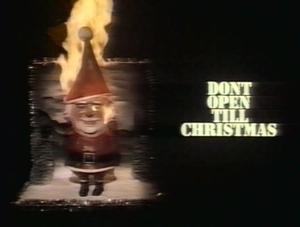
Film Review: Don’t Open ‘Til Christmas (dir. by Edmund Purdom, et al)


It’s been a while since I reviewed a real grindhouse/exploitation film on this site so I want to remedy that by talking about an English slasher film called Don’t Open ‘Til Christmas.

As the movie opens, we find ourselves in England with Christmas quickly approaching.  The fog-drenched streets of London have apparently been besieged by drunk old men dressed up like Santa Claus.  However, at least one citizen has taken things into his own hands by wandering the streets at night and killing anyone he comes across dressed as Santa Claus.  Seriously, we see a lot of Jolly St. Nicks meeting an untimely end in this film.  Most of them are done in by straight razor but at least one ends up getting shot and then another ends up bursting into flame and one Santa even up getting a spear driven through the back of his head.

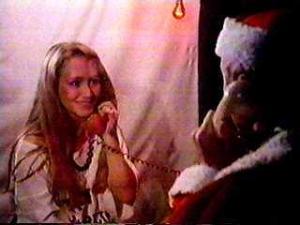
That Santa has a daughter named Kate (Belinda Mayne) and Kate has a boyfriend named Cliff (Gerry Sundquist).  While they make most of their money by standing out in the middle of street and playing the flute, Cliff also has a side job as just a generally sleazy guy.  The day after Kate’s father dies, Cliff tries to convince Kate to take part in a pornographic, Santa-themed photo shoot.  Needless to say, Kate doesn’t react well to this and storms out.  So, Cliff convinces another model to wear the Santa suit.  That model is later caught outside in that Santa suit by the killer.  However, after opening the suit and giving the camera an excuse to linger over the model’s body the killer leaves without harming her.  This would seem to indicate that he’s only looking to kill men in Santa suits.  Normally, I’d be all for this development because fair play is fair play except for the fact that its eventually revealed that the whole Santa suit thing is pretty much just a red herring.  But, more on that later.

Anyway, Kate wants justice for her father but unfortunately, the police investigation is being headed up by Inspect Harris and you know that Harris isn’t going to be much help because he’s played by Edmund Purdom.  Purdom appeared in a lot of Italian and Spanish horror films in the 70s  and 80s and he was always the epitome of British incompetence.  Purdom is also credited as being director here but again, more on that later.

Now, by the time the 100th Santa has been brutally murdered, you might think that people would just naturally stop dressing up as Santa Claus when they’re out in public but no, that doesn’t appear to occur to anyone.  Instead, we get a mall Santa getting castrated while standing at a urinal.  And then we get another one getting killed while visiting a local sex shop and talking to a character credited as “the Experience Girl” (played surprisingly well by Kelly Baker).  Yet another Santa finds himself getting murdered while backstage at a TV variety show.  His body is discovered by Caroline Munro (star of Starcrash and Maniac) who plays herself and gets to sing a disco song before finding the body.  She also gets to wear this really amazing red dress that I would kill to own because, seriously…

Suddenly, this guy named Giles (played by Alan Lake, who apparently died right before this film was released) pops up and tells Kate that he’s a reporter and he starts asking her all theese questions about her father.  Kate gets mad and tries to call up Inspector Harris just to be told that Harris is out for the day taking care of some personal business.  Hmmm…could Harris be our killer?  It makes sense since he’s played by Edmund Purdom.  Then again, Cliff could be the killer as well because, while Kate is doing all this, Cliff is making money by selling her sexual favors to his friends.  Then again, it seems that Giles might be the killer because he then promptly shows up and kills Kate.

Meanwhile (we’re only about 40 minutes in to the film by this point), the Experience Girl is being interviewed by Harris’s partner, a tall guy named Powell who hates women.  The Experience Girl tells Powell that she would know who the killer is if she saw the killer smile.  Powell tells her she’s an idiot.  So, the Experience Girl goes back to work.  Giles shows up and smiles.  Experience Girl screams.  Giles kidnaps her but instead of killing her, he takes her to his flat and chains her up.  Giles explains that he’s a killer because Inspector Harris is his brother and Giles is jealous.  The Experience Girl knows who Harris is despite the fact that we’ve only seen her meet Powell. 

Speaking of Powell, he investigates Kate’s death and realizes he may have made a mistake dismissing the Experience Girl.  Then he tries to open a car door and gets electrocuted until he eventually ends up blowing up.

Now, none of this qualifies as being a spoiler because, even at this point, there’s still nearly 40 minutes of plot left.

Like a lot of 80s grindhouse films, the production of Don’t Open ‘Til Christmas is shrouded in mystery.  Shooting on the film apparently started in 1981 but it the film wasn’t actually completed and released until 1984.  Reportedly, Edmund Purdom was the original director but he ended up walking off the set which led to screenwriter Derek Ford taking over the movie for two days before he was apparently fired.  The film was then completed by Alan Birkinshaw (and possibly a few other people), working under the name of Al McGoohan.

Certainly, this explains why the film is such a huge mess but it’s also a part of the fun as watching the movie becomes a game of trying to figure out who directed what. 

Since Purdom walked off the film, I think it’s fairly safe to assume that he directed all of the scenes that he appears in.  (It also explains why his character disappears from the movie after the first 40 minutes.)  These scenes are all distinguished by the general immobility of the camera.  Purdom’s scenes are so static and so defiantly dull that they almost work in a strangely Warholian way.  The actors wander into frame, the actors wander out of the frame, the out-of-focus lens rebelliously refuses to follow them. 

The non-Purdom scenes — the scenes in which men dressed like Santa are graphically murdered and the scenes featuring the “Rxperience Girl” — appear to have snuck in from a totally different movie and often, they’re only link to anything we’ve seen in the Purdom scenes is some awkwardly dubbed dialogue.  These scenes feel as if they’re drenched in sleaze.  The camera not only moves, it lingers and it invades like a voyeur looking at dirty pictures in a public library.  Unpleasant on their own, these scenes somehow become even more distasteful when compared to the aritificiality of the Purdom scenes. 

It all makes for a very disorienting viewing experience and if the film isn’t really well-done enough to ever become disturbing or nightmarish, it still had a very odd dream-like feel to it.  Major characters wander through the film without every actually meeting each other.  Seemingly important plot points are brought up just to be quickly abandoned and forgotten.  Even all the multiple murders turn out to have very little to do with Santa Claus or Christmas.  If nothing else, this is a unique slasher film in that the murders are pretty much just  red herrings.

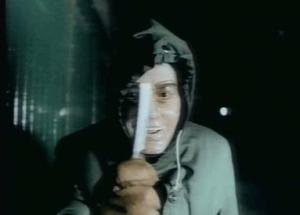
There’s a lot in this movie that doesn’t work but, as with many grindhouse films, that just adds to the charm of Don’t Open ‘Til Christmas.  Even the ending — which everyone seems to criticize — is oddly appropriate in that it makes as little sense as everything else we’ve seen on screen.  Also, like most grindhouse films, there’s a handful of memorable moments that actually do work.  For instance, the killer’s mask is genuinely creepy.  The scene where Giles chases the Experience Girl through the streets of London is also handled well and is even more suspenseful in that it takes place during the day as opposed to expected dark and foggy night.  And again, Kelly Baker is a sympathetic, if unexpected, protaganist in the role of the Experience Girl (though you get the feeling that the role was created and cast long after Purdom left the initial production).  Finally, this is a film that epitomizes the spirit that makes the Grindhouse great — i.e., it may have taken two years and multiple directors and the end result might be kind of chaotic but, in the end, the movie got made.

I ended up watching Don’t Open ‘Til Christmas last night because there have been reports that its about to finally snow here in North Texas and, as a result, I was in a holiday mood.  Since this is apparently one of those movies that has entered the public domain, the version I own is a part of one of those “50 Horror Classics” collections that Mill Creek puts out.  As a result, the transfer looked and sounded terrible.  But you know what?  That terrible transfer added a certain charm to the film.  Don’t Open ‘Til Christmas is a movie that was meant to be seen with a lot of random scratches and faded colors flashing across the screen. 

So, in the end, Don’t Open ‘Til Christmas is a pretty bad movie but it’s an undeniably watchable and oddly memorable one.  Plus, it features that really great red dress.  Seriously, just to die for…

Lisa Marie Does…Season of the Witch (dir. by Dominic Sena)


I have to write this review quickly because I have a feeling that, in another 30 minutes or so, my body’s immune system will succeed in destroying any trace of Season of the Witch.

In Season of the Witch, Nicolas Cage and Ron Perlman play two Crusaders who eventually get disillusioned with killing people so they desert the army, end up in a small village somewhere, and are informed that the town is being destroyed by the plague because a curse has been put on the town by a witch.  Cage and Perlman are then recruited by the local town’s cardinal (Christopher Lee, who is pretty much wasted under all of this really nasty plague makeup) to take the witch to a monastery that is located somewhere else.  You’re never really sure where any one location is in relation to another in this film, which is a bit of a problem since the majority of the film is taken up with the journey to the monastery. 

Anyway, the Monks at the monastery have this ancient book that apparently contains all these incantations that can be used against evil.  This book is the only one left in existence which leads to the question of why nobody ever bothered to make more than a handful of copies of all of these amazingly important books.  I mean, seriously, people.  So the idea is to take this witch to the monastery and read this book which will end the plague.

So, we go through the whole journey thing and a few unimportant characters are killed off along the way and Cage and Perlman discuss the meaning of life and faith and, at first, we’re led to doubt whether or not the accused witch is actually guilty but then she starts causing all of these supernatural, witch-like thing to happen so I guess the filmmakers got bored with that whole subplot early.

Then we reach the monastery and a whole other movie starts.  Seriously, I cannot begin to put into words just how massively the tone of the film changes once they reach the monastery.  The film actually becomes good in a kind of silly, over-the-top way as soon our knights are dealing with all of these flying demons and there’s disfigured monks all over the place, and the priest gets to say, “We’re going to need more holy water,” at one point.  (“Yay!” I nearly shouted out in the audience, “Catholic action movie one-liners!”)  The tone changes so massively that Season of the Witch actually becomes a really fun and entertaining little action movie but, unfortunately, just as soon as things start to get really fun — bang!  Movie is over.  Thank you for coming out tonight, folks.  Now get the Hell outta here.

Season of the Witch is, to put it politely, a mess.  This isn’t all that surprising as the movie is being released in January and January is, of course, reserved for either Oscar contenders going into wide release, films starring Jason Statham, or movies that are being released because the studio is contractually obligated.  Ron Perlman, being a veteran of both Guillermo Del Toro and Jean-Pierre Jeneut, knows exactly how play his role but Cage just rides around on his horse looking like he’s late for Halloween party.  Director Dominic Sena appears to have a mancrush on Zack Snyder and does the whole speed up the camera randomly then go into slow-mo even more randomly thing but it doesn’t really add up to anything more than just confusion.

Finally, I left this film feeling very betrayed because, seriously — how can you call your film Season of the Witch and not feature the classic Donovan song?

Film Review: Easy A (directed by Will Gluck)


For some reason, I didn’t see Easy A during its initial run even though it was one of those films that, every time I saw the commercial, seemed to be beckoning me to come down to the theater.  All of my girlfriends saw it and loved it and told me that I had to see it because apparently they sat through the whole movie going, “Oh, that’s so Lisa.”  And then, before long, every guyfriend of mine ended up seeing the film and they all came back to me and said, “You have to see this film because my date kept going, ‘Oh, that’s so Lisa!'”  Of course, when I heard that, it was time for me to start doing the whole talk-to-the-hand motion  and going, “Oh no, she didn’t!” because that’s what you do when a guy says that his girlfriend was talking about you.  Anyway, I got so busy pretending to be on Maury that I ended up missing my chance to see Easy A in a real theater.

Instead, I had to settle for seeing in a dollar theater on Thursday and can I just get off topic here for a few minutes?  Can I?  Will you indulge me for just a second for me to speak the truth?  Okay, I know that some people kinda think I’m a film snob because I’m always raving about the Angelika and finding excuses to mention that I don’t have the read the subtitles when I go to a French film.  Well, so be it.  Call me a film snob because I am now convinced that Dante’s Inferno is a dollar movie theater.  Seriously, until I saw Red and Easy A this week, I just assumed that people with really bad hygiene just didn’t go to the movies.  Now, I see that they just hang out at the dollar theaters.  And here’s the thing — even though they’re only paying a dollar, they still can’t show up for the freaking movie on time!  Seriously, what is the deal with these dumbfug toadsuckers who just want to come in to the theater 30 minutes late and then spend 10 more minutes wandering around in the dark looking for a seat.  Look, you can look in a newspaper, you can look online, you can call the mutherfracking theater — IT IS NOT THAT HARD TO FIND OUT WHEN YOUR FREAKING MOVIE IS STARTING, PEOPLE!    And then, you  not only show up late but you bring your own food with you because, of course, who doesn’t want to spend an hour listening to you trying to open up one of those loud, crinkly bags of Sun Chips while everyone else is trying to pay attention to the movie?  I mean, you’re already late, you only paid a froking dollar to get in — JUST BUY SOME FRICKING POPCORN, YOU SELF-CENTERED, MYNA BIRD-LOOKING, DUMBFUG MOTHAFRACKER!  I MEAN…GAWD!

I’m sorry…where was I?

Oh yeah, Easy A.  It’s a good movie, probably one of the best high school films I’ve ever seen.  How good was this movie?  I still loved it even though I was watching it in Dante’s Inferno.

Emma Stone plays Olive, a high school student who — in order to get out of going on a weekend camping trip with her best friend — tells a lie about having a date with a boy named George.  (And I can’t blame her because seriously, camping?  BLEH!)  The next Monday, Olive is asked for the details of her imaginary date and her inability to give anything more than the vaguest of details is interpreted to mean that she lost her virginity over the weekend.  (Vagueness being interpreted as sluttiness happens far more often than most of us like to admit.)  Olive’s story about losing her V-card is overheard by Marianne (Amanda Bynes) and soon the entire school is aware that Olive is no longer hymenally challenged.  In short, Olive is now … a girl with a reputation! (Cue ominous music and Vincent Price laughter.)

Soon, Olive — previously a perfectly content wallflower — is the most notorious student at school.  Popular boys want to talk to her.  Unpopular girls want to be her.  At first, Olive tries to tell people the truth, that she was just telling a story.  After people refuse to believe her, Olive starts to go with the flow and enjoy the benefits that come from being extremely popular.  After her gay friend asks her to pretend that she had sex with him in order to help him survive the homophobic world of high school, Olive finds herself being given money and giftcards from other boys in school, all of whom are paying for the right to say that they’ve had sex with her.  Olive decides to embrace her new role of faux-fatale by dressing like she’s on the CW and stitching an A (a la the Scarlet Letter) on all of her clothes. 

And then, she starts to discover the truth about having a reputation in high school.  A reputation makes you both popular and an outcast at the same time and Olive finds herself trapped in a web made up not so much by her lies as by everyone else’s assumptions.  Can Olive escape and find happiness?  Can she find true love with Todd (played by Penn “Oh. My. God! He’s so freaking hot!” Badgley)?  Will she get a chance to have the pointless musical number that she assures us, at one point, her story truly does need?  Will Emma Stone receive an Oscar nomination for her performance as Olive?

Well, the answer to that last question is probably no (though she did receive a Golden Globe nomination) because Easy A is not the type of movie that usually gets nominated for Oscars.  And that’s a shame because Stone gives one of the best performances of the year here.  In the comedic scenes, she manages to generate a hundred more genuine laughs than Annette Bening did in The Kids Are All Right and in the dramatic scenes, she proves herself to an actress of true range.  If you want to see some truly great acting, just consider the scene where Olive goes on her first actual date since becoming known as “the school slut.”  Staring out nervously talking too much and giddily laughing at her own private dates (one of the many scenes that made me go, “Oh my God!  I do that too!”), Stone effortlessly transitions to having an emotional breakdown in a parking lot after discovering that her date has no interest in her and is only with her because he heard she would be an easy lay.  I don’t think there’s a girl over the age of 15 who doesn’t know how painful that feels, to be reduced only to what strangers think of you.  It’s a pain that stays with you and Stone captures it perfectly and, silly as it may sound and at the risk of going all girl power here, I almost felt that when I saw Olive triumphing over it that there was hope for me and for everyone else.

Easy A rang very true to me, not the least because I was one of the girls with a “reputation” while I was in high school.  Then again, I don’t think there’s many girls who didn’t have a reputation for something in school.  Some of us had a reputation for doing it and some had a reputation for not but in the end, it was usually all used to keep us in the same prison of insecurity, resentment, and entrapment.  To its credit, Easy A not only captures the negative side of having a reputation but also realizes and show that having a reputation can be fun and liberating as well.

Even beyond such larger concerns, Easy A is an entertaining, funny movie that not only rings true but is genuinely likable in way that a similar film like Juno never was.  I mean, I loved Juno but in the end, you couldn’t hep but feel that the film was mostly about screenwriter Diablo Cody trying to make herself into a cooler teenager than she actually was.  (And that’s not meant as a criticism, just an impression.)  Juno was almost too perfect and too brilliantly sarcastic.  You liked her but never quite believed in her.  Olive, as played by Emma Stone, is a normal teenager who doesn’t always say the perfect thing and, who most of the time, is just as much of a dork as the rest of us.  My favorite sequence in the whole film is one where Olive ends up spending a weekend growing obsessed with the song “Pocketful of Sunshine” and it wasn’t because it fed into some sort of wish-fulfillment fantasy.  Instead, it was because it was a scene that made me very honestly think, “Oh my God, I’ve done that so many times.”

Easy A is a surprisingly thoughtful and intelligent movie that just happens to be disguised as a breezy, teen comedy.  That high school, in general, is a world full of fucked up ideas and attitudes about sex is no great secret but Easy A is smart enough to realize that the real world is pretty much just one big high school.  I saw the movie too late to include it on my list of the Top 25 Films of 2010 but it is one of the best films of 2010.

Film Review: Made in Dagenham (dir. by Nigel Cole)


Made in Dagenham, an immensely likable and even inspiring film from England, is based on a true story.  It dramatizes the 1968 strike of sewing machinists at the Ford assembly plant in Dagenham, England.  The all-female workforce walked off the job in protest to the fact that they were not being paid an equal rate with their male co-workers.  Going from being treated as a sexist punchline to eventually shutting down production at the Dagenham plant, these women brought the issue of equal pay for equal work to the world’s attention and, ultimately, played a large part in the passage of legislation designed to guarantee equal pay regardless of sex.  And, while it might sound like the material for standard, overly sentimental move-of-the-week, Made in Dagenham is both a warm-hearted tribute and an immensely entertaining film.

Usually, I’m wary of films that claims to “pay tribute to strong women,” largely because they always 1) seem to be rather condescending towards the women they’re claiming to pay tribute and 2) always seem to be intent on providing a very narrow definition of what it means to be “strong.”  Far too often, either stridency or an idealized noble savagery is presented in the place of “strength.”  What makes Made in Dagenham a true tribute to strong women is that it portrays women as individuals and as human beings (as opposed to idealized figures of either reverence or loathing).  What a novel idea!  All of the strikers — from Sally Hawkins as the strike’s leader to Geraldine James as the oldest striker to Jaime Winestone as the youngest — are treated with a definite (and refreshing) respect yet at the same time they’re never so idealized as to become plastic saints.  They’re not presented as being models of perfection.  Instead, they’re just working mothers and wives who are simply standing up for their rights and you would have to be heartless not to end up rooting for them.

On my list of my 25 favorite films of 2010, Made in Dagenham was number #22 and that’s largely because of Sally Hawkins’ performance as the strike leader.  Hawkins is hardly a household name but if you’ve seen her in films like Happy-Go-Lucky, An Education, and Never Let Me Go, then you know that Hawkins is one of those rare performers who is capable of both being ordinary and a star at the same time.  She brings an authentic feel to her working class characters even when she’s acting for a condescending and elitist director like Mike Leigh.  To understand just how important Hawkins is to the success of this movie, just try to imagine the exact same film but starring either Sandra Bullock or Julia Roberts.  One can imagine that either Bullock or Roberts would be given a lot more inspiring speeches (complete with triumphant music in the background) and a few scenes where they would get to say something sassy (and ultimately pointless) to all the one-dimensional male chauvinists standing in their way.  They also probably would have contracts to keep from having to act underneath the hideous (but historically authentic) beehive hairdoes  that Hawkins and the other women in the film have.  Hawkins, however, gives her performance without any of the usual Hollywood safety nets and she is completely and totally winning playing a strong-willed but inherently nice woman who struggles to be a wife, a mother, a worker, and an activist all at the same time.  As I watched her performance, I couldn’t help but be reminded of my mom who raised four daughters on her own and who was the strongest woman I know.  I ultimately felt as if Hawkins performance was a tribute to not only my mom but every other woman throughout history whose strength is, far too often, ignored by those who do the recording.

Made in Dagenham is not a perfect film.  For all the authentic moments in the film, there’s a few that are a bit too obvious and, when they show up, they fit in so awkwardly with everything else on-screen that they temporarily throw the whole film out of whack.  This is the type of film where, as Sally Hawkins gives the most important speech of her life at a labor conference, she looks up just in time to see that her husband (Daniel Mays) has shown up in just the nick of time and is now standing in the back of the room, watching her with an apologetic smile on his face.  It’s a sweet scene and, for all I know, it actually did happen that way but it still temporarily makes the movie feel like a self-consciously inspirational Lifetime movie.

And then there’s the issue of Miranda Richardson, who essentially has an extended cameo role as Barbara Castle.  Though Castle is known not at all in the States (most of the people in the theater with me seemed to think Richardson was supposed to be playing Margaret Thatcher and I might have thought the same if I hadn’t looked the movie up on Wikipedia before seeing it), she was quite prominent in the UK.  A left-wing member of Parliament and a pioneer for women in politics, Castle was Secretary of State for Employment at the time of the strike and, as shown in the film, she eventually intervened in the strike and helped to bring about legislation designed to guarantee women equal pay with their male co-workers.  As such, Castle is as much of a part of this story as the actual strikers and you can’t fault the movie for including several briefs scenes featuring her watching the situation from afar.  What you can fault director Nigel Cole for is allowing Richardson to overact to such an extent that her scenes come across as so heavy-handed that they epitomize every negative cliché of a feminist film.  Richardson plays her role with an attitude that seems to shout, “The real star is here,” and I found myself resenting her because she seemed to be determined to ruin a truly inspiring film.

But the thing is, despite these flaws, Made in Dagenham is an inspiring film.  It’s inspiring because of Hawkins and it’s inspiring because of an ensemble of actresses (including Hawkins’ Education co-star Rosamund Pike who does a great job in a role that could have felt artificial if performed by a lesser actress) who come together perfectly.   I saw Made in Dagenham on January 1st and it was the perfect film to start 2011 off with.

A Quickie With Lisa Marie: Red (dir. by Robert Schwentke)


Red (which I saw at the dollar theater this previous Monday) is a lot like the boy who took you to Homecoming: likable, occasionally enjoyable, but ultimately rather forgettable.  It’s a movie that you enjoy for what it is but, at the same time, it’s hardly a film I could ever imagine watching twice.  I never went out with Taylor again after Homecoming either. 

Anyway, the movie itself is about a retired CIA agent (Bruce Willis) who spends all of his time flirting on the phone with Sarah (Mary Louise Parker) who works for the company that sends Willis his pension checks.  (Willis always rips the checks up so he’ll have an excuse to call Parker.)  As the Christmas season approaches, Willis is paid a visit by a bunch of men dressed in black who proceed to blow up his house.  Willis escapes death, kidnaps Parker (under the pretense that her life is in danger because of how much they talk but mostly just so he can date her), and sets about getting all of his fellow retired spies (Morgan Freeman, John Malkovich, and Helen Mirren) together.  Meanwhile, a determined, young, and hot CIA agent (Karl Urban) has been assigned to track Willis down and kill him.

The plot is really pretty standard but director Robert Schwentke keep things interesting by both playing up and acknowledging just how ludicrous the standard action movie is.  If nothing else, this is a film that respect its audience.  It undesrstand that we understand that we’re watching an action movie and it assumes that we’ve seen enough action movies that we know how the genre is supposed to work.  And while Schwentke pulls off all of the standard action moves like a pro, what makes the movie memorable are the small moments where he plays with and subverts our expectations. 

He’s helped by his cast, a solid group of professionals who could play these roles in their sleep but yet, to their credit, still appear to invest themselves in the film.  All of the performers make strong individual impressions yet still manage to gel perfectly as an ensemble.  As opposed to most films of this sort, you really believe that these characters are old friends and that they do have a shared history.  One of the film’s main strengths comes from observing how all the different characters respond to each other — nobody has the exact same reaction.  This is kind of what Sylvester Stallone tried to pull off with The Expendables.  The difference here, I suppose, is that Red features John Malkovich, Morgan Freeman, Helen Mirren, and Bruce Willis while Stallone had to work with Jason Stathan and Terry Crewes.

Among the cast, Malkovich is probably the real crowd pleaser as a former MK-Ultra experiment.  He is convincingly insane in his role and he gets almost all of the film’s best one liners.  He also has a scene where he deflects an incoming rocket in a way that made the audience cheer.  However, for me, the best part of the film was the unexpected chemistry between Parker and Willis.  Through all of the action sequences and self-referential humor, you really do hope they end up together.

That said, there’s still something missing from the film.  It never quite goes as far as you would like in embracing the inherent absurdity of the action genre and, after a strong start, the film does have some trouble maintaining its frantic pace.  Add to that, Richard Dreyfuss shows up and and throws the whole ensemble out of whack by attempting to chew any piece of scenery he can get his teeth on.  Still, for what it is, Red is an enjoyable little movie and sometimes, that’s enough.

Your Love Consists Of 6 Trailers In A Blood-Stained Bamboo Cage


Hi there!  Welcome to the first edition of Lisa Marie’s Favorite Grindhouse and Exploitation Trailers for 2011.  All 6 of our trailers in this edition are Italian.  And, as always, most of them should be watched with caution and definitely not watched at work.   (Also, I wouldn’t be surprised if Youtube yanked one or two of them offline within a week or so.  So, watch while you can.)

1) Eaten Alive

This is actually one of Umberto Lenzi’s not that terrible movies.  Which doesn’t mean it’s good.  Just means that it’s not that terrible.  This is the movie in which Lenzi manages to turn the Jonestown Massacre into a cannibal film.  Ivan Rassimov, who looks like a Russian Charlton Heston, plays Jim Jones.  Also, you might recognize the music because it ended up being used in about a 100 different Italian exploitation trailers.

2) Andy Warhol’s Frankenstien

One of the most misleading titles of all time as Warhol had very little to do with this film beyond lending Paul Morrissey and Joe Dallesandro.  This is better known as Flesh For Frankenstien.  The trailer really doesn’t do justice to the movie but I had to include it because, even if it’s not my favorite trailer, it’s a classic exploitation trailer in just the shameless way that Andy Warhol’s name is used to sell the film.

3) Zombi 4

Believe it or not, this movie is actually a lot of fun.  One of the stars is apparently a gay porn star but I’ve never been able to figure out who he’s playing in the film.

4) Planet of the Vampires

Believe it or not, this is one of Mario Bava’s best.

5) Emanuelle Around The World

There’s no way I could do a series like this and not include at least one trailer from Joe D’Amato’s Emanuelle films.

6) Murderock

I had to finish out this all-Italian edition with a little Lucio Fulci.  And I had to go with Murderock because it features a lot of dancing.  The trailer is also memorable for revealing the identity of the killer. 

A Quickie With Lisa Marie: True Grit (directed by Joel and Ethan Coen)


True Grit is probably the most straight-forward film that has ever come from the irony-laced imaginations of Joel and Ethan Coen.  Perhaps that’s appropriate since the movie is essentially an homage to that most All-American of all movie genres, the western.

Taking place in 1878, True Grit tells the story of Mattie Ross, a 14 year-old girl (Hailee Stienfeld) whose father is killed by a drifter named Tom Chaney (Josh Brolin).  Tom flees into Oklahoma so Mattie goes to Ft. Smith, Arkansas and hires alcoholic, one-eyed U.S. Marshal Rooster Cogburn (Jeff Bridges) to track Chaney down.  Cogburn agrees and teams up with a Texas ranger named LeBouef (Matt Damon) who is also looking to capture Chaney for an unrelated crime (and to pick an equally unrelated reward).  The three of them form an unlikely and uneasy alliance as they search the harsh wilderness for Chaney, who has hooked up with outlaw Ned Pepper (Barry Pepper).  Along the way, reality proves itself to be far less prosaic and ideal and justice turns out to be far less straight forward than Mattie had originally assumed.

As you might expect from a Coen Brothers film, there’s a lot of moral ambiguity on display.  Cogburn is a former outlaw who is mainly motivated by his own greed while LeBouef is an arrogant blowhard.  Meanwhile, the nominal villains often show more humanity than our “heroes.”  Even Tom Chaney appears to be more overwhelmed than evil.  This is a western where the “good guys” ambush their enemies and shoot them in the back.  Throughout the film, the Coens contrast the beautiful cinematography of Roger Deakins and Carter Burwell’s traditional score with the brutality and violence on-screen.

True Grit is a remake of a 1969 film and Jeff Bridges is getting a lot of attention for taking on a role that was originally played by John Wayne.  I haven’t seen the original film so I can’t say if Bridges gives a better performance than Wayne.  However, to be honest, Bridges probably gives the least interesting performance in the entire film.  I know that a lot of people are raving about his work here but I think those raves are more about the actor and less about the performance itself.  When people look back on this movie, they won’t remember Rooster Cogburn as much as they’ll remember Jeff Bridges wearing an eyepatch and slurring his words like your alcoholic cousin on the 4th of July.  Bridges gives a good enough performance but there’s nothing here that couldn’t have been done just as well (or better) by either Tommy Lee Jones or Joe Don Baker.

If anything, the movie belongs to Steinfeld who gives a wonderfully focused performance as Mattie and who serves as the perfect audience surrogate.  As the two main villains, Brolin and Pepper both give excellent performances and the fact that both of them are almost likable only serves to make them all the more effective as “bad” guys.

True Grit is a good movie because the Coen Brothers aren’t capable of doing any less.  Technically, it’s probably one of the best films of 2010.  Still, the movie left me vaguely disappointed.  For what it is — a straight genre piece — it’s a superior work of craftsmanship.  However, from the Coens, I’ve come to expect a bit more. 


Film Review: The Fighter (directed by David O. Russell)


I’m usually pretty cynical when it comes to “inspiring” movies, especially when they’re 1) based on a true story and 2) centered around some sort of professional sport.  Usually, these films turn out to be not so much inspiring as just insipid and predictable.  However, there is always an exception to any rule and this year, that exception is David O. Russell’s touching and exciting boxing film, The Fighter.

To put it mildly, professional athletics are not my thing.  I get bored with football and the squeaky shoes of basketball annoy me.  I did briefly get caught up in the world series this year but then the Rangers lost to the Giants and I pretty much swore never to allow my heart to be broken again.  Tennis would be tolerable if not for all the grunting.  I will occasionally watch a minute or two of golf but that’s just because I think golf courses are pretty.  However, boxing does hold a certain primal fascination for me.    Maybe it’s because I’ve seen far too many guys do the whole “Who you calling a bitch, bitch?” routine without ever throwing a punch (I swear, guys remind me of cats when they try to verbally spar, with all the hissing and staring) that it’s just undeniably exciting (in so many ways) to actually see two men actually punching each other until one is undeniably the winner.  However, boxing — as a sport — is still largely a mystery to me.  I don’t know who the current champion is nor do I know how or why he got to be the champion.  I can name a few boxers — Muhammad Ali (because everyone knows him), Mike Tyson (ditto), George Foreman (because we own one of his grills), Oscar De La Hoya (because he’s cute), and Lennox Lewis (because he was on the first season of The Celebrity Apprentice).

And now, thanks to The Fighter, I know of “Irish” Mickey Ward and his half-brother Dicky Eklund.

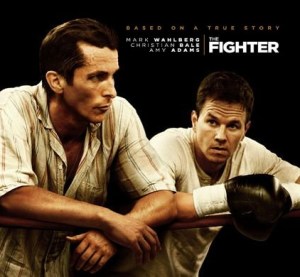
In the film, Mickey Ward (played by Mark Wahlberg) is portrayed as being a well-meaning, blue-collar guy who lives in Lowell, Massachusetts (home of Jack Kerouac) and who makes a living as a “stepping stone,” a below-average boxer who is used by better boxers as just a “stepping stone” on their way to a bigger fight.  He is managed by his overbearing mother (Melissa Leo) and is trained by his half-brother, Dicky (Christian Bale).  Dicky used to be a pro-boxer himself but, as the film begins, he  is more interested in smoking crack than throwing punches.  Still, Dicky remains a local hero and his mother’s favorite and Mickey lives in his shadow.

After one final humiliating defeat in the ring, Ward decides to stop boxing and instead devotes his time to his new girlfriend, a bartender named Charlene (Amy Adams).  Dicky, meanwhile, ends up getting sent to prison.  With Dicky locked away, Mickey starts to come into his own as a person and a boxer and he eventually reenters the ring.  Eventually, he gets his chance at a championship fight.  However, at the same time, Dicky is released from prison and trying desperately to reenter Mickey’s life despite Charlene’s insistence that Mickey stay away from his loving but self-destructive family. 

By the film’s conclusion, the story has become less about Mickey Ward’s fights in the boxing ring and more about his own battle to find the confidence necessary to stop being dominated by the people around him and to live and take responsibility for his own life and his own future.  As undeniably exciting as all of the boxing is, it’s the film’s portrait of Mickey Ward as an essentially nice guy struggling to be independent that makes The Fighter such a moving film.

If you’ve read Sharon Waxman’s Rebels in the Backlot, then you might feel that know a bit about director David O. Russell.  Of the six directors profiled in that book, Russell came across the most negatively, a temperamental prima donna who was portrayed as being the type to accidentally make a great film.  Well, I don’t know if that portrait is an accurate one but The Fighter is no accident.  Russell directs this film with an energy and an attention to detail that puts so-called “nice guy” directors like Ed Zwick to shame.  For me, Russell is at his best in the film’s opening scenes where Mickey and Dicky strut through the streets of Lowell while Heavy’s How You Like Me Now plays in the background.  Not much happens in these scenes.  For the most part, Dicky just BSes with the locals while Mickey shyly watches.  But, in just a matter of minutes, Russell manages to tell us everything that we need to know about Mickey Ward, Dicky Eklund, and Lowell, Massachusetts.

Russell also gets four excellent performances from his lead actors.  Everyone already knows that Christian Bale is amazing in the role of Dicky.  Let’s be honest — we all know he would be even before this film opened.  He’s Christian Bale and Dicky Eklund is a great role.  So instead of repeating what you already know, I’m going to take some time to praise Bale’s co-stars, all three of whom give excellent performances.

As Mickey Ward, Mark Wahlberg once again proves that he’s one of the few leading men working today who can actually bring an air of authenticity to a blue-collar role.  At first, it seems like Wahlberg is going to be overshadowed by both Bale and Melissa Leo (much as Mickey was initially overshadowed by Dicky and his mother).  However, once Dicky has been sent to jail and the movie focuses on Mickey’s relationship with Charlene, you suddenly realize that Wahlberg really is the movie’s heart and soul.  It helps that he has a very real chemistry with Amy Adams.  There’s very few actors who can convince you that they’re falling in love on-screen but Wahlberg proves, in this film, that he’s one of them.

Playing Mickey’s mother and manager, Melissa Leo is alternatively touching and horrifying.  Whether she’s scolding Dicky for continually choosing drugs over family or accusing Charlene of being an “MTV girl,” Leo dominates every scene she’s in.  With this film, Welcome to the Riley’s, and Frozen River, Melissa Leo has quickly become one of my favorite actresses.

Finally, in the role of Charlene, Amy Adams is finally given a chance to show what she’s actually capable of when given an actual character to play.  I’ve always liked Amy Adams because she’s always come across as so genuinely sweet in almost every role she’s played.  Plus, we’re both redheads, we both wanted to be ballerinas, and we both briefly worked at the Gap when we were 18 (though not at the same time, obviously.  And not at the same Gap either).    Furthermore, before breaking into acting, Amy Adams was a Hooters girl and I once applied for a job at Hooters though my mom made me go back and withdraw my application an hour later.  Plus, Amy was born in Italy which is where I would have been born in an ideal world.  And, in an ideal world, I would have her nose as opposed to the one I got stuck with.  (Sorry, I love being a fourth Italian but I still have issues with my big, Italian nose…)

So, yes, Amy Adams is one of my favorite actresses which is why it pained me to see her give such an annoying performance in Julie and Julia last year.  I was worried that maybe all the sweetness had finally given way to self-parody.  However, much as the Fighter is about characters searching for redemption, the movie is also a redemption of sorts for Amy Adams.  Yes, Charlene is another sweet-and-nurturing-girlfriend role for Adams but she brings an unexpected edginess and a very genuine anger to her role.  Charlene may be a nurturer but she’s no doormat and, for me, there’s something very refreshing about seeing a strong, independent woman in a movie who is also still very feminine, nurturing, and unapologetically sexual.  As I previously stated, Wahlberg and Adams have a very real, very definite chemistry in this film and, as a result, this film about a very violent sport is one of the most genuinely romantic that I’ve seen in a long time.

One final note: On a personal level, this movie almost made me want to go out and find a boxer to date.  Why?  So I’ll have an excuse to get dressed up all sexy-like whenever he has a fight.  Seriously, I want that black dress that Charlene wears to all of Mickey’s fights.  It’s to die for.