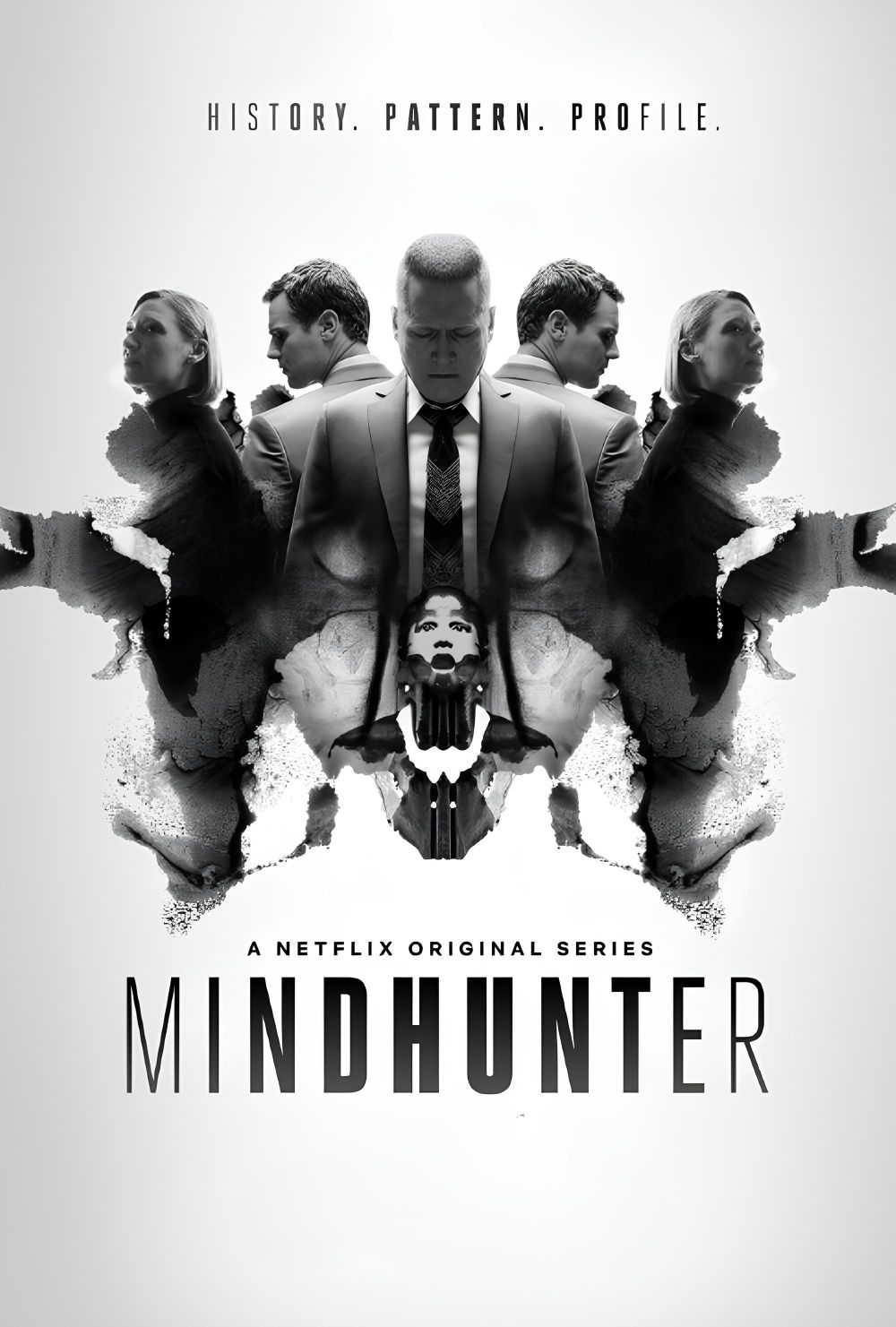
“Butchering people is hard work. Physically and mentally.” — Ed Kemper
The scariest thing in Mindhunter isn’t a crime scene. It’s how quickly a conversation with a murderer can start to feel normal. Someone makes a joke, offers an observation, or answers a question with surprising thoughtfulness, and for a moment you settle into the exchange. Then comes a detail that makes your stomach turn, delivered in exactly the same conversational tone. Across its two seasons, the Netflix series repeatedly catches you making that adjustment. You become comfortable listening to people whose actions should make comfort impossible. That’s where the show finds its particular kind of horror: not in making monsters seem alien, but in showing how easily they can sound like anyone else.
Created by Joe Penhall, with David Fincher serving as an executive producer and a defining directorial presence, Mindhunter draws from John E. Douglas and Mark Olshaker’s book Mindhunter: Inside the FBI’s Elite Serial Crime Unit. It follows the early development of criminal-profiling research within the FBI’s Behavioral Science Unit through agents Holden Ford and Bill Tench and psychologist Wendy Carr. We’ve watched countless investigators study killers and connect behavioral patterns, but what feels different here is the uncertainty. These characters aren’t applying an established formula. They’re trying to determine whether their questions can produce anything useful at all.
That gives the procedural material an unusual texture. Holden and Bill travel, negotiate access, conduct interviews, and deal with colleagues who don’t necessarily see the value in their work. Wendy wants to turn their encounters into research rather than a collection of gruesome anecdotes. The process can be repetitive, awkward, and bureaucratic, which makes it convincing. Instead of treating profiling as a supernatural gift possessed by the smartest person in the room, Mindhunter presents it as a developing discipline shaped by observation, disagreement, and mistakes. Getting someone to talk is only the beginning. Knowing what to do with the answers is another problem entirely.
Unlike Se7en, Mindhunter doesn’t surround its characters with a grimy, nihilistic atmosphere that makes the entire world feel rotten. Nor is its main driving force the obsessive, cat-and-mouse pursuit that consumes the investigators in Zodiac. Its horror comes from somewhere quieter: the suggestion that beneath everyday normalcy lurks a darker, much darker world. Ed Kemper, Dennis Rader—the BTK killer—Wayne Williams, and Charles Manson weren’t inventions designed to populate a nightmare. They existed and walked among the masses. Their histories aren’t interchangeable, but their presence throughout the series punctures the comforting idea that dangerous people must somehow announce themselves as dangerous.
Calling Mindhunter a crime thriller or police procedural, then, only gets you so far. It has horror in its DNA and both feet firmly planted in the genre. That isn’t simply because it deals with murder and sexual violence. It makes normalcy itself feel unreliable. A calm voice, a familiar routine, or an apparently reasonable explanation tells you remarkably little about the person behind it. These people occupied ordinary spaces, held conversations, and participated in a world that didn’t always recognize what they were. There’s no supernatural threat to identify and no reassuring boundary separating their world from ours.
The use of the killers’ own recorded words makes that realization harder to shake. Although Mindhunter dramatizes its encounters rather than reconstructing them as a documentary, portions of its interview dialogue draw from actual statements. You aren’t simply hearing a screenwriter invent something horrible for a villain to say. There’s a real person behind the language, someone who found ways to describe, explain, or rationalize appalling acts. The matter-of-fact presentation makes it worse. The show rarely needs to insist that you be disturbed. It simply gives you enough time to understand what you’ve just heard.
Cameron Britton’s Ed Kemper is the clearest expression of that approach. He’s articulate, conversational, and seemingly pleased that someone wants to listen. Britton doesn’t play every exchange as a warning that violence is about to erupt. He lets Kemper be engaging, which creates a more uncomfortable response than constant menace would. You understand Holden’s fascination even while recognizing the danger in it. Kemper’s willingness to talk doesn’t mean he has surrendered control. Sometimes it means he has found another way to exercise it. Britton makes the difference between access and understanding frighteningly easy to miss.
Fincher’s influence is apparent in how patiently these encounters unfold. The controlled framing, subdued interiors, and measured pacing encourage you to notice small changes: a pause, a look, a shift in posture. A room can remain physically unchanged while the balance of power inside it moves somewhere unpleasant. These are horror sequences built around conversation. Nobody needs to jump out of the shadows. The tension comes from proximity and the possibility that the investigators have become more exposed than they realize. They can leave the room, but that doesn’t mean everything they heard stays behind.
Jonathan Groff makes Holden’s confidence both understandable and irritating. His curiosity opens doors, but he starts confusing his ability to provoke a response with an ability to control the encounter. Groff preserves the earnestness beneath that arrogance. Holden wants the work to matter, but he also wants to be right. His frightening encounter with Kemper exposes how little professional enthusiasm can do when intellectual curiosity becomes physical vulnerability. Understanding danger isn’t the same thing as feeling another person take control of your safety.
Holt McCallany’s Bill Tench supplies the weary perspective Holden lacks. He’s practical, skeptical, and more aware that a useful interview can still leave damage behind. His dry humor keeps the series from becoming suffocatingly solemn, but exhaustion always feels close to the surface. The second-season situation involving his adopted son and a toddler’s death brings his professional anxieties home. The parallel sometimes feels overly arranged, yet McCallany grounds it in a father’s helplessness. Anna Torv’s Wendy provides another necessary counterweight, insisting on methods and conclusions that can withstand scrutiny. Her personal story integrates less smoothly, but her presence keeps the project from becoming a celebration of Holden’s instincts.
The Atlanta child-murder investigation pushes those instincts against a reality that refuses to accommodate them. Behavioral patterns collide with racial distrust, political pressure, institutional priorities, and families whose grief cannot be answered by an interesting theory. Holden’s certainty becomes harder to admire when the stakes extend beyond proving his approach works. Meanwhile, the glimpses of BTK quietly undermine any comforting sense of progress. Whatever knowledge the team acquires, other lives continue beyond its awareness. Understanding some offenders doesn’t mean the investigators can recognize or stop them all.
The lack of a third season makes that expanding scope especially frustrating. Fincher has declared Mindhunter finished, citing the difficulty of justifying its production costs against its audience. Instead of reaching a deliberate conclusion, the series stops with important threads still hanging. The recurring glimpses of BTK suggest a longer game that never gets played out, while the futures of Holden, Bill, Wendy, and their developing work remain unresolved. For fans and critics who championed the series, that’s more than the disappointment of losing a favorite show. It’s the frustration of watching something grow more ambitious only to have its possibilities cut short. There’s a difference between deliberately withholding easy answers and losing the opportunity to continue asking the questions.
Still, its unfinished state doesn’t erase what those two seasons accomplished. You can admire the performances, the filmmaking, and the intelligence of its procedural detail, but its lasting effect is less comfortable than admiration. It leaves you thinking about pleasant exchanges and ordinary faces that gave nothing away. Other crime shows let the solution create distance between us and the horror. Mindhunter keeps taking that distance back. By the end, the troubling question isn’t how anyone could sit across from these men and listen. It’s how many people sat across from them before anyone knew what they had done.
Previous Icarus Files:
- Cloud Atlas
- Maximum Overdrive
- Glass
- Captive State
- Mother!
- The Man Who Killed Don Quixote
- Last Days
- Plan 9 From Outer Space
- The Last Movie
- 88
- The Bonfire of the Vanities
- Birdemic
- Birdemic 2: The Resurrection
- Last Exit To Brooklyn
- Glen or Glenda
- The Assassination of Trotsky
- Che!
- Brewster McCloud
- American Traitor: The Trial of Axis Sally
- Tough Guys Don’t Dance
- Reach Me
- Revolution
- The Last Tycoon
- Express to Terror
- 1941
- The Teheran Incident
- Con Man
- Looker
- 1776
- Here
- The Adventures of Brisco County, Jr.
- The Cable Guy
- A Chorus Line
- Carrie
- Millenium


