Retro Television Review: Crime Story 1.20 “Top of the World”


Welcome to Retro Television Reviews, a feature where we review some of our favorite and least favorite shows of the past!  On Mondays, I will be reviewing Crime Story, which ran on NBC from 1986 to 1988.  The entire show can be found on Tubi!
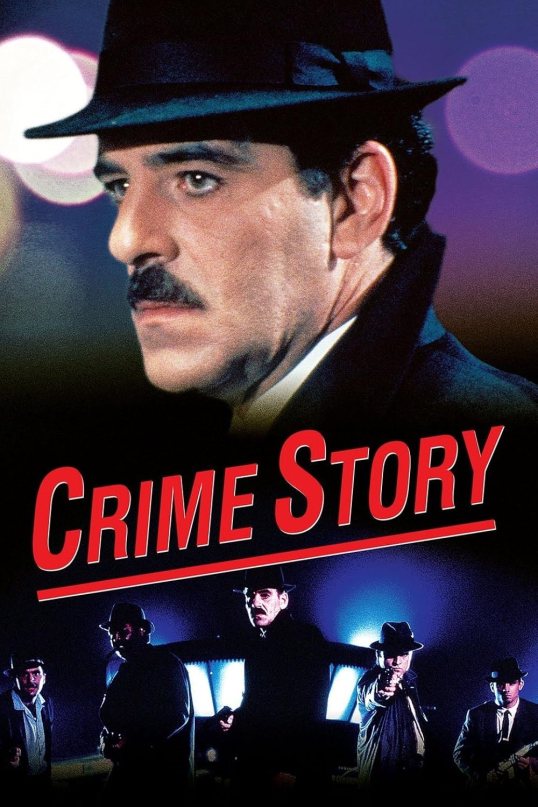
This week, Michael Mann directs the downfall of Luca!

Episode 1.20 “Top of the World”

(Dir by Michael Mann, originally aired on March 6th, 1987)

Luca has taken control of Vegas, and now he’s out of control. He’s gambling nonstop and cheating to win. While his wife spends all of her time watching The Price Is Right, Luca is carrying on affairs with both Bambi (Debbie Harry) and Max Goldman’s wife, Joanne (Debra Stipe). Luca has everything that he’s spent this entire season saying that he wanted: money, legitimacy, and power. But at heart, he’s still the same Chicago gangster that he’s always been. As Torello deduces, he needs the risk and the danger that come with being a criminal. Without it, he doesn’t know what to do with himself.

At the beginning of this episode, Torello tells the demoralized members of the MCU that they can do one of two things. They can either track down Luca’s parents and shoot them for having him, or they can start over with their attempt to build a case against him. (Torello, as intense as ever, doesn’t seem to be joking about tracking down Luca’s parents.) Torello’s plan is to sow dissension among Luca’s troops. When dapper courier Tony Dio (Paul Anka) is spotted leaving Luca’s casino with a suitcase full of skimmed cash for Manny Weisbord, he’s stopped by Torello and essentially kidnapped. They then let Max know that Luca has been sleeping with his wife and insinuate that Luca killed Tony and took the money for himself.

Meanwhile, Luca is temporarily barred from working at his casino by the Nevada Gaming Commission. He can’t even step into any of the places that he owns. Stuck at home with his wife, Luca starts to go stir-crazy. When Steve Kordo tells Luca that Weisbord is asking where his money is, Luca decides that Max is trying to stab him in the back. Luca has Frank Holman plant a car bomb in Max’s car. Though the bomb goes off, Max survives. At the hospital, a severely burned Max tells Torello that he has no intention of being a rat.

However, someone else is, and it’s exactly who you would least expect. Luca, high on pills and self-pity, rapes Pauli’s girlfriend, Donna (Audrey Matson). Pauli grabs a shotgun and starts wandering around Vegas, searching for Luca. Torello is able to arrest Pauli in a diner. Pauli tells Torello the details of every murder that Luca committed over the season, including the murder of David Abrams’s father.

After a shoot-out with Luca’s bodyguards at the casino, Torello, Abrams, and the MCU track Luca down to a restaurant where he’s having dinner with Bambi. (They’re celebrating because an appellate court has stayed the order keeping Luca out of his casinos.) At first, Luca is smug. But when he hears that Pauli is the one who betrayed him, his smile disappears. The episode ends as Luca is taken into custody.

This episode was directed by the show’s executive producer, Michael Mann. Mann does a great job keeping the action moving and showing both Luca’s rapid rise and his just-as-rapid descent. Visually, Mann plays up the darkness in which all the characters live. Nearly every scene takes place at night. When we see Torello sitting in his office, the shadows are so heavy that they almost seem to be swallowing him. This episode reminds us that, just as Luca will always be a Chicago gangster, Torello will always be a Chicago cop. Luca and Torello live in the same darkness, and it’s threatening to devour them both.

Next week, the first season concludes!
Horror Film Review: Salem’s Lot (dir by Gary Duberman)


The new version of Salem’s Lot, which has finally been released on Max after sitting on the shelf for nearly three years, is not very good.

At the same time, it’s definitely not terrible.  There are a few effective scenes.  The finale, which is a bit different from what happens in the book, is enjoyably berserk.  The film made good use of Gordon Lightfoot’s Sundown and, as a history nerd, I appreciated the fact that the movie used the book’s original 70s setting as opposed to trying to update the whole thing.  When writer Ben Mears (Lewis Pullman) wants to investigate the history of the old Marsten House, he has to go to the library.  People looking up stuff on microfiche is always, from a cinematic point of view, more compelling than them pulling up Wikipedia.

Ultimately, the movie is just kind of forgettable.  It’s mediocre in the bland way that so many recent horror films have tended to be.  The movie’s style has far more in common with David Gordon Green’s unfortunate forays into horror than to anything done by Mike Flanagan.  While it may not have originally been meant for a streaming release, streaming is where it begins because it feels like something that would get dumped on Netflix without much fanfare.

It’s a shame because Salem’s Lot really is one of Stephen King’s better novels, written at a time when King was still embracing his pulpy side and without any of the self-important commentary that’s come to mar some of King’s more recent works.  The novel is essentially a small town soap opera, documenting the often sordid lives of the citizens of Jerusalem’s Lot.  King introduces a vampire to the mix and most of the town’s problems are solved by folks dying and then coming back from the dead.  Ben Mears is a typical King protagonist, a writer from Maine who is trying to deal with a childhood trauma and who discovers that ‘Salem’s Lot has a long and apparently cursed history.  In both the book and the movie, Ben teams up with a group of vampire hunters to battle Kurt Barlow (played here by Alexander Ward) and his human servant, Straker (Pilou Asbaek).

The book works because it takes the time to turn Salem’s Lot into a vivid community and, as such, it’s hard not to feel the loss as the town dies off as a result of Barlow’s vampiric invasion.  Clocking in at less than two hours, the movie really doesn’t have time to do that.  The movie’s version of the town just comes across as being another stereotypical New England town, full of flinty characters and mudrooms.  The community never comes to life and, as such, there’s not much emotional resonance as the community dies off.  (It’s not a coincidence that the most successful adaptation of Salem’s Lot was a miniseries.)  Add to that, the 2024 film features some truly unfortunate acting, which again makes it difficult to accept the town as a community with its own traditions and culture.

There are certain character types and themes that seem to appear in all of Stephen King’s novels and the subsequent adaptations.  At its worst, the new Salem’s Lot feels like it’s quickly going through a checklist of all of the expected Stephen King elements.  It’s like, “Main setting — check!  Writer protagonist — check!  Schoolyard bully — check!  Child in danger — check!”  The end result is a film that feels almost like a parody Stephen King, containing all of his familiar tropes without any of the literary flair that made the original book a classic of vampire literature.

The good thing is that the Tobe Hooper adaptation holds up well and it’s also available on Max.  Check it out this weekend.

Yes, A Deadly Adoption Was A Comedy…


deadly-adoption

Last night, an article appeared on Mashable in which I was declared to be one of the  “20 people who totally get the ridiculousness of Will Ferrell and Kristen Wiig’s ‘A Deadly Adoption.”  At the time, I was incredibly flattered but also somewhat incredulous.  If I was one of the 20 people who understood that the latest Lifetime film, A Deadly Adoption, was meant to be a drier than dry comedy then that meant that there were presumably people out there who did not get the joke.

And how could that be!? I wondered.

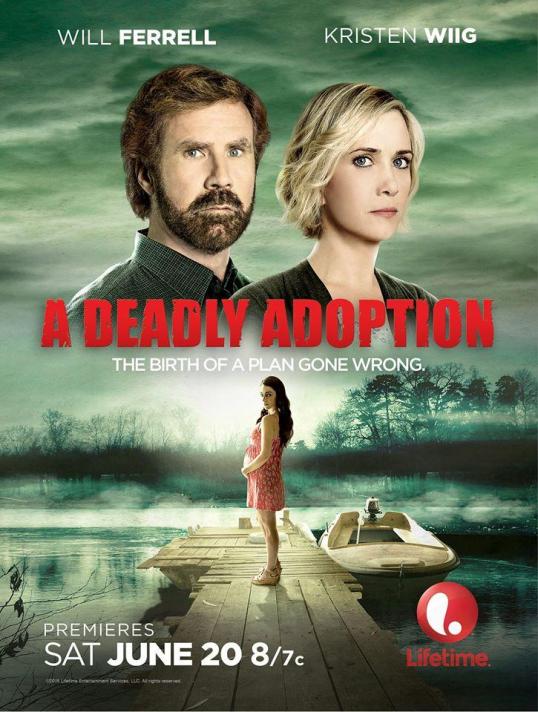
In case you missed it, on April 1st, a story was leaked that Will Ferrell and Kristen Wiig were secretly making a film for Lifetime.  The title of that film was A Deadly Adoption and early reports indicated that it was going to be a serious Lifetime film.  Because the story came out on April Fools Day, a lot of us assumed it was a joke.

However, then Will Ferrell announced that no, it was not a joke.  But now that news of the film had been leaked, he was prepared to close down production and make sure that the film never saw the light of day.  Now, whether Will was being serious in his anger or not is debatable.  (It’s easier to imagine Ron Burgundy having that reaction than Will Ferrell.)  But, regardless, cooler heads prevailed and soon, Lifetime viewers like me were enjoying commercials that featured Jessica Lowndes pointing a gun at a very grim and bearded Will Ferrell.

deadly-adoption-trailer

As the premiere approached, critics and viewers alike wondered if A Deadly Adoption was meant to be a serious film or if it was going to be a comedy.  Those who felt that the film was meant to be serious pointed out that the commercials for the film contained absolutely no hint that it might be a comedy.  Those who thought it was a comedy simply said, “Will Ferrell and Kristen Wiig.”

As for me, I pretty much knew what A Deadly Adoption was going to be from the minute that I discover it was being produced by the same people behind Spoils of Babylon.  And, when I watched the film last night, my suspicions were confirmed.  A Deadly Adoption is a drier-than-dry satire, a film that mashes together every single Lifetime movie trope in order to create the ultimate Lifetime experience.  A Deadly Adoption gets its laughs by refusing to openly acknowledge that it’s gone totally over-the-top.  Will Ferrell and Kristen Wiig both give extremely serious performances, with the humor coming from the fact that they are, with extremely straight faces, delivering dialogue and dealing with situations that are both ludicrous and yet very familiar to anyone who has ever spent a weekend binging on Lifetime.  The end result is that A Deadly Adoption both satirizes and pays tribute to everything that we love about a good Lifetime film.

(Does that make A Deadly Adoption the Sharknado of Lifetime movies?  Technically, yes.  But let’s not say that too loudly because Mia Farrow might hear and decide to live tweet the next showing.)

As for the film itself, it tells the story of Robert (Will Ferrell) and his wife, Sarah (Kristen Wiig).  Robert is a financial author who is also a recovering alcoholic with anger management issues.  (Significantly, everyone always talks about how angry Robert is, despite the fact that we never actually see him lose his temper.)  We know that Robert is a writer because he skypes with his agent and tells her stuff like, “Let’s cut chapter four.”  Sarah, meanwhile, has a typical Lifetime movie career.  She sells organic food at the local farmer’s market.  And, like all Lifetime movie heroines, she has a token and obviously doomed gay best friend named Charlie (Bryan Safi).

Years ago, as the result of an accident on a dock, a pregnant Sarah nearly drowned and lost her baby.  As a result, Robert is incredibly protective of their other daughter, Sully (Aylvvia Alyn Lind). (As part of the A Deadly Adoption drinking game, take a drink every time Will Ferrell says, “She needs her medicine!”)  Robert is also now scared of going out on the water so you better believe that the film’s conclusion is going to involve Robert in a tiny boat.

Anyway, Robert and Sarah want to adopt the unborn child of Bridget (Jessica Lowndes) but what they don’t know is that Bridget has plans of her own.  Upon accepting their offer to live with them until she gives birth, Bridget starts to subtly disrupt the lives of Robert and Sarah.  That right, she’s obsessed!  And, of course, she’s got a redneck boyfriend (Jake Weary) who drives a pickup truck and has a lot of “dangerous” tattoos.  And…

Well, I could actually devote a few thousand words to telling you the plot of A Deadly Adoption.  A lot of stuff happens.  In fact, every single plot point from every single Lifetime film ever made gets used at some point.  Everything about this film — from the acting to the direction to the tasteful decor of Robert and Sarah’s house to the almost obsessive focus on Jessica Lowndes’s cleavage — is designed to make this film look like a typical Lifetime film.

The brilliance of it comes from the fact that Ferrell, Wiig, Lowndes, and Weary all deliver their increasingly ludicrous lines with such intense commitment and low-key seriousness.  (Kristen Wiig, in particular, is great.)  With the exception of one line about lighter fluid and a dance party at the end of the film, there’s nothing in A Deadly Adoption that plays for obvious laughs.  Instead, the film is a two-hour inside joke and, if you get the joke, you’re one of the cool kids.

Unfortunately, there are a lot of uncool kids out there and a lot of them did not get the joke.  If you check out the comments left on the film’s imdb page, you’ll discover that there’s still a lot of people out there who are wondering whether this was meant to be a serious film or not.

*Sigh*

To quote Ron Burgundy, “GREAT ODIN’S RAZOR!”

(Did he say that?  Sounds like something he would say.)

Anyway, to answer those who still do not know — yes, A Deadly Adoption was a comedy.

And it was a brilliant one at that!

This is what I feel like doing when people say they don't know if A Deadly Adoption was supposed to be funny.

This is what I feel like doing whenever people say they don’t know if A Deadly Adoption was supposed to be funny.