Today’s music video of the day features Danny Trejo riding a motorcycle through the desert and doing other badass, Danny Trejo-type things. I know that a lot of people will watch this video and think to themselves, “My God, he can sing too!” However, believe it or not, Trejo is just lip-syncing. I know. I was shocked to find that out, too. That said, Trejo does a pretty good job lip-syncing and it’s possible that he may have been singing during the filming.
Seriously, who doesn’t love Danny Trejo? Not only is he a good actor who appears to sincerely want to improve the lives of other people but he’s got a pretty inspiring personal story too. So today, we happily wish the best of birthdays and we invite you to….
There haven’t been many trailers to share, lately. That’s largely due to the uncertainty that’s surrounding COVID-19 and when — if ever — certain films are going to be able to get a theatrical release. That said, there is a new trailer out and I think that a lot of our readers are going to be interested in it.
So, without further ado….
Inmate #1 is a documentary about how all-around badass Danny Trejo went from being a convict to being a cultural icon. As anyone who has ever seen Trejo interviewed can tell you, he’s got an inspiring life story and he’s also a wonderful storyteller. I’m looking forward to seeing this documentary, which will be released in the United States on July 7th.
Delfina, a precocious ten year-old, desperately needs a bone marrow transplant. Unfortunately, the only available donor is Rudy Salazar (Danny Trejo), a sociopath who is currently sitting on Death Row. (We’re told that Rudy is the only possible donor because both he and Delfina are “half-Mexican, half-Greek.” I’m not a medical expert but I imagine there’s probably more to finding a donor than just that. And, even if it was that simple, surely Rudy and Delfina are not the only two people of Mexican-Greek ancestry living in Los Angeles.) Lydia Cantrell (Sofia Shinas), who works for the governor, arranges for Rudy’s death sentence to be commuted to life in prison in return for him donating his marrow. At the hospital, Rudy stages a violent escape and soon, he and his old gang are on a rampage.
It falls to renegade Detective Quin Quinlan (C. Thomas Howell) to track down Rudy and bring his rampage to an end. The only catch is that Rudy has to be captured alive because Delfina still needs that transplant. Complicating matters is that Quinlan really enjoys shooting the bad guys.
If the plot of Dilemma sounds familiar, you may be one of the handful of people who remember an old Michael Keaton/Andy Garcia film called Desperate Measures. Desperate Measures may have had the same plot as Dilemma (along with a bigger budget and bigger stars in the cast) but it didn’t have Danny Trejo. Trejo appears without his trademark mustache and he really plays up the idea that Rudy Salazar is one evil dude. Rudy’s so evil that he even laughs at shooting people in the back. When a member of his gang is wounded in a shootout and begs, “Don’t leave me, dawg!,” Rudy takes one look at him and says, “You’re of no use to me.” Only Danny Trejo can make a line that work. With the rest of the cast not making much of an effort one way or the other, Danny Trejo is the best thing about Dilemma and one of two reasons to watch the movie. The other reason is to watch in amazement as both the police and the criminals fire thousand of bullets at each other without ever having to stop and reload their guns. Luckily, they’re all terrible shots who only have good aim when its convenient for the plot.
In many ways, the 1997 monster film Anaconda is an incredibly dumb movie but let’s give credit where credit is for. Whoever was in charge of casting this movie managed to assemble the most unlikely group of co-stars that you would ever expect to see in a movie about a documentary crew who run into a giant snake while sailing down the Amazon River.
I mean, let’s just consider the most familiar names in the cast. Jennifer Lopez. Ice Cube. Jon Voight. Owen freakin Wilson. I mean, it’s not just that you wouldn’t expect to come across these four people all in the same movie. It’s that they all seem to come from a totally different cinematic universe. They’ve all got their own unique style of acting and seeing them all on the same small boat together is just bizarre. You’ve got Jennifer Lopez, delivering her lines with a lot of conviction but not much sincerity. And then you’ve got Ice Cube coolly looking over the Amazon and basically daring the giant snake to even think about trying to swallow him. Owen Wilson is his usual quirky self, delivering his lines in his trademark Texas stoner drawl. And then you’ve got Jon Voight.
Oh my God, Jon Voight.
Voight plays Paul Serone, a Paraguayan who says that he can help the documentary crew find an isolated Amazon tribe but who, once he gets on the boat, basically takes over and announces that he’s actually a snake hunter and he’s planning on capturing the biggest anaconda in existence. It takes a while for the snake to show up. When it finally does, it’s actually a pretty impressive throw-back to the type of cheesy by entertaining monsters that used to show up in drive-in movies back in the 50s and the 60s. But really, the biggest special effect in the movie is Jon Voight. Wisely, Voight doesn’t waste any time trying to be subtle or in anyway believable in the role of Serone. Instead, Voight gives a performance that seems to be channeling the spirit of the infamous Klaus Kinski. Voight growls, snarls, and glares as if the fate of the world depended upon it and he rips into his Paraguayan accent with all the ferocity of a character actor who understands the importance of being memorable in an otherwise forgettable movie. It’s as if Voight showed up on set and looked at what was going and then said to himself, “Well, Jon, it’s all up to you.” Serone is really a pretty vicious character. I mean, he literally strangles a character to death with his legs! But, thanks to Voight’s crazed energy he’s still the most compelling character in the movie. It’s really scary to think about what the film would have been like without Voight shaking things up. Along amongst the cast, Voight seems to understand just how silly Anaconda truly is. Voight takes a rather middling monster movie and, through sheer force of will, manages to make it at least somewhat entertaining.
Personally, I’d like to see a remake of Anaconda, one that would feature the same cast but would be directed by Werner Herzog. Just imagine if Herzog had told the story of that trip down the Amazon. Gone would be the bland dialogue and rudimentary character motivations. Instead, we’d have Jennifer Lopez slowly going insane while hundreds of monkey lay siege to the boat and Ice Cube musing on the never ending conflict between man and nature. Herzog’s Anaconda would probably be just crazy enough to keep up with Jon Voight’s performance.
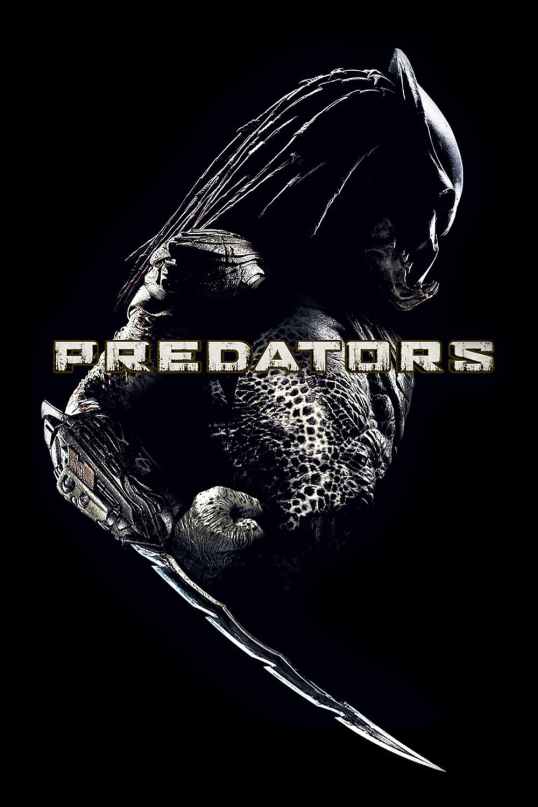
It would be twenty years before those space-faring hunters, the Predators, would return to the big screen. Sure, they appeared in the two Aliens vs. Predator films of the early 2000s, but I don’t count those as part of the Predator franchise—mostly because they weren’t the headliners. Plus, those two mash-up films were all kinds of awful.
2010’s Predators, directed by Nimród Antal and produced by Robert Rodriguez, set out to breathe new life into the sci-fi action franchise that the two AvP entries had drained of excitement. From the early 1990s until this film’s release, the Predator mythology had steadily expanded through novels, comics, and games, creating a world as rich as any in science fiction. Longtime fans came to understand the Predators’ culture, mindset, and technology.
For some, that world-building stripped away the mystery that made the Predator such an iconic monster. Others felt it helped establish consistent rules, allowing future stories to build on a solid foundation instead of endlessly one-upping what came before.
Predators embraced this expanded lore while adding a new wrinkle: the introduction of the so-called “Super Predators,” bigger, faster, and meaner than the classic hunters we’d seen over the decades. Another new element placed the story on an unnamed planet serving as an extraterrestrial game preserve, where Predators could hunt their chosen prey on familiar ground.
This setup lent a new dimension to the narrative. The humans being hunted had nowhere to run, and whatever advantage they might have enjoyed on Earth vanished instantly. They were now being hunted on Predator turf—a cruel inversion of game hunting, like a safari where the prey has no chance against its well-equipped pursuers.
Despite these new additions to the lore, the film mostly works as an action-thriller. We get the requisite band of misfits, murderers, and killers—the worst humanity has to offer, but the best at what they do. They range from black-ops mercenaries and elite snipers to cartel enforcers and even a serial killer.
Leading this reluctant ensemble is the enigmatic Royce, played by Oscar-winner Adrien Brody, who surprisingly pulls off the wiry, cold-hearted black-ops soldier. The film hinges on his performance. He’s not a team player, nor is he likable—he fits the antihero mold perfectly, willing to sacrifice anyone if it means surviving another hour. Yet he understands that his best chance lies in keeping others alive, if only as tools for his own survival. He’s the audience surrogate, the one who rolls his eyes as everyone else makes one bad decision after another.
Antal’s action direction recalls the McTiernan era. He favors long, sweeping takes that clearly define the geography of each battle—a quality too rare in modern action cinema, where quick cuts and shaky edits often stand in for real dynamism. Where the film falters is in its reliance on exposition-heavy dialogue. After nearly every action set piece, the momentum stalls as characters explain what’s happening. Laurence Fishburne even appears in a role that exists purely to deliver exposition.
Now, about those Super Predators: they’re an intriguing trio who expand the series’ creature variety, though at the cost of making the classic Predator seem almost obsolete. There’s the Tracker, who uses alien hunting dogs to flush out prey; the Falconer, who employs a cybernetic drone that feels straight out of the Marvel Cinematic Universe; and the Berserker, the biggest and most brutal of the three, relying on raw power rather than skill or strategy.
They look fantastic but slightly diminish the menace of the original Predator design. Against this new breed, the traditional hunters seem almost helpless.
Still, Predators stands several notches above what audiences got from the two AvP movies. Despite an exposition-heavy script and a bold but polarizing decision to downplay the classic Predator’s threat, Antal’s entry injects enough adrenaline and fresh lore to reenergize the series. It’s unfortunate that the AvP films’ lingering stench colored its reception, but over time, more fans have come to appreciate Predators for what it is: a fun, muscular, and engaging slice of sci-fi action.
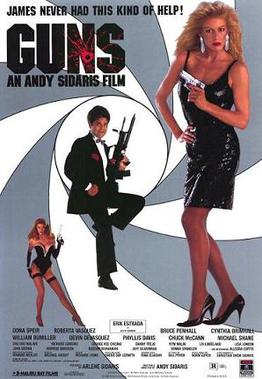
As you can probably tell by looking at the poster at the top of this review, the 1990 film Guns was Andy Sidaris’s attempt to make a Bond film. Not only does the poster feature a man in a tuxedo and two gun-wielding women but the tag line even reads, “James Never Had This Kind of Help!”
Much like a Bond film, Guns features a secret agent fighting to defeat an international conspiracy. The agent’s efforts lead her and her allies to several different cities in several different … well, really only one country. Being a Sidaris film, it’s doubtful the Guns really had the budget to film anyplace other than the United States but still, the action does move from Lake Huvasa, Arizona to Hawaii to Las Vegas. That’s about as close as a Sidaris film ever gets to featuring exotic locations.
(If Lake Havusa sounds familiar, that’s because Jimmy Kimmel gave away at trip to Lake Havusa during the Oscars.)
And like any good Bond film, Guns has a flamboyant and almost comically evil villain. Juan “Jack of Diamonds” Degas (telenovela star and future reality tv mainstay Erik Estrada) is an international gun dealer and an all-around sociopath. He’s the type who shoots someone and then smirks about it. He’s so evil that he’s even got Danny Tejo working as his main henchman! That’s really evil! Estrada gives a surprisingly good performance in the role. Especially when compared to the forgettable villains who appeared in Sidaris’s previous films, Juan Degas feels like a worthy opponent. It’s not just that he’s evil. It’s that he’s so damn smug about it. You can’t wait to see him get taken down.
Degas is planning on smuggling a bunch of Chinese weapons into America through a base on Hawaii. The only problem is that Donna (Dona Speir) and her new partner, Nicole Justin (Roberta Vasquez), are based in Hawaii! Degas knows that he has to get rid of them if he’s going to have any hope of succeeding. (For whatever reason, it never occurs to Degas to smuggle the weapons through Guam or American Samoa. I mean, there are other islands out there.) When Degas sends two cross-dressing assassins to kill Nicole, they end up not only shooting the wrong woman but also killing a friend of Dona’s as well.
Now, it’s personal!
Except, it was already personal. In a typical example of Sidaris’s make-it-up-as-you-go-along style of plotting, it turns out that Degas previously killed Donna’s father. And now, it appears that it might get even more personal because Degas has kidnapped the Attorney General of Nevada, who happens to be Donna’s mother!
Obviously, this means that it’s time to gather together another group of misfit agents and take down the bad guys. That means that Savage Beach‘s Shane Abilene (Michael J. Shane) and Bruce Christian (Bruce Penhall) both show up again. It also means that a lovable magician named Abe (Chuck McCann) gets to help out as well. Unfortunately, one member of the team is eventually blown up by a remote control boat.
That’s right! A remote control boat! For some reason, remote control vehicles were a Sidaris obsession and it’s not a Sidaris film without someone getting blown by either a remote control boat or helicopter.
Anyway, there’s a lot of explosions to be found in Guns but the good thing is that it’s women blowing stuff up and it’s women who are in charge of the entire operation. That’s the thing with a Sidaris film like this one. For all of the nudity and the double entendre-filled dialogue, Guns was an action film where women got to shoot the guns, beat up the bad guys, and ultimately save the world from a smirking misogynist. When Donna picked up that rocket launcher, it was both ludicrous and empowering at the same time.
Guns is one of Sidaris’s better films. For once, despite all of the usual Sidaris red herrings, the plot can actually be followed and Estrada is an appropriately hissable villain. While the film may not be able to compete with the best of the Bond films, it’s still more fun that SPECTRE.
To quote The Main With No Name, “When a man’s got money in his pocket, he begins to appreciate peace.”
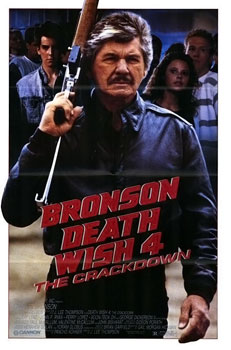
Two years have passed since Paul Kersey (Charles Bronson) last visited and cleaned up New York. He is back in Los Angeles, the president of his own successful architectural firm. Now a rich man, he has retired from killing criminals, though he still has dreams where he shoots muggers in parking garages. Paul has a new girlfriend, journalist Karen Sheldon (Kay Lenz). When Karen’s teenage daughter, Erica (Dana Barron), dies of a cocaine overdose, it’s time for Paul to get his gun out of storage and blow away a drug dealer.
Shortly after shooting that drug dealer, Paul finds a note on his front porch. “I know who you are,” it reads. Paul then gets a call from a mysterious man (John P. Ryan) who identifies himself as being a reclusive millionaire named Nathan White. Nathan explains that his daughter also died of a cocaine overdose. He wants to hire Paul to take out not just the drug dealers but also the men behind the dealers, the bosses. Using his vast resources, Nathan has prepared a file on every major drug operation in Los Angeles. He offers to share the information with Paul.
“I’ll need a few days to think about it,” Paul says but we all know he’s going to accept Nathan’s offer just as surely as we know that Nathan White has an ulterior motive that won’t be revealed until the movie’s final twenty minutes.
For the first time, Paul is no longer just targeting muggers and other street criminals. This time, Paul is going after the guys in charge and trying to bring an end to drug trade once and for all. (The idea that the best way to win the war on drugs was just to kill anyone involved in the drug trade was a very popular one in the late 80s.) L.A.’s two major drug cartels are led by Ed Zacharias (Perry Lopez) and the Romero Brothers (Mike Moroff and Dan Ferro). Along with their own activities, Paul and Young work the turn the two cartels against each other.
It’s not just the criminals that have changed in Death Wish 4. Paul has changed, too. Paul used to just shoot criminals and run away. In Death Wish 4, he gets more creative. He sneaks into Zacharias’s mansion and bugs the phone so that he can keep track of what’s going down. When it comes time to kill a table full of drug dealers (one of whom is played by Danny Trejo), Paul doesn’t shoot them up. Instead, he sends them a bottle of champagne that explodes when they open it. By the end of the movie, Paul is blowing away the bad guys with a grenade launcher! How many former conscientious objectors can brag about that?
The biggest difference between Death Wish 4 and the films that came before it is the absence of director Michael Winner. Winner and Bronson had a falling out following Death Wish 3 and, as a result, Winner had little interest in returning to the franchise. Instead, Winner was replaced by J. Lee Thompson, who had already directed Bronson in several other Cannon films. As a result, Death Wish 4 is less “heavy” than the previous Death Wish films. Whereas Winner’s direction often felt mean-spirited and exploitive, Thompson plays up the film’s sense of airy adventure.
Though it barely made a profit at the box office and has been dismissed by critics, Death Wish 4 is an enjoyable chapter in Paul’s story. If you’re looking for mindless 80s mayhem, Death Wish 4 gets the job done with admirable efficiency. It would have made a great ending for the franchise but Bronson would return to the role one last time.
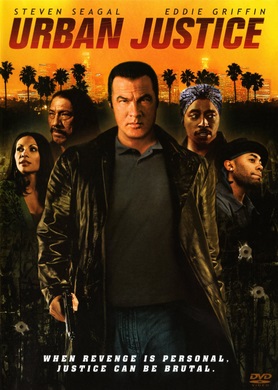
Steven Seagal returns and this time, he’s out for justice! Urban justice!
After his son, a beloved Los Angeles cop, is assassinated, Simon Ballister (Seagal, of course) comes out of retirement to get revenge. Retirement from what? Like most of Seagal’s characters, Simon has a deadly and legendary past. Nearly everyone who meets him says something like, “So, you’re Simon.” Everyone wants Simon Ballister to do something for them. El Chivo (Danny Trejo!) wants Simon to help defeat his rival, Armand Tucker (Eddie Griffin). Armand Tucker wants to be Scarface. Simon just wants revenge.
Much like Elvis, Steven Seagal’s career can be divided into a thin and a fat period. Thin Steven Seagal was all over movie screens in the 90s, making up for the fact that he could not act by convincingly beating people up. Fat Steven Seagal appears almost exclusively in direct-to-video productions. He does everything that Thin Seagal did but he sweats a lot more while doing it. Unfortunately, Fat Seagal is an even worse actor than Thin Seagal. Since Fat Seagal produces almost all of his own films, there is no one around to say, “Let’s cut away from Steve during this speech, he looks stupid.”
Urban Justice is peak Fat Seagal. It actually features more fights than the typical Fat Seagal movie but they are all edited in such a way that it is obvious that most of the blows were delivered by a stuntman while Seagal undoubtedly stood in a corner, trying to catch his breath. Since Urban Justice features Seagal in what is supposed to be the ghetto, he calls everyone that he meets, “motherfucker.” Fat Seagal has the same Clint Eastwood-style rasp that he had when he was Thin Seagal but he still sound stupid whenever he says, “I want the motherfucker who killed my son.”
Eddie Griffin is pretty good as Armand Tucker. I don’t know if Eddie improvised all of his dialogue but it certainly seems like he did. All of the movie’s best lines belong to Eddie Griffin. Just one example: “Man, fuck Santa Claus! He never gave me shit! That’s why I sell dope!” As for Danny Trejo, he doesn’t do much but he’s Danny Trejo.
Personally, looking over the career of Steven Seagal, I think he made a mistake by trying to be an action hero. It is hard to think of any other actor with as unlikable a screen presence as Steven Seagal. If Steve had made his career playing villains, he would probably still have a good career going. People would gladly play money to see Steven Seagal get blown up at the end of a Jason Bourne sequel. Instead, he insisted on playing the hero and his career is now made up of appearing in direct-to-video movies and threatening to run for governor of Arizona.
To quote Clint Eastwood, “a man’s got to know his limitations.”
This is the one where Charles Bronson sodomizes a guy with a dildo.
Don’t worry, though. Bronson does it off-screen and the guy was abusing Nicole Eggert so he had it coming.
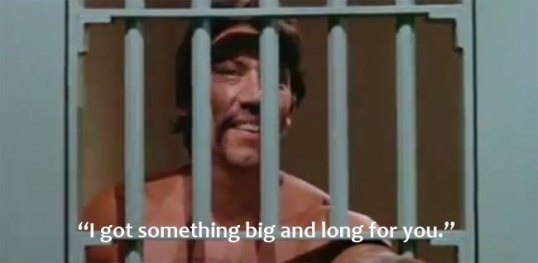
In Kinjite, Bronson plays Lt. Crowe, a tough LAPD vice cop who hates two groups of people: pedophiles (which is cool, who doesn’t hate them?) and the Japanese (which is not cool). Not only does Crowe sodomize a pervert but he also forces a pimp to eat a gold watch and later, with the help of his partner, he holds another man over the edge of a balcony, just to have that man accidentally slip out of his shoes and plunge to his death. Finally, Crowe tosses a convict into a prison cell, where another prisoner (played by Danny Trejo, in what may have been his film debut) announces that he’s “got something big and long for you.” Crowe chuckles, “That’s justice” and then walks away.
Danny Trejo in Kinjite
Of the many strange films that Bronson made for Cannon Films, Kinjite may be the strangest. The main plot involves Crowe searching for and rescuing the kidnapped daughter of a Japanese businessman (James Pax). Before his daughter was kidnapped, the businessman groped Crowe’s fifteen year-old daughter on a city bus. The entire movie seems to be building up to the moment that Crowe, who is portrayed as being overprotective of his daughter, discovers what the businessman did but that moment never comes. There are numerous scenes of the businessman in Japan but they do not have anything to do with the rest of the plot. Strangely, neither Crowe’s daughter nor his wife (played by Peggy Lipton) are ever menaced by the bad guys. What type of Charles Bronson movie is this?
In Bronson’s defense, he was 71 year-old when he made this movie and, off screen, his wife Jill Ireland was battling the cancer that would eventually take her life. Bronson can be excused for not appearing to be overly invested in Kinjite: Forbidden Subjects. (Since Kinjite means Forbidden Subjects in Japanese, the actual title of this movie is Forbidden Subjects: Forbidden Subjects.) No one appears to have made much of an effort on Kinjite, though Bronson’s stunt double gets a good work out. Kinjite is full of scenes where Bronson throws a punch in close-up but his first in never actually shown connecting with anyone. Most of the action scenes are clumsily filmed so that Crowe keeps his back to the camera. All Kinjite needs is a supporting turn from Troy McClure and a cameo from McGarnagle and it would be perfect viewing for The Simpsons.
Kinjite would be the final film that Bronson made for Cannon Films. It would also be the last Bronson film to be directed by J. Lee Thompson. After Kinjite, Bronson appeared in two more feature films: Sean Penn’s The Indian Runner (which, if not for Penn’s pretentious direction, could have launched Bronson on a second career as a first-rate character actor) and a final Death Wish film. Bronson returned to television, appearing in three made-for-TV movies before retiring in 1999. Bronson died in 2003 but, as long as there are people who enjoy a good action movie, he will never be forgotten.
This scene is not from Kinjite but it’s still pretty fucking cool.
Edward Furlong is Ron Decker, a spoiled 18 year-old from a rich family who is arrested and sent to prison when he’s caught with a small amount of marijuana. Being younger and smaller than the other prisoners, Ron is soon being targeted by everyone from the prison’s Puerto Rican gang to the sadistic Buck Rowan (Tom Arnold). Fortunately, for Ron, prison veteran Earl Copen (Williem DaFoe) takes him under his wing and provides him with protection. Earl is the philosopher-king of the prison. As he likes to put it, “This is my prison, after all.” If he can stay out of trouble, Ron has a chance to get out early but, with Buck stalking him, that’s not going to be easy.
Based on a novel by ex-con Edward Bunker, Animal Factory was the second film to be directed by Bunker’s Reservoir Dogs co-stars, Steve Buscemi. Though it was overlooked at the time, Animal Factory is a minor masterpiece. Taking a low key approach, Buscemi emphasizes the monotony of prison life just as much as the sudden bursts of violence and shows why someone like Ron Decker can go into prison as an innocent and come out as an animal. DaFoe and Furlong give two of their best performances as Earl and Ron while a cast of familiar faces — Danny Trejo, Mickey Rourke, Chris Bauer, Mark Boone Junior — make up the prison’s population. Most surprising of all is Tom Arnold, giving Animal Factory‘s best performance as the prison’s most dangerous predator.


 To quote The Main With No Name, “When a man’s got money in his pocket, he begins to appreciate peace.”
 Steven Seagal returns and this time, he’s out for justice! Urban justice!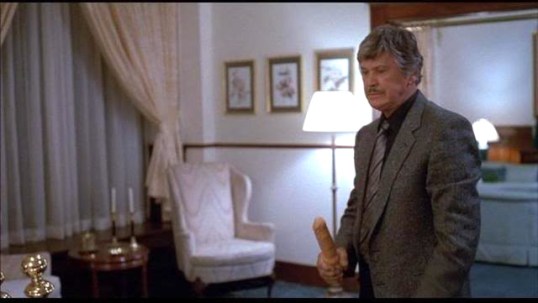

 Edward Furlong is Ron Decker, a spoiled 18 year-old from a rich family who is arrested and sent to prison when he’s caught with a small amount of marijuana. Being younger and smaller than the other prisoners, Ron is soon being targeted by everyone from the prison’s Puerto Rican gang to the sadistic Buck Rowan (Tom Arnold). Fortunately, for Ron, prison veteran Earl Copen (Williem DaFoe) takes him under his wing and provides him with protection. Earl is the philosopher-king of the prison. As he likes to put it, “This is my prison, after all.” If he can stay out of trouble, Ron has a chance to get out early but, with Buck stalking him, that’s not going to be easy.
