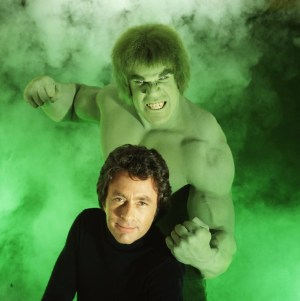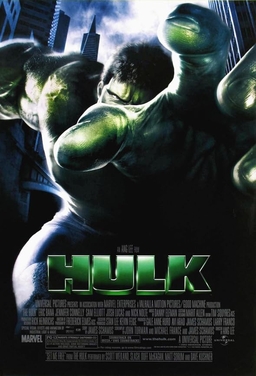
Hulk (2003, directed by Ang Lee)


After an early childhood of being abused and experimented upon by his mad scientist father, David (Nick Nolte), Bruce Banner (Eric Bana) has grown up to be a mild-mannered scientist who represses his anger. However, when he gets exposed to elevated gamma radiation, a change comes over Bruce and, whenever he gets angry, he turns into the Hulk, a green-skinned creature who cannot contain his rage. Banner finds himself on the run while his father, who has returned to Bruce’s life, tries to manipulate his son’s condition to get revenge on everyone whom he feels has betrayed him. Eventually, David takes a dose himself and transforms into the Absorbing Man, leaving comic book readers to wonder why, out of the Hulk’s wonderful rogue’s gallery of villains, a film would feature one of the least interesting.

It’s easy to forget just how surprised people were when it was announced that Ang Lee was going to be directing a film based on a comic book. “Really?” people said. “But Ang Lee’s an Oscar-winning filmmaker. Why would he make a movie about the Hulk?” A lot of people were even more surprised when the film came out and was more concerned with Bruce’s dysfunctional relationship with his father than with the usual comic book action (though it did have plenty of that). Lee’s use of a forgettable villain like Absorbing Man made more sense once it became clear that Bruce and David were meant to have absorbed their anger from their dysfunctional backgrounds. When Hulk came out in 2003, most critics dismissed it as being an interesting failure.

Today, even though I’m more aware than ever of the film’s flaws, I prefer Ang Lee’s Hulk to the subsequent Marvel versions. In Ang Lee’s Hulk, not every problem can be solved by a CGI battle and not every line is delivered with a wink and a nod. I even prefer Eric Bana to both Edward Norton and Mark Ruffalo because Bana doesn’t shy away from portraying Bruce as being someone who is actually pretty boring when he’s not the Hulk. For most of the movie, Bana’s version of Bruce Banner has no desire to become a superhero or to fight evildoers. He just wants to get through the day without turning into an uncontrollable monster and destroying things. Bana’s Hulk is out of control in a way that Marvel’s Hulk rarely is. Also, Sam Elliott and Jennifer Connelly are both better choices for Thaddeus Ross and his daughter Betty than either William Hurt or Liv Tyler. From the minute you see him, Sam Elliott just is Thunderbolt Ross.

Dismissed when it was first released, Hulk is a film that gets better with each viewing.


The Godson (1998, directed by Bob Hoge)


After the violent death of his son Sonny Calzone, the Oddfather (Dom DeLuise) announces that his other son, Guppy Calzone (Kevin McDonald, of the Kids In The Hall), will be taking over the family business.  Guppy is sent to Mafia University, where he learns how to garrote a traitor and dismember a body.  Guppy falls in love with Don Na (Fabiana Udenio), the daughter of the Rodfather (Rodney Dangerfield), the leader of a rival family.

The Godson tries to do to gangster movies what Airplane! did to disaster movies.  Dom DeLuise does a good Brando impersonation and there’s a funny moment where Guppy stops the action and tries to convince people in the audience to buy a Guppy action figure.  Otherwise, this is a poorly-done parody film.  Good comedy is all about timing and The Godson flunks that test.  Jokes are either too long or too short but hardly any of them stick.  The idea of Mafia University is funnier than the, if you’ll excuse the phrase, execution.  Even worse, the movie doesn’t make much use of Rodney Dangerfield.  When one of the funniest men who ever lived appears in your movie, it’s cinematic malpractice not to give him a chance to shine.

If the film has a highlight, it’s Lou Ferrigno as a member of the Oddfather’s crew.  Otherwise, this is a missed opportunity.

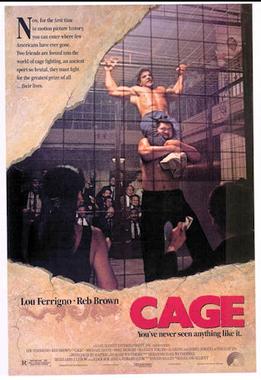
Cage (1989, directed by Lang Elliott)


As with so many stories, it all starts with Vietnam.

In 1969, soldier Billy Thomas (Lou Ferrigno) heroically saves the life of his captain, Scott Monroe (Reb Brown).  Unfortunately, while their helicopter is taking off, Billy takes a bullet to the head.  While he survives the wound, he is left with the mind of a child.  Scott dedicates his life to taking care of Billy and, after the war, they open a bar together.  However, mobster Tony Baccola (Michael Dante) feels that Billy would be the perfect contestant for a series of fight-to-death cage matches that have been set up by Chinese gangster Tin Lum Yin (James Shigeta).  In desperate need of money, Tony kidnaps Billy and forces him to fight, telling him that it’s what Scott needs him to do.  Billy doesn’t want to fight and, when he first enters the cage, he says, “Hi, how are you?” and tries to shake his opponent’s hand.  But when his opponents try to hit Billy, he has no choice but to defend himself.  It’s up to Scott to rescue his friend.

The plot of this movie is pretty dumb but I’m not embarrassed to say that the film itself won me over.  The fights were decent but the main reason why the movie works is because of Lou Ferrigno and Reb Brown, who made their friendship and their bond feel very real.  Ferrigno was especially good in this film.  How can you not root for a guy who just wants to be everyone’s friend and who, even after his twelfth cage match, still gets upset over having to hit people?

A pure B-movie all the way, Cage also features familiar faces like Branscombe Richmond, Al Leong, and Danny Trejo.  Most of the critics may not have liked it but Ferrigno has described Cage as being his his favorite film performance and I agree.

Scenes That I Love: Lou Ferrigno Battles A Bear in Luigi Cozzi’s Hercules


Today’s scene that I love comes from Luigi Cozzi’s 1983 epic, Hercules!

In this scene, Hercules (Lou Ferrigno, making up for his lack of range with nonstop and likable sincerity) shows us the proper way to deal with a rampaging bear.  There have been a lot of film versions of Hercules, some good and some bad.  But none were quite as cheerfully weird as the Hercules that was given to us by Lou Ferrigno and Luigi Cozzi.

Live Tweet Alert: Join #FridayNightFlix For Hercules!


As some of our regular readers undoubtedly know, I am involved in a few weekly live tweets on Twitter and Mastodon.  I host #FridayNightFlix every Friday, I co-host #ScarySocial on Saturday, and I am one of the five hosts of #MondayActionMovie!  Every week, we get together.  We watch a movie.  We tweet our way through it.

Tonight, at 10 pm et, #FridayNightFlix has got 1983’s Hercules, starring Lou Ferrigno and Sybil Danning!

If you want to join us this Friday, just hop onto twitter, start the movie at 10 pm et, and use the #FridayNightFlix hashtag!  It’s a friendly group and welcoming of newcomers so don’t be shy.

Hercules is available on Prime and Tubi!  See you there!

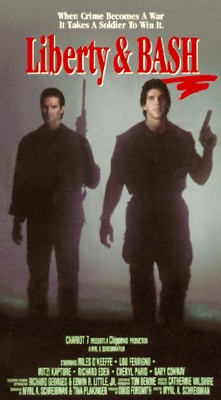
Liberty & Bash (1989, directed by Myrl A. Schreibman)


Liberty (Miles “How much Keeffe is in this film?” O’Keeffe) and Bash (Lou Ferrigno) served together in Nam and then came back to Los Angeles to clean up the streets.  Liberty is a parole officer who doesn’t take no for an answer.  Bash owns a gym and runs a Guardian Angels type of operation.  Their friend and fellow vet, Jesse (Richard Eden), has a mullet and wears acid-washed mom jeans.  Jesse lives with his sister, Melissa (Cheryl Paris), who never wears pants.  When Jesse is murdered by a drug lord who spends almost all of his time soaking in the tub, Liberty and Bash eventually get around to seeking revenge.

The movie is called Liberty & Bash but Bash is actually only in a few minutes of the movie and Lou Ferrigno’s voice is dubbed by another actor.  This was probably done because Ferrigno is partially deaf and, as a hard-of-hearing person who happens to be a big Lou Ferrigno fan, that really bothered me.  Of the many storylines that floated through Liberty & Bash, Lou Ferrigno leading a Guardian Angels chapter was probably the one with the most potential but Liberty & Bash doesn’t do much with that.  When Bash wasn’t around, the other characters should have been saying, “Hey, where’s Bash?”

Instead, the movie is all about Liberty.  Even though Liberty is trying to bring the drug lord to justice and prove that Jesse didn’t commit suicide, the majority of the film is taken up with scenes of Liberty arguing with his girlfriend, a social worker named Sarah (Mitzi Kapture).  Sarah is pregnant but she’s considering getting an abortion.  Liberty spends almost the entire movie trying to talk her out of getting an abortion.  Sarah and Liberty even argue about it during the film’s climatic action scene.  I’m not kidding.  This is the first action film that I’ve ever seen where the action was regularly interrupted by the abortion debate.  The movie is obviously on Liberty’s side but Liberty is so obnoxious about it that the audience will be on Sarah’s side.  Sarah can’t make up her mind until one of the bad guys points a gun at her belly and she says, “My baby!”  

It’s a weird movie and doesn’t add up to the much.  If not for a little profanity and some brief nudity, Liberty & Bash could have passed as the pilot for syndicated, Stephen J. Cannell cop show.  Mr. B (Charles Dierkop) is Los Angeles’s least intimidating drug lord.  Mitzi Kapture is sexy, elegant, and displays the patience of a saint as Sarah.  Miles O’Keeffe is usually the coolest cat this side of Michael Pare but in this movie, he’s surly and won’t stop yelling at his girlfriend. Cheryl Paris spends almost the entire movie in her underwear, showing that the filmmakers at least knew who their target audience was.  Those who like to keep an eye out for mullets and off-the-shoulder t-shirts will find the film to be a feast.  The movie had miles of Keeffe but it needed more Bash.

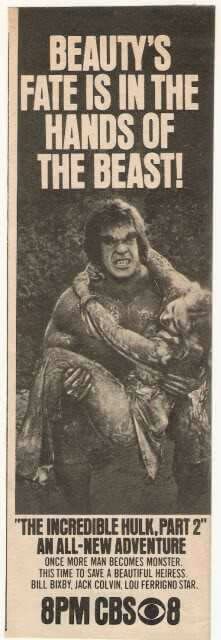
The Death of the Incredible Hulk (1990, directed by Bill Bixby)


David Banner (Bill Bixby), still hoping to find a cure for the condition that causes him to turn into the Hulk (Lou Ferrigno) whenever he gets injured or stressed out, heads up to Portland.  Pretending to be a simple-minded janitor named David Bellamy, Banner gets a job working in the lab of Dr. Ronald Pratt (Philip Sterling).  Banner hopes that Dr. Pratt’s research holds the secret that can release him from being the Hulk.  When Dr. Pratt learns Banner’s secret, he and his wife (Barbara Tarbock) work with Banner to try to cure him and to understand the Hulk.

David Banner is not the only person who has infiltrated the lab.  KGB agent Jasmin (Elizabeth Gracen) has also been sent to the lab with orders to steal Pratt’s research.  Jasmin hates working for the KGB but she’s been told that her sister will be killed unless she complete one final mission.  When Jasmin meets and falls in love with David, she starts to reconsider her loyalties.  When the KGB finally makes their movies, Jasmin is going to have to decide who to help and the Hulk is going to have to come through and save the day one final time.

David Banner’s saga finally comes to a close in The Death of the Incredible Hulk, the third and last of the Incredible Hulk television movies.  It’s also the best of the three, though that might not by saying much when you consider the quality of the first two.  While the other two movies both served as backdoor pilots for other heroes and the Hulk was barely even present in the 2nd movie, The Death of the Incredible Hulk keeps the focus squarely on David Banner and the Hulk.  (Though Jasmin does seem like she could be a version of the Black Widow, I think the similarities between the two characters are a coincidence.  Beautiful and conflicted KGB agents were a popular trope in the 80s and early 90s.)  Both Bixby and Ferrigno get to show off what they can do in their signature roles.  Bixby is especially good at capturing Banner’s tortured and lonely existence and his performance helps to make The Death of the Incredible Hulk something more than just another cheap sci-fi TV movie.

Though the film stays true to its title and ends with a mortally wounded Banner saying that he’s finally free, it was not intended to be the final Hulk film.  There were plans to bring David Banner back to life and presumably, the Hulk would have come back with him.  Unfortunately, Bill Bixby himself died in 1993, before shooting could begin on The Return of the Incredible Hulk.


The Trial of the Incredible Hulk (1989, directed by Bill Bixby)


Still on the run and hoping to find a cure for the condition that causes him to transform into the Incredible Hulk, David Banner (Bill Bixby) is now in New York and using the name David Belson.  He’s grown a beard to keep himself from being recognized.  I guess it’s like when Superman used to put on his glasses.  When David sees a woman being harassed on the subway by two thugs, it’s too much stress for him and he transforms into the Hulk (Lou Ferrigno).  When the Hulk turns back into David, he is arrested and charged with being a mugger.  (No one believes the witness’s account of seeing a huge green man on the subway.)

Despite the title, the Hulk never goes on trial, though there’s a dream sequence where David turns into the Hulk in a courtroom.  (Stan Lee plays the jury foreman.)  Just having a nightmare about turning into the Hulk is enough to cause the transformation for real.  No New York jail can hold the Hulk.

David’s lawyer is blind and yes, his name is Matthew Murdock (played by Rex Smith).  Murdock thinks that the attack on the subway was somehow linked to a crime lord named … yes, Wilson Fisk.  Fisk (John Rhys-Davies) wants to set up a national crime syndicate, as if Lucky Luciano didn’t already do that.  Using the name Daredevil, Murdock tries to prevent that.  David eventually ends up helping.

The Trial of the Incredible Hulk is a huge tease.  It promises the Hulk on trial but, instead, it’s just a backdoor pilot for a Daredevil TV series.  Just like in The Incredible Hulk Returns, the Hulk is forced to make room for a new hero.  But at least The Incredible Hulk Returns actually featured the Hulk working with Thor.  In Trial of the Incredible Hulk, the Hulk is hardly present at all.  Banner encourages Murdock not to give up, even after he’s badly beaten by Fisk’s men, and he works with Matt to help him prepare for a rematch.  But the final battle is almost all Daredevil.  Once he escape from prison, Banner doesn’t turn into the Hulk once.

Rex Smith isn’t bad as Daredevil.  While he’s not as good as Charlie Cox, he’s still better than Ben Affleck.  While the movie does not feature the classic Daredevil costume, it does at least get Daredevil’s origins and powers correct.  John Rhys-Davies hams it up as Wilson Fisk.  One of Marvel’s most intriguing villains is turned into just another generic bad guy in an office.  It’s disappointing.

The Trial of the Incredible Hulk ends with Murdock pledging to protecting the city and Banner again hitchhiking away.  Daredevil would have to wait for another 25 years before getting his own series.  Banner would return in The Death of the Incredible Hulk.


A Movie A Day #145: The Incredible Hulk: A Death In The Family (1977, directed by Alan J. Levi)


Following the events of The Incredible Hulk and with the world convinced that he is dead, Dr. David Banner (Bill Bixby) is hitchhiking his way across California, hoping to reach a hospital where research is being done on the effects of gamma radiation.  When he stops off in an orange grove, he spots a young, crippled woman named Julie (Laurie Prange).  When Julie faints, David carries her back to her mansion.  It turns out that, after the mysterious death of her father, Julie stands to inherit millions.  David suspects that her doctor (played by William Daniels) may be poisoning her and he gets a job working on the grounds of her mansion.  At first, David thinks that his biggest problem is going to be the head groundskeeper (Gerald McRaney), who is jealous of David’s relationship with Julie.  But, actually, it’s Julie’s stepmother (Dorothy Tristan) that David has to watch out for.  When David tries to protect Julie and a bitter hermit (John McLiam) from the stepmother’s evil plans, he soon finds himself being pursued through the swampland by both men with guns and tabloid journalist Jack McGee (Jack Colvin).  They are all making David Banner angry and they’re about to discover that they wouldn’t like David Banner when he’s angry.

This was the second pilot for The Incredible Hulk.  It aired a week after the first pilot and, like that one, it was also given a theatrical release in Europe.  While the first movie established David Banner’s backstory and explained why he transformed into the Hulk whenever he bumped his head on a door frame or twisted his ankle, A Death in The Family is more typical of the series that would follow.  Like every subsequent episode, A Death In The Family opens with David Banner finding an odd job and ended with him walking down the road with his thumb stuck out.  In between, Banner helps a special guest star.

Watching the second pilot, it’s easy to see why CBS took a chance on The Incredible Hulk even though, at the time, comic book adaptations were considered to be a risk.  Both Bill Bixby and Lou Ferrigno really throw themselves into playing Banner and his alter ego and the show takes the idea seriously.

There’s nothing special about the pilot’s story.  The stepmother and the doctor are obviously guilty from the start.  But the plot (and the 90 minute running time) does allow for four appearances by the Hulk.  David Banner even gets attacked by a grizzly bear, which brings the Hulk right out.  David Banner always had the worst luck with wild animals and barbed wire.  The Hulk, though, just throws the grizzly bear over into the next pond.  The bear is not harmed.  The Hulk may have been angry but he was never really dangerous.

Finally, for the record, Death In the Family featured the first of many aliases that David Banner would assume over the next four years.  This time, he’s David Benton.

A Movie A Day #144: The Incredible Hulk (1977, directed by Kenneth Johnson)


It may seem hard to believe now but there was a time when comic book adaptations were considered to be a risky bet at best.  In 1977, Marvel Comics sold the television rights for four of their characters to Universal Productions. This led to three unsuccessful pilots (one for Dr. Strange and two for Captain America), a Spider-Man series that lasted for two seasons, and The Incredible Hulk.  As opposed to the other Marvel adaptations, The Incredible Hulk series was popular with fans and (some) critics and ultimately lasted for four seasons.
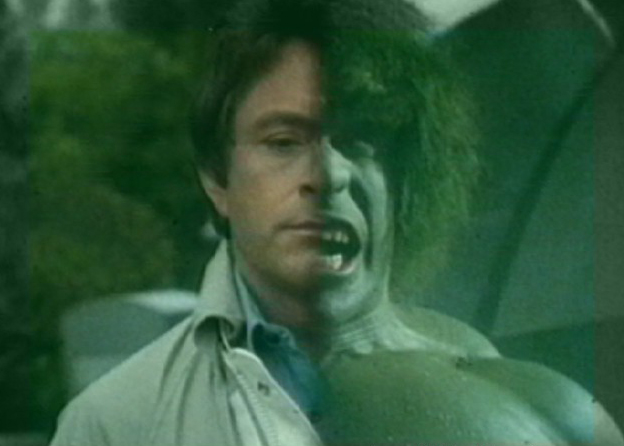
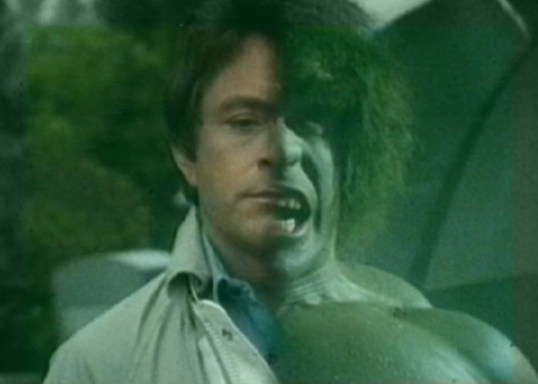
It all started with a 90 minute pilot that aired in 1977.  Haunted by the car accident that caused the death of his wife and his inability to rescue her, Dr. David Banner (Bill Bixby) is researching why, in times of extreme stress, ordinary people can suddenly experience moments of super human strength.  What he theorizes is that it is a combination of body chemistry and gamma radiation caused by sun spots.  Eager to test his theory, David straps himself into a chair and zaps himself with gamma radiation.  At first, it seems as if nothing has changed.  But when David’s driving home, he gets a flat tire.  When he struggles to change the tire, in the middle of a hurricane nonetheless, David gets mad.  Suddenly, his eyes turn green and soon so does the rest of him as David Banner is transformed into the Incredible Hulk (Lou Ferrigno, except for one shot where the Hulk is played by Richard Kiel).  The Hulk runs through the woods, accidentally scaring a girl and getting shot by a hunter.  When the Hulk falls asleep, he transforms back into David, who has no memories of what he did while he was the Hulk.  While David and his colleague, Elaina Marks (Susan Sullivan), investigate what happened to him, tabloid reporter Jack McGee (Jack Colvin) tries to uncover the results of David and Elaina’s research.

Other than introducing the Hulk and giving Banner a backstory, the pilot didn’t have much in common with the series that followed.  Along with being a comic book adaptation, the series was also a remake of The Fugitive.  With everyone convinced that the Hulk had murdered both him and Elaina, David was always on the run and trying to find a way to cure his condition.  Every episode would begin with David working a new odd job and getting involved in a new situation and almost every episode ended with David hitchhiking while the show’s famous piano theme played over the final credits.  Because David was always either getting beaten up or tangled in barbed wire, the Hulk would show up twice an episode.  David Banner just couldn’t catch a break.

The pilot seems to take forever to get going, devoting a lot of time to David and Elaina doing research.  In those days before the success of The Dark Knight and the MCU legitimized comic books as a cultural force, The Incredible Hulk was determined to show that it was not just a show for kids.  Today, the pilot is too slow-paced and self-consciously serious but still contains the elements that made the show itself became a success.  Bill Bixby takes his role seriously and Lou Ferrigno is the perfect choice for the Hulk.  Decades after they first aired, the Hulk-transformation scenes are still undeniably cool.  It was also during the pilot that Dr. Banner uttered those famous and oft-parodied words: “Mr. McGee, don’t make me angry.  You wouldn’t like me when I’m angry.”

As of this week, reruns of The Incredible Hulk are now being shown, daily, on both H&I and the El Rey network.  I will be watching.