The Blues Brothers! They’re on a mission from God.
Jake (John Belushi) and Elwood Blues (Dan Aykroyd) are two Chicago orphans who love the blues and committing crime. After Jake is paroled from Joliet Prison, he’s picked up by Elwood in an old police car. Elwood traded the original Bluesmobile for a microphone. Jake understands, even if he still doesn’t like being seen in a police car. When they visit the orphanage where they were raised, Sister Mary Stigmata (Kathleen Freeman) beats them with a ruler and tells them that the orphanage is going to close if she can’t pay a $5,000 tax bill. Jake and Elwood set out to reform their band, raise $5,000, and save the orphanage. Jake and Elwood may be two career criminals who never take off their dark glasses but they’re on a mission from God.
Along the way to putting the band together and raising $5,000, Jake and Elwood meet characters played by everyone from James Brown to Ray Charles to Aretha Franklin. You never know when a big production number might break out. Jake and Elwood also step on a few toes. Soon, the Blues Brothers being chased by the police, the national guard, Jake’s parole officer (John Candy), Charles Napier’s country-western band, and a group of Illinois Nazis (led by Henry Gibson). There’s also a mysterious woman (Carrie Fisher) who wants to kill them. She has an impressive array of weapons but terrible aim.
The Blues Brothers was the first comedy to be based on a Saturday Night Live bit. Unlike most other SNL movies, The Blue Brothers develops its plot far beyond what was originally seen on television. Jake and Elwood get a full backstory and they also get personalities that go beyond the black suits and the dark eyewear. The Blues Brothers features Belushi at his most energetic but it’s also one of the few films to actually know what to do with Dan Aykroyd’s eccentric screen presence. If Belushi’s Jake is all about earthly pleasures, Aykroyd’s Elwood almost seems like a visitor for another world. Aykroyd’s performance of the Rawhide theme song is one of the film’s highlight.
The Blues Brothers has its share of funny lines and its famous for the amount of pointless destruction that it manages to fit into its storyline (with the “unnecessary violence” being authorized by the Chicago police to stop the Blues Brothers) but it’s also as surprisingly sincere tribute to the blues. It’s a movie that can balance Ray Charles shooting at a shoplifter and a massively destructive car chase in a suburban mall with Cab Calloway playfully performing Minnie the Moocher and Aretha Franklin bringing down the house (or diner, as the case may be). The movie can feature both a jump over an open drawbridge and Steven Spielberg as the clerk at the tax office. It’s one of the strangest comedies ever made and it features all the excesses that would bring an end to 70s Hollywood but when Jake and Elwood say they’re on a mission from God, you believe them.
“The world isn’t run by weapons anymore, or energy, or money. It’s run by little ones and zeroes, little bits of data. It’s all just electrons.” — Cosmo
Sneakers is one of those early-’90s studio thrillers that feels oddly cozy for a movie about global surveillance and information control. It plays like a hangout movie that just happens to revolve around a world-breaking black box, and whether that balance works for you will pretty much decide how much you click with it.
Set in San Francisco, Sneakers follows Martin Bishop (Robert Redford), a one-time radical hacker now leading a boutique team that gets paid to break into banks and corporations to test their security. When a pair of supposed NSA agents lean on him about a skeleton in his past, they strong-arm him into stealing a mysterious “black box” from a mathematician, which turns out to be a codebreaker capable of cracking pretty much any system on Earth. From there, the crew gets pulled into a bigger conspiracy involving shady figures and high stakes, with Martin confronting echoes from his activist days.
The first thing that jumps out about Sneakers is the cast, which is frankly stacked even by modern standards. Redford brings an easy, weathered charm to Bishop; there’s a low-key joke baked into the movie that this legendary leading man is now playing a guy who looks like he spends more time worrying about his back pain than saving the world, and it works. He’s surrounded by a motley crew: Sidney Poitier’s ex-CIA operative Crease, Dan Aykroyd’s conspiracy-addled tech nut Mother, David Strathairn’s blind audio savant Whistler, and River Phoenix’s eager young hacker Carl. Mary McDonnell rounds things out as Liz, Martin’s ex, who gets roped back into his orbit and ends up doing some of the film’s most memorable social-engineering work.
What makes this lineup click—and really shine—is how effortlessly the ensemble works together, especially with Robert Redford and Sidney Poitier anchoring it as the team’s leaders. Redford’s Bishop is the steady, pragmatic brain, always one step ahead but grounded by his regrets, while Poitier’s Crease brings that sharp-edged authority from his CIA days, barking orders with a mix of gruffness and loyalty that keeps everyone in line. Their dynamic is electric: you get these moments where Bishop’s quiet scheming bounces off Crease’s no-nonsense intensity, like when they’re coordinating a break-in and trading barbs mid-scheme, and it sells the years of trust they’ve built. It elevates the whole group, giving the younger or quirkier members—Mother’s wild theories, Whistler’s uncanny ears, Carl’s fresh energy—a solid foundation to riff off, turning what could be chaos into a tight, believable unit. Phil Alden Robinson directs the film almost like an ensemble comedy interrupted by bursts of espionage, so the banter and the little grace notes between jobs end up being as memorable as the heists themselves. There’s a looseness to the way the team bickers, teases, and riffs on each other that sells the idea they’ve been doing this for years, long before the plot kicked in. You feel that especially in scenes where they’re all huddled around some piece of tech or puzzling out a clue; the script allows them to overlap, crack side jokes, and be fallible instead of treating them like slick super-spies who never misstep.
Tonally, the movie walks an interesting line. On one hand, this is very much a tech thriller about the power of information, with the ominous “Setec Astronomy” anagram (“too many secrets”) tying it all together. On the other, this is a film where an extended sequence revolves around tricking a socially awkward engineer on a date so they can steal his voice patterns and credentials, and the whole thing plays like a romantic caper more than anything. Robinson leans hard into suspense in key stretches—most notably toward the end, where tension builds through clever set pieces involving motion sensors, improvised skills, and closing threats—but even then the movie never loses its sense of mischief.
That playfulness can be both a strength and a limitation. The upside is obvious: Sneakers is fun. It’s easy to watch, easy to rewatch, and it rarely drowns you in jargon for the sake of sounding smart. Instead, it abstracts the tech into clear stakes—this box breaks codes, this system controls money and power—so you always understand the “why” behind every scheme even if you don’t follow every “how.” The downside is that, for a movie nominally about the terrifying implications of a universal decryption key, it doesn’t dig as deeply into the horror of that idea as it could. It gestures at themes of privacy, state overreach, and the weaponization of data, but it’s more interested in using those ideas as a playground than as something to rigorously interrogate.
Viewed from 2026, the tech is obviously dated—landlines, old terminals, magnetic cards—but that almost works in the film’s favor now. There’s a retro-futurist charm to seeing characters talk about “ones and zeroes” and the power of information as if they’re whispering forbidden knowledge, when today that conversation is basically the nightly news. At the time, the film was praised for being ahead of the curve on the idea that whoever controls data controls everything, and you can still feel that prescience. The irony is that what was once cutting-edge has softened into a kind of warm nostalgia, which might be why the movie has quietly settled into cult-favorite status rather than staying in the mainstream conversation.
On a craft level, the movie is sturdy across the board. John Lindley’s cinematography keeps things bright and clean rather than shadow-saturated, which reinforces that lighter tone; San Francisco looks lived-in and slightly mundane, not like a glossy cyber-noir playground. James Horner’s score is a big asset: a jazz-inflected, airy sound that gives scenes a sense of cool rather than danger, which again nudges things toward caper more than hard thriller. It’s the kind of soundtrack that sneaks into your head and quietly sets the mood without demanding too much attention, and a lot of fans single it out as one of his more underappreciated efforts.
If there’s a major weak spot, it’s probably in how the film handles its big ideas and antagonists. The central conflict draws on ideological clashes from the characters’ pasts, but it mostly serves as a charismatic foil rather than a fully fleshed-out debate. The story doesn’t push too hard on challenging cautious pragmatism versus radical change, or probe deeply into who benefits from the status quo. For a tale built on “too many secrets,” the moral landing feels predictable rather than revelatory.
The film also shows its age in how it uses certain characters, especially Liz and Carl. McDonnell gets moments to shine—her date with Werner Brandes is a highlight—but Liz is often pushed to the side once the plot machinery gets going, which is a shame given the sparks between her and Redford. River Phoenix’s Carl is similarly underused; he’s the young blood in a team of older pros, and you can see hints of a more emotionally grounded arc there, but the film keeps him mostly in comic-relief mode. It doesn’t derail the movie, but it does contribute to the sense that Sneakers is more interested in being a breezy ensemble hang than in fully developing everyone it introduces.
Still, it’s hard to deny the movie’s overall charm. The central heist beats are cleanly staged, the reversals are satisfying without being overcomplicated, and the script gives almost every member of the team at least one clutch contribution so it feels like a true group effort. The later stretches cleverly tie together the tech setup and character dynamics, ending on a light coda that underscores the film’s affection for its quirky crew over global intrigue.
As for how it holds up, Sneakers isn’t an untouchable classic, but it’s a very easy film to recommend if you have any affection for ’90s thrillers, ensemble casts, or tech-adjacent stories that don’t drown you in circuitry diagrams. Some of its politics feel glib, some of its gadgets are charmingly antique, and its big questions about Information Age ethics are more backdrop than deep dive. But the film’s mix of laid-back humor, light suspense, and grounded, slightly rumpled characters gives it a distinct flavor that a lot of modern, hyper-slick hacker movies lack.
If you go in wanting a serious, hard-edged exploration of cyber-warfare and state power, Sneakers will probably feel like it’s only skimming the surface. If you’re in the mood for a smart, lightly twisty caper that lets you spend two hours with a killer cast tossing around clever dialogue amid escalating capers, it’s still a very satisfying watch.
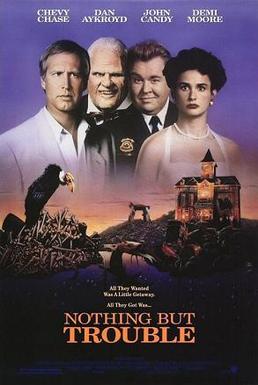
Publisher Chris Thorne (Chevy Chase) is eager to get to know lawyer Diane Lightson (Demi Moore) so he agrees to drive her and two Brazilian hangers-on from Manhattan to New Jersey. The Brazilians encourage Chris to take a detour, which leads to him running a stop sign, getting into a high-speed chase with chief of police Dennis Valkenheiser (John Candy), and being detained in the dilapidated village of Valkhenheiser. Dennis decides to leave town with the Brazilians, leaving Chris and Diane to face the wrath of 106 year-old Judge Alvin “J.P” Valkenheiser (Dan Aykroyd). Judge Valkenheiser has spent decades killing anyone who breaks the law in his village, though he also kills anyone who he just dislikes. The Judge assumes Chris is a banker (and he hates bankers) and is prepared to kill him unless he marries the Judge’s granddaughter, Eldona (John Candy, in drag). This town is nothing but trouble and Chris and Diane have to escape.
Nothing But Trouble was both the directorial debut and swan song for Dan Aykroyd. (Aykroyd also wrote the script, from a story that was written by his brother, Peter.) The film was an notorious box office bomb and watching, it’s easy to see why. The story is all over the place, awkwardly mixing humor and horror. Anyone who has seen the early seasons of Saturday Night Live knows that young Dan Aykroyd was one of the funniest people around but, when it comes to the movies, he’s always worked better with a collaborator than on his own. As a director, Aykroyd throws a little bit of everything into Nothing But Trouble and the movie feels overstuffed.
As an actor, though, Aykroyd is funny. Whatever laughs are to be found in Nothing But Trouble are largely the result of his performance as the Judge. Chevy Chase seems bored. Demi Moore actually gives a decent performance but she plays her role straight. John Candy is likable as Dennis but too cartoonish as Eldona. Aykroyd, however, so commits himself to playing the 106 year-old judge that he wrings laughs from even the weakest of lines. Criticize Aykroyd the director all you want, Aykroyd the actor delivers.
One final note: The rap group Digital Underground makes a cameo appearance as themselves, performing in the Judge’s courtroom after getting arrested for speeding. When I was watching Chevy Chase mugging for the camera and Dan Aykroyd walking around hunched over, I hardly expected to see a young Tupac Shakur suddenly show up but he did. Digital Underground’s cameo is one of the film’s better moments, even if they don’t perform The Humpty Dance.
In the year 1979, a young Steven Spielberg attempted to conquer comedy in the same way that he previously conquered horror with Jaws and science fiction with Close Encounters of The Third Kind. Working from a script written by Robert Zemeckis and Bob Gale, Spielberg made a film about the days immediately following Japan’s attack on Pearl Harbor. The name of the film was 1941 and it remains Steven Spielberg’s only attempt to direct a full-out comedy. There’s a reason for that.
The film follows a large group of characters over the course of one day and night in 1941. It’s been six days since Pearl Harbor was attacked and the streets of Los Angeles are full of young men who are preparing to ship out and older man who are paranoid about when the next attack is going to come. However, Major General Joseph Stilwell (Robert Stack) just wants to see Dumbo at the local theater. Meanwhile, his womanizing aide (Tim Matheson, giving the same performance here that he did in National Lampoon’s Animal House) just wants to get Stillwell’s aviation-lusting secretary (Nancy Allen) into an airplane.
Elsewhere, Ward Douglas (Ned Beatty) is happy to allow Sgt. Tree (Dan Aykroyd) and his men (including John Candy) to set up on an anti-aircraft gun in his front yard. Ward’s daughter, Betty (Dianne Kay), is only concerned about entering a dance contest with her friend, Maxine (Wendie Jo Sperber). Cpl. Sitarski (Treat Williams) and dishwasher Wally Stephens (Bobby D iCicco) both hope to be Betty’s partner and their rivalry leads to a massive (and seemingly never-ending) brawl.
While Ward deals with the gun in his front yard, another concerned citizen — Claude Crumm (Murray Hamilton) — keeps watch from atop of Ferris wheel, along with amateur ventriloquist Herbie Kazlminsky (Eddie Deezen).
But that’s not all! Susan Backilinie recreates her role from a previous Spielberg film, skinny dipping while the Jaws theme plays in the background and running straight into a submarine that is commanded by Commander Akiro Mitamura (Toshiro Mifune, trying to maintain his dignity). Mifune decides to attack Hollywood but no one on the submarine is sure where that is. Christopher Lee appears as an arrogant German who is along for the ride. Slim Pickens shows up as a lumberjack who is temporarily captured by the Japanese. John Belushi plays Wild Bill Kelso, who flies his airplane through Los Angeles. Warren Oates yells and laughs. Dick Miller, Elijah Cook Jr. and Lionel Stander show up in small roles.
“Since when is Steven funny?” According to Peter Biskind’s Easy Riders, Raging Bulls, this was the reaction that most of Spielberg’s friends had when he announced that his next film would be a screwball comedy set during World War II. Watching the film, one gets their point. The majority of the film’s humor comes from people looking at the camera and screaming. There’s a lot physical comedy, which would undoubtedly work in small amounts but which grows rather tiring when it’s dragged out to the extent that Spielberg’s drags it out. (A brawl at a USO show seems like it should be funny but Spielberg allows it to go on for too long and the careful choreography takes away any element of spontaneity.) The film attempts to duplicate the style of Animal House (and it’s probably not a coincidence that Matheson, Belushi, and director John Landis all have roles in the film) but Spielberg often seems as if he’s trying too hard. There’s nothing subversive about the humor. It’s more antic than funny.
A huge problem is that there really isn’t much of a story here. Spielberg, who is normally one of Hollywood’s best storytellers, attempts to do a loose, Altman-style ensemble film and the result is that none of the characters feel alive and there’s never any sense of narrative momentum. There are a few performers who manage to make an impression amongst all the explosions and the yelling. John Belushi has the advantage of not having to share the majority of his scenes with anyone else. Warren Oates’s manic energy is more than welcome. Wendie Jo Sperber deserved more screentime. Murray Hamilton and Eddie Deezen frequently made me laugh. There’s a wonderful moment where Robert Stack’s intense general cries while watching Dumbo. But, for the most part, the film never comes together.
That said, 1941 is definitely a Steven Spielberg film. It received three Academy Award nominations, for Cinematography, Sound, and Visual Effects. (All three of those categories, not surprisingly, are more associated with spectacle than with comedy.) The film looks great! Spielberg’s attention to detail is there in the production design and the costumes. Watching 1941, you can see Spielberg’s talent while also seeing why he never directed another comedy.
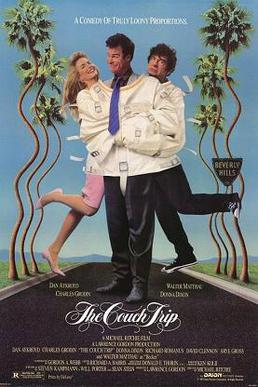
When renowned radio psychiatrist George Matlin (Charles Grodin) has a nervous breakdown, he takes a trip to Europe with his wife (Mary Gross) to both recover and also work on his marriage. (Matlin’s breakdown was the result of an extramarital affair.) Needing someone to host Dr. Matlin’s radio show, his producers call Dr. Lawrence Baird (David Clennon), who oversees a mental facility in Chicago. They assume that Dr. Baird is just dumb enough that they won’t have to worry about him overshadowing Dr. Matlin while he’s guest-hosting. However, when they call, Dr. Baird is out of his office and the phone is answered by John Burns (Dan Aykroyd), a con artist who has been pretending to be insane so that he can avoid serving time in prison. Pretending to be Baird, Burns accepts their offer and then escapes from the asylum and heads to Beverly Hills. The real Dr. Baird, not knowing about the offer, goes on vacation in Europe. Though Burns had originally only been planning on doing the radio job long enough to get paid enough money to head to Mexico, he soon becomes a celebrity with his non-nonsense, blunt advice.
There’s a lot of talented people in TheCouchTrip, including Walter Matthau as a former priest-turned-kleptomaniac and Aykryod’s wife, Donna Dixon, as Matlin’s colleague and Burns’s eventual love interest. Director Michael Ritchie was responsible for some of the best films of the 70s and radio psychiatry is certainly a ripe subject for satire. Why, then does, The Couch Trip fall flat? Some of it is because the movie never seems to know if it wants to be wacky farce or a dramedy about a criminal who finds a new life helping people. The other big problem is that the talented Dan Aykroyd is miscast as the type of unapologetic smartass that Bill Murray could play in his sleep. (In a version where Murray played John Burns, Aykroyd would have been perfect casting as George Matlin.)
Aykroyd was one of the most talented members of the original Not Ready For Prime Time Players. (His impersonations of Nixon and Jimmy Carter were second-to-none.) Sadly, Hollywood has never figured out what to do with his off-center talent. The Couch Trip is a prime example of that.
What’s an Insomnia File? You know how some times you just can’t get any sleep and, at about three in the morning, you’ll find yourself watching whatever you can find on cable or streaming? This feature is all about those insomnia-inspired discoveries!
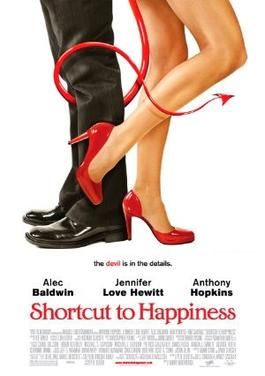
If you’re having trouble getting to sleep tonight, you can always jump over to Tubi and watch Shortcut to Happiness, a.k.a. The Devil and Daniel Webster.
When was Shortcut to Happiness released? There’s some debate about that. Though the film’s credited director is Harry Kirkpatrick, it was actually directed by Alec Baldwin. (Please, no Rust jokes.) The film was shot in 2001, in New York City. However, shortly before filming could be completed, the film’s financiers were arrested and charged with bank fraud which led to the film ending up in limbo. A rough cut of the movie appeared at a few film festivals in 2003. By that point, Baldwin had started to distance himself from the film, claiming that he wasn’t given a chance to shoot all of the scenes that he needed to and that the film was taken away from him in post-production. A newly edited version of the film was finally released in 2007, six years after filming began.
Alec Baldwin not only directed the film but starred as Jabez Stone, an aspiring writer who makes a deal with the devil (Jennifer Love Hewitt) to become a successful published author. Stone gets his wish but it comes with a price. In ten years, he will have to give up his soul. Stone becomes rich and successful, writing books that have absolutely no literary merit. He loses all of his friends and, by the time the ten year deadline rolls around, Stone is miserable. Stone sues to keep his soul. He’s defended by Daniel Webster (Anthony Hopkins), a man who Stone thought was just a publisher but who apparently is actually the famed 19th century statesman. (The film is rather vague on this point.) In one of the film’s few funny moments, the jury is revealed to be made up of deceased writers, including Ernest Hemingway and Mario Puzo. The trial plays out and …. well, again, it’s hard to really follow any of the arguments made by either Webster or the Devil. The film is so tonally inconsistent and poorly directed that I was often left wondering if Hopkins and Hewitt had even been on the set at the same time.
Both Hopkins and Hewitt give good performances. The problem is that they both seem to be appearing in different films. Hewitt gives a broadly comedic performance as the Devil, pouting whenever Webster argues with her. Hopkins, meanwhile, seems to be recycling his dignified and very serious performance from Amistad. Meanwhile, Baldwin the director totally miscasts Baldwin the actor. For the film to work, Jabez needs to be young and hungry. Instead, Baldwin comes across as someone who is already old enough to know better than to make a deal with the Devil.
It’s a true mess of a film but worth seeing just because of the story behind it. That said, the 1941 version of The Devil and Daniel Webster remains the one to beat.
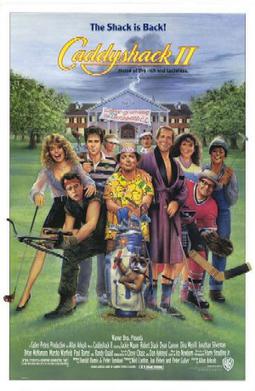
Welcome back to Bushwood Country Club! The Gopher is still stealing balls and burrowing through the course. Ty Webb (Chevy Chase) is still the majority shareholder of the club, even though he now only plays golf inside of his mansion. And that’s it!
Only the Gopher and Chevy Chase returned for Caddyshack II. Ted Knight died before the movie went into production. Bill Murray didn’t want to recreate his role from the first movie. Rodney Dangerfield was involved in developing the movie but then dropped out after two million had already been spent in pre-production. Chevy Chase was paid seven figures to return and he later called it one of the biggest mistakes of his career. Only the Gopher didn’t complain.
With hardly anyone from the first film willing to come back for a second round, Caddyshack II features comedian Jackie Mason as Jack Hartounian, a real estate developer whose daughter, Kate (Jessica Lundy), wants to be a part of the WASPy Bushwood social set. When Chandler Young (Robert Stack) keeps the plain-spoken Jack from being given a membership, Jack teams up with his old friend Ty and buys Bushwood. He turns Bushwood into an amusement park called Jackie’s Wacky Golf. Kate tells Jack that he’s ruined everything and turned Bushwood into Coney Island. Chandler hires survivalist Tom Everett (Dan Aykroyd) to kill Jack and then agrees to play Jack in a round of golf. The winner wins Bushwood.
A bust with both audiences and critics, Caddyshack II is one of the worst sequels ever made. Why would you do a sequel to Caddyshack that features almost nothing that made the first film so entertaining? Jackie Mason was a great comedian and writer but he wasn’t much of an actor and he makes a poor replacement for Rodney Dangerfield. The film really loses me when Chandler Young literally pays money to have Jackie murdered. It’s just a step too far. Not even Ted Knight tried to kill Rodney Dangerfield and Dangerfield was a lot more obnoxious than Jackie Mason ever was. Not even the dancing Gopher can generate much laughs and Kate’s right. Jackie’s Wacky Golf really is a terrible place.
There are some interesting actors and actresses in the supporting cast. The lovely Dyan Cannon plays Jack’s love interest and is one of the few good things about the movie, despite having no chemistry with Mason. Randy Quaid gives a manic performance as Jack’s lawyer, a role that was originally meant for Sam Kinison. Jonathan Silverman is the good caddy who falls for Jack’s daughter while Chynna Phillips is Chandler’s snobby daughter who befriends Kate and tells her she should change her last name to Hart. Dan Aykroyd delivers all of his lines in a high-pitched voice that isn’t funny but which becomes very annoying.
The slobs win again. The snobs are defeated and the Gopher dances with noticeably less enthusiasm. There has never been a Caddyshack 3.
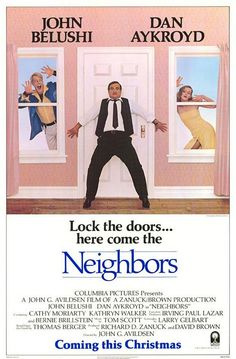
Uptight suburbanite Earl Keese (John Belushi) is paranoid about his new neighbors, Vic (Dan Aykroyd) and Ramona (Cathy Moriarty). Ramona continually tries to seduce Earl (and everyone else) while Vic is loud and obnoxious, always telling off-color jokes and insinuating that Earl is less of a man than he is. Earl thinks that there’s something mentally wrong with Vic but Earl’s wife and daughter (played respectively by Kathryn Walker and Lauren-Marie Taylor) love both Vic and Ramona. Over the course of one very long night and morning, Earl grows more and more suspicious even as he starts to feel truly alive for the first time in several years.
Based on a novel by Thomas Berger, Neighbors is an unfortunate attempt at dark comedy that also turned out to be the final film appearance of John Belushi. It’s appropriate that Belushi’s final film featured him with his comedic partner and best friend, Dan Aykroyd, though I think most of their fans would rather remember them for The Blues Brothers than Neighbors. Originally, Aykroyd was cast as Earl while Belushi was meant to play Vic but the two actors decided to switch roles at the last minute. It takes a while to get used to seeing Belushi as an uptight character who worries about the neighbor’s dog digging up his flower garden but Belushi actually does give a good performance as Earl, revealing that he had more range as an actor that most suspected. Aykroyd and Moriarty also give good performances, though Aykroyd’s performance is not as much a departure as Belushi’s. Earl is an amiable eccentric with several out-there beliefs, which also sounds like a good description of Dan Aykroyd.
Why, despite the talented cast, does Neighbors fail? Director John G. Avildsen was the wrong choice to direct the film. From the first shot of Earl and Vic’s two houses sitting on a hill and looking like left-over sets from The Addams Family, Avildsen directs in a cartoonish manner that is not appropriate for a comedy-of-manners. The book’s humor comes from Earl becoming progressively more and more unstable but, in the movie, Earl seems to be unhinged from the start. Bill Conti’s musical score drives him every point with a thudding obviousness. Conti’s style was perfect for the soaring anthems of Rocky but not for a comedy like Neighbors.
Unfortunately, this would be Belushi’s final film. Neighbors was released in December of 1981. John Belushi died four months later.
As Christmas approaches, Mortimer (Don Ameche) and Randolph Duke (Ralph Bellamy) make a bet to determine whether it’s nature or nurture that shapes someone’s future. The fabulously wealthy owners of Duke & Duke Commodity Brokers, the brothers casually frame their director, Louis Winthrope III (Dan Aykroyd), for everything from dealing drugs to sealing money to cheating on his girlfriend (Kirstin Holby). After Louis is kicked out of both his job and his mansion, the Dukes hire a street hustler named Billy Ray Valentine (Eddie Murphy) to take his place. Earlier Winthrope tried to get Valentine arrested for approaching him in the street. Now, Valentine is living in Winthrope’s mansion, with Winthrope’s butler and Winthrope’s job.
While Winthrope tries to survive on the streets with the help of a outwardly cynical but secretly kind-hearted prostitute named Ophelia (Jamie Lee Curtis, in her first non-horror starring role), Billy Ray surprises everyone by using his street smarts to become a successful, suit-wearing businessman. The Dukes, of course, have no intention of keep Billy Ray Valentine on as their director. Not only are the Dukes snobs but they’re racists as well. Once their one dollar bet has been settled, they start planning to put Billy Ray back out on the streets with Winthrope.
Trading Places was Eddie Murphy’s follow-up to 48 Hrs and he again showed himself to be a natural star while playing the type of role that could have been played by Dan Ayrkroyd’s partner, John Belushi, if not for Belushi’s early death. (Jim Belushi has a cameo as a party guest.) Murphy gets to show off a talent for physical comedy and Trading Places is one of the few films to really take advantage of Dan Aykryod’s talents as both a comedian and actor. Winthrope goes from being a coddled executive to being as streetwise as Valentine. This is probably Aykroyd’s best performance and he and Eddie Murphy make for a good team.
But the real stars of the film are four actors who weren’t really thought of as being comedic actors, Denholm Elliott, Don Ameche, Ralph Bellamy, and especially Jamie Lee Curtis. Ophelia is a much edgier character than the “final girls” that Curtis was playing in horror films and Curtis steals almost every scene that she’s in. Ameche and Bellamy are great villains and it’s fun to watch them get their comeuppance. What screwball comedy would be complete without a sarcastic butler? Denholm Elliot fills the role of Coleman perfectly.
Trading Places was a box office success when it was released and it’s now seen as being one of the new Christmas classics, a film for the adults to enjoy while the kids watch Rudolph and Frosty. I think the movie ends up going overboard towards the end with the gorilla and Dan Aykroyd wearing blackface but, for the most part part, it’s still a very funny and clever movie.
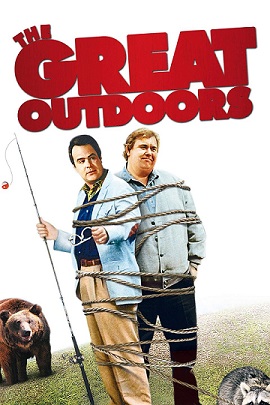
Chet Ripley (John Candy) wants to have a nice vacation up at the lake with his wife (Stephanie Faracy) and their two sons, Buck (Chris Young) and Ben (Ian Giatti). Unfortunately, no sooner has he arrived than the vacation is crashed by Chet’s sister-in-law (Annette Bening, making her film debut) and her husband, Roman (Dan Aykroyd). Roman represents everything that that the mild-mannered Chet hates. Roman is loud, obnoxious, and obsessed with showing off his wealth. Roman knows nothing about how to survive in the great outdoors and he treats Chet like he’s a loser but, for the sake of giving his family a good vacation, Chet tries to get along with Roman. At first, it doesn’t work but eventually, Chet and Roman have to team up to find Roman’s daughters and deal with not only a bear but also talking raccoons. Meanwhile, Buck falls in love with local girl, Cammie (Lucy Deakins). I imagine the same can be said of a lot of people who caught this film on HBO when they were twelve.
The Great Outdoors is very much a comedy of the late 80s. Roman may be a crass Yuppie but it doesn’t appear that Chet is suffering financially either. The humor is broad and physical but the film never resorts to the gross-out style that has since come to define cinematic comedy. It’s a film that makes fun of the obligations of family life while also celebrating them and you won’t be shocked to learn that the script was written by John Hughes. John Candy is likable and Dan Aykroyd has a demented twinkle in his eye.
It’s not a bad movie but I just wish it had been funnier. Don’t get me wrong. When you’re a kid and you come across The Great Outdoors on cable, it’s hilarious because it’s got John Candy waterskiing and a bear and, of course, the talking raccoons. Watching it as an adult, though, it’s easier to see just how much the material and the film’s family-safe approach holds back both Candy and especially Aykroyd. Both of them were capable of being wild comedic performance but, in The Great Outdoors, the movie doesn’t let either one of them really go crazy and that’s too bad. Instead of being a showcase for the best of SNL and SCTV, it becomes an amusing but ultimately very safe family comedy. (Arguably, Hollywood never really figured out the best way to use Candy and Aykroyd’s comedic talents, though Candy’s films before his untimely death suggested that he was on the verge of a genuine breakthrough.)
I did laugh when I rewatched The Great Outdoors but I didn’t laugh as much as I did when I was a kid. Now, I feel old and I’m thinking about how unfortunate it is that John Candy died before production could start on the biopic of Fatty Arbuckle that Candy was tentatively set to star in. Much like Phil Hartman, it’s hard to watch John Candy today without thinking about how he was taken when he was on the verge of probably doing what would have been his best work.
 The Blues Brothers! They’re on a mission from God.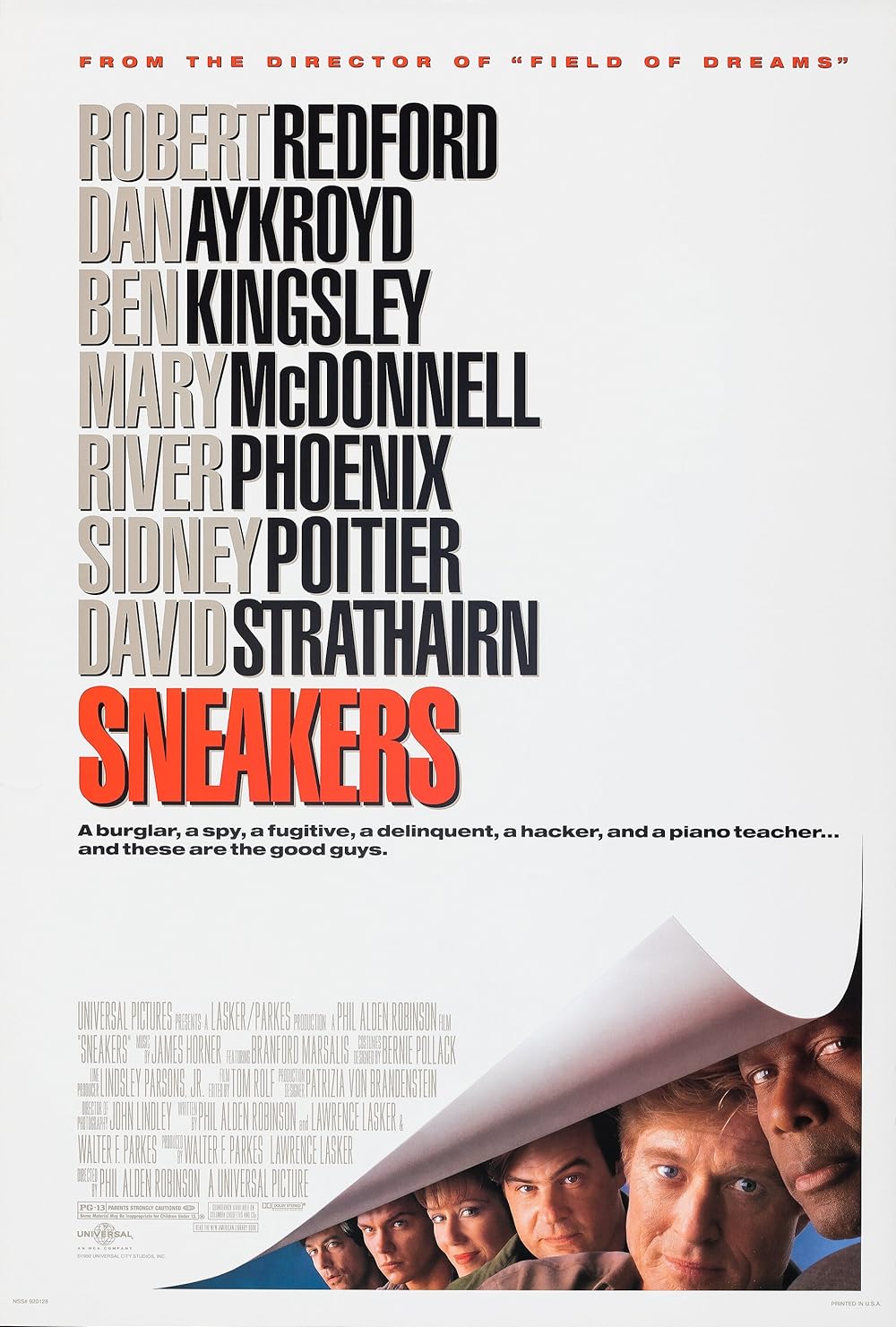


 Through the Shattered Lens