In the projects of Chicago, Byron Harper (Michael Warren) runs a nonprofit basketball farming system and helps black kids, many of whom would have no other prospects other than a live of poverty or crime, to find a home in college basketball programs. Byron is passionate about what he does but he’s also a stern taskmaster and not quick to forgive. When one of his best players, Casey (Nigel Miguel), developed a drinking problem, Byron kicked him off his team. Byron’s main concern is his stepson, Truth (Victor Love). Truth is a great basketball player but also has an addiction to cocaine and an attitude problem.
For reasons that are never made clear, white lawyer Zack Telander (D.B. Sweeney) shows up on the court and says he wants to play one-on-one with Byron. Everyone assumes that Zack is a drug dealer and they tell him to get lost. But when one of the players is shot, Zack is the only person at the court who has a car. Zack rushes the player to the hospital and he wins Byron’s trust. Byron needs Zack to look over a professional contract that is being offered to Truth by sleazy sports agent David Racine (Richard Jordan).
For reasons that are again never made clear, Byron tells Zack to coach some of the more troubled players on the court, including Casey. At first, Zack isn’t much of a coach but eventually, he gets the players to trust him and start playing like a team. He also tries to get burned-out Matthew Lockhart (Bo Kimble) to start playing the game again.
HeavenIsAPlayground is a mess of a movie that doesn’t really seem to be sure what it wants to say about basketball, the projects, or race relations. The main problem is that a lot of the decisions made by Byron and Zack don’t make any sort of logical sense. Moments of broad comedy are mixed with moments of high drama and it makes for an unconvincing and overly melodramatic sports movie.
Heaven Is A Playground had a long pre-production phase. At one point, a young Michael Jordan agreed to play the role of Matthew Lockhart. By the time the film actually went into production, Jordan was a superstar and had neither the time (nor, probably, the desire) to co-star in a low-budget sports movie. After the movie flopped, director Randall Fried sued Jordan for breach-of-contract, claiming that he caused the film’s box office failure by refusing to appear in it and, as a result, Fried’s directorial career stalled. In the suit, Fried claimed that he was on the verge of being “the next Steven Spielberg” until Jordan refused to do his film. The jury found Jordan not liable and awarded him $50,000.
(Trying to sue Michael Jordan was a terrible idea in 1998 and it’s probably still a terrible idea today. People love Jordan!)
Personally, I have to say that Mike made the right decision.
In a rural Ohio, a working class high school football teams plays an exhibition game against the rich school on the other side of town. The working class team is coached by Vince DeAntonio (D.B. Sweeney), a former NFL offensive coordination and the son of a coach. Vince is a tough taskmaster who tells his players that winning is not going to easy and it’s not going to be fun but he also has the connections necessary to get Joe Namath to stumble into the locker room and give a speech to his team. The quarterback (Charlie Carver) of the rich high school is the son of the businessman (Richard Portnow) who is planning on moving his factory down to Mexico and putting the entire town out of work. The quarterback (Logan Huffman) of the working class high school team is the son of an inventor (Willlam Mapother) who is being sued by a corporation that wants to steal his invention. Both of the quarterbacks like the same cheerleader (Maddie Hasson). This game is about more than just who scores the winning touchdown. It’s about town pride.
I love a good underdog story but Underdogs didn’t seem to know what story it wanted to tell. It spent as much time with the inventor and his court case as it did with the football team and the whole thing ended up becoming a commercial for his product. (The movie is based on a true story.) When it actually did get around to the football scenes, it was all too predictable. The team was bad and then the team was good and the entire game came down to one final throw of the football with the clock counting down. One weird thing about the movie is that it put a lot of emphasis on Vince recruiting unlikely players to his team but once he had them on the team, we hardly ever saw them again.
At least the movie’s heart was in the right place and it didn’t turn the cheerleaders into stereotypes, like so many high school football movies do. D.B. Sweeney was okay as the coach but I don’t know if William Mapother’s character was supposed to come across as being as strange as he did. I’m glad the underdogs proved themselves but the movie could have been better.
What’s an Insomnia File? You know how some times you just can’t get any sleep and, at about three in the morning, you’ll find yourself watching whatever you can find on cable or streaming? This feature is all about those insomnia-inspired discoveries!
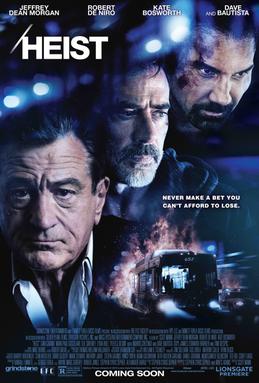
If you find yourself awake later tonight, you can always go over to Tubi and watch the 2015 direct-to-video action thriller, Heist.
Heist takes place in Louisiana. Francis “The Pope” Silva (Robert De Niro) is a mobster and businessman who owns a riverboat casino. The Pope lives his life according to a set of simple but very specific rules. He doesn’t lend money. He doesn’t forgive people who betray him. If you steal from him, he will track you down and he will get his money back and he will make you regret your decision. Working as his main henchman is the sadistic Dog (Morris Chestnut). The Pope’s former main henchman was a man named Luke Vaughn (Jeffrey Dean Morgan) but Luke grew tired of the violence and walked away from it all. Now, Luke works as a dealer in The Pope’s casino. His daughter is sick and Luke desperately needs $300,000 to pay her medial bills. When The Pope refuses to give him the money, Luke teams up with security guard Jason Cox (Dave Bautista) and sets out to rob the place.
The robbery is carefully planned by Luke but, inevitably, things go wrong. A security guard shows up earlier than he was supposed to. A shootout leads to Jason’s best friend, Dante (Stephen Cyrus Sepher), getting shot. The getaway driver panics and drives off, leading to Luke, Cox, and Dante hijacking a bus. Cox orders the bus driver (D.B. Sweeney) to take them to Galveston but Luke is more concerned with getting the money to his daughter. Meanwhile, two police officers — Kris Bajos (Gina Carano) and Detective Marconi (Mark-Paul Gosselaar) — follow the bus, each pursuing their own agenda.
Considering that this film is basically a low budget rip-off of Speed (albeit without a bomb threatening to take out the cast), Heist has an impressive cast and they all do a good job of elevating the film above its B-movie origins. Don’t get me wrong. There are hundreds of plot holes to be found in Heist. The film’s big twist really doesn’t make much sense when you think about it. But, in the end, Heist is an entertaining thrill ride that moves quickly enough that most viewers really won’t have time to obsess on all the lapses of logic. Morgan plays his role with just enough heart that you want his criminal to succeed. De Niro brings some extra layers to a role that could have been a caricature. There’s a brief scene in which he meets his estranged daughter (Kate Bosworth) and, as a result, you suddenly see his character in an entirely new light. As a character who seems like a much more sinister version of Zach Morris, Mark-Paul Gosselaar keeps you guessing. And finally, Gina Carano — years before her cancellation — gives an earnest performance that works despite her character being rather inconsistently written.
Heist is an entertaining and fast-paced action film with a good cast and an interesting story. If you can’t sleep, you might as well be entertained.
It’s hard to know where to really start with Megalopolis.
Directed, written, produced, and financed by Francis Ford Coppola, Megalopolis takes place in an alternate version of the United States of America. In this alternative world, New York is called New Rome and it is dominated by a handful of wealthy families. Former District Attorney Franklyn Cicero (Giancarlo Esposito) has been elected mayor. Everyone seems to hate Cicero and the character tends to come across as being a bit whiny so you really do have to wonder how he got elected in the first place.
Cicero is obsessed with the powerful Crassus-Catallina family, which is headed by banker Hamilton Crassus III (Jon Voight). Hamilton’s nephew is Cesar Catallina (Adam Driver), a brilliant architect who won a Nobel Prize for inventing a type of invisible material. Ever since Cesar’s wife vanished under mysterious circumstances, a cloud of scandal has hung over Cesar’s name and with that scandal has come popularity with both the masses and the tabloid press. When Cesar was tried for murder, the prosecutor was Franklin Cicero. Cesar was acquitted but he now spends his time drinking and mourning his wife. Cesar also has the power to stop time for everyone but him. Why he has this power and how he came to possess it is never made clear, though Cesar compares it to the way that a great painter or writer can capture one moment for eternity.
Cesar is driven through the rainy streets of New York by his chauffeur, Fundi Romaine (Laurence Fishburne). Fundi also serves as the film’s narrator, ruminating about how the Roman Empire eventually became a victim of its own decadence. Just in case the viewer somehow doesn’t pick up on the fact that the movie is comparing modern America to ancient Rome, Fundi informs us of this fact. Thanks, Fundi!
After Cesar publicly denounces Cicero’s plans to turn New Rome into a casino, Cicero’s daughter Julia (Nathalie Emmanuel) decides to take a break from decadent partying to follow Cesar around and try to discover whether or not he actually murdered his wife. Julia discovers that Cesar is not only still mourning his wife but she also witnesses him stopping time. Soon, Julia is working for Cesar’s design firm. At some point, she and Cesar become lovers.
Meanwhile, Cesar’s former lover, Wow Platinum (Aubrey Plaza), has married Crassus and is plotting to take control of his bank. Working with Wow is Cesar’s buffoonish cousin, Clodio Pulcher (Shia LaBeouf), who organizes the angry citizens of New Rome into a mob that threatens the safety and power of both Cicero and Cesar. “Make Rome Great Again,” a sign reads at one of Clodio’s rallies, just in case anyone was missing Coppola’s point.
Clodio is obsessed with destroying Cesar. First, he frames Cesar for deflowering New Rome’s vestal virgin, the singer Vesta Sweetwater (Grace VanderWaal). Then, he sends a 12 year-old assassin after Cesar. Cesar fears that he’s lost his ability to stop time. Julia falls more and more in love with him. Cicero gets booed everywhere he goes and, after his fixer (Dustin Hoffman) is mysteriously killed, he finds himself helpless against Clodio’s mob. Can Cesar be convinced to abandon his self-pity long enough to stand up to Clodio?
And what about the Russian spy satellite that just crashed into New Rome? Who will rebuild the city?
And …. well, let’s just say that there’s a lot going on in New Rome.
Francis Ford Coppola originally came up with the idea for Megalopolis in 1977 and he spent decades trying to bring the film to the big screen. Eventually, Coppola ended up producing and financing the film himself. From 2023 to the the day of the film’s Cannes premiere, the trade papers were full of stories about how difficult the production had been, with the underlying theme being that everything was Francis Ford Coppola’s fault and that the movie would be an unmitigated disaster. (In the coverage found in both Variety and The Hollywood Reporter, there seemed to be a good deal of hostility directed at Coppola’s decision to work outside of the Hollywood system.) Disgruntled members of the crew complained that Coppola was an undisciplined director who spent most of the production high. A half-baked attempt to generate a #MeToo scandal around the film made it obvious that Coppola had burned a lot of bridges with both Hollywood and the media. The film was released to critical derision and poor box office returns. Coppola is 85 years old and it’s entirely possible that Megalopolis will be his final film.
Critics be damned, I liked the majority of Megalopolis. Though the film may be thematically and narratively incoherent, it is a feast for the eyes and it’s hard not to respect the fact that, in this age of overwhelming conformity, Coppola brought his own unique vision to the screen. There are a few moments of genuinely macabre beauty to be found in the film. When the Russian satellite crashes into New York, we don’t see the impact but, on the city walls, we do see the shadows of people screaming in fear. When a drunk Cesar is driven through New Rome, he sees gigantic statues stepping off of their bases and slumping to the ground, exhausted with being on display. Coppola films New Rome like a beautiful, open-air prison. It’s an amazing view but don’t even think about trying to escape. The scenes in New Rome’s Coliseum are filled with an epic yet seedy grandeur. At times, the film’s scenes seem to be almost randomly assembled, leaving us to wonder if we’re seeing the past, the present, or maybe just something that Cesar is imagining in his head.
What is the film actually about? It’s not always easy to say. Even in his best films, Coppola has had a tendency to be self-indulgent. Sometimes, that self-indulgence pays off. Though few would admit it now, The Godfather Part II is one of the most self-indulgent films ever made. But it’s also brilliant so it doesn’t matter. However, with Megalopolis, it’s hard not to feel that this film was such a passion project for Coppola that he didn’t stop to consider whether or not he really had anything new to say. Megalopolis is hardly the first film to compare the supposed decline of America to the fall of the Roman Empire. As much as I enjoyed the film’s visuals, I cringed at the film’s ending. One can only imagine how a past Coppola collaborator like John Milius would have reacted to a bunch of children reciting a pledge to take care of the “one Earth.”
It’s a random film, one in which plot points are raised and often quickly abandoned. At one point, Cesar starts to recite Hamlet’s famous “to be or not to be” soliloquy. The cast is huge and everyone seems to be acting in a different movie. Surprisingly enough, neither Esposito nor Adam Driver are particularly believable in their roles, though I think that has more to do with the film’s loose narrative structure than anything else. Shia LaBeouf is convincingly feral as Clodio while Jon Voight seems to be having fun as the wealthy and crude Crassus. The best performance in the film comes from Aubrey Plaza, who plays her role like a vampish femme fatale who has somehow found herself in a science fiction story. Plaza holds nothing back with her performance and she actually manages to bring some genuine human emotion to Coppola’s surreal epic.
Megalopolis is a monument to self-indulgence but it’s always watchable. Coppola may not know what he’s trying to say but he captures the surreal beauty that comes from getting trapped in one’s own imagination. Megalopolis is not a film for everyone but I’m glad it exists. At a time when artistic freedom seems to be under constant attack, it’s hard not to be happy that Coppola did things his way.
ALERT! They took down their whiny trailer because all those bad reviews from Christmas Past were FAKE! Francis listen, I get it- everyone likes attention or whatever, but you playing the I’m so Put-Upon card is really really really ANNOYING! Cut it out! Paisan, you’ve had a great career and made BANK- BE HAPPY.
Welcome all, I’m going to review the “Megalopolis” trailer and just so you know – this was directed by a GENIUS. Really, that’s in the trailer and not just for a little while; they give a middle-finger to anyone who didn’t like a Coppola film for a solid 44 seconds! If you don’t think this movie is genius, too bad moron- it’s awesome, you’re a filthy plebe!
From what I can glean from the trailer, Cesar Catilina (Adam Driver) is tired of New York decadence; so, he wants to make a new city that’s way fancier and weirder. I’ve played Sim City before; so, maybe it’s got like a lot of happy faces when the plumbing works and sad faces if there’s not enough power? Without question, that was a fun game and if you didn’t enjoy it – you are part of the great unwashed!
This trailer has A LOT of scowling. Cesar Catilina scowls A LOT in the trailer and no one can scowl like Adam Driver. He was born to scowl!!!! Cesar appears to be a magical city planner who wants to make a better city that is vaguely or overtly communist- it is difficult to discern. If it’s anything like real communism, Francis will like it a lot theoretically without any consequences.
I have the distinct impression that this movie is more like a painting; it is visually stunning but with no plot. If you don’t like the film, remember you’re a petite bourgeois rube who brushes his teeth with his fingers. This film seems like “The Darjeeling Limited”- really pretty and Jason Schwatzman was in that film too and it revolved around finding good … tea??? I originally wrote it as “The Darjeeling UNLIMITED” now that would’ve been a film- Think of all the tea we could’ve watched them drink! Remember kids, you only rent Darjeeling Tea!!!
If you want a film where if you say you liked it, you’re 12% more sophisticated- “Megalopolis” is for you! For me, after this trailer, I think I’m going watch something with Dwayne “THE ROCK” Johnson in it. Maybe he’ll do a “Rampage 2”?
In conclusion, this film is GENIUS and the director is a GENIUS and if you don’t think so, I’m going to register you as a pederast and put garbage on your lawn!
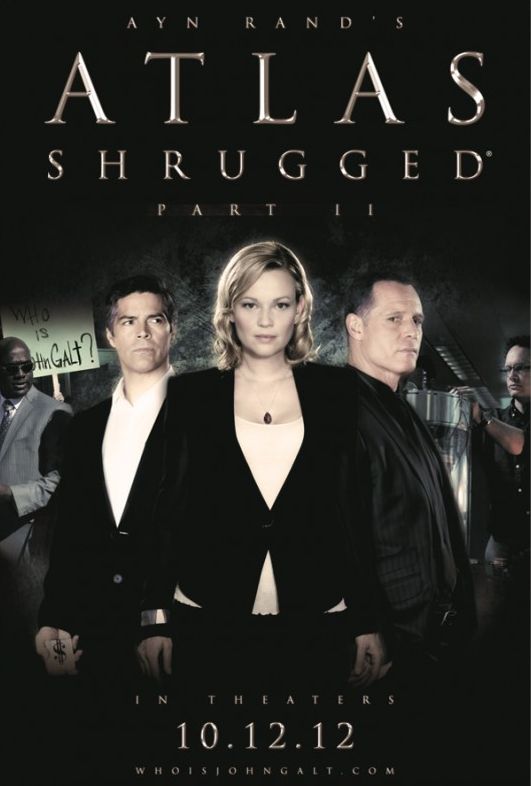
2012’s Atlas Shrugged: Part II picks up where Part I left off.
The time is still the near future. (Part I specifically set the story as taking place five years into the future. Part II declines to use a specific date but it does feature some news personalities playing themselves so it’s still clearly only meant to be a few years from 2012.) The economy has gotten even worse. The poor are only getting poorer while the rich are getting richer. Under the direction of Head of State Thompson (Ray Wise) and his main economic advisor, Wesley Mouch (Paul McCrane), the government has nationalized nearly every business. Halfway through the film, Thompson declares a national emergency and uses the Fair Share Law to invoke Directive 10-289. All inventors, businessmen, and other creative people are required to sign their patents over to the government and to stop trying to develop now techniques. Wages are frozen. No one can be fired and no one can be hired. Creative thinking is discouraged. Asking questions or expressing doubt is forbidden. People are encouraged to snitch on anyone not following the Directive. Thompson and Mouch insist that it’s for the “good of the people,” and anyone who disagrees runs the risk of being dragged into court and sent to prison for ten years. Meanwhile, gas now costs $42.00 a gallon. One of the funnier moments of the film features someone paying $865.72 to fill up a truck.
Dagny Taggart (Samantha Mathis), the Vice President of Taggart Transcontinental Railways, is still trying to discover who invented an experimental motor that she found hidden away in a mine. The motor could potentially change the way that goods are transported but it appears to be missing one component. Unfortunately, all of the great scientists and inventors have been vanishing, with many of them leaving behind notes that ask, “Who is John Galt?” Meanwhile, Dagny’s lover, Hank Rearden (Jason Beghe), fights to protect Rearden Metal from being taken over by the government and Dagny’s brother, James (Patrick Fabian), sells out to Wesley Mouch with the end result being that there’s no one left at Taggart Transcontinental with the intelligence or the experience necessary to keep two trains from colliding in a tunnel.
Given that Ayn Rand herself was an atheist who wrote very critically of religion, it’s interesting how much of Atlas Shrugged: Part II feels like one of those evangelical films where the Rapture comes and the entire world falls apart because all of the believers have suddenly vanished. In the case of Atlas Shrugged, the world falls apart because all of the creatives and all of the leaders of industry and all of the innovative thinkers have abandoned it so that they can create a new community with John Galt. (They’ve “stopped the motor of the world.”) In many ways, this is the ultimate in wish fulfillment, a way of declaring, “They’ll miss me when I’m gone!” Indeed, the majority of people who keep a copy of Rand’s novel displayed on their bookcase do so because they believe that they would be one of the lucky ones who was approached by Galt. No one expects that they’ll be the person left behind to try to run the railroad. It’s a bit like how like the most strident Marxist activists always assume they’ll be the ones organizing the workers as opposed to being a worker themselves.
Not surprisingly, the same critics who attacked Part I didn’t care much for Atlas Shrugged Part II. When I first saw it, I thought the film was a bit too long and I was annoyed that, with the exception of a few minutes at the end, the film didn’t really seem to move the story forward. At the same time, just as with the first film, I appreciated the fact that the second film was proudly contrarian in its portrayal of the government as being inherently incompetent. After all, this was 2012, back in the “good government” era, when a lot of people still reflexively assumed that the government was staffed only by hyper-competent policy wonks who knew what they were doing and who were only concerned with making sure that “the trains ran on time,” to borrow an old expression.
Rewatching the film this weekend, I have to say that I actually appreciated Atlas Shrugged Part II a bit more than the first time I watched it. Yes, Part II was still a bit too long and the domestic drama between Hank and his wife fell flat but Part II is still a marked improvement on the first film. Some of that is because Part II had a higher budget than Part I and, as a result, it didn’t look as cheap as the first film. The corporate offices looked like actual corporate offices and the factories looked like real factories. Secondly, the second film had an entirely different cast from the first film. Samantha Mathis, Jason Beghe, and especially Patrick Fabian were clear improvements on the actors who previously played their roles. That’s especially important when it comes to Mathis and Beghe because, as opposed to the first film, Part II convinces the viewer that Dagny and Hank actually are as important as they think they are. When the trains collide in the tunnel, the viewer never doubts that Mathis’s Dagny could have prevented the disaster if not for the government’s attempts to force her out of her own company. As well, the viewer never doubts that Beghe’s Hank would fight to the end to protect his business, even if it means prison. One wouldn’t have necessarily believed that while watching the first film.
Finally, having lived through the COVID era, the film’s portrait of government overreach and incompetence feels a lot more plausible when watched today. One doesn’t have to be a fan of Rand’s philosophy or agree with her solutions to see the parallels between Directive 10-289 and the policies that led to children being kept out of schools and numerous small business having to shut their doors. In an era when most people’s faith in governmental institutions has been broken to such an extent that it might never be fixed in our lifetime, Atlas Shrugged Part II resonates. Whereas the film once felt subversive, now it feels downright prophetic.
As some of our regular readers undoubtedly know, I am involved in a few weekly live tweets on twitter. I host #FridayNightFlix every Friday, I co-host #ScarySocial on Saturday, and I am one of the five hosts of #MondayActionMovie! Every week, we get together. We watch a movie. We tweet our way through it.
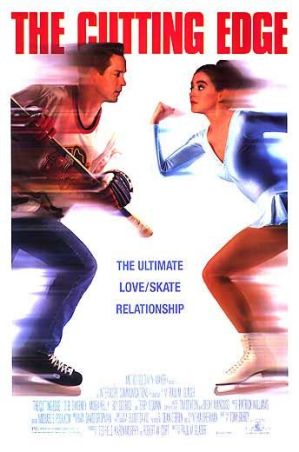
Tomorrow, at 10 pm et, I will be hosting #FridayNightFlix! The movie? 1992’s The Cutting Edge!
It’s figure skating, hockey, and love! D.B. Sweeney is a former hockey star. Moira Kelly is a figure skater with a reputation for being a diva. Terry O’Quinn and Roy Dotrice are the distinguished character actors who are brought in to class the joint up. Can Sweeney and Kelly win the gold and fall in love at the same time!?
If you want to join us this Friday, just hop onto twitter, start the movie at 10 pm et, and use the #FridayNightFlix hashtag! I’ll be there tweeting and I imagine some other members of the TSL Crew will be there as well. It’s a friendly group and welcoming of newcomers so don’t be shy.
This movie is a personal favorite of mine and I can’t wait to play host tomorrow night!
This weekend's live tweets, hosted by me:#FridayNightFlix (Friday, 10 pm et) — The Cutting Edge (1992)#ScarySocial (Saturday 9 pm et) — The Texas Chainsaw Massacre Part 2 (1986)
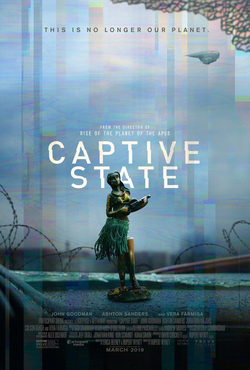
Captive State came out in March and, before it was released, it seemed like it had the potential to be something special. The trailer looked good. The cast was impressive. Perhaps even more importantly, the film was directed by Rupert Wyatt, who did such a good job with Rise Of The Planet Of The Apes. Surely, if anyone had the talent to create a convincing film about life under an alien dictatorship, it would be Rupert Wyatt!
In fact, my only reason for concern had to do with when the film was being released. March seemed like a very strange time to be releasing a big “event” film. Don’t get me wrong. A March release isn’t as bad as a January or even a February release. I mean, unless your film is a romantic comedy, you definitely do not want it to be released in either one of those two months. Those months are where studios dump their worst films so that they can die a quiet death. March, on the other hand, is when the studio releases films that have the potential to be a success but which they’re still not expecting to set the world on fire.
Of course, there have been exceptions to that rule, as both Wes Anderson (Grand Budapest Hotel) and Jordan Peele (Get Out) can tell you. So, as Captive State’s release date approached, we were left to wonder. Would this be another case of a film being better than it’s release date or would this be just another forgettable but not terrible movie that the studio probably spent a bit too much money on?
Captive State, sadly, turned out to be more of a case of the latter than the former.
The film opens with Chicago being invaded in 2019. Significantly, unlike other recent invasion films, this one doesn’t spend too much time on the invasion itself or Earth’s initial attempts to fight back. Instead, it jumps forward eight years, to 2027. The aliens are in control of Earth, though the aliens themselves claim to only be “legislators” who are governing the planet for our own good. While the majority of Earthlings just seem to be resigned to accepting being conquered as their new normal, there are a few resistors. There’s also quite a few collaborators. The tricky part of life in 2027 is figuring out who you can and can not trust.
There’s a lot of characters in Captive State and, at times, it can be difficult to keep track of how everyone’s related and who is working for who. However, that seems to be intentional on the film’s part. Rather than telling a conventional tale of alien conquest, Captive State sets out to be a serious exploration of what life would be like for the people living under the thumb of not just an intergalactic dictatorship but actually any dictatorship. The Legislators rule by fear. The collaborators have their own individual reasons for collaborating but, now that they’ve declared which side they’re on, there’s no going back for them. One way or another, they’ve sealed their fate. The same can be said for those in the rebellion. Meanwhile, most people are just trying to not get caught in the crossfire.
And the thing is …. you want the film to work. It’s an intriguing idea and how can you not respect that fact that Wyatt wanted to try to do something a little bit different with his story of alien invasion? But sadly, the film never works the way that you’re hoping it will. The film tries to do a lot in just 109 minutes. In fact, it probably tries to do too much and, as a result, there’s little time to get to know the characters, the majority of whom come across as being underwritten and with murky motivations. Captive State hinges on the actions of a detective played by John Goodman but the film itself doesn’t seem to be sure of who Goodman’s supposed to be. Hence, the film’s final twist seems to come out of nowhere. It’s hard not to feel that the ideal way for Captive State to have told its story would have been as a 10-episode miniseries on HBO. Trying to stuff all of this into under two hours of running time just doesn’t work.
And it’s a shame, that it doesn’t. Ambition should never be faulted. If only the results, in this case, lived up to the ambition.
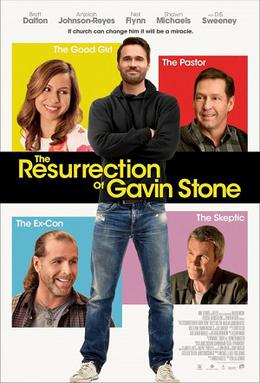
Well, we’re halfway through October and the annual Shattered Lens Horrorthon and what better time than now to review a …. faith-based comedy about an irresponsible actor who pretends to be a Christian so that he can star in a megachurch’s Easter play?
Embrace the unexpected!
The 2017 film, The Resurrection of Gavin Stone, tells the story of Gavin Stone (Brett Dalton), a former child star who is now better known for his stints in rehab than for his acting. After a trip to his hometown ends with Gavin getting arrested for public intoxication and apparently firing a catapult off the top of his hotel, Gavin is sentenced to do community service. He has to live with his estranged father (Neil Flynn) and he can’t leave Ohio until he’s completed his hours. What about Gavin’s career back in California? What career?
Anyway, Gavin ends up doing his community service at the local Protestant megachurch. The well-meaning pastor (D.B. Sweeney) suggests that Gavin just do maintenance work until his hours are up. Gavin would rather try out for the lead role in the church’s annual Easter play, both because he wants to act and because he has a crush on the play’s director (Anjelah Johnson-Reyes), who just happens to be the pastor’s daughter.
“Well, the play is a part of our ministry,” the pastor explains, “so we do ask that everyone involved be a Christian.”
“I am a Christian!” Gavin announces, even though he’s totally not.
Naturally, Gavin gets cast in the role of Jesus. Along with learning about his role, Gavin spends rehearsals shaking up the church’s somewhat stodgy play and, slowly but surely, becoming a better human being. However, when Gavin is suddenly offered a role on a television series, he must decided whether to do what’s best for the play or what’s best for his career. You can probably already guess what’s going to happen.
Obviously, a lot of people are going to be turned off by the film’s Christian origins but The Resurrection of Gavin Stone is actually a surprisingly sweet movie and, compared to most faith-based films, it’s not particularly heavy-handed. Unlike a lot of Christian films, Gavin Stone actually has a sense of humor about itself and it’s hard not smile a bit when Gavin, after spending a night with Google, shows up for church on Sunday with a Jesus fish on his bumper and loudly greeting everyone with “Blessings!” Brett Dalton (who we all know as Grant Ward on Agents of SHIELD) is sincere and likable in the lead role. Anjelah Johnson-Reyes is stuck with the underwritten stock role of being the preacher’s daughter who loosens up over the course of the movie but she actually does a pretty good job of bringing some spark to the character.
The Resurrection of Gavin Stone has its flaws, of course. There’s a few times that the dialogue gets a bit clunky and you never quite buy the film’s positive conclusion. But what this film’s does very well is that it captures the excitement of being a part of a production. The best parts of the film are the ones that just focus on the characters rehearsing. Anyone who has ever been involved with a community theater will be able to relate and it’s kind of fun to watch everyone progress from stiffly reading from the script to delivering their lines like fully committed amateur thespians. The Resurrection of Gavin Stone is at its best when it celebrates the joy of performing.
In just a few more hours, the 2019 MLB regular season will begin when the Mariners’s Ichiro Suzuki tosses out the first pitch of the season. The Mariners and the A’s will be playing a pair of games in Japan, at the Tokyo Dome. In America, it will be around four in the morning when that first pitch is thrown so I’ll probably miss it.
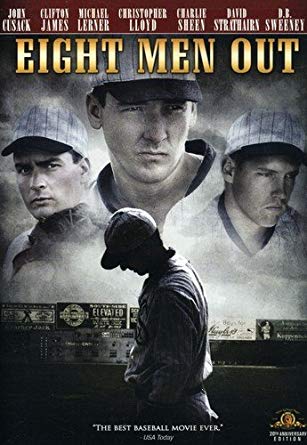
Even if I might not be able to watch the opening pitch, I can still watch my favorite baseball movie, Eight Men Out. Eight Men Out is about the 1919 World Series and how eight members of the Chicago White Sox were accused of conspiring with gamblers to throw the championship. While everyone agrees that most of the players were guilty, Eight Men Out suggests that both Shoeless Joe Jackson and Buck Weaver were wrongly accused and, unlike the other players, should not have been banned from playing in the major leagues.
The final scene of Eight Men Out takes place several years after the scandal. A group of baseball fans think that they’ve spotted Shoeless Joe playing for a semi-professional team. While they debate whether or not that’s really Shoeless Joe, Jackson’s old teammate, Buck Weaver, tells them that there will never be another player as great as Joe Jackson. John Cusack plays Weaver while D.B. Sweeney plays Jackson.
 In the projects of Chicago, Byron Harper (Michael Warren) runs a nonprofit basketball farming system and helps black kids, many of whom would have no other prospects other than a live of poverty or crime, to find a home in college basketball programs. Byron is passionate about what he does but he’s also a stern taskmaster and not quick to forgive. When one of his best players, Casey (Nigel Miguel), developed a drinking problem, Byron kicked him off his team. Byron’s main concern is his stepson, Truth (Victor Love). Truth is a great basketball player but also has an addiction to cocaine and an attitude problem.


 Through the Shattered Lens