Here’s 4 Different Actors Reading Edgar Allan Poe’s The Raven!


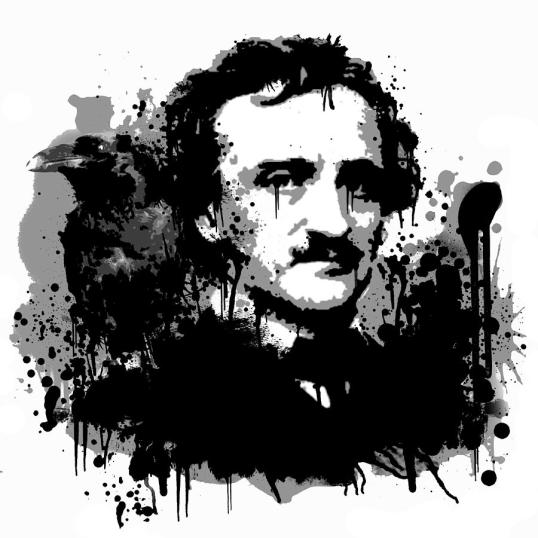
edgar-and-the-raven-paul-green

Let’s all wish Edgar Allan Poe a happy 207th birthday!  In honor of the occasion, here’s four different actors reading The Raven!

First here’s Vincent Price!

And now it’s time for Christopher Lee!

Check out James Earl Jones!

And, of course, we have to include Christopher Walken!

And here’s the poem, in all its glory.  Read it aloud in your own voice!

Once upon a midnight dreary, while I pondered, weak and weary,
Over many a quaint and curious volume of forgotten lore—
While I nodded, nearly napping, suddenly there came a tapping,
As of some one gently rapping, rapping at my chamber door.
“’Tis some visitor,” I muttered, “tapping at my chamber door—
Only this and nothing more.”

Ah, distinctly I remember it was in the bleak December;
And each separate dying ember wrought its ghost upon the floor.
Eagerly I wished the morrow;—vainly I had sought to borrow
From my books surcease of sorrow—sorrow for the lost Lenore—
For the rare and radiant maiden whom the angels name Lenore—
Nameless here for evermore.

And the silken, sad, uncertain rustling of each purple curtain
Thrilled me—filled me with fantastic terrors never felt before;
So that now, to still the beating of my heart, I stood repeating
“’Tis some visitor entreating entrance at my chamber door—
Some late visiter entreating entrance at my chamber door;—
This it is and nothing more.”

Presently my soul grew stronger; hesitating then no longer,
“Sir,” said I, “or Madam, truly your forgiveness I implore;
But the fact is I was napping, and so gently you came rapping,
And so faintly you came tapping, tapping at my chamber door,
That I scarce was sure I heard you”—here I opened wide the door;—
Darkness there and nothing more.

Deep into that darkness peering, long I stood there wondering, fearing,
Doubting, dreaming dreams no mortal ever dared to dream before;
But the silence was unbroken, and the stillness gave no token,
And the only word there spoken was the whispered word, “Lenore?”
This I whispered, and an echo murmured back the word, “Lenore!”—
Merely this and nothing more.

Back into the chamber turning, all my soul within me burning,
Soon again I heard a tapping somewhat louder than before.
“Surely,” said I, “surely that is something at my window lattice;
Let me see, then, what thereat is, and this mystery explore—
Let my heart be still a moment and this mystery explore;—
’Tis the wind and nothing more!”

Open here I flung the shutter, when, with many a flirt and flutter,
In there stepped a stately Raven of the saintly days of yore;
Not the least obeisance made he; not a minute stopped or stayed he;
But, with mien of lord or lady, perched above my chamber door—
Perched upon a bust of Pallas just above my chamber door—
Perched, and sat, and nothing more.

Then this ebony bird beguiling my sad fancy into smiling,
By the grave and stern decorum of the countenance it wore,
“Though thy crest be shorn and shaven, thou,” I said, “art sure no craven,
Ghastly grim and ancient Raven wandering from the Nightly shore—
Tell me what thy lordly name is on the Night’s Plutonian shore!”
Quoth the Raven “Nevermore.”

Much I marvelled this ungainly fowl to hear discourse so plainly,
Though its answer little meaning—little relevancy bore;
For we cannot help agreeing that no living human being
Ever yet was blessed with seeing bird above his chamber door—
Bird or beast upon the sculptured bust above his chamber door,
With such name as “Nevermore.”

But the Raven, sitting lonely on the placid bust, spoke only
That one word, as if his soul in that one word he did outpour.
Nothing farther then he uttered—not a feather then he fluttered—
Till I scarcely more than muttered “Other friends have flown before—
On the morrow he will leave me, as my Hopes have flown before.”
Then the bird said “Nevermore.”

Startled at the stillness broken by reply so aptly spoken,
“Doubtless,” said I, “what it utters is its only stock and store
Caught from some unhappy master whom unmerciful Disaster
Followed fast and followed faster till his songs one burden bore—
Till the dirges of his Hope that melancholy burden bore
Of ‘Never—nevermore’.”

But the Raven still beguiling all my fancy into smiling,
Straight I wheeled a cushioned seat in front of bird, and bust and door;
Then, upon the velvet sinking, I betook myself to linking
Fancy unto fancy, thinking what this ominous bird of yore—
What this grim, ungainly, ghastly, gaunt, and ominous bird of yore
Meant in croaking “Nevermore.”

This I sat engaged in guessing, but no syllable expressing
To the fowl whose fiery eyes now burned into my bosom’s core;
This and more I sat divining, with my head at ease reclining
On the cushion’s velvet lining that the lamp-light gloated o’er,
But whose velvet-violet lining with the lamp-light gloating o’er,
She shall press, ah, nevermore!

Then, methought, the air grew denser, perfumed from an unseen censer
Swung by Seraphim whose foot-falls tinkled on the tufted floor.
“Wretch,” I cried, “thy God hath lent thee—by these angels he hath sent thee
Respite—respite and nepenthe from thy memories of Lenore;
Quaff, oh quaff this kind nepenthe and forget this lost Lenore!”
Quoth the Raven “Nevermore.”

“Prophet!” said I, “thing of evil!—prophet still, if bird or devil!—
Whether Tempter sent, or whether tempest tossed thee here ashore,
Desolate yet all undaunted, on this desert land enchanted—
On this home by Horror haunted—tell me truly, I implore—
Is there—is there balm in Gilead?—tell me—tell me, I implore!”
Quoth the Raven “Nevermore.”

“Prophet!” said I, “thing of evil!—prophet still, if bird or devil!
By that Heaven that bends above us—by that God we both adore—
Tell this soul with sorrow laden if, within the distant Aidenn,
It shall clasp a sainted maiden whom the angels name Lenore—
Clasp a rare and radiant maiden whom the angels name Lenore.”
Quoth the Raven “Nevermore.”

“Be that word our sign of parting, bird or fiend!” I shrieked, upstarting—
“Get thee back into the tempest and the Night’s Plutonian shore!
Leave no black plume as a token of that lie thy soul hath spoken!
Leave my loneliness unbroken!—quit the bust above my door!
Take thy beak from out my heart, and take thy form from off my door!”
Quoth the Raven “Nevermore.”

And the Raven, never flitting, still is sitting, still is sitting
On the pallid bust of Pallas just above my chamber door;
And his eyes have all the seeming of a demon’s that is dreaming,
And the lamp-light o’er him streaming throws his shadow on the floor;
And my soul from out that shadow that lies floating on the floor
Shall be lifted—nevermore!

Following The Amazon Prime Recommendation Worm #1


I know everyone has been dying for me to do another one of those movie roundup things I used to do. And by everyone, I mean no one. Well, this is gonna be sort of like that again. Late last year I decided to conduct a little experiment. On Amazon Prime you can go to a section marked “Customers Also Watched”. In there is exactly what you think. I thought it might be interesting to pick a movie, then when I finish it, take the first recommendation in that section and keep repeating this until I run out of recommendations. Basically traversing a probabilistic graph like an ant algorithm except there may be no end point and since it’s just me, there’s no convergence on a path. It’s just me following the probabilistic graph generated by what other customers picked to watch after they watched something else. I started on December 18th, 2015. Since I can’t always get around to doing full reviews of things, I thought it would be fun to give you occasional updates with little reviews of each of these films. And boy are there some strange ones. This is going to be a big one with 34 films I’ve watched so far. I’ll try to do these in shorter amounts in the future. We’ll see how long I can keep this up. I will keep poster art out here because of the enormous number of films in this one. Here we go!

  1. Seduction: The Cruel Woman (1985, dir. Monika Treut & Elfi Mikesch) – Last year I watched a film called Female Misbehavior (1992) by Monika Treut. She is a German director who, at least in the 1980s, made really bizarre arty sex movies. This was no exception. While I did enjoy Female Misbehavior quite a bit, this was just weird. But kind of weird in a good way. It follows a woman who runs a place that caters to people’s fetishes. That’s really it. There’s not much to say in retrospect except to make sure you are in that experimental arty mood if you are going to sit down and watch this. If you are, then you could possibly enjoy it. I kind of did.
  2. Satan’s Slave (1976, dir. Norman J. Warren) – This one just wasn’t any good. It was a 1970s British horror film that reminded me of the awful Virgin Witch (1972). It was just plain boring. A girl goes and stays in a house with family and gets caught up in a cult. Or at least that’s the plot summary. It’s just boring stuff that tries to build an atmosphere and has a few “scary” sequences. Not worth your time.
  3. Cruel Passion (1977, dir. Chris Boger) – This in an adaptation of the Marquis de Sade’s Justine. Unfortunately, it’s almost as boring as actually reading the original book. The general story is about a girl who is cast out and goes from place to place being taken advantage of sexually. So wait, that means Lars Von Trier got Dogville from Justine and Nymphomaniac from Anita: Swedish Nymphet (1973). Interesting. Far more interesting than this lousy sexploitation movie. She really doesn’t do a whole lot of wandering. She really isn’t taken advantage of that much either. At least it knew how to end itself properly. By that I mean it had her killed off. You are better off with Justine de Sade from 1972 instead.
  4. Her and She and Him (1970, dir. Max Pécas) – This is one of those movies put out by Audubon Films. They brought a lot of foreign sex related films to the U.S. and dubbed them. This was one of them. It’s actually pretty offensive. A naive exchange student from Sweden shows up in Paris and winds up in a screwed up lesbian relationship with an older woman. Meanwhile, a young man is in a messed up gay relationship. Both the lesbian and the gay guy are portrayed as damaged or just plain weird. Of course the two young people end up together and say some stupid things to imply that being straight is normal, but we should still feel sorry for the homosexuals. Do I even have to say skip this one? Oh, except there is one funny goof in this movie. The young girl goes down on the older lady who is standing in a well lit room. Yet, her lower half must be in a different place cause it’s like nighttime down there.
  5. Virgin Machine (1988, dir. Monika Treut) – This movie is about a German woman who becomes fascinated by sexual things outside the perceived “norms”. As a result, she ultimately winds up in San Francisco. It’s arty for sure, but you can still kind of follow along here. There is the scene where the male impersonator simulates ejaculation with a beer bottle. However, the only thing really worth seeing here are the few scenes with Susie Sexpert/Susie Bright. I didn’t know who she was, but she’s apparently well known in my neck of the woods. You can find her online. She has been known as the “Pauline Kael of Porn”. People probably know her best as playing Jesse in the Wachowski’s movie Bound (1996) as well as being a technical advisor on the film. The few scenes with her are rather interesting. I could have watched a whole movie where the lead character just talked to her. Too bad she doesn’t.
  6. The Immoral One (1980, dir. Claude Mulot) – My advice here is to simply not watch it on Amazon Prime. They edited it heavily. Shouldn’t surprise me I guess since it’s made by the director of the porn film Pussy Talk (1975). It’s about a woman who is in a car accident that recovers from her amnesia by listening to audio tapes. It’s just a thin excuse to show her as a call girl going to her clients. Unfortunately, the second anything starts it just cuts away to the next non-sex scene. It’s really abrupt like you’ve just come to the end of a Godfrey Ho movie. And it’s a real shame to cause the lead actress is very pretty and the movie is well shot. The sex scenes are probably very well done, but you won’t see them on Amazon Prime. Too bad. Also, a little strange considering I believe Her and She and Him had hardcore penetration in one scene. Whatever.
  7. Sexus (1965, dir. José Bénazéraf) – Oh, god! This was terrible. It’s one of those movies where seriously nothing happens. I think Michael Snow’s Wavelength (1967) had more action than this. A girl gets kidnapped and she kind of falls in love with her captors and things fall apart. It’s the worst kind of foreign arthouse garbage. Just stay away from this thing. I really can’t stand Godard. I’m really not even a fan of his first film Breathless. Take Breathless and remove anything enjoyable about it and make it about a kidnapping. That’s this movie.
  8. The Lickerish Quartet (1970, dir. Radley Metzger) – I like my review on Letterboxd: “That was an artsy and pretentious mess.” Yes, it is. It’s about two older people and young man who watch porn films together. Then they go to a carnival and bring a woman back who they think was in a movie they watched. What follows is a film really wanting to be something akin to Alain Resnais’ Last Year at Marienbad (1961). A lot of arty stuff and a lot of stuff that just screams: “You wouldn’t understand if I told you” nonsense. It even tries to get really meta about it all at the end. Don’t bother with this. Go watch Last Year at Marienbad instead. It’s wonderful!
  9. Sweet Ecstasy (1962, dir.Max Pécas) – Back to Max again. This time he brought along Elke Sommer to be in a film that wants to be something akin to Antonioni’s films with Monica Vitti. Except it’s stupid bad foreign upper class stuff that you saw a lot during this period. My biggest problem with this movie, other than that it sucked, is the burning boat scene. There’s a part where the adult children are on a boat having some sort of auction where they have Elke Sommer tied up. The boat catches on fire and they all flee onto lifeboats. They then realize they left Elke behind and rescue her. Afterwards, they try to punish the guy who accidentally set the boat on fire. They make him do stupid childish things. It’s dumb. But what pisses me off is that while people are fleeing the room where Elke is we can clearly see her tied, not gagged, but not screaming for help. Sorry, but once you see it, then you just keep yelling at the screen that it was your own damn fault for letting them tie you up and then saying nothing as the room burned. Regardless, more worthless foreign stuff.
  10. The Curious Female (1970, dir. Paul Rapp) – It took ten of these, but I finally hit one I would recommend. This movie takes place in the future where apparently a master computer rules over everything. However, instead of making everyone “moral”, it makes them all orgy bisexual loving folks. Some of them gather in a place where they can watch old movies that show how people used to live. It’s certainly is weird. They only watch two films. The first is a silent movie where a vacuum salesman shows up and gets screwed by the lady of the house. Then they watch some movie called The Three Virgins. That makes up the rest of the film. It cutting between the film and the folks in the room watching it, who by the way, are also actors within the film they are watching. The Three Virgins thing revolves around a computer dating business and what happens when a guy comes in looking for a virgin. There’s only two things I really want to mention here. One, is the black lesbian character named Pearl. I watched several lesbian movies directed by women at the beginning of last year from the past 10 years or so and this was a much better character. The movies I watched were like Loving Annabelle (2006) or Bloomington (2010). They quickly turned into basically softcore porn, tried to make lesbianism as forbidden as possible, and just wouldn’t stop to let us actually get to know them a little. Pearl is just a girl who figures out that she’s still a virgin at her age because she likes girls instead. That’s it! We get to know her a bit and she just discovers that about herself. Nice, simple, and positive. Then there’s the extremely over the top gay guy who comes into the computer dating place. He’s an odd duck. He’s every stereotype you can think of, but at the same time he stands up for himself and doesn’t take anyone’s crap. He’s interesting. Oh, also we find out that 13 year old girls are taken to the “elderly gentleman” to lose their virginity in the future. Yes, just the girls. It never says where the guys are taken though and they obviously don’t keep their virginity in the future either. I recommend this one.
  11. Days of Sin and Nights of Nymphomania (1963, dir. Poul Nyrup) – This is just an odd sit. It’s a Danish movie that was again brought over by Audubon Films which means more sex stuff. It’s basically a house party with mostly naked women doing whatever it is they were doing in front of the camera. But then near the end it just seems to turn on a dime into a heist movie that ends with a guy killing a girl, I think, and getting arrested. Some of the stuff with the girls is kind of pretty, but there’s just no reason to subject yourself to this.
  12. Chain Gang Women (1971, dir. Lee Frost) – Spoiler alert! There are no chain gang women in chain gang women. It goes for awhile like a gritty look at men on a chain gang before finally letting a couple of them escape. Then they run into two women. One is attached to one of the guys, but the other rapes her. Then they run into a very young girl who is married to a much older man. They sort of take advantage, sort of go to rescue her, but the old man kills them both and keeps the girl. Just a pointless sexploitation film with a title as accurate as 1,000 Convicts And A Woman.
  13. Savage Abduction (1973, dir. John Lawrence) – This one actually goes under three titles: The Bloody Slaying of Sarah Ridelander, Cycle Psycho, and Savage Abduction. Well, Sarah Ridelander is killed at the beginning, but that death is hardly important enough to be called a “Bloody Slaying” or be in the title. Cycle Psycho at least alludes to the fact that a motorcycle gang is in this, but they are hardly psychos. Strangely, Savage Abduction is the most accurate title. The movie is about a crazy guy who blackmails another guy into getting two young girls for him. He does this because he murders the man’s wife at his request. A motorcycle gang with the word “savage” in their names do the abducting. And by abducting I mean simply pick up two stupid young girls who thought hitching a ride with random motorcyclists was a good idea. The rest of the film is just killing time till it decides it has enough minutes in the runtime to have what little climax it has in store for the audience play out. After Savage Island (1985), I’m beginning to think Fred and Ben Savage are the only good things with “savage” in them.
  14. The Torture Chamber of Dr. Sadism (1967, dir. Harald Reinl) – More like dangle Christopher Lee in our face, take him away, then bring him back for the end. This was pretty bad. Most of the movie you follow two guys and two girls on their way to some castle. The girls basically overreact in fear to everything. However, the guys underreact to everything just running towards the obvious danger. What a waste of time. Making it in the first place, and then me watching it.
  15. Sacred Flesh (2000, dir. Nigel Wingrove) – Wanna watch nuns have sex with each other while the Mother Superior argues with Mary Magdalene? No? Neither did I. This is just nunsploitation that tries to give itself some meaning with the Mother Superior/Mary Magdalene stuff. If I want something in that vein, then that’s what Ken Russell’s The Devils (1971) is for. Seriously, go watch it now. It even looks like it’s available on Amazon now. In the past you had to track down a copy online because the film was being sat on by the studio to a ridiculous degree. Skip Sacred Flesh.
  16. Primitive London (1965, dir. Arnold L. Miller) – And by Primitive London, they mean heavy cynicism and a bunch of stripping. It’s a Mondo movie. Nothing ridiculous like the pond scene from Brutes and Savages (1978) or anything like that. The most interesting things are probably the stripper running from club to club to make money and when they talk to Mods and Rockers. Can’t think of a good stripper movie to recommend really, but as for Mods and Rockers, see Quadrophenia (1979) for the Mods and Rocker (1972) for the Rockers. I’m not sure if it’s become easier to find Rocker now years after I tracked down a copy, but it’s worth it. If memory serves, the movie is easy to find, but English subtitles for the German aren’t. Still worth it. This movie is okay. Nothing to seek out.
  17. The Wild Women of Wongo (1958, dir. James L. Wolcott) – There’s a hell of a title for what is a really boring movie. I know I say boring a lot, but that’s because I never took the SATs. Yeah, sure, that’s a good enough excuse for me. I could explain the plot, but there’s no point. It’s just a 1950s primitive exploitation film that is just some nonsense some people thought up to have some attractive women run around in small outfits and that’s it. No reason to watch this at all.
  18. Bad Girls From Mars (1990, dir. Fred Olen Ray) – Ah, good old Fred Olen Ray. This film tries to be meta about the production of a movie because it’s cheap and that way it doesn’t have to build many sets until it settles on an ending that was already tired even before Sleepaway Camp (1983). And I haven’t even seen that movie yet. I’ll get to it eventually along with Fatal Games (1984), but it’s just a slight twist on the ending of Friday the 13th (1980) because Girls Nite Out (1982) already proved that having it be the mother again was done for. I know I’m getting to be a broken record here, but no. Skip it!
  19. The Nude Set (1957, dir. Pierre Foucaud) – Also called The Fast Set and Mademoiselle Strip-tease. Just a whole lot of stripping. Another primitive exploitation film from overseas. These movies are such a waste of time. I can’t even tell you how unbearable some of them are. However, there is something weird that happens near the end of this film. Up until it happens, the movie is just about a girl and some friends visiting strip clubs. Then seemingly out of nowhere a dream sequence happens that looks like it’s straight out of Fred and Ginger 1930s musical. No joke. And it isn’t even clear that it’s a dream at first either. Then the movie just crashes into it’s ending. Onward! Unfortunately, it’s to more stripping.
  20. Lap Dancing (1995, dir. Mike Sedan) – Think this might have been rushed into production to capitalize on Showgirls (1995)? You’re probably right. Especially when one of the guys even bares a resemblance to Kyle MacLachlan. It’s not good, but at least it didn’t hinge it’s success entirely on a single performance that didn’t hold up like Verhoeven’s film did. As you can tell, I’m not one of those revisionist critics who wants to turn Showgirls and Starship Troopers (1997) into misunderstood masterpieces. They’re both garbage. At least Starship Troopers is entertaining garbage and you can tell yourself Verhoeven was trying to make the whole film like it was a piece of propaganda from the fascist regime within the film. However, you’re better off exploring other Verhoeven films such as Soldier of Orange (1977) or Turkish Delight (1971) that he made before coming to the states. Even Black Book (2006) with its spaghetti western archetypes is more worth your time. As for Lap Dancing, it’s kind of bi-polar. Most of the time it’s just stripping, but then it will suddenly go into full on sentimental mode complete with sad music. It’s about a girl who comes to Hollywood looking for fame and ends up at a strip club that looks like the night club from Atom Egoyan’s Exotica (1994). Or at least it did for me. Skip! And apparently, I can’t stop referencing other movies. I think it’s a disease.
  21. From The Head (2011, dir. George Griffith) – Want to see a film that will probably make my gems list at the end of 2016 now? See From The Head. It’s an indie film that takes place entirely inside the men’s restroom at a strip club. The main character is a bathroom attendant. People come in and go out delivering there bits (literally and figuratively). It does start to drag a bit, but it still pulls through. I like when they had the women’s restroom break and the ladies just used the men’s and neither the guys nor the girls really seemed to care one bit about using the same bathroom. As they shouldn’t. But then they take that away by having their bathroom fixed. Honestly, I think it needed that to liven things up more, but like I said, it still pulls through. The lead, played by the director, is interesting, and it’s a job I don’t think I’ve ever seen given the attention of a full movie. Worth seeing.
  22. Las Vegas Story (2015, dir. Byron Q.) – There really isn’t anything to say about this. A lady with kids is a prostitute in Las Vegas and we just see her go about her stuff as she moves towards trying to open a male escort business. That’s really it. The only thing I remember of interest is that apparently a girl playing the slots was acting too suspicious as a prostitute on the casino floor to the lead actress by simply playing the slots, but later she and a friend will just go right up to a lady at a bar to try and sell her on buying an escort from them. Didn’t get that. This is one of those that I can’t recommend, but I can see other people getting more out of this than I did.
  23. Birthday (2009, dir. James Harkness) – This on the other hand. I can’t see getting anything out of this rambling nonsense. It’s one of those movies that feels like you are sitting in a college liberal arts class where people who have no idea what they are talking about say things they think are profound in the hopes somebody will be impressed. The only difference is it’s a brothel with David Lynch lighting and the prostitutes are the ones talking. Yep. Boring as it sounds. I love when people call something like this a meditation on something. I’m sorry, but I’ve seen that done. This isn’t it.
  24. The Case Of Unfaithful Klara (2009, dir. Roberto Faenza) – A guy hires a private investigator to follow around his girlfriend. The guy basically strings him along under the pretense of protecting his client from being hurt which has ties to his own personal life. Nope! Nope! Nope! Boring! I didn’t care about any of this.
  25. Extase (2009, dir. Cheyenne Carron) – Speaking of not caring about any of this. I didn’t care about this either. It’s once again people yacking in a room with artsy shots and sets. This time it has to do with God. Wow! What a surprise there. This is just one of those short indie arty modeled on good foreign films films that I think is made by a director to simply try things out and hopefully go on to make something better, less derivative, more coherent, and original. However, her other films look like they are just taking the sex and religion thing and running with it. Next!
  26. A Swedish Midsummer Sex Comedy (2009, dir. Ian McCrudden) – Oh, boy! You mean I get to watch several storylines between several people play out at a party where Luke Perry is brought in so people will go see the movie and the characters keep switching from Swedish to English and back? Wow! Don’t sign me up. This is one of those movies that you would have expected Hugh Grant to be in back in the early 1990s like Four Weddings And A Funeral (1994). People have some issues, they come out at a party, and things resolve. I don’t know what to say about this movie except that it’s so not worth your time.
  27. Camembert Rose (2009, dir. Barnabás Tóth) – It’s an indie coming of age story from Hungary that’s reasonably good. Nothing amazing here. A kid who wants to see the world has a bit of a nutty dad who still loves the hell out of him. He leaves and goes somewhere else for awhile, then returns home. Not great, but I kind of enjoyed this one.
  28. Please, Please Me! (2009, dir. Emmanuel Mouret) – Wanna see a modern day French director desperately try to make his own Jacques Tati film and fail? I know you don’t, so skip this. It has a stupid beginning and a stupid ending with mostly a party sequence in between that acts like a really lame and childish version of the restaurant scene from Tati’s Playtime (1967). Just go watch a Tati film instead. There’s no reason to settle for this.
  29. Strange Fits Of Passion (1999, dir. Elise McCredie) – I’ve heard the mermaids singing, and they are trying to tell us to stay away from Strange Fits Of Passion. It’s about a girl who you will spend the entire film screaming at to please let her get laid already so she can calm down. She even has two gay friends who can see her festering and having the female equivalent of blue balls, but do nothing about it. I wanted to step into the film and punch them in the crotch. I know very few people will get the reference at the beginning of this, so go watch the movie I’ve Heard The Mermaids Singing (1987) instead of this movie. So much indie! So much indie! My head is going to explode and dancing suns are going to pop out!
  30. Summer Vacation (2012, dir. Tal Granit & Sharon Maymon) – Luckily, the next film was not only a short, but decent too. It’s from Israel and is about a family who is on vacation when the father runs into a former male lover. Not sure if he’s supposed to be gay or bi, but it doesn’t matter. It’s a nice little film that shows the father’s struggle. Nothing more, nothing less.
  31. Cold Blooded (2007, dir. Sylvie Verheyde) – Back to France for more indie. This movie is supposed to be about a messed up girl and a former soldier, but it’s mainly about the soldier. The stuff with her wasn’t really anything I thought was worthwhile. I could have really just done with a movie about the soldier dealing not only with his past, but his present demons. The lead actor kind of made me think of a French Benicio Del Toro. A definite skip, but I liked the actor and wouldn’t mind seeing him in something else.
  32. Enthralled (2014, dir. Chip Tsao) – This is when Amazon Prime launched me into Asia and I’m still stuck there. This comes to us from Hong Kong. It’s supposed to be about some guys who were friends as kids, then we see them as adults, but if I hadn’t read the plot summary then I wouldn’t have made the connection. As for the dialog and the message, it felt like they kept taking a brick and bashing it into my head to drive home its points. The only thing noteworthy here is that a guy sleeps with both the mother and her son.
  33. Desire (2002, dir. Eung-soo Kim) – Wanna watch a movie about lifeless, soulless, and loveless characters made by a director in love with Zhangke Jia, Robert Bresson, and Chantal Akerman’s Jeanne Dielman? If you said yes, then what the hell is wrong with you? This is one of those movies I thought was going to kill me. The only film I can think of that it really reminded me of was Bresson’s The Devil, Probably (1977), but that’s probably just because everything happens with such lifeless acting that Bresson was known for. Heck maybe Marguerite Duras’ India Song (1975) is a more appropriate film to think of based on Desire. I didn’t like either of those movies and they are still better options than Desire. It’s just several people who walk through a series of loveless stuff and empty moments that aren’t what anyone would call life.
  34. Origin Of Monogamy (2013, dir. Min Kyeol) – Sticking with South Korea like Desire, this one was actually not in IMDb at the time. Amazon Prime seems to have a lot of Korean cinema in it, but the titles are alternate and usually not in IMDb. Oh, and of course they don’t subtitle the credits. Heck, even a Korean director quote tweeted me on Twitter, then went on to say that Amazon Prime basically makes Korean cinema more accessible outside of South Korea than it is within the country itself. As for this movie, oh god! The movie begins with a therapist seeing a doctor who tests people for deadly diseases such as AIDS. During the session it comes out that she is manipulating results to make it look like certain men have AIDS which causes them to kill themselves. I’m sure there was more stuff I was supposed to pick up on, but I got stuck on that and that it seemed all the Korean girls wore way too much makeup and lipstick combined with really short dresses. I believe it ends with her deliberately infecting a guy with AIDS so that he will be stuck marrying her. It ends with them in front of a grave stone dressed for a wedding with him looking half dead. I guess that’s where this title comes from. It also goes under the title Sins Of A Marriage.

I got through it! I promise I will try to do this in smaller chunks in the future. Should be interesting to see how long Amazon Prime is going to keep me in South Korea adding these unIMDBd movies into their database.

Sci-Fi Review: Star Wars Episode III: Revenge of the Sith (2005, directed by George Lucas)


Star_Wars_Episode_III_Revenge_of_the_Sith_posterThe year 2005 was a dark time to be a fan of Star Wars.

The first two parts of the highly anticipated prequel trilogy had been released and had left fans feeling as if millions of voices had cried out in terror and suddenly been silenced.  No sooner had fans started to recover from the trauma of The Phantom Menace then Attack of the Clones was unleashed and they were stunned to learn that a movie could be even more pointless than The Phantom Menace.

The summer of 2005 promised the release of Star Wars Episode III: The Revenge of the Sith.  Fans were excited because they knew that Anakin Skywalker would finally be transformed into Darth Vader but they also knew that he would still be played by Hayden Christensen.  Many of us who went to see the movie on its opening weekend did so with low expectations and mixed feelings.

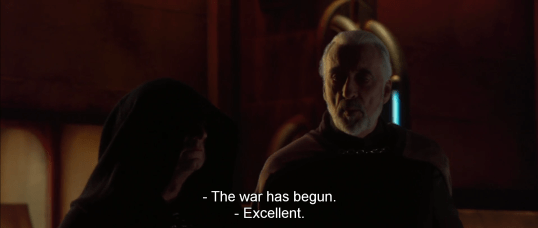
“WAR!” the opening title crawl of Revenge of the Sith declared, as if it was trying to reassure those of us in the audience that it would not be another boring Star Wars prequel.  There was nothing in the crawl about taxation or trade routes.  Instead, it was all about how the Galactic Republic was at war with separatists and how Chancellor Palpatine was being held prisoner by General Grievous.  After an exciting battle on Grievous’s flagship, Anakin not only rescued Palpatine but also decapitated Christopher Lee’s Count Dooku, despite the fact that Dooku had surrendered and was unarmed.  That’s when those of us watching knew that Revenge of the Sith was not going to be like the other two prequels.  Revenge of the Sith was going to be darker and edgier and not just for kids.  A headless Count Dooku action figure would not be sold at your local toy store.

Looking back, it is easy to forget how relieved many of us were that Revenge of the Sith was not terrible.  After the bitter disappointment of the first two prequels, we were happy that Jar Jar Binks only appeared during one shot towards the end of the film and he did not speak.  We were happy that Ewan McGregor and Natalie Portman both finally got to give performances that justified casting actors of their caliber as Obi-Wan and Amidala.  We were happy that, since Anakin and Amidala were secretly married between Attack of the Clones and Revenge of the Sith, we did not have to sit through any more scenes of them falling in love.  Many of us had found Hayden Christensen’s performance to be petulant in Attack of the Clones and, intentionally or not, Revenge of the Sith seemed to validate our suspicions by having both Yoda and Mace Windu say the same thing about Anakin.  After the embarrassment of Phantom Menace and Attack of the Clones, this was a prequel that we felt we could get behind.

mswr

And we were really happy with the climatic battle between Obi-Wan and Anakin.  After Anakin had gone over to the dark side, he and Obi-Wan dueled on a volcanic planet.  “You were supposed to be the chosen one!” Obi-Wan shouted after chopping off Anakin’s legs.  After being left to die by Obi-Wan, Anakin was rescued by Emperor Palpatine.  It was only after being encased in that famous black armor that Palpatine told the new Darth Vader that Amidala had died.  Darth Vader’s “Nooooooooo!” would go down in history.

At the end of the film, Jimmy Smits was seen giving an infant Luke to Owen and Beru Lars and Darth Vader and the Emperor were seen standing on the bridge of an imperial ship and looking out at the skeleton of the Death Star.  For the first time since the prequels were first released, some of us applauded at the end of a Star Wars film.

When, ten years later, I rewatched Revenge of the Sith for the first time in a long while, my immediate impression was that it was nowhere close to being as good as I remembered.  Without a doubt, it was still the best of the prequels but how much was that really saying?  Of all the prequels, it came the closest to capturing the sense of awe and excitement that made the original trilogy (even Return of the Jedi) so entertaining but, at the same time, it still had many of the same flaws that afflicted Phantom Menace and Attack of the Clones.  Hayden Christensen was as stiff and inexpressive as ever, as was George Lucas’s dialogue.  (When Obi-Wan tells Anakin that Palpatine is evil, Anakin actually replies, “From my point of view, the Jedis are evil!”  He shouts this in the middle of a light saber duel.)  Even the movie’s most shocking moment, when Anakin murdered a group of children, was no longer effective because everyone in the movie insisted on calling the children “younglings.”

revenge_of_the_sith600

Throughout the entire prequel ordeal, George Lucas would insist that it was necessary to see all three of the prequels to really understand the story he was trying to tell and how it fit in with the original trilogy.  However, of all the prequels, Revenge of the Sith is the only one that feels as if it adds anything to what we had already learned from watching the original trilogy.  Nor is there anything to be gained from having seen the first two prequels before watching Revenge of the Sith for the first time.  The main accomplishment of Revenge of the Sith was to prove that The Phantom Menace and Attack of the Clones were entirely unnecessary.  (Revenge of the Sith actually works better if you have never seen Phantom Menace because there is no way that the Anakin played by Jake Lloyd could have grown up to be the Anakin played by Hayden Christensen.)

Why, when we originally watched Revenge of the Sith, did so many of us think that it was so much better than it actually was?

In the year 2005, we were just happy to have a Star Wars film that did not totally suck.

Jar

Sci-Fi Review – Star Wars: Episode II – Attack of the Clones (dir. by George Lucas)


Attack of the Clones is, at least in my opinion, the worst Star Wars film ever made. Hands down. That is not to say it’s not mildly entertaining, but it demands a great deal of good will from its viewer to keep him from sneering at the movie constantly, especially if said viewer is a fan.

Christ, where do I even begin.

It’s important to note that Episode II is a transition movie. If that’s not clear enough, what I mean is that it’s a movie that exists to connect both the childish, yet potentially endearing Episode I, and the much darker and edgier Episode III. Episode II is somewhere inbetween these two moods, trying to make the transition smoother, disastrously so. It’s catastrophic in many levels, but mostly because of Hayden Christensen’s Anakin Skywalker. We’ll get there soon.

Episode II starts as a movie about politics. Now, I like fictional world politics as much as the next person. I honestly do. Especially in a space opera setting. But in Star Wars the politics are dull and barely explained. Padmé Amidala’s two terms as democratically elected Queen of Naboo (wait, what?) are now over, and she continues her career as a politician by becoming a senator. The story begins by trying to make it interesting that people are trying to kill Amidala, on what appears to be politically motivated crimes. We don’t get much context, except that she opposes some other senators. Palpatine, being the super trustworthy guy everyone always knew he was, assigns the Jedi Order to protect her, and finds that Obi-Wan is a suitable bodyguard for Padmé, considering their friendship way back in Episode I. Of course, Obi-Wan must take his apprentice, Anakin Skywalker, with him. And hilarity ensues.

Now, you’re probably familiar with whom Anakin is to become, and you probably know whose father he is, so this movie must establish one very important thing; an origin to the affection between future Lord Vader and an unwitting woman, so that we can learn whose womb was it that those guys from the original trilogy came from. Therefore, in addition to being about lackluster politics, this is a movie about love.

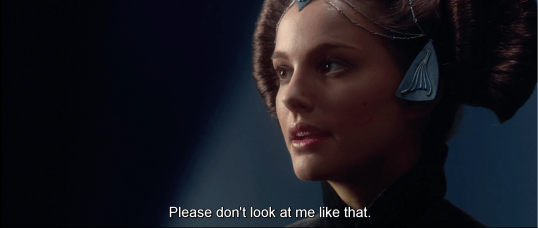
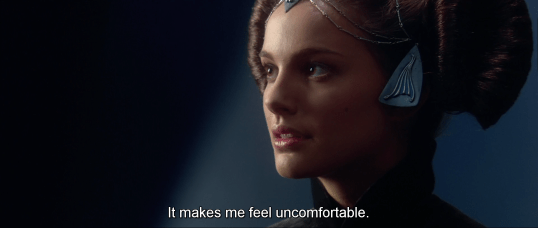
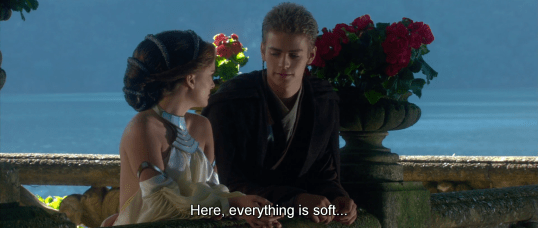
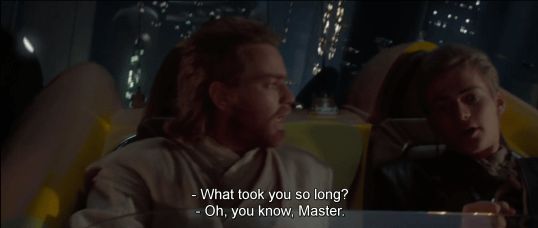
Ani1Ani2Ani3Ani4

DAMN SON.

Now, I have to agree with Padmé. You can preach all you want about how you have a massive crush on Hayden Christensen’s mini braid, but that piercing sex offender gaze made me uncomfortable. Throughout the first act, Anakin goes from flirting with the poor woman to actively doing stuff very similar to sexual harassment. I mean, seriously, look at this lecherous, leering asshole.

Ani5.png

Darth Vader has always been regarded as one of the greatest villains of cinema, but I never figured that he was also one of the sleaziest. 

I wish this was the only problem with Anakin. Maybe it’s not Mr. Christensen’s acting, but the poor writing (though I suspect that, considering his absence in major movies this decade, his acting was definitely a factor). Young Skywalker is a very gifted Jedi, being immaculately conceived by midi-chlorians and all (I can’t stop laughing), and he is painfully aware of his skills, which he shows through an overpowering arrogance. Now, arrogance when done right can be charming, and perhaps that was the intention; to make Darth Vader a badass even as a teenager, a daredevil, someone who just barely succeeds, but does it with style. Anakin, however, comes across as impudent, annoying, and exceedingly stupid. It seems Anakin can’t go two scenes without doing something that would displease the Jedi council, and entirely aware of it too. ‘Cause that’s just how he rolls. James Dean from a galaxy far far away.

Second act comes. Anakin grows more and more adolescent and fascist. More politics happen. Then there are some cool action scenes that seem to save the film. Obi-Wan is written as barely having a personality, aside from comments that try to make it evident that he is growing older and grumpier, even though he can’t be much more than 30. Regardless, he is arguably the saving grace in the main cast, at the very least as far as really cool fights go. He pilots fighter ships, he fights with a lightsaber; the man sees some action. It’s almost depressing to see an actor of Ewan McGregor’s caliber being reduced to action hero and grumpy mentor to an angsty teenager.

Grantorino.png

Their dynamic is oddly reminiscent of Gran Torino

Jar Jar also appears. Fan favourite Jar Jar. I feel this is worth mentioning because in an extremely important scene he proposes (as stand-in senator for Amidala) to convey supreme power to Chancellor Palpatine. Yes, that Chancellor Palpatine, and I have to wonder why they couldn’t task this burden to an unnamed senator. Don’t people hate the poor gungan enough? It’s as if George Lucas is just fucking with his public to see how far they can go, at this point.

And then, in the third act, we are introduced to the big bad: Count Dooku, played by the late Sir Christopher Lee. You’d think that bringing this legend of acting might infer that this character is the highlight of the cast. Might have been. Dooku is a character full of potential. He’s obviously evil, but with just the right amount of idealism to seem more shades of grey than the cruel, pure black villains the series are accostumed to. But apparently all he does is some exposition, then pave the way for the epic arena fight scene that kind of defines this movie as a Star Wars film (perhaps one of the only things that defines this as a Star Wars film), some more exposition, a lightsaber duel (a really cool one, wrapping up the whole two things that make this a Star Wars film), and then he’s gone, apparently having started a war. The movie is over, without fully explaining why things escalated, and who exactly Count Dooku represents that the Republic is at war with.

Grantorino.png

WAR AGAINST WHOM???

I’m serious when I say this can be an entertaining movie. The fight scenes can be fun and you can laugh at what ridiculous situations the actors are subjected to. But it’s mostly incredibly dull. It’s a film that throws you into an extended torrent of politics you need to understand beforehand to appreciate, and that lead to Clone Wars, a pretty cool spin-off that most people never got to see and that might as well have been properly included as crucial to the continuity since it’s much better than this. As a standalone film, the story is a confusing, rushed mess even at two hours long. As a Star Wars film, Attack of the Clones makes it obvious that the series is not infallible. Horribly, gapingly, obviously not infallible.

Horror Film Review: Death Line (dir by Gary Sherman)


“Mind the doors!”

— The Man (Hugh Armstrong) in Death Line (1972)

Before I get to far into reviewing the unjustly obscure British horror film, Death Line, I want you to take a look at the film poster below.

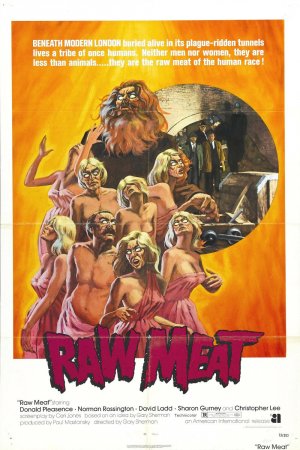
Deathlinerawmeat

This is the poster that was used when Death Line was released in the United States.  Now, I have to admit that I like this poster but that’s largely because I’m a lover of old grindhouse and exploitation films.  And this poster is a perfect example of the grindhouse aesthetic.  Of course, it’s not surprising that this poster is largely misleading.

First off, the title has been changed to Raw Meat.  That makes sense when you consider that the film is about a cannibal but it also creates the mistaken impression that this film is primarily about cannibalism.  It’s not.  Actually, Death Line is a film about class differences and government secrecy.  (Though it’s probably best to leave this as a topic for another post, I think it can be argued that almost every film made in the UK is, in some way, about class and secrecy.)

The bearded man is obviously meant to be a stand-in for Death Line‘s cannibal.  Known as the Man and played by Hugh Armstrong, he is the last descendant of a group of Victorian railway workers who were buried alive during the construction of the London underground.  The Man is the product of generations of cross-breeding.  And while the Man is definitely frightening at first, he ultimately emerges as the film’s only truly sympathetic figure.  He’s hardly the intimidating figure pictured above.  Instead, he’s a heart-breakingly pathetic figure who, having grown up in the shadows of the underground, is only capable of uttering three words: “Mind the doors.”  There’s a lengthy scene in which the Man howls in anguish after the death of his wife.  I don’t care if he was a cannibal, it still brought tears to my eyes.

The poster does offer up a glimpse of two men who appear to be searching an underground tunnel.  This image, at the very least, is accurate.  The two men are Inspector Calhoun (Donald Pleasence) and his partner, Detective Sergeant Rogers (Norman Rossington).  When the Man makes the mistake of attacking, murdering, and eating a member of a Parliament, Calhoun and Rogers are the ones who end up investigating the case.  What’s interesting is that neither Calhoun nor Rogers are presented as being sympathetic characters.  In fact, Calhoun is something as a fascist.  When Christopher Lee tells them to stop investigating the case, Calhoun is less upset over the government cover-up and more angered by the fact that he doesn’t like being told what to do.

There are two other people investigating the case, though neither one of them are present on the poster.  Alex Campbell (David Ladd) is an American college student and, though Alex starts out as sympathetic to the Man, that changes when the Man kidnaps his girlfriend (Sharon Gurney) and tries to make her into his new wife.  Alex serves as a stand-in for the self-righteous activists who, in most films, would be responsible for saving the day.  It’s telling of just how cynical a film Death Line is that Alex ultimately turns out to be even more ineffectual than Calhoun and Rogers.

Finally, the poster offers up a group of half-naked people.  I have no idea who these people are supposed to represent but I’m sure they helped to sell tickets!

As for Death Line, it’s an unjustly obscure film.  Whether you track it down under the original title or the Americanized title of Raw Meat, be sure to watch it.

GODS OF THE HAMMER FILMS 2: Peter Cushing, Christopher Lee, and HORROR OF DRACULA (1958)


gary loggins's avatarcracked rear viewer

hor drac4

(second of a series)

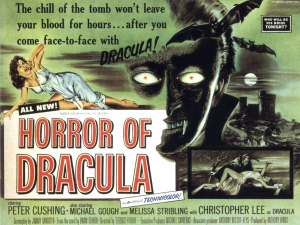
Hammer Films Ltd. knew they were on to something with the release of 1957’s THE CURSE OF FRANKENSTEIN. The Gothic horror was box office gold on both sides of the Atlantic, and Hammer wasted no time finding a follow up. Reuniting CURSE OF FRANKENSTEIN costars Peter Cushing and Christopher Lee with director Terence Fisher, the company set its sights on giving the full Eastmancolor treatment to Bram Stoker’s immortal Count Dracula.

View original post 554 more words

Gods of the Hammer Films: Peter Cushing, Christopher Lee, and THE CURSE OF FRANKENSTEIN (1957)


gary loggins's avatarcracked rear viewer

curse4

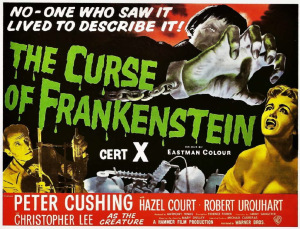
When Britain’s Hammer Films began in the early 1930’s they were just another movie production company. After finding some success with the 1955 sci-fi adaptation THE QUARTERMASS EXPERIMENT, they chose to make a Gothic horror based on Mary Shelley’s classic 1818 novel about a man obsessed with creating artificial life. FRANKENSTEIN had been filmed many times before, most notably Universal’s 1931 version that brought eternal fame to Boris Karloff. This time however, the producers shot in vibrant color, with blood and body parts on gory display. Tame stuff compared to today’s anything goes horrors, but in the fifties it was considered quite shocking.

Peter Cushing and Christopher Lee had appeared in two films before, Lawrence Olivier’s 1948 HAMLET and John Huston’s 1952 MOULIN ROUGE, though not as a team. Once CURSE OF FRANKENSTEIN was unleashed upon the public, they were paired another nineteen times, making Cushing and Lee terror’s all-time tandem. HORROR OF DRACULA came next, with…

View original post 613 more words

Film Review: Safari 3000 (1982, dir. Harry Hurwitz)


Christopher Lee and Mini-Me

Christopher Lee and Mini-Me

Ever seen that episode of AVGN for Darkwing Duck on the TurboGrafx-16? It starts off with the Nerd going through numerous games that you know are bad just by the title. Moon Ranger, Kid Niki, Dudes With Attitude, Deathbots, and Mad Max for the NES. They’re clearly bad games, but there just isn’t enough material to work with for a proper episode of the show. Safari 3000 is the cinematic equivalent to those reject games. However, since I suffered through it, now you must hear about it. And yes, I borrowed that sentence from Necessary Roughness (1991).

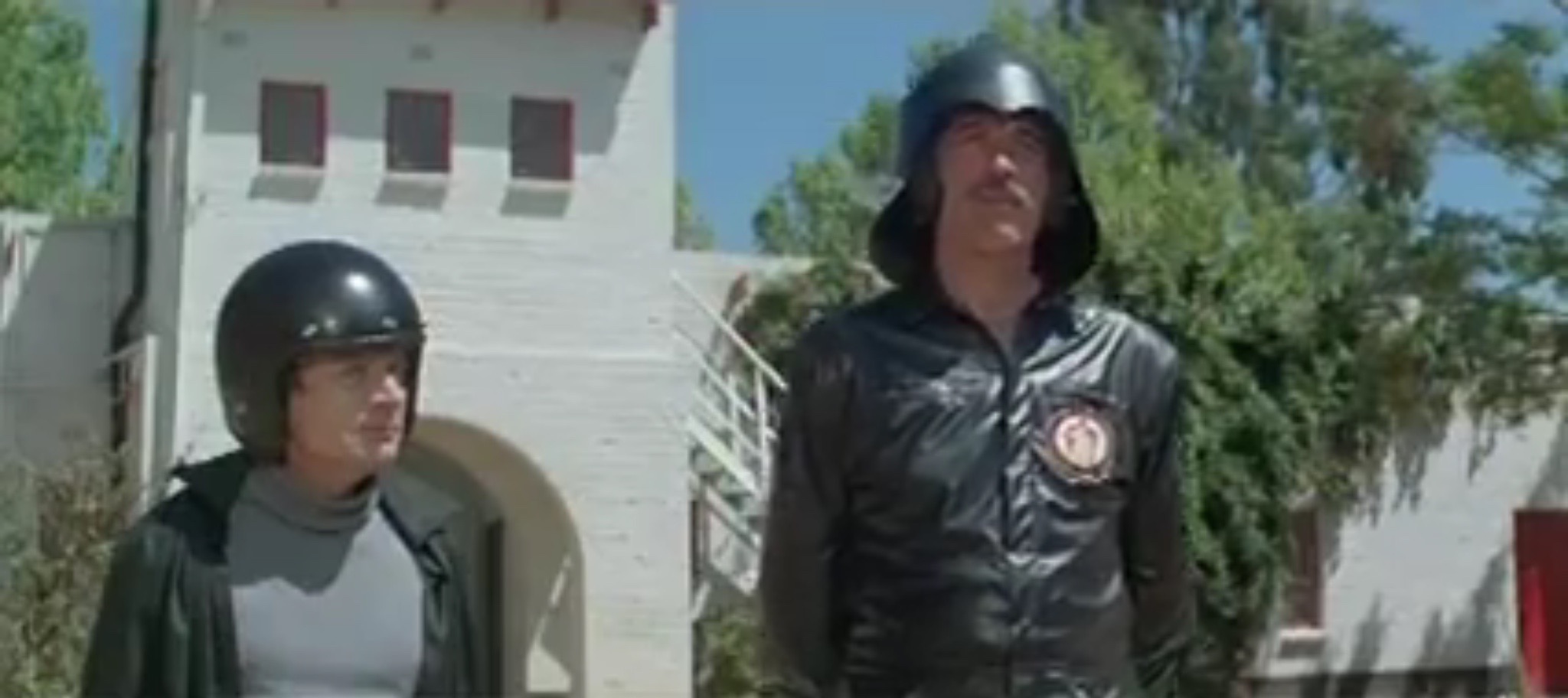
As you can see from the picture above, Christopher Lee is in this with a mustache, leather outfit, and a Darth Vader helmet. Why the Darth Vader helmet? I have no clue. Why does this little guy follow him around? No clue, but he does jump off a building near the beginning of the film. Why? I found out there is a movie called Pterodactyl Woman from Beverly Hills (1997) today so I don’t even know how we still exist, let alone why he jumps off the building.

So what is Safari 3000 about? There’s some sort of race in Africa and several teams are going to compete. Christopher Lee and the little guy…wait, of course, it’s a reference to The Man With The Golden Gun (1974)! That’s also why his name is Count Borgia in order to reference the Hammer Dracula films.

Well, there are other teams. I saw one that is clearly supposed to be two Japanese guys, and another made up of Italians. There are also two ladies who are listed as the American Housewives team in the credits. I’d find it offensive, but it’s an apt description because at the beginning of the race they say that while their husbands go to Vegas, they go to race cars.

David Carradine and Stockard Channing

David Carradine and Stockard Channing

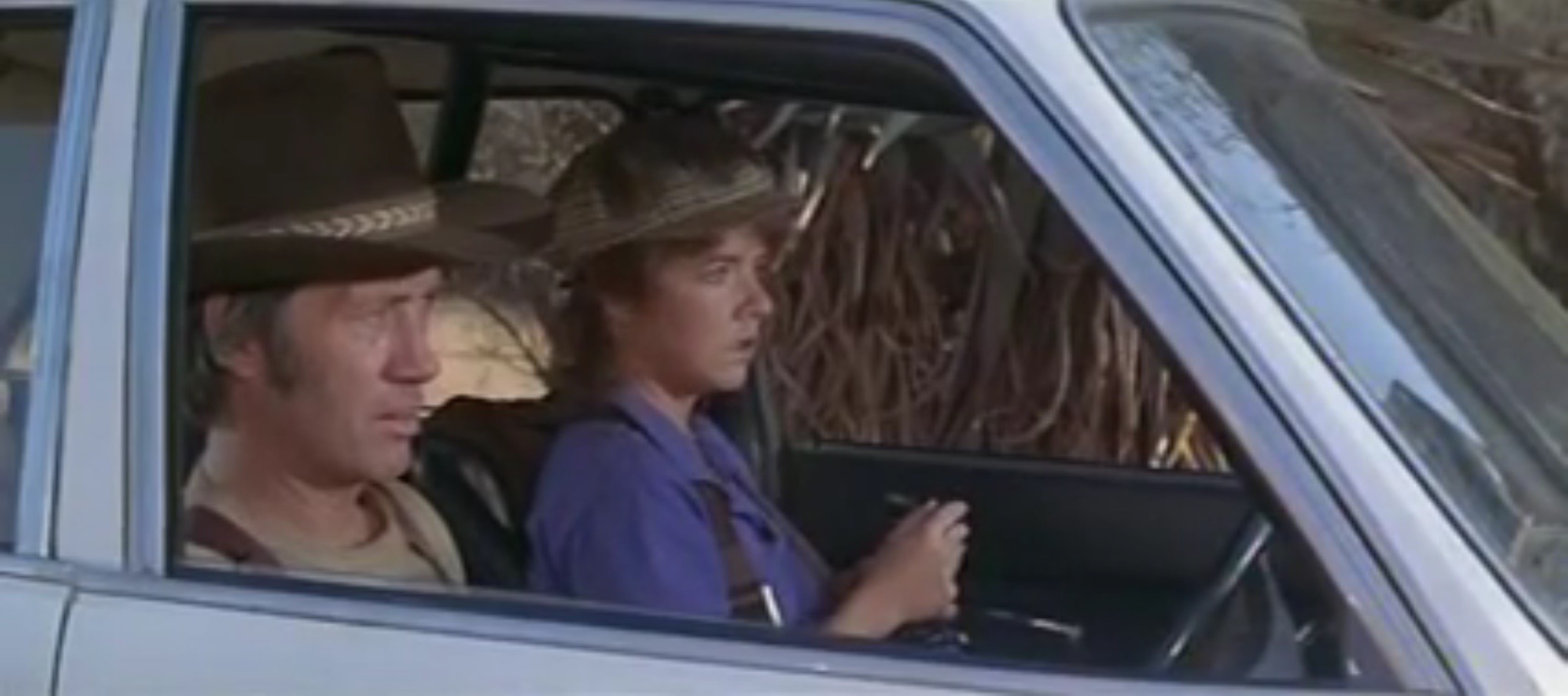
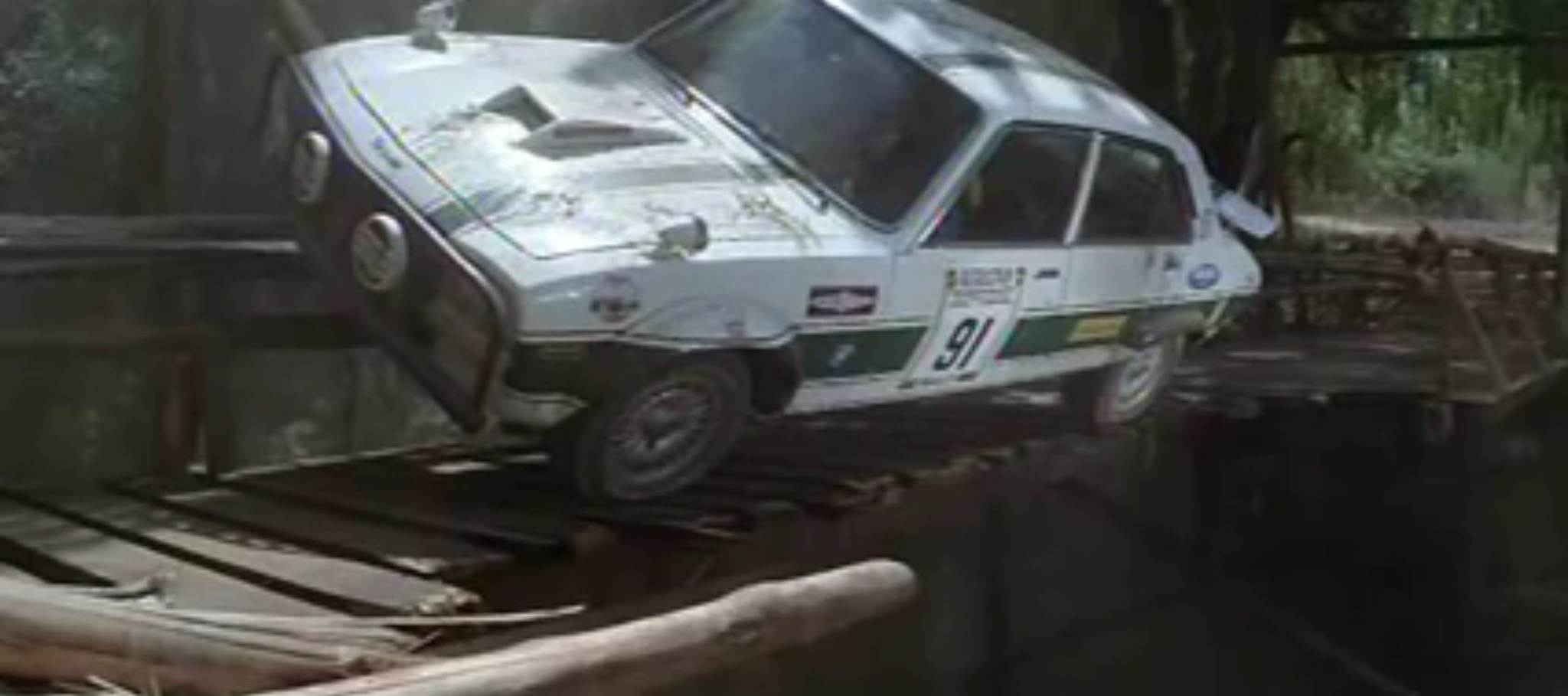
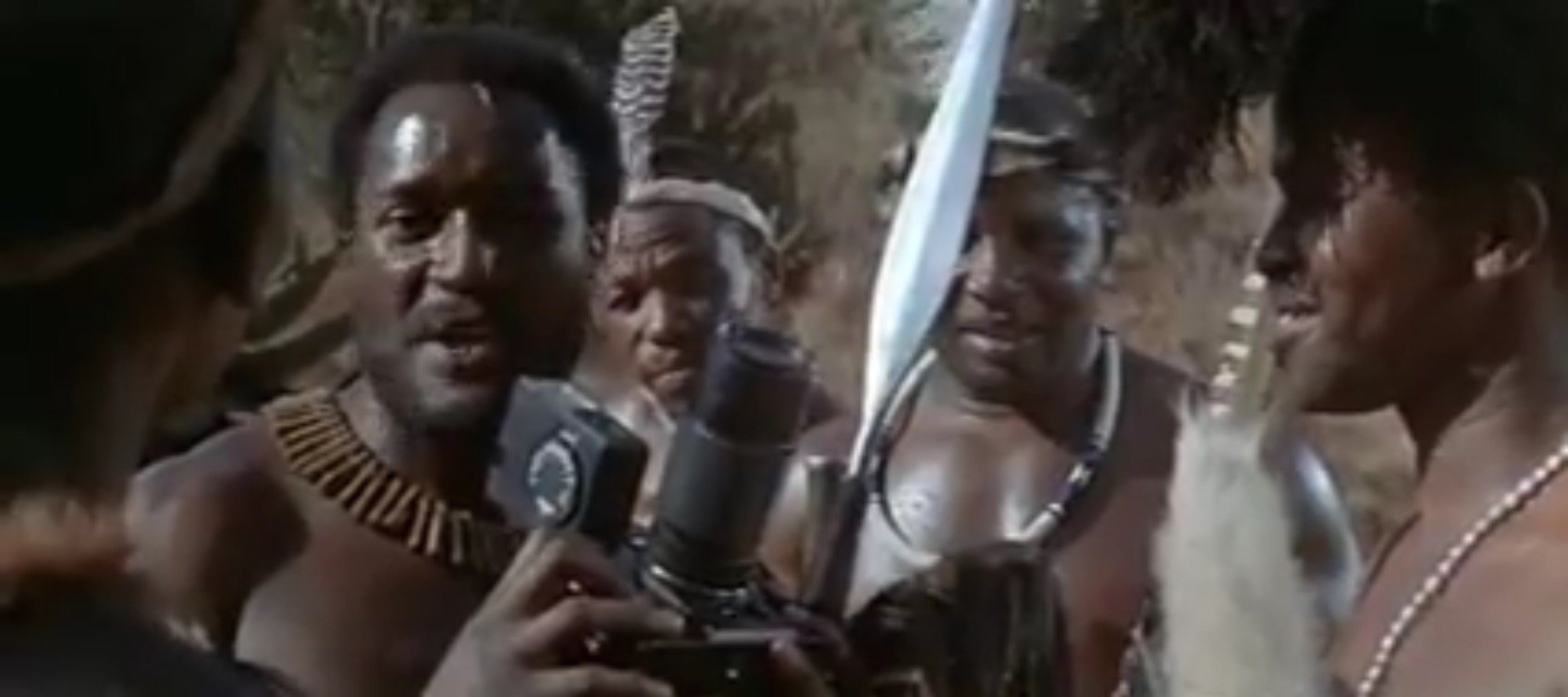
This movie gets to the race pretty quickly, which is good. Channing convinces her superior at Playboy to let her go to cover this race with Carradine as her driver. What follows is promising with some laughs. They get across a partially broken bridge with a little trick driving. A local African guy gets angry at them, pretends to be unable to speak English, then leaves them alone when they give him a fancy camera. Then he promptly turns around, perfectly describes the camera to his buddies, and takes a shot of of his friend.

Trick Driving

Camera!

Camera!

Smile!

Smile!

However, after that it just gets boring. The main problem is that there isn’t enough cutting between the different racers to get us excited or keep us engaged. Nor does enough happen to Channing and Carradine for us to feel them bond the way the movie wants us to believe they do.

In the end, you get a few laughs. You get to see some wildlife. Then the movie ends and you move on. In my case, to the next movie.

Winning, one way or another

Christopher Lee, R.I.P.


Jinnah

The picture above is Christopher Lee in the 1998 film Jinnah.  In this epic biopic, Lee played Muhammad Ali Jinniah, the founder of modern Pakistan.  Up until yesterday, I had never heard of Jinnah but, after news of Lee’s death broke, Jinnah was frequently cited as being Lee’s personal favorite of his many roles and films.

Consider that.  Christopher Lee began his film career in the 1940s and he worked steadily up until his death.  He played Dracula.  He played The Man with the Golden Gun.  Christopher Lee appeared, with his future best friend Peter Cushing, in Laurence Olivier’s Oscar-winning Hamlet.  He played Seurat in John Huston’s Moulin Rouge.  He appeared in both The Lord of the Rings and the Hobbit trilogies.  He appeared in several films for Tim Burton.  He even had a small role in Martin Scorsese’s Hugo.  He appeared in two Star Wars prequels.  He appeared in the original Wicker Man (and reportedly considered it to be his favorite of his many horror films).  He appeared in Oscar winners and box office hits.  And, out of all that, Christopher Lee’s personal favorite was Jinnah, a film that most people have never heard about.

Unless, of course, you live in Pakistan.  When I did a google search on Christopher Lee, I came across several Pakistani news sources that announced: “Christopher Lee, star of Jinnah, has died.”

And really, that somehow seems appropriate.  Christopher Lee was the epitome of an international film star.  He worked for Hammer in the UK.  He worked with Jess Franco in Spain and Mario Bava in Italy.  He appeared in several movies in the United States.  And, in Pakistan, he played Jinnah.  And I haven’t seen Jinnah but I imagine he was probably as great in that role as he was in every other role that I saw him play.  Over the course of his long career, Christopher Lee appeared in many good films but he also appeared in his share of bad ones.  But Christopher Lee was always great.

It really is hard to know where to begin with Christopher Lee.  Though his death was announced on Thursday, I haven’t gotten around to writing this tribute until Friday.  Admittedly, when I first heard that Lee had passed away, I was on a romantic mini-vacation and had promised myself that I would avoid, as much as possible, getting online for two days.  But, even more than for those personal reasons, I hesitated because I just did not know where to start when it came to talking about Christopher Lee.  He was one of those figures who overwhelmed by his very existence.

We all know that Christopher Lee was a great and iconic actor.  And I imagine that a lot of our readers know that Lee had a wonderfully idiosyncratic musical career, releasing his first heavy metal album when he was in his 80s.  Did you know that Lee also served heroically during World War II and, after the war ended, helped to track down fleeing Nazi war criminals?  Did you know that it has been speculated that Lee may have served as one of the role models for James Bond?  (Ian Fleming was a cousin of Lee’s and even tried to convince Lee to play Dr. No in the first Bond film.)  Christopher Lee lived an amazing life, both on and off the screen.

But, whenever one reads about Christopher Lee and his career or watches an interview with the man, the thing that always comes across is that, for someone who played so many evil characters, Christopher Lee appeared to be one the nicest men that you could ever hope to meet.  Somehow, it was never a shock to learn that his best friend was his frequent screen nemesis, Peter Cushing.

Christopher Lee is one of those great actors who we assumed would always be here.  The world of cinema will be a sadder world without him.

Legends together

Legends together

Here is a list of Christopher Lee films that we’ve reviewed here on the Shattered Lens.  Admittedly, not all of these reviews focus on Lee but they do provide a hint of the man’s versatility:

  1. Airport ’77
  2. Dark Shadows
  3. Dracula A.D. 1972
  4. Dracula Has Risen From The Grave
  5. Dracula, Prince of Darkness
  6. Hercules in the Haunted World
  7. The Hobbit
  8. The Hobbit: Battle of the Five Armies
  9. Horror Express
  10. The Horror of Dracula
  11. Hugo
  12. Jocks
  13. The Man With The Golden Gun
  14. The Satanic Rites of Dracula
  15. Scars of Dracula
  16. Scream and Scream Again
  17. Season of the Witch
  18. Starship Invasions
  19. Taste The Blood of Dracula
  20. The Wicker Tree

Sir Christopher Lee was 93 years old and he lived those 9 decades in the best way possible.  As long as there are film lovers, he will never be forgotten.

A Quick Review: The Hobbit: The Battle of the Five Armies (dir by Peter Jackson)


TheHobbit5Armies

It seems kind of weird to do a quick review for a 144 minutes film that not only serves as the end of one epic trilogy but also as a prequel for yet another epic trilogy.

Well, so be it.  I hate to admit it but I really don’t have that much to say about The Hobbit: The Battle of the Five Armies beyond the fact that I saw it on the day after Christmas, I enjoyed it, and I thought Aidan Turner was really hot.  It’s not a perfect film but then again, The Hobbit has never been a perfect trilogy.  As opposed to the Lord of the Ring films, The Hobbit told a story that could have easily been told in two films.  As a result, whenever you watch one of The Hobbit films, you’re aware of all of the filler that was included just to justify doing three films.

But so what?  The Hobbit films are fun.  Despite the cynical economic reasons behind turning The Hobbit into a trilogy, director Peter Jackson’s love for the material always came through.  In the title role, Martin Freeman was always likable.  Ian McKellan and Christopher Lee made for properly enigmatic wizards.  Though apparently his inclusion caused some controversy among purists, it was nice to Orlando Bloom as Legolas.  I also liked Evangeline Lilly’s elf character, even if everyone else seemed to dislike her and her love story with Aidan Turner.  And then there was Benedict Cumberbatch providing a perfectly evil and self-satisfied voice for Smaug.

I have to admit that, with the exception of Aidan Turner, I was never a big fan of the dwarves.  They were all so surly and bad-tempered and it didn’t take me too long to get tired of Richard Armitage showing up as Thorin and acting like a jerk.  However, in the final part of the trilogy, Armitage’s surly performance started to make sense.  As Thorin grew more and more paranoid, I saw that The Hobbit was actually using both the character and Armitage’s performance to make a much larger point.  Power corrupts and most conflicts are ultimately all about money and property.  It was a good message.

When the Battle of the Five Armies started, I was shocked to discover how little I remembered about the previous two Hobbit films.  It took me a while to get caught up on who everyone was and why they were all fighting over that mountain.  As opposed to the LoTR films, it’s not always easy to get emotionally invested in The Hobbit films.  But, Jackson is a good director and he’s a good storyteller and, even though it took me a while to get caught up, I was still often enthralled with what I was watching on screen.  The images were so stunning and the battle scenes were so spectacularly done that I could handle being occasionally confused.

Battle of the Five Armies is a fitting end for the Hobbit trilogy.  It’s not a perfect film but it is exciting and fun and that’s really all that matters.  At the end of it, the audience in the theater applauded, not just for the film but in recognition of everything that Peter Jackson has given us over the past 14 years.

It was a good way to spend the day after Christmas.