Today’s horror on the lens is the 1972 classic Horror Express!
And you can watch it below!
Today’s horror on the lens is the 1972 classic Horror Express!
And you can watch it below!
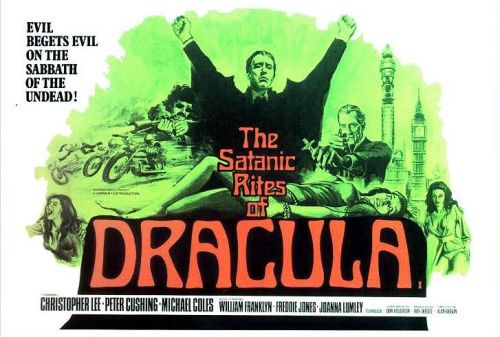 First released in 1973 and, like Dracula A.D. 1972, set in what was then the present day, The Satanic Rites of Dracula was the 8th entry in the Hammer Dracula series. It was also the last to feature Christopher Lee in the role of Dracula and that perhaps is why, judging by some of the other reviews that I’ve read online, The Satanic Rites is one of the more reviled entries in the series.
Judging from a lot of those reviews, the attitude seems to be that The Satanic Rites of Dracula was so bad that it was the film that made Christopher Lee say, “No more!” Reportedly, Lee felt that the film itself was both poorly written and that it was too violent. And, even though the film is rather tame by the standards of today’s horror films, The Satanic Rites is still probably one of the more extreme entries in the series. The film features a graphic and drawn-out flashback in which we see a naked woman sacrificed by a Satanic cult, a scene that’s bloody even by the standards of Hammer. Later, when Jessica Van Helsing (played by Joanna Lumley, who took the role over from Dracula A.D. 1972‘s Stephanie Beacham) is menaced by a pack of female vampires, the vampires literally claw at her body like wild animals. And finally, when one of Dracula’s brides is staked, blood literally splashes across the screen.
Christopher Lee was not a fan of The Satanic Rites of Dracula and neither are a lot of critics but you know what? I think The Satanic Rites of Dracula is actually rather underrated. If nothing else, it’s certainly far more unpredictable than some of the far more critically embraced Dracula films.
Satanic Rites opens with a British secret agent (Maurice O’Connell) escaping from a country house in which he had previously been held prisoner. Though he’s fatally wounded during the escape, the agent manages to tell his superiors that, at the house, he witnessed a Satanic ritual that involved some of the most important people in the British government. Since one of the accused occultists is a government minister, the secret service passes the case on to Scotland Yard’s Inspector Murray (Michael Coles, reprising his role from Dracula A.D. 1972) and then provide him with clandestine assistance. (Or something like that. To be honest, I get the feeling that the main reason Murray was called in was to maintain some continuity between Dracula A.D. 1972 and The Satanic Rites of Dracula.) Murray suspects that vampires may be involved so he calls in Lorrimar Van Helsing (Peter Cushing).
After discovering that his old friend, scientist Julian Keeley (Freddie Jones), is a part of the cult, Van Helsing deduces that it’s all part of huge conspiracy headed by none other than Dracula himself. The plan is to release a mutated form of bubonic plague and wipe out humanity.
Why is Dracula planning on destroying humanity?
Van Helsing theorizes that this might be Dracula’s way of committing suicide. By wiping out humanity, Dracula will no longer have anyone to feed upon and his undead existence will finally end. And, if nothing else, you have to admit that is a pretty interesting motivation!
How can you not enjoy a film that’s as strange as The Satanic Rites of Dracula? It may not be a typical Hammer Dracula film and it may be a bit too obviously an attempt to revitalize a fading franchise by tossing everything that was then trendy at it but so what? This is one of those movies that could have only been made at a certain point in time by a certain group of filmmakers and, as such, it’s valuable as both history and entertainment.
Christopher Lee may have hated The Satanic Rites of Dracula but he’s being way too hard on the film. If nothing else, it provided a nice excuse for Christopher Lee and Peter Cushing to face off and how can you not appreciate that?
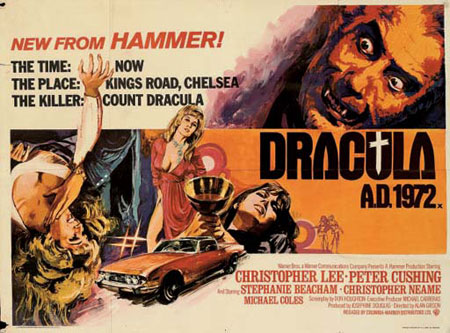
Dracula A.D. 1972 opens in 1872 with a genuinely exciting fight on a runaway carriage that ends with the death of both Count Dracula (Christopher Lee) and his nemesis, Prof. Van Helsing (Peter Cushing). However, as Van Helsing is buried, we see one of Dracula’s disciples (played by Christopher Neame, who had an appealingly off-kilter smile) burying Dracula’s ashes nearby. The camera pans up to the clear Victorian sky and, in a sudden and genuinely effective jumpcut, we suddenly see an airplane screeching across the sky.
Well, it’s all pretty much downhill from there. Suddenly, we discover that a hundred years have passed and we are now in “swinging” London. The city is full of red tourist buses, hippies wearing love beads, and upright policemen who always appear to be on the verge of saying, “What’s all this, then?” We are introduced to a group of hippies that are led by a creepy guy named Johnny Alculard (also played — quite well, actually — by Christopher Neame). One of those hippies (Stephanie Beacham) just happens to be the great-great-granddaughter of Prof. Van Helsing. Apparently, she’s not really big on the family history because she doesn’t notice that Alculard spells Dracula backwards. Then again, her father (played by Peter Cushing, of course) doesn’t either until he actually writes the name down a few times on a piece of a paper.
Anyway, the film meanders about a bit until finally, Alculard convinces all of his hippie friends to come take part in a black mass. “Sure, why not?” everyone replies. Well, I don’t have to tell you how things can sometimes get out-of-hand at black mass. In this case, Dracula comes back to life, kills a young Caroline Munro, and eventually turns Johnny into a vampire before then setting his sights on the modern-day Van Helsings.
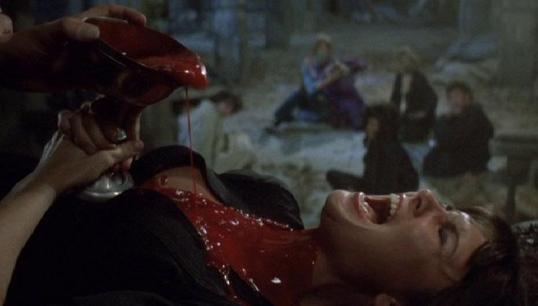
Dracula A.D. 1972 was Hammer’s attempt to breathe some new life into one of its oldest franchises and, as usually happens with a reboot, its critical and (especially) commercial failure ended up helping to end the series. Among even the most devoted and forgiving of Hammer fans, Dracula A.D. 1972 has a terrible reputation. Christopher Lee is on record as regarding it as his least favorite Dracula film. And the film definitely has some serious flaws. Once you get past the relatively exciting pre-credits sequence, the movie seriously drags. There’s a hippie party sequence that, honest to God, seems to last for about 5 hours. As for the hippies themselves, they are some of the least convincing middle-aged hippies in the history of fake hippies. You find yourself eagerly awaiting their demise, especially the awkward-looking one who — for some reason — is always dressed like a monk. (Those crazy hippies!) But yet…nothing happens. All the fake hippies simply vanish from the film. Yet, they’re so annoying in just a limited amount of screen time that the viewer is left demanding blood. Add to that, just how difficult is it to notice that Alculard is Dracula spelled backwards? I mean, seriously…
To a large extent, the charm of the old school Hammer films comes from the fact that they’re essentially very naughty but never truly decadent. At their heart, they were always very old-fashioned and actually quite conservative. The Hammer films — erudite yet campy, risqué yet repressed — mirrors the view that many of my fellow Americans have of the English. For some reason, however, that Hammer naughtiness only works when there’s the sound of hooves on cobblestone streets and when the screen is populated by actors in three-piece suits and actresses spilling out of corsets. Dracula A.D. 1972 did away with the support of the corset and as a result, the film is revealed as a formless mess with all the flab revealed to the world.
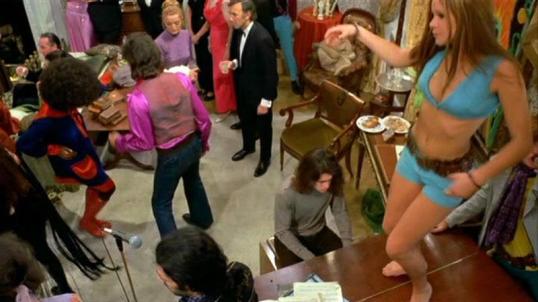
Still, the film isn’t quite as bad as you may have heard. First off, the film — with its middle-aged hippies — has a lot of camp appeal. It’s the type of film that, once its over, you’re convinced that the term “groovy” was uttered in every other scene even though it wasn’t. As with even the worst Hammer films, the film features a handful of striking images and Christopher Neame is surprisingly charismatic as Alculard.
As with the majority of the Hammer Dracula films, the film is enjoyable if just to watch the chemistry between Christopher Lee and Peter Cushing. Both of these actors — so very different in image but also so very stereotypically English — obviously loved acting opposite of each other and whenever you see them on-screen together, it’s difficult not to enjoy watching as each one tried to top the other with a smoldering glare or a melodramatic line reading. As actors, they brought out the best in each other, even when they were doing it in a film like Dracula A.D. 1972. In this film, Cushing is like the father you always you wished you had — the stern but loving one who protected you from all the world’s monsters (both real and cinematic).
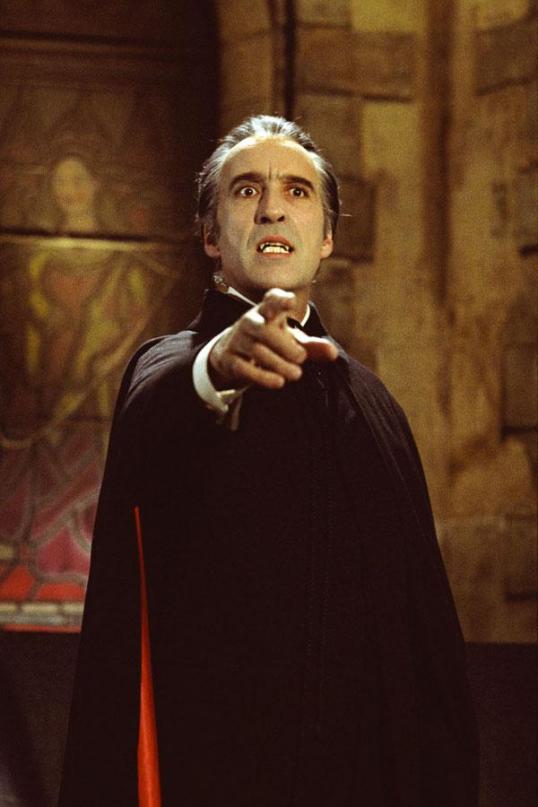
As for Lee, he’s only in six or seven scenes and he has even fewer lines but, since you spend the entire film wondering where he is, he actually dominates the entire movie. Lee apparently was quite contemptuous of the later Hammer Dracula films and, oddly enough, that obvious contempt is probably why, of all the Draculas there have been over the years, Lee’s version is the only one who was and is actually scary. F0rget all of that tortured soul and reluctant bloodsucker crap. Christopher Lee’s Dracula is obviously pissed off from the minute he first appears on-screen, the embodiment of pure destructive evil. And, for whatever odd reason, the purity of his evil brings a sexual jolt to his interpretation of Dracula that those littleTwilight vampires can only dream about. Even in a lesser films like Dracula A.D. 1972, Christopher Lee kicks some serious ass.
So, in conclusion, I really can’t call Dracula A.D. 1972 a good film nor can I really suggest that you should go out of your way to see it.. I mean, I love this stuff and I still frequently found my mind wandering whenever Cushing or Lee wasn’t on-screen. However, it’s not a terrible movie to watch if you happen to find yourself trapped in the house with 90 minutes to kill.
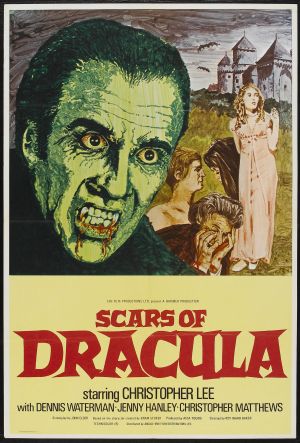
As I watched the opening of 1970’s Scars of Dracula, I found myself wondering several things.
First off, why do people even bother with trying to kill Dracula? At the end of every Hammer film, Dracula would end up dying but then, just as surely, he would be revived in the sequel. Now, I do think that Hammer deserves some credit for, at the very least, trying to maintain some sort of continuity over the course of its 9 Dracula films. At least they didn’t have Dracula just mysteriously show up alive at the beginning of each sequel. Instead, there was always someone or something who would show up at the beginning of the film for the exact purpose of bringing Dracula back to life. Scars of Dracula, for instance, opens with a rubber bat hovering over the red dust that was once Dracula. The bat spits up some blood and, before you know it, Dracula’s back and, once again, he’s being played by Christopher Lee.
Secondly, what happens to old vampire hunters? Dracula shows up in film after film but, for the most part, his antagonists only show up once and then disappear, with the notable exception, of course, of Peter Cushing’s Van Helsing. Then again, seeing as how they probably know that Dracula never stays dead for more than two years, it’s totally understandable that his enemies would probably leave town while they had the chance.
I mentioned Peter Cushing’s Van Helsing. Interestingly enough, Cushing doesn’t appear in as many Dracula films as you probably think. However, whenever we think of Christopher Lee’s Dracula, we also think of Cushing’s Van Helsing. Peter Cushing was one of the few Hammer actors who had a screen presence as memorable as Christopher Lee’s. As a result, Cushing’s Van Helsing was always seen as a worthy and credible opponent.
The downside of that is that is, when you watch a Dracula film that doesn’t feature Cushing, you find yourself very much aware of just how boring and bland most of Dracula’s other opponents truly were. For the most part, Lee’s Dracula had to deal with an increasingly generic band of “nice” young men and women, none of whom could come close to matching Lee’s dominance of the screen.
Sometimes, of course, that didn’t matter. But often times, as with Scars of Dracula, it’s really hard not to wish that Dracula was spending his time dealing with another Van Helsing instead of the film’s forgettable heroes.
In Scars of Dracula, Simon Carlson (Dennis Waterman) drops by Dracula’s castle while searching for his missing brother Paul (Christopher Matthews). Accompanying Simon is Paul’s fiancee, Sarah (Jenny Hanley). Naturally, Dracula wants to make Sarah into his bride. Complicating matters is the fact that Dracula’s servant, Klove (Patrick Troughton), has also fallen in love with Sarah. There’s plentiful gore, a little nudity, a lot of rubber bats, and Hammer mainstay Michael Ripper shows up playing yet another inn keeper. Christopher Lee is, as always, an intimidating and cruel presence of Dracula and Patrick Troughton has a lot of fun as Klove. But whenever the film focuses on its bland young leads, it comes to a halt.
Scars of Dracula is okay without being particularly memorable. It’s not one of the best of the Christopher Lee’s Dracula films but it has enough of the Hammer style to, if you’re in the right mood, enjoyable.

Two years after being temporarily destroyed at the end of Dracula Has Risen From The Grave, Dracula returned in 1970’s Taste The Blood of Dracula! Returning in the role and uttering only a handful of lines, Christopher Lee gave one of his most intimidating performances in the role of everyone’s favorite vampire.
Picking up where Dracula Has Risen From The Grave ended, Taste the Blood of Dracula opens with a sleazy merchant named Weller (Roy Kinnear) upsetting his fellow passengers during a carriage ride through Eastern Europe. After they forcefully toss him out of the carriage, Weller comes across a crucifix-impaled Dracula. Weller watches as Dracula dissolves into red dust. Weller gathers up the dust and Dracula’s ring and brooch.
A few months later, the plot picks up with three wealthy men in England. Hargood (Geoffrey Keen), Paxton (Peter Sallis), and Secker (John Carson) pretend to be charitable church goers but, in reality, they spend most of their spare time down at a wonderfully ornate brothel. One night, at the brothel, they meet a disgraced nobleman named Courtley (Ralph Bates), who was disinherited for attempting to hold a black mass. Intrigued by Courtley’s promise to give them an experience that they’ll never forget, the three men agree to purchase Dracula’s blood from Weller.
When they go to meet Courtley in a desecrated church, things suddenly go wrong. Courtley attempts to force the three men to drink from a goblet containing a mix of his and Dracula’s blood. After all three of the men refuse, Courtley himself drinks the blood. The men respond by beating Courtley to death and then fleeing from the church. After the men are gone, Courtley’s dead body transforms into a now living Dracula. Dracula announces that those who have destroyed his servant will now be destroyed themselves.
And he proceeds to do just that, turning the men’s children into vampires and then commanding them to kill their parents. Among those possessed are Alice (Linda Hayden), Hargood’s daughter for whom the film suggests Hargood may have incestuous feelings. Alice is in love with Paul (Anthony Corlan), the son of Paxton. When both Alice and his sister Lucy (Isla Blair) disappear, Paul sets out to find them and instead, comes across Dracula…
Taste the Blood of Dracula features Dracula at his cruelest (which, of course, makes it all the more ironic that his main motivation here is to avenge the death of his servant). Whereas Dracula could probably very easily kill all three of the men himself, his decision to use their children to get his revenge adds a whole new level of horrific ickiness to the film. Fortunately, none of the three men are particularly likable but still, it’s hard not to be disturbed when you’re confronted by the image of a vampirized daughter driving a stake into her own father’s heart.
But then again, that’s a part of the appeal of the old Hammer films, isn’t it? Hammer films actually “go there” in a way that the period’s American horror films would probably never quite dare.
As for Taste the Blood of Dracula, there’s a lot to recommend it. Director Peter Sadsy keeps the action moving, both the sets and the supporting cast are properly baroque, and how can you go wrong with Christopher Lee playing Dracula? Christopher Lee is one of those actors who could do so much with just a glare and the fact that his Dracula says very little only serves to make him all the more intimidating and frightening.
Christopher Lee, of course, has never made a secret of the fact that he didn’t particularly care much for the Hammer Draculas, often complaining that the films failed to stay true to the spirit of Bram Stoker’s conception of the character. Undoubtedly, Lee does have a point and the Hammer Draculas did decline in quality over the years. (Just wait until we get to Dracula A.D. 1972.) But Taste the Blood of Dracula is still a pretty effective vampire film. Hammer’s Dracula may not have been Stoker’s Dracula but, as played by Lee, he still dominates our dreams and nightmares.
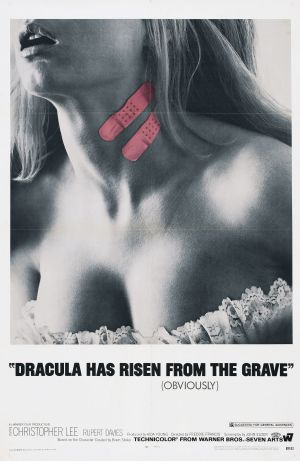 There’s a scene in 1968’s Dracula Has Risen From The Grave in which Maria (Veronica Carlson), the innocent niece of Monsignor Muller (Rupert Davies), sneaks out of her bedroom window and walks across the rooftops of a small village in Eastern Europe. She’s making her way to the bedroom of her boyfriend Paul (Barry Andrews), who the Monsignor has ordered her to stop seeing on account of the fact that Paul is an atheist. The camera views Maria from above with her pink dress and blonde hair contrasting against the gray city streets below her. It’s a beautiful scene and it is so visually stunning that you can forgive the fact that it doesn’t really move the story forward.
In its way, this scene is the epitome of everything that works about Dracula Has Risen From The Grave. Director Freddie Francis was an award-winning cinematographer who stepped in, at the last moment, to direct after original director Terrence Fisher broke his leg. Dracula Has Risen From The Grave is full of stunning imagery — shadow-filled forests, beautifully ornate bedrooms, and decaying castles and churches. When Christopher Lee’s Dracula shows up on screen, he literally seems to emerge from the shadows and when he attacks one barmaid who has made the mistake of disobeying him, the entire image is briefly tinted a blood red. When Dracula approaches his victims, his bloodshot eyes fill the entire screen. The film is full of so many memorable images that it’s easy to forgive the fact that, dramatically, Dracula Has Risen From The Grave is somewhat inert.
Picking up from where Dracula, Prince of Darkness left off, Dracula Has Risen From The Grave shows what happens when Monsignor Muller and a cowardly priest (Ewan Hooper) perform an exorcism at Dracula’s castle. The priest, frightened by thunder, attempts to flee but instead just ends up slipping and banging his head on a rock. The priest’s blood awakens Dracula (Christopher Lee) who, after putting the priest under his mental control, then seeks revenge on Muller by making Maria his bride. It’s up to Paul to try to save Maria’s life but, unfortunately, Paul is such an atheist that he refuses to recite a prayer even after he drives a stake through Dracula’s heart. This leads to perhaps the most dramatic staking fail in the history of vampire cinema.
Seriously, don’t trust atheists to kill your vampires…
How you respond to Dracula Has Risen From The Grave will probably depend on how much originality you demand from your 1960s British vampire films. Storywise, the film is nothing that you haven’t seen before and Barry Andrews doesn’t exactly make for an exciting hero. But, for me, the film’s visuals make up for the occasional weakness of the plot.
Add to that, Christopher Lee is in top form as Dracula. I’ve been trying to figure out the appeal of Lee’s Dracula because, unlike a lot of other actors who have played the role, Lee never attempts to turn the vampire into a sympathetic character. There is no romance to Lee’s Dracula. Unlike other cinematic vampires, Lee’s Dracula doesn’t spend his time mourning for a lost love or yearning for a release from having to be a prisoner to his undead state. Lee’s Dracula doesn’t even have the sense of humor that modern audiences have come to expect from their iconic villains. Instead, Lee’s Dracula is pure evil and yet, at the same time, Lee is such an imposing and charismatic actor that he makes evil compelling.
As I watched Dracula Has Risen From The Grave, I realized why Lee’s Dracula has such appeal. Lee’s Dracula sees what he wants and he takes it. He doesn’t allow anything to stand in his way and whenever boring mortals like Paul or the Monsignor attempt to stop him, he simply tosses them out of the way.
He’s evil.
He’s frightening.
And that’s exactly the way he should be.
 “My master is dead but he left instructions that the house should always be ready for visitors.”
“Who was your master?”
“His name was Count Dracula…”
— A snatch of dialogue from Dracula, Prince of Darkness (1966)
Dracula, Prince of Darkness is notable for many reasons.
First off, this movie marked Christopher Lee’s return to the role that he played 8 years earlier in The Horror of Dracula. After being forced to make one Dracula film without Dracula, Hammer Films was finally able to make a direct sequel to The Horror of Dracula.
As a result of Lee returning, this was also the first of the Hammer Draculas to feature the previously destroyed Lord of the Vampires being revived through a splash of blood. This was a plot element that all subsequent films in the series would feature and, to a certain extent, you have to admire Hammer’s efforts maintain some form of continuity. Whereas it would have been easy enough to just have Dracula show up with no explanation as to why he’s back, the Hammer films at least tried to make sure everything followed some sort of identifiable logic. (Or, at least they did until Dracula A.D. 1972 but we’ll get to that movie later…)
This was the first Dracula film not to feature (with the exception of the footage from Horror of Dracula that opens the film) Peter Cushing in the role of Van Helsing. And while the film probably would have been improved by the presence of Cushing, the film does come up with a more than adequate substitute in the form of Andrew Keir’s Father Sandor. Whereas Cushing’s Van Helsing always seemed to be a rather rational vampire hunter, Keir brings a truly demented energy to the role.
And finally, Dracula, Prince of Darkness is probably best remembered for being the Dracula film in which Dracula does not speak. He does hiss a few times but, for the most part, Dracula is silent throughout this entire film and, instead, relies on his servants Klove (Philip Latham) and Ludwig (Thorley Walters) to do most of the talking.
Why Dracula doesn’t speak is a matter of debate. Christopher Lee has claimed that he refused to say any of the dialogue that had been written Dracula while screenwriter Jimmy Sangster wrote, in his autobiography, that Dracula was specifically written to be a silent role. (Or, as Sangster put it, “Vampires don’t chat.”)
Regardless of why Dracula is silent, it actually works quite well. Sangster’s right. Vampires don’t chat and Christopher Lee’s haughty Dracula would be the least likely of all to make small talk. Dracula’s silence both reminds us of the contempt with which he views the living and it also plays up the animalistic aspects of the character. It helps, of course, that Christopher Lee is one of those actors who can do more with one dismissive glare than most actors could do with 20 pages of the most florid and overwritten dialogue.
As for the film itself, it serves as a reminder that the only thing that need happen for evil to be triumphant is for stupid tourists to take a holiday in Transylvania. Ignoring the warnings of practically everyone else on the planet, the Kents — Alan (Charles Tingwell) and wife Helen (Barbara Shelley) and Charles (Francis Matthews) and wife Diana (Suzan Farmer) — spend the night at Dracula’s castle. Dracula’s servant, Klove, murders Alan and drains his blood over Dracula’s ashes. Soon, Helen is a vampire, Diana has been selected to be Dracula’s latest bride, and it’s up to Sandor and Charles to save everyone’s soul.
Dracula, Prince of Darkness is a lot of fun. It’s full of all the usual Hammer touches — melodramatic dialogue, ornate castles, pretty costumes, plentiful gore, unfriendly villagers, and not-quite-brilliant heroes — and, best of all, it’s got Christopher Lee proving that Dracula doesn’t need to speak to be frightening. Subsequent films in the Hammer Dracula series would grow increasingly uneven but Dracula, Prince of Darkness is a worthy entry.
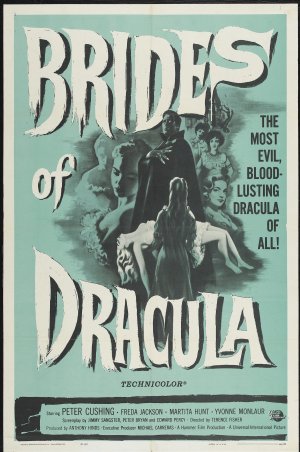 So, imagine this. Two years have passed since your film company released a low-budget film called Horror of Dracula. To the surprise of many, the film became an international hit that not only revived interest in the character of Dracula but also made a star out of an imposing and opinionated actor named Christopher Lee. Naturally, being a smart film mogul, you want to make a sequel to Horror of Dracula. Both director Terrence Fisher and screenwriter Jimmy Sangster have agreed to return to make a second part of the franchise. Now, all you have to do is recruit your star…
…and Christopher Lee doesn’t want to do the film!
There are conflicting reports on just how much Christopher Lee disliked the Hammer Dracula films. Lee, himself, has been inconsistent on the subject, occasionally claiming that he hated all of them and then other times saying that he only disliked the sequels. One thing that does remain consistent is that Lee reportedly feared being typecast as Dracula and, as a result, he initially declined to be a part of any sequel.
Nowadays, they’d probably just recast the role with Nicolas Cage. But this was the late 50s/early 60s and, instead of recasting, Hammer just made a Dracula film without Dracula. Yes, the film may have been called The Brides of Dracula but, beyond being mentioned in the film’s prologue, Dracula never makes an appearance. For that matter, there really aren’t any brides of Dracula either. There are three female vampires but none of them are turned into vampires by Dracula. Instead, the vampire in question is Baron Meinster (David Peel, who does a pretty good job in the role but who, needless to say, is no Christopher Lee).
Dracula does not return for The Brides of Dracula but his nemesis Prof. Van Helsing (Peter Cushing) does. Cushing was so well-cast as Van Helsing and brought such a sense of righteous fury to the role that his presence goes a long way towards making up for the absence of Christopher Lee. When you look at and listen to Cushing’s Van Helsing, you’re left with little doubt that this is a man who has dedicated his life to destroying vampires and that he’s quite good at it.
And it’s a good thing that Van Helsing shows up because, regardless of whether Dracula is directly involved or not, Transylvania has some issues. The Brides of Dracula opens with a French school teacher named Marianne (Yvonne Monlaur) finding herself stranded at an old castle. The owner of the castle — Baroness Meinster (Martita Hunt) — allows Marianne to spend the night but asks her to please refrain from releasing her son, Baron Meinster, from the chains that hold him prisoner. Naturally, Marianne does exactly the opposite. She steals a key and sets the Baron free.
Of course, the Baron is a vampire and soon he’s feeding on the inhabitants of a nearby village. The Baron has also decided that Marianne should be his bride. Will Prof. Van Helsing be able to save Marianne’s soul and defeat a second vampire? You’ll have to watch the movie to find out!
And you certainly should. Once you get over the fact that Brides of Dracula does not feature Lee’s iconic Dracula, the film itself is surprisingly entertaining, filled with all of the gothic touches, creepy scenery, evil villains, bloody throats, and heaving cleavage that you would expect from a Hammer film. Peel, Hunt, and Monlaur are all well-cast and best of all, Peter Cushing is Dr. Van Helsing!
In short, it’s not bad for a Dracula film that doesn’t actually feature Dracula.
(As some of our longtime readers might remember, I originally posted this review on October 11th, 2013. I’m going to be posting reviews of all of the Hammer Dracula films today so I figured I would start things off by reposting my thoughts on the very first of them, 1958’s Horror of Dracula. Add to that, I happen to really like this review!)
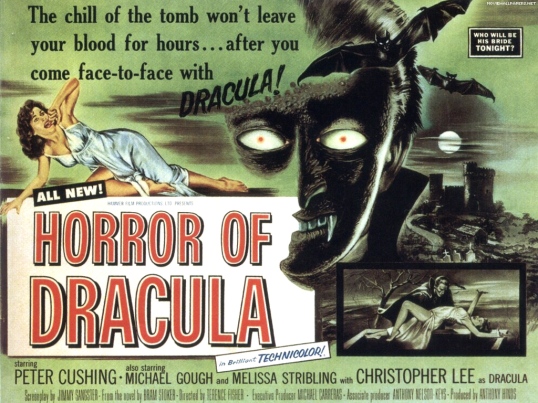
Of all the monsters who have appeared in horror cinema, Count Dracula is perhaps the most iconic. Reportedly, Dracula first appeared on film in 1920, in a silent Russian film that is now considered to be lost. In 1921, he would appear in a Hungarian film called Dracula’s Death and in 1922, he would be renamed Count Orlok for the German masterpiece Nosferatu. Indeed, by the time Bela Lugosi gave his famous performance in Tod Browning’s Dracula, the count had been appearing in films for at least 11 years. In nearly 100 years of filmmaking, a countless number of actors have brought Dracula to life.
We could spend hours debating who was the best Dracula and certainly, there are some worthy contenders. Bela Lugosi brought a continental sophistication to the role, while John Carradine was properly intimidating and theatrical. Udo Kier, Gary Oldman, Thomas Kretschmann, Leslie Neilsen, Zandor Vorkov, and Frank Langella have all played the prince of darkness, to varying degrees of success.
Yet for me, as worthy as any of those actors may be, there is only one true Dracula and he was played by Christopher Lee.
Lee famously played Dracula in seven movies for Hammer Films and, though he has often complained about the quality of these films (especially the later ones, which tended to mix Dracula with hippies), they were largely responsible for making Christopher Lee into the iconic figure that he remains today. It’s also largely due to Lee’s performance that horror fans like me continue to discover and appreciate the films of Hammer today.
As played by Christopher Lee, Dracula was pure evil. Lee’s Dracula had no use for self-pity and one can only imagine what his reaction would have been if he had ever run into the self-torturing vampires of Twilight. Lee’s Dracula had no use for doubt or regret. Instead, he was a determined animal who was driven by a singular lust for blood.
And yet, at the same time, Lee brought an intelligence to the role that was often lacking in previous performances. Lee’s Dracula may have been an animal but he was a cunning animal. Whereas it’s easy for me to imagine escaping from the clutches of Bela Lugosi, I know that if Lee’s Dracula wanted me then he would have me. There’s no escape from Lee’s Dracula. He’s too quick, determined, and intelligent.
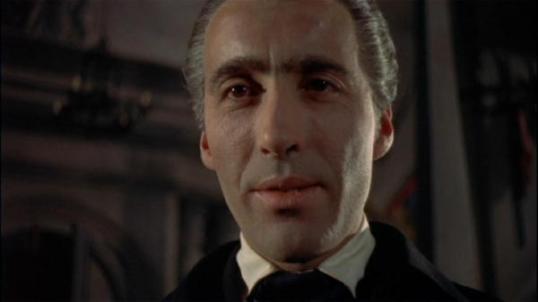
His animal nature made Lee’s Dracula frightening but it was his cunning and determination that made him dangerous and, ultimately, even sexy. (While I’ve read that audiences in 1931 swooned over Bela Lugosi, whatever sex appeal he may have had is lost on modern viewers like me.) It has often been argued that Bram Stoker meant for Dracula to be a symbol of all the desires that were repressed by Victorian society. That’s certainly true when it comes to Christopher Lee’s carnal and viscous portrayal of the character.
Of the seven Dracula films that Christopher Lee made for Hammer Films, the first remains the best. Released in 1958 and known as Dracula in the UK and the Horror of Dracula in the US, it revitalized the horror genre and helped to make stars of both Christopher Lee and Peter Cushing. Especially when compared to some of the sequels that Hammer subsequently produced, it remains one of the best Dracula films ever made.

The film is a very loose adaptation of Stoker’s original novel. Jonathan Harker comes to Dracula’s castle in Romania. Though posing as a librarian, Harker has actually come to the castle to drive a stake through the heart of both Dracula and his vampire bride. However, no sooner has Harker staked the bride than he’s overpowered and bitten by Dracula. Significantly, all of this occurs within the first 10 minutes of the film. As opposed to certain other Dracula films, Horror of Dracula gets straight to the point. And why shouldn’t it? After all, anyone watching the film already knows that Dracula’s a vampire so why waste time trying to convince us otherwise? We don’t watch Dracula for the familiar story as much as we watch to discover how different filmmakers will choose to tell that story.
When Harker’s colleague, Prof. Van Helsing (played with the perfect amount of intensity by Peter Cushing) shows up at the castle, he discovers that Harker is now a vampire and that Dracula is nowhere to be found.
Dracula, needless to say, is out for revenge. He stalks Harker’s fiancee Lucy, as well as Lucy’s brother Arthur Holmwood (Michael Gough) and his wife Mina (Melissa Stribling). Much as in Stoker’s original novel, Lucy is eventually turned into a vampire and it’s up to Van Helsing and Arthur to stop both her and her new master.
(Of course, in Stoker’s original novel, Harker is not turned into a vampire and instead marries Mina while the aristocratic Arthur is one of Lucy’s three suitors. However, I have to say that I always thought the literary Harker was a bit on the dull side and that Arthur was always my favorite character so I’m happy that he gets to be the hero here.)
If I had to pick one film to epitomize everything that I love about the Hammer brand of horror, it would be Horror of Dracula. As directed by Terrence Fisher, the film moves at an exciting, non-stop pace while the traditionally lush cinematography is almost bombastically colorful. Cushing and Lee, who were the best of friends off screen, make for formidable opponents, with Cushing embodying good just as effective as Lee embodied evil. Though it’s been over 50 years since Horror of Dracula was originally released, the film remains effective and, not coincidentally, a lot of fun.
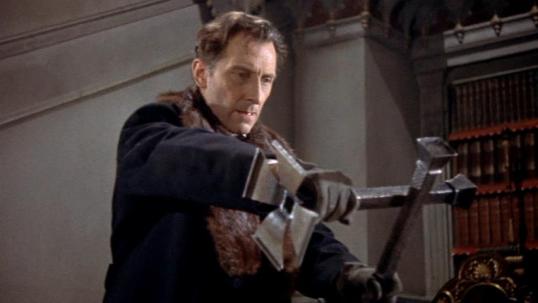
Quite simply put, this is a film that, for so many reasons, remains a true pleasure to watch.
One final note — I often find myself lamenting that I was born several decades too late and I realize just how true that is whenever I watch a film like Horror of Dracula. Seriously, I would have loved to have been a Hammer girl, showing off my cleavage and getting hypnotized by Christopher Lee.
Seriously, what more could you want?
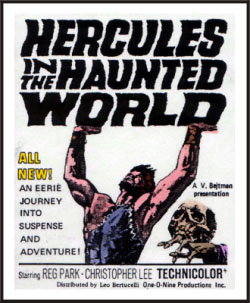
In many ways, 2014 was the year of Hercules. Or, at the very least, it could have been the year of Hercules. Neither one of the two Hercules film released this year exactly managed to set the American box office on fire. Of the two, The Legend of Hercules was memorable largely for being forgettable while the Dwayne Johnson-starring Hercules was far better than any film directed by Brett Ratner has any right to be.
Neither one of them, however, can really hold a candle to the 1961 film, Hercules In The Haunted World. In this Italian film, Hercules (Reg Park) discovers that his lover Princess Deianira has gone insane so he goes to Hades in order to get the Stone of Forgetfulness, so he can use it to cure her. The story’s really not that important. What is important is that this visually stunning film was the first color film to be directed by Mario Bava and that the film’s villain is played by Christopher Lee.
Enjoy!
 Through the Shattered Lens