Late Night Retro Television Review: CHiPs 4.10 “Forty Tons Of Trouble”


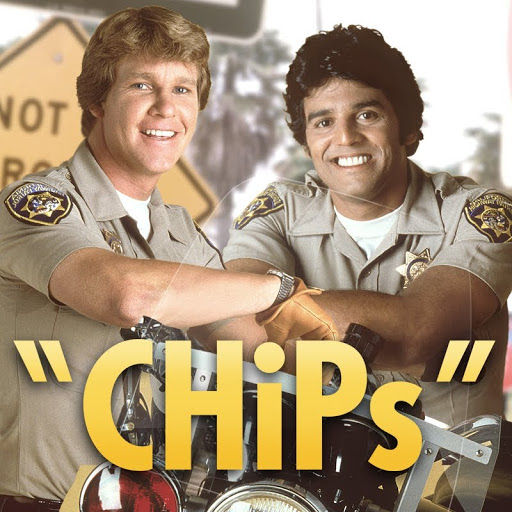
Welcome to Late Night Retro Television Reviews, a feature where we review some of our favorite and least favorite shows of the past!  On Mondays, I will be reviewing CHiPs, which ran on NBC from 1977 to 1983.  The entire show is currently streaming on Prime!

This week, two sets of thieves cause trouble!

Episode 4.10 “Forty Tons Of Trouble”

(Dir by Gordon Hessler, originally aired on January 11th, 1981)

A group of criminals is stealing equipment from construction sites and selling it on the black market.  An attempt to steal a loader leads to it rolling down a Los Angeles street until Baker is able to jump onto it and crash it into a (hopefully) abandoned building.  Getraer points out that Baker just destroyed a building.  Baker shrugs and says he’s always wanted to do that.

A different group of criminals is stealing parts for their drag racer.  The CHiPs have their own car entered into the drag races.  Of course, it’s driven by Ponch.

After two accidents on the highway and several chases, Baker and Ponch (but mostly Ponch) capture the bad guys.  Paula Kohl (Mary Louise Weller), the owner of Kohl Construction, appreciates the efforts of Baker and Ponch (but mostly Ponch).

In other words, this was a typical episode of CHiPs.  Still, it’s memorable because of the supporting cast.  Amongst the construction site thieves is Robert Englund.  Englund thinks that Sarge (Taylor Lacher) is taking to many risks when it comes to trying to steal loaders and bulldozers but Sarge is like, “I got it under control.”  Meanwhile, amongst the drag race thieves, is Chris Mulkey.  Mulkey doesn’t get to do much but he does get two scenes where he smirks at Ponch.  Sadly, both characters end up getting arrested during this episode but have no fear.  Robert Englund went on to play Freddy Krueger.  Chris Mulkey went on to play the sleazy but strangely likable Hank Jennings on Twin Peaks.

As for the rest of the episode — hey, I don’t ask for much from CHiPs.  As long as there’s a good crash scene and a lot of cool cars, I’m happy.  This episode delivered.  One could ask why Ponch is always the one who gets to do the cool things, like driving in the race and taking Paula out on a fancy date.  Earlier seasons usually tried to portray Ponch and Baker as being equals.  This season, though, has clearly been The Ponch Show.  It’s a legitimate criticism but …. eh.  Sometimes, you just want to watch a chase or two.


48 Hrs (1982, directed by Walter Hill)


48 Hrs. begins with a violent and bloody jailbreak.  The fearsome Billy Bear (Sonny Landham) helps his criminal associate, Albert Ganz (James Remar), escape from a chain gang and kills several guards in the process.  Billy and Ganz then head to San Francisco, where they start killing their former associates while searching for Luther (David Patrick Kelly).  Another bloody shootout leaves several detectives dead and SFPD Detective Jack Cates (Nick Nolte) looking for revenge.

That’s not the way you might expect one of the most famous comedies of the 80s to begin.  It’s not until Jack arranges for another associate of of Ganz’s to be released from prison for 48 hours that anything humorous happens in the film.  However, because Reggie Hammond is played by Eddie Murphy, 48 Hrs. quickly becomes very funny.

Murphy was appearing on Saturday Night Live when he was cast in 48 Hrs, in a role that was written with Richard Pryor in mind.  One of the first things that Murphy requested was that the character’s name be changed from Willie Biggs to Reggie Hammond.  Murphy made the role his own and watching him, it’s hard to believe that he was only 21 and also that 48 Hrs was his first film.  Murphy performs with the confidence of a natural movie star.  He’s good in the film’s most famous scene, where he pretends to be a cop and talks down an entire bar full of rednecks.  (I can’t repeat his most famous line but everyone knows it.)  But Murphy is even better in the scenes where he’s just reacting to Nolte’s slovenly cop.

The comedy in 48 Hrs comes from the mismatched partnership and initially hostile chemistry of Jack Cates and Reggie Hammond.  Cates has a job to do while Reggie, understandably, wants to enjoy as much freedom as he can before he gets sent back to prison.  The humor is so effective because it’s almost entirely character-based.  There are no gags but there are two well-written characters with differing ways of looking at the world who have to learn how to work with each other.  The two of them start out disliking and distrusting each other but ultimately become best friends, even if Jack does punch Reggie and Reggie does keep trying to steal Jack’s lighter.  Because this is a Walter Hill movie, there’s still a lot of action.  Nolte and Murphy may make you laugh but there’s nothing funny about full-on psycho performances of James Remar and Sonny Landham.  48 Hrs. not only allows Murphy and Nolte to show off their comedic ability but it also allows them to be true action heroes.

Popular with critics and audiences, 48 Hrs. was the most commercially successful film of 1982.  It set the standard for most buddy-cop movies to this day and it introduced the world to Eddie Murphy.

The Unnominated: The Long Riders (Dir by Walter Hill)


Though the Academy of Motion Picture Arts and Sciences claim that the Oscars honor the best of the year, we all know that there are always worthy films and performances that end up getting overlooked.  Sometimes, it’s because the competition too fierce.  Sometimes, it’s because the film itself was too controversial.  Often, it’s just a case of a film’s quality not being fully recognized until years after its initial released.  This series of reviews takes a look at the films and performances that should have been nominated but were, for whatever reason, overlooked.  These are the Unnominated.

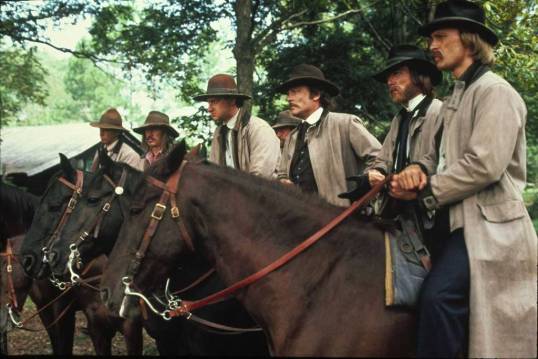
First released in 1980, The Long Riders is one of the many films to tell the story of the James/Younger Gang.

A group of former Confederate guerillas who became some of the most notorious bank robbers to roam post-Civil War America and who were based in Missouri, the brothers who made up the James/Younger Gang were hunted by the Pinkertons and beloved by the citizens who viewed them as being 19th Century Robin Hoods.  Following a disastrous attempt to rob a bank in Northfield, Minnesota, the Younger brothers were captured by the government while Jesse and Frank James made it back to Missouri.  Jesse was shot in the back by Bob Ford while Frank subsequently surrendered to authorities and made a good living on the lecture circuit.

The Long Riders tells the story of the gang, from their first encounter with the heavy-handed Pinkertons to the Northfield raid to Frank’s eventual surrender.  Director Walter Hill both celebrates the legend of the James/Younger Gang while also emphasizing that all the members of the gang were also individual humans who had their strengths and their flaws.  Hill emphasizes the idea of the gang being a group of post-war rebels, still fighting a war against a government that is more interested in protecting banks than looking after people.  The Long Riders deconstructs the legend while also celebrating it.

The main thing that sets The Long Riders apart from other films about the James/Younger Gang is the fact that the brothers are played by actual brothers.  David, Keith, and Robert Carradine plays the Youngers.  Randy Quaid plays Clell Miller while Dennis Quaid assumes the role of the cowardly Ed Miller.  Nicholas and Christopher Guest make a memorably creepy impression as Charley and Bob Ford.  And finally, Jesse and Frank James are played by James and Stacy Keach.  (The Keaches also worked on the film’s script).  And while Stacy is definitely the more charismatic of the Keach brothers, the film makes good use of James’s rather stoic screen presence.  While the rest of the gang enjoys the outlaw life, James Keach’s Jesse is rigid, serious, and ultimately too stubborn and obsessive for his own good.

Now, the casting might sound like a gimmick but it works wonderfully.  When Clell chooses the gang over Ed, it carries an emotional weight because we’re watching real brothers reject each other.  The comradery between the Carradines carries over to the comradery between the Youngers and it also informs their occasional rivalry with the better known James brothers.  While it is Stacy Keach and David Carradine who ultimately dominate the film, every brother in the cast makes a strong impression.  Also giving a memorable performance is Pamela Reed as a defiantly independent Belle Starr, who loves David Carradine’s Cole Younger but marries Sam Starr (James Remar).  The knife fight between Carradine and Remar is one of the film’s highlights, as is the violent and disastrous attempt to rob the bank in Northfield.

The Long Riders is an exciting and ultimately poignant western but sadly, it received not a single Oscar nomination, not even for the stunning cinematography or Ry Cooder’s elegiac score.  Fortunately, just like the legend of the James/Younger Gang, The Long Riders lives on.

Previous entries in The Unnominated:

  1. Auto Focus 
  2. Star 80
  3. Monty Python and The Holy Grail
  4. Johnny Got His Gun
  5. Saint Jack
  6. Office Space
  7. Play Misty For Me

An Offer You Can’t Refuse #23: Gotti (dir by Kevin Connolly)


Few recent films have been as misunderstood as Gotti.

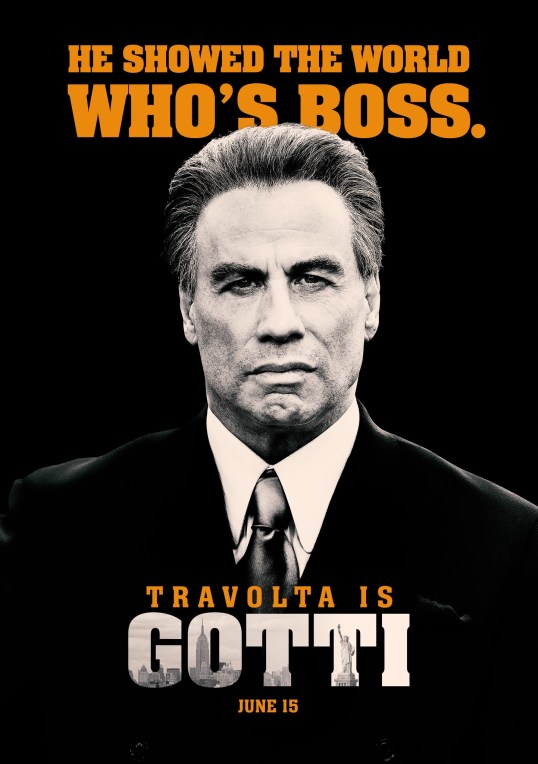
When this film was first released in 2018, it was slammed by critics and it flopped at the box office.  On Rotten Tomatoes, it managed a score of 0% from the critics.  At the same time, the opening day audience score was 80%.  (Over subsequent days, the audience score would drop to 46%.)  This disparity was blamed on studio employees inflating the audience score, though I think it’s more likely that, after months of negative press about the film’s troubled productions, critics were already looking forward to slamming the film before they even had a chance to see it.  At the same time, the buzz on Gotti was so bad that the opening day audience was made up of a combination of John Travolta die-hards (whoever they may be) and people who were expecting such a trainwreck that all Gotti had to do to surpass their expectations was to occasionally be in focus.

Then again, it could be that some members of the audience understood what I instinctively understood when I first watched GottiGotti is not really a film about John Gotti, the flamboyant New York mob boss who ruled the streets with an iron fist and who eventually ended up dying of cancer in prison.  Instead, whether it was the filmmaker’s actual intention or not, Gotti is a film about the audience’s fascination with not only gangsters but also the movies that have been made about them.

It’s true that John Travolta may be playing someone namned John Gotti but the film goes out of its way to remind you that he’s not the real John Gotti.  The film is full of archival news footage of the real John Gotti, either laughing it up with reporters or smirking while sitting in a courtroom.  Every time that we’re shown footage of the real John Gotti, we’re reminded of the fact that, at not point during the film, does Travolta look anything like John Gotti.  Add to that, the real Gotti is always smirking whereas Travolta always looks somewhat grim.  At the time this film came out, many claimed that this was evidence of lazy filmmaking but I viewed it as being a Brechtian distancing device.  Whenever the real Gotti makes an appearance, we’re reminded that we’re just watching a movie and then we’re encouraged to ask ourselves why we would want to watch a movie about such a disreputable figure.

The movie opens with John Travolta standing next to the Brooklyn Bridge and speaking directly to the camera.  Though Travolta is meant to be speaking to us as John Gotti, the sight of him standing near a bridge in New York will automatically remind some viewers of a previous Travolta film, Saturday Night Fever.  The character that Travolta played in Saturday Night Fever, Tony Manero, has come to epitomize New York in the 70s.  The film suggests that, in much the same way, Gotti epitomized New York in the 80s and 90s.  Gotti, the film is saying, is as much of an icon of the popular imagination as Tony Manero dancing in a white suit.

Why is Gotti speaking directly to us in that scene?  It may seem like a framing device until, a few minutes later, we see a bald and sickly Gotti in a prison meeting room, telling his life story to his son, John, Jr. (Spencer LoFranco).  Gotti talking in prison is then established as the narrative’s other framing device.  So, why was Gotti speaking to us on the bridge and why did he look so healthy and have a full of head of hair when the film has made it clear that the newly bald Gotti is going to die in prison?  When I first saw the film, my initial thought was that the Gotti who speaks directly to the audience was meant to be a ghost.  But then it occurred to me that he’s actually not meant to be John Gotti at all.  Instead, the Gotti who talks to us on the bridge is meant to be our popular conception of what gangsters like John Gotti as like.  He’s what we imagine gangsters to be — i.e., tough-talking, well-dressed, and played by an iconic actor.  As such, the film’s narration is not being provided by John Gotti.  Instead, it’s being provided by the person that we imagine someone like Gotti to have been.

Is the imprisoned Gotti meant to be the real Gotti?  Perhaps.  However, it’s hard not to notice that, over the course of the film, Gotti’s son never ages.  Though several decades pass, Gotti’s son always looks like he’s in his mid-twenties.  When he visits his father in prison and talks about having teenage children of his own, it feels odd because he barely looks old enough to be out of high school.  That may seem like lazy filmmaking but again, I would argue that this is a distancing device.  It’s a reminder that we’re not watching reality.  Instead, we’re choosing to watch actors pretending to be gangsters.

Once you accept that Gotti is a film not about John Gotti but instead about those of us in the audience who are watching, the film makes a lot more sense.  The film’s cliches about life in the Mafia are revealed to be not so much the result of an uninspired script as they’re an homage to American folklore.  Of course, there’s going to be a scene where Gotti tells his children never to rat on their friends.  Of course, there’s going to be random shootings and burly men demanding respect.  This is a gangster movie, after all.  By populating the cast with people who you normally wouldn’t expect to see playing members of the Mafia — Stacy Keach, Chris Mulkey, Pruitt Taylor Vince — Gotti continually reminds you that you’re watching a movie.  The real mafia isn’t like this, Gotti is saying, but the mafia of the popular imagination is.  Why are we horrified by real-life crime and yet we flock to movies that claim to recreate it for our entertainment?  This is the issue at the heart of Gotti.

Gotti’s flaws are there to remind us that we’re just watching a movie.  They’re also there to make us wonder why we’re watching that particular movie.  Gotti asks us why audience idolize killers like John Gotti.  Why do we turn them into folk heroes?  Is it because we imagine them to be characters in films as opposed to actual human beings?  Whether or not one feels that the film succeeded in its goal, this is an offer that you cannot refuse.

Previous Offers You Can’t (or Can) Refuse:

  1. The Public Enemy
  2. Scarface (1932)
  3. The Purple Gang
  4. The Gang That Could’t Shoot Straight
  5. The Happening
  6. King of the Roaring Twenties: The Story of Arnold Rothstein 
  7. The Roaring Twenties
  8. Force of Evil
  9. Rob the Mob
  10. Gambling House
  11. Race Street
  12. Racket Girls
  13. Hoffa
  14. Contraband
  15. Bugsy Malone
  16. Love Me or Leave Me
  17. Murder, Inc.
  18. The St. Valentine’s Day Massacre
  19. Scarface (1983)
  20. The Untouchables
  21. Carlito’s Way
  22. Carlito’s Way: Rise To Power

Film Review: First Blood (dir by Ted Kotcheff)


First Blood was not what I was expecting.

From everything that I had heard and seen over the past few years, I was under the impression that this 1982 film was the ultimate in mindless action.  I figured that the film was basically just two hours of Sylvester Stallone hiding in the woods, firing a machine gun, riding a motorcycle, and eventually blowing up a small, bigoted town.  It wasn’t a film that I was in any particular hurry to experience but I knew it was one that I would have to watch eventually, if just because of how many filmmakers have cited the film as an influence.  On Sunday night, First Blood aired on the Sundance Channel and, for the first time, I watched it all the way through.  What I discovered is that there’s a lot more to First Blood than I had been led to believe.

Now, don’t get me wrong.  It’s definitely an action film.  Stallone spends a lot of time hiding in the woods, firing a machine gun, riding a motorcycle, and blowing up a town.  Somewhat improbably, only one character actually dies over the course of the film, though quite a few end up getting maimed and wounded.  There’s even a close-up of Stallone stitching up a nasty gash on his arm, which totally made me cringe.  But, even with all the gunfire and explosions, First Blood has more on its mind than just carnage.  It’s a brooding film, one that angrily takes America to task for its treatment of its veterans and outsiders.  In its way, it’s an action film with a heart.

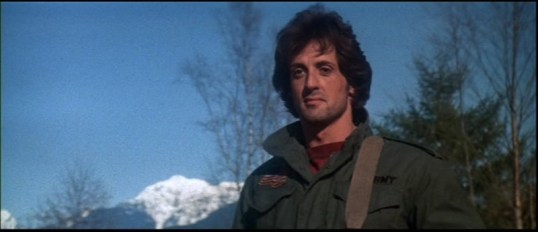
Sylvester Stallone plays John Rambo, a troubled drifter who is still haunted by not only his experiences in Vietnam but also by the feeling that his own country doesn’t want him around.  When Rambo, with his unkempt hair and wearing a jacket with an American flag patch prominently displayed, shows up in the town of Hope, Washington, it’s not to cause trouble.  He just wants to see an old friend, a man with whom he served.  Unfortunately, his friend has died.  The man’s bitter mother says that he got cancer from “that orange stuff they were spraying around.”  Even though the war is over, it’s still killing the only people who can possibly understand how Rambo feels about both his service and his uncertain place in American society.

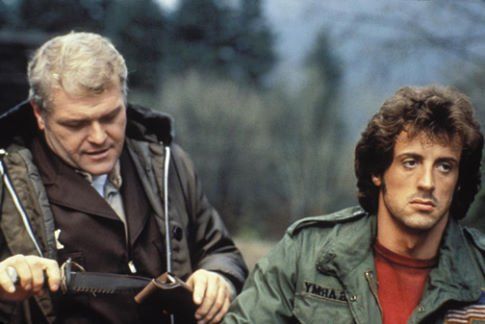
As Rambo walks through the town, he’s spotted by Sheriff Will Teasle (Brian Dennehy).  Rambo just wants to get a cup of coffee and relax.  Teasle, however, views Rambo as being a stranger and, therefore, a possible threat to his town.  Teasle wants Rambo to leave.  Rambo wants to know why, after everything that he’s sacrificed for his country, he’s being told that he needs to get a haircut.  From this simple conflict — a misunderstanding really, as Teasle doesn’t know that Rambo is mourning the death of his friend and instead interprets Rambo’s sullen silence as being a threat — an undeclared and unwinnable war soon breaks out.

Technically, Teasle is the film’s villain.  He’s the one who arrests Rambo for vagrancy.  It’s his abusive deputies who cause Rambo to have the flashbacks that lead to him breaking out of jail.  It’s Teasle’s arrogance that leads to him ignore the warnings of Rambo’s former commanding office, Sam Trautman (Richard Crenna).  And yet, Teasle himself is never portrayed as being an evil man.  Instead, Dennehy plays Teasle as being well-meaning but stubborn.  It’s been written that the most compelling villains are the ones who don’t realize that they’re the villain and that’s certainly true in Teasle’s case.  Teasle’s job is to protect the town and its citizens and that’s what he’s determined to do.  If his actions become extreme, it has less to do with any deliberate cruelty on his part and everything to do with the fact that, towards the end of the film, he finally figures out that he’s in way over his head.

Once Rambo has disappeared into the woods and maimed (but not killed) all of Teasle’s deputies, he only has one request and that’s to be left alone.  He simply wants to stay in the woods, hunting for food and free from a society that has nothing to offer him during peacetime.  What’s interesting is that, at the start of the film, everyone wants Rambo to just disappear.  He’s a reminder of not just the turmoil of the Vietnam era but also the fact that Vietnam was the first war that America lost.  Rambo’s presence is viewed as being like an ugly scar that you wish would just fade away.  However, once Rambo does actually vanish, people won’t stop looking for him.  As opposed to the later films in the franchise, the Rambo of First Blood doesn’t want to fight anyone.  Rambo just wants to be left alone in solitude and considering the way that he’s treated by the town of Hope, it’s hard to blame him.

And so, you end up sympathizing with this John Rambo.  Even thought he’s blowing up a town during the Christmas season and there’s a few scenes where he’s kind of scary, it’s impossible not to feel that he has a right to his anger.  You find yourself wishing that the Sheriff had just left him alone or that maybe Rambo had just taken Teasle’s earlier advice and left town.  Because, as you watch the film, you know that 1) there was no good reason why any of this had to happen and 2) things probably aren’t going to end well for either John Rambo or Will Teasle.

First Blood was based on a novel that was first published in 1972.  The film spent nearly a decade in development, as various directors, screenwriters, and actors circled around the project.  At one point, First Blood was envisioned as an anti-war film that would have been directed by Sidney Lumet and which would have featured a bearded Al Pacino lurking through the wilderness and killing not only Teasle but also several deputies and national guardsmen.  When Stallone agreed to star in the film, he also rewrote the script, transforming Rambo into a sympathetic outsider who goes out of his way not to kill anyone.  The end result was an underdog story that audiences could embrace.

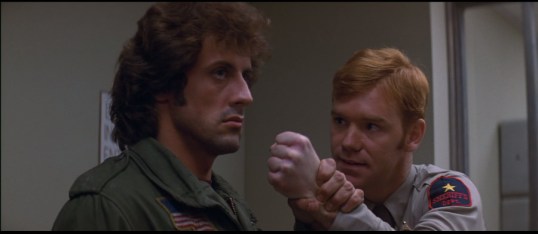
Seen today, it’s interesting to see how many familiar faces pop up in First Blood.  For instance, a young and really goofy-looking David Caruso pops up and totally overacts in the role of the only sympathetic deputy.  A less sympathetic deputy is played by Chris Mulkey, who would go on to play other unsympathetic characters in a huge number of movies and TV shows.  Interestingly enough, the most sadistic of the deputies was played by Jack Starrett, who directed a several classic B-moves in the 70s.  (One of Starrett’s films was The Losers, in which a bunch of bikers were sent to Vietnam to rescue an American diplomat.)

As opposed to many of the films that it subsequently inspired, First Blood holds up surprisingly well.  It may be violent but it’s violence with a heart.

A Movie A Day #294: Ghost In the Machine (1993, directed by Rachel Talaly)


Karl (Ted Marcoux) is a serial killer who works in an electronics store and who steals address books and uses them to pick his victims.  His latest stolen address book belongs to Terry (Karen Allen).  Before Karl can start killing Terry’s family and friends, he is killed in a car accident.  Because there is a lightning storm going on at the same time, the dead Karl is able to transfer his evil soul into the electrical grid.  Traveling from appliance to appliance, Karl starts to kill all of Terry’s friends and co-workers.  A microwave oven.  A hand dryer.  A dishwasher.  If it is electrical, Karl can use it to kill.  Fortunately, Terry knows a legendary hacker (Chris Mulkey) who can help her fight back.

Like Prison, Destroyer, and The Horror Show, Ghost in the Machine is another dumb movie about a psycho who gets his soul transformed into electricity.  Ghost In The Machine was also obviously influenced by The Lawnmower Man and the entire movie is full of early 90s paranoia about the internet and computers in general.  Rachel Talaly, who got her start with the Nightmare on Elm Street franchise and who has recently directed some of the best received episodes of Doctor Who, does a good job with the deaths but cannot do anything with the lousy script and unlikable characters.  Nearly everyone who dies is killed because they know Terry but that never seems to bother her.

I think every 90s kid, or at least every 90s male, watched Ghost In The Machine on HBO and had a crush on Shevonne Durkin.

A Movie A Day #282: Jack’s Back (1988, directed by Rowdy Herrington)


When med student Rick Westford (James Spader) is found hung at the free clinic where he worked, the police say that he committed suicide.  Rick’s estranged twin brother, John (James Spader), does not agree and launches an investigation of his own.  With the help of Rick’s co-worker, Chris (Cynthia Gibb), John discovers that Rick may have learned the identity of a serial killer who has been copying the crimes of Jack the Ripper and murdering prostitutes in Los Angeles.  However, the killer knows that John is getting close to discovering his identity so the killer sets out to frame John not only for the prostitute murders but for the murder of his brother as well.

Jack’s Back is a movie that deserves to be better known than it is.  James Spader gives two great performances, as both Rick and John.  He and Cynthia Gibb make a good team and Jack’s Back actually does some unexpected things with their relationship.  Jack’s Back was directed by Rowdy Herrington, who is best known for Roadhouse and Gladiator.  Jack’s Back is part murder mystery, part action thriller, and part horror movie and Herrington does a good job of switching back and forth through Jack’s Back constantly shifting tone.  Because this is a low-budget movie with a small cast, there really are not enough suspects to make the murderer’s identity a surprise but Spader, Herrington, and Gibb always keep things interesting.

This is a film that really does deserve to be better known.

The TSL’s Horror Grindhouse: Wolves at the Door (dir by John Leonetti)


I’m really not sure what to make of Wolves at the Door.

I knew the film was inspired by the crimes of Charles Manson and his family before I watched the film.  Not only was Wolves at the Door specifically advertised as being “Inspired by The Infamous Manson Family Murder Spree” but just check out the plot description that was provided by Warner Bros:

Four friends gather at an elegant home during the Summer of Love, 1969. Unbeknownst to them, deadly visitors are waiting outside. What begins as a simple farewell party turns to a night of primal terror as the intruders stalk and torment the four, who struggle for their lives against what appears to be a senseless attack.

The Manson Family have inspired a countless number of films, so that’s not really an issue.  Almost all of those films either presented Manson and his followers as being the epitome of evil or they told stories that were heavily and obviously fictionalized.

Wolves at the Door, however, is different.  Other than in some news footage that is shown during the end credits, Manson is not seen in the film.  For that matter, the members of the Family don’t get much screen time either.  Mostly, they’re just seen as shadows, creeping down hallways and sometimes materializing in a doorway before vanishing.  There’s no mention of Helter Skelter or the Beatles.  I’d have to rewatch the film to say for sure but I think it’s possible that we only hear them say one or two words over the course of the entire movie.

Instead, Wolves at the Door spends most of its running time with the victims of the Manson Family, following them as they are unknowingly stalked inside of a Los Angeles mansion.  Usually, in a film like this, you would expect the names to be changed but, for some reason, that doesn’t happen in Wolves At The Door.

So, Katie Cassidy plays a pregnant actress who is named Sharon.

Elizabeth Henstridge plays a coffee heiress who is named Abigail.

Adam Campbell plays Abigail’s Polish boyfriend, who is named Wojciech.

Miles Fisher plays a hairdresser who is named Jay and who just happens to be Sharon’s ex-boyfriend.

And, finally, Lucas Adams plays a teenager stereo enthusiast named Steven, who just happens to be in the wrong place at the wrong time.

Speaking as someone who loves horror and who has defended some of the most critically derided films of all time, everything about Wolves at the Door just feels icky, tacky, and wrong.  Many grindhouse horror films have been inspired by actual crimes but most of them at least changed the names of the victims.   You really have to wonder just what exactly the filmmakers were thinking here.

(Then again, just two years ago, NBC greenlit a show called Aquarius, which could have just as easily been called “The Adventures of Young Charlie Manson.”)

It’s not just that Wolves at the Door is offensive.  In fact some of the best movies of all time were specifically designed to be offensive.  The problem with Wolves at the Door is that it’s also just a very shoddy film.  (In fact, if the film had been well-made, it wouldn’t be quite as offensive.)  Though the actors may be talented, they’re let down by a script that’s full of some of the clunkiest dialogue that I’ve ever heard.  Though the soundtrack may feature some good songs, they’re still the same damn songs that show up in every movie set in 1969.  (Judging from the movies, everyone in 1969 just listened to the same five songs over and over again.)  Though the movie itself is only 73 minutes long, it is so abysmally paced that it feels much, much longer.

Sadly, this film was directed by John Leonetti, who did a pretty good job with Annabelle.  Again, I’m not sure what exactly he or anyone else was thinking with Wolves at the Door, which I’m going to go ahead and declare to be the worst film of 2017.  I know that the year isn’t over yet but I just can’t imagine anything as bad as this.

TV Review: Twin Peaks 2.16 “The Condemned Woman” (dir by Lesli Linka Glatter)


twin-peaks-sign

My apologies for the delay on this everyone.

“The Condemned Woman” refers to Josie Packard (Joan Chen), who has just about the worst day of her life in her episode.

It all begins with the items left by Windom Earle on Sheriff Truman’s (Michael Ontkean) desk. After listening to the tape recording, Truman notes that he’s not going to let Dale Cooper (Kyle MacLachlan) out of his sight. Cooper lets Truman know that if Windom really wanted him dead, it would have happened already. Looking over the chess board, they give a call to Lucy, to have Pete Martell (Jack Nance) come by the sheriff’s office as soon as they can. When he’s done with the phone, he finds Cooper gazing longingly at the face mask on the table.

“She was the love of my life, Harry.” Cooper says, speaking of Caroline Earle (Brenda Mathers).

We find Pete on the phone with Lucy, letting her know that he’ll be right over to the precinct as soon as he can. He then serves breakfast to Catherine Martell (Piper Laurie) and Andrew Packard (Dan O’Herlihy), who is surprised any the arrangement of his breakfast into a face. As the two have a good chuckle, Catherine interrupts by asking Pete to get the salt and paper. Pete does so, wishes them well, and then heads out. Over breakfast, Catherine asks about Ghostwood. Andrew informs her that everything’s set and she should be leaving for Paris the next day.

The door opens and Josie walks in, so shocked to find Andrew alive that she passes out on the floor. Not a good start for Josie in this episode.

In Truman’s office, Hawk (Michael Horse) brings in Hank (Chris Mulkey) who is arrested for the attempted murder of Leo Johnson (Eric Da Re). Hank says he’s not there, but Truman mentions he has a witness saying he’s there. Hank offers to be a witness regarding the murder for Andrew Packard, and points the finger at Josie. This causes Hawk to react and kick the crutches out from under Hank, making him collapse on the table before taking him out of the room. Truman has a moment of brief anger after Hank is escorted out.

In an adjacent office, Al Rosenfield (Miguel Ferrer) lays it all out. The bullets from a recently deceased individual match the ones pulled from Cooper’s torso, all leading to Josie Packard. Cooper asks Rosenfeld to hold off, as he’s going to speak with Josie and ask her to turn herself in.

Back at the Great Northern, Audrey (Sherilyn Fenn) receives an envelope before taking over the Concierge desk as part of her training. A young man (Billy Zane, Titanic), approaches the desk and asks to have his luggage brought in. He recognizes her and mentions he has a photo of her in a dress and pigtails, with fond memories. He remembers her playing as Heidi. She recalls the memory as well, though she was 10 at the time. Why is he holding on to that picture? Before she can say anything about it, he’s already left the table and is moving on. Going back to the envelope, she finds the right side of a torn paper with parts of messages. It contains words such as:

High heaven…

One another;

Be forgiven

Brother;

The earth

Kiss the sea:

Work worth

Me?

It also contains a message to meet at the Roadhouse at 9:30. Strange stuff, indeed.

We’re at Ed (Everett McGill) and Nadine’s (Wendy Robie).  He’s fixed the damage to the shelves when Nadine arrives to inform him that she and Mike are in love. They had a wonderful time at their wrestling trip. At first, Ed is a little upset, but she reminds him that he and Norma (Peggy Lipton) are together, so why not? Nadine informs Ed it’s time to break up.

In the next scene, Cooper and Josie are talking about what they found. He tells her she has to come by the Precinct later today or he’s going to come hunting for her. When he leaves, Catherine (who’s been listening in the entire time) comes in and asks what’s wrong, pointing out all of the ways that Josie’s in trouble. Between Eckhardt coming after her and the police, she’s in a corner. It’s Piper Laurie playing the wicked role to a “T”, and she’s great in this scene. In the book-case, Catherine takes a pair of keys, leaving behind the Walter PPK, which Josie cradles. She may need that later on.

We’re at the Great Northern, and Ben Horne (Richard Beymer) is in wonderful spirits after his recovery tied to the Civil War re-enactment Dr. Jacoby helped with. Bobby Briggs (Dana Ashbrook), Audrey and Jerry (David Patrick Kelly) are on hand. As they talk the young man Audrey met earlier enters the office and is introduced as John Justice Wheeler.
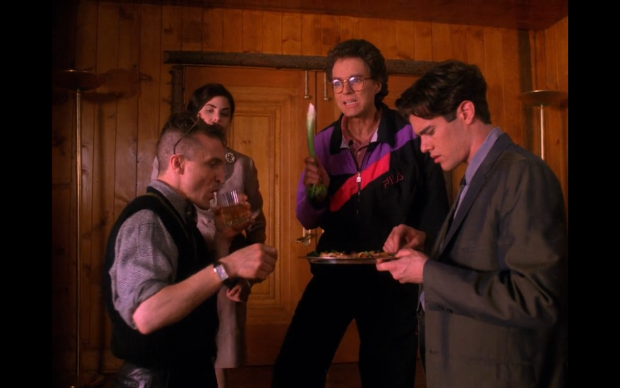
Twin Peaks - Meeting with Ben Horne

The Horne’s (with a Brigg) gather for a meeting.

At the sit down, Ben explains that Horne Industries is in a bad way. The lands once owned by them are now owned by the Martells. His plan includes a Pine Weasel, indigenous to Twin Peaks, but almost extinct. They plan to fight the Ghostwood Development with this, and if that works out, perhaps he’ll run for the Senate. If that storyline works out, it would be interesting if it’s referenced in the Revival next month. I’ll admit that I like this version of Ben Horne. He’s less of a weasel (for want of a better word) than what he was up until now.

At the RR Cafe, a man pays his tab and leaves. On the table where he sat is an envelope for Shelly (Madchen Amick). Norma is on the phone with her sister, and explains to Shelly that her sister Annie will be visiting her from a local convent. They both discover the envelope and Shelly opens it, revealing another part of the letter that was given to Audrey earlier. Shelly’s has the following:

Waves clasp…

Flower wo…

Ordained it’s….

Sunlight…

The moon beams…

TwinPeaks - Ed-Norma.jpg

A long lost love, found at last.

Along with this is the same notification to meet at the Roadhouse at 9:30. As they think about it, Ed comes into the cafe with a deeply focused look. He walks right up to Norma and tells her that he’s loved her for years and this is their time now. Ed gives Norma a sweet embrace, a sweeter kiss, and Shelly leaves them be with a smile. Nice one, Ed.

We’re outside somewhere, and Leo (Eric Da Re) is whittling a piece of wood into Arrows, though he doesn’t speak. The man we saw at the diner (Kenneth Welsh) talks to Leo while examining some arrowheads. They have something planned for Twin Peaks, though what that is, we’re not sure.

In prison, Norma visits Hank, who’s still bruised from getting beat up by Nadine.. Hank asks her to vouch for her to help get out, but she’s not having any of it. She’s leaving him, and that’s that. He tells her to give him an alibi and he’ll give her a divorce. She still won’t cave in, and to this, Hank calls her a whore.

Norma’s response made me laugh, given that Billy Zane is also in this episode. She uses a line that James Cameron would also use later on in his film Titanic (said to Billy Zane’s Character):

“I’d rather be his whore than your wife.”

That makes me wonder if Cameron was a fan of Twin Peaks. Anyway, Norma leaves a screaming Hank behind, heading off to her new life with Ed.

We’re at the conference room in the precinct, with Pete, Truman and Cooper mulling over a Chess board. Pete, after much deliberation, makes a move and states that it will take Windom Earle some time to counter that one in a way that would remove a chess piece and lead to another killing.

In walks Rosenfield, with some more news on the forensics report. He steps out into the hallway with Cooper, explaining that they matched the gunpowder on Josie’s gloves with the bullets from before, and they have a witness who saw her leave the location of the recently deceased. Though Cooper states he handles it, an upset Truman steps into the hall, staring at both men.

He knows. Truman leaves, heading for Josie’s.

We find Josie working on her makeup when Andrew walks into the room and offers her a drink. As they sit down and talk, it’s revealed that Andrew truly loved Josie very much, but the same couldn’t be said of Josie. When she asks for him to help her, Andrew tells her what Catherine said earlier, that she should speak with Eckhardt. On the way out, she calls to him. He tells her “We won’t speak again.”

This would have been a perfect time for Dan O’Herlihy to almost close the door, stop in reflection and then say to Josie “Oh, and Happy Halloween.” before leaving.

James (James Marshall) and Donna (Lara Flynn Boyle) are reunited after the escape from Evelyn’s. They’re at a picnic, and Donna wishes James well, though he has to leave Twin Peaks. They have a brief kiss and it’s a nice goodbye for James if he’s actually leaving.

Truman arrives at the Martell’s, looking for Josie. Pete and Catherine tell him that she’s off to the Great Northern, after everything that’s gone on with Eckhardt. Truman rushes off to find her.

The next scene is a great one between two veteran actors. Thomas Eckhardt (David Warner, Tron, The Omen, Time Bandits, Turtles II: The Secret of the Ooze) and Andrew Packard, have a small talk in the elevator after revealing that Andrew is alive and well. The conversation is about Josie, making her sound like some sort of concubine. Andrew goes on to say that Josie loses her heart often, as she’s caught up with Sheriff Truman. Eckhardt mentions he’s taken care of that. But how, we’re left to wonder. Andrew warns Eckhardt that Josie is going to come back to him, and that’s a dangerous thing. He doesn’t get off of the elevator with Eckhardt, as he’s still considered dead to many.

Before Eckhardt leaves, Andrew calls out to him from the elevator, causing both men to pause.

“Happy Halloween.” I say, smiling, hoping O’Herlihy will say the same.

“Bye!!!” he simply says. Dammit.

Dan O'Herlihy- Happy Halloween

Though it has nothing to do with the episode, I’d have loved to have heard Dan O’Herlihy say this.

In the main lounge of the Great Northern, Audrey, Ben and John Justice Wheeler are seated at a table. Ben asks John to be his teacher, as he’ll be the open book “upon whose virgin pages you shall scribe.” This causes Audrey to choke a little, given what she’s seen of her father. The new Ben is environmentally aware, lighting up a cigar and then putting it out at the realization. Before they can go into great detail, Ben is called away. This gives John (wishing to be called Jack) and Audrey some time to themselves. She’s a little defensive when it comes to Horne Industries and his help. Audrey asks him what he did, when he wasn’t saving the world. He states he was traveling all around, but that it’s good to be home, looking at her with a lifted brow.

“I’m only 18.” She responds with a swallow in her throat. Both Jack and I have the same reaction to this. “What does that have to do with the price of eggs?” He wasn’t coming on to her (at least, I didn’t take what was being said as such). Audrey recalls the envelope meeting and tells Jack she has to go, but that she’d be seeing him again.

I hope so, too. They seem like they’d make an interesting couple, if she can’t be with Cooper.
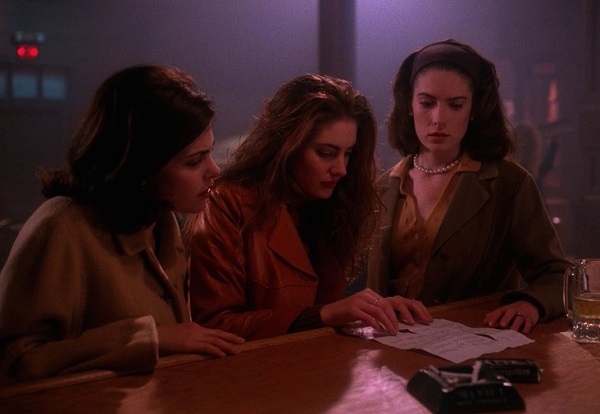
Twin Peaks - Girls at the Bar

Someone’s leaving the women of Twin Peaks a love note, but who? And Why?

Donna finds Shelly at the bar. They make their greetings and Shelly asks Donna why she’s there. She mentions she received an envelope with part of a letter, which she lays down on the bar top. Shelly notices her letter and produces hers, laying it side by side. Audrey then appears and produces her own now. They’re able to read the complete letter:

See the mountains kiss high heaven
  And the waves clasp one another;
No sister-flower would be forgiven
   If it disdained its brother;
And the sunlight clasps the earth
   And the moonbeams kiss the sea:
What is all this sweet work worth
   If thou kiss not me?”

It’s from Percy Bysshe Shelley, “Love’s Philosophy”, but none of the girls get the reason behind why it was sent. At the end of the bar, the man who was talking with Leo earlier watches them….watches them close.

Cooper gets a phone call in his room while learning how to Fly Fish. It’s cute how well he’s adjusting to Twin Peaks life. It’s Catherine, from the way the call sounds. Cooper says he’s going to come back there to retrieve Josie, but he’s told that Josie’s there at the Great Northern, in Thomas Eckhardt’s suite.

Cooper hangs up and grabs his gun. It’s go time.

As he walks through the hallway, he hears screaming, followed by a gunshot. Cooper bursts into the room, his gun drawn. Two figures can be seen laying in bed. One rises, revealing himself as Thomas Eckhardt, a gunshot wound in his torso. Eckhardt chuckles softly, takes a few steps and then drops to the floor, dead.

Josie is kneeled on the bed, her pistol trained on Cooper. When asked why she shot Cooper, Josie admits it was because he came to Twin Peaks and it would come to this day. Harry Truman enters the room. She then turns the pistol on him. She asks Harry to forgive him, and that she never meant to hurt him. Josie has something similar to a seizure and collapses on the bed, where Truman rushes to her aid.

It’s too late. Josie Packard, murderer of Thomas Eckhardt, shooter of Agent Cooper, and Truman’s love, loses her life. A bad day indeed.

Now here is where things get weird than they normally do on Twin Peaks. A bright light envelops the bed, and Cooper stares as BOB appears, asking “Coop!! What happened to Josie!?” in a roar. His figure is replaced by the Man From Another Place (Michael Anderson), who dances on the bed.

The light fades. Cooper’s left to wonder what he’s seen. The camera tilts to a nearby dresser, where we can see Josie or (Josie’s Soul) screaming, her face pushing through the woodwork of a dresser knob. Could the Great Northern be the Black Lodge Hawk was talking about? Why is Cooper seeing BOB after they got rid of him through Leland Palmer?
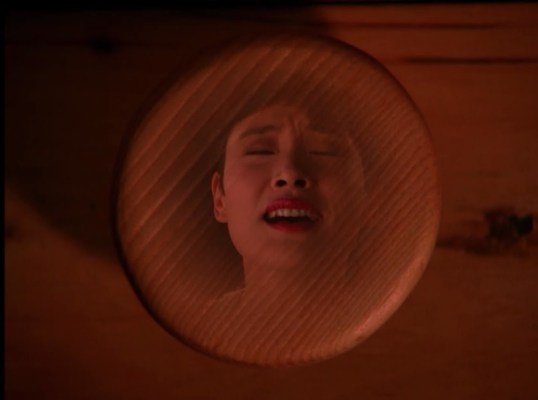
TPJosiesoul

Josie Packard, meeting her fate.

Goodness, this show is so strange. It’s a better one than it deserves to be, and happily closes some of the loops, tightening up the story. No more James, No more Josie. Hopefully, the last six episodes made for a sharper tale.

Previous Entries in The TSL’s Look At Twin Peaks:

  1. Twin Peaks: In the Beginning by Jedadiah Leland
  2. TV Review: Twin Peaks 1.1 — The Pilot (dir by David Lynch) by Lisa Marie Bowman
  3. TV Review: Twin Peaks 1.2 — Traces To Nowhere (directed by Duwayne Dunham) by Jedadiah Leland
  4. TV Review: Twin Peaks 1.3 — Zen, or the Skill To Catch A Killer (dir by David Lynch) by Lisa Marie Bowman
  5. TV Review: Twin Peaks 1.4 “Rest in Pain” (dir by Tina Rathbone) by Leonard Wilson
  6. TV Review: Twin Peaks 1.5 “The One-Armed Man” (directed by Tim Hunter) by Jedadiah Leland
  7. TV Review: Twin Peaks 1.6 “Cooper’s Dreams” (directed by Lesli Linka Glatter) by Lisa Marie Bowman
  8. TV Review: Twin Peaks 1.7 “Realization Time” (directed by Caleb Deschanel) by Lisa Marie Bowman
  9. TV Review: Twin Peaks 1.8 “The Last Evening” (directed by Mark Frost) by Leonard Wilson
  10. TV Review: Twin Peaks 2.1 “May the Giant Be With You” (dir by David Lynch) by Leonard Wilson
  11. TV Review: Twin Peaks 2.2 “Coma” (directed by David Lynch) by Jedadiah Leland
  12. TV Review: Twin Peaks 2.3 “The Man Behind The Glass” (directed by Lesli Linka Glatter) by Jedadiah Leland
  13. TV Review: Twin Peaks 2.4 “Laura’s Secret Diary” (dir by Todd Holland) by Lisa Marie Bowman
  14. TV Review: Twin Peaks 2.5 “The Orchid’s Curse” (dir by Graeme Clifford) by Lisa Marie Bowman
  15. TV Review: Twin Peaks 2.6 “Demons” (dir by Lesli Linka Glatter) by Leonard Wilson
  16. TV Review: Twin Peaks 2.7 “Lonely Souls” (directed by David Lynch) by Jedadiah Leland
  17. TV Review: Twin Peaks 2.8 “Drive With A Dead Girl” (dir by Caleb Deschanel) by Lisa Marie Bowman
  18. TV Review: Twin Peaks 2.9 “Arbitrary Law” (dir by Tim Hunter) by Lisa Marie Bowman
  19. TV Review: Twin Peaks 2.10 “Dispute Between Brothers” (directed by Tina Rathbone) by Jedadiah Leland
  20. TV Review: Twin Peaks 2.11 “Masked Ball” (directed by Duwayne Dunham) by Leonard Wilson
  21. TV Review: Twin Peaks 2.12 “The Black Widow” (directed by Caleb Deschanel) by Leonard Wilson
  22. TV Review: Twin Peaks 2.13 “Checkmate” (directed by Todd Holland) by Jedadiah Leland
  23. TV Review: Twin Peaks 2.14 “Double Play” (directed by Uli Edel) by Jedadiah Leland
  24. TV Review: Twin Peaks 2.15 “Slaves and Masters” (directed by Diane Keaton) by Lisa Marie Bowman
A Movie A Day #105: Patti Rocks (1988, directed by David Burton Morris)


Though Chris Mulkey may be best known for playing ex-con Hank Jennings on Twin Peaks, he is also a well-respected character actor who, since the start of his career in the 1970s, has appeared in over 200 different films and TV shows.  He has played a countless number of government agents and criminals and he was even one of the deputies who tried to track down Sylvester Stallone in First Blood.

But Mulkey’s best performance might be in a film that he co-wrote, Patti Rocks.

In Patti Rocks, Mulkey plays Billy Regis, a blue collar worker who spends his days ferrying people across the Mississippi river and his nights bragging about his success with women.  One night, he tracks down his old friend, Eddie (John Jenkins).  He tells Eddie that he has gotten his girlfriend, Patti Rocks, pregnant.  What Patti does not know is that Billy is already married and has two children.  Billy wants Eddie to drive with him to Wisconsin so he call tell Patti the truth.  Depressed over his recent divorce, Eddie agrees.

It is an all night drive, during which Billy and Eddie talk about their own lost dreams, work, and especially sex.  Billy claims to be a womanizer but even he secretly seems to understand how empty his boasts are.  When they meet a woman who is just as outspoken as Billy is, Billy gets quiet.  When they finally reach Patti’s apartment, Patti (Karen Landry) turns out to not be who Eddie was expecting.

Patti Rocks tells a simple, episodic story about two immature men in the throes of a mid-life crisis.  Not much happens but the dialogue rings true and everyone watching Patti Rocks will recognize Billy and Eddie as someone that they know and maybe even see some of themselves in the characters.

Chris Mulkey and John Jenkins first played the characters of Billy and Eddie in the 1976 independent feature, Loose Ends.  Though it never received a wide theatrical release, Loose Ends started Mulkey’s career as a busy character actor.