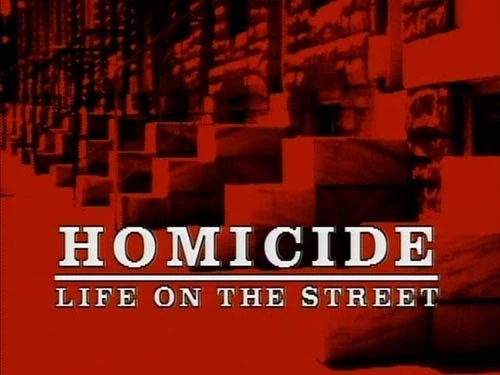
Welcome to Retro Television Reviews, a feature where we review some of our favorite and least favorite shows of the past! On Sundays, I will be reviewing Homicide: Life On The Street, which aired from 1993 to 1999, on NBC! It can be viewed on Peacock.
This week, the third season of Homicide comes to an end.
Episode 3.2o “The Gas Man”
(Dir by Barry Levinson, originally aired on May 5th, 1995)
The third season of Homicide was coming to an end and NBC was dragging its heels as to whether or not it would renew the show. Homicide was critically acclaimed but its ratings were low, despite the efforts to make the show more audience-friendly during the third season. Producer Barry Levinson grew frustrated with NBC’s refusal to tell him whether or not the show would be renewed. Feeling that show was probably over, Levinson and showrunner Tom Fontana decided to do something truly radical. They crafted a series finale that sidelined most of the major characters.
Instead, The Gas Man focuses on Victor Helms (Bruno Kirby) and his best friend, Danny Newton (Richard Edson). Helms has just gotten out of prison, where he served six years after a gas heater he installed malfunctioned and caused the death of one of his customers. Helms blames Frank Pembleton for the loss of both his freedom and his family. (After getting released, Helms tries to talk to his teenage son but is rejected.) Helms and Newton follow Pembleton across Baltimore, watching as he goes to work and to a fertility clinic. While Pembleton is investigating the murder of a fortune teller, Helms and Newton sneak onto the crime scene and find both the murder weapon and the fortune teller’s severed head. Helms takes both of them home and sends pictures to the Baltimore Sun, trying to taunt Pembleton. Both the Sun and Pembleton assume its a hoax. Eventually, Helms makes his move and, even with a knife to Pembleton’s throat, he realizes that he doesn’t have it in him to commit a cold-blooded murder. He starts to cry. Pembleton arrests him. Life goes on.
This was an interesting episode. The first time I saw it, I was a bit annoyed that the focus was taken off the lead characters. But the more I think about it, the more I appreciate what Levinson was going for. With this episode, he shows us what happens after the investigation and the conviction. Victor Helms is angry because he feels, perhaps with some justification, that he was unfairly charged and convicted. He’s obsessed with Pembleton but it’s clear that Pembleton doesn’t even remember him. For Pembleton, arresting Victor Helms was a part of his job, nothing more. For Helms, it was the moment that his entire life collapsed. Bruno Kirby and Richard Edson both gave good performances as Helms and Danny. Kirby captured Helms’s obsession but he also gave us some glimpses of the man that Helms used to be. As portrayed by Edson, Danny’s loyalty to his friend was actually kind of touching.
Of course, it turned out that this episode was not the series finale. Homicide would return for a fourth season, without Daniel Baldwin or Ned Beatty. We’ll start season four next week!
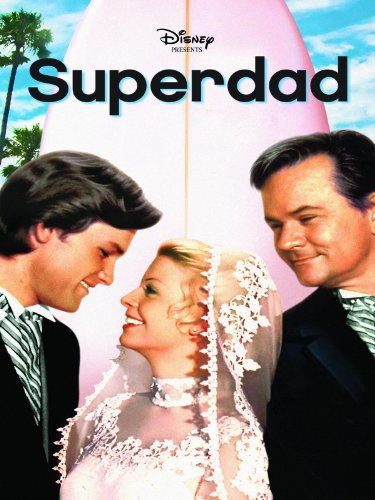
In 1973’s Superdad, Disney takes on the generation gap.
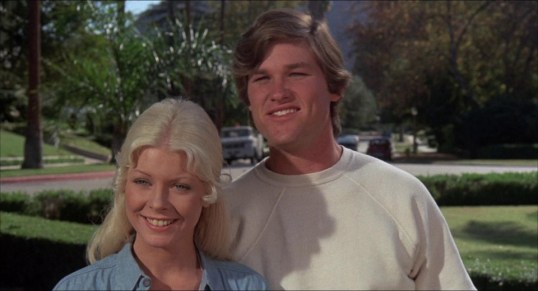
Charlie McCready (Bob Crane) just can’t understand what’s going on with his daughter, Wendy (Kathleen Cody). She’s smart, pretty, and has the potential for a great future ahead of her but all she wants to do is hang out with her friends on the beach. Eccentric Stanley Schlimmer (Bruno Kirby) drives everyone around in a souped-ambulance. Ed Begley, Jr. (who plays a character who doesn’t even get a name) joins in whenever the group sings a folk song. Wendy’s boyfriend, Bart (young and likable Kurt Russell), is a surfer and water skier. Charlie is truly convinced that this extremely clean-cut group of teenagers is going to lead his daughter astray. In fact, Wendy wants to marry Bart! Charlie attempts to hang out with Wendy, Bart, and his friends on the beach and he can’t keep up. He can’t water ski, he can’t play football, he can’t play volleyball. All he can do is scream in this weird high-pitched voice. The entire time is Bart is extremely nice to him and doesn’t even make fun of him for not being able to hit a volleyball over a net. I mean, even I can do that! But because Charlie’s not dealing well with becoming middle-aged, he decides that Bart is a threat.
(I’m going to assume that Charlie also teams up with a creepy friend and starts filming himself having threesomes with groupies, though we don’t actually see that happen in the film. The subtext is there, though!)
Charlie decides that he has to get Wendy away from this group and the best way to do that would be to trick her into thinking she’s received a scholarship to …. Yes, this is just that stupid …. a scholarship to a prestigious university. While Bart and his healthy, non-smoking, non-drinking friends are all going to City College and living at home with their parents, Wendy will be miles away at a college where she can do anything that she wants. Charlie thinks this is a great plan. One gets the feeling that Charlie, for all of his overprotectiveness, hasn’t read a newspaper in 20 years. Seriously, has he not been keeping up with what was happening on most college campuses in the late 60s and early 70s?
The main problem with this film is that Charlie is an incredible jerk. It’s one thing to be overprotective. Fathers are supposed to be overprotective of their daughters. It’s one thing to worry about his daughter not having a good deal of ambition. I can even understand him getting annoyed with Stanley because Stanley is kind of annoying. (Watching this film, it’s hard to believe that Bruno Kirby was just one year away from playing the young Clemenza in The Godfather, Part II.) But seriously, Charlie is freaking out over his daughter dating KURT RUSSELL! In this film, Kurt Russell plays a character who is always polite, mild-mannered, sensible, and remarkably understanding of Charlie’s attempts to keep him from marrying Wendy. There is one scene where Bart gets upset and he barely even raises his voice. He’s incredibly likeable and, for all of this film’s flaws, it’s still easy to see why Kurt Russell became a star.
Of course, what really makes this film a cringe-fest is that it stars Bob Crane as a family man with a secretly manipulative side and, the whole time I was watching, I kept having flashbacks to Greg Kinnear in Auto-Focus. Wendy, to make her dad really angry, gets engaged to an actual hippie named Klutch (Joby Baker) and there’s a scene in which Klutch and Charlie get into a fight in Klutch’s artist studio. Every time Klutch swung anything near Charlie’s head, I definitely cringed a bit. Red paints get spilled everywhere, though luckily it ends up on Klutch and not Charlie. Still, watching the film, I couldn’t help but think that there are worse things that could happen to someone than having their daughter marry Kurt Russell.
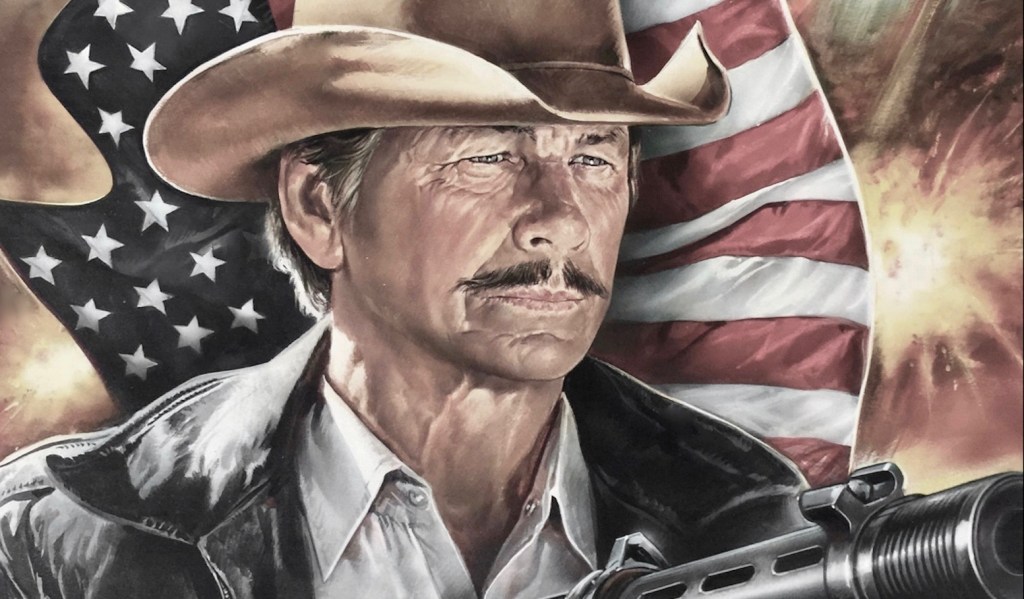
After a couple of decades of toiling away in TV and supporting roles, Charles Bronson became a huge international film star in 1968 when he starred in the films FAREWELL, FRIEND (with Alain Delon), and Sergio Leone’s ONCE UPON A TIME IN THE WEST (with Henry Fonda). For the next 5 years, Bronson would star in successful international co-productions, before hitting it big in the United States with the influential 1974 blockbuster, DEATH WISH. From 1974 to 1977, Bronson had his pick of any role that he wanted. This was probably the most interesting time in his career as he truly tried to expand his range with films like the depression-era HARD TIMES (1975), the romantic comedy FROM NOON TILL THREE (1976), the Raymond Chandler-esque ST. IVES (1976), and the surreal western THE WHITE BUFFALO (1977). But after 1977’s TELEFON and a series of underwhelming box office returns in the states, Bronson’s star was on the wane. He wouldn’t have his next #1 box office hit until he joined forces with the infamous Cannon studios in 1982 for the sequel to his biggest hit and DEATH WISH II. Cannon Studios would provide Bronson with a guaranteed paycheck and a non-stop presence on cable TV and at the video store for the remainder of the decade. I call the films that Bronson made between 1977 and 1982 the in-betweens. They don’t really fit into his European phase (1968-1973), his post-DEATH WISH phase (1974-1977) or his Cannon phase (1982-1989). To be completely honest, it seemed his career was somewhat in limbo at this point, and the movies he made during these years are some of his least well-known.
One of the movies that Charles Bronson made during the in-between years was 1980’s BORDERLINE. In this film, he plays Jeb Maynard, a border patrolman and expert tracker who will stop at nothing to find the human smuggler responsible for killing his friend and fellow patrolman Scooter, played by Wilford Brimley. I like this lower-key Bronson film. Director Jerrold Freedman has made a more realistic film than a lot of the movies in Bronson’s filmography. Outside of the murder that gets the story going, and the final showdown with the lead smuggler (a young Ed Harris), most of the film is made up of good old-fashioned field work and investigation. Bronson even based much of his performance on the technical advice of legendary border patrolman Albert Taylor. Now that doesn’t mean there aren’t some solid, action-packed scenes during the movie. My favorites include a scene where an undercover Maynard goes into Mexico with the mother of a young Mexican boy who was accidentally killed at the same time as Maynard’s friend Scooter. Maynard poses as a family member of the woman in hopes of being smuggled across the border so he can see how the illegal immigrants are being brought in. When thieves intercept the group, all hell breaks loose, and Maynard and the woman must fight their way out. Another badass moment occurs when Bronson beats needed information out of one of the smugglers in a nasty bathroom. This last scene is especially enjoyable for us Bronson fans.
There are so many good actors in this film. Outside of Bronson, Brimley, and Ed Harris, the cast is filled out by other veterans like Bruno Kirby, Bert Remsen, Michael Lerner, John Ashton, and Charles Cyphers. On a side note, Ed Harris gets the “introducing” credit here, even though he had appeared in several TV shows, as well as the movie COMA with Michael Douglas. This was his first major role in a feature film though. I also want to throw out special mention to Karmin Murcelo. She’s not a household name, but she’s excellent as the mother of the young boy who gets killed with Wilford Brimley’s character, who then helps Bronson in his quest to find the killer. Her career extended over 3 decades, and it’s easy to see why based on this performance.
BORDERLINE may not be an explosive action film like some of Bronson’s other work, but it’s an effective drama with a good performance from the star. I think he embodies the character perfectly. It’s also just as relevant in 2025 as it was in 1980, and I give the film a solid recommendation.
Years ago, I wrote a post called What Could Have Been: The Godfather, in which I discussed all of the actors and the directors who were considered for The Godfather.
It remains one of the most widely viewed posts that we’ve ever had on this site. I guess that shouldn’t be a surprise. People love The Godfather and they love playing What If? Would The Godfather still have been a classic if it had been directed by Otto Preminger with George C. Scott, Michael Parks, Burt Reynolds, and Robert Vaughn in the lead roles? Hmmm …. probably not. But, in theory, it could have happened. All of them were considered at one point or another.
However, in the end, it was Francis Ford Coppola who directed The Godfather and it was Marlon Brando, Al Pacino, James Cann, and Robert Duvall who brought the Corleone family to life. The Godfather, as everyone knows, was a huge hit and it went on to win the Oscar for Best Picture of the year. As the film ended with the future of the Corleone family still up in the air, there was obviously room for a sequel.
When Paramount Pictures first approached Coppola about writing and directing a sequel, he turned them down. He said he was done with The Godfather and didn’t see any way that he could improve on the story. It’s debatable whether or not Coppola truly felt like this or if he was just holding out for more money. It is known that Coppola did suggest to Paramount a possible director for Part II and that director’s name was Martin Scorsese.
What would Martin Scorsese’s The Godfather Part II have looked like? It’s an intriguing thought. At the time, Scorsese was best-known for Mean Streets and it’s probable that Scorsese’s film would have been a bit messier and grittier than Coppola’s version. If Coppola made films about the upper echelons of the Mafia, Scorsese’s interest would probably have been with the soldiers carrying out Michael’s orders. While Scorsese has certainly proven that he can handle a huge productions today, he was considerably younger and much more inexperienced in the early 70s. To be honest, it’s easy to imagine Scorsese’s Godfather Part II being critically and commercially rejected because it would have been so different from Coppola’s. A failure of that magnitude would have set back Scorsese’s career and perhaps even led to him returning to Roger Corman’s production company. As such, it’s for probably for the best that Coppola did eventually agree to shoot the sequel, on the condition that Coppola be given creative control and Paramount exec Robert Evans not be allowed on the set. While Coppola was busy with Godfather Part II, Scorsese was proving his versatility with Alice Doesn’t Live Her Anymore.
After Coppola was signed to direct, the next best question was whether or not Marlon Brando would return to play the role of Vito Corleone. The film’s flashback structure would ensure that Vito would remain an important character, despite his death in the first film. Coppola reportedly considered offering Brando the chance to play the younger version of Vito but he changed his mind after he saw Robert De Niro in Scorsese’s Mean Streets. Still, it was felt that Brando might be willing to show up in a cameo during the film’s final flashback, in which Michael tells his family that he’s enlisted in the army. Frustrated by Brando’s refusal to commit to doing the cameo, Coppola told him to show up on the day of shooting if he wanted to do the film. When Brando didn’t show, the Don’s lines were instead rewritten and given to Tom Hagen. It’s hard not to feel that this worked to the film’s advantage. A last-minute appearance by Brando would have thrown off the film’s delicate balance and probably would have devalued De Niro’s own performance as the younger version of the character.
Brando wasn’t the only member of the original cast who was hesitant about returning. Al Pacino held out for more money, which makes sense since he was literally the only cast member who could not, in some way, be replaced. Richard Castellano, who played Clemenza in the first film, however learned that he that hard way that he was not quite as indispensable as Al Pacino. In Part II, Clemenza was originally meant to have a large role in both the flashbacks and the present-day scenes. However, when Castellano demanded more money and the right to rewrite his own lines, the older Clemenza was written out the film and replaced by the character of Frankie Petangeli (played by Michael V. Gazzo).
It’s impossible to find fault with Gazzo’s performance but it’s still hard not to regret that Castellano didn’t return. Imagine how even more poignant the film’s final moments would have been if it had been the previously loyal Clemenza who nearly betrayed Michael as opposed to Frankie? Indeed, even after the part was rewritten, many of Frankie’s lines deliberately harken back to things that Clemenza said and did during the first film. Because Clemenza is a very prominent character during the film’s flashbacks, his absence in the “modern” scenes is all the more obvious.
When the role of Young Clemenza was cast, it was still believed that Richard Castellano would be appearing in that film. One of the main reasons that Bruno Kirby was selected for the role of Young Clemenza was because Kirby had previously played Castellano’s son in a television show. Also considered for the role was Joe Pesci, who was working as a singer and a comedian at the time. (His partner in his comedy act was Frank Vincnet.) If Pesci had been cast, he would not only have made his film debut in The Godfather Part II but the film also would have been his first pairing with Robert De Niro. (Interestingly enough, Frank Sivero — who played Pesci and De Niro’s henchman, Frankie Carbone, in Goodfellas, also had a small role in Godfather Part II, playing Vito’s friend, Genco.)
As for the film’s other new major character, there were several interesting names mentioned for the role of gangster Hyman Roth. Director Sam Fuller read for the role and Coppola also considered Elia Kazan. Perhaps the most intriguing name mentioned as a possible Roth was that of James Cagney. (Cagney, however, made it clear that he was content to remain retired.) In the end, the role was offered to Al Pacino’s former acting teacher, Lee Strasberg. Like Gazzo, Strasberg made his film debut in The Godfather Part II and, like Gazzo, he received his only Oscar nomination as a result.
The legendary character actor Timothy Carey (who was courted to play Luca Brasi in the first film) met with Coppola to discuss playing Don Fanucci, the gangster who is assassinated by Vito. A favorite of Stanley Kubrick’s, Carey reportedly lost the role when he pulled out a gun in the middle of the meeting.
Originally, the film was supposed to end in the mid-60s, with a now teenage Anthony Corleone telling Michael that he wanted nothing to do with him because he knew that Michael had Fredo murdered. (That famous scene of Michael bowing his head was originally supposed to be in response to Anthony walking out on him as opposed to the sound of Fredo being shot.) Cast in the role of teenage Anthony was actor Robby Benson so perhaps it’s for the best that the scene was ultimately not included in the film.
Some of the smaller roles in Part II were played by actors who were considered for larger roles in the first film. The young Tessio was played by John Aprea, who was also considered for the role of Michael. Peter Donat, who played the lead Senate counsel in Part II, was considered for the role of Tom Hagen. The rather tall Carmine Caridi, who played Camine Rosato in Part II, was originally cast as Sonny until it was discovered that he towered over everyone else in the cast. And, of course, Robert De Niro famously read for the role of Sonny and was cast in the small role of Paule Gatto before he left The Godfather to replace Al Pacino in The Gang Who Couldn’t Shoot Straight. (Of course, the whole reason that Pacino left The Gang Who Couldn’t Shoot Straight was so he could play the role of Michael in The Godfather. In the end, it all worked out for the best.)
Finally, former teen idol Troy Donahue played Connie Corleone’s second husband, Merle Johnson. Merle Johnson was Troy Donahue’s real name.
Personally, I think The Godfather Part II is one of the few films that can be described as perfect. Still, it’s always fun to play what if.
When exactly did Leonardo DiCaprio become a good actor?
That may seem like a strange question because, today, Leonardo DiCaprio is often and rightfully described as being one of the greatest actors around. He regularly works with the best directors in Hollywood, including Martin Scorsese. His performances in The Aviator, The Wolf of Wall Street, and The Revenant should be viewed by any aspiring actor.
And yet, it’s easy to forget that Leonardo DiCaprio has been around forever. Long before he was Martin Scorsese’s go-to actor, he was appearing in movies like Critters 3. He started his career when he was 14 years old and spent a few years appearing in commercials and sitcoms before making his film debut in 1991. (He was 17 when he made his first movie but, as anyone who has seen any of his early movies can attest, he looked much younger.) When you watch those early DiCaprio films, you’re left with the impression of an actor who had some talent but who definitely needed a strong director to guide him. Watching those early DiCaprio films, it’s always somewhat amazing to see both how good and how bad DiCaprio could be, often in the same movie. If a scene called for DiCaprio to be quiet and introspective, he was a wonder to behold. But whenever a scene called for big dramatic moment or gesture, DiCaprio would often become that shrill kid who made you cringe in your high school drama class. I think that part of the problem is that the young DiCaprio was often cast as a passionate artist and, when you’re a certain age, you tend to assume that being a passionate artist means that you spend a lot of time yelling.
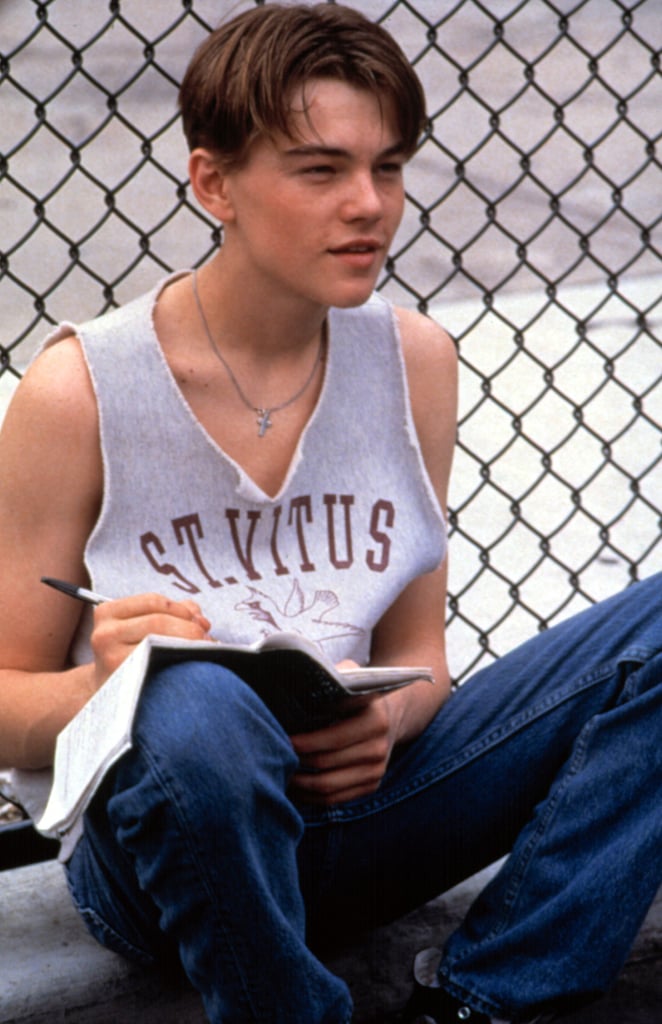
Take a film like 1995’s The Basketball Diaries, for instance. In this film, Leonardo DiCaprio plays a real-life poet named Jim Carroll. The film deals with Carroll’s teenage years, which were basically made up of going to Catholic school, writing poetry, playing basketball, committing petty crimes, and eventually getting hooked on heroin. It’s pretty dramatic stuff and, with his face that’s somehow angelic and sardonic at the same time, the young DiCaprio certainly looks the part of a teenager who split his time between private school and the streets. Though the young DiCaprio was way too scrawny to be believable as a star basketball player, he’s convincing in the scenes where he’s writing out his thoughts and his poems.
But then, Jim’s best friend (played by Michael Imperioli) dies of leukemia and a despondent Jim goes from pills and inhalants to heroin and both the film and DiCaprio’s performance quickly goes downhill. Playing drug addiction (and, even worse, drug withdrawal) tends to bring out the worst instincts in even the best actors and that’s certainly the case with DiCaprio’s performance in The Basketball Diaries. Suddenly, Leo is shaking and yelling in that shrill way that he used to do and, when he has gets emotional, he overplays the emotions to the extent that you can actually hear the snot being sorted back up his nostrils and you, as the viewer, start to get embarrassed for him. As soon as Jim starts screaming at his mother (played by Lorraine Bracco), you really wish that the director or the writer or maybe the other actors had stepped in and said, “Leo …. dial it down a little.” If you need proof that DiCaprio’s a far better actor today than he was in 1995, just compare Leo on drugs in The Basketball Diaries to Leo on drugs in The Wolf of Wall Street.
When The Basketball Diaries does work, it’s usually because of the actors around DiCaprio. In one of his earliest roles, Mark Wahlberg has such an authentic presence that you kinda wish he and DiCaprio had switched roles. (Yes, there was a time when Mark Wahlberg was a better actor than Leonardo DiCaprio.) Bruno Kirby is chilling in a few cringey scenes as Jim’s basketball coach. Ernie Hudson bring some welcome gravitas to the role of an ex-junkie who tries to help Jim straight out. And then there’s poor Lorraine Bracco, bringing far more to the role of Jim’s underappreciated mother than was probably present in the script.
The Basketball Diaries is one of those films that seems profound when you’re like 15 and you come across it playing on TBS at like 2 in the morning. Otherwise, it’s mostly interesting as evidence that, over the past 20 years, Leonardo DiCaprio has certainly grown as an actor.
The year is 1943 and America is at war. All young men are expected to join the Marines and fight for their country but the Corps is not willing to accept just anyone. Marion (Jan-Michael Vincent) wants to continue a family tradition of service but, as his drill sergeant (Michael Conrad) puts it, Marion just is not pissed off enough to be a Marine. Marion is kicked out basic training and told to go home. He is given a blue uniform to wear on his jury so that anyone who sees him will know that he couldn’t cut it.
Ashamed of his failure and in no hurry to confront his family, Marion takes the long route home. While having a drink in California, he meets a Marine (Richard Gere) who did not get kicked out of basic training. Though not yet 30, this shell-shocked Marine already has a head of gray hair, which he says he got from the horrors of war. The Marine is due to return to the fighting in Europe but, upon meeting Marion, he sees a way out. When Marion gets drunk, the Marine knocks him out, switches uniforms with him, and goes AWOL.
When Marion comes to, he discovers that everyone that he meets now judges him by his new uniform. Strangers buy him drinks. Other servicemen try to pick fights with him. When he stops off in a small Colorado town, a local waitress (Glynnis O’Connor) falls in love with him and nearly everyone that he meets assumes that he must be a hero. Marion doesn’t exactly lie about his past. Instead, he simply allows people to believe whatever they want to believe about him. It seems like an idyllic situation until three prisoners from a nearby Japanese internment camp escape and the towns people expect Marion to help capture them.
Loosely plotted and sentimental, Baby Blue Marine is a dramatic version of Preston Sturges’s Hail The Conquering Hero. Though the film has a gentle anti-war message, it’s actually more about nostalgia for a simpler and more innocent time. If the film had been made at height of the Vietnam War, it might have been more angrier and more cynical. But, instead, this is one of the many post-Watergate films that wistfully looked back upon the past. When Marion settles into the town, he finds what appears to be a perfect and friendly home. Only the nearby internment camp and the town’s hysteria over the escape prisoners serve as reminders that things are never as ideal as they seem. Jan-Michael Vincent gives one of his best performances as the well-meaning Marion and actors like Richard Gere, Bert Remsen, Katherine Helmond, Dana Elcar, Michael Conrad, Bruno Kirby, and Art Lund all make strong impressions in small roles.
One of the few films to be produced by television mogul Aaron Spelling, Baby Blue Marine is not easy to find but worth the search.
What’s an Insomnia File? You know how some times you just can’t get any sleep and, at about three in the morning, you’ll find yourself watching whatever you can find on cable? This feature is all about those insomnia-inspired discoveries!
Last night, if you happened to be awake at 2:30 in the morning, you could have turned over to Starz and watched the 1997 film, Donnie Brasco.
Benjamin “Lefty” Ruggiero (Al Pacino) has spent his entire life as a loyal Mafia soldier. It’s the only life that he knows and he can tell you some stories. He remembers the early days, back when men like Lucky Luciano, Frank Costello, and Meyer Lansky were in charge of things. Lefty is proud to say that, over the years, he’s successfully carried out over 20 hits. Lefty is lucky enough to be an associate of an up-and-comer nicknamed Sonny Black (Michael Madsen). While Sonny was in prison, Lefty kept an eye on Sonny’s family. Lefty feels that Sonny owes him. Whether Sonny feels the same way isn’t always quite clear.
Lefty’s problem is that everyone loves him but few people respect him. The aging Lefty is viewed as being a relic and, at most, they merely tolerate his constant bragging. Lefty may fantasize about the big bosses knowing who he is but, when he tries to greet one of them at a party, it becomes clear that he doesn’t have the slightest idea who Lefty is. Lefty spends his time worrying that he’s dying and dreaming of one last opportunity to make a name for himself.
In fact, perhaps the only really good thing that Lefty has going for him is his friendship with Donnie Brasco (Johnny Depp). Donnie is a jewel thief, a tough and volatile orphan who Lefty introduces to Sonny. Sonny is immediately impressed with Donnie. In fact, Sonny thinks so highly of Donnie that he assigns Donnie to look over his operations in Florida. Lefty can only watch as his protegé’s star starts to eclipse his own. But that’s not necessarily a bad thing. As Lefty explains it, Donnie’s success is also Lefty’s success because Lefty is the one who brought Donnie into the crew. Of course, if Donnie ever fails, the failure will be on Lefty as well.
As for Donnie … well, his name isn’t actually Donnie. His real name is Joe Pistone and he’s a FBI agent. When he first agreed to work undercover, he was told that the assignment would only last for a few months. Instead, the months turn into years and, piece by piece, Joe vanishes as he transforms into Donnie. The formerly soft-spoken college graduate is soon beating up waiters and chopping up bodies in basements. His wife (Anne Heche) fears that her husband may no longer exist. “I am not becoming like them,” Joe/Donnie says at one point, “I am them.”
Donnie Brasco is hardly the first film to examine life in the Mafia. It’s not even the first movie about an undercover FBI agent who manages to worm his way into the mob’s hierarchy. What sets Donnie Brasco apart are the performances of Pacino, Depp, Heche, Madsen, and, as a talkative mob associate, Bruno Kirby. As played by Pacino, Lefty may be a hardened killer but he’s also just a working class guy who wishes that his boss would just show him a little appreciation. Lefty may be capable of casually shooting a guy in the back of the head but, at the same time, there’s something heartbreakingly sad about the sight of him tearing up a greeting card that he hoped to personally deliver to the big boss. As for Johnny Depp, he gives a surprisingly restrained performance, rarely raising his voice except when he’s yelling at his family. Donnie may appear outwardly calm but the stress of losing his identity is always present in his eyes.
Interestingly, for a mob movie, there’s little violence to be found in Donnie Brasco. It’s not until 90 minutes in that we get the expected scene of rival mobsters getting ambushed and gunned down. Donnie Brasco isn’t about violence. Instead, the film’s heart is to be found in the story of Lefty and Donnie’s odd friendship. Instead of being about who is going to kill who, this film is about Lefty’s desire to be something more than he is and Joe’s struggle to remember who he used to be before he became Donnie. It’s a touching and effective gangster film and one to keep an eye out for.
At his Colorado ranch, journalist Hunter S. Thompson (Bill Murray) is up against a deadline. He has to finish his story about his friendship with the radical lawyer and activist, Carlo Lazlo (Peter Boyle). Thompson flashes back to the time that he covered a trial in which Lazlo defended a group of young men charged with possession of marijuana. When the men are sent to prison, Lazlo snaps and physically attacks the prosecutor. Later, Lazlo resurfaces during the Super Bowl and tries to convince Thompson to join him in fighting a revolution in Latin America. And finally, in 1972, Lazlo tracks Thompson down while Thompson is traveling with the Nixon campaign.
Bill Murray as the legendary gonzo journalist, Dr. Hunter S. Thompson?
It sounds like a great idea, it’s just too bad that the movie’s not any good. Where The Buffalo Roam may be based on three of Thompson’s best known articles but it never feels gonzo. It never comes close to capturing Thompson’s anarchistic spirit. The real Thompson did drugs by the handful, was fascinated by guns, and always seemed to be on the verge of plunging into the abyss. Where The Buffalo Roam’s Thompson is a mild prankster and an ironically detached hipster, the type who the real Dr. Thompson probably would have kicked out of a moving car. As for Carlo Lazlo, the character is based on Oscar Zeta Acosta, the infamous “Samoan attorney” that Thompson renamed “Dr. Gonzo” in Fear and Loathing In Las Vegas. The movie never figures out what to do with the character or Peter Boyle.
While preparing for the role, Bill Murray spent months hanging out with Thompson and, according to the book, Saturday Night: A Backstage History of Saturday Night Live by Doug Weingard and Jeff Hill, literally became Hunter Thompson for not only the duration of the filming but for several months afterward:
“In a classic case of the role overtaking the actor, Billy returned that fall to Saturday Night so immersed in playing Hunter Thompson he had virtually become Hunter Thompson, complete with long black cigarette holder, dark glasses, and nasty habits. ‘Billy,’ said one of the writers, echoing several others, ‘was not Bill Murray, he was Hunter Thompson. You couldn’t talk to him without talking to Hunter Thompson.'”
Neither Thompson nor Bill Murray were happy with Where The Buffalo Roam‘s neutered version of gonzo and the film is really for Murray completists only. The closest that Hollywood had gotten to getting Thompson right remains Terry Gilliam’s adaptation of Fear and Loathing in Las Vegas.
Believe it or not, The Trial of Billy Jackwas not the only lengthy sequel to be released in 1974. Francis Ford Coppola’s The Godfather Part II was released as well and it went on to become the first sequel to win an Oscar for best picture. (It was also the first, and so far, only sequel to a best picture winner to also win best picture.) Among the films that The Godfather, Part II beat: Chinatown, Coppola’s The Conversation, and The Towering Inferno. 1974 was a good year.
Whenever I think about The Godfather, Part II, I find myself wondering what the film would have been like if Richard Castellano hadn’t demanded too much money and had actually returned in the role of Clemenza, as was originally intended. In the first Godfather, Clemenza and Tessio (Abe Vigoda) were Don Corleone’s two lieutenants. Tessio was the one who betrayed Michael and was killed as a result. Meanwhile, Clemenza was the one who taught Michael how to fire a gun and who got to say, “Leave the gun. Take the cannoli.”
Though Castellano did not return to the role, Clemenza is present in The Godfather, Part II. The Godfather, Part II tells two separate stories: during one half of the film, young Vito Corleone comes to America, grows up to be Robert De Niro and then eventually becomes the Godfather. In the other half of the film, Vito’s successor, Michael (Al Pacino), tries to keep the family strong in the 1950s and ultimately either loses, alienates, or kills everyone that he loves.
During Vito’s half of the film, we learn how Vito first met Clemenza (played by Bruno Kirby) and Tessio (John Aprea). However, during Michael’s half of the story, Clemenza is nowhere to be seen. Instead, we’re told that Clemenza died off-screen and his successor is Frankie Pentangeli (Michael V. Gazzo). All of the characters talk about Frankie as if he’s an old friend but, as a matter of fact, Frankie was nowhere to be seen during the first film. Nor is he present in Vito’s flashbacks. This is because originally, Frankie was going to be Clemenza. But Richard Castellano demanded too much money and, as a result, he was written out of the script.
And really, it doesn’t matter. Gazzo does fine as Frankie and it’s a great film. But, once you know that Frankie was originally meant to be Clemenza, it’s impossible to watch The Godfather Part II without thinking about how perfectly it would have worked out.
If Clemenza had been around for Michael’s scenes, he would have provided a direct link between Vito’s story and Michael’s story. When Clemenza (as opposed to Frankie) betrayed Michael and went into protective custody, it would have reminded us of how much things had changed for the Corleones (and, by extension, America itself). When Tom Hagen (Robert Duvall) talked Clemenza (as opposed to Frankie) into committing suicide, it truly would have shown that the old, “honorable” Mafia no longer existed. It’s also interesting to note that, before Tessio was taken away and killed, the last person he talked to was Tom Hagen. If Castellano had returned, it once again would have fallen to Tom to let another one of his adopted father’s friends know that it was time to go.
Famously, the Godfather, Part II ends with a flashback to the day after Pearl Harbor. We watch as a young and idealistic Michael tells his family that he’s joined the army. With the exception of Michael and Tom Hagen, every character seen in the flashback has been killed over the course of the previous two films. We see Sonny (James Caan), Carlo (Gianni Russo), Fredo (John Cazale), and even Tessio (Abe Vigoda). Not present: Clemenza. (Vito doesn’t appear in the flashback either but everyone’s talking about him so he might as well be there. Poor Clemenza doesn’t even get mentioned.)
If only Richard Castellano had been willing to return.
Clemenza and Vito
But he didn’t and you know what? You really only miss him if you know that he was originally meant to be in the film. With or without Richard Castellano, The Godfather, Part II is a great film, probably one of the greatest of all time. When it comes to reviewing The Godfather, Part II, the only real question is whether it’s better than the first Godfather.
Which Godfather you prefer really depends on what you’re looking for from a movie. Even with that door getting closed in Kay’s face, the first Godfather was and is a crowd pleaser. In the first Godfather, the Corleones may have been bad but everyone else was worse. You couldn’t help but cheer them on.
The Godfather Part II is far different. In the “modern” scenes, we discover that the playful and idealistic Michael of part one is gone. Micheal is now cold and ruthless, a man who willingly orders a hit on his older brother and who has no trouble threatening Tom Hagen. If Michael spent the first film surrounded by family, he spends the second film talking to professional killers, like Al Neri (Richard Bright) and Rocco Lampone (Tom Rosqui). Whereas the first film ended with someone else closing the door on Kay, the second film features Michael doing it himself. By the end of the film, Michael Corleone is alone in his compound, a tyrant isolated in his castle.
Michael’s story provides a sharp contrast to Vito’s story. Vito’s half of the film is vibrant and colorful and fun in a way that Michael’s half is not and could never be. But every time that you’re tempted to cheer a bit too easily for Vito, the film moves forward in time and it reminds you of what the future holds for the Corleones.
So, which of the first two Godfathers do I prefer? I love them both. If I need to be entertained, I’ll watch The Godfather. If I want to watch a movie that will truly make me think and make me question all of my beliefs about morality, I’ll watch Part Two.
Finally, I can’t end this review without talking about G.D. Spradlin, the actor who plays the role of U.S. Sen. Pat Geary. The Godfather Part II is full of great acting. De Niro won an Oscar. Pacino, Gazzo, Lee Strasberg, and Talia Shire were all nominated. Diane Keaton, Robert Duvall, and John Cazale all deserved nominations. Even Joe Spinell shows up and brilliantly delivers the line, “Yeah, we had lots of buffers.” But, with each viewing of Godfather, Part II, I find myself more and more impressed with G.D. Spradlin.
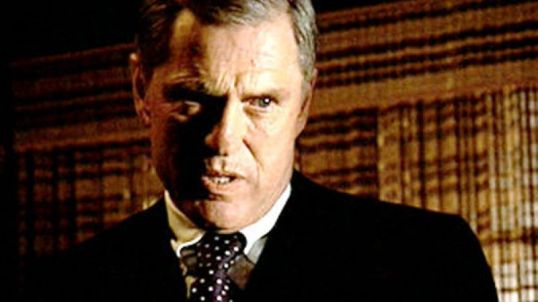
Sen. Pat Geary doesn’t have a lot of time on-screen. He attends a birthday party at the Corleone Family compound, where he praises Michael in public and then condescendingly insults him in private. Later, he shows up in Cuba, where he watches a sex show with obvious interest. And, when Michael is called before a Senate committee, Geary gives a speech defending the honor of all Italian-Americans.
G.D. Spradlin as Sen. Pat Geary
But the scene that we all remember is the one where Tom Hagen meets Sen. Geary in a brothel. As Geary talks about how he passed out earlier, the camera briefly catches the sight of a dead prostitute lying on the bed behind him. What’s especially disturbing about this scene is that neither Hagen nor Geary seem to acknowledge her presence. She’s been reduced to a prop in the Corleone Family’s scheme to blackmail Sen. Geary. His voice shaken, Geary says that he doesn’t know what happened and we see the weakness and the cowardice behind his almost all-American facade.
It’s a disturbing scene that’s well-acted by both Duvall and Spradlin. Of course, what is obvious (even if it’s never explicitly stated) is that Sen. Geary has been set up and that nameless prostitute was killed by the Corleones. It’s a scene that makes us reconsider everything that we previously believed about the heroes of the Godfather.
For forcing us to reconsider and shaking us out of our complacency, The Godfather, Part II is a great film.
(Yes, it’s even better than The Trial of Billy Jack.)
I have to admit that, as someone who watches a lot of movies that were made before she was even born and who is just fascinated by history in general, I have often wondered what the 60s and the 70s were really like. Oh, don’t get me wrong. I know what everyone says they were like — hippies, disco, cocaine, Watergate, Jimmy Carter, Viet Nam, and all the rest. But people’s memories usually fade with the passage of time and it’s always hard not to feel that whatever I’m hearing is either an idealization or an exaggeration. That’s one reason why I like watching the often critically reviled, low-budget films of that period. Since these films were usually made by people who didn’t really care what judgmental viewers like me would think 20 years in the future, they are usually far more accurate when it comes to portraying the world from which they came than a film that was by a big studio whose main concern was to present an idealized portrait of existence that would not alienate any potential ticket buyers. Crown International Pictures may never have been an acclaimed film studio but, as one of the more prolific producers of 70s exploitation fare, their films now serve as a valuable historical record of the time in which they were made.
If I want to know what it was like to be young and perhaps stupid in the 70s, I go to Crown International Pictures.
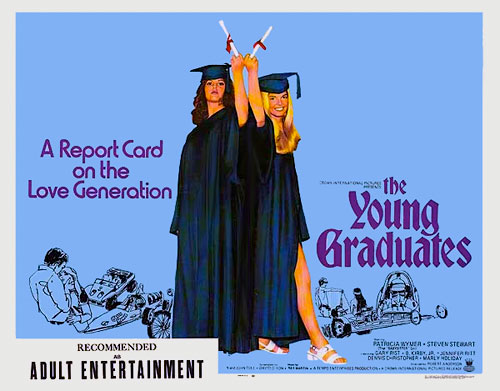
Take The Young Graduates for example. First released all the way back in 1971, The Young Graduates was advertised as being “a report card on the love generation.” The Young Graduates gives us a clue as to what it was like to be a teenager in 1971. Judging from the film, it really sucked.
The Young Graduates tells the story of Mindy (Patricia Wymar), who is on the verge of graduating from high school. She has a boyfriend named Bill (Gary Rist) but wow, is he boring! All he wants to do is compete in drag races and it quickly becomes apparent that he’s incapable of expressing his emotions. (Assuming that he has any. The film is a bit ambiguous on this point.) So, Mindy gets bored and has an affair with one of her teachers, the very married Jack Thompson (Steven Stewart). Soon after realizing that Mr. Thompson will never leave his wife for her, Mindy suspects that she might be pregnant. So, she and her friend Sandy (Marly Holliday) decided to take a road trip to Big Sur. Along the way, they meet a sweet hippie (Dennis Christopher), a bunch of bad hippies, and some really bad bikers. During their entire journey, they are pursued by Bill, Mr. Thompson, and Sandy’s boyfriend, Les (Bruno Kirby).
Though you wouldn’t know it from the film’s peppy soundtrack or Wymar’s cheerful performance as the continually put upon Mindy, The Young Graduates is actually a pretty dark movie. With the exception of Pan, everyone that Mindy meets outside of high school is not to be trusted. Essentially, she’s exploited by everyone that she meets and what makes it all the more disturbing is that Mindy smiles throughout the whole ordeal, almost as if Candide had been reincarnated in the form of a teenage girl.
So, The Young Graduates is really not much of a film. Subsequent Crown International films would revisit high school and almost all of them would feature better acting and a far more interesting plot than the The Young Graduates. No, the film does not work as a drama. But as a documentary and as a time capsule, there’s a lot to enjoy about The Young Graduates. The fashion, the haircuts, the music, and just the film’s general attitude are such relics of the late 60s and early 70s that the film is the next best thing to owning a working time machine.
That said, if The Young Graduates was an accurate picture of that time — well, I might not be asking for a time machine this Christmas after all!



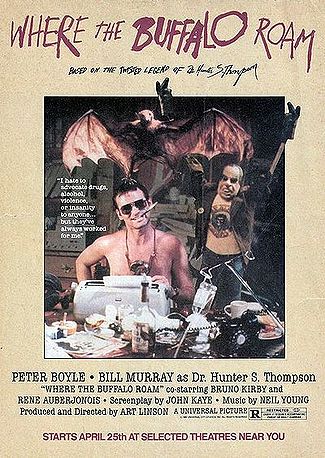 At his Colorado ranch, journalist Hunter S. Thompson (Bill Murray) is up against a deadline. He has to finish his story about his friendship with the radical lawyer and activist, Carlo Lazlo (Peter Boyle). Thompson flashes back to the time that he covered a trial in which Lazlo defended a group of young men charged with possession of marijuana. When the men are sent to prison, Lazlo snaps and physically attacks the prosecutor. Later, Lazlo resurfaces during the Super Bowl and tries to convince Thompson to join him in fighting a revolution in Latin America. And finally, in 1972, Lazlo tracks Thompson down while Thompson is traveling with the Nixon campaign.

 Through the Shattered Lens