Guilty Pleasure No. 94: Revenge of the Nerds (dir. by Jeff Kanew)


Revenge of the Nerds captures the wild, unfiltered spirit of 1980s college comedies, blending underdog triumph with over-the-top raunchiness that feels both nostalgic and awkwardly dated today. Released in 1984, this Jeff Melman-directed flick stars Robert Carradine and Anthony Edwards as Lewis and Gilbert, two freshmen nerds who face relentless bullying from the jock-dominated Alpha Beta fraternity at Adams College. What starts as a straightforward tale of misfits fighting back evolves into a chaotic mix of pranks, parties, and questionable morals, making it a polarizing watch that still packs a punch for fans of the era’s humor.

The story kicks off with Lewis and Gilbert arriving full of optimism, only to have their dreams torched—literally—when the Alpha Betas accidentally burn down their dorm during a hazing gone wrong. Relocated to a rundown gym with other campus outcasts, the nerds band together under the banner of Tri-Lam, turning their rejection into fuel for clever retaliation. From panty raids to talent show showdowns, the film barrels through a series of escalating antics, peaking at the Greek Games where brains battle brawn in absurd competitions like tricycle races and tug-of-war twists. It’s pure 80s escapism, with a runtime under 100 minutes that keeps the energy high and the laughs coming in rapid-fire succession, even if not every gag is a home run.

The nerd ensemble steals the show, each character a walking stereotype brought to vivid life. Carradine’s Lewis is the slick-talking instigator with a knack for schemes, while Edwards’ Gilbert provides the earnest heart, delivering a pivotal speech about acceptance that gives the movie unexpected emotional depth. Curtis Armstrong as Booger delivers unforgettable gross-out moments, from belching symphonies to shameless flirtations, and Larry B. Scott’s Lamar brings flamboyant athletic flair that subverts expectations. The jocks, led by Ted McGinley’s smug Stan, serve as perfect foils—arrogant, muscle-bound villains who embody the era’s macho excess. Supporting turns, like Julia Montgomery’s Betty navigating boyfriend drama, John Goodman’s boorish Coach Harris, or Bernie Casey’s wise U.N. Jefferson, add layers to the campus power struggle.

Humor-wise, Revenge of the Nerds leans hard into juvenile territory: fart jokes, streaking, and wild panty raid sequences filmed with hidden cameras that push boundaries even for the time. The film’s climax involves Lewis impersonating Stan to woo Betty, a plot point that plays as triumphant revenge but lands as deeply problematic through today’s lens, highlighting consent issues amid the cheers. Similarly, the sorority spying and casual objectification reflect 80s attitudes toward women and minorities that feel crass now, contributing to its mixed modern reception. Yet, these elements are balanced by genuine camaraderie among the nerds, fostering a sense of belonging that resonates as a counter to real-world bullying.​

Technically, the movie holds up as a product of its time. The soundtrack, featuring the iconic title track by The Rubinoos and funky cues during party scenes, amps up the fun, while practical effects like the nerds’ gadget-filled house add quirky charm. Cinematography emphasizes the divide between polished frat row and the nerds’ scrappy turf, with wide shots of campus chaos underscoring the rebellion. Written by Tim Metcalfe, Steve Zacharias, and Jeff Buhai, the script zings with quotable lines—”We are the sons of the sons of bitches”—and smartly flips the slobs-vs-snobs formula by rooting for the geeks.

Culturally, Revenge of the Nerds helped define the “nerd pride” archetype, paving the way for films like PCU and influencing pop culture’s embrace of geek culture from The Big Bang Theory to Marvel dominance. It spawned three sequels, a musical adaptation, and endless references, cementing its place as a time capsule of Reagan-era college life—rowdy, rebellious, and unapologetically politically incorrect. For balance, its strengths lie in infectious energy, memorable characters, and a pro-outsider message, but weaknesses include uneven pacing in setup scenes and humor that too often punches down rather than up.

The film continues the trend of 80s raunchy teen comedies first popularized by Bob Clark’s Porky’s, ramping up the gross-out gags and frat-house antics while shifting the focus to nerd empowerment over sexual hijinks. The nerds’ talent show finale, uniting misfits in a joyous medley, delivers pure catharsis, proving brains and heart can topple bullies. It’s not flawless—some jokes bomb, and the ending rushes a bit—but its scrappy spirit endures for those who grew up quoting Booger’s lines or cheering Tri-Lam’s win. Fans of Animal House or Old School will find familiar thrills, while modern audiences might prefer the cleaner satire of The Good Place. Ultimately, Revenge of the Nerds earns a solid recommendation with caveats: a rowdy good time if you roll with the 80s vibe, but skip if consent gags are deal-breakers.

Previous Guilty Pleasures

  1. Half-Baked
  2. Save The Last Dance
  3. Every Rose Has Its Thorns
  4. The Jeremy Kyle Show
  5. Invasion USA
  6. The Golden Child
  7. Final Destination 2
  8. Paparazzi
  9. The Principal
  10. The Substitute
  11. Terror In The Family
  12. Pandorum
  13. Lambada
  14. Fear
  15. Cocktail
  16. Keep Off The Grass
  17. Girls, Girls, Girls
  18. Class
  19. Tart
  20. King Kong vs. Godzilla
  21. Hawk the Slayer
  22. Battle Beyond the Stars
  23. Meridian
  24. Walk of Shame
  25. From Justin To Kelly
  26. Project Greenlight
  27. Sex Decoy: Love Stings
  28. Swimfan
  29. On the Line
  30. Wolfen
  31. Hail Caesar!
  32. It’s So Cold In The D
  33. In the Mix
  34. Healed By Grace
  35. Valley of the Dolls
  36. The Legend of Billie Jean
  37. Death Wish
  38. Shipping Wars
  39. Ghost Whisperer
  40. Parking Wars
  41. The Dead Are After Me
  42. Harper’s Island
  43. The Resurrection of Gavin Stone
  44. Paranormal State
  45. Utopia
  46. Bar Rescue
  47. The Powers of Matthew Star
  48. Spiker
  49. Heavenly Bodies
  50. Maid in Manhattan
  51. Rage and Honor
  52. Saved By The Bell 3. 21 “No Hope With Dope”
  53. Happy Gilmore
  54. Solarbabies
  55. The Dawn of Correction
  56. Once You Understand
  57. The Voyeurs 
  58. Robot Jox
  59. Teen Wolf
  60. The Running Man
  61. Double Dragon
  62. Backtrack
  63. Julie and Jack
  64. Karate Warrior
  65. Invaders From Mars
  66. Cloverfield
  67. Aerobicide 
  68. Blood Harvest
  69. Shocking Dark
  70. Face The Truth
  71. Submerged
  72. The Canyons
  73. Days of Thunder
  74. Van Helsing
  75. The Night Comes for Us
  76. Code of Silence
  77. Captain Ron
  78. Armageddon
  79. Kate’s Secret
  80. Point Break
  81. The Replacements
  82. The Shadow
  83. Meteor
  84. Last Action Hero
  85. Attack of the Killer Tomatoes
  86. The Horror at 37,000 Feet
  87. The ‘Burbs
  88. Lifeforce
  89. Highschool of the Dead
  90. Ice Station Zebra
  91. No One Lives
  92. Brewster’s Millions
  93. Porky’s

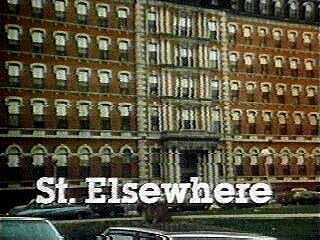
Retro Television Review: St. Elsewhere 3.1 “Playing God, Part One”


Welcome to Retro Television Reviews, a feature where we review some of our favorite and least favorite shows of the past! On Fridays, I will be reviewing St. Elsewhere, a medical show which ran on NBC from 1982 to 1988.  The show can be found on Daily Motion.

Today, we start the third season of St. Elsewhere with some new opening credits!

Episode 3.1 “Playing God, Part One”

(Dir by Bruce Paltrow, originally aired on September 19th, 1984)

The opening of the third season finds that St. Eligius is just as depressing as it’s ever been.

Fiscus leads a group of new residents, including Dr. Elliott Axelrod (played by new series regular Stephen Furst), through the hospital.  Fiscus comes across as being an arrogant jackass.  I guess that’s the appeal of being a second-year resident.  You get to look down on all of the first-years.

Jack is still dating Clancy (young Helen Hunt).  When Clancy tells Jack that she’s pregnant, he’s shocked when she says she’s planning on getting an abortion.  Jack proposes to her.  Clancy says she’s not ready to get married and she’s not ready to have a baby.

Dr. Craig is still yelling at Dr. Ehrlich.  Dr. Ehrlich is still annoying the nurses.

Speaking of the nurses, they’re going on strike!

Three firefighters (one of whom is played by Erin Hudson) are injured while on the job and are rushed to St. Eligius with severe burns.  Luckily, plastic surgeon Bobby Caldwell (Mark Harmon, without that terrible mustache he wore during season two) is on call.

Dr. Peter White is working in a shady clinic and is still suing for his right to be a resident.

A traffic accident leaves one nun in a coma and apparently brain-dead.  Sister Doemnica (Michael Learned) wants to take her off life-support.  Westphall (Ed Flanders), who seems even more depressed than usual, disagrees.  It looks like there’s going to be some conflict about this.  For once, I’m on Westphall’s side.  I’m believer in hope.

Auschlander is still battling his cancer.

In other words, it’s another day at St. Eligius.  The third season premiere did a good job of re-introducing viewers to the hospital.  The snarkiness of Fiscus’s tour nicely balanced all of the more dramatic moments in the episode.  If anything has me worried, it’s the possible return of the loathsome Peter White.  How is the hospital going to deal with the return of a man who they all know is a rapist, even if he was somehow acquitted?  I guess we’ll find out.

14 Days of Paranoia #6: The Player (dir by Robert Altman)


1992’s The Player tells the story of Griffin Mill (Tim Robbins).

It’s not easy being Griffin Mill.  From the outside, of course, it looks like he has the perfect life.  He’s a studio executive with a nice house in Hollywood.  He’s young.  He’s up-and-coming.  Some people, especially Griffin, suspect that he’ll be the president of the studio some day.  By day, he sits in his office and listens to pitches from respected screenwriters like Buck Henry.  (Henry has a great idea for The Graduate II!)  During the afternoon, he might attends dailies and watch endless takes of actors like Scott Glenn and Lily Tomlin arguing with each other.  Or he might go to lunch and take a minute to say hello to Burt Reynolds.  (“Asshole,” Burt says as Griffin walks away.)  At night, he might go to a nice party in a big mansion and mingle with actors who are both young and old.  He might even run into and share some sharp words with Malcolm McDowell.

But Griffin’s life isn’t as easy as it seems.  He’s constantly worried about his position in the studio, knowing that one box office failure could end his career.  He fears that a new executive named Larry Levy (Peter Gallagher) is after his job.  Two new screenwriters (Richard E. Grant and Dean Stockwell) keep bugging him to produce their downbeat, no-stars anti-capitol punishment film.  His girlfriend (Cynthia Stevenson) wants to make good movies that mean something.  Even worse, someone is sending Griffin threatening notes.

It doesn’t take long for Griffin to decide that the notes are coming from a screenwriter named Dave Kahane (Vincent D’Onofrio).  Griffin’s attempt to arrange a meeting with Dave at a bar so that Griffin can offer him a production deal instead leads to Griffin murdering Dave in a parking lot.  While the other writers in Hollywood mourn Dave’s death, Griffin starts a relationship with Dave’s artist girlfriend (Great Scacchi) and tried to hide his guilt from two investigating detectives (Whoopi Goldberg and Lyle Lovett).  Worst of all, the notes keep coming.  The writer, whomever they may be, is now not only threatening Griffin but also seems to know what Griffin did.

After spend more than a decade in the industry wilderness, Robert Altman made a critical and commercial comeback with The Player.  It’s a satire of Hollywood but it’s also a celebration of the film industry, featuring 60 celebrities cameoing as themselves.  Everyone, it seems, wanted to appear in a movie that portrayed studio execs as being sociopathic and screenwriters as being whiny and kind of annoying.  The Player both loves and ridicules Hollywood and the often anonymous men who run the industry.  Largely motivated by greed and self-preservation, Griffin may not love movies but he certainly loves controlling what the public sees.  In the end, only one character in The Player sticks to her values and her ideals and, by the end of the movie, she’s out of a job.  At the same time, Griffin has a social life that those in the audience can’t help but envy.  He can’t step out of his office without running into someone famous.

The Player is one Altman’s most entertaining films, with the camera continually tracking from one location to another and giving as a vision of Hollywood that feels very much alive.  Tim Robbins gives one of his best performances as Griffin Mill and Altman surrounds him with a great supporting cast.  I especially liked Fred Ward as the studio’s head of security.  With The Player, Altman mixes melodrama with a sharp and sometimes bizarre comedy, with dialogue so snappy that the film is as much a joy to listen to as to watch.  That said, the real attraction of the film is spotting all of the celebrity cameos.  (That and cheering when Bruce Willis saves Julia Roberts from certain death.)  Altman was a director who often used his films to explore eccentric communities.  With The Player, he opened up his own home.

Previous entries in 2025’s 14 Days Of Paranoia:

  1. The Fourth Wall (1969)
  2. Extreme Justice (1993)
  3. The Lincoln Conspiracy (1977)
  4. Conspiracy (2007)
  5. Bloodknot (1995)

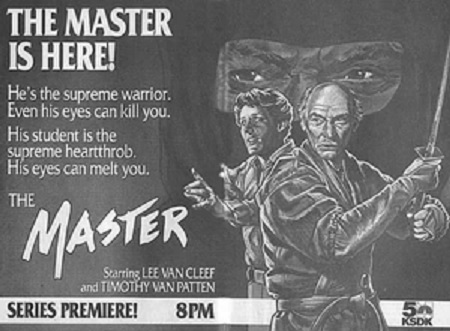
Retro Television Reviews: The Master 1.2 “Out-of-Time Step”


Welcome to Retro Television Reviews, a new feature where we review some of our favorite and least favorite shows of the past! On Fridays, I will be reviewing The Master, which ran on NBC from January to August of 1984. Almost all nine of the show’s episodes can be found on Tubi!

The adventures of John Peter McAllister and Max Keller continue!

That’s right, the search for McAllister’s daughter is still on and Max is still learning how to be a ninja.  But, before we get to their latest adventure, it’s time to enjoy the opening credits!

Episode 1.2 “Out-of-Time Step”

(Dir by Ray Austin, originally aired on January 27th, 1984)

“Hi, I’m Max Keller and this is how I spend my mornings….” Max Keller tells us in voice over as we watch footage of Max (Timothy Van Patten) balancing on a rope that’s been tied between two trees.  Yes, Max is still our narrator and John Peter McAllister (Lee Van Cleef) is still training him to become a ninja.  Max is also still traveling in his van and with his hamster.

At the end of the previous episode, Max and McAllister were heading down to Atlanta to search for McAllister’s daughter.  At the start of this episode, we discover that they are in San Francisco, investigating a lead that McAllister’s daughter may have danced at a club called Truffles.  So, did they go to Atlanta or did they just change their mind and decide to stick around California?  More to the point, did NBC say, “Hey, we’re not paying for you people to go out of state?”

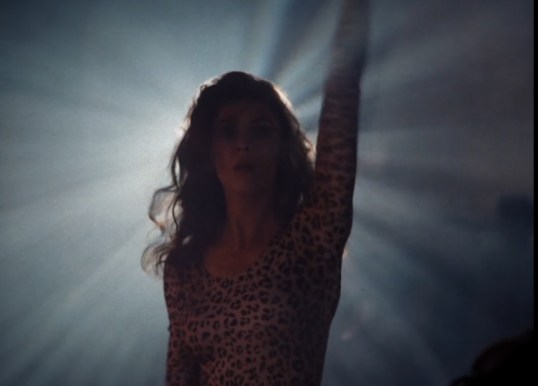
Anyway, Truffles turns out to be a club that’s owned by Charlie Patterson (Charles Collins), a former film star who has fallen on hard times.  (Charles Collins was a real-life dancer and when Patterson watches footage of a screen test that his character supposedly did for a Hollywood production, the footage is actually of Collins performing in a 1936 film called Dancing Pirate.)  Patterson has two daughters.  Kelly (Shanna Reed) is a dancer who thrills the club’s patrons every time she steps out onto the stage.  The other, Jill (Lori Lethin), uses a wheelchair.  Jill tells Charlie that he’s “an ex-hoofer with two daughters, one who wheels and one who does cartwheels.”

Upon arriving at Truffles, Max and McAllister discover that Charlie is being intimidated by Chinatown gangster, Johnny Chan (Brian Toshi) and Chan’s main enforcer, Mr. Lika (Soon-Tek Oh).  Mr. Lika spots McAllister’s medallion and realizes that McAllister is a trained ninja.  McAllister spots Mr. Lika’s ring and realizes that Mr. Lika is a member of the Yakuza.   This establishes a mutual respect between the two of them, one that inevitably leads to a final battle between Soon-Tek Oh and Lee Van Cleef’s stunt double.

Of course, McAllister does more than just fight Mr. Lika.  He also encourages Jill to stand up from her wheelchair and take a few steps.  And when Johnny Chan has Kelly kidnapped, he and Max rescue her.  (But not before Johnny shouts at her, “You’re a dancer!  DANCE!”)  It leads to a lot of action scenes but it doesn’t bring them any closer to McAllister’s daughter.

This episode wasn’t bad, largely because Soon-Tek Oh and Lee Van Cleef got a chance to face off.  Even if all of the actual fighting was done by Van Cleef’s stunt double, it’s still undeniably fun to watch these two icons glare at each other and exchange tough guy dialogue.  Plus, there was a lot of dancing!  I always appreciate any show that finds room for more than one dance number, even if they are obviously lifted from Flashdance.

As I mentioned earlier, this episode ended with McAllister and Max nowhere close to finding McAllister’s daughter.  But Max promised that they could keep looking.  I’m sure they’ll find her.  It’s not like America is that big.

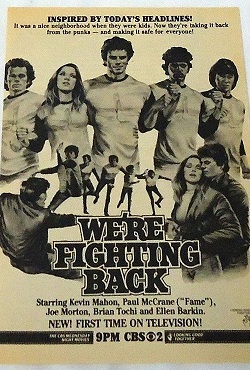
Retro Television Reviews: We’re Fighting Back (dir by Lou Antonio)


Welcome to Retro Television Reviews, a feature where we review some of our favorite and least favorite shows of the past!  On Sundays, I will be reviewing the made-for-television movies that used to be a primetime mainstay.  Today’s film is 1981’s We’re Fighting Back!  It  can be viewed on YouTube!

We’re Fighting Back opens with a title card informing the viewer that the film that they are about to see is based on a true story and that the characters are based on the Guardian Angels, a group of New Yorkers who took it upon themselves to patrol neighborhoods and the subways.  However, the film’s plot is fictionalized and all of the names have been changed and basically, the entire story is made up.  It gets the film off to a strange start.  This film is based on a true story, except that it’s not.

Morgan “Case” Casey (Kevin Mahon) is a young man living in New York with his father.  When his father is mugged in the subway and ends up in the hospital, Case decides to take it upon himself to patrol the trains.  He recruits his co-workers at the local hamburger place.  Benny (Ramon Franco) says he is streetwise.  Ling (Brian Tochi) claims that he’s good at fighting.  Preacher (Paul McCrane) …. well, I’m not sure what Preacher’s special skill is but he’s recently moved to New York from Alabama.  Case and his friends lose their first big fight against a gang of muggers, which leads to Case yelling at all of them and announcing that they need to recruit more members and get trained up on how to fight.  Preacher thinks that Case is putting everyone’s life in danger but Case is determined to clean up the neighborhood.

Teaming up with some former gang members, Case forms the organization that will become the Guardian Angels.  Among those who join are a tough waitress named Chris Capoletti (a young Ellen Barkin) and a Hungarian immigrant named Janos (an equally young Stephen Lang).  At first, attorney Elgin Jones (Joe Morton) thinks that Case and his organization are going to be a bunch of lawless vigilantes but, after meeting Case and seeing Case refuse to allow an obvious psychopath to join the group, Elgin decides to become a part of Case’s anti-crime crusade.

And …. well, that’s pretty much it.  There’s not much of a plot here.  Case and Preacher are briefly estranged but they are friends again by the end of the movie.  Eventually, Case faces off with Tony (John Snyder), the gang leader who mugged his father.  For the most part, though, this is a film without much real conflict.  In this film’s portrayal of urban crime, it turns out to be remarkably easy to clean up a neighborhood.  Apparently, you just need to get a bunch of people to give a damn.  One watches the movie and wonders why no one ever came up with this extremely simple solution in the past.  The film goes out of its way to tell us that Case is not some sort of Charles Bronson-style vigilante but Case never has to face any muggers as dangerous as The Giggler.  If Case lived in the Death Wish 3 neighborhood, who knows what type of approach he would have gone with.

Under the best of circumstances, this film would seem simplistic.  Watching this film after the past few years, in which we’ve seen an increasing number of unarmed people getting hurt and killed by self-appointed vigilantes who felt that they shouldn’t have been in their neighborhood or train car, it’s hard not to feel that We’re Fighting Back is incredibly naïve and rather irresponsible.  (The Death Wish films are so shameless and over the top that they’re difficult to take seriously as any sort of manifesto.  We’re Fighting Back plays out with all the earnestness of a call to action.)  Need to clean up your neighborhood?  Just do it yourself!  Just fight back!  Obviously, that’s an idea that appeals to a lot of people but, in reality, it rarely seems to work out the way that it should.

Police Academy 4: Citizens on Patrol (1987, directed by Jim Drake)


Long before the end credits of 22 Jump Street imagined Jonah Hill and Channing Tatum going to culinary school, the flight academy, and into outer space, the Police Academy films bravely tested just how far one already thin premise could already be stretched.

In Police Academy 4, Commandant Eric Lassard (George Gaynes) comes up with another plan to make the city safer.  (Since Lassard has been coming up with plans for three years without any success, it may be time to let the old man retire peacefully.)  This time, he wants to institute Citizens on Patrol, which would mean training citizens to act like cops.  It sounds like the type of terrible idea that could get a city sued into bankruptcy but considering that this is a city where a human sound effects machine and the former head of the 16 precinct’s biggest gang can become decorated police officers, I guess it’s as good an idea as any.

As usual, Carey Mahoney (Steve Guttenberg) and the gang are ready to help Lassard.  Bruce Mahler’s Fackler is no longer a part of the ensemble but Bubba Smith, Bobcat Goldthwait, Michael Winslow, David Graf, Tim Kazurinsky, Marion Ramsey, and Brian Toschi are all back.  Also returning, after skipping out on the first two sequels, is Capt. Harris (G.W. Bailey).  Harris wants to see Lassard fail so that he can take over the police academy.  It’s the same thing as the first three films.  As in previous Police Academy films, there’s a visit to the Blue Oyster leather bar and a last minute crime wave to give the Citizens on Patrol a chance to prove they belong in the program.  The Citizens on Patrol include Billie Bird, Brian Backer, David Spade, wrestler Tab Thacker, and Corrine Bohrer as a love interest for Bobcat Goldthwait.  Sharon Stone also makes an appearance, playing a journalist and improbably falling for Steve Guttenberg.  Watching the film, it is obvious that the idea was that, in future Police Academy films, the Citizens on Patrol could replace any of the regular cast members who wanted too much money to return.  As a result, almost every veteran of the cast has a doppelganger in the Citizens on Patrol.  Brian Backer could replace Steve Guttenberg.  Tab Thacker is there to put Bubba Smith on notice that no one is irreplaceable.  Is Bobcat Goldthwait being difficult?  Just remind him that David Spade can play a crazy eccentric too.

Police Academy 4 is the most crowded of the Police Academy films and, even by the franchise’s undemanding standards, most of the jokes fall flat.  Jim Drake took over as director after the director of the previous two films, Jerry Paris, died of a brain tumor and Drake struggles to balance low comedy with police action.  Guttenberg and company don’t have the same energy in this installment as they had in the previous three and the new cast members all feel as if they’re out place sharing scenes with the veterans, like a group of underclassmen who have been invited on the senior trip.

This would be the final Police Academy film for Steve Guttenberg.  Would the franchise be able to survive without him?  Check here tomorrow to find out with my review of Police Academy 5!

Police Academy 3: Back in Training (1986, directed by Jerry Paris)


Police Academy 3 opens with a state in the middle of a fiscal crisis.  Money has to be saved somewhere and the governor (Ed Nelson) has decided that it’s not necessary for the state to have two police academies.  I am not sure why the governor would be the one to make that determination since the previous two Police Academy films established that the academies are run by the city but I guess I should remember that I’m watching a Police Academy film and not ask too many questions.

Which academy is going to be closed down?  Will it be the academy run by Commandant Lassard (George Gaynes) or the one run by Commandant Mauser (Art Metrano, returning from the second film)?  Mauser is willing to use any dirty, under-handed trick to keep his academy open.  Meanwhile, Lassard has his most recent graduating class returning to instruct his latest batch of recruits.  Can Mahoney (Steve Guttenberg) and Michael Winslow’s human sound effects machine save the academy?

When I watched Police Academy 3 this weekend, I was surprised to discover that it wasn’t as bad as I remembered.  Maybe it’s because I watched it immediately after the first two films and my senses were dulled but Police Academy 3 turned out to be an amiable and enjoyably stupid comedy. It helped that two of the new recruits were played by Tim Kazurinsky and Bobcat Goldthwait.  Returning to the roles that they first played in the second movie, Kazurinsky and Goldthwait make for a good comedic team.  As for the rest of the Police Academy regulars, they all do their usual comedy bits like pros and without any fuss.  It’s predictable and sometimes, funny.

Police Academy 3 was the first Police Academy film to have a PG-rating and, as a result, the jokes were still as juvenile and crude as the first two movies but, at the same time, Police Academy 3 seems to have made peace with the fact that it’s target audience was a bunch of adolescent boys dropped off at the theater by their mothers.  Mauser is still regularly humiliated but no one gets a blow job while standing in front of a podium.  This is a Police Academy for the entire family, assuming that your family is easily amused and not too demanding.

Police Academy 3 is a dumb movie and the recurring joke about policemen accidentally entering the Blue Oyster Bar is even less funny the third time that it’s used.  There’s also a Japanese recruit who only seems to be included because, back in the 80s, American films were obsessed with making fun of Japan.  Despite all that, Police Academy 3 is still not as bad as the usual Police Academy sequel.

But what about Police Academy 4?  Check in tomorrow to find out if it’s also better than I initially remembered.

(It’s not.)