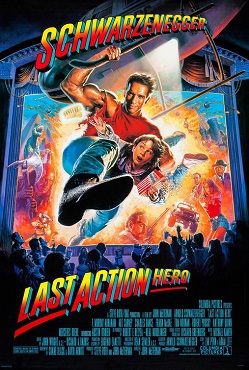
Guilty Pleasure No. 84: Last Action Hero (dir by John McTiernan)


Oh, Last Action Hero.

Ever since this film was first released in 1993, it’s usually held up as an example of a Hollywood fiasco.  The script was originally written to be a modest satire of action films.  The screenwriters wrote the character of Jack Slater, an movie action hero who comes into the real world, for Dolph Lundgren.  Instead, the film became an Arnold Schwarzenegger extravaganza and the studio ended up tossing a ton of money at it.  When the film was originally released, the reviews were mixed and the box office was considered to be disappointing.  (That it went up against the first Jurassic Park was definitely an underrated issue when it came to the box office.)  Ever since then, The Last Action Hero has had a reputation for being a bad film.

Well, I don’t care.  I like The Last Action Hero.  Yes, it’s a bit overproduced for a comedy.  (It breaks my own rule about how no comedy should run longer than two hours.)  Yes, it gets a bit sentimental with ten year-old Danny Madigan (Austin O’Brien) using a magic, golden ticket to enter the film world of his hero, Jack Slater.  If you want to argue that the film should have devoted more time to and gone a bit deeper into contrasting the film world with the real world, I won’t disagree with you.  But I will also say that Sylvester Stallone starring as The Terminator in Jack’s world was actually a pretty funny sight gag.  Danny knowing better than to trust a character played by F. Murray Abraham made me laugh.  Danny’s fantasy in which Arnold Schwarzenegger played Hamlet was made all the better by the fact that his teacher was played by Laurence Olivier’s wife, Joan Plowright.   Danny DeVito as Whiskers the Cartoon Cat makes me laugh as well, even if it is perhaps a bit too bizarre of a joke for this particular film.  (There’s nothing else about the Jack Slater films that would explain the presence of a cartoon cat.)

When you set aside the idea of the Last Action Hero being a symbol of Hollywood bloat and just watch it as a film, it emerges as an enjoyably goofy action movie, one that captures the joy of watching movies (because who hasn’t wanted to enter a movie’s world at some point in their life), and also one that features a rather charming performance from Arnold Schwarzenegger.  (Schwarzenegger, I should add, plays both himself and Jack Slater.  One of my favorite jokes is when the real Schwarzenegger is at a premiere and he mistakes the evil Ripper for Tom Noonan, the actor who played him in the previous Jack Slater film.)  Yeah, the golden ticket is a little bit hokey but who cares?  Underneath all of the special effects and action and money spent on star salaries, Last Action Hero is an action movie and comedy with a heart.  Danny meets his hero but also gets to become a hero himself.  And Jack Slater turns out to be everything you would hope your movie hero would be.  In the end, it’s obvious that a lot of the criticism of this film has more to do with the appeal of riding the bandwagon as opposed to what actually happens on screen.

Last Action Hero is a movie that I’ll happily defend.

Previous Guilty Pleasures

  1. Half-Baked
  2. Save The Last Dance
  3. Every Rose Has Its Thorns
  4. The Jeremy Kyle Show
  5. Invasion USA
  6. The Golden Child
  7. Final Destination 2
  8. Paparazzi
  9. The Principal
  10. The Substitute
  11. Terror In The Family
  12. Pandorum
  13. Lambada
  14. Fear
  15. Cocktail
  16. Keep Off The Grass
  17. Girls, Girls, Girls
  18. Class
  19. Tart
  20. King Kong vs. Godzilla
  21. Hawk the Slayer
  22. Battle Beyond the Stars
  23. Meridian
  24. Walk of Shame
  25. From Justin To Kelly
  26. Project Greenlight
  27. Sex Decoy: Love Stings
  28. Swimfan
  29. On the Line
  30. Wolfen
  31. Hail Caesar!
  32. It’s So Cold In The D
  33. In the Mix
  34. Healed By Grace
  35. Valley of the Dolls
  36. The Legend of Billie Jean
  37. Death Wish
  38. Shipping Wars
  39. Ghost Whisperer
  40. Parking Wars
  41. The Dead Are After Me
  42. Harper’s Island
  43. The Resurrection of Gavin Stone
  44. Paranormal State
  45. Utopia
  46. Bar Rescue
  47. The Powers of Matthew Star
  48. Spiker
  49. Heavenly Bodies
  50. Maid in Manhattan
  51. Rage and Honor
  52. Saved By The Bell 3. 21 “No Hope With Dope”
  53. Happy Gilmore
  54. Solarbabies
  55. The Dawn of Correction
  56. Once You Understand
  57. The Voyeurs 
  58. Robot Jox
  59. Teen Wolf
  60. The Running Man
  61. Double Dragon
  62. Backtrack
  63. Julie and Jack
  64. Karate Warrior
  65. Invaders From Mars
  66. Cloverfield
  67. Aerobicide 
  68. Blood Harvest
  69. Shocking Dark
  70. Face The Truth
  71. Submerged
  72. The Canyons
  73. Days of Thunder
  74. Van Helsing
  75. The Night Comes for Us
  76. Code of Silence
  77. Captain Ron
  78. Armageddon
  79. Kate’s Secret
  80. Point Break
  81. The Replacements
  82. The Shadow
  83. Meteor

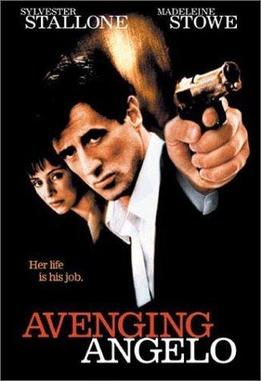
Avenging Angelo (2002, directed by Martyn Burke)


When mob boss Angelo (Anthony Quinn) is assassinated on the orders of the son of a former rival, bodyguard Frankie Delano (Sylvester Stallone) takes it upon himself to protect Angelo’s daughter, Jennifer (Madeleine Stowe).  The problem is that Jennifer, who was adopted by a normal couple, doesn’t know that she is the daughter of a mobster.  Her life and her marriage are already falling apart even before Frankie reveals the truth to her.  All she wants to do is disappear into the pages of a romance novel written by her favorite writer, Marcello (Raoul Bova) but Marello is not quite what he seems.

Sylvester Stallone has had a long career, full of high points (Rocky, First Blood, The Expendables, Creed) and low points (too many to list).  Avenging Angelo, made at a time when it was assumed that the aging Stallone would never again play Rocky Balboa or John Rambo, is a moderate low point.  It’s no Rocky but it’s still better than Stop!  Or My Mom Will Shoot!  Overall, it’s not very good and a lot of the humor falls flat but Stallone and Madeleine Stowe are both likable and they have a few moments that display what seems like genuine chemistry.  It’s still a slow movie that awkwardly mixes comedy and action but it was not the disaster that I was expecting it to be when I first found it on Tubi.  It’s more forgettable than bad.  If there is anything to really regret when it comes to Avenging Angelo, it’s that Anthony Quinn did not get a more memorable swan song.

Avenging Angelo was Stallone’s second movie to go straight to video.  It’s easy to forget not but the conventional wisdom in 2002 really was that Stallone was washed up.  There were jokes about whether or not he would follow Schwarzenegger’s lead and go into politics.  Stallone, however, proved all the naysayers wrong, proving that he could still throw punches as Rocky Balboa and John Rambo while The Expendables revealed a Stallone who could finally laugh at himself.  Avenging Angelo turned out to be not the end of Stallone’s career but instead just a detour.  Say what you will about the man and his movies, Sylvester Stallone is an American institution.

Film Review: The Shoes of The Fisherman (dir by Michael Anderson)


The 1968 film, The Shoes of The Fisherman, opens in a snowy Siberian labor camp.  For the past twenty years, this camp has been the home of Kiril Pavlovich Lakota (Anthony Quinn), the Ukrainian archbishop of Liviv.  Kiril is unexpectedly released by Russia’s new leader, Piotr Ilyich Kamenev (a very British Laurence Olivier).  After explaining to Kiril that Russia and China are on the verge of nuclear war due to a famine that has been instigated by U.S. sanctions, Kamenev tells Kiril that he is being released on the condition that he tell no one about the conditions at the Russian labor camp.  Kiril starts to protest just for Father Telemond (Oskar Werner), the Vatican’s representative, to say that the conditions have already been agreed to.

In Rome, Kiril meets the Pope (John Gielgud), who makes the humble Kiril a cardinal, over Kiril’s objections that he just a “simple man.”  Later, when the aged Pope suddenly dies, Kiril is unexpectedly elected, as a compromise candidate, to succeed him.  Still humble and considering himself to be a simple man with a simple mission, Kiril suddenly finds himself as one of the most revered and powerful men on the planet.  With Father Telemond as his secretary, Kiril tries to make the Vatican responsive to the needs of the people and sets out to bring peace between the Russians and the Chinese. That turns out to be easier said than done, especially when Telemond himself is eventually accused of heresy for his progressive views.

(And yes, Telemond is a Jesuit….)

The Shoes of the Fisherman is a type of film that should be familiar to anyone who has any knowledge of the Hollywood studios in the 60s.  It’s the type of big and self-serious film that was meant to tell audiences, “You won’t find anything this opulent and important on television!”  The cast is designed to appeal to everyone.  Anthony Quinn and Laurence Olivier are there for the older viewers (especially the older viewers who made up the majority of the Oscar voters in 1968) while, for the younger voters, there’s handsome Oskar Werner as a Jesuit who interpretation of the Gospels is so radical that even Pope Francis would probably tell him to step back a little.  For the older, anti-communist viewers, there are scenes that portray the harsh conditions at a Siberian labor camp.  The commies put Kiril in prison so he must be one of the good guys.  And for the younger, more liberal viewers, there was the suggestion that the threat of World War III was largely due to the actions of the American government.  And, just in case there was still anyone who thought that television was preferable to a prestige picture, TV star David Janssen shows up as a cynical reporter whose wife (played by Barbara Jefford) is a doctor who Kiril helps to get some medicine for one of her dying patients.  Director Michael Anderson includes enough sudden zoom shots to let younger viewers know that he’s with them while still directing in a stately enough manner to appeal to the older viewers.

The end result is a film that is big and grand but also rather slow.  The film gets bogged down in subplots that don’t really add much to the overall story.  We spend way too much time with the reporter and his wife.  Anthony Quinn does a good enough job as Kiril, giving a rather subdued performance by Quinn standards.  (A scene where Kiril recites a Jewish prayer for a dying man is wonderfully acted by Quinn, who seems to truly be emotionally invested in the film’s message of togetherness.)  Laurence Olivier is not at all convincing as a Russian but still, he has the stately bearing of a man used to being in power.  Like many of the studio productions of the late 60s, The Shoes of The Fisherman tries a bit too hard to strike a balance between old school Hollywood and the counterculture and the film ultimately feels rather wishy-washy as a result.  It’s a noble film with good intentions but it’s not particularly memorable.

Film Review: The Don Is Dead (dir by Richard Fleischer)


“The Don is Dead!” shouts the title of this 1973 film and it’s not lying.

After the powerful and respect leader of the Regalbuto crime family dies, the Mafia’s governing body meets in Las Vegas to debate who should be allowed to take over the family’s operations.  Frank Regalbuto (a smoldering Robert Forster) wants to take over the family but it’s agreed that he’s still too young and hot-headed.  Instead, control of the family is given Don Angelo DiMorra (Anthony Quinn), an old school Mafia chieftain who everyone agrees is a man of respect.  Don DiMorra will serve as a mentor to Frank while Frank’s main enforcers, The Fargo Brothers, will be allowed to operate independently with the understanding that they will still respond if the mob needs them to do a job.  Tony Fargo (Forrest) wants to get out of the rackets all together while his older brother, Vince (Al Lettieri), remains loyal to the old ways of doing things.

Frank is not happy with the arrangement but he has other things to worry about.  He knows that there’s a traitor in his family.  While he and the Fargo brothers work to uncover the man’s identity so that they can take their revenge, Don Angelo falls in love with a Vegas showgirl named Ruby Dunne (Angel Tompkins).  However, Ruby is engaged to marry Frank and, when Frank returns from taking care of the traitor, he is tipped off as to what has been happening in his absence.  Frank goes crazy, nearly beating Ruby to death.  Don Angelo declares war on Frank and the Fargo brothers are forced to decide which side they’ll serve.

In the 1970s, almost every crime film was either a rip-off of The French Connection or The Godfather.  The Don Is Dead is unique in that it attempts to rip off both of them at the same time.  The film opens French Connection-style with a couple of hoods trying to double-cross Frank during a drug deal, leading to shoot-out.  (Keep an eye out for Sid Haig as one of Frank’s men.)   The film is full of scenes that are meant to duplicate the gritty feel of The French Connection though, needless to say, none of them are directed with the cinema verité intensity that William Friedkin brought to that classic film.  Meanwhile, Anthony Quinn plays a character who is very much reminiscent of Don Vito Corleone, even pausing at one point to tell Frank that “drugs are a dirty business.”  The Godfather‘s Abe Vigoda and Al Lettieri show up in supporting roles and Robert Forster gives a performance that owes more than a little to James Caan’s Oscar-nominated turn as Sonny Corleone.  (Interestingly enough, both Quinn and Forster were among the many actors considered for roles in The Godfather.)

Unfortunately, the film itself is slowly-paced and never really draws us into the plot.  Director Richard Fleischer, who directed a lot of films without ever developing a signature style, brings none of the intensity that William Friedkin brough to The French Connection nor can he duplicate Francis Ford Coppola’s operatic grandeur.  The Don is Dead plays out like a particularly violent made-for-TV movie.  There’s a lot of talented people in the cast but they’re defeated by thinly drawn characters.  Robert Evans often said that Coppola was hired to direct The Godfather because, as an Italian-American, he would bring an authenticity to the material that a non-Italian director would not be able to do.  The Don Is Dead would seem to indicate that Evans knew what he was talking about.

Insomnia File #66: Ghosts Can’t Do It (dir by John Derek)


What’s an Insomnia File? You know how some times you just can’t get any sleep and, at about three in the morning, you’ll find yourself watching whatever you can find on cable or streaming? This feature is all about those insomnia-inspired discoveries!

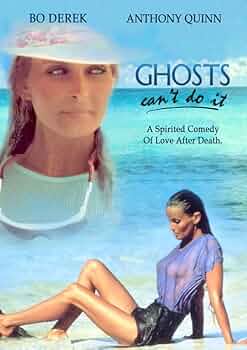
If you find yourself having trouble getting to sleep tonight or tomorrow, you may want to try watching 1989’s Ghosts Can’t Do It.  It won’t necessarily put you to sleep but it will give you something to ponder while you lie in bed and stare up at the ceiling.  For instance, how exactly did this movie get produced without anyone coming up with a better title than Ghosts Can’t Do It?

Bo Derek plays Kate, the wife of elderly billionaire Scott (played by Anthony Quinn, who appears to be drunk in the majority of his scenes).  Despite their age difference, Kate and Scott are deeply in love.  When they’re not playing in the snow and riding horses around the ranch, they’re having sex.  “Sex, sex, sex, sex!” the movie seems to chant in almost every scene.  But then Anthony Quinn has a heart attack, which in this film means that he spends what appears to be hours lying in the snow while trading jokes with Kate.  (It’s important to be able to joke with your partner but if my man had a heart attack, my first reaction would be to get a doctor.)

Scott survives his heart attack but he’s told that, in his weakened state, he can no longer have sex.  Also, he can’t get a new heart because he’s too old.  Facing a future without sex, Scott shoots himself.  Fortunately, Scott’s guardian angel (Julie Newmar) takes sympathy on him and sends his spirt back down to Earth.  Only Kate can see and hear him and, while she’s happy to be reunited with him, they are both upset to discover that ghosts can’t do it.

Scott comes up with a plan.  Kate needs to find a young, virile lover and then murder him so that Scott can possess his body and then he and Kate can have sex whenever they feel like it.  Because that plan makes total sense and there’s no way that it could lead to Kate’s soul being damned to an eternity in Hell, Kate agrees.  Kate travels the world, having sex and looking for a man who will be able to please her after she has murdered him.  Eventually, Kate meets a charming young criminal named Fausto (Leo Damian) and decides that he’ll do.  Scott can’t wait to inhabit Fausto’s body but Kate suddenly realizes that she might not have it in her to be a murderer!  Well, she’ll never know unless she tries.  (I never thought that I would be able to shoot down a drone but then, one night in December….)

While all of this is going on, Kate is handling Scott’s business affairs.  This leads to a meeting with a famous and ruthless businessman named Donald Trump.  Yes, the 45 and 47th President of the United States plays himself in this film.  Kate and Trump meet in a conference room to discuss a deal.  Kate mentions that she read Trump’s book.  Trump smiles and nods.  They have hard-boiled business dialogue.  Kate tells Trump that he’s “too pretty” to be as ruthless as he is.  ‘You noticed,” Trump says.  It’s a pretty dumb scene but, from a historical point-of-view, it’s a reminder of the fact that, long before he was elected President, Trump was already a ubiquitous figure on the American pop cultural scene.

Ghosts Can’t Do It is definitely a misfire, albeit one that is such a huge misfire that it become interesting in the same way that trainwrecks are often interesting.  Almost everything about it, from the dialogue to the attempts at humor to the nearly unreadable font that is used for the opening credits, feels wrong.  There is one brief moment that works, in which Kate dances with her ghost husband and, for the first and only time in the film, we see a flicker of genuine chemistry between Bo Derek and Anthony Quinn.  (Bo Derek, I will mention, is not quite as bad an actress as her reputation suggests.  It’s just that she should have been playing campy soap opera villainesses on late night television as opposed to starring in her husband’s crackpot films.)  Otherwise, this movie is perhaps the worst movie to ever feature both a two-time Oscar winner and a future President.  And, for that reason, it’s a watchable curiosity.  It’s just what insomnia demands.

Previous Insomnia Files:

  1. Story of Mankind
  2. Stag
  3. Love Is A Gun
  4. Nina Takes A Lover
  5. Black Ice
  6. Frogs For Snakes
  7. Fair Game
  8. From The Hip
  9. Born Killers
  10. Eye For An Eye
  11. Summer Catch
  12. Beyond the Law
  13. Spring Broke
  14. Promise
  15. George Wallace
  16. Kill The Messenger
  17. The Suburbans
  18. Only The Strong
  19. Great Expectations
  20. Casual Sex?
  21. Truth
  22. Insomina
  23. Death Do Us Part
  24. A Star is Born
  25. The Winning Season
  26. Rabbit Run
  27. Remember My Name
  28. The Arrangement
  29. Day of the Animals
  30. Still of The Night
  31. Arsenal
  32. Smooth Talk
  33. The Comedian
  34. The Minus Man
  35. Donnie Brasco
  36. Punchline
  37. Evita
  38. Six: The Mark Unleashed
  39. Disclosure
  40. The Spanish Prisoner
  41. Elektra
  42. Revenge
  43. Legend
  44. Cat Run
  45. The Pyramid
  46. Enter the Ninja
  47. Downhill
  48. Malice
  49. Mystery Date
  50. Zola
  51. Ira & Abby
  52. The Next Karate Kid
  53. A Nightmare on Drug Street
  54. Jud
  55. FTA
  56. Exterminators of the Year 3000
  57. Boris Karloff: The Man Behind The Monster
  58. The Haunting of Helen Walker
  59. True Spirit
  60. Project Kill
  61. Replica
  62. Rollergator
  63. Hillbillys In A Haunted House
  64. Once Upon A Midnight Scary
  65. Girl Lost

Lisa Reviews An Oscar Nominee: The Guns of Navarone (dir by J. Lee Thompson)


The Oscar nominations are finally due to be announced on March 15th and the Oscars themselves are scheduled to be awarded at the end of April.  In anticipation of the big event (and the end of this current lengthy awards season), I am going to spend the next two months watching and reviewing Oscar nominees of the past.  Some day, I hope to be able to say that I have watched and reviewed every single film nominated for Best Picture.  It’s a mission that, with each passing year, I come a little bit closer to acomplishing.

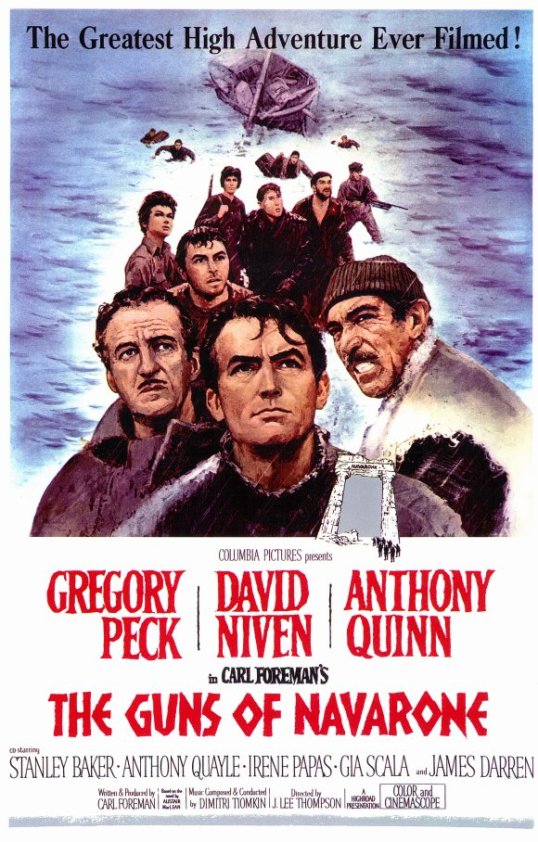
Tonight, I decided to start things off by watching the 1961 best picture nominee, The Guns of Navarone.

The Guns of Navarone takes place in 1943, during World War II.  2,000 British troops are stranded on the Greek island of Kheros and the Nazis are planning on invading the island in a show of force that they hope will convince Turkey to join the Axis powers.  The Allies need to evacuate those troops before the Nazis invade.  The problem is that, on the nearby island of Navarone, there are two massive guns that can shoot down any plane that flies over and sink any ship that sails nearby.  If the British soldiers are to be saved, the guns are going to have to be taken out.

Everyone agrees that it’s a suicide mission.  Even if a commando team manages to avoid the patrol boats and the German soldiers on the island, reaching the guns requires scaling a cliff that is considered to be nearly unclimbable.  Still, the effort has to be made.  Six men are recruited to do the impossible.  Leading the group is Major Roy Franklin (Anthony Quayle), a natural-born leader who is described as having almost supernatural luck.  Franklin’s second-in-command is Keith Mallory (Gregory Peck), an American spy who speaks several languages and who is an expert mountain climber.  Spyros Pappadimos (James Darren) and Butcher Brown (Stanley Baker) are both assigned to the team because they have fearsome reputations as killers, though it quickly becomes clear that only one of them kills for enjoyment.  Colonel Stavrou (Anthony Quinn) is a member of the defeated Greek army and he has a complicated past with Mallory.  Finally, Corporal Miller (David Niven) is a chemistry teacher-turned-explosive expert.  Waiting for the men on the island are two members of the Resistance, Spyros’s sister Maria (Irene Papas) and her friend, Anna (Gia Scala).  The mission, not surprisingly, the mission doesn’t go as planned.  There’s violence and betrayal and not everyone makes it to the end.  But everyone knows that, as tired as they are of fighting, the mission cannot be abandoned.

The Guns of Navarone was a huge box office success when it was originally released, which probably has a lot to do with it showing up as a best picture nominee.  It’s an entertaining film and, watching it, it’s easy to see how it served as a prototype for many of the “teams on a mission” action films that followed.  Though none of the characters are exactly deeply drawn, that almost doesn’t matter when you’ve got a cast that includes actors like Gregory Peck, Anthony Quinn, and David Niven.  At it best, the film works as a triumph of old-fashioned movie star charisma.  Peck is upright and determined to do whatever needs to be done to get the job done.  Quinn is tempermental and passionate.  David Niven is cynical, witty, and very, very British.  Quayle, Darren, and especially Stanley Baker provide strong support.  Before Sean Connery got the role, Stanley Baker was a strong contender for James Bond and, watching this film, you can see why.

Seen today, there’s not a lot that’s surprising about The Guns of Navarone.  It’s simply a good adventure film, one that occasionally debates the morality of war without forgetting that the audience is mostly watching to see the bad guys get blown up.  Some of the action scenes hold up surprisingly well.  The scene where the team is forced to deal with a German patrol boat is a particular stand-out.

The Guns of Navarone was nominated for 7 Academy Awards, including Best Picture.  Though it lost the top prize to West Side Story, The Guns of Navarone still won the Oscar for Best Visual Effects.

Man From Del Rio (1956, directed by Harry Horner)


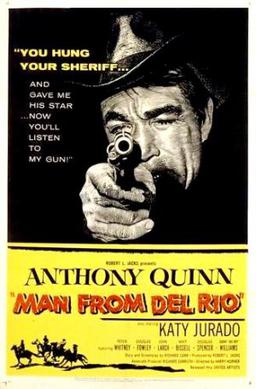
In this western, Anthony Quinn plays Dave Robles, a Mexican gunslinger who rides into the town of Mesa, searching for an outlaw named Dan Ritchey (Barry Atwater).  When Dave finds Ritchey, he discovers that Ritchey has been invited to Mesa by one of the town’s richest men.  Dave doesn’t let that stop him from gunning Ritchey down in the street.

No one in town is upset that Ritchey’s dead.  Instead, they’re impressed with how quick Dave is on the draw.  When Dave runs another group of outlaws out of town, the townspeople decide to hire him as their new sheriff.  Reluctantly, Dave agrees.  At first, saloon keeper Ed Bannister (Peter Whitney) thinks that Dave will be easy to control but Dave surprises him by taking his new position seriously.  Soon, Dave is having to fight off all sorts of bad guys.  Meanwhile, Estella (Katy Jurado), the town’s nurse, goes from distrusting Dave to falling in love with him and begging him to set down his guns and join her in a peaceful life.

Man From Del Rio is a surprisingly good and intelligent B-western.  Anthony Quinn gives a brooding performance as Dave, who is a far cry from the type of upright lawmen who typically appeared in the westerns of the period.  As played by Quinn, Dave Robles is a brute who becomes the film’s default hero just because everyone else is even worse than he is.  Dave may be an outlaw and a killer but he’s neither dishonest nor a sadist, which is what sets him apart from the other bad men who ride through Mesa.  Dave only kills when he feels that he has to and he doesn’t do it for pleasure.  Because he’s inarticulate and uncomfortable with the trappings of civilization, men like Bannister assume that Robles will be easy to control but he proves them wrong.  Quinn’s outstanding performance sets the stage for the type of morally ambiguous western heroes who would become prominent in the late 60s and the 70s.  He gets good support from Katy Jurado and, in the role of the town’s previous sheriff, Douglas Spencer.

Along with an interesting plot, Man From Del Rio also has all of the gunfights and tough talk that a western fan could hope for.  Capped off by Anthony’s Quinn’s star turn, it’s a superb B-western.

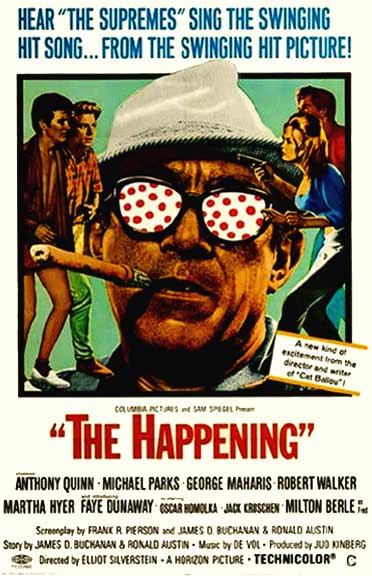
An Offer You Can Refuse #5: The Happening (dir by Elliot Silverstein)


https://www.youtube.com/watch?v=lAupa3dICGs

The 1967 film, The Happening, opens with two “young” people — Sureshot (Michael Parks) and Sandy (Faye Dunaway) — waking up on a Florida beach.  The previous night, they attended a party so wild that the beach is full of passed out people, one of whom apparently fell asleep while standing on his head.  (It’s a happening!)  From the dialogue, we discover that, despite their impeccably clean-cut appearances, both Sureshot and Sandy are meant to be hippies.

After trying to remember whether or not they “made love” the previous night (wow, how edgy!), Sandy and Sureshot attempt to find their way off of the beach.  As they walk along, they’re joined by two other partygoers.  Taurus is played by George Maharis, who was 38 when this film was shot and looked about ten years older.  Taurus is a tough guy who carries a gun and dreams of being a revolutionary and who says stuff like, “Bam!  Et cetera!”  Herbie is eccentric, thin, and neurotic and, presumably because Roddy McDowall wanted too much money, he’s played by Robert Walker, Jr.

Anyway, the four of them end up stealing a boat and talking about how life is a drag, man.  Eventually, they end up breaking into a mansion and threatening the owner and his wife.  Since this movie was made before the Manson murders, this is all played for laughs.  The owner of the mansion is Roc Delmonico (Anthony Quinn).  Roc used to be a gangster but now he’s a legitimate businessman.  The “hippies” decide to kidnap Roc because they assume they’ll be able to get a lot of money for him.

The only problem is that no one is willing to pay the ransom!

Not Roc’s wife (Martha Hyer)!

Not Roc’s best friend (Milton Berle), who happens to be sleeping with Roc’s wife!

Not Roc’s former mob boss (Oscar Homolka)!

Roc gets so angry when he find out that no one wants to pay that he decides to take control of the kidnapping,  He announces that he knows secrets about everyone who refused to pay any money for him and unless they do pay the ransom, he’s going to reveal them.  We’ve gone from kidnapping to blackmail.

Along the way, Roc bonds with his kidnappers.  He teaches them how to commit crimes and they teach him how to be anti-establishment or something.  Actually, I’m not sure what they were supposed to have taught him.  The Happening is a comedy that I guess was trying to say something about the divide between the young and the middle-aged but it doesn’t really have much of a message beyond that the middle-aged could stand to laugh a little more and that the young are just silly and kind of useless.  Of course, the whole young/old divide would probably work better if all of the young hippies weren’t played by actors who were all either in their 30 or close enough to 30 to make their dorm room angst seem a bit silly.

It’s an odd film.  The tone is all over the place and everyone seems to be acting in a different movie.  Anthony Quinn actually gives a pretty good dramatic performance but his good performance only serves to highlight how miscast almost everyone else in the film is.  Michael Parks comes across like he would rather be beating up hippies than hanging out with them while Faye Dunaway seems to be bored with the entire film.  George Maharis, meanwhile, goes overboard on the Brando impersonation while Robert Walker, Jr. seems like he just needs someone to tell him to calm down.

But even beyond the weird mix of acting style, the film’s message is a mess.  On the one hand, the “hippies” are presented as being right about the establishment being full of hypocritical phonies.  On the other hand, the establishment is proven to be correct about the “hippies” being a bunch of easily distracted idiots.  This is one of those films that wants to have it both ways, kind of like an old episode of Saved By The Bell where Mr. Belding learns to loosen up while Zack learns to respect authority.  This is an offer that you can refuse.

And that’s what’s happening!

Previous Offers You Can’t (or Can) Refuse:

  1. The Public Enemy
  2. Scarface
  3. The Purple Gang
  4. The Gang That Could’t Shoot Straight

Insomnia File #42: Revenge (dir by Tony Scott)


What’s an Insomnia File? You know how some times you just can’t get any sleep and, at about three in the morning, you’ll find yourself watching whatever you can find on cable? This feature is all about those insomnia-inspired discoveries!

Earlier today, If you were having trouble getting to sleep around one in the morning, you could have turned over to TCM and watched the 1990 action film, Revenge.

Revenge is an almost absurdly masculine film about two men who are in love with the same woman and who, as a result, end up trying to kill each other and a lot of other people.

Jay Cochran (Kevin Costner) is a U.S. Navy aviator who, when we first see him, is doing the whole Top Gun thing of flying in a fast jet and making jokes while his navigator worries about dying.  Interestingly enough, Top Gun and Revenge were both directed by Tony Scott so perhaps this opening scene was meant to be a self-reference.  Well, regardless of intent, it’s a scene that goes on forever.  This is Jay’s last flight, as he’s due to retire.  We go through an extended retirement party, where everyone has a beer and Jay gives one of those bullshit sentimental speeches that men always give in films like this.

Jay has been invited to estate of Tibbey (Anthony Quinn), who is a Mexican gangster.  Tibbey and Jay are apparently old friends, though it’s never quite explained how the youngish Jay knows the not-very-youngish Tibbey.  Tibbey is one of those gangster who is incapable of doing anything without first talking about what an amazing journey it’s been, going from poverty to becoming one of the most powerful men in Mexico.

Tibbey apparently wants to play tennis with Jay and take him hunting.  Jay decides that he’d rather have an affair with Tibbey’s much younger wife, Miryea (Madeleine Stowe).  Miryea is upset that Tibbey doesn’t want to have children because he feels that pregnancy would ruin her body.  When Tibbey finds out about the affair, he sends Miryea to a brothel and Jay to the middle of the desert.  That’s Tibbey’s revenge!

Except, of course, Jay doesn’t die because he’s Kevin Costner and if he died, the movie would end too quickly.  So, Jay fights his way back from the desert, intent on not only finding Miryea but getting his own revenge on Tibbey!

(It’s hard to take a bad guy named Tibbey seriously, even if he is played by Anthony Quinn.)

Revenge goes on for way too long and neither Tibbey nor Jay are really sympathetic enough to be compelling characters.  You never really believe in Tibbey and Jay’s friendship, so the whole betrayal and revenge aspect of the film just falls flat.  On the plus side, youngish Kevin Costner is not half as annoying as cranky old man Costner.  Anthony Quinn was one of the actors who was considered for the role of Don Corleone in The Godfather and, watching him here, you can kind of see him in the role.  He would have been a bit of a crude Corleone but Quinn had an undeniably powerful and magnetic screen presence.  In Revenge, Quinn chews up and spits out all of the scenery and is not subtle at all but it’s entertaining to watch him because he’s Anthony Quinn.

Anyway, Revenge ends with a tragedy, as these things often do.  Anthony Quinn never says, “Revenge is a dish best served cold,” and that, to me, is a true missed opportunity.

Previous Insomnia Files:

  1. Story of Mankind
  2. Stag
  3. Love Is A Gun
  4. Nina Takes A Lover
  5. Black Ice
  6. Frogs For Snakes
  7. Fair Game
  8. From The Hip
  9. Born Killers
  10. Eye For An Eye
  11. Summer Catch
  12. Beyond the Law
  13. Spring Broke
  14. Promise
  15. George Wallace
  16. Kill The Messenger
  17. The Suburbans
  18. Only The Strong
  19. Great Expectations
  20. Casual Sex?
  21. Truth
  22. Insomina
  23. Death Do Us Part
  24. A Star is Born
  25. The Winning Season
  26. Rabbit Run
  27. Remember My Name
  28. The Arrangement
  29. Day of the Animals
  30. Still of The Night
  31. Arsenal
  32. Smooth Talk
  33. The Comedian
  34. The Minus Man
  35. Donnie Brasco
  36. Punchline
  37. Evita
  38. Six: The Mark Unleashed
  39. Disclosure
  40. The Spanish Prisoner
  41. Elektra

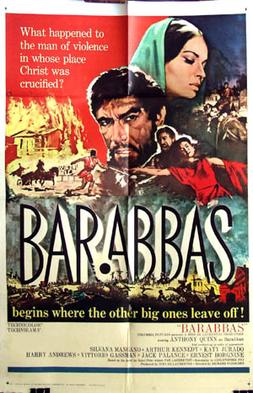
Film Review: Barabbas (dir by Richard Fleischer)


Who was Barabbas?

The simple answer to that is that Barabbas was the prisoner who, according to the Gospels, Pontius Pilate released during Passover.  As the story goes, Pilate gave the people the choice.  He could either release Barabbas or Jesus.  For what crime was Barabbas being held?  The Gospel of Matthew merely says that Barabbas was a “notorious prisoner.”  Mark and Luke both write that he was involved in a recent riot and that he was a murderer.  The Gospel of John refers to him as being a bandit, which may have been another term for revolutionary.  Regardless of what crime he had committed, the people overwhelmingly called for Barabbas to be released and for Jesus to be crucified.  What happened to Barabbas after he was set free is not recorded but has been the subject of a good deal of speculation over the centuries.

(Of course, there are some scholars who believe that the Barabbas story was simply an invention of later writers, designed to shift the responsibility for the crucifixion away from the Romans.  There’s also some who say that Jesus and Barabbas were actually the same person and that the inclusion of the Barabbas story was meant to indicate that Jesus was actually a revolutionary who was working to free Judea from Roman role.  I imagine Dan Brown will eventually base a novel on this theory, so look forward to hearing your grandma debating the historicity of Barabbas at some point in the future.)

Back to the original question, who was Barabbas?

According to the 1961 film of the same name, Barabbas was Anthony Quinn.

Based on a novel by the Nobel Prize-winning Swedish author, Pär Lagerkvist, Barabbas opens with Pilate (Anthony Kennedy) making his infamous offer.  Barabbas or Jesus?  Perhaps the only person more shocked than Pilate by the people’s decision is Barabbas himself.  A brutish and violent man, Barabbas is looking forward to returning to his old life but, as he leaves the prison, he finds himself fascinated by the sight of Jesus stoically carrying the cross, heading to the fate that Barabbas was spared.  Later, Barabbas witnesses the Crucifixion and is shaken when, upon Jesus’s death, the sky turns black.

(Director Richard Fleischer shot the Crucifixion during an actual solar eclipse, so that the sky actually did turn black during filming.  It’s a stunning scene.)

For the rest of his life, Barabbas is haunted by both his narrow escape from death and his subsequent notoriety.  When Barabbas tries to reunite with his former lover, Rachel (Silvana Mangano), he discovers that not only does she now want nothing to do with him but that she has also become a follower of Jesus.  (Later, in a surprisingly graphic scene, Rachel is stoned to death.)  Barabbas becomes convinced that he cannot die and he becomes increasingly reckless in his behavior.  Over the next few decades, he finds himself sold into slavery and forced to spend 20 years working in the harsh sulfur mines of Sicily.  He befriends a Christian named Sahak (Vittorio Gassman) and, with him, is trained to be a gladiator by the sadistic Torvald (Jack Palance).  Eventually, Barabbas finds himself rejected by both the Romans and the Christians while Rome burns all around him.

Barabbas is a film that really took me by surprise.  I’ve seen a lot of Biblical and Roman films from the 50s and 60s and I was expecting that Barabbas would be another sumptuously produced but slow-paced epic, one that would inevitably feature stiff dialogue and overly reverential performances.  I mean, don’t me wrong.  I happen to love spectacle and therefore, I enjoy watching most of those old historical and religious epics.  But still, for modern audiences, these films can often seem rather … well, hokey.

But Barabbas was totally different from what I was expecting.  As wonderfully played by Anthony Quinn, Barabbas wanders through most of the film in a state of haunted confusion.  Even at the end of the film, after he’s met St. Peter (Harry Andrews), Barabbas doesn’t seem to fully understand what he believes or how he’s become one of the most notorious men in Rome.  Quinn plays Barabbas almost like a wild animal, one that has been cornered and trapped by his own infamy.  The more Barabbas struggles against his fate, the more trapped he becomes.  Barabbas may be a brute but, the film suggests, even a brute can find some sort of redemption.  Quinn gets good support from the entire supporting cast.  Jack Palance is perfectly evil as Torvald while Vittorio Gassman, Silvana Mangano, and Ernest Borgnine bring some needed nuance to characters who, in lesser hands, could have just been cardboard believers.

Barabbas is a surprisingly dark film.  When Rachel is stoned, the camera doesn’t flinch from showing just how cruel an execution that was.  Nor does the camera flinch from the violent brutality of the gladiatorial games.  When Barabbas is sold into slavery, the sulfur mines of Sicily are depicted in Hellish detail and practically the only thing that saves Barabbas from spending the rest of his life being smothered under a cloud of sulfur is a giggly Roman woman who decides to buy Barabbas so that he can serve as a good luck charm.  The scenes of Barabbas’s skill of a gladiator are contrasted with the bloodthirsty crowd demanding and cheering death.  Even when Barabbas joins the Christians in the Roman catacombs, he discovers that they want nothing to do with him, suggesting that they believe in forgiveness for everyone but him.  The spectacle of Rome is displayed but so is the terror of what lies underneath the city’s ornate surface.  If Barabbas is occasionally a ruthless or unsentimental character, one need only look at the world he lives in to understand why.

With the exception of a few slow scenes at the start of the film, director Richard Fleischer does a good job of keeping the action moving.  It’s a long film but it never becomes a boring one.  In the end, thanks to Quinn’s performance and the film’s unflinching portrayal of life in ancient Rome, Barabbas is a biblical epic for people who usually don’t like biblical epics.