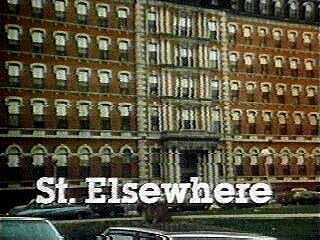
Welcome to Retro Television Reviews, a feature where we review some of our favorite and least favorite shows of the past! On Fridays, I will be reviewing St. Elsewhere, a medical show which ran on NBC from 1982 to 1988. The show can be found on Daily Motion.
This week, the lights go out.
Episode 4.10 “Loss of Power”
(Dir by Mark Tinker, originally aired on December 11th, 1985)
Due to a blizzard, the power has gone down in Boston. At St. Eligius, the backup generator comes to a sputtering and unreliable life. Over the course of the night shift, many things happen in the dark.
Dr. Craig successfully performs lifesaving surgery without being able to use any of the tools that surgeons have come to take for granted. After the grueling operation is completed, he leaves the ER without thanking anyone else. Dr. Wade chases after him and tells him that he should have at least told everyone that they did a good job. Dr. Craig replies that everyone did their job like they were supposed to. Just the fact that he allows them into his operating room should be thanks enough.
Pru Dowler (Amanda Wyss), the developmentally challenged teenager who was caught having sex in her hospital room a few episodes ago, returns with her mother (Terrence O’Connor). Pru has been having stomach pains and morning sickness. After Dr. Morrison confirms that Pru is pregnant, her mother says that Pru will be having an abortion. Morrison tries to talk her out of it, to no avail.
Working at the nurses’ station, Helen Rosenthal gets a summons to appear in court. Lucy is suing over the incident in which Helen slapped her.
Fiscus and Mona have sex in the hospital and, when Fiscus proposes, Mona accepts.
Elliott treats a patient who claims that he’s going to turn into either a vampire or a werewolf at midnight. Elliott thinks that the man belongs in the psych ward, but then he discovers that the man is actually suffering from a real condition that makes it difficult for him to go out during the day. The man spent so much time being made fun of for his nocturnal lifestyle that he eventually decided that he really was a vampire.
And finally, Dr. Westphall is stuck in an elevator with a claustrophobic man (Michael Des Barres) who is also named Donald. Stuck in an elevator with a stranger, Westphall does what he always does. He uses the situation as an excuse to start talking about the volunteer work he did in Ethiopia and how disappointed he is that everyone doesn’t share his attitude when it comes to community outreach. The other Donald responds by talking about the time he was thrown in jail for marijuana possession. Eventually, the other Donald dislocates his shoulder when he throws himself against the elevator doors.
Seriously, can you think of anything worse than being stuck in an elevator with Donald Westphall? Westphall is already one of the most depressing people on the planet. Now imagine being trapped in a confined space with him. Once again, this episode proves that Westphall can take any situation and turn it into a lesson about how he’s right and everyone else is wrong.
That said, I liked this episode. It reminded me of the season-one episode that featured a small group of doctors working the night shift. It was interesting to see how everyone adjusted to the darkness. This was a workplace episode in which we watched as everyone did their best under less than ideal conditions. In the end, it was obvious that Dr. Craig was correct.
His people are the best.
It would just be nice if he would let them know that once in a while.
It’s been two months since I last did one of these. With October approaching and horror movies demanding my attention, I decided to get at least one essay in here before the ghosts and the goblins take over for a month. Fair warning: This is not one of my happier editions of Thoughts On The Culture (and some of the earlier drafts were even angrier!) but these are some things that I’ve been trying to say for a few years now. If not now, when?
25 Years Ago
Every September 11th I decide I am going to write about the anniversary, and almost every year I give up after a few sentences. After the first few sentences, I always find myself getting too angry to continue.
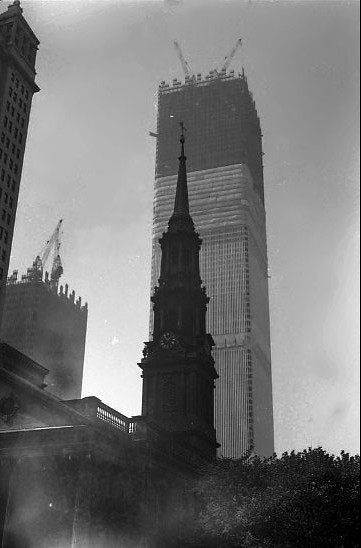
There were 2,977 official victims of 9/11. And then there are the people who died in the days, months, years, and decades afterward, some from illnesses related to the toxic dust at the scene, some from the depression and anxiety that followed the attacks, and many in the wars that were fought after the attack. The world changed that morning. That is a difficult thing to deal with in one essay.
I know that a lot of my friends who are a bit more on the Left than me get upset with the patriotic rituals that surround the anniversary. That is because 9/11 sits badly with their preferred narrative, the idea that America is always at fault, that terrorists are simply activists trying to be heard, and that a capitalist society like this one is always one disaster away from collapse.
9/11 showed something else. I do not care if you dislike American foreign policy. That does not justify killing nearly three thousand innocent people. Subsequent investigations did not reveal saintly militants with a message. They revealed a crew of men whose ideas about sex and morality looked to be permanently stuck in early adolescence. And America did not collapse. That day is full of stories of heroism and sacrifice from the kind of ordinary Americans who usually don’t get much respect from our leaders. A society in which people have individual freedom does not come apart because of a disaster. Meanwhile, to take two countries long beloved by the anti-American Left, Venezuela couldn’t survive the loss of Hugo Chavez and Cuba’s power grid cannot even handle a visit from Hasan Piker.
Heroism
Actor Steve Buscemi was an FDNY firefighter with Engine 55 from 1980 to 1984. The day after the attacks, Buscemi put on his old uniform and worked 12-hour shifts for days on end. He did not have his people alert the media. He did not brag about it later. He did it because he thought it was his duty. A lot of other people, who were not famous, did the same. Father Mychal Judge, a fire department chaplain, died while praying over the bodies of those who had crashed down to the streets. The passengers of UA 93 fought back and, at the cost of their own lives, prevented one of the planes from crashing into the U.S. Capitol. That was America on September 11th.
A Few Words From My Father
My dad thought the attacks showed how weak the terrorists actually were. As he put it, flying a plane into a building does not take a genius. It just takes someone willing to do it. He was not intimidated. He took the lack of immediate follow-up attacks to mean the whole operation was sloppier than it looked on television. He thought the terrorists had gotten lucky, and that their leaders would be blown to oblivion soon enough. At the time, everyone assumed he was wrong. “Well, not many people agree with you on that,” one of my cousins said. It turned out my father was largely right.
Who Is More Traumatized?
This week, on Twitter or X or whatever you want to call it, a lot of Zoomers have been complaining that 9/11, an event which they were not even around for, is getting too much attention, and that the COVID years were actually the worst trauma.
The trauma from 9/11 came from not knowing what the future held, and from the feeling that another attack could come at any moment. On 9/11, even those of us who did not live in New York watched the attacks unfold on television. I saw people jumping to their deaths. I saw, and heard, the towers fall. Those images have never left. On that day, they were in the whole country’s head. As for COVID, how traumatized you were depended a great deal on which state you were living in. Not everyone was set free from the lockdowns at the same time.
The weird thing, to me, is this attitude that trauma is a competition. Nothing seems to scare certain people more than the fact that not everyone looks at the world the same way they do.
Is It Okay To Lighten The Mood?
It’s always okay to lighten the mood. In fact, I think there are times when writers have a duty to lighten the mood. Sometimes, I think it’s too tempting (and perhaps too easy) to simply obsess on the bad at the expense of the good. It’s easy to focus on the darkness but we need to be willing to accept that there are reasons to be happy as well. For instance, Big Brother is nearly over. Seriously, this has been a very frustrating season of the show that I love to moderately dislike. This season hasn’t so much been bad as it’s just been overwhelmingly bland. It’s not good enough to get excited about but it’s not really bad enough to hate. Fortunately, it’ll all be over on October 1st, just in time to celebrate the scary season!
Admittedly, this is mostly good news for me and my friend Jim. I introduced him to Big Brother last season and I don’t think he’s ever going to forgive me.
On a Happier Note
Let’s end this edition on a hopeful note. I am already busy watching and reviewing films for this year’s Horrorthon. October is my favorite time of the year, and I look forward to celebrating it with all of you!
“Alex! Alex! You’re walking away from history! History! Did Chris Columbus say he wanted to stay home? No! What if the Wright Brothers thought that only birds should fly?” — Centauri
The Last Starfighter is one of the most purely enjoyable science-fiction adventures of the 1980s: earnest, inventive, occasionally corny, and driven by the kind of wide-eyed imagination that modern blockbusters too often confuse with sheer scale. Directed by Nick Castle, the 1984 film builds an entire intergalactic adventure around a premise that could have been dismissed as a gimmick: an arcade champion discovers that his favorite game is actually a recruitment test for a real war in space. Instead of treating that premise ironically, the film commits to it wholeheartedly, and that sincerity is ultimately what makes it endure.
Lance Guest stars as Alex Rogan, a teenager living in the Starlite Starbrite trailer park with his mother and younger brother, Louis. Alex is smart, resourceful, and visibly restless. He wants to get out of his small-town surroundings, attend college, and build a better future, but financial strain and family responsibility keep making those ambitions seem less realistic. His one reliable escape comes from an arcade machine outside the local store called The Last Starfighter. Alex plays constantly, eventually achieving a record score that attracts the attention of the game’s mysterious creator, Centauri.
Robert Preston’s Centauri is one of the film’s great pleasures. He is an interstellar recruiter who behaves like a flamboyant carnival salesman, arriving in Alex’s life with a strange vehicle, flashy clothes, a rapid-fire sales pitch, and a proposition that sounds completely insane. Centauri reveals that The Last Starfighter is not merely a video game; it is a test designed to identify young people with the reflexes, tactical instincts, and courage needed to become Gunstar pilots for the Rylan Star League. Alex has not just beaten a difficult arcade game. He has qualified to defend an entire civilization from the Kodan Armada.
That central idea remains the movie’s strongest asset. It transforms a familiar adolescent fantasy into something emotionally resonant. Alex is not gifted with a magical sword, superpowers, or an ancient royal lineage. He is selected because he became exceptionally skilled at something the adults around him would probably regard as a waste of time. His ability to master a video game becomes proof that he has discipline, intelligence, hand-eye coordination, and the ability to make decisions under pressure. For anyone who grew up playing arcade games, it is an irresistible fantasy: the thing you are good at for fun might one day turn out to matter more than anyone realizes.
The film understands, however, that being offered a larger life is not the same as being ready for it. Alex initially reacts to the truth with disbelief and fear rather than instant heroism. He wants to return home. He assumes there has been a mistake. That response helps ground the movie, because Alex is not a prepackaged action hero. He is a teenager who has dreamed of escaping his circumstances but has never seriously considered the sacrifices that escape might require. It is easy to want a more exciting future when it is only an idea. It is harder when that future involves leaving your family, crossing the galaxy, and possibly dying in a war you barely understand.
Lance Guest gives Alex enough insecurity and frustration to make his eventual growth satisfying. Alex can be impatient and occasionally self-centered, but he never comes across as unlikable. He feels trapped, and the film makes that frustration understandable. His conflict is not simply whether he can destroy enemy ships; it is whether he can accept that he deserves a larger destiny than the one he has assumed is available to him. By the time he decides to fight, he has moved beyond wanting adventure as an escape. He has chosen to take responsibility for something greater than himself.
Catherine Mary Stewart is also appealing as Maggie Gordon, Alex’s girlfriend. Maggie is not given an enormous amount to do, but she has more personality than the standard passive romantic interest in many 1980s adventure films. She cares deeply about Alex, yet she also has every reason to be hurt and confused when he suddenly disappears and begins acting strangely. Her scenes with Beta Alex, the android duplicate sent to take Alex’s place on Earth, provide some of the movie’s most amusing moments. Beta Alex looks exactly like him, but his behavior is just strange enough to create an entertaining mixture of comedy and unease.
The Beta Alex subplot is one of the film’s cleverest touches because it allows the story to explore Alex’s absence without simply abandoning the Earthbound characters. Beta Alex is a convincing physical duplicate, but he cannot quite replicate the nuances of being human. His overly literal responses, awkward attempts at social interaction, and bizarre behavior around Maggie make him a memorable comic creation. The device also reinforces the contrast between Alex’s old life and the extraordinary new situation he has been pulled into. While the real Alex is in space facing a galactic conflict, the people at home are left trying to make sense of a version of him that seems familiar but fundamentally wrong.
Robert Preston’s performance gives the entire movie energy whenever Centauri appears. He could easily have become an irritating eccentric, but Preston makes him funny, charismatic, and unexpectedly warm. Centauri sees Alex’s potential before Alex sees it himself. Beneath the fast talking and theatrical mannerisms is a real belief in the people he recruits. He does not merely need another pilot; he genuinely wants Alex to become the person he is capable of being. Preston’s presence adds an old-fashioned show-business charm to a film otherwise built around futuristic hardware and computer-generated spacecraft.
Dan O’Herlihy is equally important as Grig, the reptilian alien navigator assigned to work with Alex. Grig initially seems like the typical stern mentor figure, but he gradually becomes one of the movie’s most likable characters. He has experience, discipline, and a personal history with the war that gives the conflict some added seriousness. His partnership with Alex works because they begin from very different places. Grig is a hardened veteran who has seen the cost of battle, while Alex is an overwhelmed rookie who still wants to go home. As they learn to trust each other, their relationship becomes the heart of the space-adventure material.
The villains are broad but effective. Xur and the Kodan Armada are not psychologically complex antagonists, yet the movie does not need them to be. Their purpose is to represent a threat large enough to force Alex into a defining choice. Xur’s willingness to betray the Star League and sacrifice innocent lives for power makes him an appropriately clear villain for this kind of adventure. The conflict is straightforward: a small group of defenders must stand against an overwhelming enemy force, and Alex must decide whether he will be one of those defenders.
The visual effects are perhaps the most historically fascinating part of The Last Starfighter. The film was an early showcase for computer-generated imagery, using digital effects for its spacecraft, alien environments, and space-combat sequences. At the time, this was revolutionary. Seen today, the visual effects are obviously dated. The ships have a smooth, artificial quality, the textures are basic, and the movement lacks the weight and complexity audiences expect from modern computer animation. Yet there is still something charming about them. They represent a major transitional period in science-fiction filmmaking, when filmmakers were beginning to discover what computers could do for cinematic spectacle.
The early CGI gives the movie a distinctive visual identity rather than simply making it look obsolete. The Gunstar fighter, the Kodan fleet, and the distant alien landscapes have the clean, geometric appearance of an advanced arcade game brought to life. That is fitting for a story about a teenager whose gaming skills translate into real combat ability. The computer-generated imagery may not have the tactile realism of the practical miniature work seen in films such as Star Wars or Blade Runner, but it has an important place in the history of visual effects. The movie was imagining a future that the technology of its day could only partially create, and that ambition remains visible in every digital battle.
The Gunstar itself is a memorable piece of science-fiction design. It looks futuristic while still retaining the simplicity of a classic arcade spaceship, and the cockpit scenes effectively sell the sensation of Alex being thrown into something far beyond his experience. The climactic use of the “Death Blossom” maneuver is especially satisfying because the film treats it as a genuine last resort. It is the cinematic equivalent of unleashing a devastating power-up at the exact moment an arcade game seems impossible to win. The sequence is flashy, uncomplicated, and immensely fun.
What makes The Last Starfighter last is not its special effects alone, nor is it just nostalgia for the arcade era. The movie works because it is fundamentally optimistic. It believes that potential can emerge from unlikely places and that someone who feels ignored, trapped, or underestimated may still possess the ability to do something remarkable. Alex is not chosen because he is already fearless. He becomes heroic because he eventually chooses to act despite being afraid.
The film is not perfect. Its dialogue can be cheesy, some characters are thinly developed, and the dated effects may be difficult for viewers accustomed to modern CGI. Even so, those imperfections are part of its charm. The Last Starfighter is colorful, sincere, and unashamedly enthusiastic about its own premise. It remains a lovable science-fiction adventure because it takes the dreams of a video-game-playing teenager seriously. It asks viewers to imagine that the skill everyone dismisses, the hobby that feels like an escape from ordinary life, might actually be the first sign that they are capable of something far greater.
As some of our regular readers undoubtedly know, I am involved in a few weekly watch parties. On Twitter, I host #FridayNightFlix every Friday and I co-host #ScarySocial on Saturday. On Mastodon, I am one of the five hosts of #MondayActionMovie! Every week, we get together. We watch a movie. We tweet our way through it.
Tonight, at 10 pm et, I will be hosting #FridayNightFlix! The movie? 1993’s Matinee!
If you want to join us this Friday, just hop onto twitter, find Matinee on Prime, start the movie at 10 pm et, and use the #FridayNightFlix hashtag! I’ll be there happily tweeting. It’s a friendly group and welcoming of newcomers so don’t be shy.
Produced by Martin Bregman, directed by Brian De Palma, written by Oliver Stone, and starring Al Pacino, the 1983 remake of Scarface is one of the best-known, most iconic gangster films ever made. It opened to mixed reviews but it’s gone on to be recognized as a classic. Everyone can quote the script: “Say hello to my little friend!” “In this country, you gotta make the money first. Then when you get the money, you get the power. Then when you get the power, then you get the women.” “Say goodnight to the bad guy!”
Scarface starts with one of my favorite opening scenes of all time. Powered by Giorgio Moroder’s score, the opening credits of Scarface play out over footage of the real-life Mariel boatlift. Combined with footage of Fidel Castro ranting that Cuba does not need the Marielitos, this opening gives real-world credibility to everything that follows. We then segue from the actual boatlift to Al Pacino as Tony Montana, answering questions with that shit-eating grin on his face.
Listen to the interrogation scene carefully and you’ll hear both Charles Durning and Dennis Franz, dubbing the lines of the actors who played the immigration agents.
4 Or More Shots From 4 Or More Films is just what it says it is, 4 shots from 4 of our favorite films. As opposed to the reviews and recaps that we usually post, 4 Shots From 4 Films lets the visuals do the talking!
Today is the birthday of Brian De Palma and that means that it is time for….
6 Shots From 6 Brian De Palma Films
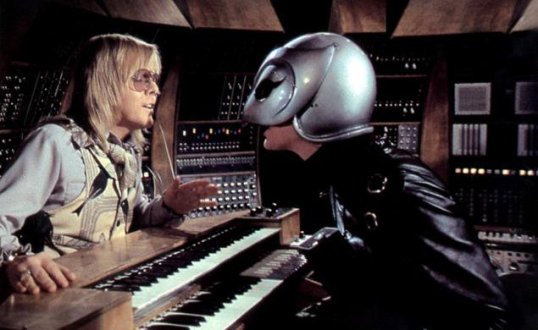
Phantom of Paradise (1974, dir by Brian De Palma, DP: Larry Pizer)
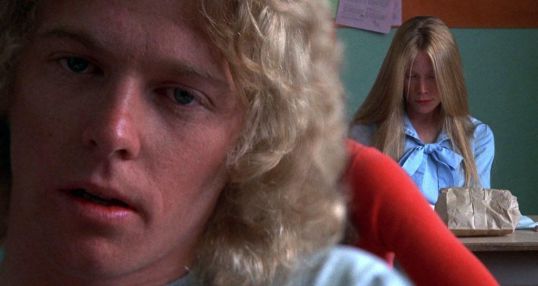
Carrie (1976, dir by Brian De Palma, DP: Mario Tosi)
Dressed to Kill (1980, dir by Brian De Palma, DP: Ralf D. Bode)
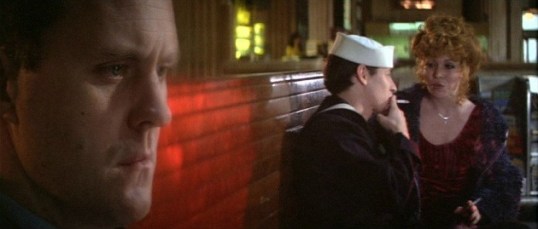
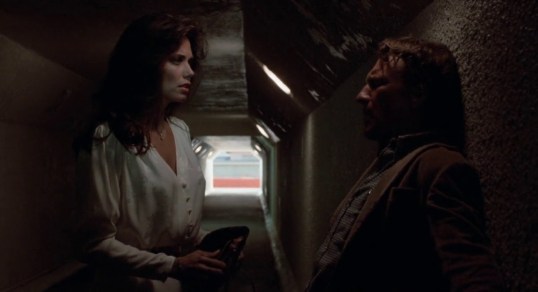
Blow Out (1981, dir by Brian De Palma, DP: Vilmos Zsigmond)
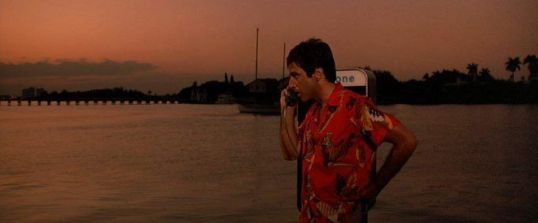
Scarface (1983, dir by Brian De Palma, DP: John A. Alonzo)
Body Double (1984, dir by Brian De Palma, DP: Stephen Burum)
Welcome to Late Night Retro Television Reviews, a feature where we review some of our favorite and least favorite shows of the past! On Thursdays, I will be reviewing Hunter, which aired on NBC from 1984 to 1991. The entire show is currently streaming on Tubi and several other services!
This week, we begin the second season!
Episode 2.1 “Case X”
(Dir by David Soul, originally aired on September 21st, 1985)
Adult-film actresses are turning up dead all over Los Angeles. Hunter and McCall have the case, and it does not take them long to see the pattern. The killer is sleazy photographer Tony Cochran (Leo Rossi), and the women are being supplied to him by former adult star turned talent agent Andrea Burden (Rita Taggart). Knowing who the murderer is and having the evidence to arrest him are two different things. After Tony murders his brother (Sam Anderson) and frames him for the crimes, it looks as if Tony might walk.
So, of course, McCall goes undercover. She joins the fitness club where Andrea works out and looks for girls. She poses in lingerie for Tony. (Just as in the first season, McCall going undercover seems to largely mean McCall wearing less clothes than usual.) And when Tony kidnaps her, it is up to Hunter to rescue her and fill Tony with lead.
In other words, the second season of Hunter opens in a style familiar to anyone who watched the first. Hunter is still a shoot-first rebel. McCall is still his continually in-peril partner. The bad guy still underestimates this violent duo. While Hunter and McCall solve the crimes and kill the villains, Bernie Terwilliger keeps trying to write them up for every infraction imaginable. In this episode, Terwilliger counts seven violations of police policy on the part of Hunter and McCall. I counted a bit more but maybe Terwilliger was trying to be charitable.
The one real change between seasons is a new commanding officer. John Amos has been replaced by Bruce Davison. As Captain Wyler, Davison wears a three-piece suit, never has a hair out of place, and bristles when Hunter refuses to follow orders. That said, Wyler congratulates Hunter at the end of the episode and tells Terwilliger to back off the ethics investigation. For once, Hunter has a boss who is not actively trying to get him kicked off the force.
The episode itself is pretty predictable. As soon as Leo Rossi’s name appeared in the guest credits, it was easy to guess who the murderer would turn out to be. Hunter is not a show about complex mysteries or shocking twists. It is a show about the chemistry between Fred Dryer and Stepfanie Kramer, and about the promise that the bad guys will be punished. This episode delivered on both.