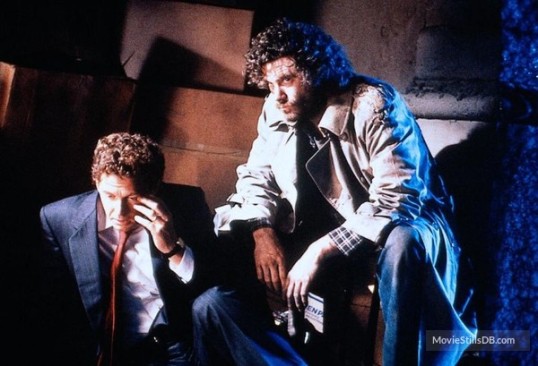
Breaker One-Nine, Breaker One-Nine, it’s time to put the hammer down with a pair of Trucksploitation flicks from the sensational 70’s! The CB/Trucker Craze came to be because of two things: the gas crisis of 1973 and the implementation of the new 55 MPH highway speed limit imposed by Big Brother your friendly Federal government. Long-haul truckers used Citizen’s Band radios to give each other updates on nearby fueling stations and speed traps set up by “Smokeys” (aka cops), and the rest of America followed suit.
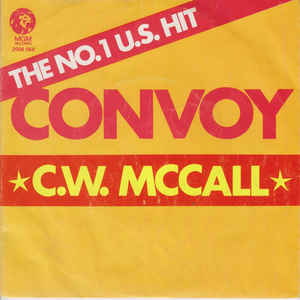
Country singer C.W. McCall had a massive #1 hit based on CB/trucker lingo with “Convoy”, and the trucker fad was in full swing. There had been trucker movies made before – THEY DRIVE BY NIGHT, THIEVES’ HIGHWAY, HELL DRIVERS, and THE WAGES OF FEAR come to mind – but Jonathan Kaplan’s 1975 WHITE LINE FEVER was the first to piggy-back on the new gearjammer…
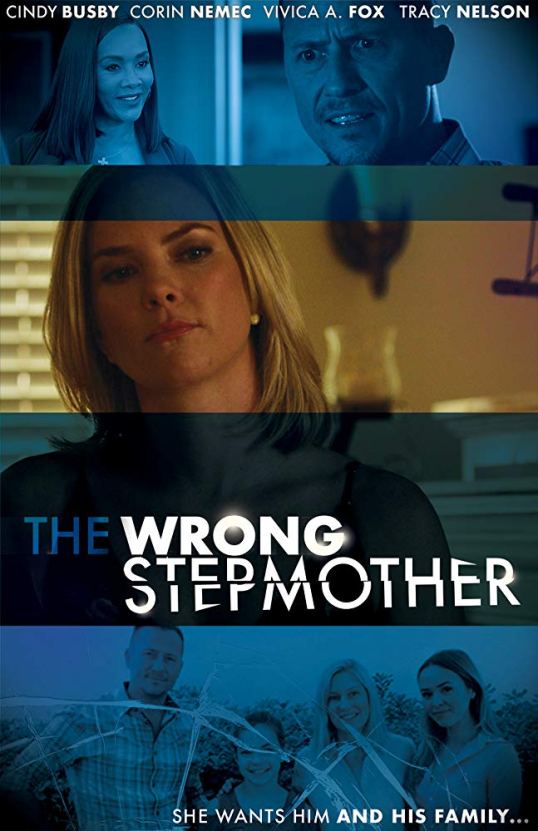
Actually, Maddie (Cindy Busby) is not a mother, though she would like to be. She not even a stepmother, despite what the title says. Instead, she’s just dating the recently widowed Michael (Corin Nemec). If she does end up marrying Michael, Maddie will become a stepmother — perhaps even a WRONG stepmother — to his two daughters, Lilly (Calli Taylor) and Nicole (McKinley Blehm).
It doesn’t take Lilly long to realize that there’s something off about Maddie. For one thing, she catches Maddie trying to check her social media. Then she overhears Maddie claiming to be her mother. And finally, Maddie changes up Lilly’s college admission essay. See, Lilly wrote about how much her late mother influenced her. Maddie, however, changes it into an essay about how much Lilly loves her future stepmother.
Yes, Maddie has some issues. As we discover at the start of the film, she has a history of stalking people. About halfway through the film, she murders two people. Whenever you’re watching a film on Lifetime, you know someone’s going to get murdered at exactly halfway through the film. You can set the time by it.
As with all of Lifetime’s “Wrong” films, Vivica A. Fox has a small role. In this one, she plays Ms. Price, the high school guidance counselor who is extremely unimpressed by Lilly’s college admissions essay. When Ms. Price confronts Lilly about how unimpressive her essay was, Fox delivers the lines with such subtle fury and annoyance that it brought back a lot of high school memories for me. As played by Fox, Ms. Price is the type of high school counselor who scares you to death but who also changes your life for the better. If Ms. Price had been my counselor, I definitely wouldn’t have spent so much time skipping class and shoplifting makeup at Target.
Anyway, the main complaint that you always hear about Lifetime films is that they’re all exactly the same but that’s actually their appeal. They’re fun to watch, precisely because 1) they’re predictable and 2) the viewer is always going to be smarter than the people in the movie. I mean, we can take one look at Maddie and say, “Okay, don’t let her in the house.” However, Michael’s not that smart and, if he was, we really wouldn’t have a movie. Sometimes, you just have to stop crying about plausibility and enjoy what you’re watching.
The Wrong Stepmother gets a big boost from the casting of the always likable Corin Nemec as Michael. I mean, it’s pretty much impossible not to root for a character played by Corin Nemec, even if that character is way too trusting of someone who he met on a dating app. Meanwhile, Cindy Busby is properly psychotic as Maddie and, of course, you’ve got Vivica A. Fox changing lives as Ms. Price.
The Wrong Stepmother is an entertaining Lifetime film. Watch it with your snarkiest friends.
According to the good people at Checkiday, the proper way to celebrate National Bikini Day is to put on a bikini and head to the beach! Unfortunately, I don’t live anywhere near the beach so instead, I’ve just been cleaning the house and taking out a wasp nest while wearing a bikini, which is an experience that’s both frightening and empowering at the same time.
(Seriously, we had a huge wasp nest that showed up overnight over the front door. I went outside and sprayed the nest, which resulted in the porch getting covered with dying and angry wasps. Of course, that’s when I realized that, because of the whole bikini thing, I had put on a t-shirt but I’d forgotten to put on shoes so I was barefoot, the backdoor was locked, and I didn’t have my keys on me, again because of the whole bikini thing. Rather than walking in bare feet across a porch covered by angry wasps, I literally crawled through a window to get back in the house, at which point I put on my shoes, went outside, and swept up all the wasps and the nest. It’s been quite a day!)
Anyway, as we often do here at the Shattered Lens, we’re going to recognize both this holiday and four of our favorite movies! Here, in honor of National Bikini Day, are….
Franklyn Carlysle (William Katt) is a fine, upstanding city councilman, with a rich wife (Wendy MacDonald) and a bright future. Carlysle wants to be mayor and he’s come up with the perfect scheme. He’s going to work with a developer to renovate Dante’s Square, the city’s notorious red light district.
One night, while Franklyn is driving through Dante’s Square, he’s carjacked. Someone knocks him out before stealing both his car and his wallet. When Franklyn comes to, he discovers that he’s being watched over by Sam Silver (played by Rick Dean). Sam is apparently a homeless philosopher, who tells Franklyn that he’s been taking life too seriously and that sometimes, you just have to yell, “Fuck this shit!” at the top of your lungs. When Franklyn asks where he can find a phone so he can call the cops, Sam leads Franklyn to the Yin Yang Club. It’s there that Franklyn sees Lynne (Maria Ford), a dancer to whom he is immediately attracted. Suddenly, his missing car and his stolen wallet no longer seem that important. With his marriage already in trouble, Franklyn returns to the club the next night.
Franklyn soon discovers that Lynne has a thing for being choked during sex. Even though Sam keeps telling him things like, “Nothing wrong with the dark – you spend half your life in it – trouble is, most people keep their eyes closed,” Franklyn is worried that his affair with Lynne will derail his mayoral ambitions. However, when Lynne shows up dead, Franklyn finds himself dealing with a much bigger problem. He’s now the number one suspect in her murder. Things just get stranger as Franklyn discovers that he wasn’t the only one cheating, meets a masked, gun-wielding stripper, and discovers that Sam might not even be of this world.
William Katt and Rick Dean in Naked Obsession
It can be said, without fear of hyperbole, that Naked Obsession in the Citizen Kane of Roger Corman-Produced Straight-To-Video Maria Ford-Stripper movies. This is largely due to the performance of the late, great Rick Dean in the role of Sam. Sam’s not just just a homeless drunk with a motormouth. As played by Dean, he’s a philosopher king and, the film hints, much more. He comes across like an angel of the devil and he’s exactly what Franklyn Carlysle needs to liven up his too safe life. Maria Ford, who specialized in playing troubled strippers in Roger Corman films, gives one of her best performances and, in the role of Franklyn’s secretary, Elena Sahagun, has some great scenes too. Finally, William Katt classes up the joint, giving a real performance as Franklyn instead of just sleepwalking through the film. Dan Golden’s direction emphasizes the surreal and, by the time the end credits roll, Naked Obsession will leave you wanting to spend a night or two at Dante’s Square.
Like so many classic films from the golden age of late night Cinemax. Naked Obsession has never been released on DVD or Blu-ray but it can be found on YouTube.
A filmmaker is sometimes only as good as their last film. If you mentioned director Rian Johnson’s name around 2012, it was probably met with wild applause. After all, he gave us the time travelling thriller Looper, with Bruce Willis, Emily Blunt and Joseph Gordon-Levitt.
Mentioning Johnson now breeds a bit of contempt after his outing on Star Wars: The Last Jedi. The film was hit with reviews ranging from daring to awful, and most of the Star Wars fanbase don’t think of what he’s done there.
With his newest film, Knives Out, Johnson looks like he’s moving forward. The film appears to be a classic whodunit with a fantastic cast. Christopher Plummer, Chris Evans, Ana de Armas, Jamie Lee Curtis, Toni Collette, Daniel Craig, Don Johnson, Lakeith Stanfield, Michael Shannon, Katherine Langsford, and Jaeden Martell round out the cast list, which is pretty great overall. The story seems to cover the murder of a patriarch, and a family of suspects which reminds me of the classic Infocom game, Deadline. Hoping for the best with this one.
The other night, I watched 2018’s The House That Jack Built on Showtime and I have to say that, sitting here the morning afterwards, I kind of wish that I hadn’t. It’s a well-made film and there’s a bit more going on underneath the surface that some other reviews might lead you to suspect but, at the same time, it’s also deeply unsettling and, even by the standards of Lars von Trier, disturbing. It’s not a film to watch right before you go to bed, nor is it a film to watch at the beginning of a long week. I’m still feeling the after effects of having watched this movie and I imagine I’ll probably be jumpy for the next few days.
The title character, Jack (Matt Dillon), is someone who loves to talk about himself. He’s an engineer but he wishes he was an architect. He thinks of himself as being an artist and an intellectual and he has no hesitation about informing you that he’s smarter than just about everyone else on the planet. He’s annoyed that he’s not better-known. He feels that his work is underappreciated.
The House that Jack Built runs two and a half hours and, as a result, we spent a lot of time listening to Jack talk. One thing that quickly becomes apparent is that Jack knows a lot but he understand very little. He spends a lot of time talking about Glenn Gould, Goethe, and Nazi architecture but his thoughts on them are rather shallow and predictable. When we see flashbacks to Jack’s youth, we don’t see any signs of the intelligence that he claims to possess as an adult. Instead, we just see a scowling country boy who used to abuse animals. Jack may insist on calling himself “Mr. Sophistication” but there’s really nothing sophisticated about him and one gets the feeling that his faux intellectualism is something that he developed to justify the fact that he’s a sociopath and a serial killer. Jack claims to have murdered at least 60 people and he also says that each murder was a work of art. If art reflects the time and place in which it was made than how can we condemn Jack for reflecting the soullessness and cruelty of the real world in his own creations? The answer, of course, is that we can very easily condemn Jack. Jack uses the state of the world to justify his actions but that doesn’t mean we have to buy what he’s selling.
The House That Jack Built is built around a lengthy conversation between Jack and an enigmatic character named Verge (Bruno Ganz). Jack shows Verge the “five incidents” that, over the course of 12 years, have defined who Jack is as a person and a serial killer. The five incidents feature Jack killing everyone from a stranded motorist (Uma Thurman) and a grieving widow (Siobhan Fallon Hogan) to a terrified mother and her two sons. Jack has a brief and toxic relationship with one of his victims (heart-breakingly played by Riley Keough) and it leads to an act of violence that’s so disturbing that I don’t even want to relive it long enough to write about it. Throughout it all, Jack tries to justify himself while Verge continually calls him out on his bullshit. Watching the film, I found myself very thankful for Verge. The film would have been unbearable if it has just been Jack bragging on himself, unchallenged. Verge not only calls out Jack but also anyone who would idolize someone like Jack. At times, the film itself seems to be ridiculing the whole idea of the Hannibal Lecter-style serial killer. There’s nothing suave or witty about Jack. He’s just a loser with no soul.
Even though I was watching the R-rated version (as opposed to the unrated director’s cut), the murders were still disturbingly graphic. But what really made the film unsettling was its peek into Jack’s nihilistic worldview. As much as he may try to convince you otherwise, it soon becomes clear that there’s nothing going on inside of Jack’s head. When Jack isn’t suffering from delusions of grandeur, he’s mired in self-pity. (Listening to Jack, one is reminded of the infamous BTK Killer, who spent hours in court describing his murders without a hit of emotion but who later broke into tears when informed that he would be spending the rest of his life in prison.) Unlike most movie serial killers, Jack doesn’t have a flamboyant origin story or any sort of trauma-related motive for his crimes. He kills because he wants to. Jack is capable of being superficially charming. As a sociopath, he’s learned how to put people at ease. But there’s nothing behind that charm. When he performs some post-mortem surgery to give one of his victims a permanent smile, the results are grotesque because Jack has no idea what a real emotion looks like. (Jack weakly waves at the body, as if he’s trying to teach himself how to act like a normal person.)
Throughout the film, we get a lot of stock footage. (It’s justified by the fact that Jack is talking about art and history, two subjects about which he only has a surface knowledge.) Interestingly enough, we also get several clips that were lifted from Von Trier’s previous films. At one point, Jack passes a cabin that some viewers will recognize from Antichrist. While Jack tries to dispose of a body, David Bowie’s Fame plays on the soundtrack and it’s hard not to be reminded of how Bowie’s Young Americans played over the closing credits of both Dogville and Manderlay. We’re left to wonder if Jack is meant to be, in some way, a stand-in for Von Trier. Much like Jack, Von Trier is often accused of using his own artistic pretensions to justify a nihilistic and misogynistic worldview. It’s easy to imagine Verge as a stand-in for some of Von Trier’s fiercest critics. What then are we to make of the fact that the film also portrays Verge as being correct and Jack as being (literally) bound for Hell? Is Von Trier telling us that, as much as some people may dislike him and his work, at least he’s not a serial killer like Jack? Is Von Trier attacking himself? Or is Von Trier perhaps satirizing his own controversial persona? Perhaps all three are correct.
By the film’s end, Jack is in Hell. Interestingly enough, the portal to Hell is found in a house that’s made up of the bodies of Jack’s many victims. Verge — short for Virgil, of course — gives him a tour. When Jack sees a broken bridge, Virgil informs him that it once led to Heaven but it can’t be crossed now. However, Jack is convinced that he can climb over a cliff and make his way to Heaven. Virgil assures Jack that many have tried but none have succeeded. Jack, of course, tries and, needless to say, he doesn’t make it. In the end, redemption is impossible and yet you wonder how, in a world with Heaven and, one assumes, God, Jack even came to exist in the first place. If Jack had channeled his sociopathic nature into something more productive than murder, would he have been allowed into Heaven?
As I said, it’s a well-made film but it’s also deeply unsettling. I’m probably going to be jumping at my own shadow for at least a week or two. At the very least, I’m not answering the door for anyone….
From all of the writers and the cat here at the Shattered Lens: Happy 152nd birthday, Canada!
O Canada! How we love you! It’s not just that your people are nice and your basketball teams are impressive. It’s not just that your wilderness is beautiful and your cities are gorgeous. It’s also that so many great movies have been made by or have starred Canadians! The first Canadian film was produced in 1897 but the Canadian film industry really took off in the 70s and the 80s. That’s when Canadian directors like David Cronenberg, Atom Egoyan, and others started to make films that were both uniquely Canadian and, at the same time, universal in their appeal. At the same time, that’s also when Canadian generous tax shelter laws lured a countless number of low-budget productions to the country. Though these films were often disguised as being American productions, they gave early work to several talented Canadian actors and technicians.
Here’s just a few of our favorite Canadian films:
The Canadian film industry has continued to grow, giving us everyone from James Cameron and Denys Arcand to Xavier Dolan and Denis Villeneuve. Along with some wonderful films, Canada has also given us Degrassi and a countless number of Lifetime movies! No wonder the flame-haired one loves Canada so much!
So, Canada — Happy Birthday! Thank you for being you and thank you for not taking it personally that time America tried to invade you back in 1812. We love you, Canada!
We’re at the halfway mark as far as 2019 in concerned, which means that the Oscar race is about to start getting a lot more clear. Soon, instead of random guesses, we’ll be making educated guesses. Then again, it is important to remember that — at this time last year — no one thought Bohemian Rhapsody would score a best picture nomination. In fact, only a few people have ever heard about Green Book.
So, as always, take my monthly predictions with a grain of salt. They’re based on a combination what I’m hearing (and reading) from other film people and my own instincts (for whatever their worth). To be honest, I suppose that these predictions reflect my own prejudices as well. I’d love to see Terrence Malick honored, for instance. I also think that it’s a crime that Amy Adams hasn’t ever won an Oscar so I have her listed, even though I fear she might be miscast as the lead in The Woman In The Window. At the same time, I’m bored with Meryl Streep getting nominated just for showing up so I left her out of my predictions, even though she has two high-profile films coming out later this year.
To see how my thinking has (or hasn’t) evolved, check out my predictions for January, February, March, April, and May!
And now, here are the predictions!
Best Picture
1917
A Beautiful Day In the Neighborhood
Cats
Fair and Balanced
Harriet
A Hidden Life
The Irishman
JoJo Rabbit
Once Upon A Time In Hollywood
The Peanut Butter Falcon
Best Director
Kasi Lemmons for Harriet
Terrence Malick for A Hidden Life
Sam Mendes for 1917
Martin Scorsese for The Irishman
Quentin Tarantino for Once Upon A Time In Hollywood
Best Actor
Antonio Banderas in Pain & Glory
Leonardo DiCaprio in Once Upon On A Time In Hollywood
You couldn’t go anywhere in 1984 without hearing “On the Dark Side” blaring from a car radio or your neighborhood bar’s jukebox. That’s thanks in large part to audiences rediscovering 1983’s EDDIE AND THE CRUISERS via repeated showings on HBO, turning the film into an instant cult classic and veteran Providence-based rockers John Cafferty & The Beaver Brown Band into FM-radio favorites. The film hadn’t done well when first released to theaters, but exposure on the fairly-new medium of Cable TV garnered new fans of both it and Cafferty’s soundtrack album.
Investigative reporter Ellen Barkin looks into the mysterious death of Eddie Wilson (played by Michael Pare’), lead singer of The Cruisers, whose death in a car accident is shrouded in secret, as the body was never found. Was it suicide? murder? or is Eddie still alive? She digs deep to uncover the facts about what happened that fateful night…
With the exception of the Marvel films, franchises have struggled to live up to box office expectations during 2019. Even Toy Story 4 is considered to have had a “soft” opening.
Here’s the final trailer, which was released earlier today. If nothing else, Dwayne Johnson and Jason Statham are two action stars with a similar appreciation for the absurd and it’s hard to imagine not having at least a little bit of fun watching them play off of each other for two hours or so.




 Franklyn Carlysle (William Katt) is a fine, upstanding city councilman, with a rich wife (Wendy MacDonald) and a bright future. Carlysle wants to be mayor and he’s come up with the perfect scheme. He’s going to work with a developer to renovate Dante’s Square, the city’s notorious red light district.