Film Review: The Rite (dir. by Mikael Hafstrom)


Last night, me, Jeff, and my sister Erin braved the melting ice and snow in order to drive out to the AMC Valley View and see The Rite, which is the latest movie to come out about exorcism.

(Quick sidenote: Yes, the AMC Valley View has replaced the closed Regal Keystone as my place to see mainstream, establishment films.  It’s actually a pretty nice little theater and it’s located in Valley View Mall so, at the very least, you can do some shopping before you see your film.  Add to that, I think I’ve developed a girlcrush on the girl who always sells us our tickets because she’s 1) something like 6 feet tall and 2) she just gives off this really sarcastic, monotone, I-don’t-give-a-fuck vibe.  Oh!  And they’ve also got that old House of the Dead video game in the lobby and last night, Erin played it and Jeff and I were laughing so hard because she just started shooting everything!  That said, the theater doesn’t do matinee showing and oh my God, I hate the drive up there because it means having to cross Coit road and once you get pass Coit, nobody knows how to drive.  Bleh.  But anyway….)

The Rite begins with those dreaded words: “The following is based on true events.”  We then meet Michael Kovak (played by Colin O’Donoghue) who is the son of a mortician who lies about wanting to be a priest so he can get a scholarship to the seminary and get a college degree in psychology.   His plan, of course, is to get the degree and then resign from the deaconate before actually taking his vows.  However, when he attempts to resign, the Father Superior refuses to accept the resignation.  He also refuses to accept Michael’s claim of having no faith in God.  Instead, he convinces Michael to go to Rome and to take a class on exorcism.  The theory here — and it’s the same theory that seems to crop up in every film ever made about exorcism — is that if you can see proof of the devil then therefore, you’re seeing proof of God because one can’t exist without the other.  Some people would call that wishful thinking but regardless, Michael goes to Rome and who wouldn’t?  Rome is full of old buildings, beautiful people, stray cats, great food, and romantic possibilities, after all.

Rome is also the home of Father Lukas (played by Anthony Hopkins) who is a veteran exorcist.  When Michael expresses some doubts in Exorcism Class, he’s sent to learn from Lukas.  Michael watches as Lukas performs several exorcisms and yet, he still refuses to believe that any of it is real.  Even when the possessed start to spit up Holy Nails and pieces of the One True Cross, Michael continues to argue that it’s all a psychological condition.  But then, Michael starts to have disturbing visions of his father (played by Rutger Hauer) and Lukas starts to act strangely and Michael comes to realize that, regardless of whether he believes in the devil, the devil certainly believes in him.

The Rite actually has a few things to recommend it.  The scenes in Rome are shot to emphasize the eerie atmosphere over easy shocks and, as a result, the film creates a sense of unease that is so subtle that the viewer is almost seduced into sharing the film’s Manichean world view.  Anthony Hopkins is always fun to watch on-screen and he knows exactly how much over-the-top to go in his performance without descending to the level of camp.

Unfortunately, director Mikael Hafstrom never quite manages to settle on the correct pace for the film.  Some scenes are over much too quickly while others seem to just drag on for an eternity.  It seems to take forever for Michael just to get over to Rome and even once he does arrive in Italy, you’re never sure of how long he’s supposed to be there, how long he’s already been there, or how many days pass between his first meeting with Hopkins and the end of the film.  

The film’s other big flaw, along with the slow pace, is the character of Michael or, more specifically, Colin O’Donoghue’s passively blank performance as Michael.  Since the film is essentially meant to be about Michael’s struggle with belief, it would be good if the film’s star was capable of suggesting some sort of inner emotional life.  Instead, O’Donoghue simply comes across as a block of wood that’s been whittled into the shape of a man.   As a result, Micheal never seems to be a man in the throes of a crisis of faith.  Instead, he just seems petulant.  Anthony Hopkins is so dynamic and O’Donoghue so bland that you actually resent O’Donoghue for having more screen time.

Director Mikael Hafstrom deserves some credit for trying to make a “serious” movie about exorcism but, to be honest, I prefer the more unapologetically sordid approach of a film like The Last Exorcism.  Ultimately, The Rite tries so hard to be serious that it forgets to be entertaining.
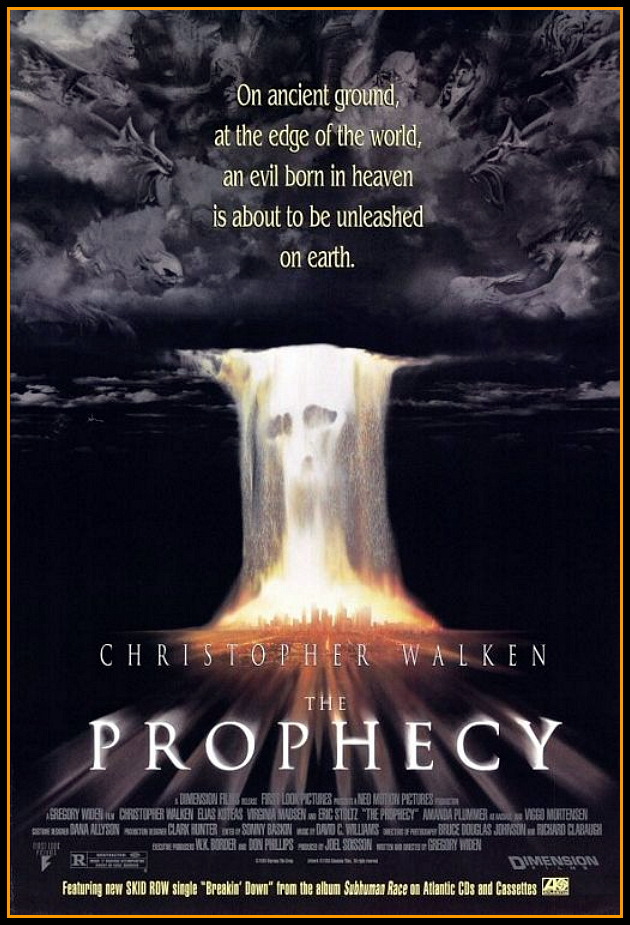
Film Review: The Prophecy (dir. by Gregory Widen)


I first found out about this little cult film starring the very awesome Christopher Walken around 1993 or so when I was at the local Waldenbooks (yes there used to be bookstores not named Barnes & Noble or Borders back in the day) looking at the latest issue of Fangoria. Inside the magazine they were doing a brief feature on an upcoming horror film tentatively called God’s Army. All I saw was that it was to star Christopher Walken and it had gore and angels in it. That alone peaked my interest and I was looking forward to seeing it in the theaters. Almost two years passed and nothing about it was ever heard again until I visited the video rental place near my house and saw a VHS tape (yeah, those big videocassette thingies) with the title of The Prophecy and starring Christopher Walken.

This was the film I was so hyped to seeing in the theaters. The title had changed from it’s earlier (and much cooler) one of God’s Army. It would seem that it’s film distributor had little to no faith in the box-office potential of the film and just delayed it’s release to the point that when it did come out no one knew about it barely anyone saw it. It was a real damn shame since filmmaker Gregory Widen made such a good film that was able to mash-up horror, angels and a detective story all in one without creating a mess of things.

The Prophecy was about the war in heaven we were never taught about in Sunday school. We all know about the war in heaven where Lucifer and the rebel angels who followed him tried to overthrow God. That didn’t go over so well for Lucifer and he and his band of fallen angels were cast out into Hell by God and his right-hand man the Archangel Michael. This film talks about the second war in heaven soon thereafter which no one outside those who wrote little-known apocryphal texts about it (and being apocryphal they never were included in the Bible). This war now had a new group of angels led by the Archangel Gabriel rebelling against God for choosing humans (talking monkeys as these new rebels called them) above all living creatures including the angels themselves for God’s love. This war was now in a state of stalemate after countless millenia, but a prophecy about a soul so dark and evil was to be the tipping point for either side. This particular soul was to be found on Earth and whoever acquires it would break the stalemate and finally bring this second war to an end.

With this in mind we have Walken as the Archangel Gabriel coming down to Earth to look for this soul so he can finally win the war for his side (which also means the end of mankind). It’s the angel Simon (played by Eric Stoltz) who comes down to stop him from getting this soul or, at the very least, hide it from Gabriel. With these two factions of angels vying to acquire this soul we have a Detective Thomas Daggett smack in the middle of the case investigating all the weird happenings and deaths surrounding the battle between these two factions. The dead bodies of angels begin to appear on morgue slabs looking like eyeless, hermaphroditic specimens and angelic script found in crime scenes brings Daggett back to his time studying to be a priest before images of angels warring amongst themselves breaks him down and he quits the seminary to become a cop instead.

It would come down to these three factions racing against time to acquire this dark soul.

The film is not as gory as it’s feature in Fangoria made it out to be, but it is quite violent and bloody that I understand why it got the horror label attached to it. It’s more a dark fantasy thriller more than horror. It’s rare in today’s film that we see angels portrayed as the bloodthirsty beings that the really are. The film even points out this oft-ignored detail of God’s messengers. Angels are always the ones God sends to punish or send a very serious message to his chosen beings that is Man. The Prophecy shows this aspect of angels in full light and how their attitudes about humanity might lead some of them to hate God for raising Man above even them.

Christopher Walker does a great job conveying Gabriel’s hate and contempt for humans. His Gabriel is like one of those pundits always on tv (both liberal and consevative) who are so into their sides’ message that they never see the other side as anything but the enemy. One could almost say that Walken’s Gabriel is like then apocalypse-hungry version of Glenn Beck and Keith Olbermann in one body. This is not to say that Walken goes over-the-top with his performance. In fact, he’s quite subdued in how he uses those many tics and voice mannerisms a whole cottage industry has grown around in.

Walken’s portrayal of Gabriel infuses what could’ve become a one-note villain with lots of layers and complexities that the rest of the cast were able to play off from. His character would be terrifying one moment then smoothly switch over to being funny and charming then back to terror. It’s due to his great performance that the other cast members like Stoltz as the weary, loyal angel Simon and Koteas as the fallen religious cop Daggett were able to bring their own performance to another level. This is quite a feat since the dialogue in the film was a mixed bag of horror cliches and interesting Biblical-speak about secret wars, apocryphal books and prophecies. The film even has a nice appearance of the first fallen angel himself and none other than Viggo Mortensen plays Lucifer.

The Prophecy does have a feeling that it was always one misstep away from becoming an awful film. This had happened with 2010’s Legion and did that film about angels and the apocalypse turn out to be a huge steaming pile of shit-turd. But while Dimension Film saw the film fall over on the side of bad for myself and those who have come to admire and love this cult classic the film stayed balance between good and bad. Widen’s film never went over to the side of becoming a truly great film, but it also never fell on the side that Legion ended up on. What Prophecy ended up becoming was a film that was almost grindhouse in nature, but even then it still looked too good with too many good performances to be given that label. The fact that it contains one of Christopher Walken’s best performances speaks well of a film that many critics during it’s early days had dismissed as just another bad horror film.

In the end, this film became just one of the many little-gems that got lost in film studio money politics. I definitely would recommend this cult film to people who haven’t seen it, but I would tell them to stop at just this film and not even go near the four sequels which came after it.

From Vanishing Point To Shivers, Here’s 6 More Trailers


As the snow outside slowly melts and I try to decide what to wear when I go see The Rite tonight, why don’t you enjoy six more of Lisa Marie’s Favorite Grindhouse and Exploitation Trailers?

1) Vanishing Point (1971)

I had to include this trailer at some point since Vanishing Point is one of the key influences on Quentin Tarantino’s Death Proof section of Grindhouse.  Is Vanishing Point the ultimate trip?  Maybe but I think there’s one other film that came out the same year that might disagree…

2) The Jesus Trip (1971)

And here it is!  I haven’t seen this actual film but the trailer would seem to indicate that this is some sort of religious biker film.  But then you have that final scene in the trailer and you’re kinda like, “Uhmmm….sacreligious much?”  Anyway, this is one of those trailers that I find myself watching over and over again.  I guess I was destined to grow obsessed with this trailer as it appeals to both my exploitation fanatic side and my fallen Catholic side.  Put them both together and I guess you’ve got The Jesus Trip.

Seriously, this is just a weird trailer.

3) Horror House On Highway 5 (1985)

I’ve come across this film on DVD a few times and I’ve always been seriously temped to buy it just on the basis of the title.  However, I may just end up settling for having seen the trailer because, to be honest, the trailer would seem to indicate that there’s a lot of really, really ugly people in this movie.  And ugly people kinda sorta make me nervous.

4) Revenge of the Cheerleaders (1976)

I guess this is like the grindhouse version of Bring It On.  Watching the trailer, I have to wonder why high schools in 70s movies always looked so dirty and unwashed.  I mean — BLEH!  Seriously, if my school had been that dirty, I would have ended up dropping out of school when I was 15.  I mean, gawd damn!  Get out the Scrubbing Bubbles and every sanitizer you can find and just — oh my God.  I think it’s the cafeteria that really makes me shudder.  Anyway, as for the rest of the trailer, I asked my sister Erin if it looked like a truthful depiction of high school cheerleading since she used to be one and she said no because most cheerleader don’t survive getting blown up as easily as the ones in this trailer.

5) Bad Girls Go To Hell (1965)

This is a film from the notoriously odd Doris Wishman.  Someday, somebody — maybe even me — is going to turn the life of Doris Wishman into a great novel and an even better film.

6) Shivers (1975)

And let’s close things out with a little Cronenberg.  From 1975, it’s Shivers.

Film Review: Dracula A.D. 1972 (dir. by Alan Gibson)


If you’re following the news then you probably heard that Dallas got hit with like a 100 inches of snow yesterday.  Seriously, more snow fell yesterday than has even fallen in recorded history (or, at the very least, in my recorded history).  You want to talk about Snowmageddon?  Well, we had a Snowpocalypse.

The neighborhood on Friday morning (picture taken by Erin Nicole Bowman)

So, I spent most of yesterday cooped up inside with my sister and our cat and once we got over the whole fun of being able to go outside and scream, “SNOW DAY!” at the top of our lungs, there really wasn’t much to do.  So, in an attempt to fight off cabin fever, I raided my DVD collection and we ended up watching one of the old Christopher Lee-as-Dracula-films from Hammer Studios.  Specifically, we ended up watching Dracula A.D. 1972.

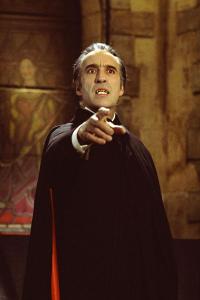
The film opens in 1872 with a genuinely exciting fight on a runaway carriage that ends with the death of both Count Dracula (Christopher Lee) and his nemesis, Prof. Van Helsing (Peter Cushing).  However, as Van Helsing is buried, we see one of Dracula’s disciples (played by Christopher Neame, who had an appealingly off-kilter smile) burying Dracula’s ashes nearby.  The camera pans up to the clear Victorian sky and, in a sudden and genuinely effective jumpcut, we suddenly see an airplane screeching across the sky.

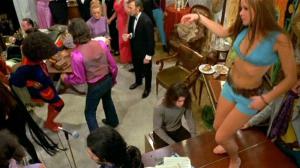
Well, it’s all pretty much downhill from there.  Suddenly, we discover that a hundred years have passed and we are now in “swinging” London.  The city is full of red tourist buses, hippies wearing love beads, and upright policemen who always appear to be on the verge of saying, “What’s all this, then?”  We are introduced to a group of hippies that are led by a creepy guy named Johnny Alculard (also played — quite well, actually — by Christopher Neame). One of those hippies (Stephanie Beacham) just happens to be the great-great-granddaughter of Prof. Van Helsing.  Apparently, she’s not really big on the family history because she doesn’t notice that Alculard spells Dracula backwards.  Then again, her father (played by Peter Cushing, of course) doesn’t either until he actually writes the name down a few times on a piece of a paper.

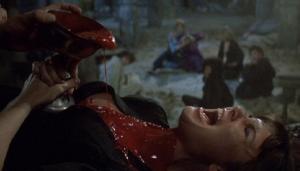
Anyway, the film meanders about a bit until finally, Alculard convinces all of his hippie friends to come take part in a black mass.  “Sure, why not?” everyone replies.  Well, I don’t have to tell you how things can sometimes get out-of-hand at black mass.  In this case, Dracula comes back to life, kills a young Caroline Munro, and eventually turns Johnny into a vampire before then setting his sights on the modern-day Van Helsings.

Dracula A.D. 1972 was Hammer’s attempt to breathe some new life into one of its oldest franchises and, as usually happens with a reboot, its critical and (especially) commercial failure ended up helping to end the series.  Among even the most devoted and forgiving of Hammer fans, Dracula A.D. 1972 has a terrible reputation.  Christopher Lee is on record as regarding it as his least favorite Dracula film.  And the film definitely has some serious flaws.  Once you get past the relatively exciting pre-credits sequence, the movie seriously drags.  There’s a hippie party sequence that, honest to God, seems to last for about 5 hours.  As for the hippies themselves, they are some of the least convincing middle-aged hippies in the history of fake hippies.  You find yourself eagerly awaiting their demise, especially the awkward-looking one who — for some reason — is always dressed like a monk.  (Those crazy hippies!)  But yet…nothing happens.  All the fake hippies simply vanish from the film.  Yet, they’re so annoying in just a limited amount of screen time that the viewer is left demanding blood.  Add to that, just how difficult is it to notice that Alculard is Dracula spelled backwards?  I mean, seriously…

To a large extent, the charm of the old school Hammer films comes from the fact that they’re essentially very naughty but never truly decadent.  At their heart, they were always very old-fashioned and actually quite conservative.  The Hammer films — erudite yet campy, risqué yet repressed — mirrors the view that many of my fellow Americans have of the English.  For some reason, however, that Hammer naughtiness only works when there’s the sound of hooves on cobblestone streets and when the screen is populated by actors in three-piece suits and actresses spilling out of corsets.  Dracula A.D. 1972 did away with the support of the corset and as a result, the film is revealed as a formless mess with all the flab revealed to the world.

Still, the film isn’t quite as bad as you may have heard.  First off, the film — with its middle-aged hippies — has a lot of camp appeal.  It’s the type of film that, once its over, you’re convinced that the term “groovy” was uttered in every other scene even though it wasn’t.  As with even the worst Hammer films, the film features a handful of striking images and Christopher Neame is surprisingly charismatic as Alculard. 

As with the majority of the Hammer Dracula films, the film is enjoyable if just to watch the chemistry between Christopher Lee and Peter Cushing.  Both of these actors — so very different in image but also so very stereotypically English — obviously loved acting opposite of each other and whenever you see them on-screen together, it’s difficult not to enjoy watching as each one tried to top the other with a smoldering glare or a melodramatic line reading.  As actors, they brought out the best in each other, even when they were doing it in a film like Dracula A.D. 1972.  In this film, Cushing is like the father you always you wished you had — the stern but loving one who protected you from all the world’s monsters (both real and cinematic). 

As for Lee, he’s only in six or seven scenes and he has even fewer lines but, since you spend the entire film wondering where he is, he actually dominates the entire movie.  Lee apparently was quite contemptuous of the later Hammer Dracula films and, oddly enough, that obvious contempt is probably why, of all the Draculas there have been over the years, Lee’s version is the only one who was and is actually scary.  F0rget all of that tortured soul and reluctant bloodsucker crap.  Christopher Lee’s Dracula is obviously pissed off from the minute he first appears on-screen, the embodiment of pure destructive evil.  And, for whatever odd reason, the purity of his evil brings a sexual jolt to his interpretation of Dracula that those little Twilight vampires can only dream about.  Even in a lesser films like Dracula A.D. 1972, Christopher Lee kicks some serious ass.

So, in conclusion, I really can’t call Dracula A.D. 1972 a good film nor can I really suggest that you should track down a copy of the DVD.  I mean, I love this stuff and I still frequently found my mind wandering whenever Cushing or Lee wasn’t on-screen.  However, it’s not a terrible movie to watch if you happen to find yourself trapped in the house by a mountain of snow.

Quickie Review: Running Scared (dir. by Wayne Kramer)


Director Wayne Kramer’s follow-up to his directorial debut (The Cooler) shows that he has a flair for drama and suspense that borders the line between reality and surrealism. Running Scared has such a gritty, washed out look right from the get-go that one starts to think it’s a film lifted right out of the 70’s. But that is only part of what Kramer does in creating a look and feel for Running Scared. Kramer actually uses every kind of trick in a director’s book to give his film such an over-the-top sense that the audience really doesn’t know what to expect just around the next dark corner.

Running Scared‘s first ten minutes sets up what the rest of the next two hours are going to be like. Kramer direct’s this ten minutes like a man possessed. The direction and editing is frantic and frenetic. Some have said that it’s all been done before by Tarantino, Woo and a dozen other action-stylists out of Hong Kong, but I disagree. Kramer’s style owes alot more to the grandfather of excessive film violence and that’s Sam Peckinpah. I’m not comparing Running Scared to Peckinpah’s seminal classic The Wild Bunch, but the pace and look of the chaotic shoot-out in the tiny apartment to start the film brings to mind the opening and closing shoot-outs of Peckinpah’s film.

Kramer knows he’s not making a social statement or even an intellectually relevant film. What he does know is that he wants to tell a fairy tale of one man’s hectic day and all the craziness he has to go through during that day. And this is what Running Scared really has turned out to be. A fairy tale set in an modern, dank, urban landscape where our hero (though anti-hero is more like it) and the two kids in his life must travel a surreal place filled with mack-daddy pimps, hooker with a heart of gold, corrupt cops and even a pair of child pedophiles who also turn out to be husband and wife. Running Scared is a like Grimms fairy tale as seen and told in a modern setting.

The cast of actors Kramer has assembled all do a good job in populating this violent, profane modern fairy tale. I’d be the last to think that Paul Walker was an actor who had any talent, but his performance in this film has given me pause to think that maybe its not him, but the projects he’s been doing that’s given him a bad reputation as an actor (which continues to this day as he continues to put himself in bad projects). Gone is the California surfer dude persona he seems to saddle himself with in most of his roles. He actually inhabits the low-level mobster soldier he plays as Joey Gazelle. This film may not be his breakout performance but it will open up some eyes. The boy’s got some skill he’s never been able to show before. The other actor who makes a standout performance is one Cameron Bright who plays Oleg. The neighbor kid whose theft of a mob gun Joey is suppose to make disappear turns Joey’s life upside down. Cameron’s almost like Pinocchio in that its through him that we see all the crazy characters he runs across. It’s a testament to Kramer’s direction that he’s able to get such good performances from Walker, Bright and the rest of the cast in a film that’s as confusing, complicated and surreal as this film turned out to be.

Running Scared was a wonderful surprise of a film for 2006. It’s an unabashed fun, thrilling urban fairy tale that goes for broke in everything it does. Wayne Kramer’s direction shows that his very good work in filming The Cooler wasn’t a fluke and one-time deal. He’s no Tarantino and surely not in the same league as Sam Peckinpah whose films this one owes alot to in style and feel, but he’s slowly making a name for himself as one who can do good work. Oh, Paul Walker does a good job in it as well.

What Lisa Watched Last Night: Love Sick: Secrets of a Sex Addict (dir. by Grant Harvey)


On Tuesday night, as the temperature outside plunged down to 13 degrees and the ice continued to build up on the street outside, I watched Love Sick: Secrets of a Sex Addict on the Lifetime Movie Network.

Why Was I Watching It?

Uhmmm…hello?  Check out the title.

What Was It About?

This is one of those movies that starts with “Based on a True Story” and then continues on with “Some names and details have been changed.”  So, in other words, this is all true except for the parts that are false.  (Actually, this film is based on a memoir by Sue Silverman.)

Sally Pressman stars as Sue Silverman.  Sue is a writer.  While she battles writer’s block, her husband spends his time going to work and then coming home and whining about it.  Apparently, every day, he comes home, refuses to have sex, and says something like, “You could get a job…”  Or, hey, buddy — here’s what you could do: adjust your bra and stop crying like a little bitch.  Seriously.

(Frequently asked question: When is the right time to call a man bitch?  Any time he starts acting like one.)

Anyway, Sue responds to this by going out and sleeping with every man in Canada with the exception of her husband and who can blame her when you consider that her husband is a little bitch. 

Soon, Sue is undressing whenever she find herself alone with a man — any man.  Her obsession with sex soon brings an end to her marriage and eventually Sue is forced to go through one of those pain-in-the-ass interventions where everyone sits around and goes, “You’re addiction has harmed me in the following ways: 1) you borrowed money to spend on lingerie and you have yet to pay me back, 2) you missed my birthday party, 3) you fucked my husband…”

So, poor Sue ends up at the rehab place where the whole thing is like tough love and all “You will obey these rules or we’ll kick you out.  So there!”  Among the many rules: “No masturbation, no lingerie, no smoking, no avoiding eating, no throwing up…”  Uhm, fascist much?

(And also, what type of man leaves his wife because she wants to have sex?  Seriously, what a toadsucker.)

What Worked?

Oh, it all worked.  This was pure Lifetime Movie goodness in that it took a whole lot of serious issues and then presented them in such a way that made it impossible to take any of it seriously.  Ominous music, over-the-top dramatic line readings, and finally, a therapist who says exactly the right thing and magically makes all of the problems disappear.

Plus, I love that title.

What Didn’t Work?

Technically, the acting was pretty bad (with the exception of Sally Pressman) and the film dragged once Sue got into therapy.  But who cares?  Just check out that title.

“Oh my God!  Just like me!” Moments

Towards the end of the film, Sue says that knowing she was desired was occasionally the only thing that she could cling to, the only thing that allowed her to maintain her fragile sense of identity.  I’ve been there.  Who hasn’t?

I also share Sue’s obsession with black underwear.  Seriously, you can’t look bad in black lingerie.

Lessons Learned 

Some men, apparently, actually do say “Not tonight, I’m tired” when it comes to sex.  I’m still having a hard time buying that one.

Rehab is not fun.


Quickie Review: Stander (dir. by Bronwen Hughes)


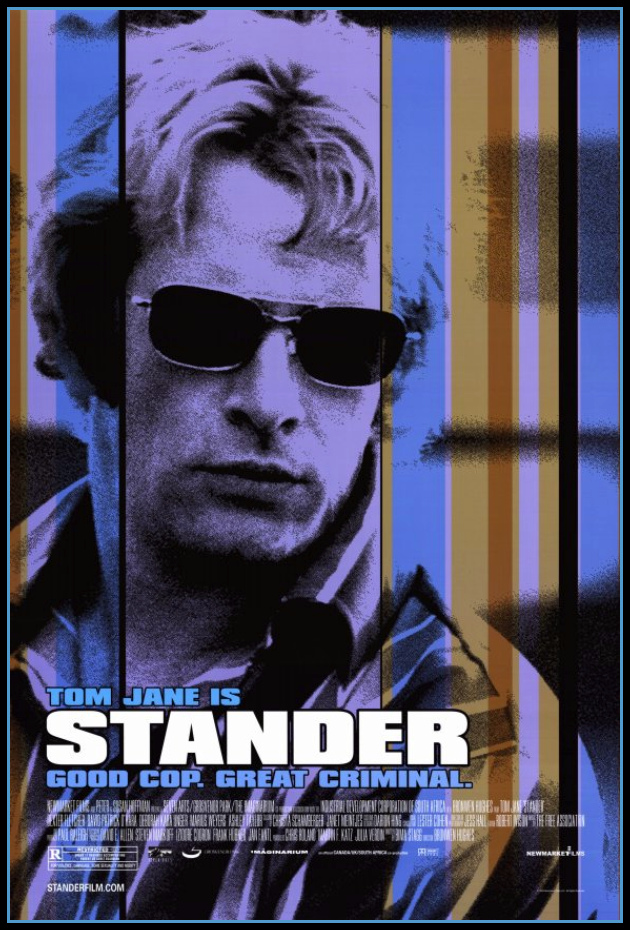
Stander was a very good film about the real-life exploits of Andre Stander, Lee McCall and Allan Heyl who were known collectively as The Stander Gang. The Stander Gang was well-known for their daring and reckless bank robberies in their homeland of South Africa. The film stars Thomas Jane (The Punisher, The Mist) as the title character with Dexter Fletcher (Band of Brothers and Lock, Stock and Two Smoking Barrels) and David Patrick O’Hara (Braveheart, Doomsday) rounding out the rest of the Stander Gang.

The film starts off introducing Andre Stander as a highly decorated member of the South African Police Force in the late 1970’s and the beginning of the anti-apartheid movement. It shows Andre Stander’s growing disgust and disenchantment in his government’s racist apartheid policies and his own role in enforcing it. After a violent and brutal break-up of an anti-apartheid protest gathering where Stander kills a protestor, the film begins to move into meat of the story. Stander’s disenchantment with the government causes him to commit bank robberis in audacious fashion as a way to rebel and defy the very state he has sworn to protect and serve.

The scenes where Stander commits these bank robberies were shot well and showed just how daring Andre Stander really was in his exploits. There’s even a sequence where he returns to the scene of his most recent crime to investigate the robbery. A robbery he just committed just hours before during his lunchtime. These scenes and the later ones when he’s joined by two other bank robbers shows Tom Jane at his finest. I think many would be hard-pressed not to think Jane’s performance as a South African, accent and all, wasn’t authentic. His charisma ruled throughout the film and was mostly evident through the many bank robbing sequences. He truly gave Andre Stander the air of a Robin Hood character who, despite his criminal acts, became a sort of folk antihero.

The second half of the film details the exploits of Stander after his incarceration for his bank robberies while a captain of the South African Police Force. It’s here that we meet the rest of Stander’s Gang as he recruits fellow inmate and outlaws Lee McCall and Allan Heyl. Even the way Stander engineers his escape from the work-prison he has been sent to shows his daring in thumbing his nose at the state and the police he used to be a part of. Dexter Fletcher was very good as the twitchy and less stable Lee McCall whose nerves begin to fray the bolder and bolder the gangs bank robberies become. David Patrick O’Hara was also good as the very professional bank robber Allan Heyl. Heyl didn’t have the charisma that Stander had, but he was the rock which kept the robberies from spiraling out of their control. It was great to see O’Hara in another strong role. Some might recognize him as the scene-stealing Stephen, the Irish rebel who joins William Wallace’s fight against the English during Mel Gibson’s Braveheart.

The rest of the film was pretty much one bank robbery after the other with the Stander Gang always one step ahead of the police task force put together to capture them. In a twist of fate, the task force was headed by Stander’s former friend in the police force Cor Van Deverter whose intimate knowledge of Stander’s tactics and thought-processes helps in slowly closing the noose around the gang. There’s abit of a repetition in the robberies and the getaways, but they serve an important purpose of slowly building up the Stander Gang’s folk hero status amongst the population. It also showed the effect it had on some of the members of the gang. As popular and infamous the gang had become they were still outlaws who knew that sooner or later their luck would run out and they’d either be put back into prison or killed outright. For some it was the latter and for others the former.

Throughout the film, one could sense that some of the motivations behind Andre Stander’s actions as a bank robber was to assuage his guilt over the sanctioned acts of brutality he had to perform to protect the apartheid government of his nation. The film and the story being told was almost a full-length film of Stander’s attempt to make up for his past transgressions. And what better way to do this than use the system of the state against itself. He himself points out that a white man could get away with anything when most of the policemen in the city were called away to deal with an emergency regarding the black majority population. Stander realizes this to be true and his second career as a bank robber was born. The film only hints at him being a very good policeman, but the majority of the film shows just how much better he was as a criminal.

The film was expertly directed by Bronwen Hughes and as said earlier had strong performances from all the main leads in the film. The story rarely slowed down to the point that the story lost its direction. Every scene always led to the next part of the story being told until the very bitter end. Stander was a very good film anchored by a fine performance from Thomas Jane. The film showed a brief glimpse into South Africa’s apartheid past and how one individual’s decision to defy the state led to a brief, but daring life of a modern-day Robin Hood.

Film Review: The Mechanic (dir. by Simon West)


A few years ago, I declared that January should just be renamed Statham because seriously, Jason Statham was in like almost every single freaking movie released that month.  Seriously, it was like every time I turned on the TV, there was yet a new commercial featuring Jason Statham in some movie that I had absolutely no desire to see.  “Oh look,” I’d say, “that’s Jason Statham swinging a sword.  Oh, now he’s driving a car really fast.  Oh, wow, now Jason Statham’s looking off to the side and squinting…”

Well, this January, Jason Statham is only starring in one film and it might be the best of his career.  At the very least, it’s the first time I’ve been able to kind of see the guy’s appeal as a film star.  That film is The Mechanic and it opened this week.

In the Mechanic, Jason Statham plays a contract killer.  He’s known as a mechanic because he “fixes” problems.  After Statham’s mentor (Donald Sutherland) is killed, Statham takes the man’s son (Ben Foster) under his wing and starts to teach Foster the tools of the trade.  However, unlike the cool and detached Statham, Foster is a jittery and angry psychopath.  However, despite their differing approaches, they are forced to work together when the same man (Tony Goldwyn) who ordered Sutherland’s murder decides to come after them.

As I stated before, I’ve never quite gotten the appeal of Jason Statham as an actor.  In fact, as Jeff and I waited for the film to start, I said, “I’ve never really gotten Jason Statham.”  As soon as I said that, this woman sitting in front of us turned around in her seat and I swear to God, she rolls her eyes at me in this way that said, “Bitch, please.  Like Jason Statham would ever give your raggedy ass a second look.” 

I proceeded to narrow my eyes in a way that said, “You best be watching what you say, you nasty ass ho.”

She cocked her head in a way that said, “Oh, no you didn’t!”

I flared my nostrils in a way that said, “Oh yes, I did, you hootchie ass skank…”

She leaned forward as if to say, “Gurl, you need to get Jesus in your life…” 

I smirked as if to say, “Jesus?  What does Jesus have to do with this?”

Before she could answer, the movie started.

Anyway, what was my point?  Oh yes, Jason Statham.  In the past, I’ve never gotten his appeal but in this film, I did.  For the first time, I saw him as something other than just an expressionless English guy.  Statham is athletic but, unlike a lot of other action movie stars, he’s not so ludicrously muscle-bound that you can’t believe him as some guy you might run into out on the street.  Previously, I just thought that Statham was a bad actor but, with the Mechanic, I realized that, whereas other actors act with their eyes and their voice, Statham acts with his body.  You look at Statham with his constant scowl and his cold eyes and you believe that he could kill someone in real life as well as in the movies.  Statham is perfectly cast as a professional killer and The Mechanic wisely doesn’t try to suggest that the character is anything more than just a very disciplined sociopath.  Much like the best pulp heroes, Statham’s mechanic is a hero by default.  He’s a bad guy but everyone else in the movie is worse.

Also, there’s a scene about ten minutes into the film where Statham, fresh from killing a drug lord, changes clothes in a linen closet and as soon as he removed his shirt, I said, “Oh, I see the appeal now.”

Playing opposite of Statham, Ben Foster gives another one of his intense performances.  Throughout the film, Foster is perpetually on the verge of exploding and his typically high energy performance provides a nice contrast to Statham’s typical nonperformance.  He’s the Eli Wallach to Statham’s Clint Eastwood.  However, Foster doesn’t just rely on theatric for his character.  Instead, he gives a complex, multi-faceted performance as a character who, in the hands of a lesser actor, could have just been your average psychopath.  He even manages to win some sympathy for a character who, on paper, wouldn’t seem to deserve it.  Even more importantly, he brings out the best in Statham in a way that previous co-stars like Sylvester Stallone couldn’t. 

Director West keeps the action moving quickly without ever letting the movie degenerate into just a collection of over-the-top set pieces.  When the film does break out into action, West handles it like a pro and, as spectacular as the action may get, he still manages to keep things in the realm of the believable.  However, West also invests the film with a dark, almost grim atmosphere that fills every scene with a feeling of impending doom and growing paranoia.

The Mechanic is a fast-paced, unapologetic thriller that, in its way, ultimately becomes a masterpiece of the pulp imagination.   It’s very easy to imagine this as an Antonio Margheriti film from the early 80s, starring David Warbeck and Giovanni Lombardo Radice in the Statham and Foster roles.  Both director West and the cast deserve to be applauded for making a grindhouse film for the 21st Century.

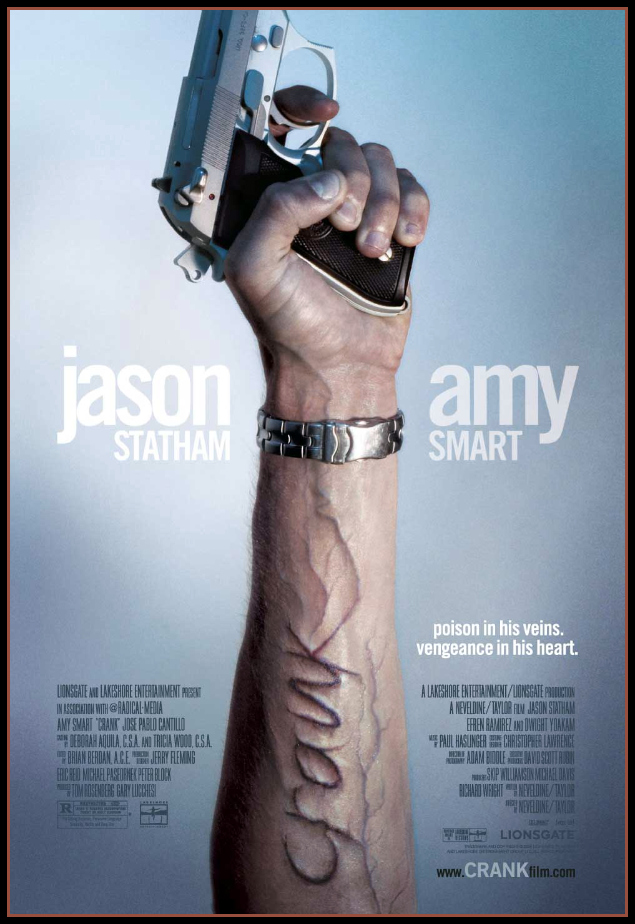
Review: Crank (dir. by Neveldine/Taylor)


Through the Shattered Lens has been quite eclectic when it comes to reviewing films, music and all forms of entertainment. While we’re not averse to the more high-brow and artistic fare what will come across to most visitors of the site is how love for grindhouse and exploitation films are quite strong in this place. Grindhouse and exploitation of the 60’s, 70’s and 80’s usually fill the bill but once in a while a certain film of aq more recent time frame will make the cut. One such film is the over-the-top, ultraviolent and extremely funny film Crank from Mark Neveldine and Brian Taylor, or as they like to call themselves, Neveldine/Taylor.

One thing I must point out is how this movie has confirmed Jason Statham in my eyes as the current action-star of the last couple years. A favorite of Brit action-auteur director Guy Ritchie, Statham has gradually built himself a decent list of action-movies that take good advantage of Statham’s old-school sense of machismo and smirking confidence reminiscent of the such past macho actors like Lee Marvin, Charles Bronson and Steve McQueen just to name a few. Statham is thick in body, but none too muscular and his wry, British sardonic personality mixes well with his many different action-movie personas. In Crank he pretty much steals and holds the ludicrous and unique different plot from spiralling out into camp and MST3K territory. Even though Statham would never be considered an acting giant, his performance as the hitman Chev Chelios racing against time to avenge his inevitable death was very well done. Crank starts with a bang and doesn’t let up. Like the actions and behavior of its main character, this film seems to be racing towards the end and not caring to slow down and give the audience a chance to take a breather. He literally willed this film to be nothing but crazily entertaining.

Many have called the idea for Crank as another derivative of the mid-90’s action film Speed. I’d be the first to say that they’re really not off the mark by much. Instead of a bus wired to explode if it dips below a predetermined speed, Crank puts the same premise and uses a human body instead. The human in question is one Chev Chelios whose botching of a contract hit lands him in a bit of hot water with the underworld bosses who hired him to do the job. Ambushed and knocked unconscious, Chelios soon wakes up to realize that something is definitely wrong with him. A bit of villain grandstanding from the employer he disappointed, Chelios quickly finds out that he has been injected with an exotic cocktail of chemicals called the Beijing Cocktail (definitely sounds like something made-up for a grindhouse flick) which would kill him by inhibiting his body’s ability to produce adrenaline. He learns from a colleague that he will need to keep his adrenaline pumping constantly to remain among the living and must do so by any means necessary. Whether he accomplishes this through extreme physical activities, drugs, and energy drinks Chelios must do them all in order to buy himself enough time to tie up lose ends in his life and to find the employers who have killed him. That is pretty much the story of Crank in a nutshell.

Crank doesn’t take much of the film’s early minutes to explain some backstory on Chelios other than him being a professional hitman. Instead writer-directors Neveldine/Taylor use the entire running time of the movie to gradually give glimpses into what kind of a person Chev Chelios is. With their use of handheld digital cameras and kinetic-style editing and camera shots, Neveldine/Taylor takes the premise of Crank and lets the audience ride along not just as passive viewers but almost like active participants. The “in the now” look of the film with some shots angled so that they’re almost in first-person or over the shoulder views doesn’t look as gimmicky as it sounds. One film released the same year that compares to Crank in terms of unique filmmaking for an action film it would be Running Scared that was released earlier this year. Both take the action flick conventions and dare to rise above it either through a dark fairytale style that was Running Scared or the manic, darkly amoral humor that gives Crank such an exhilirating sense of pacing.

The one thing that people will remember most about this movie is the many action sequences that happen throughout the film. With their decision to use handheld digital cameras, action sequences in Crank take on an almost hyperkinetic look to them. Again this film shares some similarities with Running Scared with how its action sequences were shot with such inventive use of angles and framing not to mention in-your-face violence. Crank has less of the surreal quality of Running Scared and more of a live newscast. In fact, at times I felt as if I was watching a news crew vainly chasing after Statham’s character as he paints the Los Angeles with non-stop adrenaline-pumping violence and activities. Whether its him getting into an outnumbered free-for-all brawl with a certain inner-city gang or having a very impromptu, unexpected and thoroughly indecent display of public affection with dozens in witness, the film’s amoral and sense of active nihilism makes this film a most politically-incorrect one. There’s a scene involving a taxi driver that was wrong on so many levels yet it invoked some of the biggest laughs and reactions from myself and the audience around me when I first saw it in the theaters.

The violence comes hard and fast and unlike Statham’s past couple of Transporter flicks, there’s nary a martial art choreographed fight scene to be seen. No, Chelios is an action film character who attacks and fights with sudden directness and brutality with as little movements required as possible. Chelios doesn’t need kung fu or karate moves to take out an opponent when a a well-placed kick, punch, elbow, etc…is all that’s needed to put a man down. Crank’s action sequences also had no CGI used (something I learned prior to seeing the film) with Statham doing most of his stunts. This wouldn’t be too much of a big deal until one factors in the fact that one of the action pieces takes place in a helicopter flying a thousand or so feet above the street of LA. Statham must have quite a steely pair if there’s truth behind him doing that helicopter fight with no greenscreen CG trickery or wire-fu assistance used.

Outside of Statham the rest of the cast took to their roles with a relish and had fun with them. And as with every action-flicks the hero will need a foil to motivate him. Statham’s Chelios has his opposite number in Verona played with thuggish calculation by Jose Pablo Castillo. Then there’s Doc Dwight Yoakam as Doc Miles. Chelios’ acquaintance whose knowledge of all things chemical borders on the absurd but in Crank makes it work. But the other performer who stood out outside of Jason Statham has to be Amy Smart as Chelios’ ditzy but well-meaning girlfriend, Eve. She plays this character to the hilt and seem to be having a ball while doing so. Her outdoor scene of PDA with Statham and a follow-up scene during a car chase shows me that Ms. Smart was pretty game about going all the way with how to portray her character.

I won’t mention too many more details on what actually happens in the film since I think its best to see it for oneself. Words can’t really describe the sheer insanity and fun mayhem this movie puts up on the big-screen. The story may not be too original and it’s lead may not be the best actor out there, but what Statham lacks in acting proficiency he more than makes up for sheer charisma and old-school machismo that’s way too rare in action-flick actors nowadays. Crank is more than your run-of-the-mill action movie. The creativity shown by writer-directors Neveldine/Taylor gives Crank a unique look and their attempts to try new techniques succeeds more than it fails. But in the end this film lives and dies on the shoulders of Jason Statham who I must say is the action-hero of this new generation of actors.

So, better grab hold tight of something or someone, because this film is one hell of a ride and you’re not getting off until the very end whether you like it or not.

6 Trailers Designed To Induce Hysteria


This latest edition of Lisa Marie’s Favorite Grindhouse and Exploitation Trailers was meant to have a theme.  I was only going to include trailers of films that have been reviewed on the Hysteria Lives! website.  Unfortunately, I ran in to some trouble with the New Year’s Evil trailer and I ended up going with a different trailer of a movie that hasn’t been reviewed on the site.  So, yes, the theme kinda falls apart at the end.  But anyway, let’s get things started…

1) The Strange Vice of Mrs. Wardh (1970)

Sergio Martino doesn’t get as much attention as Dario Argento, Lucio Fulci, and Mario Bava but he made some giallo classics and this is one of them.  Yes, the trailer’s in Italian but stick with it anyway.  Also, the person who uploaded this to Youtube, included another trailer — this one for Lucio Fulci’s Lizard In A Woman’s Skin — after the end of the Mrs. Wardh trailer.

2) Happy Birthday To Me (1981)

You can tell that this trailer from 1981 isn’t messing around because the birthday cake gets it!  I saw this movie on TV a few years ago.  The brain surgery scenes really freaked me out.  Another thing that freaked me out was a scene where all the high school snobs decided to spend their night at a special showing of High Noon.  Why couldn’t I have gone to high school with a bunch of film snobs?  Seriously, life sucks.

3) Don’t Open The Door (made in 1975, released in 1979)

All together now: “Don’t.  Don’t.  Don’t.  Don’t.  Don’t…”  With all due respect to the very hot Eli Roth, that was my favorite of the fake trailers from Grindhouse.  Anyway, Don’t is not a real film but Don’t Open The Door is.  Exploitation film of the 70s and the 80s were always trying to tell us how to live our lives.  Don’t stand by the window, don’t look in the basement, don’t go in the house, don’t go into the woods…alone, and now, apparently we can’t even open the freaking door.  This actually reminds me of this time that we were visiting my grandma and I was up in the attic exploring and I heard my sisters downstairs calling out my name because they couldn’t find me so I tried to open the attic door and I accidentally yanked off the door knob.  Agck!  That was scary.  But I survived and here’s the trailer…

4) Body Count (1987)

I haven’t seen this one so all of my information on it comes from what I’ve read online.  Apparently, this was Italian director Ruggero Deodato’s attempt to make an American-style slasher film so, of course, it takes place at a summer camp.  David Hess is in this one and apparently, he’s not playing the killer for once.  Former Russ Meyer star Charles Napier is in this one too.  As for why I love this trailer, just listen to narrator at the end of the trailer when he starts tossing out various taglines.  It’s as if the film’s producers were arguing about which tagline to use and finally someone said, “Fuck it, just toss them all in there!  Now, shut up and behave!  It’s time for dinner!”

5) Scalps (1983)

Horror will surround you … and we’re not just talking about the acting.  I love it when trailers dare you to actually sit through the entire movie.  (And, I should add, that I own Scalps on DVD and, bad acting aside, it’s actually a surprisingly effective little horror movie.)

6) Bloody New Year (1987)

I wanted to include the trailer for a film called New Year’s Evil here but the only one I could find had this huge advertising logo across the bottom of it.  But while I searched, I came across the trailer for another New Year’s horror film, Bloody New Year.  And you know what?  I’ve seen New Year’s Evil and it sucks and it had a really nasty sort of sadism to it that makes you feel dirty after you watch it.  So, fuck New Year’s Evil.  Now, let’s all have a Bloody New Year!

Finally, since that Lizard in a Woman’s Skin extra actually means that there were 7 trailers in this edition as opposed to 6, I’m going to add one more bonus trailer so that we can end things on an even number.  There’s no way I couldn’t take the opportunity to include Edgar Wright’s brilliant fake trailer, Don’t.