Is Upstream Color The Best Film of 2013?


(Minor Spoilers Ahead)

Is Upstream Color, the new film from Shane Carruth, the best film of 2013?

Realistically, it’s probably too early to say.  After all, it’s only April and there’s a lot of films waiting to be released.  However, it’s hard for me to imagine how a more thought-provoking, haunting, and occasionally frustrating film could be released this year.

Don’t get me wrong.  A lot of viewers aren’t going to embrace this low budget, independently made film.  Some will dismiss Upstream Color as being pretentious or they’ll incorrectly assume that the film is all about style over substance.  Even in this age of Tree of Life and Beasts of the Southern Wild, Upstream Color is not the type of film that’ll be embraced come Oscar time.

But no matter.  As of right now, Upstream Color is the best film of 2013.

Director Shane Carruth made his directorial debut in 2004 with Primer.  Made on a budget of $7,000 and filmed in my hometown of Dallas, Primer was a low-key but intriguing film about time travel.  It was a science fiction film that succeeded not through CGI but through an intelligent presentation of ideas.  I have to admit that I’ve watched Primer a handful of times and I still don’t quite understand everything that happens in the film.  However, that’s a huge part of the film’s appeal.

The same can be said of Upstream Color.

Playing out like a mash-up of David Cronenberg and Terrence Malick and told through a series of jump cuts, Upstream Color begins with Kris (Amy Seimitz), a successful young woman who is kidnapped by an enigmatic figure known as the Thief (Thiago Martins).  The Thief uses a drug made out of orchid larvae to hijack her mind.  Once she has given him all of her money, the Thief vanishes while the larva continues to grow in Kris’s body.

A mysterious man identified in the credits as The Sampler (played quite brilliantly by Andrew Sensenig) comes to Kris’s aid.  As Kris lies unconscious in a tent, The Sampler cuts the larva out of her body and then puts it into the body of a pig.  The pig is set loose in a pen with hundreds of other pigs who apparently carry larvae in their bodies.  Kris, meanwhile, wakes up the next morning in her car with no memory of why she’s covered in blood, why she’s lost her job, or why her bank account is now empty.

One jump cut later and suddenly, we see Kris riding a train through downtown Dallas.*   We’re not sure how much time has passed but we can see that Kris has changed.  With her hair cut short, Kris sits huddled in the back of the train.  Also on the train is Jeff (Shane Carruth).  Despite Kris’s efforts to be anonymous, Jeff notices her and eventually manages to strike up a conversation with her.

Kris finds herself oddly drawn towards Jeff, especially after he confesses to her that he once stole a lot of money from his employers and he’s not quite sure why he did it.  Not realizing that they’re both victims of the Thief, Jeff and Kris fall in love.  Fortunately, Carruth and Seimetz have a palpable chemistry.  You believe both of them as wounded souls and as lovers.  As a result, even as the film gets more and more surreal, you still care about these two characters and their relationship.

While Kris and Jeff fall in love and struggle to understand what happened to them in the past, the Sampler continues to appear throughout the film as a detached observer.  Sometimes, he’s recording the sounds of nature.  At other times, he’s looking over his pigs.  And then, sometimes, he’s just there.  For his first few appearances, the Sampler seems to be almost a benevolent figure but, halfway through the film, he performs one action that forces you to reconsider everything that you’ve previously seen him do.

Who is the Sampler and how is he connected to the Thief and Kris and Jeff?  This is one of the many questions that the film poses and, quite frankly, the answer is not easy to find.  Don’t get me wrong, the answer is there.  You just have to be willing to look for it.  Carruth, a former engineer, directs with an eye for the reoccurring patterns of nature. (For instance, the curve of the larva in Kris’s bloodstream is later replicated by the sight of Kris and Jeff curled up in each other’s arms.)  As opposed to the very verbal Primer, Upstream Color is a film almost totally told through image and, as a result, one has to be willing to be an observant viewer in order to learn the answers to the film’s questions.  The film’s final 15 minutes features no dialogue, just images scored to Carruth’s propulsive electronic score.  It’s a brave move on Carruth’s part and, even more importantly, it works brilliantly.

As you might guess from reading this review, Upstream Color is not an easy film to understand.  As a filmmaker, Carruth emphasizes the surreal and the obscure but, much like David Lynch, he comes up with images that are so haunting that you can’t look away even if you don’t fully understand what you’re seeing.  Upstream Color may, at times, be an obscure film but it’s compelling in its obscurity.  This is a film that is meant to be seen with four of your smartest friends.  This is a film that is meant to be debated and argued about.

In other words, it may very well be the best film of 2013.

——

*On a personal note, I do have to admit that I loved seeing how much of this movie was filmed at places that I either go to or drive by every single day.

Disconnected From Disconnect


Disconnect, the feature film directing debut of award-winning documentarian Henry-Alex Rubin, has been getting some fairly positive reviews.  According to Rotten Tomatoes, the film has a critical score of 71 while audiences have been even more impressed.  The last time I checked, it had an audience score of 83%.  If you’ve seen any of the commercials for this film then you’ve undoubtedly heard it referred to as being “the best film of the year.”

That’s high praise for a film that’s essentially Crash with better acting.

Much like Crash (which, incidentally, I consider to be the worst film to have ever won the Oscar for Best Picture), Disconnect is an ensemble film that tells several different stories.  For whatever reason, first-time directors seem to have a weakness for movies with ensemble casts and multiple-story lines.  When done well, an ensemble film can say something profound about the way that people in a society relate to one another.  When done poorly (like in Crash or Disconnect), they just feel trendy.  Watching Disconnect, I felt as if the filmmakers couldn’t come up with a way to tell one compelling story from beginning to end so, instead, they just tossed together fragments of three separate stories and then desperately tried to come up with a theme to connect them all.

That theme, by the way, is that our reliance of modern technology has created a society where people are Disconnected from one another.

Gee, you think?

Disconnect tells three separate, inter-connected stories.  In one story, Paula Patton and Alexander Skarsgard are a married couple who are struggling to deal with the recent death of their child.  Skarsgard deals with his grief by going on long business trips and getting addicted to online gambling.  Meanwhile, Patton joins an online support group and finds herself tempted to have affair another member (Michael Nyqvist).  Patton’s activities leads to identity theft and bankruptcy.  With the help of a sleazy private investigator (Frank Grillo), Patton and Skarsgard try to track down the man who stole their identity.  This story falls apart once Patton and Skarsgard find the man and both characters suddenly start acting in the most inconsistent ways conceivable.  It really should be impossible t0 make charismatic performers like Alexander Skarsgard and Paula Patton seem  bland and boring but somehow, Disconnect manages to do it.

In the film’s best storyline, Grillo’s teenage son (Colin Ford) catfishes and cyber-bullies an alienated classmate (Jonah Bobo).  When Bobo hangs himself as a result, Ford is wracked with both guilt and fear.  Ford’s attempts to cover-up his involvement leads to him meeting and briefly befriending Bobo’s father (Jason Bateman), who has no idea what led to his son attempting suicide.  In this story, Bateman proves that he’s as good with drama as he is with comedy and Ford’s complex and multi-layered performance is more than award-worthy.  This was probably the most powerful part of the film and, if the filmmakers had simply concentrated on this story (as opposed to diluting it by making only one part of a multi-part film), Disconnect would fully deserve the high-praise that it’s currently receiving.

In the film’s third (and most flamboyant) storyline, Andrea Riseborough is a cynical and opportunistic reporter who does a story about a cocky teenager (Max Thieriot) who performs on an adults-only site and who recruits other teenagers for a manipulative pimp (played by none other than Marc Jacobs).  Riseborough finds herself charmed by the teenager (and who can blame her because, after all, he’s played by Max Thieriot) and soon she’s having an affair with him.  However, her news story captures the attention of the F.B.I. and soon both Thieriot and Riseborough find themselves in danger.

At first, I thought I was going to enjoy this storyline because I love Max Thieriot.  He’s ideally cast here and he gives a good, sympathetic performance. For that matter, so does Andrea Riseborough and even Marc Jacobs brings a certain reptilian charm to his role.  However, this story falls apart as it quickly becomes obvious that the filmmakers, having set up a potentially interesting situation, have no idea what to do with it.  Instead, much as with the characters played by Skarsgard and Patton, Riseborough ceases to behave with anything resembling logic or consistency.  Both she and Thieriot go from being interesting, well-rounded characters to being mere plot devices.

That, ultimately, is the main reason why Disconnect fails.  With the exception of the characters played by Bateman and Ford, nobody in this film feels real and, again with the notable exception of Bateman and Ford’s storyline, very little that happens feels genuine.  The film is watchable because of the talented cast but, otherwise, it’s a melodramatic and predictable mess that seems to think that it’s a lot smarter than it actually is.

Perhaps that’s why so many people over on the imdb have been praising this film as “the best of the year.”

Some people will always enjoy feeling like they’re thinking without actually having to do it.

The Daily Grindhouse: Homebodies (dir by Larry Yust)


Can we just be honest about something?

Most of us are a little bit scared of the elderly.

Oh, we try to deny it.  We talk about how they’re “real characters” or we attempts to convince ourselves that their eccentricities are actually signs of an incurable zest of life.  We tell ourselves that old people remind us of the value of carpe diem but, ultimately, they creep most of us out because, when we look at them, we see our own future.  Regardless of what we do today or tomorrow, we’re all going to eventually become old.  Perhaps that’s why there’s a whole industry devoted to keeping old people out of sight and out of mind.

Today’s entry in the Daily Grindhouse, the obscure 1974 film Homebodies, is effective precisely because it understands that unpleasant truth.

Directed by Larry Yust, Homebodies tells the story of Mattie (Paula Trueman).  Mattie is one of seven elderly retirees who are the sole residents of a condemned apartment building.  All around them, buildings are being torn down and replaced with new apartments.  When an uncaring social worker (Linda Marsh) shows up and informs them that they’re going to be forcefully relocated to an assisted living facility, Mattie take matters into her own hands.  She realizes that every time there’s an accident on a construction site, work stops for a few days.  Hence, if there are enough accidents, work will be stopped indefinitely.  Mattie and her fellow residents (some reluctantly and some not) are soon murdering anyone they view as a threat.  While this is effective initially, things get complicated once Mattie starts to view some of her fellow residents with the same contempt that she previously reserved for construction workers.

Homebodies is one of those odd and dark films that could have only been made in the 70s.  When the film begins, one would be excused for expecting to see a heart-warming comedy about a bunch of plucky seniors outsmarting the forces of progress and real estate.  After all, the elderly residents of the condemned building are all appropriately quirky and, as played by Paula Trueman, Mattie doesn’t seem like she’d be out-of-place as one of the prankers on Betty White’s Off Their Rockers.  Linda Marsh’s social worker and Kenneth Tobey’s construction foreman both seem like the type of authority figures who one would expect to see humiliated in a mawkish 1970s comedy film.

Instead, Homebodies turns out to be an effectively creepy and dark little film.  When the elderly residents of the apartment building fight back, they do so with a surprising brutality that’s all the more effective because of the harmless exteriors of Mattie and her fellow residents.  Paula Trueman makes Mattie into a truly fascinating and frightening monster.  When a few of her fellow residents start to question Mattie’s methods, you truly do fear for them because Mattie has truly proven herself to be capable of just about anything.  While Trueman dominates the film, the entire cast is excellent.  As a classic film lover, I was happy to see that one of the residents was played by Ian Wolfe, a character actor who will be recognizable to anyone who has ever watched TCM.

(Remember the old man who gave the lecture at the observatory in Rebel Without A Cause?  Him.)

I first saw Homebodies on YouTube and I was going to share it below but, apparently, the video has been pulled from the site.  That’s a shame because it’s a film that definitely deserves to be seen, if for no other reason than to appreciate the performances from a cast of underrated character actors who, sadly, are no longer with us.   Unfortunately, the best I can offer is this Spanish-language trailer for the film.

Lisa Marie Is Tempted By Tyler Perry’s Temptation


(Warning: This Review Contains Spoilers)

A few nights ago, I somehow managed to convince my BFF Evelyn to accompany me to see the latest film from Tyler Perry, Temptation.

Now, I know what you’re asking.  Why did I want to see it?  There’s a few reasons.

Tyler Perry is the most successful film director that I know next to nothing about.  Prior to seeing Temptation, the extent of my exposure to Perry’s aesthetic was catching about 5 minutes of Madea Goes To Jail on Lifetime.  (5 minutes was about all I could take.)  Still, as a critic who occasionally mentions the auteur theory, I felt the need to experience at least one of Perry’s films for myself.

Secondly, I thought the commercials for Temptation were intriguing.  Between all the smoldering glances and the portentous dialogue, Temptation looked like it would be a lot of fun.

Finally, Temptation has been getting such negative reviews that I simply knew I would have to see it eventually.  Seriously, when a film is compared to The Room by more than one critic, I have to see it.

Before I get around to comparing him to Tommy Wiseau (who, for the uninformed, directed the so-bad-it’s-good classic The Room), I want to say a few good things about Tyler Perry.

1) Largely as a result of his own hard work, Tyler Perry has found a lot success in an industry that, historically, hasn’t been very accommodating to black filmmakers.

2) Although critically reviled, Tyler Perry’s films have provided a showcase for talented African-American performers who are usually ignored by mainstream, Hollywood filmmakers.

3) Tyler Perry’s films are also popular with an audience that is largely ignored by mainstream Hollywood filmmakers.

4) Despite his reputation for being an egotist, Tyler Perry was actually rather charming and humble when he introduced the clip for Precious at the 2010 Academy Awards.

That said, Tyler Perry’s Temptation is a bad, bad movie.  At the same time, it’s also a lot of fun in much the same way that Tommy Wiseau’s The Room is fun.  Much like Tommy Wiseau, Tyler Perry seems to have a better understanding of melodrama than reality.  Much like The Room,  you watch Temptation in utter amazement that someone not only wrote this crap but then directed it and released it.  When Evelyn and I saw the film, the theater was deserted except for the two of us and that worked out perfectly because the only way to really enjoy Temptation is to yell back at the screen.

Judith (played by Jurnee Smollett-Bell, who gives a good performance and  deserves a better film) is married to Brice (Lance Gross), a hard-working, practical-minded pharmacist who loves his wife and has perhaps the sexiest abs ever seen on a movie screen.  However, Brice often forgets Judith’s birthday and refuses to have sex anywhere other than a bedroom so we can all guess what’s going to happen, right?

Judith works as a therapist at a matchmaking agency that’s run by Janice (Vanessa L. Williams, whose amazingly bad French accent is explained in one of the few intentionally funny scenes to be found in this film).  Among her co-workers is Ava.  Ava is played by Kim Khardashian, who delivers her lines just as robotically as you would expect Kim Khardashian to deliver her lines in a Tyler Perry film.  Evelyn and I especially had a fun time imitating the way that Kim described the character of Harley (played by Robbie Jones) as being “The.  Largest.  Social.  Media.   Inventor.   Since.   Zuck.  Er.  Berg.”

Harley claims that he wants to invest in Janice’s business but it soon becomes obvious that, despite having the second most sexist abs ever seen on a movie screen, Harley is actually the devil and he’s intent on seducing Judith.  Harley taunts Judith for never having sex outside of a bedroom.  (At this point, Evelyn yelled, “Girl, that man’s no good for you!”) Janice responds by attempting to have sex with Brice in the kitchen just to be rejected because, as Brice points out, that’s not what the kitchen is for.  Soon, Janice is having steamy bathtub sex with Harley and snorting cocaine.

“Girl,” I said as I watched her descent into decadence, “you need to get Jesus in your life.”  As anyone who knows me can tell you, I was being sarcastic so you can imagine my reaction when, one scene later, Judith is confronted by her mother (Ella Joyce) and a group of church ladies who have formed a prayer circle to pray for Judith’s soul.  Say what you will about The Room, a prayer circle is one plot element that Tommy Wiseau left out of his epic.

While all this is going on, Brice has befriended Melinda (Brandy Norwood).  Melinda is on the run from her ex-boyfriend.  Not only did this boyfriend physically abuse her but he also infected her with HIV.  Is there anybody out there who can’t guess who Melinda’s ex-boyfriend is?

Temptation is a film with a message and that message seems to be that straying from either marriage or the church will result in God punishing you with HIV.  It reminded me of the type of horror stories that I used to hear when I was younger.  These stories were always about some girl disobeying her parents, sneaking out at night, or lying in confession and either dying in a car accident or being forced into prostitution as a result.  Interestingly enough, the story’s outrage was never directed towards the other driver or the pimp.  The main message of these stories was that these terrible things would never have happened if only the girl hadn’t insisted on doubting authority or thinking for herself.

That seems to be the message of Temptation as well.  If only Judith had been content to only have sex in the bedroom.  If only Judith had been content to obey her husband and keep going to church.  Instead, she had to wonder what it would be like to have sex in the kitchen and she just had to stop giving praise to the Lord.  As a result of trusting the wrong man, both she and Melinda get HIV.  Meanwhile, Brice is allowed to find love with a new, church-going woman.  The film ends with sadder but finally wiser Judith going to church with her mother and the obvious message is that HIV was God’s way of reminding Judith not to stray in the future.

In some ways, Tyler Perry is lucky that Temptation is such an inept film because, otherwise, it would seriously be one of the most offensive films ever made.

However, it is such an inept, predictable, melodramatic, and overwritten film that, much like with The Room, Temptation almost becomes a work of outsider art.  You watch fascinated that anyone could possibly share this film’s worldview.  I recently caught a midnight showing of the Room and it was a lot of fun.  I threw spoons across the theater and yelled at the screen.  I have a feeling that, within the next few years, Tyler Perry’s Temptation will start to show up on the midnight circuit.

Hopefully, when it does, Evelyn and I will be able to catch a showing and join in with the entire audience as we shout, at the screen, “Girl, that man’s no good for you!”

A Blast From The Past: Perversion For Profit


Today’s blast from the past comes to us from the Citizens For Decent Literature, Inc.  Originally made and released back in 1965, this 30-minute film features a deep-voiced authority figure explaining the dangers of adult magazines and sordid paperbacks.

How can I put into words how much I love this little piece of politically incorrect  Americana?

It’s just so 1965.

Lisa Marie Picks The 50 Best Films of The Past 3 Years


Black-Swan_400

As of this month, I have been reviewing films here at the Shattered Lens for 3 years.  In honor of that anniversary, I thought I’d post my picks for the 50 best films that have been released in the U.S. since 2010.

Without further ado, here’s the list!

  1. Black Swan (directed by Darren Aronofsky)
  2. Exit Through The Gift Shop (directed by Banksy)
  3. Hanna (directed by Joe Wright)
  4. Fish Tank (directed by Andrea Arnold)
  5. Higher Ground (directed by Vera Farmiga)
  6. Shame (directed by Steve McQueen)
  7. Anna Karenina (directed by Joe Wright)
  8. The Cabin In The Woods (directed by Drew Goddard)
  9. 127 Hours (directed by Danny Boyle)
  10. Somewhere (directed by Sofia Coppola)
  11. Life of Pi (directed by Ang Lee)
  12. Hugo (directed by Martin Scorsese)
  13. Inception (directed by Christopher Nolan)
  14. Animal Kingdom (directed by David Michod)
  15. Winter’s Bone (directed by Debra Granik)
  16. The Artist (directed by Michel Hazanavicius)
  17. The Guard (directed by John Michael McDonagh)
  18. Bernie (directed by Richard Linklater)
  19. The King’s Speech (directed by Tom Hooper)
  20. Bridesmaids (directed by Paul Feig)
  21. Tinker, Tailor, Soldier, Spy (directed by Thomas Alfredson)
  22. Django Unchained (directed by Quentin Tarantino)
  23. Never Let Me Go (directed by Mark Romanek)
  24. Toy Story 3 (directed by Lee Unkrich)
  25. The Girl With the Dragon Tattoo (directed by Niels Arden Oplev)
  26. Young Adult (directed by Jason Reitman)
  27. Sucker Punch (directed by Zack Snyder)
  28. The Master (directed by Paul Thomas Anderson)
  29. Incendies (directed by Denis Villeneuve)
  30. Melancholia (directed by Lars Von Trier)
  31. Super (directed by James Gunn)
  32. Silver Linings Playbook (directed by David O. Russell)
  33. Scott Pilgrim Vs. The World (directed by Edgar Wright)
  34. The Last Exorcism (directed by Daniel Stamm)
  35. Skyfall (directed by Sam Mendes)
  36. Easy A (directed by Will Gluck)
  37. Harry Potter and the Deathly Hallows Parts 1 and 2 (directed by David Yates)
  38. The Avengers (directed by Joss Whedon)
  39. How To Train Your Dragon (directed by Chris Sanders and Dean DeBois)
  40. Win Win (directed by Thomas McCarthy)
  41. Les Miserables (directed by Tom Hooper)
  42. Take This Waltz (directed by Sarah Polley)
  43. Cave of Forgotten Dreams (directed by Werner Herzog)
  44. Rust and Bone (directed by Jacques Audiard)
  45. Cosmopolis (directed by David Cronenberg)
  46. Ruby Sparks (directed by Jonathan Dayton and Valarie Faris)
  47. Brave (directed by Mark Andrews and Brenda Chapman)
  48. Martha Marcy May Marlene (directed by Sean Durkin)
  49. Jane Eyre (directed by Cary Fukunaga)
  50. Damsels in Distress (directed by Whit Stillman)

What Lisa Marie and the Snarkalecs Watched Last Night #78: Battledogs (dir by Alexander Yellen)


On Saturday night, the Snarkalecs and I watched the SyFy original movie, Battledogs.  (Also watching was a mentally unstable moron from Buffalo, NY named Michael Conklin.  But more about him later…)

Battledogs

Why Were We Watching It?

Because we’re snarkalecs and that’s what snarkalecs do.

What Was It About?

Donna Voorhees (Ariana Richards) is a nature photographers who visits our friend to the north and gets bitten by a Canadian lycanthrope.  When she returns to New York, she ends up transforming into a werewolf  herself and manages to kill nearly everyone at JFK Airport.  Everyone that she doesn’t kill is infected with the werewolf virus.

Donna and the rest of the infected are captured by the military.  Under the watch of the sinister Lt. Gen. Monning (Dennis Haysbert), the infected are doped up with tranquilizers and left to aimlessly wander around a prison.  With the help of a sympathetic major (Craig Sheffer) and a scientist (Kate Vernon), Donna and the rest of the infected escape the prison and soon New York is overrun by werewolves.

Meanwhile, the U.S. President (Bill Duke) spends a lot of time sitting out in the middle of Central Park and looking depressed…

What Worked?

Battledogs was produced by the Asylum.  As soon as I saw the words “The Asylum Presents…” at the beginning of the opening credits, I knew that Battledogs was going to be a lot of fun.

Battledogs was surprisingly well-cast.  While Craig Sheffer made for a dull hero, Dennis Haysbert was a great villain.  Admittedly, he was one of those villains who spent the whole movie talking about his plans as opposed to actually carrying them out but, fortunately. Haysbert has a great voice.  Haysbert turned Lt. Gen. Monning into a genuinely menacing character.

The scenes in which the tranquilized infected wander about in a daze had a nicely surreal feel to them.  While watching them, I actually compared them to a similar scene from Jean Rollin’s Night of the Hunted.  That’s probably going a bit too far but still, they were handled very well.

On a final note, Bill Duke plays perhaps the most ineffectual president in the history of ineffectual presidents.  Speaking as someone who has little faith in governmental authority, I found Duke’s performance to be the most realistic part of the film.

What Did Not Work?

Oh, I suppose there are things I could complain about.  I could point out that the film may have been set in New York but it was obviously (and I do mean obviously) filmed in Canada.  (Actually, no, it was not!  As Mike Conklin so politely points out in the comments below, Battledogs was filmed in Buffalo and yes, a look at the imdb does confirm that this film — despite seeming very Canadian, was indeed filmed in New York.  I apologize for the careless error. — LMB)   There were also a few plot holes that I could talk about if I felt like being nit-picky.

But you know what?

There is nobody worse than someone who would actually get nit-picky about an Asylum film.  Asylum Films are made for audiences who have a sense of humor and their “flaws” are ultimately a very intentional part of the fun.  The Asylum makes fast-paced, unpretentious films for people who want to be entertained for 90 minutes.  You know what you’re going to get when you see “The Asylum” name and, unlike most major studio films, Asylum films can be counted on to deliver exactly what they promise.  This film promised battle dogs and it delivered.

Therefore, the entire film worked.

“Oh my God!  Just like me!” Moments

To be honest, despite featuring not one but two female leads, Battledogs was a pretty masculine film.  The emphasis was definitely on people either shooting guns or beating each other up.  That’s not necessarily a criticism because, if New York was overrun by werewolves, I imagine there was be a certain amount of societal breakdown.  However, the fact of the matter is that I’m scared of guns and the only fights I’ve ever been in have involved a lot of hair-pulling and little else.  As a result, there really weren’t any “Oh my God!  Just like me!” moments in Battledogs.

That said, Ariana Richards’ character reminded me of my sister, the Dazzling Erin, because they’re both talented photographers.

Lessons Learned

Apparently, the best way to avoid being killed in a nuclear blast is to jump into the Hudson River right when the bomb goes off.  In today’s unpredictable world, that’s a good thing to know.

Everyone Else Is Talking About The “Evil Dead” Remake, So I Guess I Will, Too


Evil-Dead-Poster

Let’s get one thing straight right off the bat — first-time director Fede Alvarez’s new remake/”reimagining” of Sam Raimi’s 1981 classic The Evil Dead (this time going out minus the article at the beginning of the title, so it’s just Evil Dead, thank you very much) is not, as its ad poster claims, “the most terrifying film you will ever experience.” That’s actually a gutsier tag line than it sounds on first reading, since it’s essentially promising that not only is this flick scarier than anything you’ve already seen, it’s scarier than anything else you’re ever going to see for the rest of your life. It can’t live up to that, period — and truth be told, it’s not even very scary at all.

Which isn’t to say that it’s bad or anything. In many key respects — eschewing CGI for “real” special effects, not even trying to cast somebody new in the role of Ash since  absolutely anyone would suffer in comparison to Bruce Campbell (who, along with Raimi, is on board as at least an air-quote producer on this one) — Alvarez and  his cohorts (including, it pains me to say, co-screenwriter Diablo Cody, who I was fairly certain was going to fuck things up here in some way, shape, or form but, pleasingly, doesn’t) get a lot of what they’re trying to do here right. The film is gory beyond belief, moves at nearly the same breakneck pace as its ’81 template, there’s a sublimely wrong tree-rape (yes, you read that correctly) scene,  the script provides a believably updated reason for why our five protagonists are getting together in a remote cabin in the woods — that looks very much like the original, might I add — in the first place ( I won’t spell it out too specifically but it gives new meaning to the old “withdrawal’s a bitch” cliche), and the performances are, on the whole, fairly solid.

They’ve also wisely chosen not to mess with the whole “haunted book inked in human blood and bound in human skin that releases untold evil onto the world” premise, so points all around for not only not messing with what worked in the original, but also for not trying to catch  lightning in a bottle twice by hewing too closely to it. Alvarez seems to have gone into this one knowing what he should and shouldn’t play around with, and that puts him a step ahead of your average horror remake director.

Here’s the rub, though — whenever you’re trying to update the look and feel of a $375,000 production on a budget of $14 million, something’s bound to get lost in translation, and no matter how hard it tries, Evil Dead circa 2013 just can’t capture the grittiness, the grime, the immediacy and, dare I say it, the heart of its progenitor. Alvarez is definitely going for an old-school approach here, and I commend him for that, but it’s still (and obviously) not old-school in actuality. Once you poke beneath the paper-thin surface, it becomes fairly obvious that any successes the new film has are more or less of the cosmetic and superficial variety. It looks good, sure — but it still feels kinda wrong, even though it’s doing its level best to cover that up by, again to its credit,  not giving you too much time to think.

I mentioned before that I by and large liked the cast — Shiloh Fernandez, Lou Taylor Pucci, Jessica Lucas, Elizabeth Blackmore and, especially, Jane Levy as our doomed (or is she?) central “heroine,” Mia — all do a nice job. But none of them especially stand out, either, which isn’t too bad a mini-metaphor for the movie itself as a whole — it’s thoroughly competent in terms of its execution, but there’s not much extra “spark” to the proceedings. Alvarez seems to understand the essential ingredients for making a solid, respectful, won’t-piss-you-off updating of a classic, but he’s got some way to go before he can create a genuine classic from whole cloth himself.

In some respects, there’s really not a whole lot he can do about that — The Evil Dead was shot in a remote Tennessee cabin while Evil Dead constructed its own location in New Zealand that set out to ape the look and feel of middle-of-nowhere USA as best it can — but that’s just endemic of the greater problem at work here, namely that this is a story that just plain not only doesn’t need a so-called “upgrade,” but literally can’t survive one with its celluloid soul intact. I give Alvarez all the kudos in the world for trying, and for at least understanding the surface elements of what made the original the undeniable classic that it’s rightly hailed as, but so much of what made Raimi’s flick the singular triumph that it was can never be duplicated. Hence, I guess, why I just referred to it as a “singular” work. In short, while we’re still talking about the first one some 32 years after its release, I’ll be damn surprised if people are talking about this remake very much even a year from now.

Still — they did what they could here, I suppose. I had an exchange with a couple of friends on facebook earlier today about the endless stream of remakes in general that we’re forced to navigate, and it made me realize that at some unspecified, silently-arrived-at point, I went from going into these things thinking “I hope they get it right this time” to  “dear God I hope they don’t fuck this one up.” It’s a subtle shift, sure, but it  certainly speaks volumes about the general performance of the studios’ big-budget-remake machine. I’m pleased to say that Alvarez et. al. don’t fuck this one up (and whatever you do, hang around until the credits are over — you’re guaranteed to leave with a smile on your face even if you don’t actually like the film at all), but it is what it is. The Evil Dead 1981 was a product of blood, sweat, tears, determination, and — weird as it may sound — love, put together by folks who didn’t always know what they were doing but were always giving it more than their best effort. Evil Dead 2013 is, for all its attempts to duplicate the trappings of its predecessor, a professionally-executed Hollywood production. You tell me which is gonna be better.

Hell —  tell me which has to be.

Any Takers For “Spring Breakers” ?


spring-breakers-IGN-poster-debut-610x903

So, we’ve finally discovered what it takes for Harmony Korine to go mainstream — a couple of  established stars, a little T&A, and hey! — he’s in the club. Hell, he can even manage to get himself invited onto Letterman outta the deal — although apparently he can’t stick around for long. Still, the fact remains — long (hell, decades) after you’d given up on the very notion it would ever happen, Hollywood has opened its doors to the guy who gave us Gummo, Julien Donkey-Boy, and Trash Humpers. And truth be told, he didn’t have to dumb down his sensibilities all that much in the process.

Okay, yeah — Spring Breakers is full of Girls Gone Wild-type footage of hot young flesh parading around in bikinis (or less), muscle-heads partying in jock straps, beer bongs being poured on impossibly tight stomachs, impromptu lesbian make-out sessions, yadda yadda yadda. But it’s piled on so thick and so repetitiously that there’s no way Korine can possibly be engaging in anything but parody of the Bacchanalian subculture he’s depicting. The film never takes itself too seriously, even when it ventures into some pretty dark territory, and it seems to me  that our guy Harmony is sending a none-too-sly message to the Tinseltown suits who previously wouldn’t have touched his work with a 50-foot pole : “this is what you want? Okay. But we’re doing it my way.”

And frankly, that “way” hasn’t changed much — the ultra-naturalistic hand-held camerawork, hallucinatory pacing and editing, and free-from improvisation (as usual, the story per se here doesn’t seem to follow any set “script” as you or I understand the term and appears mostly to consist of the actors getting into character and then ad-libbing from there) of his earlier efforts remains, and the end result is more akin to a series of “found footage” snippets pieced together pretty haphazardly than anything else. The setting may be different this time around, but the basic Korine modus operandi is essentially the same.

In short, if you’ve been following this guy’s career over the course of the pas couple of decades, you’ll only think you’re getting into something different with Spring Breakers, but by the time Ellie Goulding’s “Lights” plays over the end credits, there’s no doubt that this work fits in very comfortably with the rest of his directorial oeuvre. Think Trash Humpers in bikinis, or Gummo with “hotties” rather than genetic rejects, and you won’t be too far off thSo, here’s the deal — four friends (Selena Gomez, Vanessa Hudgens, Ashley Benson and Korine’s wife, Rachel) at a piece of shit college in piece of shit Kentucky are bored out of their minds and want to go down to St. Pete to live it up over Spring Break. There’s just one problem — they don’t have enough money. In order to alleviate that situation, three of them (Gomez’s character — named, appropriately enough, Faith — a devoutly religious young woman most of the time sits it out) decide to pull a heist at a local fast-food chicken stand using those purportedly realistic-looking squirt guns the cops are always telling us fooled ’em whenever they shoot some poor kid who was holding one dead. They get away with it and head down for a week of sun, fun, sex, booze, and drugs — but they don’t get away with that, because they’re busted at a party that gets out of hand. Don’t fret too much, though, friends, as they aren’t forced to cool their heels in jail for very long. A local dope dealer/wannabe-rapper who goes by the handle of Alien (James Franco, doing his best impression of Gary Oldman in True Romance , just substitute hip-hop for reggae) takes a liking to them when he sees them in court and bails ’em out en masse. Does he have ulterior motives? Of course, and watching him use pimp-like “turning out” psychological manipulation on the ladies in order to seduce them into into being hench-women in his pot-selling-and-armed-robbery enterprise (his only other “employees” are two identical twin brothers that Korine taps from the low end of that gene pool he’s always wading in  ) is both creepy and cool at the same time.

That being said, Alien’s not a one-dimensional character (even though most of the girls, frankly, are) and he does seem to develop a genuine emotional bond with his new recruits. Faith doesn’t fall for his shtick and hops a bus home, but the rest are in. And that, of course, is where the troubles really begin.

Korine follows a pretty delicate balancing act the rest of the way — he eschews standard “don’t aim higher than your station in life or it’ll end in tears” morality-play-style sermonizing even though the material could be played that way pretty easily, while simultaneously upping the ante on the over-the-top-ness of it all in a manner so sly that you almost don’t even notice that it’s happening. The ladies get Alien to fellate a gun silencer and it feels perfectly natural, fer cryin’ out loud! But what the hell, they all appeared before the judge in nothing but their bikinis a few short scenes ago, so anything goes here, right?

sb_05886_wide-06c6935db4ddef9146576f2e298d85bd0682b527-s6-c10

The final shoot-’em-up at the end, at which point another of the former-foursome has made her way northward after taking a bullet in the arm, does in fact strain credulity a bit, but by then the ethos of the film —in short, presenting the blatantly absurd in the most free-form, unforced manner possible — is so firmly established that, even if you don’t exactly buy it, you don’t mind it. The flick’s firing on all its admittedly warped cylinders, and your choices are either go with the flow or pull your hair out. Since I don’t have all that much hair left, the decision is  a pretty simple one.

2477-Spring_Breakers_Harmony_Korine

I suppose, at the end of the day, there will be those who go into this thing for no other reason than to see three-and four-way sex or former “Disney Girls” gone bad. If that’s your thing, fair enough — but I have to warn you, if that’s what put your butt in the seat, you’re destined to head for the exits scratching your head, even though the film delivers everything you want to see in even more ample proportion than you’d probably been expecting. The rest of us? We’ll have thoroughly enjoyed a movie that’s never as stupid as it pretends to be.

“Alienator” : Fred Olen Ray Gives “The Terminator” A Sex Change


Screen Shot 2012-10-19 at 4.59.15 PM

Give Fred Olen Ray credit — the guy’s a survivor. While his name has never been attached to a genuine B-movie classic — although Hollywood Chainsaw Hookers definitely has its fans — he’s found a way to remain, if not exactly relevant, at least employed for decades now and has , according to official IMDB totals, written 56 films, produced 80, starred in 143, and directed a staggering 128! Granted, directing 128 movies isn’t nearly as difficult as it sounds when most have two-or three-day production schedules, but still —

Anyway, Fred seems to be settling comfortably into the tail end of his career now helming SyFy network made-for-TV numbers and “Skinemax” fare such as Busty Housewives Of Beverly Hills, but back in the late ’80s/early ’90s the straight-to-video market was  wide open territory for low-budget mavens such as himself and he was more than willing to help blaze the  magnetic tape trail once the celluloid one he’d been treading previously dried and crinkled up with the demise of the drive-ins and downtown exploitation houses that had helped put food on his table (and we’ll get back to gastronomic analogies at the end of this review, just you wait and see!). A true visionary never gives up, he just gives it his best in another venue, right?

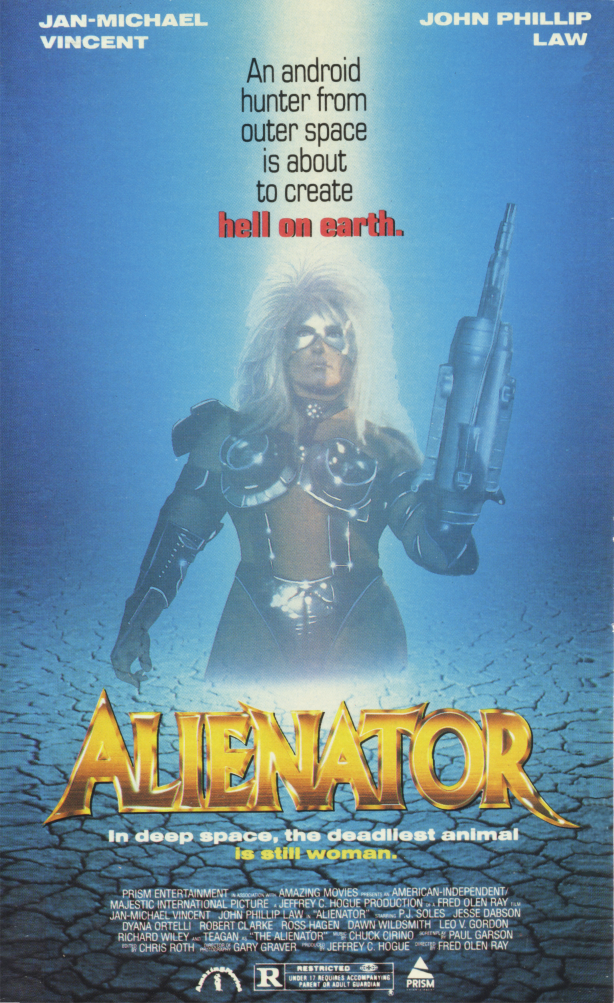
Unfortunately, even Fred’s best was never all that great, and the movie in our proverbial crosshairs today, 1990’s Alienator is far from his best indeed, although you’d never know it based on its drop-dead awesome premise, to wit : a supposedly evil intergalactic criminal genius/madman named Kol  (Ross Hagen) is about to be executed on a distant spaceship-prison thingie but , of course, manages to affect a semi-daring escape in a shuttle that  eventually crash-lands in a forest on Earth. There he makes friendly with a  park ranger (who’s got  the park ranger-iest name you’ll ever come across),  Ward Armstrong (John Phillip Law) and a bunch of annoying teenagers, but little do Kol and his new-found comrades suspect that the spaceship commander (named, simply, “Commander,” and played by Jan-Michael “anything for a buck” Vincent) from whose deadly clutches he managed to free himself has sent a Terminator-esque super-tracker after him, the ultra-deadly — and titular — Alienator herself!

alienator

Yes, I said herself — the Alienator, you see, is played by a female ( I think, at any rate, although it wouldn’t surprise me if she had some chromosomal issues going on, and I wouldn’t bet on her ability to pass an Olympic-style genetic screening test) bodybuilder who went by the snappy one-word name of Teagan at this, the apex (such as it was) of her career. She’s basically a cyborg — or maybe android, I never could tell the the difference — chick in a metal bikini who is damn hard to kill and displays, as you’d expect, the emotional range and affect of, say, a walnut. A single-minded killing machine with what appears for all intents and purposes to be a giant pair of binoculars on her boobs, arms that are thicker than my legs, and legs that are thicker than the trunk of the tree in my backyard. Are you afraid yet? You should be — but not so much of the Alienator her(him? it?)self as the unfortunate movie that bears her name.

I know, I know — you read about it on paper (or, as the case may be, your computer screen) and think to yourself “my God, how can you go wrong here?,” but trust me, friends, you can — this flick is a drag. All the actors play it disarmingly straight when by all rights they should be hamming things up, the pacing is dull as toasted rye, and the special effects aren’t good enough to be — well, good — but aren’t bad enough to be hysterical. In short, it’s all an exercise in sleepwalking, “get-it-in-the-can”-style movie-making, and can barely hold your interest despite the fact that by all rights it sure should given its appealingly blatant absurdity.

alienator-1

Still, if you’re in the (entirely advisable under most circumstances) habit of ignoring me, you can check it out for yourself as Alienator came out last week on DVD from Shout! Factory as part of their new “4 Action-Packed Movie Marathon” two-disc set where it shares billing with another early-90s DTV number from Ray, the Heather Thomas (yeah, I forgot about her, too) “starring” vehicle Cyclone, as well as the pretty-decent-all-things-considered Gary Busey revenge flick Eye Of The Tiger and fan favorite Cannon actioner Exterminator 2. The technical specs for Alienator are as follows : digitally remastered (and darn good) widescreen transfer, remastered mono sound, and no extras. Which is fine, really, especially since this package retails on Amazon for eight bucks.

51cAg+l+wbL._AA300_

Look, we might as well be honest here —odds are that if you’re gonna get this thing it’s for Exterminator 2 (I know that’s why I picked it up) so anything else is literally (okay, metaphorically — told you we’d get back to that)  just gravy, but ya know, sometimes turkey (or beef, or chicken, or whatever) tastes better plain, and Alienator is a cinematic condiment you can definitely skip and still get more than your money’s worth out of the main entree on offer here.

Which is kind of a  shame, really, because it sure sounded good on the menu.