What Lisa Watched Last Night: 2-Headed Shark Attack (dir. by Christopher Douglas-Olen Ray)


Last night, I turned over to the SyFy network and I watched a little film called 2-Headed Shark Attack.

Why Was I Watching It?

I blame twitter.  Every Saturday, at 8:00 pm, a group of brave and witty film fans log onto twitter and spend the next two hours deconstructing whatever movie might happen to be playing on the SyFy network that night.  Last night, that film was 2-Headed Shark Attack.

Also, how often do you get to see a shark with two heads?  I saw a lamb with two heads once and that was pretty disturbing but a shark with two heads?  Seriously, there was simply no excuse for not watching.

(Speaking for myself, I couldn’t handle having two heads, just because I suspect the other head would be an attention whore.)

What Was It About?

For some reason, there’s a bunch of incredibly stupid college students on a boat that’s floating out in the middle of nowhere.  Apparently, they’re taking part in a “semester at sea” program though, as I watched the film, I came to suspect that they had actually been kidnapped by pirates claiming to be professors and they were unknowingly being delivered to a white slavery ring in Aruba.

Anyway, the head professor (or pirate) is Prof. Babish (former Bachelor Charlie O’Connell) and when the boat starts to sink, largely because of his own stupidity, he decides to take all of his students to a nearby atoll.  There, they can all hang out and deliver terrible dialogue while the ship’s hull is repaired and the professor’s wife (Carmen Electra) works on her tan.

The only problem is that the atoll is in the process of sinking and there’s a shark with two heads prowling the waters…

What Worked?

Like most Asylum films, 2-Headed Shark Attack is a film that was made to be watched with friends.  If you’re taking the film seriously, you’re missing the point.  This is one of those films that invites you to sit back and laugh along with it. 

The two-headed shark was the best actor in the film and it was easy to root for him. 

Charlie O’Connell has a scene where he gets what appears to be a minor scratch on his leg and he responds by going, “Ow, ow, ow, ow, ow, ow, ow, ow…” for about ten minutes straight.  It simply has to be seen to be believed.

What Did Not Work?

The film’s heroine was played by Brooke Hogan and wow.  Whether it was because of the sleep-inducing way she delivered her lines or the fact that her character claimed that she could repair the boat because, “My dad was a welder,” I have to say that I have never so wanted to see one person get devoured by a two-headed shark.

Initially, those of us on twitter were really excited because we thought that one of the characters was named Tequila.  However, it soon became obvious that we had all misheard and his name was actually Dikilla.  Don’t get me wrong, Dikilla is a pretty good name but, after we had all had so much fun with the idea of him being named Tequila, it was hard not to be disappointed to discover that we were wrong.

“OH MY GOD!  Just like me!’ Moment 

Though she was roundly despised by just about everyone on twitter, I have to admit that I very much related to the character who became known as “the blue eyeshadow girl.”  She was the girl who continually came up with the silliest solutions to the group’s predicament.  She also had a gun for most of the film but, during the final minutes, revealed that she had absolutely no idea how to use it when she fired point-blank at the two-headed shark and, somehow, managed to miss every time.  Even as I made fun of her on twitter, I silently thought to myself, “That would so be me if I had ever signed up for a semester at sea.”

Lessons Learned

Double the head equals double the fun.
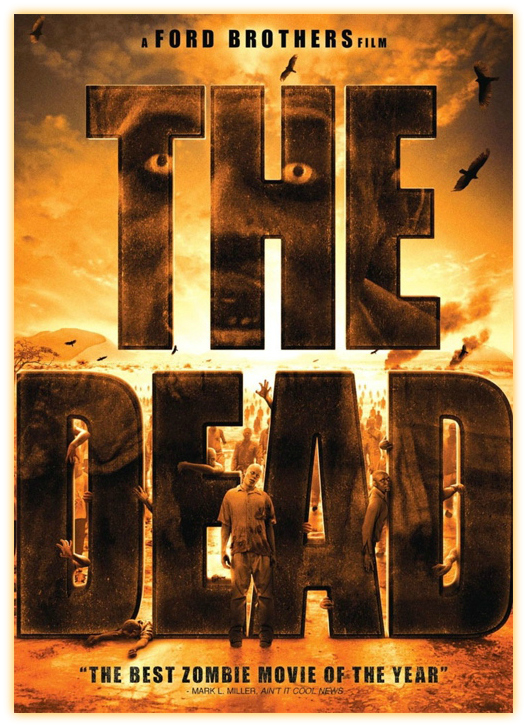
Review: The Dead (dir. by The Ford Brothers)


Zombies.

I’ve heard the collective groans from many who have achieved zombie oversaturation. For some reason the renaissance of the zombie subgenre which began during the early 2000’s continues unabated. One just has to look at the huge popularity of Robert Kirkman’s long-running horror comic book The Walking Dead right up to the even more popular tv adaptation of the comic book which now enters it’s 3rd season on AMC TV. Yet, not everything zombie-related in entertainment could be considered scary or even entertaining. If one looks at the dozens of direct-to-video which seems to come out month in and month out that barely rises above amateur production and execution one does have to feel that the subgenre should just die and go away. Then something like The Dead by the British sibling filmmakers The Ford Brothers comes along and breathes some fresh blood into the scene.

An indie film shot pretty much in northwest Africa (Burkina Faso and Ghana), The Deadis a throwback to the classic Romero zombie films before the new millennium and, even moreso, the Italian zombie films of Lucio Fulci with emphasis on Zombie. The Ford Brothers pretty much shot the film in some of the worst conditions a film crew could find itself in. It doesn’t matter whether it was the baking mid-day heat in the open plains and desert right up to the very real armed conflict which continues in the region to this very day. These two British siblings definitely took some guerilla filmmaking lessons from their hero Romero in how to stretch their tiny budget and still come out with a very good production.

The Deadis a pretty straightforward zombie film and acts more like a road film than your typical zombie story which tend to focus heavily on the siege aspect of the genre. We don’t get sieges in this film. The openness of the African plains and desert made for an interesting change of pace to the typical urban and/or countryside locales past zombie films ended up using. The film also spent so much of it’s running time in broad daylight which also made it stand out from it’s zombie film brethren which used night time as a prop to create dread and mounting terror. The Ford Brothers were able to use that very brutal heat and searing African midday sun to give the film a beautiful look but also one that highlighted it’s apocalyptic and hopeless situation. The light showed zombies shambling along from every direction, slow as they may be, in that steady, silent pace that was as inevitable as Death itself.

The story of the film is quite bare bones with the opening sequences pretty much introducing the two storylines that would intersect very early and combine to become one. There’s the lone survivor of a military evacuation flight out of the area and back to America (at least Europe) in Lt. Brian Murphy (played by Rob Freeman) whose role as a flight engineer in the doomed flight gives him the necessary technical skills to fix an abandoned vehicle he finds, but who is not what one would call a hardened soldier unlike Sgt. Daniel Dembele (played Ghana actor by Prince David Oseia) whose role as a soldier gives him the skills to protect Murphy. The two become traveling companions who must traverse the post-apocalyptic West African landscape that always have zombies, silent and sure slowly and patiently finding their way to the two no matter how fast and far they go.

Murphy wants to get back to his wife and daughter back in the States though he doesn’t know if they’re still alive or not. Daniel wants to find his son who was rescued by soldiers in the beginning of the film as their home village succumb to an attack of the dead. These similar goals become the very thing which helps the two bond together despite their cultural and ideological differences.

The film doesn’t go too heavy with the themes and ideas of Africa and zombies, but they’re there and the Ford Brothers don’t try to avoid them either. Throughout the film one could see that the film could easily be a metaphor for the birthplace of mankind also becoming the beginning of its end. There’s also the shadow of the crimes of Western colonialism and interference in a land whose people have been exploited and used like chess pieces on the grand world stage. Like some of the best zombie films, The Deaduses the apocalyptic setting and the danger of the zombies as a way to explore serious themes and ideas but do so without being too obvious or heavy-handed. In fact, the Ford Brothers actually were quite subtle with their handling of these ideas throughout the film. This made for a much more streamlined story, but also kept the film from heading into epic territory.

Freeman spends almost the whole time on the screen which stretched his performance somewhat. At times his dialogue came out natural and then on another sequence he would come off stilted. It’s not surprise that some of the best scenes Freeman’s Murphy had was when in the presence of Oseia’s Sgt. Daniel Dembele. Hiss presence on screen almost overshadows Freeman at times and one could almost wonder how much the better the film would’ve been if it was just Daniel searching for his son and no Murphy character to distract things. Oseia’s performance becomes the moral center of the film and as the story unfolded one felt like rooting for the man to find his son even though the odds on him succeeding rises with each passing minute.

The Dead is not a perfect film and one could say that it’s very straightforward nature becomes too generic and evident at certain times during the film. Yet, the rough and raw way the Ford Brothers wrote and shot the film with some very good performances from it’s cast made up for any shortcomings the film had. Even the gore effects wasn’t hampered by the minuscule budget. This film should satisfy gorehounds and story aficionados both. That’s something that most indie zombie films can’t boast about that this film can. The film’s ending leaves things somewhat open for a sequel (something the brothers are open to exploring as a future project) with the final shot evoking a “Lone Wolf and Cub” vibe before the fade to black.

The Ford Brothers’ The Dead saw a very limited release in 2010 and 2011 but has now seen a wide DVD/Blu-Ray release for 2012. For some it would be a buy and a keeper, but at the very least it deserves a rental to see what all the hoopla was about.

A Quickie With Lisa Marie: Cosmopolis (dir. by David Cronenberg)


“I wanted you to save me.” — Paul Giamatti in Cosmopolis

It’ll probably take the rest of the world a few years to realize this but David Cronenberg’s Cosmopolis is not only a good film but occasionally, it’s even a great film.  What it is not is an easy film.  Instead, this film is a throwback to the such Cronenberg films as Videodrome and eXistenZ, films that served to not only challenge the audience’s expectations but to occasionally attack them as well.

Plotwise, Cosmopolis is a day in the life of a 28 year-old billionaire named Eric Packer (played by Robert Pattinson, who gives an excellent performance that hints at the neurosis that boils underneath surface ennui).  Packer wants to get a haircut so he spends nearly the entire day sitting in the back of his stretch limo, being driven through an increasingly violent and disturbing New York.  Rarely leaving the safety of his limo, Packer has several chance meetings with his wife, who refuses to have sex with him, and picks up several other women who are willing to have sex with him.  He also finds the time to have a prostate exam and discuss (and discuss) the meaning of life with several of his cronies, all of whom seem to pop up in the back of his limousine without warning and who also seem to vanish once Packer tires of listening to them.  Along the way, Packer finds both himself and his limousine being targeted for destruction but he never changes his plans or his direction.  After all, he needs a haircut…

Many reviewers are treating Cosmopolis, with its portrayal of a man who has too much money and not enough humanity, as if it’s some sort of Occupy manifesto and, indeed, there are several scenes where Cosmpolis does seem to serve as a mouthpiece for the anti-capitalist Occupy ideology.  There are also several scenes where Cosmopolis plays as a very deliberate modern-day version of Jean-Luc Godard’s Marxist-themed, pro-revolution Weekend.  However, to simply call Cosmopolis a pro-Occupy film is  to offer up an interpretation that’s a bit too simplistic.  After all, when the Cosmopolis version of the Occupy protestors do make an appearance, they’re either rioting in the streets  (and getting nothing more than a bemused smirk from Packer) or else they’re being represented in the form of a shambling and somewhat pathetically bitter character played by Paul Giamatti.  When Giamatti accuses Packer of hurting other people with his lifestyle, Packer confidently replies, “Don’t pretend that you care about other people,” and it’s rather obvious that, in the troubled world of Cosmopolis, both the excesses of the 1% and the Occupy movement spring from the same poisoned well of narcissism and anger.  In Cosmopolis, neither of the competing ideologies are presented as being a solutions but instead, both are seen as signs that the world is beyond saving.

Ultimately, Cosmopolis is a return to themes that should be familiar to anyone who is familiar with Cronenberg’s work.  Like many Cronenberg protaganists, Eric Packer is a neurotic man who has attempted to make himself invulnerable to a messy and imperfect world and, in the process, he has surrendered his humanity.  While the world outside collapses, Packer is sealed off in his stretch limo.  Over the course of the day, it becomes increasingly obvious that he stays in the limo because that limousine is an environment that he can control.  It also becomes apparent that the sterility of his perfect limo has left his incapable of relating to or even understanding the world outside.  It’s only as the film progresses and Packer continually finds himself forced to exit the limousine that his true nature starts to come to the surface.  It’s only when, at the end of the film, Packer finds himself permanently separated from his limousine that the film can reach its apocalyptic ending.

Ever since it appeared at Cannes, Cosmopolis has been getting a lot of mixed reviews and it’ll probably never be the type of film that is embraced by the masses.  It’s too cold and clinical to be beloved by many filmgoers.

Well, that’s their loss.

In a year that’s been dominated by bland and safe movies, Cosmopolis is a film that dares to challenge the audience.  It’s a film that dares to say that all is not right with the world and that there might not be any easy or crowd-pleasing solutions.

Love it or hate it, we need (and deserve) films like Cosmopolis.

Film Review: Lawless (dir. by John Hillcoat)


For most of 2012, I was excited about seeing one film and that film was Lawless.  Why was I so excited about seeing Lawless?  Well, first off, I had spent most of the year being bombarded by the film’s genuinely exciting trailer.  Seriously, that trailer was more entertaining than 80% of the film that I’ve seen this year.  Judging from the trailer, the film was a period piece that took place during one of my favorite decades, the 1920s.  The film dealt with bootleggers and I’m proud to say that there’s a few of those on my family tree.  The trailer also featured Gary Oldman firing a tommy gun, Jessica Chastain dancing, Guy Pearce acting odd, and Tom Hardy being all tough and Tom Hardy-like.

When I watched that trailer, it didn’t matter that the film starred Shia LeBouf (who has always struck me as being a bit of a whiney actor).   It didn’t matter that director John Hillcoat previously wasted good material with his adaptation of The Road.  It didn’t even matter that the film was greeted with indifference at Cannes.  “Oh,” I told myself, “that’s just the French critics being reflexively anti-American.  Lawless has Truffaut written all over it…”

The only thing that tempered my enthusiasm for Lawless was when the first of the 30-second commercials started to appear on television.  As opposed to the exciting trailer, these commercials made the film seem rather average and they now put less emphasis on the film’s stylistic excesses and more on the fact that the film was apparently “based on a true story.”  The tone of the television spots was so different from that of the theatrical trailer that it was hard not to conclude that the PR geniuses at the Weinstein Company weren’t sure how to sell the film.  I found myself wondering if Lawless would be as confused as its ad campaign.

Last Friday, I finally saw Lawless and judged for myself.

Lawless tells the story of the three Bondurant brothers.  In the 1920s, these brothers are succesful bootleggers who work out of rural Virginia and who maintain a peaceful coexistence with local law enforcement through a steady supply of bribes.  The oldest brother is a taciturn World War I veteran named Forrest (played by Tom Hardy.)  The youngest brother is Jack (Shia LeBouf), who idolizes violent gangsters like Floyd Banner (Gary Oldman).  The middle brother is Howard (Jason Clarke).  Howard spends most of the movie yelling.

Things are peaceful for the Bondurant brothers until, one day, a corrupt and oddly fastidious prohibition agent named Rakes (Guy Pearce) shows up and demands a cut of whatever profit the brothers make from their bootlegging.  Forrest refuses and soon Rakes and the Bondurants are engaged in a very violent and bloody war.

That war, however, doesn’t stop Jack from pursuing a relationship with a rebellious preacher’s daughter (played by Mia Wasikowska).  Meanwhile, Forrest hires a new waitress to work at the family bar.  Maggie (Jessica Chastain) is a former dancer from Chicago and soon, she and Forrest are cautiously pursuing their own relationship.  As for Howard, he yells a lot.

Lawless is an odd film.  The actors are all well-cast and Shia LeBouf probably gives his first genuinely good performance here.  The film’s violent action sequences are well-choreographed and one could even argue that, in the character of Rakes, the film is drawing a very relevent parallel to America’s own modern-day war on drugs.  And yet, as I watched the film, I felt oddly detached from the action onscreen and the Bondurants never came to life for me as individual characters that were worth rooting for.  I think the ultimate problem with Lawless is the same problem that Hillcoat ran into with The Road.  Lawless is a film full of beautiful visuals and striking sequences but none of it seems to naturally flow together.  As a result, the film is visually striking but narratively weak.

As a result, Lawless is ultimately a case of the triumph of style over substance.  How you react to the film will probably depend on how much importance you put into either one of those two elements.  If you’re willing to accept the film simply as a collection of striking visuals (as I was), you’ll find a lot to enjoy in Lawless but if you’re looking for something deeper, you’ll probably be disappointed.

You’re also going to be disappointed if you go to Lawless expecting to see a Gary Oldman film because Oldman is only in about four minutes of the film, his best scene is in the trailer, and his character lacks that touch of eccentric charisma that Oldman typically brings to his villains.  Instead, it falls to Guy Pearce to be eccentric and evil and he does a great job.  Sporting an accent as odd as his haircut, Pearce brings a brilliantly perverse jolt to even the simplest of line readings.  Lawless is at its best when its content to just let Guy Pearce play at being Gary Oldman.

Film Review: The Apparition (dir. by Todd Lincoln)


Since it opened last Friday, the new PG-13 horror film The Apparition hasn’t been getting much love from either critics or audiences.  When last I checked, the film had a 3% approval rating over at Rotten Tomatoes and it had gotten exactly one positive review.  However, if I’ve made one thing very clear in my reviews here on the Shattered Lens, it’s that I hate the bandwagon mentality that runs rampant throughout the online film community.  So, instead of immediately focusing on The Apparition’s (many) faults, I’m going to start this review by pointing out a few positive things about this film.

The Apparition is only 82 minutes long and is shorter than both Avatar and David Fincher’s rip-off of The Girl With The Dragon Tattoo.

The Apparation is not in 3-D.

The Apparition is not a found footage film.  There’s no attempt made to try to insult your intelligence by convincing you that you’re watching something that actually happened 20 years ago.

Though an adorable (if intrusive) dog dies early on, no cats are harmed during the course of this movie.

The film’s final 10 minutes are actually rather effective and oddly disturbing.  Solely on the basis of the film’s final scenes, I would probably see the next movie that Todd Lincoln directs.

Finally, if you’re like me and you enjoy making out at the movies, The Apparition is the perfect film to see.  First off, it’s a horror movie and, even though nothing scary actually happens for the majority of the film, you can always fake being scared as an excuse to grab your man.  (And, as we all know, sometimes you just have to fake it…) Secondly, chances are that if you two do see The Apparition, you’ll pretty much have the entire theater to yourself.  Third, since nothing really happens for the most of the movie, you won’t have to worry about missing anything important while you two are having your fun.

As for the film itself, it tells a story that should be familiar to anyone who has seen Paranormal Activity or Insidious. 

Kelly (Ashley Greene) and her boyfriend Ben (Sebastian Stan) are taking care of a house located in a nearly deserted subdivision.    We spend the first half of the movie getting to know Kelly and Ben.  We follow them as they debate what to have for lunch, as they shop at Costco, and as they play video games.  We quickly discover that, together, Kelly and Ben are perhaps the most boring couple ever.  Seriously, I have had nightmares about befriending a couple like Kelly and Ben and then having to attend a couples party at their house where all the other couples play Pictionary and want to tell you all the details about the last time they went snowboarding at Telluride.

Of course, a huge part of the problem with Ben and Kelly, as a couple, is that the actors playing them have next to no chemistry.  Watching Greene and Stan on-screen, you have a hard time believing that they’ve even known each other for five minutes, let alone that they’re enough in love that they would stay together even after it becomes apparent that there’s some sort of otherworldly demon chasing after Ben as the result of a séance that he attended 3 years ago.

One of the frustrating things about The Apparition is that, occasionally, you can see hints of the movie that it could have been if the script had been a little bit sharper and if the performances were a little less flat.  Visually, Lincoln does a good job of highlighting the isolation of the house and, even if he didn’t quite succeed, I can appreciate what he was attempting with the slow build up.  But this is one of those films where every effective moment is immediately answered by two moments that don’t work.  This is a film that’s smart enough to have Kelly demand to leave the haunted house, just to then reveal that leaving means camping out in a tent that’s been set up in the back yard.

(Even worse, the film later establishes that there’s actually a pretty nice motel within driving distance of the house.  You really do have to wonder why Kelly — who was so terrified that she literally ran out of the house in her underwear — would feel safer just because she’s now staying in a tent that’s about two feet away from the demon that’s trying to kill her.  Then again, I hate camping so maybe it’s something that I’m just not capable of understanding.)

Finally, if you’re like me and you’re still suffering withdrawal pains from the end of the Harry Potter films, you might want to see this film just for the chance to see Tom Fenton playing the role of Ben’s friend Patrick.  Unfortunately, Fenton’s only in about ten minutes of the film and Patrick, sad to say, is no Draco.

Quick Review: Premium Rush (Dir. by David Koepp)


I have a love / hate relationship with David Koepp.

Loved The Shadow, Stir of Echoes, Angels & Demons, Panic Room, Jurassic Park and The Lost World (even to see him get eaten by a T-Rex while running down a busy street). I hated War of the Worlds (I’m sorry, but there’s no way Justin Chatwin’s character could have made it through that film), Mission: Impossible and Indiana Jones and the Kingdom of the Crystal Skull. Sometimes he hits the mark, and other times he misses.

Premium Rush falls somewhere in between. I really don’t have a whole lot to say about it. It’s mostly very good, particularly the bike riding scenes, but overall, the story could have been a little stronger and Michael Shannon (to me, anyway) felt really out of place here. It’s one of those movies where you pluck your brain out of your head and place it in the seat next to you. As long as you don’t give the movie too much thought and just enjoy the ride that’s presented to you, you’ll do just fine. At only 90 minutes, it moves very quickly and you’ll find yourself at the end before you really know it. I’ve seen this type of film before with Thomas Michael Donnelly’s Quicksilver, starring Kevin Bacon and 1993’s Airborne, directed by Castle Producer and former X-Files alum, Rob Bowman.

Wilee (Joseph Gordon-Levitt) is the best bike messenger around. He’s so good that he rides a ‘fixee’, a bike with no brakes, no sets of gears other than the basics and where the pedals always move (no cruising). Weaving in and out of traffic, he makes his way through each delivery with lots of style. There are these decision points that happily reminded me of both my bike riding times and motorcycle ones where Wilee has to find the next available angle to ride through. Scenes like that help to keep the action moving, when it happens. Premium Rush also showcases some great areas of Manhattan as they travel around. It’s a great looking film in that sense, with low cuts of bike wheels and jumps, but again, you’re either riding through the city and hoping they don’t hit, or you’re off the bike waiting to find out if they’ll jump onto another one again.

Basically, the story is that Wilee is given a special package that he needs to deliver, and a corrupt cop is on his tail, played over the top by Michael Shannon. That’s all there is to it. Get the package where it needs to go. Levitt does well in the film, as does Dania Ramirez and Aasif Mandvi. If there’s anyone in the movie who didn’t quite gel with me, it would be Michael Shannon. Shannon’s a good actor, and he’s not bad here, just really animated. It felt like a role that would have been better suited for Willem Dafoe or someone strange like that. I never felt any kind of fear or even worry when Shannon was around. He came off more like a bumbling crook in a film like Baby’s Day Out”, than someone who really needed what Wilee was carrying.

Koepp is getting better at directing, but some of the writing is a little off. The film suffers from the same problem that Green Lantern had with it’s climax or Tron: Legacy did with some of it’s parts. You have a few scenes where it could have been stronger had things moved in one direction, but then veers off. The impact just isn’t as great. I won’t go into detail on what they are, but for me, I saw a few things that could have been changed (or at least one in particular).

Overall, Premium Rush is a fun film that may get you wanting to ride after seeing it, but just don’t ask a lot of it. Just get your popcorn, sit back and enjoy where it all goes.

What Lisa Marie Watched Last Night: Eddie Macon’s Run (dir. by Jeff Kanew)


Last night, as morning slowly approached, I curled up on the couch in my comfy Hello Kitty bathrobe and turned the TV over to the Retro Channel, where I watched a film from 1983.  The name of that film?  Eddie Macon’s Run.

Why Was I Watching It?

The short answer is insomnia.  The long answer is that, when I checked the guide to see what was on TV at 3 in the morning, Eddie Macon’s Run was the only film listed that I had never heard of before.  Since my life’s goal is to see every single film ever made, I knew I would have to watch this mysterious Eddie Macon’s Run at some point so I figured, “Why not tonight?”

What Was It About?

Eddie Macon’s running!  Okay, well, there’s actually a little more to it than that…

Eddie (played by John Schneider, who has appeared in countless SyFy films) is a nice, blue-collar guy who finds himself wrongly imprisoned in Hunstville, Texas.  During the prison rodeo, Eddie manages to escape and soon, he’s running down to Mexico where his wife and son are waiting.  Kirk Douglas plays the cop who chases Eddie across Texas.  Whenever Douglas shows up on screen, we hear a saxophone playing on the soundtrack.  Scenes of Eddie thinking about his family are accompanied by country songs that, the credits reveal, were sung by John Schneider.  Yes, it’s that type of film.

What Worked?

To be honest, the main thing that worked for me about this film is that it was shot on location in rural South Texas.  That’s the same part of Texas that my mom grew up in and whenever I would bug her to tell me a story about when she was “my age,” the stories always took place in South Texas and I always enjoy seeing it in films (even if that film, as in the case of this one, goes out of its way to make South Texas seem like the 9th circle of Hell).

John Schneider, all hot and sexy here, gave a surprisingly good performance.

Kirk Douglas, meanwhile, didn’t really give that good of a performance but my God, that man could grimace with the best of them.

A kind of youngish John Goodman shows up for about 2 minutes and the whole process of going, “Oh my God, is that John Goodman!?  I think that is John Goodman!” provided a nice break from the film’s general monotony.

What Did Not Work?

This is one of those films that, though it was filmed in Texas, was obviously made by Yankees.  As such, the movie is full of actors who were obviously imported from up north and who are painful to listen to as they attempt to recreate the accents of South Texas.   

The film, itself, moved about as slowly as the sun going down over the flat plains in North Texas.  Seriously — for a film that featured nonstop running and Kirk Douglas finding about a hundred different ways to clench his jaw, Eddie Macon’s Run sure was boring.  There’s a scene where Eddie is menaced by two ranchers and I swear to God, it seemed to last for a few hours. 

It also quickly became apparent that the only way for the film’s plot to be believable was for every single character in the film to be a complete idiot. 

“Oh My God!  Just Like Me!” Moment

Eddie eventually meets the niece of the governor of Texas (played by Lee Purcell) and she agrees to help Eddie run because it’s “just a slow Wednesday.”  That’s totally why I would get involved with an escaped fugitive as well.

Lessons Learned

Give me a couch and put me in a Hello Kitty bathrobe and I’ll watch anything.


Lisa Marie Does Killer Joe (dir. by William Friedkin)


I nearly didn’t get to see Killer Joe.

Killer Joe, the latest film from William Friedkin (who, 40 years ago, won an Oscar for directing The French Connection), is rated NC-17 for “graphic disturbing content involving violence and sexuality, and a scene of brutality.”  That, more than anything, was why I wanted to see Killer Joe.  I wanted to see just how extreme a film starring Matthew McConaughey could possibly be.  However, I also knew that the NC-17 rating would mean that I would have to show my ID before being allowed to have my mind corrupted.  See, I might be 26 years old but most people seem to assume that I’m 17.  That is, until I speak.  At that point, they usually realize that they’ve guessed incorrectly and decide that I’m actually 15.

Sure enough, when me and my BFF Evelyn bought our tickets to see Killer Joe earlier this week, I was asked to show my ID. Smiling my sweetest smile, I held up my driver’s license.  I was expecting that the ticker seller would just glance at the ID and then say, “Thank you,” but instead, he literally appeared to be studying my picture.  His eyes shifted from the license to me and back to the license.  I was starting to get nervous because, after all, it’s not like I was trying to get through airport security.  I just wanted to see a forbidden movie.

Behind me, I heard Evelyn say, “That looks like a fake to me.”

“Ha ha,” I cleverly replied.

Evelyn responded with, “I don’t trust her.  Maybe you guys should strip search her…”

Finally, the ticket seller looked away from my driver’s license and, as he handed me my ticket, he told us that the theater’s management had instructed him to make sure that we understood that we were about to see an explicitly violent film.  He also told us that there were free donuts available at the concession stand.  That was nice of him.

So, after all that, I finally got to see the forbidden film Killer Joe and you know what?  Killer Joe earns its NC-17 rating, not so much because it’s any more exploitive than any other mainstream film released this year but because it’s actually honest about being an exploitation film.  Killer Joe may be playing in the arthouses but it’s a grindhouse film and proud of it.

Killer Joe takes place in my hometown of Dallas (though it was filmed in New Orleans) and it features perhaps the sleaziest group of losers that you’ll find on a movie screen this year.  Chris (Emile Hirsch) is a drug dealer who lives with his mother and who moves, talks, and thinks with the scrambled energy of a meth addict.  His father Ansel (Thomas Haden Church) is an affably stupid alcoholic who lives in a trailer park with his second wife, Sharla (Gina Gershon, who gives a ferociously good performance here) and his daughter, 16 year-old Dottie (Juno Temple).  Dottie is a spacey girl who is given to sleep walking and who doesn’t appear to be quite all there.  Chris is creepily overprotective of her and, though it’s never implicitly stated, it quickly becomes obvious that there’s a rather disturbing subtext to her relationship with both Chris and her father.

Chris has managed to get into debt with some local criminals but he’s got a plan.  As he explains to Ansel, his mother has got a sizable life insurance policy and if she dies, the money will go to Dottie.  Chris and Ansel hire a hitman to carry out the murder for them.  That hitman is Joe (Matthew McConaughey, giving the performance of his career), a demonic charmer who always dresses in black and who has a day job as a homicide detective.  When Chris and Ansel explain that they don’t have the money to pay him in advance, Joe agrees to take Dottie as a retainer. 

Soon, Joe is living in the trailer park with Dottie, Chris is getting brutally beaten up every time he goes out in the daylight, and the murder doesn’t seem to be any closer to actually happening.  When Joe finally does make his move, it all leads to a lot of very brutal violence, a series of betrayals, and a very disturbing scene involving a drumstick from Kentucky Fried Chicken.  As I said before, Killer Joe earns that NC-17.

William Friedkin, who has had a rather uneven career, dives right into the film’s sordid atmosphere.  The majority of the film takes place in that Hellish trailer park and Friedkin perfectly captures the feeling of a society made up of people who are trapped by their own lack of intelligence, imagination, and status.  There’s been a lot of films made about white trash but Killer Joe gets it right, creating an all too believable Hell where everyone can afford to buy a pit bull but not a decent suit (or, in the case of Dottie, a bra).  When the violence does come, Friedkin doesn’t shy away from showing it nor does he try to pretend that violence doesn’t have consequences.  When people get hurt in Killer Joe, they stay hurt. 

Matthew McConaughey is a wonder as Killer Joe.  Whereas many actors would tend to go overboard with such a psychotic character (and you’d be justified in expecting McConaughey to go overboard as well), McConaughey is actually rather restrained for most of the film. The power of his performance comes from the fact that, while everyone else is going crazy, McConaughey is subdued and steady.  It’s only when he speaks to Dottie that we get a few clues of just what exactly it is that lurks beneath Killer Joe’s coolly professional manner.  It’s only towards the end of the film that McConaughey allows his performance to get a bit more showy but, by that point, the entire film has gone to such an extreme that Joe still seems almost sensible.

Killer Joe, however, is not a perfect film.  Though the film is set in North Texas (and, in fact, the Texas-setting is pretty important to the film’s overall plot), it was filmed in Louisiana.  Speaking as someone who has lived in both of those fine states, trust me when I say that, visually, there’s a huge visual difference between Texas and Louisiana.  (Evelyn and I shared a laugh  when we spotted Palm Trees in the film’s version of Dallas.) 

While the clumsy use of Louisiana as a stand-in for Texas probably won’t be noticeable to anyone outside of the Southwest, a far more noticeable problem with Killer Joe is that the film is based on a stage play and, despite some efforts to open up the action, the film still basically feels rather stagey.  This is the type of movie where people tend to deliver semi-poetic monologues about their childhood at the drop of a (cowboy) hat.  To a certain extent, the staginess made it easier to handle the film’s violence (and perhaps that was Friedkin’s intention) but, at other times, it just caused the action to drag.

Ultimately, Killer Joe is a film that I would recommend with reservations.  It’s definitely not for everyone and I don’t know that it’s a film that I’ll ever want to sit through again (seriously, I’ll be surprised if I ever manage to eat another drumstick) but it is a movie worth seeing.  If nothing else, it’s the closest were going to get to a true grindhouse film this year.

Film Review: ParaNorman (dir. by Sam Fell and Chris Butler)


I have to admit that I wasn’t expecting much from the new animated film ParaNorman.  As much as I love animated films, ParaNorman‘s trailer had never really captured my imagination.  (Or, at the very least, it hadn’t captured my imagination in the way that the trailers for Brave and Wreck-It Ralph did.)  For the most part, the only reason that ParaNorman was even on my radar was because it was advertised as being the latest film from the creators of Coraline and the only reason that Jeff and I ended up seeing this film last Friday instead of The Expendables 2 was because I had a slight headache and didn’t want to have to spend two hours listening to men yelling, guns firing, and bombs exploding.

In other words, I saw ParaNorman with low-to-no expectations and sometimes, that’s the perfect way to go to the movies because I absolutely loved ParaNorman.

ParaNorman tells the story of Norman (Kodi Smit-McPhee), a shy boy who has the ability to talk to the dead.  This talent comes in handy because Norman happens to live in the haunted New England town of Blithe Hollow. 

I fell in love with ParaNorman during the opening credits, in which we watch as Norman talks to the spirts of everyone from an unfortunte aviator to a squished dog, all the while simply trying to get to school on time.  In this short, wonderfully animated sequence, we learn everything that we need to know about Norman and the town of Blithe Hollow.  We learn that Norman is shy, he’s lonely, and he’s also one of the few people in the world nice enough to actually be polite to a pushy ghost demanding his attention.  As for the town of Blithe Hollow, it’s a memorably ugly creation, full of ominous buildings that seem to have sprung straight from a nightmare of German Expressionism. 

Blithe Hollow, we soon learn, is a town that’s haunted by a lot more than just a few restless spirits.  The town was founded by Puritans who, as the film begins, are mostly remembered for their witch hunts.  Centuries ago, the town founders burned a witch at the stake and that witch cursed the town.  While it wouldn’t be right for me to give away too many details of the plot, it turns out that the witch’s curse is very much real and, as a result of a several complications and mistakes on the part of both Norman and the citizens of Blithe Hollow, the town is soon overrun by zombies. 

In a twist that would make George Romero proud, the citizens of Blithe Hollow soon prove themselves to be a hundred times more monsterous and dangerous than the film’s actual monsters.  However, as only Norman can actually talk to the dead, he soon discovers that there’s more to the “zombie rampage” then meets the eye.  Soon, it becomes apparent that Norman’s the only one who can give the witch what she wants and save Blithe Hollow from the sins of the past.

Not surprisingly, there were a lot of children at the showing that Jeff and I attended and ParaNorman had enough silly moments to keep them entertained.  They seemed to enjoy the comedic relief provided by Norman’s fat and loyal friend Neil (voiced by Tucker Albrizzi).  That said, ParaNorman isn’t really a film for children.  It starts out slow and wisely devotes a good amount of time  to establishing the oppressive atmosphere of Blithe Hollow.  The film’s resolution comes not with the spectacle that we’ve been conditioned to expect from animated films but instead, the movie ends on a rather subdued, almost mournful note.  ParaNorman‘s humor is combined with a very real sense of melancholy and loss.  This is a film that can be enjoyed by kids but only truly understood by adults.

(If Dellamorte Dellamore is ever remade as an animated film, I expect the end result will look a lot like ParaNorman.)

 Don’t get me wrong, ParaNorman is a funny film that’s full of clever details and smart vocal performances. Along with Smit-McPhee and Albrizzi, the voice cast includes Anna Kendrick, Casey Affleck, John Goodman, Jeff Garlin, and Leslie Mann.  All of them deliver their lines with just the right combination of sincerity and melodrama.  However, the film is really stolen by Jodelle Ferland, who voices the condemned witch and who brought me to very real tears towards the end of the movie.

ParaNorman is hardly a perfect film but’s a nicely ambitious one and it has a good message about tolerance.  I wasn’t expecting much from it and I ended up adoring it.  Perhaps I should lower my expectations more often.

Quick Review: ‘Expendables 2’ (dir. Simon West)


‘Expendables 2’, the “last blockbuster of the summer” as some advertisements have put it, was set to be the explosive and testosterone filled ending to this blockbuster season. Like its predecessor, it once again contains Sylvester Stallone, Jason Statham, Dolph Lundgren and Terry Crews; but with extended performances by Arnold Schwarzenegger and Bruce Willis who appeared briefly in the first film, as well as the addition of Chuck Norris and Jean-Claude Van Damme. From the cast alone one would expect a lot of mayhem, death and one liners. Well I can assure you that it delivers on all fronts but I’m sad to report I still sit here feeling pretty unsatisfied with the final product.

The film starts off some time after the events of the first film, with our group of brawny mercenaries for hire doing what they do best, which is of course mowing down an army of rebel soldiers causing chaos in some village in the middle of nowhere. The only addition to the group is a young sniper with a few years in Afghanistan under his belt. This opening scene is one of the highlights of the film, and contains enough death and explosions to match that of the typical modern action flick.

When the mission is over they head back home to relax, well to drink and ride motorcycles which seems to be all they do on their off time, but this is cut short when an old ‘friend’ comes calling and orders them to go retrieve a package in the middle of some plane crash site in the mountains of Albania. They do, things don’t go as planned and the package is stolen by a ruthless group of ‘super rebels’ led by a man named Vilain (no I’m not joking, the films main villain is named Vilain), and in the process one of our ‘Expendables’ gets killed. Well this leads to someone swearing revenge, and they go off to crack some skulls, get their vengeance and while they’re at it possibly save the world.

If that all reads like something you’ve seen before it is because you have. Now you might be saying “well that isn’t necessarily a bad thing” and I agree, but the problem is that even if it isn’t meant to be Oscar worthy or original, even if those involved were looking to just produce an over the top action flick, you’d think at least something from it would stick out. You’d think when all was said and done it would not be so easily forgotten. Sadly, for me, that isn’t the case. Within an hour of leaving the theater I had already gotten over any post-viewing enthusiasm, and just felt rather empty about the whole experience. Sure there were some moments worth remembering, like Arnie ripping the door off of a smart car, but the action was just so devoid of any style or coherence, the story was so dull and predictable, and even the main cast of characters just seemed to be rehashing what they previously did in their first outing. Perhaps its biggest mistake was that for a film that seemed to be trying so hard to emulate all those great action films of the past, it did it so well that it doesn’t stand out enough to be anything “special”.Yeah, it has a pretty awesome cast but what was once a novelty for the first film now just felt like more of the same.

That isn’t to say it is bad because it isn’t. It does what it needs to do in terms of entertainment, it kicks a whole lot of ass and you’ll enjoy yourself while you watch it. I sure did. There  is enough action and laughs, along with great references, and an awesome performance by Jean-Claude Van Damme that warrants not only an initial viewings but revisits. I just hope that when the inevitable third film is made, that they do more than just throw in a bunch of action stars of yesteryear and maybe make an attempt to be a bit more creative, stylish and add just a tad bit of substance, which I would hope isn’t asking too much.